“Students are dying. They want us to help them.”
 Suicide is the third leading cause for people ages 15 to 24 in the United States. Thirty percent of teen suicides are committed by LGBTQ teens (That’s three times as many as by straight teens). More often than not, these suicides are the result of bullying. When you consider that 86% of gay and lesbian students report being bullied; 66% of bullying victims polled believe that professionals–teachers, school administration and school counselors–responded poorly and only 10 – 20% of bystanders witnessing bullying incidents take action to stop the bullying, it’s easy to see we have a crisis on our hands.
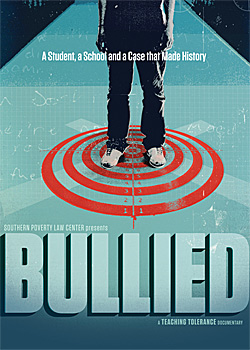
These numbers were projected on the screen before the showing of the Southern Poverty Law Center’s documentary, Bullied: A Student, a School and a Case That Made History, sonsored by the GVSU College of Education at GVSU Loosemore Auditorium Tuesday evening. The film put a face on these numbers. When he was five years old, Jamie Nabozny told his grandmother that he was a “homosexual,” a word he could barely pronounce. At age seven, he came out to his mom. His was a loving, supportive two-parent (heterosexual) family.
When Jamie entered Ashland Junior High School as a seventh grader, the bullying began. Every day when he went to school, he faced unrelenting verbal taunts and mild physical abuse: shoving, his books and papers thrown around, being pushed up against the lockers.
After one particularly tough day, he attempted suicide by taking a bottle full of pills and ended up in the emergency room. His parents went to the school to ask them to help stop the bullying. The junior high principal’s response, “Boys will be boys.”
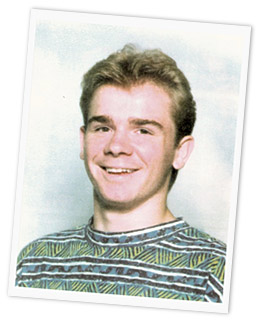
Jamie Nabozny during his high school years
In high school, the bullying escalated. He tried to hide from his tormentors, but wasn’t always successful. He endured physical violence regularly, to the point that he was hospitalized and had to have surgery after one particularly violent beating. Again, his parents went to the school principal. His attackers were let off without even a verbal reprimand. The high school principal’s response, “That’s what happens when you hit on the hockey team.” (Jamie did not “hit on” his fellow students.)
Jamie ran away and landed at a teen shelter in Minneapolis. A legal advisor there suggested that he and his parents sue the school district. They did and they won. The landmark case has set a precedent and served as a warning to schools across the nation that not keeping LGBTQ students safe from bullying can be very expensive. (Jamie won $900,000.)
After the film, WGVU’s Shelley Irwin moderated a panel of four experts. Her first question, was the film relevant? Denise Brogan-Kator, interim executive director of Equality Michigan, said the film’s message was particularly relevant in Michigan as we are one of only five states that does not have laws against bullying. Seems our legislators are afraid to include language that refers to LGBTQ youth. “We are going to hurt kids because we aren’t going to protect the queers. That just makes me nuts,” Brogan-Kator said. “Bullying is bad, period. Everybody should be safe. But if you include everybody without naming them, you include and protect no one. LGBTQ youth are the principal target of bullying in today’s schools. Studies have shown that the number one target are students who are gay or perceived to be gay. If you break the gender norms, you are a target. These kids are dying. Is it relevant? My god, is it relevant.”
Michele Coyne, a consultant to schools on bullying prevention, added that kid bullies become adult bullies, child abusers and perpetrators of domestic violence. “60% of kids who are considered bullies in grades six through nine will have a conviction by age 24. This is not a surprise,” she said. “It’s not only the victim who is hurt. The bullies and the bystanders don’t fare much better.
She has witnessed bullies harassing classmates they perceive as gay as early as third grade. “Kids with sexual minority parents, they are also considered to be targets.”
Kay Waters, a Grand Rapids school counselor noted that while bullying issues are being addressed, schools still have a long ways to go. “Educators need to have that open ear, be sensitive and model respect for all students. (We need to do) more than identify the problem, we have to continue to work together to find answers.”
Sue Verduin-Miller, a Grand Rapids school social worker, agreed. “It takes courage at times. It’s very easy for adults who are bothered to become bystanders who are quiet. If a person is aware of harassment and they are afraid to speak up, chances are there are a lot of other people nearby who are afraid to speak up. Acceptance of bullying depends on silence and isolation.”
When dealing with bullies, school staff needs to provide ongoing follow-up. Taking action only once or twice creates a situation where the bullies want to reassert themselves. “We need comprehensive school programs. There are good ones out there but most schools aren’t bothering to implement them,” Coyne said. “When we start hearing words being coined like ‘bullicide,’ it’s time.”
Equality Michigan offers school administrators and teachers free training in how to create safe schools. Its curriculum is youth approved by Michigan’s legislature. “We will come into your schools and educate you on how to implement programs,” she said.
Irwin asked what the parents’ role is. Waters replied that even when parents want to do their best for their kids, they are hampered because they don’t know what their rights are. Even so, parents remain their children’s best advocate. Verduin-Miller added that schools often do not follow-up when a parent does bring up issues.
Parents often are not aware their child is being bullied. They may shrug off a child’s complaints as being normal conflicts all kids face growing up. VerDuin-Miller stressed the importance of really listening to what children are saying and finding support if bullying is suspected.
Indicators of bullying include faking illness to get out of school, bedwetting or odd behavior like making up reasons to go in a certain school door. “Parents are hungry for information and not just the parents of victims, but parents of bystanders, too,” Coyne said. “They give a kid courage and moral fortitude to step in and help someone else. Teach your kids that it’s just not acceptable to pick on people. Help your children develop strong self esteem and self worth so A) they don’t bully and B) they step in.”
While it would have been even more enlightening had the panel included a college student who had experienced bullying during high school, overall, the four went a long ways in presenting important information to the audience, which included many education majors. They also shared these resources: Schools Where Everyone Belongs: Practical Strategies for Reducing Bullying by Stan Davis; Nobody Left to Hate: Teaching Compassion after Columbine by Elliot Aronson; A Silent Crisis: Creating Safe Schools for Sexual Minority Youth; and the Web site tolerance.org.
“The young people whose lives are no longer in existence because they took a bottle of pills or tied a rope around their necks, those young people are lost from us forever,” Brogan-Kator said. “What do we do about that? We be aware. We take Jamie’s lesson into the world with us. You can’t back down when somebody tells you ‘Don’t worry about it.’ These are kids’ lives.”
Anti-Union legislation introduced in Michigan

Last week members of the State Representative Commerce Committee introduced legislation that could make Michigan a “Right to Work” state. But don’t let the language fool you. Right to Work is just code for anti-union.
On January 13th, House Bill 4054 was introduced by Representatives Knollenberg, Jacobsen, MacMaster, McMillin, Lund, Genetski and LaFontaine. The bill is designed to change legislation that has been in place since 1939 when Michigan adopted labor laws reacting to the demands of working people who were fighting for better legal protections against employers.
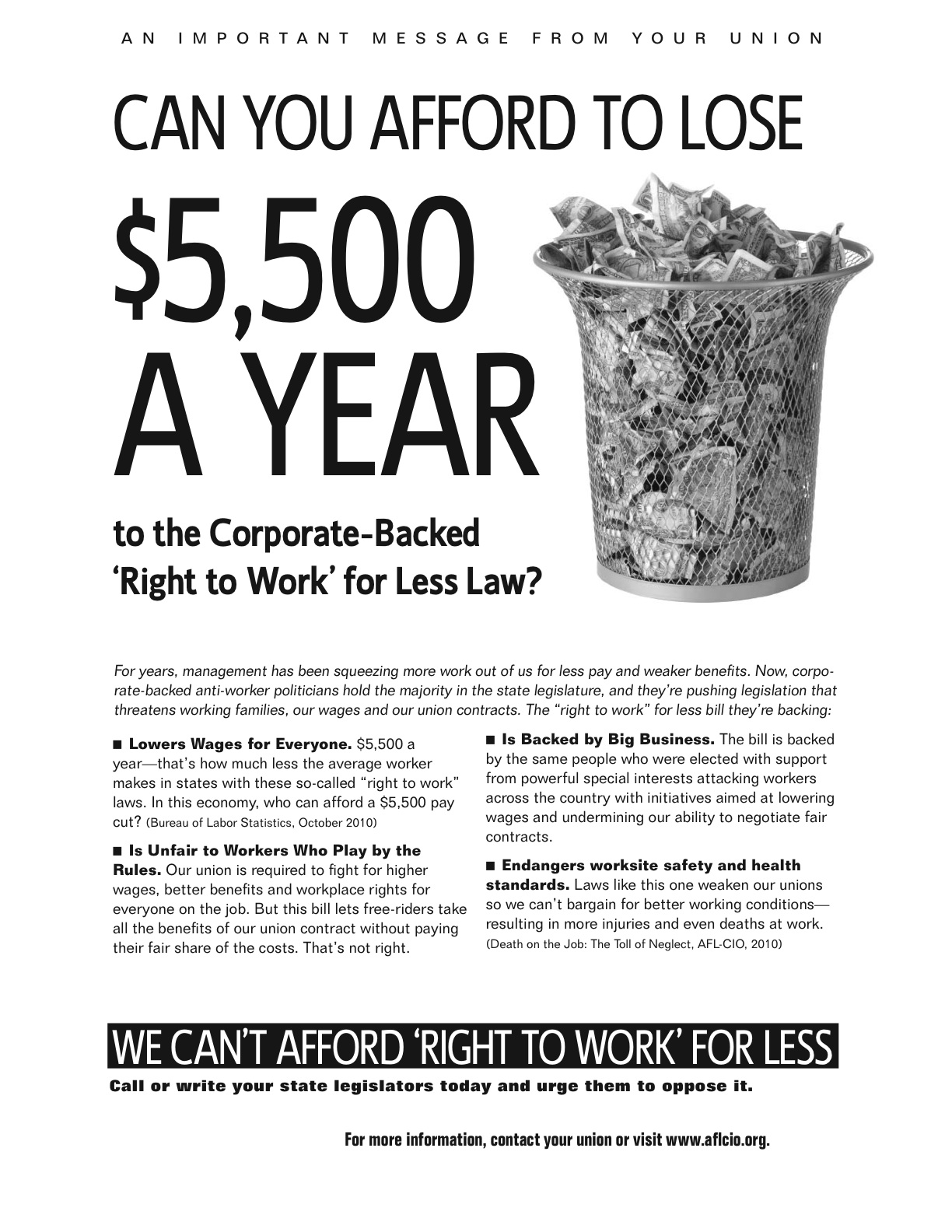
This new legislation would undermine even further the protections that working class people have and is designed as a clear attack against organized labor. There are currently 22 states in the country that have right to work laws.
However, this proposed legislation should not come as a surprise, particularly to people in West Michigan. The local business elite, through the West Michigan Regional Policy Forum have made making Michigan a “Right to Work” state one of their top priorities at both of the last gatherings here in Grand Rapids. At last year’s forum they even invited anti-labor activist Rick Berman to conduct a workshop on how to an anti-union/right to work campaign.
So far there has been little news coverage concerning this legislation and the larger unions in the state have done little in response besides create education flyers for distribution. (Like the 2 flyers you can download from this posting.)
There is no timeline for when HR 4054 will be voted on, but people can follow this issue by going to the Michigan legislative page for updates. If we hear about any organized efforts to fight this legislation we will post that information in the future.
A local grass roots nonprofit working for environmental justice and urban food security, Our Kitchen Table (OKT) has received a $360,000 grant from the The W.K. Kellogg Foundation “to strengthen the capacity of southeast urban neighborhood residents in Grand Rapids, Michigan, to address food and environmental health disparities impacting vulnerable children, families, and individuals by creating resident owned gardens and managed Healthy Food Demonstration Sites.” The grant will extend over a three-year period with the goal of neighborhood residents taking over the work for themselves.
OKT has been addressing environmental justice and food security issues in the Grand Rapids area for the past several years. The grant will expand their

Urban gardeners learn about compost at one of OKT's “Steps to Growing Healthy Urban Food Gardens” workshops last summer.
programs to many more area residents with the hope of making a real and lasting impact on people’s health in Grand Rapids’ urban neighborhoods.
OKT’s objectives for the grant funded project include planting and maintaining 100 neighborhood-based food gardens. OKT focuses on helping individuals and families plant those gardens in their own spaces. Education and training components will teach adults and children how healthy foods help manage both diet related illnesses (diabetes, heart disease and obesity) and environmental health issues (asthma and lead poisoning).
Twenty trained community Urban Fellows/Peer Educators will teach even more community members about food self-reliance, food security and having access to a nutritional neighborhood-based food system. Other objectives include establishing resident owned and managed Healthy Food demonstration sites and training both adults and children how to safely address environmental hazards associated with food gardening.
The project will focus on four Grand Rapids neighborhoods: Eastown, Baxter, SECA and Garfield Park. These neighborhoods have been identified as being at highest risk for food insecurity as well as environmental health issues, including lead poisoning.
In 2010, OKT offered the Grand Rapids community many educational and gardening opportunities including a food summit, food garden walking and bicycle tours and a series on healthy urban food gardening.
Anyone interested in starting a food garden or engaging with the program can contact Lisa Oliver King for more information at lisak1@aol.com.
Comcastrophe: FCC approves Comcast/NBC merger

(This Media Alert is from the national group Free Press.)
The decision was handed down moments ago and you should be mad as hell.
The FCC just blessed the merger of Comcast, the nation’s largest cable and home Internet provider, with NBC Universal. The Justice Department approved the merger, too, leading to the unprecedented consolidation of media and Internet power in the hands of one company.
There’s no way to sugarcoat it. Wherever you live, the Comcast-NBC merger is a disaster.
Letting one company control the pipes and the content that flows over those pipes is a formula for abuse. Comcast-NBC could soon hike up rates, take away your favorite channels or even stop you from watching your favorite shows online. Comcast has already targeted Netflix and other companies that compete with its video and Internet offerings.

The merger lays waste to then-candidate Barack Obama’s 2008 promise, when he said, “I strongly favor diversity of ownership of outlets and protection against the excessive concentration of power in the hands of any one corporation, interest or small group. I strongly believe that all citizens should be able to receive information from the broadest range of sources.”
We at Free Press believe that, too. But unlike the president and his FCC chairman, we’re not caving to corporate pressure. Free Press is working with our allies and activists to fight for more open, democratic and diverse media.
Here’s how you can help:
1. First, let Washington know that there are consequences to blessing this bad deal. You can tell everyone that this merger is a disaster by Tweeting about it, spreading the word via Facebook, and sharing this e-mail with others.
2. Next, join our national network of local Comcast watchdogs. Sign this pledge to protect your community against future Comcast abuses, and we’ll connect you to a growing network of activists in your area and beyond.
3. Finally, support the Free Press Action Fund so we can mobilize a broad coalition to stem the tide of new media mergers sure to follow in the wake of Comcast-NBC.
Today’s deal, combined with the FCC’s recent loophole-ridden, fake “Net Neutrality” rule, sets the stage for Comcast to turn the Internet into something that looks like cable TV. This administration has a long list of weak compromises to corporate lobbyists during its first two years. But today’s merger is particularly alarming.
You might be saying, “I’m not a Comcast customer, so I’m not worried.” But Comcast will jack up the prices that other cable and online distributors pay for NBC content, and you’ll pay higher prices — we promise.
You might be saying, “I can just get a new Internet provider if I don’t like it.” But there’s almost no broadband competition. And as TV, radio, phone and other services increasingly become Internet-based, cable will be the only connection that’s fast enough to deliver high-quality media and services to most Americans.
You might be saying, “Why should I care about a business deal between two giant companies?” But this merger is certain to be the first domino to fall in a series of mega-media mergers. The FCC’s blessing of Comcast-NBC will embolden companies like AT&T or Verizon to try to gobble up content providers like Disney and CBS, creating a new era of media consolidation where even fewer companies control the content you watch and all the ways you watch it.
The Comcast-NBC merger is truly catastrophic for the public, and for the future of media, technology and democracy
The Significance of Baby Doc’s Return to Haiti
(This article was written and submitted by Joe Spaulding.)
In 2004, the Bush Administration committed an egregious act against Democracy that was so well hidden and efficiently executed that when Eric Alterman and Mark Green wrote The Book on Bush: How George W. (Mis)leads America, their 400 page, thoroughly well-researched, and extremely accurate hit job highlighting the negative consequences of policies championed and enacted by Bush and his cabinet members during his presidency, they completely overlooked it. Respected scholar and law professor Ilan Peleg also failed to mention it in his critique of Bush’s foreign policy The Legacy of George W. Bush’s Foreign Policy: Moving Beyond Neoconservatism.
These were books written by skilled researchers that were looking ferociously for information to paint George W. Bush in a negative light. On February 29, 2004, Jean-Bertrand Aristide, the democratically elected president of Haiti was kidnapped at gunpoint by U.S. agents, forced onto a U.S. jet, and flown to the Central African Republic. During the flight the lives of his family and the people of Haiti were threatened if he did not sign a slip of paper claiming he willfully abdicated his office. On the plane he used a smuggled cell phone to call Rep. Maxine Waters and Randall Robinson (a man who struggled to get the U.S. to enact sanctions against South Africa during Apparthied) and inform them that he was overthown by a U.S. backed coup. He has not been allowed to return to Haiti since, and his Lavalas Party is banned from elections.
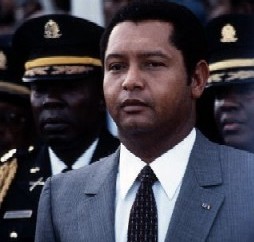
Jean-Claude “Baby-Doc” Duvalier was the president of Haiti from 1971-1986, when he was overthrown by a popular uprising. He was a drug-running thug who used fear, torture, rape, and assasinations to maintain order in Haiti. The Tonton Macoute, his father’s death squad/secret police answered to his every call and executed people he percieved as threats. His presidency was tolerated and even supported by the Reagan and Nixon Administrations because he vocally denounced Communism. The aid the U.S. sent to Duvalier to help the Haitian people not starve to death was stolen by Baby Doc and used to let him live comfortably in Paris when he was exiled after 1986. On January 16, 2011, Jean-Claude Duvalier returned to Haiti without being arrested.
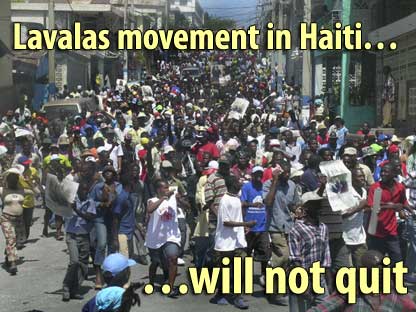
The media coverage of Baby Doc’s return has been abysmal, and this potentially has serious consequences for Haiti. Mac McCelland at Mother Jones has writen a short article that makes no mention of Aristide, and only has a brief mention of Baby Doc’s human rights abuses, which implies Haitians are welcoming Duvalier back with open arms. An AP article at NPR.org makes brief mention of the Tonton Macoute’s human rights abuses but also ignores Aristide completely.
The BBC World Service tried to construct Baby Doc as harmless and also failed to mention the Aristide or the Lavalas Party. Jacqueline Charles at the Miami Harald mentioned neither Duvalier’s crimes nor Aristide’s kidnapping, but she did make it sound like Haitians were very receptive to Baby Doc’s return. Clarens Renois at the Sydney Morning Herald actually writes the word “Aristide” once, but overlooks his specific story to simply point out he was another exiled president.
On the ground in Haiti, the people are mostly interested in the return of Baby Doc in as much as it takes away the government’s ability to justify the continued exile of Aristide. This is not a narrative that entities interested in the spread of neoliberal structural adjustment policies want the world to hear, because it brings into question the idea that opening up free markets in developing countries is the only way to lead them to democracy.
Duvalier has more than demonstrated his willingness to siphon aid funds from the U.S. and IMF while imposing policies on Haitians that allowed their exploitation by American and European corporations. The U.S. has demonstrated it’s bipartisan willingness to extend aid to regimes that will not try to raise the minimum wage, provide access to education and health care for all citizens, or nationalize industries like Aristide did.
The same corporate interests that control the majority of the mainstream media (and in the near future all of the media if we do not get some real net neutrality protections soon) and influence our politicians have a lot to lose if Aristide is allowed to return to Haiti. They will be trying their hardest to convince the global public that Haitians do not want him back.

About 300 people walked silently in the cold today at the GVSU Allendale campus to kickoff a week of events commemorating the birth of Dr. Martin Luther King Jr.
As people wove through the campus they walked past signs that provided a chronology to the life of Dr. King. Some signs also included statements from Dr. King while others highlighted actions that he participated in during his short lived 39 years.
The silent walked ended and people filed in doors to hear the words of one of the founding members of the Student Non-Violent Coordinating Committee (SNCC), Judy Richardson. Judy was a graduate of Moorhead College is a co-producer of the Eyes on the Prize series and author of the recently released book Hands on the Freedom Plough: Personal Accounts of Women in SNCC. The civil rights activist is also the director of the documentary Scarred Justice: The Orangeburg Massacre 1968.
After making a few opening comments, Richardson then shows a clip from the film, a clip which provides a context for the community of Orangeburg where the students massacre took place in 1968.
According to Richardson, the majority of the population in the area was Black, but White people controlled all the power, both politically and economically. This White Supremacist power structure was threatened when students began to confront the owner of a segregated bowling alley.
Students began asking questions about how a local businessman could exclude people from his business. After four days of protests the campus was under lockdown, with local and state police, along with National Guardsman. Police open fire without warning killing 3 college students, one high school student and wounding 28 others. Journalists that Richardson interviewed for the documentary said that all the students were shot in the back.
During the interview process they came across two White journalists who wrote a book about the massacre. One went into the hospital to interview those wounded and told the hospital personal that he was with the Bureau. The hospital thought he was with the FBI, when in fact he was the Bureau chief for the LA Times in Atlanta. Gaining access to the medical reports proved that students were shot from behind, suggesting they were all running away when police & National Guardsmen opened fire on the demonstrators.
Richardson said that the film premiered at the annual event to commemorate the massacre at South Carolina State College. She also spoke about the film production process and particularly the interview they did with Bill Barley. Barley was with the Governor’s office at the time of the shooting and was willing to talk about what had happened. When the film crew arrived at his house Barley was somewhat embarrassed since he didn’t know Judy was a Black woman. Matters were complicated when Barley told them he collects Confederate Flags. However, Richardson said that he was very forthright with what he had to say, which was to tell the truth about what happened that day in 1968.

Richardson also talked about how this event was history that had been hidden and until recently rarely talked about as part of the freedom struggle of the 1960s. She said that the Orangeburg massacre was never part of the larger public consciousness in the same way that the 1970 Kent State shootings were. Crosby, Stills, Nash and Young did not produce a song about Black students being shot in the back.
The filmmaker also talked about how the current Mississippi Governor Haley Barbour, when asked about race relations at that time said he didn’t remember it being “that bad in the 1960s.” Barbour also stated that the White Citizen’s Council were a “positive force in the community.” Richardson pointed out that the White Citizens Council were the ones bankrolling the activities of the local KKK chapters.
For instance, in Yazoo City, Mississippi, where Medgar Evers was doing organizing work, Blacks who had signed a petition had their names published in a newspaper ad, along with death threats and job loss. “This is why,” Richardson said, “it is so important to remember history and to recover it. If we don’t we end up with people learning about the civil rights struggle through films like Mississippi Burning.” Mississippi Burning was a 1988 film that depicted FBI agents as the real heroes and risk takes of the freedom struggle in Mississippi.
After her comments Richardson listened to comments and questions from the audience. Several people asked the speaker “what they could do” or “what lessons should we learn from this history about the struggle for civil rights?” This is always a difficult question for anyone to answer, since it assumes they can tell people what to do. However, Richardson did a great job of getting people to think about the importance of becoming educated about this part of history. She also felt that it was important for people to act, to organize, to start something for change or seek out groups that are already doing that work. Richardson really stressed the importance of popular education or study groups and cited A People’s History of the United States as a great text for reclaiming that history.
There were also several GVSU students who talked about being punished for skipping class to come to this hear Richardson, since the university does not give students the day off or have a policy of allowing students to attend events, even if it means missing classes. Someone from the university responded and invited students to be part of a committee to address this matter, but this writer had visions of students having a sit-in or occupying the administrative building to demand that the school have a clear and committed policy on celebrating MLK Day. Such an action would be a “lesson learned” from the kind of history that Judy Richardson shared with people on this day.
Radical Journalist, Author, Activist, Friend – The Loss of John Ross
Today I read the sad news that John Ross, writer, poet, activist and chronicler of the Zapatistas, died today in Mexico.
It is hard to believe, since just 10 months ago he sat in my living room, warming himself next to the woodstove. I remember listening to John share stories about his political battles, music, sports, social movements and his writing, all in that manner that people who spent time with him came to know.
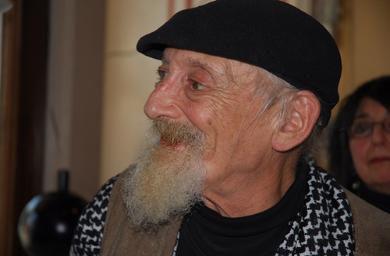
John was a no bullshit kind of person, an at times in your face kind of person, but also an extremely compassionate person. When I say compassionate, I don’t mean the fluffy kind, I mean the kind that mixes rage and justice. John was a fighter and his compassion was reflected in his writing, his spoken word and his never-ending commitment to stand with those who stood for something.
I first came across John Ross’s work when he wrote about the Zapatista uprising in Mexico with his book Rebellion from the Roots. Ross followed up that book with The Annexation of Mexico and two more books on the Zapatistas; The War Against Oblivion and Zapatistas: Making Another World Possible.

John also wrote an incredible book called Murdered by Capitalism, which is part autobiography, part reflections on the US Left. His last book, El Monstruo is sort of a “people’s history” of Mexico City.
People in Grand Rapids were fortunate to hear John speak and read from his work on two different occasions in Grand Rapids. We brought him to town in the fall of 2004, just prior to the US Presidential election and John (who had just come back from Iraq) was calling on people to engage in mass demonstrations against the war no matter who won the election. John knew all to well that electoral politics in the US was just a shuffling of people that represented power.
I ran into John in the Zapatista community of Oventic, a small village perched in the mountains of Chiapas, Mexico in 2001. It was during the New Year’s eve celebration and John was in his element, not just because he was chronicling the EZLN struggle, but because he was part of the struggle providing international solidarity for those the neoliberal henchmen of the world would like us to forget about.
John was in Grand Rapids again last year while on tour with his last book. He spoke on campuses and at community events and even in his late seventies could make you tired with his passion for intellectual sparing and sarcastic humor.
We are grateful for his humanity, for his passion and his notorious smile. We will miss you John, but your memory will live with us.
(John Ross read some of his poetry last year at Hugo Claudin’s space in Grand Rapids. Lindsay McHolme enshrined his persona in this short video where he reads the poem The Revolution is not like a faucet.)
New Type of Ads Trick Viewers, Help Circumvent DVRs

(This article is re-posted from PRwatch.)
Advertisers are using a new technique to trick DVR users and people who mute TV ads into watching their ads. The new ads, called “interstitial ads,” “podbusters” or “DVR busters,” are designed to look and feel just like the shows viewers are watching. They often feature the same actors, in character, and may use brief, insipid out-takes from the real show to lure unsuspecting viewers into watching them.
Advertisers run podbusters late in the show, around the time that cliffhanger-endings are keeping viewers on the edge of their seats. Examples of DVR busters include Tina Fey starring in an ad for American Express during her show, 30 Rock, and commercials seen near the end AMC’s Mad Men that feature actors from the show in an office environment and wearing 60’s fashions, to make people think the show has started again. By the time people realize they are really watching an ad and not the show, the commercial is almost over.
Mike Rosen, an executive with a media agency, explains that ads that mimic shows viewers really like help transfer the positive feelings people have about those shows to the products being advertised on them.
Which Dr. King will you celebrate?
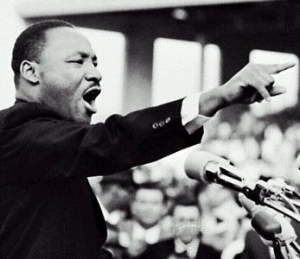
Today is the 25th anniversary of the US government’s decision to make Dr. Martin Luther King Jr’s birthday a federal holiday. During the past twenty-five years the memory and legacy of Dr. King has at times been honored, misunderstood and even co-opted.
Quite often both government and commercial media reflections on King are limited to recycling his “I Have a Dream” speech or simply focusing on his position dealing with racial justice. Last year GRIID posted a piece that highlighted the last few years of Dr. King’s life, which advocated a more radical transformation of American society. King not only called for racial justice, he was also highly critical of US militarism and the economic system of capitalism.
“We are now making demands that will cost the nation something. You can’t talk about solving the economic problem of the Negro without talking about billions of dollars. You can’t talk about ending slums without first saying profit must be taken out of slums. You’re really tampering and getting on dangerous ground because you are messing with folk then. You are messing with the captains of industry….Now this means that we are treading in difficult waters, because it really means that we are saying that something is wrong…with capitalism…here must be a better distribution of wealth and maybe America must move toward a Democratic Socialism.”
Dr. King clearly evolved from his work in the south in the 1950s to his work in the North in later part of the 1960s, culminating in his denunciation of the Vietnam War, his work on the Poor People’s Campaign and his support for the sanitation workers strike in Memphis where he was assassinated in April of 1968.
Over the years Grand Rapids has celebrated the holiday in a variety of ways, some which truly honor the legacy of Dr. King, while others co-opt his legacy. For instance, every year there is a “march” that begins at GRCC and walks downtown to Fountain St. Church. The “march” is often led by students who are members of JROTC, a program that is fundamentally a recruiting tool for the US military, which disproportionately targets minority students. Considering King’s denunciation of war/militarism and his commitment to non-violence it seems to this writer that having JROTC students lead a march in his honor bastardizes King’s message.
This year there are numerous events planned in Grand Rapids this year that seek to “honor” the legacy of Dr. King, but one that is a clear example of attempting to co-opt his message. Monday morning the Grand Rapids Urban League is hosting its 11th Annual Dr. Martin Luther King Jr. Corporate Breakfast. Besides the complete contradiction in the idea of King with a corporate breakfast, the event will honor the legislative career of Vern Ehlers. This raises the question, “how could the GR Urban League honor a man that supported war, unbridled capitalism and did not make racial justice a priority during his time in Congress?”
This irony was played out at the national level as well when the Defense Department’s general counsel Jeh Johnson recently stated that Dr. King would probably support the current US War on Terror. Johnson specifically mentioned Iraq and Afghanistan in a speech at a Pentagon celebration of Dr. King. Fortunately the folks at Rethink Afghanistan have produced this video as a sharp response to such a gross misappropriation of the message of Dr. King.
Media Alert: MetroPCS is a Net Neutrality Violator
(This Media Alert is re-posted from the group Save the Internet.)

When we access the Internet on our phones — as more of us do every day — we expect to be able to go wherever we want, whenever we want.
But a terrible new service plan from MetroPCS — the fifth-largest U.S. mobile phone carrier — is the latest phone industry attack on Net Neutrality. The company is limiting users’ ability to access certain websites and services, unless they pay extra for the privilege.
Free Press just alerted the FCC to this blatant violation of Net Neutrality.1 Please click here to tell the FCC to launch an investigation.
Here’s what MetroPCS’s new pricing scheme looks like:
- Customers purchasing the most expensive plan will have to pay extra to access Netflix, Skype or any website using “advanced HTML” on their phones.
- Those with the cheapest data option won’t be able to access any of these online services, except for YouTube — despite its similar data usage.
It gets worse. MetroPCS’s plans disproportionately affect people of color and urban communities, whom the company recognizes as a major portion of its customer base, and who largely depend on mobile phones to access the Internet.2
There is a way that we can stop MetroPCS’s discriminatory practices. Last month, the FCC adopted weak rules that leave mobile Internet users virtually unprotected from these types of abuses, with two big exceptions: They prohibit the blocking of websites and competing video and voice communication applications on mobile phones. Yet that’s exactly what MetroPCS is doing.
The FCC must now take action to protect the public and enforce these new rules. If the agency does nothing, we could see a domino effect in which larger carriers like AT&T and Verizon introduce their own forms of mobile blocking and discrimination. We can’t let that happen.
The FCC must take MetroPCS to task before other carriers follow suit. Tell the FCC: Enforce your new rules. Investigate MetroPCS’s outrageous, anti-Net Neutrality practices.
Mobile Internet users should have the freedom to access any sites or services they want. The FCC must respond to our concerns3, protect our online rights and investigate MetroPCS now.


