The Future of Capitalism debated at GVSU
Last night an estimated 250 people came to hear a debate on the Future of Capitalism on the downtown campus of GVSU. The Seidman Business Ethics Center hosted the event, which featured four panelists, two defending Capitalism and two critiquing Capitalism.

Each panelist was given eight minutes to present their argument and then each of the four were allowed to respond to comments from other panelists, before the audience was invited to comment.
Professor Nathan Goetting, editor of the National Lawyers Guild Review, was the first to speak. Goetting began by saying that free market Capitalism has never really been tried, at least not the theoretical version that is taught in business schools. Instead, Goetting pointed out, Capitalists want a strong state to intervene to protect their interests both at home and abroad. Such is the nature of all market economies, which always seek to get even richer.
Goetting mentions Wal-Mart as an example and the 2008/2009 Wall Street bailout as prime examples of how Capitalism needs the state in order to function. This state intervention comes in the form of subsidies, tax-breaks, taxpayer bailouts, deregulation and sometimes police/military intervention to protect capital interests. This led the first panelist to claim that what we have would more accurately be called mega-corporatism.
Goetting concluded his comments by saying that Liberty and Democracy should be virtues that are central to the workplace and our economy, but these are elements that Capitalism does not want or foster.
The next panelist was Mr. Craig Meurlin, a lawyer with Warner, Norcross & Judd, and former Amway VP and General Counsel from 1993 – 2000. Meurlin argued that the free market has brought many in China out of poverty, a country he has spent a great deal of time in both while he was with Amway and because of current business clients he represents. Meurlin never provided any evidence to support his claim about Chinese people being pulled out of poverty because of Capitalism.
Meurlin then acknowledged the shortcomings of Capitalism, but still thinks that it is a “successful system.” He then spent a great deal of time focusing on the role of the government and stating that the state is just as much to blame, if not more so, for the economic crisis we are currently facing. Meurlin suggested the government should make more laws that creates boundaries for the free market system, but he never articulated what those boundaries might look like. He also acknowledged mentions that corporate monopolies are problematic and identifies Proctor & Gamble as an example, which it should be mentioned has been a company that Amway has been fighting for years over claims that the P&G logo promotes Satanism.
Meurlin also blamed the US government for the Wall Street financial crisis. He criticized both the General Motors and Chrysler bailouts and bad government intervention. Then Meurlin made what seemed like a contradictory comment to this writer. He said, “When markets are too free they will destroy everything around them.”
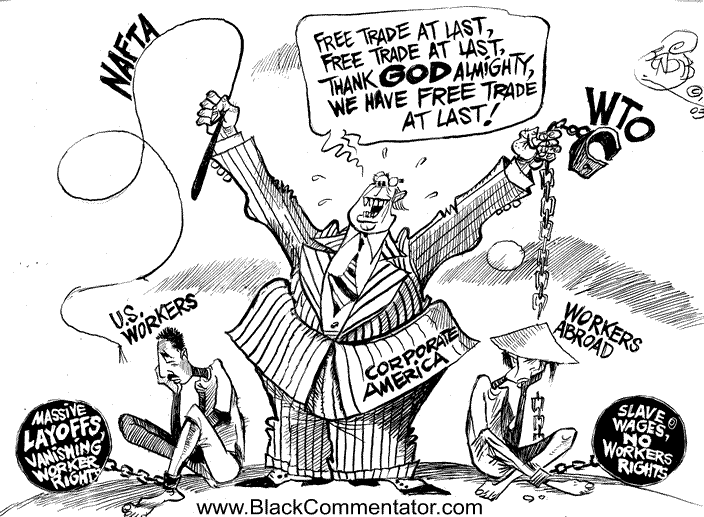
The third speaker was Professor Bruce Bettinghaus, who teaches at GVSU. Bettinghaus not sure if he was for or against Capitalism and referred to Wikipedia as a source for defining what Capitalism is. He said that Pure Capitalism is narco-capitalism, where anything goes. Bettinghaus referred to the Lord of the Flies as a literary reference to make his point. The other end of the spectrum is state control, according to the GVSU professor. Here Bettinghaus cites Marx and Animal Farm to illustrate the problem of state control. “What we have is something more in the middle,” said Bettinghaus.
Bettinghaus offered up a solution for regulation by saying that what banks needed to due was to change the capital to assets ratio, particularly for the larger banks. He thinks that the bankers are “crazy” and agrees that we have a system of corporatism and the corruption exists because they (the bankers) are the biggest contributors to Congress.
The last panelist was Tony Nelson, a GVSU graduate who works in Chicago with the Mexico Solidarity Network. Nelson took the conversation in a whole different direction by looking at real scenarios as well as the human consequences of Capitalism.
Nelson said what if you had a local businessman who made Pokeman dolls, but sets up factories in Mexico. The company makes a great deal of money, but the money comes back to West Michigan and benefits this community, not the one in Mexico where the factory is. This businessman is considered a positive influence in the community. In contrast there are farm workers (some with, some without documentation) who work picking crops in the US making very little money. They send some of their earnings back to Mexico, which can help family members survive. This migrant worker is often reviled and viewed as a burden on US society.
Nelson said he came to Capitalism based on his experience in Mexico, where people are asking us in the US to think about how our policies negatively impact them. “Capitalism is inherently flawed,” said Nelson, “and is primarily driven by profit and growth.”
The panelist went on to say that development and trade policies are decided on behind closed doors, where the public has no say. He mentions NAFTA, CAFTA, and Plan Puebla Panama as example of undemocratic policies that have been devastating for the working poor and indigenous communities in Mexico and Central America. Nelson cited the Chapter 11 provisions of NAFTA, which allows corporations to sue governments if local communities object to a factory or a mine that will pollute their communities. “These are aspects of Capitalism that most of us will not see,” said Nelson. “We don’t know the trail of production that millions are workers are subjected to.”
Nelson concluded his comments by say Capitalism is not sustainable. “They (the Capitalists) need workers to exploit and consumers who don’t care.”
Craig Meurlin was the first to respond after all four made their arguments. He agreed with the idea that what we have is mega-corporatism and this corrupts government. He even suggested that Congress should where NASCAR-like suits to display the logos of companies that make contributions to them.

However, Meurlin then posed the question, “If capitalism is flawed, what do you propose we replace it with?” Bettinghausen followed by saying that you need something that will motivate people, that will get them out of bed and that is what the free market does.
Goetting said that incentives don’t need to be selfish and people don’t need to be threatened to do good. He thinks people care about justice and caring for one another. The incentive can be communal. Nelson agreed with Goetting and said that there are other economics models that can work, but capitalism doesn’t allow for other models.
Betinghausen responded by saying that natural scarcity is what motivates us to do things. He then asked the question “Who owns NFL teams?” His point was that most of the NFL teams are owned by municipalities, which just isn’t the case. All NFL teams are owned by private individuals or corporations, except the Greenbay Packers, which are owned by the community. What the owners have been doing for years is getting municipalities to pick up much of the cost of building new stadiums with the threat of relocating if they don’t comply. (See Dave Zirin’s book Bad Sports)
Tony Nelson then responded to the question “what would you replace Capitalism with?” He said that communities should be allowed to create localized economies and that no economic system should be imposed on the whole world.
There wasn’t much time for Q&A and most of the people who asked questions made statements that suggested they were also critical of Capitalism, since most of the comments questions Meurlin and Bettinghaus.
As with most debates there simply wasn’t enough time to explore the topic. Another criticism of the forum was that all four panelists were White men, which contributed to the problem of how this topic is dealt with since women and people of color are disproportionately impacted by Capitalism in negative ways.
Radical Poetry Workshop at The Bloom Collective Saturday
 Radical Poetry Workshop
Sat. Jan 29 2-5 p.m.
T he Bloom Collective
671 Davis NW Grand Rapids
(Corner of 5th & Davis)
$3-$5 suggested donation
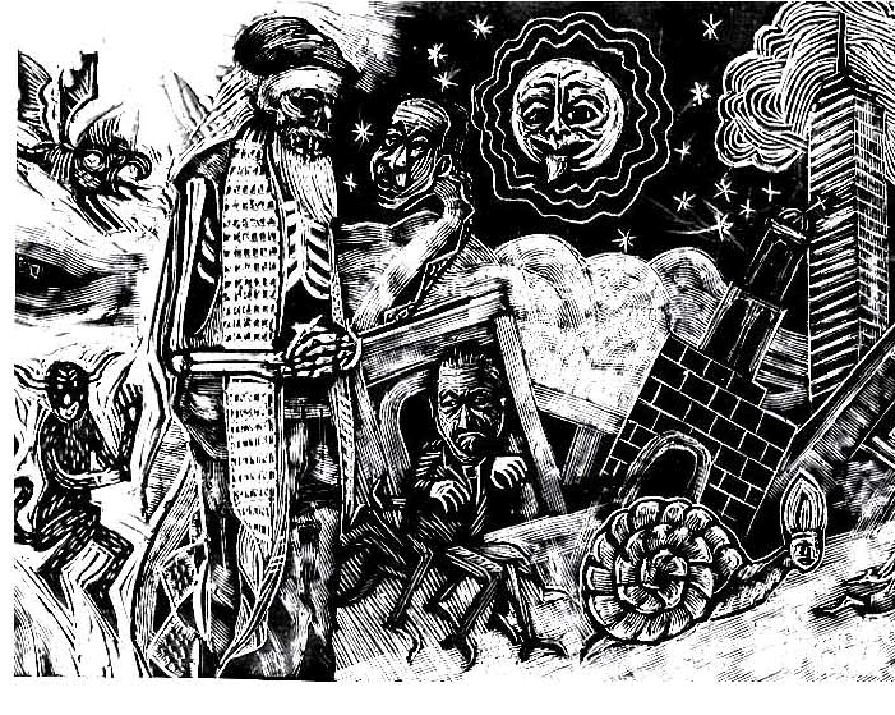
When members of The Bloom Collective began planning a Radical Poetry Workshop a few months ago, using a print depicting John Ross seemed like a logical choice for the event flyer. John passed away Jan. 17. Now, it seems only fitting that next Saturday’s event start off with video of him reading his works when he visited Grand Rapids in March 2010.
After the video presentation, The Bloom will share the works of other radical poets and lead a discussion about the importance of words to revolution. People who attend will be invited to share their own poems by reading them aloud, sharing copies or selling their poetry zines. The group might even do a little writing.
Folks who come are also invited to enjoy a potluck supper so bring a dish to pass. The Bloom will share vegan dishes. For information, visit thebloomcollective.org
(This article was submitted by Robby Fischer.)

The Muskegon County Jail has announced plans to implement a new policy that will limit inmates’ correspondence to standard-sized postcards. The policy, which is slated to go into effect February 7th, has already been adopted by jails in Ingham, Isabella, and Gratiot Counties, and is being considered for adoption in Oceana, Newaygo, and Allegan Counties.
The main reasons for the switch, as Muskegon Sheriff Dean Roesler explained to the Muskegon Chronicle, are to “cut down on staff time and allow them to concentrate on other duties, like supervising the inmates.” Roesler also claims that the new policy will “increase our security” by cutting down on contraband being mailed into the jail- specifically drugs and porn.
In another Chronicle article, Roesler claimed that he was “on solid ground” regarding the policy’s legality, on the grounds that other counties have already implemented the same postcard-only regulation. “There have been challenges raised, but none of them successful that I’m aware of,” Roesler said.
Sheriff Roelser, it would appear based on that statement, must be unaware of the recent class action lawsuit filed in Colorado Springs against the El Paso county jail, wherein that jail’s postcard-only policy was determined to be unconstitutional and was successfully reversed. The decision to reverse the practice came December 20th, 2010, after U.S. District Judge Wiley Daniel granted a preliminary injunction to the American Civil Liberties Union of Colorado. (View the Martinez vs. Maketa case).
It would behoove Sheriff Roesler to take this news into account, because the last I checked, a violation of the First Amendment rights in Michigan is just as unconstitutional as a violation of First Amendment rights in Colorado.
Luckily, Muskegonites are organizing against the policy. ‘Letters Are Better’ is a grass-roots effort that has planned a call-in day for this Thursday, January 27. On that day, anyone interested in objecting to the postcard-only policy should call Sheriff Roesler at 231.724.6236 and let him know… as frequently as possible. If you can’t get through to the Sheriff, call Mark Burns, the Jail Administrator, at 231.724.6289.
You may consider bringing up these talking points:

– Contrary to the Sheriff’s statement in the January 7th article in the Muskegon Chronicle, there have been successful challenges against the postcard-only policy. The Martinez vs. Maketa case in El Paso County, Colorado is the case in point.
– Denying inmates the right to enclose their messages limits freedom of expression. In the words of the ACLU in Colorado, “the postcard-only policy has forced prisoners to either abandon important correspondence or risk divulging highly confidential, sensitive information to anyone who will handle or see a postcard. As a result, gay prisoners have been chilled from expressing themselves when writing to their intimate partners. Prisoners with HIV or Hepatitis C have refrained from corresponding with family members about their medical conditions.”
– The argument has been made that eliminating the need have someone reading letters will “save the taxpayer’s dollars”… but in reality, that one small change will, at most, save taxpayer cents. If you cannot afford to run a jail responsibly, then you cannot afford to run a jail. Period. The proper course of action in that case is to shut it down… and that is an act that will save taxpayer dollars.
– Cases of contraband and witness intimidation are often cited as proof that letters must be done away with… but these instances say much more about the jail staff than they do about the mode of communication. If the staff had been doing their job correctly, those letters would have been intercepted.
– Rebecca Wallace, staff attorney with the ACLU of Colorado, put it nicely: “Beyond their clear constitutional violations, these policies are simply counter-productive. Letters clearly allow prisoners to maintain relationships with friends and family that will aid in their return to life after incarceration. If jail officials are serious about lowering recidivism and increasing public safety, they would do well to recognize that preserving prisoners’ rights to send letters actually protects us all.”
This unconstitutional postcard-only policy must be exposed and overturned now. If it is able to gain a foothold in West Michigan, it will set a terrifying precedent for the rest of the jails in the state.
If you would like to know more about this resistance effort, or other ways to get involved, email lettersarebetter@hotmail.com, or call 231-733-5370.

The local group Healing Children of Conflict has announced that they are hosting an event with Dr. Izzeldin Abuelaish, a Palestinian doctor who lost members of his family during the Israeli Assault on Gaza two years ago.
Dr. Abuelaish is on tour with his new book I Shall Not Hate, which recount’s his personal reflections and thoughts about the importance of non-violence and forgiveness in the midst of violence and hate.
Dr. Abuelaish was in Grand Rapids last March and GRIID was able to interview him about the death of his three daughters from Israeli bombing. He will be speaking and signing books on Thursday, February 3 at 7pm in the Schuler Books on 28th Street. This event is free and open to the public. For more information contact Healing Children of Conflict at info@healingchildrenofconflict.org.
John Muir: Nature’s Evangelist?
 Donald Worster presented the Jan. 19 January Series lecture entitled, John Muir and the Religion of Nature. Worster is professor of U.S. History at the University of Kansas and author of “A Passion for Nature: The Life of John Muir.”
Worster began with remarks about the photos of nature scenes he found on the walls of his room within Calvin College’s Prince Center. He used these as examples of how Muir’s Religion of Nature has crept into contemporary religion, even Calvinism. Even so, contemporary society, as a whole, fails to give Nature the attention our primordial connection to it would seem to require.
“Nature is usually avoided in polite academic society, avoided in political works, ignored in our business and economic work. It’s too old fashioned and has implications,” Worster said. “Why has nature fallen out of favor. . . To dismiss the movement to conserve and protect places like Yosemite is bad history. It misses just how subversive to hierarchy and tradition the love of natural beauty can be. The ideas of freedom, equality and brotherhood connected to a love of nature is rooted in a revolutionary vision of a non-hierarchical and egalitarian society.”
Worster then summarized John Muir’s life. Known as the “Father of American environmentalism” and founder of the Sierra Club, Muir was born in Scotland 1838 and immigrated to the Wisconsin frontier at age 11. A University of  Wisconsin dropout and conscientious objector, he set off on a solo, one thousand mile trek that took him to the Florida coast and then across the Ohio river. This walk across America set him on course as an advocate for nature and the wilderness. Muir’s advocacy is also credited as having been vital to the founding of national parks.
Worster’s brief biography did fail to mention bigoted statements about native peoples in Muir’s writings. Mark Davis Spense, in his book Dispossessing the Wilderness: Indian Removal and the Making of the National Parks, notes that “The Sierra Miwok that Muir encountered in the Yosemite high country, for instance, seemed ‘dirty,’ ‘deadly,’ and lazy.’“ Muir wrote, “They had no right place in the landscape.”
Philosophically, Muir rebelled against the Judeo-Christian human-centric view of the world, the idea that the Earth was created for man. Worster offered this quote describing the Judeo-Christian God from Muir’s book, Man’s Place in the Universe. “He is regarded as a civilized, law-abiding gentlemen in favor either of a republican form of government or of a limited monarchy; believes in the literature and language of England; is a warm supporter of the English constitution and Sunday schools and missionary societies; and is as purely a manufactured article as any puppet at a half- penny theater.”
Muir’s Religion of Nature was an inherent rebellion against class inequalities, hierarchy and empire, borne of his loathing for England’s upper classes.
“Muir found his god in nature, especially in the Sierra Nevada Mountains,” Worster said. His was a “duo-theism with God and Mother Nature as co-equal deities of the world, God and Nature, two artists working in harmony and gender equality.”
Worster offered this quote from Muir’s journals: “The whole wilderness seems to be alive and familiar, full of humanity. The very stones seem talkative, sympathetic, brotherly. No wonder when we think that we all have the same Father and Mother.”
This description of Muir’s spiritual connection with nature, which could be defined as being closer to animism than theism, brings to mind the contemporary works of Derrick Jensen, especially A Language Older than Words. Jensen shares how all of Nature, the animals, plants, rocks and trees speak a language older than words, a language that we today no longer hear or comprehend. This was no doubt the same language Muir heard on his travels through the wilderness of America, an America that had not yet seen the environmental destruction we see today.
 Jensen writes, “I looked closely, and saw one blade of wild grass, and another. I saw the sun reflecting bright off the needles of pine trees, and I heard the hum of flies. I saw ants walking single file through the dust, and a spider crawling toward the corner of the ceiling. I knew in that moment, as I’ve known ever since, that it is no longer possible to be lonely, that every creature on earth is pulling in the direction of life–every grasshopper, every struggling salmon, every unhatched chick, every cell of every blue whale–and it is only our own fear that sets us apart. All humans, too, are struggling to be sane, struggling to live in harmony with our surroundings, but it’s really hard to let go. And so we lie, destroy, rape, murder, experiment, and extirpate, all to control this wildly uncontrollable symphony, and failing that, to destroy it.”
Before closing, Worster admitted that John Muir did not remain loyal to his own ideals in later life. After coming into quite a bit of money, he settled comfortably into upper class, capitalist America. Jeffrey St. Clair confirms this in his book Been Brown So Long It Looked Like Green to Me: The Politics of Nature, “In 1899, railroad tycoon Edward Harriman put together an expedition of naturalists, scientists, painters and fellow robber barons to explore the coast of southeast Alaska. The shrewd head of the Union Pacific even rented the services of John Muir, the father of environmentalism and founder of the Sierra Club, thus striking a bond between corporate villains and mainstream greens that thrives to this day.”
Worster concluded, “When such success comes to people, they change their companions and change their views as well . . . despite changes in his bank account, he never thoroughly repudiated his views. This is the Muir we need to understand under better and remember.”
This writer disagrees. Throughout radical American history, the impact of social movements has been weakened when the ruling class co-opted them and made them a functioning part of the existing “system.” In addition to remembering Muir’s contributions to the environmental movement and the National Park system, we need to remember how easy it can be for the powers that be to co-opt, side-track and disempower the forces of justice and change. This lesson from the past could help those working for change to not repeat it in the present.
Let’s also remember to listen to Nature like Muir did in his younger years. It may be hard to hear what the animals and trees are saying, but let’s give it a try. If we are going to save this planet from human destruction, we need to learn, listen to and abide by Nature’s words.
The “Good News” of making weapons in Michigan

The state business journal MiBiz announced today in their e-newsletter Michigan Loves Manufacturing that the General Dynamics Corporation plant in Sterling Heights, Michigan was awarded a “$44 million contract to make tanks for the Kingdom of Saudi Arabia’s tank program.”
The announcement was based on a brief media release by General Dynamics that the MiBiz e-newsletter linked to in the News You Can Use section. No doubt the editors of MiBiz consider this “good” news since it means $44 million dollars for a weapons manufacturing company with factories in Michigan.

One can certainly argue from a business point of view that this additional $44 million dollars will keep people employed in Michigan and might even create some new jobs. One could also argue that this money helps the tax base in Michigan because that $44 million is being spent in the state.
However, the News You Can Use information on General Dynamic’s new weapons contract doesn’t provide the public with a complete picture of what this means. First, since this is a contract for tanks that will be used by the Kingdom of Saudi Arabia it is most likely being funneled through the Pentagon. This means the $44 million contract is being paid for by US taxpayers.
Second, even if the contract is directly between General Dynamics and the Kingdom of Saudi Arabi, why is this “good news?” While Saudi Arabia has been a political ally of the US since FDR developed a friendship with the royal family, Saudi Arabia is no democracy or a country that practices or promotes human rights. Human Rights Watch has been documenting Saudi human rights abuses for decades and provides amble evidence that should give any US taxpayer concern over the General Dynamic contract to provide them with tanks.
Saudi Arabia is also not a stabilizing force in the Middle East as is evidenced in its recent military involvement in the Yemeni suppression of rebel forces. The Saudi government is even forcibly returning Yemeni refugees who are fleeing the violence, which as one commentator noted is a violation of international law.

Lastly, such news from the business press does not factor in the level of political influence that a company like General Dynamics has on determining these contracts for weapons manufacturing. According to the Center for Responsive Politics, General Dynamics has given over $12.5 million dollars to political candidates since 1990, money that has been equally given to Republicans and Democrats. In addition, general Dynamics spends millions annually on Lobbying, with a total of $7.5 influencing Congress in 2010 alone.
So before we naively accept the notion that new weapons contracts are “good news” for Michigan it would be good to have all the facts before we start dancing in the streets.
New Media We Recommend
Below is a list of new materials that we have read/watched in recent weeks. The comments are not a “review” of the material, instead sort of an endorsement of ideas and investigations that can provide solid analysis and even inspiration in the struggle for change. All these books are available at The Bloom Collective, so check them out and stimulate your mind.

Revolutionary Women: A Book of Stencils, edited by Queen of the Neighborhood – Too often when people refer to or mention popular movement people they tend to still be men. This collection of short biographies makes the point that in whatever movement over the past 2 hundreds years there have been passionate and articulate women who have engaged in revolutionary action. The book features 30 women, such as Lucy Parsons, Harriet Tubman, Emma Goldman, Marie Equi, Haydee Santamaria Cuadrado, Ani Pachen, Anna Mae Aquash, Comandante Ramona, Malalai Joya and many more. Each description of these women comes with a full-page stencil image. This is a feminist book that, in the words of the editor, “delivers a swift kick to the groin of deep-rooted patriarchal history.

Fear of the Animal Planet: The Hidden History of Animal Resistance, by Jason Hribal – What do animals do when they are abused and have their freedom stripped from them? They fight back! Fear of the Animal Planet is ground breaking, not just because it has numerous stories about animals fighting back against their abusers, but because it articulates the fact that animals have agency, they have the capacity to feel, to reason and to act. This book will not only appeal to the animal rights reader, but to anyone who really wants to understand how animals who are captive in zoos, circuses and marinas respond to abuse and deprivation. A sobering book, which also inspires.

Challenging Authority: How Ordinary People Change America, by Francis Fox Piven – This is an excellent introduction into the idea that what has brought about radical social change in this country has been through the commitment and efforts of ordinary people. For anyone who has read Piven’s book Poor People’s Movements, this book is an excellent companion. Piven, who is currently under attack from the likes of Glen Beck, look at how ordinary people have made changed and influenced policy in the US through what she calls Disruptive Power. The book is only 150 pages, but provides excellent examples and analysis of the power that ordinary people have demonstrated in this country in bringing about change.
The Other Side of Immigration (DVD), by Roy Germano – This documentary, which is based on interviews with 700 Mexicans, is an excellent resource for people who care about immigrant and human rights. The film doesn’t just look at immigration, it asked the hard questions about why people are coming from Mexico. Listening to people talk about the economic changes in the past 20 years, the inability to make a living working the land and the lack of opportunities, it becomes clear that what motivates most Mexicans to come to the US is to seek a better life and to provide for their families. The film is in both English and Spanish with lots of extras based on the director’s interviews.
The Legacy of Dr. King in the 21st Century: Michael Eric Dyson addresses packed house at GVSU
Last night Rev. Michael Eric Dyson spoke on the Allendale campus of GVSU as part of the university’s MLK week. Rev. Dyson, who is the author of numerous books on a range of topics dealing with race, culture, gender, philosophy and theology, spoke for over an hour about the legacy of Dr. Martin Luther King Jr.
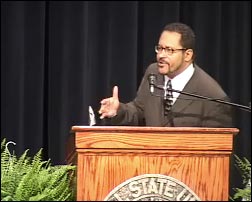
Rev. Dyson dazzled the audience with his oratory skills, his use of humor, irony and sarcasm. But Dyson was not on campus to entertain, he was there to shed light on the significance of Dr. King in the 21st Century. Dyson at times demonstrated his analytical skills, his cultural critique and his preaching style as he didn’t hesitate to raise his voice to underscore a point about what Dr. King called this country to become.
Dyson said that the legacy of Dr. King is strong, but it is vulnerable to a lot of misinformation and romance. He is often cited in conservative circles around the quote where people should be judged by the content of their character. A quote, which is often taken out of context from his, I Have a Dream Speech.
Dyson then pointed out that the people who often use the quote act as if all the impediments to racial justice that Civil Rights movement fought against are gone so that all that matters is content of one’s character. These people, who think we live in a post racial era, are the same ones who are critical of race, gender, sexual orientation and other issues of justice, according to Dyson.
Rev. Dyson then pointed out that King believed in the possibility of America, but he never hesitated to challenge America. “Everyone quotes King and wants to attach themselves to King and his Dream. However, few talk about King being a critic of America and his criticism of race, poverty, culture and militarism.”
At the time of the, I Have a Dream speech, Dyson said that Kennedy was a bystander and did not respond to the challenge of the 1963 march on Washington. However, Dyson also pointed out that the March organizers should be scrutinized as well, especially since Black women were not allowed to speak that day.
Dyson talked about King’s improvising at the March on Washington much in the same way that a jazz player improvises. However, Dyson points out that King most likely improvised in his speech because Mahalia Jackson from the stage said, “Tell them about the dream.” King did and appealed to America to fulfill its rhetoric about democracy and equality.
Dyson went on to say that in addition to mis-use of Dr. King there are people who continue to romanticize about the history of this country. He referred to the recent GOP reading of the US Constitution, where they omitted the parts about Blacks being referred to as three-fifths human. Dyson also mentioned the effort to remove the word “nigger” from Mark Twain’s the Adventures of Huckleberry Finn. Dyson admonished the audience to “Leave it in so that teachers will have to talk about race and racism and this history.”

“The Right,” Dyson said, “wants to trash King, but they fail to acknowledge that the government was hounding him constantly with wire taps, threats, and character assassination.” Dyson said that King loved America, but that doesn’t mean you can’t criticize something you love.
The speaker went on to say that the reason why some sectors despise King is because he was dangerous. He was dangerous, according to Dyson, because he put a “floodlight on the problems of America and people then wanted to blame him for shinning the light on the underside of this country.”
Dyson talked about King’s position on Vietnam, a position that was criticized by many in the civil rights community. King challenged the rich and the economic system that reduced millions to poverty. These criticisms made up what King called the “evil triplets” of racism, militarism and economic injustice.
King was not a perfect person, but this culture wants to hold Black men to a different standard, according to Rev. Dyson. He gives the example of Michael Vick the NFL quarterback who served time in prison for his participation in dog fighting. Dyson points out that dog fighting is part of the White southern culture in this country, but one rarely hears that point. He then mentions that TV pundit Tucker Carlson said that Vick should have been executed for what he did to dogs. Dyson responded, “If this is what you think, then what do you think that Black people should do to the White people who have brutalized them for so long?”
Dyson then spoke a bit about President Barack Obama and how people want to compare the two men. Rev. Dyson said, “Obama is Pharoah, not Moses!” He qualified his statement by saying that the Obama administration has deported more people than any other President, that unemployment remains high and that he has escalated the war in Afghanistan and the US military budget.
Dyson acknowledged that Obama has been under attack from the Right, but that this is no excuse to neglect his base. He said that Obama takes Black people for granted, like every Democratic President before him and points out that Obama didn’t go to UN conference on Racism, hasn’t madding funding for African nations a priority, or appointing Blacks to his cabinet.
Rev. Dyson concluded his remarks by stating that we have to extend the legacy of Dr. King. We need to use the same floodlights to expose the problems of class in this country and the realities of working people. He said, “we need to defend the rights of “our LGBT brothers & sister against the hate and discrimination they face on a daily basis.” Dyson said we need to extend the legacy of Dr. King and speak out about ageism, and made the point that instead of dissin’ on Black youth for Rap music “let’s deal with the conditions that young people live in and maybe they will stop using the lyrics they use.” Lastly, he said let’s extend King’s legacy and challenge the misogyny and patriarchy in our society. “Let’s acknowledge and lift up the multitude of women who have and continue to be at the forefront of social justice movements in this country.”
Healing Children of Conflict Film Series starts February 1

The local group Healing Children of Conflict (HCC) will be hosting its second film series beginning February 1 at Calvin College.
The focus of this film series is on the Israeli/Palestinian conflict. HCC is currently working on assisting children who have been wounded as a result of the Israeli military attacks on Palestine and the effects of the economic embargo.
The film series will take place in the Bytwerk Theater at Calvin College with all four films beginning at 7pm. This films series is free and open to the public. There will be discussions that will follow each of the films.
February 1: Occupation 101 – A thought-provoking documentary on the root causes of the Israeli-Palestinian conflict that dispels many of its misconceptions.
March 29: Peace, Propaganda and the Promised Land – A striking comparison of media coverage of the crisis in the Middle East, zeroing in on how distortions in US coverage reinforce false perceptions of the Israeli-Palestinian conflict.
April 19: Until When – An intimate portrait of a Palestinian family’s life in Dheisheh Refugee Camp, Bethlehem, during the second Intifada.
May 10: Little Town of Bethlehem – Three faiths, three men, and their ongoing struggle to sustain non-violent alternatives despite the sustain violence that has dehumanized all sides.
Here is a trailer for the first film Occupation 101:
“Students are dying. They want us to help them.”
 Suicide is the third leading cause for people ages 15 to 24 in the United States. Thirty percent of teen suicides are committed by LGBTQ teens (That’s three times as many as by straight teens). More often than not, these suicides are the result of bullying. When you consider that 86% of gay and lesbian students report being bullied; 66% of bullying victims polled believe that professionals–teachers, school administration and school counselors–responded poorly and only 10 – 20% of bystanders witnessing bullying incidents take action to stop the bullying, it’s easy to see we have a crisis on our hands.
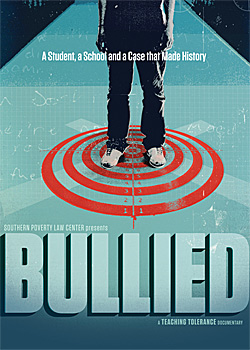
These numbers were projected on the screen before the showing of the Southern Poverty Law Center’s documentary, Bullied: A Student, a School and a Case That Made History, sonsored by the GVSU College of Education at GVSU Loosemore Auditorium Tuesday evening. The film put a face on these numbers. When he was five years old, Jamie Nabozny told his grandmother that he was a “homosexual,” a word he could barely pronounce. At age seven, he came out to his mom. His was a loving, supportive two-parent (heterosexual) family.
When Jamie entered Ashland Junior High School as a seventh grader, the bullying began. Every day when he went to school, he faced unrelenting verbal taunts and mild physical abuse: shoving, his books and papers thrown around, being pushed up against the lockers.
After one particularly tough day, he attempted suicide by taking a bottle full of pills and ended up in the emergency room. His parents went to the school to ask them to help stop the bullying. The junior high principal’s response, “Boys will be boys.”

Jamie Nabozny during his high school years
In high school, the bullying escalated. He tried to hide from his tormentors, but wasn’t always successful. He endured physical violence regularly, to the point that he was hospitalized and had to have surgery after one particularly violent beating. Again, his parents went to the school principal. His attackers were let off without even a verbal reprimand. The high school principal’s response, “That’s what happens when you hit on the hockey team.” (Jamie did not “hit on” his fellow students.)
Jamie ran away and landed at a teen shelter in Minneapolis. A legal advisor there suggested that he and his parents sue the school district. They did and they won. The landmark case has set a precedent and served as a warning to schools across the nation that not keeping LGBTQ students safe from bullying can be very expensive. (Jamie won $900,000.)
After the film, WGVU’s Shelley Irwin moderated a panel of four experts. Her first question, was the film relevant? Denise Brogan-Kator, interim executive director of Equality Michigan, said the film’s message was particularly relevant in Michigan as we are one of only five states that does not have laws against bullying. Seems our legislators are afraid to include language that refers to LGBTQ youth. “We are going to hurt kids because we aren’t going to protect the queers. That just makes me nuts,” Brogan-Kator said. “Bullying is bad, period. Everybody should be safe. But if you include everybody without naming them, you include and protect no one. LGBTQ youth are the principal target of bullying in today’s schools. Studies have shown that the number one target are students who are gay or perceived to be gay. If you break the gender norms, you are a target. These kids are dying. Is it relevant? My god, is it relevant.”
Michele Coyne, a consultant to schools on bullying prevention, added that kid bullies become adult bullies, child abusers and perpetrators of domestic violence. “60% of kids who are considered bullies in grades six through nine will have a conviction by age 24. This is not a surprise,” she said. “It’s not only the victim who is hurt. The bullies and the bystanders don’t fare much better.
She has witnessed bullies harassing classmates they perceive as gay as early as third grade. “Kids with sexual minority parents, they are also considered to be targets.”
Kay Waters, a Grand Rapids school counselor noted that while bullying issues are being addressed, schools still have a long ways to go. “Educators need to have that open ear, be sensitive and model respect for all students. (We need to do) more than identify the problem, we have to continue to work together to find answers.”
Sue Verduin-Miller, a Grand Rapids school social worker, agreed. “It takes courage at times. It’s very easy for adults who are bothered to become bystanders who are quiet. If a person is aware of harassment and they are afraid to speak up, chances are there are a lot of other people nearby who are afraid to speak up. Acceptance of bullying depends on silence and isolation.”
When dealing with bullies, school staff needs to provide ongoing follow-up. Taking action only once or twice creates a situation where the bullies want to reassert themselves. “We need comprehensive school programs. There are good ones out there but most schools aren’t bothering to implement them,” Coyne said. “When we start hearing words being coined like ‘bullicide,’ it’s time.”
Equality Michigan offers school administrators and teachers free training in how to create safe schools. Its curriculum is youth approved by Michigan’s legislature. “We will come into your schools and educate you on how to implement programs,” she said.
Irwin asked what the parents’ role is. Waters replied that even when parents want to do their best for their kids, they are hampered because they don’t know what their rights are. Even so, parents remain their children’s best advocate. Verduin-Miller added that schools often do not follow-up when a parent does bring up issues.
Parents often are not aware their child is being bullied. They may shrug off a child’s complaints as being normal conflicts all kids face growing up. VerDuin-Miller stressed the importance of really listening to what children are saying and finding support if bullying is suspected.
Indicators of bullying include faking illness to get out of school, bedwetting or odd behavior like making up reasons to go in a certain school door. “Parents are hungry for information and not just the parents of victims, but parents of bystanders, too,” Coyne said. “They give a kid courage and moral fortitude to step in and help someone else. Teach your kids that it’s just not acceptable to pick on people. Help your children develop strong self esteem and self worth so A) they don’t bully and B) they step in.”
While it would have been even more enlightening had the panel included a college student who had experienced bullying during high school, overall, the four went a long ways in presenting important information to the audience, which included many education majors. They also shared these resources: Schools Where Everyone Belongs: Practical Strategies for Reducing Bullying by Stan Davis; Nobody Left to Hate: Teaching Compassion after Columbine by Elliot Aronson; A Silent Crisis: Creating Safe Schools for Sexual Minority Youth; and the Web site tolerance.org.
“The young people whose lives are no longer in existence because they took a bottle of pills or tied a rope around their necks, those young people are lost from us forever,” Brogan-Kator said. “What do we do about that? We be aware. We take Jamie’s lesson into the world with us. You can’t back down when somebody tells you ‘Don’t worry about it.’ These are kids’ lives.”