Moral Ground Town Hall Meeting 10/26

This Tuesday, October 26 there will be a town hall meeting in Grand Rapids with co-editors of a new book entitled, Moral Ground: Ethical Action for a Planet in Peril.
Author’s Kathleen Dean Moore and Michael Nelson will be talking about their new book and inviting people to be part of the discussion of whether or not we have a moral obligation to fight in the struggle against ecological devastation.
The book includes essays from radical writers/activists such as Terry Tempest Williams, Bill McKibben, Barbara Kingsolver, Derrick Jensen, Wendell Berry, Wangari Mathai, Linda Hogan, Bell Hooks and Ursula LeGuin.
However, the book also includes essays from Thomas Friedman and Barak Obama, which on many levels seems to be counter to the messages of the other writers, particularly since Friedman and Obama are such strong defenders of the Capitalist system and are merely asking for reformist action with an economic system which inherently is ecologically destructive. This might be a useful question to pose to the authors when they are in town.
In a recent interview, Kathleen Dean Moore said that the whole “50 Simple Things You Can Do to Save the Planet,” like changing light bulbs is just “technological tinkering.” “All of this kind of technological change is on the edges when what’s really needed is a cultural sea change. We really need to have a wave of sensibility and affirmation of our obligations.”
Moral Ground Town Hall Meeting
Tuesday, October 26 7pm
Spectrum Theater
160 Fountain St. NE, Grand Rapids
(Free Event)
Love Your Body Day event at GVSU

Yesterday, the GVSU Women Studies Center hosted an event in Allendale entitled Gleeks, Grenades and Girls with Curves: Pop Culture Images of the Body. Professor Jennifer Jameslyn gave a presentation on the importance of critically examining representation in popular media as part of Love Your Body Day.
Professor Jameslyn began by presenting some data from the Gay & Lesbian Alliance Against Defamation (GLAAD) on representation in current network TV shows. Of the 587 main characters on 84 evening broadcast shows there are 565 Straight character, 14 Gay Men, 2 Lesbians and 7 Trans-gendered characters. A racial breakdown shows that 480 of the main characters are White, while only 72 are Black. For characters with disabilities there are a total of 6, 5 are men and all are White. Only one of these actors who plays a disabled person, is disabled in real life.
The presenter then talks about the importance of thinking critically about popular culture – whose bodies are represented, whose bodies are absent, whose stories are told and whose voices are silenced. Thinking critically about popular culture tells us something about ourselves and about societal norms.
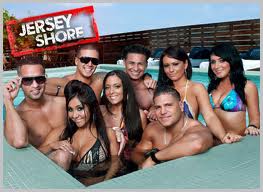
The first example she critiques is the show Jersey Shore, which she says is a classic stereotype of Italian-Americans. Jersey Shore intentionally focuses on the bodies of the characters, both male and female.
One of the interesting aspects of the show is that the men do most of the cooking, they do the laundry and the cleaning, while the women tend to drink and fight. So while the show promotes strong stereotypes about male and female bodies it does subvert certain gender stereotypes in terms of what the characters do.
At the same time, Prof. Jameslyn says that despite some behaviors not being traditional gender norms, the show does perpetuate hyper-sexualized, heterosexual norms. For instance, the male characters will often talk about women in the show in negative ways, calling them hippos, grenades and whores, thus affirming hyper-sexualized norms about beauty.
The next show she talked about is the highly popular show Glee, which at one level has much more diversity than many other shows. However, the way they use race tends to reinforce racism and racialized norms. The show’s director does state that the show is designed to try to demonstrate that it is difficult for some people to fit in.
To illustrate the point about how the show sometimes trivializes racism she shows a clip of how one of the White students interacts with a Filipina exchange student that uses racism/White Supremacy in a comedic scene. The idea is to use racist depictions in order to make a point about racist depiction, but the presenter asks if this approach just ends up perpetuating racist stereotypes and attitudes.
Professor Jameslyn said that Glee is walking a fine line between doing comedy and perpetuating racist stereotypes. The show tends to do the same things with the down-syndrome characters, which are used more as extras with no real character development. However, there is one character in a wheelchair who is presented as a much more complex person. One show even has all the students in wheelchairs so that students would be more sensitive to the difficulties for people in wheelchairs. This episode ends with a musical performance with everyone singing and moving on stage in wheelchairs.
While many people may have viewed this episode as positive for bringing attention to those with disabilities, many individuals and organizations responded to this episode with strong critiques. One critique was that while this scene may have some positive elements they are still presented from an able-bodied point of view. The presenter points out that while the show spends lots of money to bring big name celebrities on the show they don’t spend the money to hire actors with disabilities, which would make a much stronger statement.
A third show she looked at is called Huge, which is based upon teenagers at a weight-loss camp. This show does a better job at showing more complex characters, characters which dig deeper with issues around body image and beauty. In this scene one of the main characters refuses to give into the idea that she should hate her body.
Even though the show is about people struggling with their weight it is more about identity and finding out who they are. In contrast to the show The Biggest Loser, Huge is not about celebrating people losing weight, but loving themselves for who they are. Unfortunately, the show was cancelled after 10 episodes.
The presenter ended by stating that consuming pop culture is an important thing to do. “It can connect you to people, but we really need to be thoughtful about what media we consume. These representations are not fixed commodities. We don’t have to accept the media created norms about representation. We can step outside of that through more conversation and by making our own media that tells other stories and sends other messages about representation.”
How Permanent Are America’s Afghan Bases?
(This article by Nick Turse is re-posted from Common Dreams.)
Some go by names steeped in military tradition like Leatherneck and Geronimo. Many sound fake-tough, like Ramrod, Lightning, Cobra, and Wolverine. Some display a local flavor, like Orgun-E, Howz-e-Madad, and Kunduz. All, however, have one thing in common: they are U.S. and allied forward operating bases, also known as FOBs. They are part of a base-building surge that has left the countryside of Afghanistan dotted with military posts, themselves expanding all the time, despite the drawdown of forces promised by President Obama beginning in July 2011.

The U.S. military does not count the exact number of FOBs it has built in Afghanistan, but forward operating bases and other facilities of similar or smaller size make up the bulk of U.S. outposts there. Of the hundreds of U.S. bases in the country, according to Gary Younger, a U.S. public affairs officer with the International Security Assistance Force (ISAF), 77% house units of battalion size (approximately 500 to 1,000 troops) or smaller; 20% are occupied by units smaller than a Brigade Combat Team (about 3,000 troops); and 3% are huge bases, occupied by units larger than a Brigade Combat Team, that generally boast large-scale military command-and-control capabilities and all the amenities of Anytown, USA. Younger tells TomDispatch that ISAF does not centrally track its base construction and up-grading work, nor the money spent on such projects.
However, Major General Kenneth S. Dowd — the Director of Logistics for U.S. Central Command for three years before leaving the post in June — offered this partial account of the ongoing Afghan base build-up in the September/October issue of Army Sustainment, the official logistics journal of the Army:
“Military construction projects scheduled for completion over the next 12 months will deliver 4 new runways, ramp space for 8 C−17 transports, and parking for 50 helicopters and 24 close air support and 26 intelligence surveillance and reconnaissance aircraft. This represents roughly one-third of the airfield paving projects currently funded in the Afghanistan theater of operations. Additional minor construction plans called for the construction of over 12 new FOBs and expansion of 18 existing FOBs.”
If Dowd offered the barest sketch of some of the projects planned or underway, a TomDispatch analysis of little-noticed U.S. government records and publications, including U.S. Army and Army Corps of Engineers contracting documents and construction-bid solicitations issued over the last five months, fills in the picture. The documents reveal plans for large-scale, expensive Afghan base expansions of every sort and a military that is expecting to pursue its building boom without letup well into the future. These facts-on-the-ground indicate that, whatever timelines for phased withdrawal may be issued in Washington, the U.S. military is focused on building up, not drawing down, in Afghanistan.
Jobs on FOBs

A typical forward operating base set to undergo expansion is FOB Salerno, a post located near the Afghan city of Khost, not far from the Pakistani border. According to documents from the U.S. Army Corps of Engineers, plans are in the works for an expansion of that base’s fuel facilities. Estimated to cost $10 million to $25 million, these upgrades will increase fuel storage capacity to one million gallons to enhance land and air operations, and may not be completed for a year and a half; that is, until well into 2012.
In June, work was completed on a new, nearly $12 million runway at Forward Operating Base Shank, near the city of Puli Alam in Logar Province, south of Kabul. The base was formerly accessible only by road and helicopter, but its new 1.4-mile-long airstrip can now accommodate large Lockheed C-130 Hercules and Boeing C-17 Globemaster transport aircraft, enabling ever larger numbers of personnel to be deployed to the site.
Not surprisingly, government documents released in August show that FOB Shank is also set for a major boost in troop housing. Already home to approximately 4,500 military personnel, it will be adding a new two-story barracks, constructed of containerized housing units known as “relocatable buildings” or RLBs, to accommodate 1,100 more troops. Support facilities, access roads, parking areas, new utilities, and other infrastructure required to sustain the housing complex will also be installed for an estimated $5 million to $10 million. In addition, the Army Corps of Engineers just began seeking contractors to add 452,000 square feet of airfield parking space at the base. It’s meant for Special Operations Forces’ helicopters and fixed-wing aircraft. New aircraft maintenance facilities and 80,000 square feet more of taxiways will also be built at the cost of another $10 million to $25 million.
Documents reveal that this sort of expansion is now going on at a remarkably rapid pace all over the country. For instance, major expansions of infrastructure to support helicopter operations, including increased apron space, taxiways, and tarmac for parking, servicing, loading, and unloading are planned for facilities like FOB Tarin Kowt in Uruzgan Province, FOB Dwyer, a Marine base in Helmand Province, and FOB Sharana, a Paktika Province base near the Pakistani border, where the Army also announced plans for the construction of an ammunition supply facility, with storage space for one million pounds of munitions, and related infrastructure.
In late August, Walter Pincus of the Washington Post reported that construction was slated to begin on at least three $100 million base projects, including FOB Dwyer, that were not “expected to be completed until the latter half of 2011.” In addition to enhancing helicopter operations infrastructure, plans were also announced for the construction of a new, large-scale wastewater treatment facility at Dwyer, a project estimated to cost another $10 million to $25 million and, like so much of what is now being built by the U.S. military in the backlands of Afghanistan, it is not expected to be completed and put fully into use until well into the second half of 2011, if not later — that is, after President Obama’s theoretical due date for beginning to lessen the mission in that country.
And whenever you stumble upon a document indicating that work of a certain sort is taking place at one FOB, you can be sure that, sooner or later, you will find similar work at other FOBs. In this case, for example, FOB Frontenac in Kandahar Province and Tarin Kowt, north of Kandahar, are, like Dwyer, slated to receive new wastewater plants.
Much of this work may sound mundane, but the scale of it isn’t. Typical is another of the bases identified by Pincus, FOB Shindand in western Afghanistan, which is to receive, among other things, new security fencing, new guard towers, and new underground electrical lines. And that’s just to begin the list of enhancements at Shindand, including earthen berms for four 200,000-gallon “expeditionary fuel bladders and a concrete pad suitable for parking and operating fourteen R-11 refueling vehicles” — tanker trucks with a 6,000-gallon capacity — as well as new passenger processing and cargo handling facilities (an $18 million contract) and an expansion of helicopter facilities (another $25 million to $50 million).
Multiply this, FOB by FOB, the length and breadth of Afghanistan, and you have a building program fit for a long war.
Permanent Bases?
This building boom has hardly been confined to FOBs. Construction and expansion work at bases far larger than FOBs, including the mega-bases at Bagram and Kandahar, is ongoing, often at a startling pace. The Army, for example, has indicated it plans to build a 24,000 square-foot, $10-million command-and-control facility as well as a “Joint Defense Operations Center” with supporting amenities — from water storage tanks to outdoor landscaping — at Bagram Air Base. At bustling Kandahar Air Field, the military has offered contracts for a variety of upgrades, including a $28.5 million deal for the construction of an outdoor shelter for fighter aircraft, as well as new operations and maintenance facilities and more apron space, among a host of other improvements.
In June, Noah Shachtman of Wired.com’s Danger Room reported on the Army’s plans to expand its Special Operations headquarters at Mazar-e-Sharif in northern Afghanistan and cited documents indicating that construction would include a “communications building, Tactical Operations Center, training facility, medical aid station, Vehicle Maintenance Facility… dining facility, laundry facility, and a kennel to support working dogs.” A contract for that work, worth $30 million, was awarded at the end of September.
Similarly, according to a recent article in the Marine Corps Times, Camp Leatherneck, which expanded in late 2009 from a 660-acre facility to 1,550 acres, or approximately 2.4 square miles, is slated to add three new gyms to the one already there, as well as a chapel complex with three separate buildings (one big enough to accommodate up to 200 people), a second mess hall (capable of serving 4,000 Marines at a time), a new PX housed in a big-top tent, with 10,000 square feet of sales space — the current base facility only has 3,000 square feet — and the installation of a $200 million runway that can accommodate C-5 cargo planes and 747 passenger jets.
Despite a pledge from the Obama administration to begin its troop drawdowns next July, this ongoing base-construction splurge, when put together with recent signals from the White House, civilians at the Pentagon, and top military commanders, including Afghan war chief General David Petraeus, suggests that the process may be drawn out over many years. During a recent interview with ABC News Senior Foreign Affairs Correspondent Martha Raddatz, for instance, Petraeus affirmed the president’s July 2011 timeline, but added a crucial caveat. “It will be a pace that is determined by conditions,” he said.
Almost a decade into the Afghan War, he claimed, the U.S. military had “finally gotten the inputs right in Afghanistan.” Raddatz then asked if the “counterinsurgency clock” had just restarted — if, that is, it could be another nine or ten years to achieve success. “Yeah,” replied Petraeus, hastening to add that American soldiers killed there over the previous nine years had not simply died for nothing. “But it is just at this point that we feel that we do have the organizations that we learned in Iraq and from history are necessary for the conduct that this kind of campaign.”
The building boom occurring on U.S. bases across Afghanistan and the contracts for future construction being awarded at the moment seem to confirm that, whatever the White House has in mind, the military is operating on something closer to the Petraeus timeline. The new Special Operations base at Mazar-e-Sharif, to take but one of many examples, may not be completed and fully occupied for at least a year and a half. Other construction contracts, not yet even awarded, are expected to take a year or more to complete. And military timelines suggest that, if the Pentagon gets its way, American troop levels may not dip below the numbers present when Obama took office, approximately 36,000 troops, until 2016 or beyond.
At the moment, the American people are being offered one story about how the American war in Afghanistan is to proceed, while in Afghanistan their tax dollars are being invested in another trajectory entirely. The question is: How permanent are U.S. bases in Afghanistan? And if they are not meant to be used for a decade or more to come, why is the Pentagon still building as if they were?
Recently, the Army sought bids from contractors willing to supply power plants and supporting fuel systems at forward operating bases in Afghanistan for up to five years. Power plants, fuel systems, and the bases on which they are being built are facts on the ground. Such facts carry a weight of their own, and offer a window into U.S. designs in Afghanistan that may be at least as relevant as anything Barack Obama or his aides have been saying about draw-downs, deadlines, or future withdrawal plans.
If you want to ask hard questions about America’s Afghan War, start with those bases.
Yesterday, the Grand Rapids Press ran an Associated Press (AP) story about a group of state law from around the country who want to change the US Constitution say that children of undocumented immigrants who are born in the US can no longer get automatic citizenship.
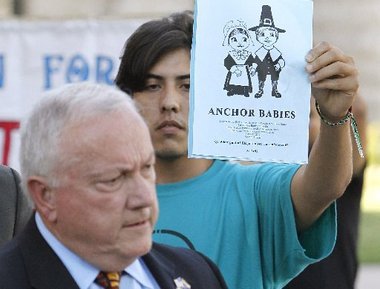
The article cites Arizona State Senator Russell Pearce as one of the lawmakers pushing for a change to the US Constitution. In the article Pearce, who wrote Arizona’s anti-immigrant law that went into affect this year, says, “We’ve allowed the hijacking of the 14th Amendment.”
The article also cites a constitutional lawyer and a spokesperson with a pro-immigration group also from Arizona.
At the end of the story the AP reporters list the states that have lawmakers who are joining in on this effort – Alabama, Delaware, Idaho, Indiana, Michigan, Mississippi, Montana, Nebraska, New Hampshire, Oklahoma, Texas and Utah.
Among the Michigan lawmakers whom are in favor of changing the US Constitution so as to not grant automatic citizenship to child born in the US from undocumented immigrants is Rep. Dave Agema. This fact prompted Grand Rapids Press writer Troy Reimink to post a short piece on MLive yesterday in order to stimulate some discussion about the topic.
Reimink quotes Rep. Agema who says, “When you get a whole bunch of states on board with this, we’ll try to get the Congress to change the 14th Amendment back to what it should be.” However, the Press writer does not ask Agema what he means when he says changing the 14th Amendment back to what it was.
Reimink also does not provide any background on Agema as to why he would support such an effort. Agema is one of the state legislators who supported a Michigan version of the anti-immigration Arizona bill. Agema also favors making English the “official” language of Michigan and held a bogus public hearing on immigration in 2007.
In addition, Reimink links to a Washington Independent article which states that lawmakers working to change the 14th Amendment would, “receive help in crafting the legislation from Immigration Reform Law Institute, the legislative arm of the pro-enforcement Federation for American Immigration Reform.”
It is unfortunate that Reimink did not mention that this group would help craft this legislation, especially since they are one of the largest anti-immigration groups in the country. FAIR has also been listed by the Southern Poverty Law Center as a hate group.
Deals with the Devil
There’s a joke that’s been circulating in Canada for a few years now. A Canadian student is asked during a geography lesson if he’d like to live in the US. The child says no. Asked why, the child replies, “Because I’d be shot sitting on my front porch, and I wouldn’t be able to afford to go to the hospital.”
Maybe the Canadians find this joke hilarious because the United States health care “system” has made us a laughingstock in the global community. A recent report from BBC news recapped the fact that our “unregulated fee-for-service,” for-profit health care has increased in cost at twice the rate of health care in other countries, and at the same time is causing our lowered life expectancies.
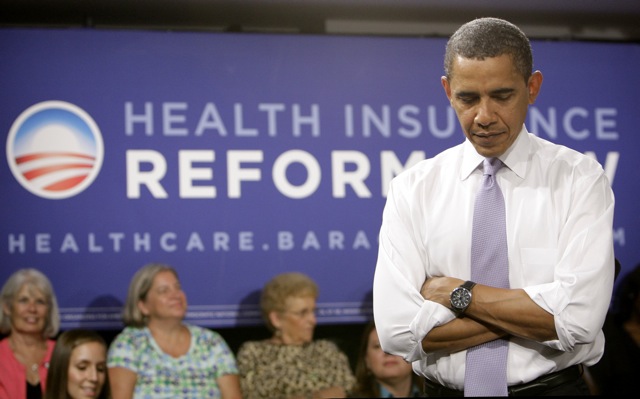
When President Obama was campaigning for office, he claimed he was going to break the backs of the big insurance companies and create universal coverage in the United States. After a year-long political theater production, health care “reform” turned out to be this: Every American would be compelled by law to buy health care—apparently whether it was affordable or not. Abracadabra, universal coverage!
We can’t be surprised that Obama’s final twist was to offer massive concessions to the capitalists; after all, many of them fueled his campaign. And now, empowered by their behind-closed-doors bailout, everyone is working to find ways around the few tattered regulations that have gone into place. For example, 30 large employers were just given waivers from the law that required them, because of their size, to provide employee insurance. One of the exempted companies is McDonald’s.
So we can’t be surprised by the news published in the Grand Rapids Press on October 19: A number of Michigan hospitals allegedly made deals with Blue Cross Blue Shield in a price-fixing scam to eliminate competitors.
The Press article chose to give the story that local spin that Editor Paul Keep seems to feel is so vital. This made the text almost incomprehensible by burying the real lead to promote the Grand Rapids story angle. I had to access the Detroit Free Press in order read an article that clearly laid out the specifics of the deal.

“Millions of Michigan consumers have paid higher health insurance premiums over the last three years because Blue Cross Blue Shield of Michigan forced at least 70 hospitals statewide to charge its competitors more, according to a lawsuit filed Monday…” the Free Press stated.
Veteran reporter Patricia Anstett went on to explain that BCBS appeared to be crushing its competition with a price-fixing scheme. The Blues even offered to temporarily pay more for services if a hospital agreed to charge other insurance companies even higher rates. Even so, everything worked out for the Blues. One hospital in Royal Oak charged Blue Cross’s competitors about 25 percent more than it charged BCBS.
BCBS continually claims that since it’s the only insurer in the state that must accept all applicants—something that is supposed to change under the new Obama regulations—it is compelled to level the playing field in order to make ends meet. But the investigation showed that the company has raked in huge benefits.
Did the Blues then pass on its newfound wealth to patients? Of course not. The company added to its “reserve fund,” now standing at $3 billion. It contributed to political campaigns. It gave big raises to its top executives. Because that’s how the capitalists roll.
Meanwhile, the Free Press reported that one customer in Southfield, Michigan, has endured 25 percent worth of increases over the past five years for what he calls a “bare bones policy” that doesn’t really cover his needs.
As other industrialized countries in the world provide their citizens with health care that far exceeds ours and costs a great deal less, it looks like we’ll be enduring this continuing road show of corruption and greed for some time to come.
When even the President of the United States bows down to the Goliath health care industry, it’s clear the only hope is for working people to unite and break the death grip that the capitalist regime has on this country. Nothing less will allow us to enjoy the same care that other citizens of the world have as their right, not as a privilege of the rich. And Canadian humor aside, that’s no joke.
BP Campaign Cash: Still Toxic Six Months After Oil Spill
(This article is re-posted from OpenSecrets.org)
 Money from the political action committee of beleaguered oil company BP largely remains a toxic asset in Washington following the massive Deepwater Horizon oil spill in the Gulf of Mexico, which started six months ago.
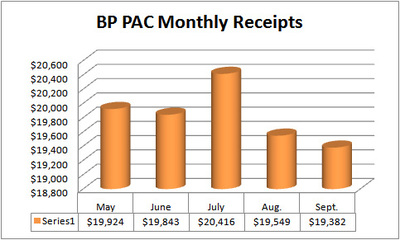
BP’s PAC did not write a single check to federal lawmakers in September, according to a Center for Responsive Politics review of campaign finance documents filed today. In fact, the PAC has not donated a dime to any federal lawmakers since May.
In May, BP’s political action committee wrote a $1,000 check to Rep. Charles Gonzalez (D-Texas), a member of the House Energy Committee, but Gonzalez never pocketed that contribution, as OpenSecrets Blog previously reported.
Instead, the PAC has focused its attention during the past several months on state-level candidates. Even then, some legislators and state-level politician seem to prefer Gonzalez’s approach of distancing themselves from the company.
Last month, the PAC wrote off contributions totaling $14,100 from 38 lawmakers in Indiana, according to OpenSecrets Blog’s review of campaign finance documents.
BP’s PAC had sent these politicians checks in June, as OpenSecrets Blog previously reported, but the candidates never cashed them. The PAC this month also reported writing off an August contribution of $750 to California Democratic state assemblywoman Norma Torres.
Nevertheless, during September, BP’s PAC donated $19,300 to three dozen state-level candidates, with 80 percent of that sum benefiting Republicans, according to the Center’s tally.
Transactions include $2,000 to Wyoming Republican gubernatorial candidate Matt Mead, $1,000 to Ohio Republican House Minority Leader Bill Batchelder, $1,000 a piece to five New Mexico politicians and a variety of other, smaller contributions to candidates and lawmakers in Indiana, Ohio, Washington and Wyoming.
In September, more than 200 BP employees contributed to their employer’s PAC, mostly in small amounts, according to the Center’s analysis.
Overall, BP’s PAC raised about $19,400 in September and ended the month with about $311,200 cash on hand. This sum is about $200 less than the amounted it raised in August, and it represents the smallest amount the PAC has taken in since the oil spill last April.
Since January 2009, BP’s PAC has contributed $80,000 to federal politicians and committees, with 56 percent of that amount benefiting Republicans. The PAC’s top beneficiaries at the federal level this cycle have been the National Republican Senatorial Committee and Sen. Lisa Murkowski (R-Alaska), who lost an August primary to the Tea Party-fueled Joe Miller, but who continues to wage a competitive write-in campaign as in independent. Both have received $5,000 from BP’s PAC.
BP’s actions became a national political issue after hundreds of millions of gallons of oil seeped into the ocean waters during the spill. In July, the well was capped, and last month, work on a relief well was completed and cement was pumped in to permanently plug it.
You can read more about the oil industry’s influence in federal politics in the 12-part OpenSecrets Blog series “Fueling Washington.”
Yesterday’s front page of the Grand Rapids Press had an interesting article that raises some interesting questions.
The article was about new research being done at the Van Andel Institute for a new chemical spray that has “potential to boost agricultural production.” The article goes on to say that the “researchers have discovered a way to activate the hormone with a biodegradable spray that not only could ease global food shortages but maybe keep your grass greener in the summer, too.”
First, since the article states that this new research could help ease global food shortages it is worth asking the question if indeed there are food shortages around the world. According to organizations like Food First, the issue is not so much a lack of food, but who has access to food. The global food crisis that began in 2008 had more to do with food policy and food prices than it did with food shortages.
The Food First reports do acknowledge that drought in some parts of the world has limited to global food reserves, but is spraying chemicals (organic or not) on a plant to make it more drought resistant is a questionable solution. Wouldn’t the more appropriate response be to find out what is causing drought in the first place?

According to many recent scientific reports the number one cause of drought worldwide is global warming. If global warming is the main cause of drought, which leads to potential food shortages, should entities like the Van Andel Institute be looking into ways to reduce carbon emissions?
Second, as was already mentioned one outcome of this kind of research might be to “keep your grass greener in the summer.” This kind of application of such research certainly raises all kinds of questions about the waste of funds and which companies might benefit economically from a chemical which makes your grass greener. Historically, this has been the case with the use of lab-tested chemicals or genetically modified plants, where most applications are driven by profits and not improving access to food for people around the world. The profit motive certainly is what motivated the so-called “Green Revolution” of the 1960s.
Third, what has worked in terms of high yields in food production and sustainable farming practices is not modern technology and genetic research, but traditional and localized methods. The world is full of examples of local farming practices that are not dependent on genetic research such as the Navdanya food project in India and the millions of small farmers who are part of Via Campesina. These farmers and organizations not only practice sustainable agricultural methods they work to influence food policies that take the power away from multinational corporations which control much of the world’s food supplies.
Lastly, one thing that is missing from the Press story on the Van Andel Institute research is an alternative perspective. With such a critical issue as global food shortages, genetic modification and chemicals used on food plants the Press should have sought out other voices for their opinion on this matter instead of publishing an article that presents the research as fact and in an extremely positive light.
(This article is re-posted from Fairness & Accuracy in Reporting.)

A multi-part FAIR exposé of PBS‘s most prominent news and public affairs programs demonstrates that public television is failing to live up to its mission to provide an alternative to commercial television, to give voice to those “who would otherwise go unheard” and help viewers to “see America whole, in all its diversity,” in the words of public TV’s founding document.
In a special November issue of studies and analyses of PBS‘s major public affairs shows, FAIR’s magazine Extra! shows that “public television” features guestlists strongly dominated by white, male and elite sources, who are far more likely to represent corporations and war makers than environmentalists or peace advocates. And both funding and ownership of these shows is increasingly corporate, further eroding the distinction between “public” and corporate television. There is precious little “public” left in “public television.”
FAIR undertook the examination following news last fall that PBS was canceling Now and that Bill Moyers was retiring from Bill Moyers Journal. PBS announced that it was replacing the two shows, which exemplified the public broadcasting mission, with Need to Know, a news magazine launched in May and anchored by two journalists from the corporate media world.
FAIR’s findings reveal: * Need to Know. FAIR’s study of the first three months of Need to Know‘s guestlist and segments finds that its “record so far provides little encouragement that it will ever serve as an adequate replacement for Now and the Bill Moyers Journal.”
The program’s heavily white (78 percent) and male (70 percent) guestlist failed to “break out of the narrow corporate media box.” Corporate representatives outnumbered activists 20 to 12. And black people appeared overwhelmingly on stories on drugs and prisons. * PBS NewsHour. If PBS‘s signature news show is any indication, the system is doing little to help us “see America whole, in all its diversity.”
— The NewsHour‘s guestlist was 80 percent male and 82 percent white, with a pronounced tilt toward elites who rarely “go unheard,” like current and former government and military officials, corporate representatives and journalists (74 percent). Since 2006, appearances by women of color actually decreased by a third, to only 4 percent of U.S. sources. – Women and people of color were far more likely to appear as “people on the street” providing brief, often reactive soundbites, than in more authoritative roles in live interviews. – Viewers were five times as likely to see guests representing corporations (10 percent vs. 2 percent) than representatives of public interest groups who might counterweigh such moneyed interests–labor, consumer and environmental organizations. – While Democratic guests outnumbered Republican guests nearly 2-to-1 in overall sources, Republicans dominated by more than 3-to-2 in the program’s longer format, live segments. (FAIR’s 2006 NewsHour study, which examined a period when Republicans controlled the White House and Congress, showed Republican guests outnumbering Democrats in both categories: 2-to-1 among all sources, 3-to-2 in the longer live interviews.) – On segments about the BP Gulf of Mexico oil spill, the most frequent story of the study period, viewers were four times as likely to see representatives hailing from the oil industry (13 percent of guests) as representatives of environmental concerns (3 percent). – On segments focusing on the Afghan War, though polls show consistent majorities of Americans have opposed the war for more than a year, not a single NewsHour guest represented an antiwar group or expressed antiwar views. Similarly, no representative of a human rights or humanitarian organization appeared on the NewsHour during the study period.
** The NewsHour, “public TV’s nightly newscast,” is actually privately owned. For-profit conglomerate Liberty Media has held a controlling stake in the NewsHour since 1994. The company is run by industry bigfoot John Malone, who has declared that “nobody wants to go out and invent something and invest hundreds of millions of dollars of risk capital for the public interest.” Public dollars still support the NewsHour, and former PBS president Ervin Duggan declared the show “ours and ours alone,” but Liberty CEO Greg Maffei refers to the program as “not our largest holding,” but “one we’re very proud of.”
And it’s not just the NewsHour. The Nightly Business Report was sold earlier this year by public station WPBT to a private company. The details of the deal–which shifts the most-watched daily business show on television into private hands–are mostly unknown.
** The Charlie Rose Show–a show produced outside the PBS system but widely carried on public television stations–boasts a remarkably narrow guestlist. FAIR found the most common guests (37 percent) were reporters from major media outlets, and corporate guests, well-known academics and government officials also made frequent appearances. Of the 132 guest appearances, just two represented the public interest voices that public television is supposed to highlight (equaling the number of celebrity chefs who appeared). Eighty-five percent of guests were male, and U.S. guests were 92 percent white.
** Washington Week, the longest-running public affairs show on public television, suffers from similar problems–which would seem to be by design, given the show’s inside-the-Beltway focus. In four months of programs (5-8/10), Washington Week presented 29 reporter guests; only one did not represent a corporate-owned outlet. Only four of 64 appearances by guests were by non-white panelists (6 percent), and the guestlist was 61 percent male.
For the full NewsHour and Need to Know reports, click on the links above. For all other content, please subscribe to Extra! today and receive the special PBS issue instantly.
Massive Chevron Ad Campaign Derailed, Media Slapstick Follows
(This article is re-posted from the Yes Men)
A day-long comedy of errors began Monday morning when the Yes Men, supported by Rainforest Action Network and Amazon Watch, pre-empted Chevron’s enormous new “We Agree” ad campaign with a satirical version of their own. The activists’ version highlights Chevron’s environmental and social abuses – the same abuses they say Chevron is attempting to “greenwash.”
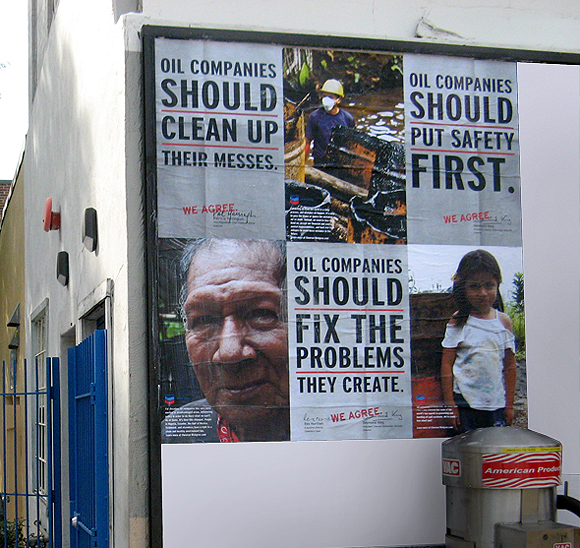
“Chevron’s super-expensive fake street art is a cynical attempt to gloss over the human rights abuses and environmental degradation that is the legacy of Chevron’s operations in Ecuador, Nigeria, Burma and throughout the world,” said Ginger Cassady, a campaigner at Rainforest Action Network. “They must think we’re stupid.”
“They say we’re ‘interrupting the dialogue,’” said Andy Bichlbaum of the Yes Men, referring to Chevron’s terse condemnation. “What dialogue? Chevron’s ad campaign is an insulting, confusing monologue – with many tens of millions of dollars behind it.”
The activists’ pre-emptive campaign began early Monday with a press release from a spoof Chevron domain, which launched the fake “We Agree” campaign hours before the real Chevron could launch its ads. The fake “We Agree” site featured four “improved” advertisements, complete with downloadable PDF files to be used in on-the-street postering.
Nine hours later, after producing its own “We Agree” press release, the real Chevron decried the hoax in a predictably curt and humorless manner. Mere moments later, the counter-campaign issued a much better denial on Chevron’s behalf, laying out Chevron’s principal arguments in its Ecuador case. “We have binding agreements with the Ecuadorian Government exempting us from any liabilities whatsoever, granted in exchange for a $40 million cleanup of some wells by Texaco in the 1990s,” the spoof press release crowed, absurdly yet accurately.
Throughout the day, a sort of slow vaudeville unfolded on the web, as a number of outlets, from industry mouthpieces to the AFP and even a watchdog group, produced accidental mash-ups of “real” and fake information.
First, Fast Company fell for the hoax (archived article here), then related their duping with humor. An outlet called “Environmental Leader,” quoted indiscriminately from both real and fake press releases, before quietly removing the fake parts a few hours later (original article archived here).
Shortly after that, Energy Digital, an online source providing “news and information for Energy Executives” (capitalization theirs), quoted extensively (archive here) from the fake release to describe Chevron’s campaign, then mentioned that the campaign had “already been spoofed.” They didn’t realize they’d just fallen for that very same spoof.
Even the AFP found itself duped (original article archived here), and described with glee the hoax “that appeared to have fooled some news outlets,” before going on to quote “the real firm” at length. (The “real firm” wasn’t.)
Nor were industry watchdog groups immune. “Oil Watchdog” dissected the hoax minutely and accurately, before citing Advertising Age as one of the outlets duped. That whole article, however, was a fake.
“If you really want to snooker the media, it’s pretty hard for them to resist,” said Mike Bonanno of the Yes Men. “We cobbled together some fake releases with string and thumbtacks and chewing gum, and we fooled the most respectable outlets.”
“Chevron is doing what we did, a million times over, with a ginormous budget – and it never reveals its subterfuge,” said Bichlbaum. “No wonder the media’s full of lies.”
“Yesterday’s spoof was a comedy of errors, but what’s happening in Ecuador is no joke,” said Mitch Anderson, a campaigner at Amazon Watch. “While Chevron spends tens of millions every year to greenwash their image and fool the media, Ecuadorians continue to die from their toxic legacy.”
Yesterday’s hoax is just the beginning for the activists. “Stay tuned,” said RAN’s Cassady. “There’s a lot more to come in the days ahead. We’re going to keep Chevron scrambling.”
On Sunday, the Grand Rapids Press ran a story on the current campaign finance data for the 2nd and 3rd Congressional Districts. The 3rd Congressional District was the focus of the article, which included the headline, “Amash keeps financing edge over Miles.”

In many ways this article is similar to one the Press ran on campaign contributions in this race back in late August, a story which we critiqued for its limited information on who was giving how much to which candidates. The same criticism could be applied to the October 17 story.
The Press reporter provides readers with totals for each of the candidates – total raised during the last quarter, amounts from political action committees (PACs), cash on hand and total raised for the entire election cycle. This is all data you can find about the 3rd Congressional race at the Center for Responsive Politics.
At one point the Press reporter states, “Nine members of the DeVos family contributed $40,000 to the Amash campaign and Alticor’s PAC gave $5,000.” While this statement is true it could easily be misinterpreted, since there are numerous other large donations from area business owners and families. (Entire contributions list for Amash) For instance, there are numerous Arab American business owners who have donated large sums of money to Justin Amash, which the Press does not highlight. However, to make such a statement would carry some baggage in the same way that stating there is a sizeable amount of money coming from the DeVos family does.
In addition, since the Press reporter decided to highlight the DeVos family contributions why not also then ask the question(s) about their relationship to Amash and whether or not such large sums of money will provide the DeVos’ will political access in the event that Amash is elected?

The Press reporter then includes some names of big donors to the Miles campaign and states that, “most of his individual donations were under $2,000.” While this may be true, many of those donations to Miles that were under $2,000 are $500 to $1,000 with some donors giving that amount more than once, which makes their donation total $2,000 or more. (Entire contributions list to Miles)
Besides limited information on individual donations to the Mile campaign the Press reporter also included one sentence about PAC money the Democratic candidate has received. “He got $20,000 from UAW-V-CAP out of Detroit and $5,000 each from the Kent County Democratic Party and Third Democratic Congressional District.”
The reporter doesn’t pursue any further investigation as to why a union from the eastside of the state would give $20,000, although that seems to be a fairly basic question that should be asked. In addition we should ask why the Press reporter includes no information on which PAC entities donated to the Amash campaign since they are larger in number ($58,518) than the PAC money Miles has received ($36,325) to date.
The last few paragraphs of the article provide limited campaign finance information for the 2nd Congressional race between Democrat Fred Johnson and Bill Huizenga. Again, since the Press provides little information on how much money these candidates received from which individuals and PAC entities voters are left in the dark about how money influences these races and which sectors are more likely to have political access after the election.
 Grand Rapids Institute for Information Democracy