Elections Cannot Erase Injustice of the US Occupation of Afghanistan
(This article by Malalai Joya is re-posted from Common Dreams.)

One year ago Hamid Karzai was declared re-elected as president of Afghanistan, ending an election that had no legitimacy in the eyes of ordinary Afghans. The presidential election last year was a fraud, with ballot stuffing, vote buying and massive corruption reported by the world’s media. Even if the independent election commission had not cancelled the planned run-off between Karzai and his main challenger, Abdullah Abdullah, it would have represented only a choice of the “same donkey with a new saddle”. People had no incentive to participate as they knew that both main candidates would bring nothing positive for Afghan people.
Karzai had lost his popularity way before the 2009 election. This was due to the ever increasing corruption of the government, the never-ending crimes of the many fundamentalists and warlords in his regime, and the financial scandals and corruption of his brothers. In Kandahar people even started calling Ahmed Wali Karzai the “little Bush”, after the hated US president.
The vast majority of Afghans have lost all hope in Karzai. For us his words and actions have no value, and that includes his latest “peace negotiations” and other measures. Including killers like Mullah Omar and Gulbuddin Hekmatyar in the government is not about negotiating for peace, but completing the decades-old circle of warlordism and fundamentalism.
It’s important to say that these so-called elections haven’t damaged Afghanistan as much as the US and its Nato allies have, with their bombing and occupation. Wikileaks has exposed some of the truth about the civilian toll of this war against the Afghan and Iraqi peoples. Afghans hold the US and Nato, and their puppet Karzai, responsible for these war crimes. They claim to fight terrorism, but in fact they are the biggest terrorists in the eyes of our people because of their crimes and brutalities.
Unfortunately the Afghan people are not yet strong enough to drive out the US, overthrow the mafia government of Karzai and bring an end to the crimes of the Taliban and other fundamentalists. Our history proves that this resistance to occupation will continue until we have won our freedom. Until both the US and the fundamentalists – of both the Northern Alliance and Taliban brands – are driven out of power in Afghanistan, we cannot see a bright future. It is now more than five years since I was elected to the Afghan parliament. My experience of this “democratic process” was to see my microphone cut off, and to be threatened with death by other MPs – many of whom teamed up to remove me illegally from my seat. My case alone is enough to prove that women’s rights in Afghanistan have not truly been safeguarded – our situation was just invoked to justify the war.
In fact, it’s important to remember another document that Wikileaks exposed earlier this year: a CIA paper assessing western public opinion on the war that recommended using “testimonials by Afghan women” expressing fear about a Taliban takeover in the event of Nato pulling out. A Time cover story featuring the disfigured Bibi Aisha was a clear example of using the plight of women as war propaganda. The headline – “What happens if we leave Afghanistan” – could have, or should have, been “What happens while we are in Afghanistan”, because crimes of mutilation, rape and murder against women are commonplace today.
Many warlords and commanders aligned with Nato and Karzai carry out their sexist, misogynist crimes with impunity. Time could, for example, have done a cover story condemning the law signed by Karzai in 2009 that legalised crimes against Shia women, or about the shocking levels of women committing suicide by self-immolation.
We had another so-called parliamentary election in September, but I chose not to run. Any hope I had for using the ballot box to achieve change in Afghanistan is gone. Like last year’s presidential vote, September’s election was full of the buying and selling of votes – one province, Paktika, reported a turnout of 626%. This sort of thing is the reason elections in Afghanistan long ago became a bad joke.
Today there is an election in the US, and it is now two years since Barack Obama was elected president. His surge of troops has brought only a surge of violence, and his expansion of the war into Pakistan has claimed many innocent lives. Obama promised “hope” and “change”, but Afghans have seen only change for the worse. Here he is now seen as a “second Bush”.
The only change that can make us hopeful about the future is the strengthening and expansion of a national anti-fundamentalist and democracy-loving movement. Such a movement can be built only by Afghans. And while we want the world’s support and solidarity, we neither need nor want Nato’s occupying forces.
Malalai Joya is an Afghan politician and a former elected member of the Parliament from Farah province.
GVSU event to discuss Native American Depictions in the Media
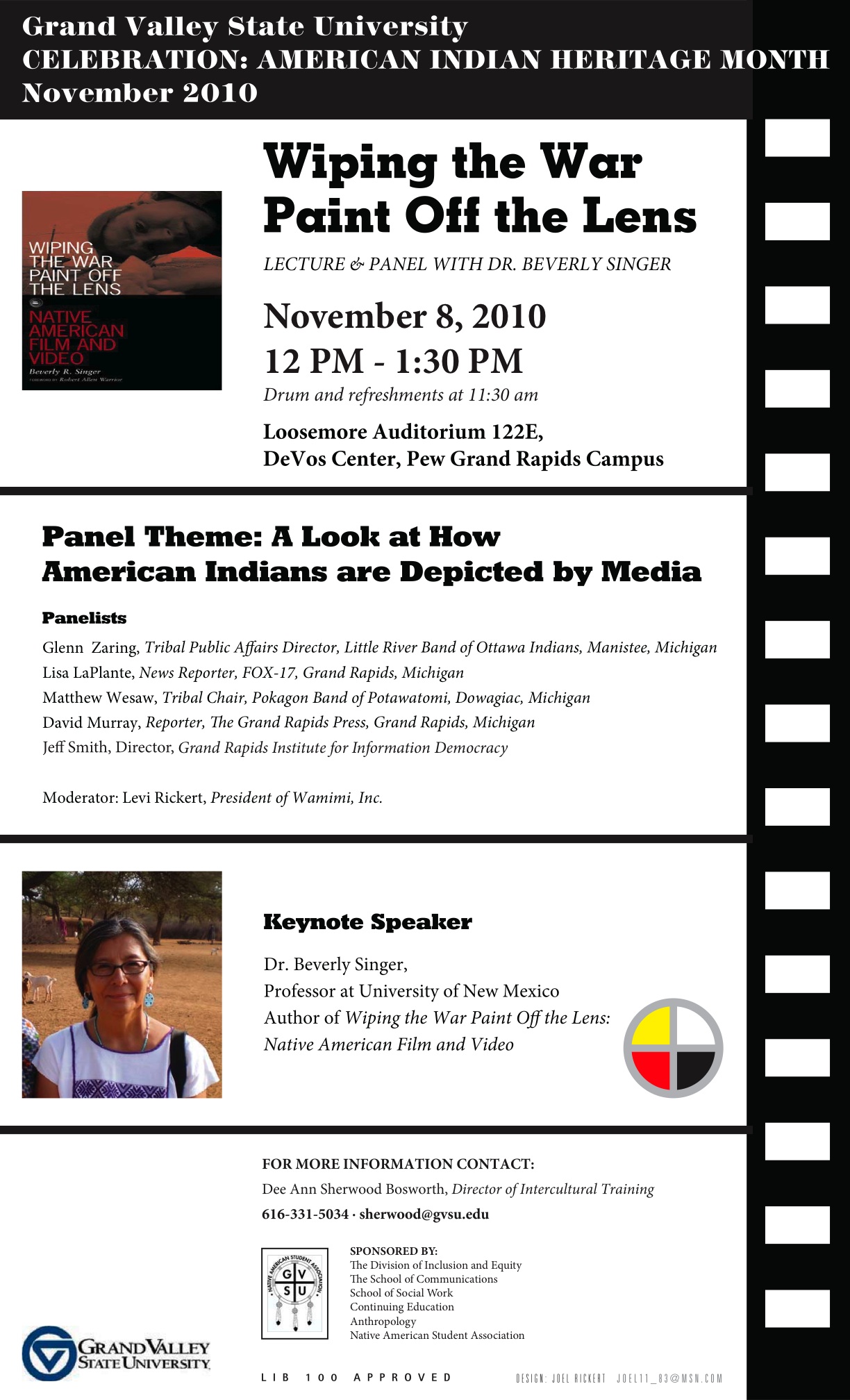
Next Monday, November 8, there will be an event at the downtown GVSU campus for American Indian Heritage Month.
The event will feature a presentation by Native American writer, filmmaker and university professor Beverly Singer. Dr. Singer is the author of the book, Wiping the War Paint off the Lens: Native American Film and Video.
After the lecture there will be a panel discussion with people from West Michigan continuing the discussion around how Native Americans are depicted in media. The panelists include:
- Glenn Zaring, Tribal Public Affairs Director, Little River Band of Ottawa Indians, Manistee, MI
- Lisa LaPlante, News Reporter, FOX-17, Grand Rapids, Michigan
- Matthew Wesaw, Tribal Chair, Pokagon Band of Potawatomi, Dowagiac, Michigan
- David Murray, Reporter, Grand Rapids Press, GR, MI
- Jeff Smith, Grand Rapids Institute for Information Democracy
The lecture by Dr. Singer begins at Noon, with drumming and refreshments at 11:30am.
The event will be held in the Loosemore Auditorium at the downtown Pew Cmapus of GVSU. For more information contact Dee Ann Sherwood Bosworth (616) 331-5034 or sherwood@gvsu.edu.
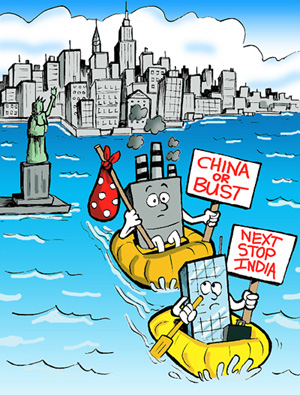
Yesterday, the Grand Rapids Press ran a front-page story about how “some” local businesses see China as an ally and not an enemy.
The article entitled, “Seeing Red,” was framed in part as one of the one contentious aspects of the election debate, particularly between 3rd Congressional candidates Justin Amash and Pat Miles.
First, it should be pointed out that the contention between Miles and Amash has more to do with their personal economic ties to China. Amash’s family does businesses in China and Miles until recently held a mutual fund in the Bank of China.
These personal investments, particularly that of Justin Amash are seen by some as another example of outsourcing, where US jobs are sent abroad because of cheap labor markets and minimal safety and environmental standards. What Amash and Miles have not talked about in this whole “debate over China” are trade policies nor the very nature of the neoliberal economic system much of the world operates in.
Second, the article, by Press reporter Ted Roelofs, follows a standard script about how we should view this issue. Roelofs cites local business people who argue that having factories or business ties to China is a good thing and is in fact what allows some local jobs to exist.
Then the article cites a local union organizer (and former Democratic Party chair) who says that China plays unfair and that she wishes the US government would protect “our markets.”

The union organizer is followed in the article by a corporate economist with the Upjohn Institute for Employment Research, who argues that if West Michigan companies want to survive they need to focus more on creating jobs that require “advanced education” instead of low-skilled labor.
The last source cited is with the furniture maker Herman Miller. Their representative says of China, “It represents a huge market opportunity for us. It would be impossible to do any kind of meaningful business if you didn’t have a presence there.” This last comment is particularly important and should tell us something about what the larger issue is in this story.
The problem is not so much about lax labor standards in places like China, or low wages or even trade practices. The issue with so many West Michigan businesses being in favor of sending jobs abroad is that it is in the nature of Capitalism to do so. Capitalism has no allegiance to countries or workers. It only has an allegiance to profits and growth.
Within a Free Market Capitalist framework it makes complete sense to seek out cheaper labor markets. This is not a new phenomenon, but one that has been hitting US-based unions hard the last 30 years.

However, since most of the unions in the US embrace Capitalism as their economic model the only argument they can make is to appeal to corporations to keep the jobs “American.” This suggests that companies like Bissell, Haworth and Wolverine World Wide have some allegiance to this country. Of course, these companies will use the local, state and federal systems when it suits their interests (tax breaks, subsidies, labor laws, etc), but their ultimate allegiance is to profits and shareholders. This is exactly why the quote from the Herman Miller representative was so important because it underscored the bottom line, which is expanding markets.
The claim made by the UAW organizer that China plays unfair is true at some level, but it fails to acknowledge that the US has had some of the most protectionist trade policies in the world. So, it’s ok for the US to subsidize farmers, which makes it difficult for farmers around the world to compete, but if other countries engage in any form of protectionism or economic incentives for businesses, then it is all of a sudden unfair.
The unions in the US should not be demonizing China, they should be building alliances with Chinese workers. If the unions in the US wanted to keep jobs in this country they should engage in factory occupations as a tactic instead of providing millions of dollars to Democratic candidates who embrace Capitalism as much as the Republicans do.
The elections are tomorrow and no matter who wins the issue of jobs and a failing economy will still be a major problem unless more people are willing to seriously examine the economic system we operate in. Yesterday’s Press article is just another example of their unwillingness to foster such an examination.
Grassroots Unionism Under Attack in Argentina
(This article by Marie Trigona is re-posted from ZNet.)
“Wherever union representation is democratic, combative or revolutionary, we must defend it. Wherever rank and file are attacked by the union bureaucracy we must defend them. Union bureaucracy is the use of union posts with the objective of curtailing unionist activity. Union bureaucracy seeks to squash any insubordination, even the most just of strikes.”
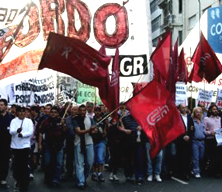
– Augustin Tosco, general secretary of Luz y Fuerza, combative labor organizer who fought for democratic union practices. He died in hiding, for fear he would be killed, after the Luz y Fuerza labor union was abolished in 1974.
The killing of a 23-year old labor activist has sparked massive protests in Argentina. Argentina’s rich labor history has been plagued with violent episodes: massacres against striking workers at the turn of the 20th century, the systematic disappearance of 30,000 activists under the dictatorship, the 38 deaths during Argentina’s 2001 popular rebellion, the 2002 police shooting of two unemployed activists Maximiliano Kosteki and Dario Santillan, and the death caused by a tear gas canister to the head of public school teacher Carlos Fuentealba in 2004. Mariano Ferreyra, an activist and student who was recently killed, sends an ominous reminder of the legacy of union bureaucracy and violence against workers.
Mariano Ferreyra was shot dead on October 20 in Argentina in a union dispute along Buenos Aires train lines. He was marching in solidarity with subcontracted train workers fired as part of cutbacks. Unionists from the main railway workers union broke up the protest against low wages and firings of subcontracted employees. As the protestors were ending the action, a group of unionists and other men began throwing rocks and running after the protestors. Television cameras showed a group of 40 men chasing after the protestors.
“The thugs from the green slate, guarded by the provincial police, were waiting for us along the train lines since early in the morning,” says Ariel Pintos, a subcontracted train employee shot in the leg at the protest. He told Pagina/12, “They chased us, yelling you’re going to pay for this, we’re going to kill you.”
Then, according to witnesses, as police stood by at least one man opened fired. Marcelo Adrian, a friend of the victim, says the corrupt union structure favors business interests. “The state is responsible, the bureaucratic unions… And the police that acted as accomplices. A group of 40 thugs from the Train Transport Union, Green list attacked us. It was a planned attack and there have been incidents of attacks against the subcontracted employees.” Three men have been arrested in connection to the shooting.
Mariano Ferreyra
The death of Mariano Ferreyra has opened wounds of the pain and preventable death which was the result of corrupt union practices. Ferreyra’s commitment as an activist was celebrated at the massive march to repudiate his death. More than 25,000 protestors came out to repudiate the death of Ferreyra, demand an end to undemocratic union practices and demand justice for the death of the activist.
The victim was a member of Argentina’s Workers Party. He began his activist activity at the age of 14 in a neighborhood branch of the Trotskyist organization shortly after the popular rebellion of 2001. The young Ferreyra participated in the 2002 road blockade in the suburb of Avellaneda where two activists lost their lives. Police shot members of the movement of unemployed workers Maximiliano Kosteki and Dario Santillan inside the Avellenada train station. This event would mark the life of Ferreyra in his commitment to activism and later tie him to the fate of the two victims. Eight years later, Ferryra was killed only a few blocks away from where Kosteki and Santillan died.
A cameraman present at the events said that after Mariano was shot he heard a person cheer: “one less lefty.” No one has been arrested in connection with the killing.
Labor practices
The workers protesting along the train lines wanted to draw attention to a common labor practice called outsourcing. The firing of 140 workers sparked the protest on October 20. The temporary workers demanding that laid-off workers get permanent employment with the Roca Railroad.

Subcontracting, synonymous with neoliberal capitalism, has become a common practice in public as well as private companies in Argentina. Workers, are hired temporarily by outsource companies that provide service along the train lines. “Subcontracted workers are paid half as much as formal workers. They do not have the right to unionize or to make demands,” says Ruben Sobrero, president of the body of delegates from the Sarmiento train line.
Argentina’s train system was dismantled during the mass privatization of public services in the 1990’s. “Menem with the participation of the current union leadership privatized the train system and more than 90,000 workers were laid off,” explains Sobrero. Today concessionaries subsidized by the state run the train system which provides services for millions of passengers who ride from the surrounding suburbs to the nation’s capital. Dozens of fatal accidents occur each year as a result of passengers falling off of overcrowded trains.
“They make us to three times the amount of work as formal employees. Many young workers have permanently injured their lower backs and when they come back from medical leave they are fired. They don’t provide us with work boots or protective uniforms. They don’t even provide us with water when we are working along the train tracks,” said Ariel Pintos.
The Train Workers Union benefits from this system because they get a percentage of ticket sales and gain from supporting business interests. At least 600 workers have been fired by the private company that is government subsidized to run the train lines that lead from the capital to the suburbs. The “violet list,” as the opposition group in the Train Workers Union is called, have organized a campaign for the formal contracting of workers and an end to subcontracting along the train lines. “The leadership of the UF doesn’t want workers to block the railways because they’ll lose part of ticket sales. They also don’t want to see salary increases for workers because that would cut into the union funds from union dues,” says Alfredo Esteban de Lucas who is a metallurgical worker that constructs trains.
Union bureaucracy
“This incident marks a rise in union violence on part of what is called union bureaucracy, which use these tactics to stop workers from organizing independently,” says Sobrero as an elected representative of an opposition slate has been the target of union violence. These incidents of violence form part of the long tradition of the union structure in Argentina, where trade unionists use tactics to pressure workers not to vote for opposition slates.
In the past year alone, representatives from the growing movement of grassroots labor organizing have been victim to threats and physical attacks. Subway workers have organized an independent union since 2006. They have held a number of protests to demand that the Labor Ministry grant legal recognition of a democratically voted independent union, breaking from the UTA transport union. The ex-wife and children of Nestor Segovia, an elected subway union representative, were attacked by police and affiliates of the UTA transport union in their home during an alleged eviction notice in November, 2009. “Union bureaucracy is strong right now because the nation’s main union CGT and the government support the apparatus. When there’s a growing movement of workers that the apparatus can’t control, the bureaucracy reacts,” said Segovia, at the national day of protest.
The International Labor Rights Forum listed the Kraft Corporation in Argentina as one of the worst companies for the right to association. The Food and Beverage Union did not support the Kraft workers’ demands or intervene when 140 workers were fired from the plant, many of whom were elected representatives from an opposition slate. Last year casino workers have also had to fight violent attacks from the formal unions in their union organizing efforts to create an independent union organization.
The nation’s main train union (UF) had threatened to stop workers from protesting on October 20. Pablo Diaz, a representative from the UF who is now under arrest for the killing of Ferreyra, publicly stated on the day of the protest “We are not going to allow the train lines to be blockaded.” In September, the subcontracted train workers organized a press conference in the Constitution train station to report the firing of 140 workers. A group from the UF’s Green slate from interrupted the press conference, shouting and pushing subcontracted workers while the police watched.
Human rights groups, journalists and academics have called for reflections and reforms in union representation. “The events demand a reflection about the significance of the struggle to democratize union representation, which forms part of a transition from the model of neoliberal deregulation of worker protection toward protection for workers,” said the Center for Social and Legal studies in a public statement about the killing of Ferreyra.
Grassroots labor organizing
At the march the day after Ferreyra’s death, dozens of groups from opposition slates marched in their work uniforms. “Most of us here are from opposition slates, we are a large movement that is proposing a new way of organizing workers, where workers have participation in assemblies,” says Segovia. This movement, called grassroots unionism, has challenged the verticality and corruption of the formal structures which groups say tries to curtail workers’ protests. Segovia adds that the government and industrial leaders worry that workers may demand better salaries and working conditions as the Argentine economy has boomed since 2003. “Union democracy implies that rank and file workers have a voice to debate. A union delegate should represent the workers, as a union delegate I was voted to reflect what rank and file workers propose.”
The death of Mariano Ferreyra reflects Peronisms’s (of the ex-president Juan Peron) tradition of union bureaucracy and attacks against workers which has reared its ugly head, despite a government that has made progressive measures. However, the diversity of opposition slates and delegates assembly fighting for democratic union representation reflects a growing grassroots labor movement, which continues to grow despite corrupt and violence practices on the part of official union leadership.
Marie Trigona is a writer, radio producer and translator based in Argentina. She can be reached through her blog, www.mujereslibres.blogspot.com
“War Is Scary as Hell”
Local folks met at Fuller Park today for the “War Is Scary as Hell” bike ride sponsored by Grand Rapids and Beyond for Peace and Justice for Afghanistan. The goal of the ride was to raise awareness about the human and financial costs of the US Occupation of Afghanistan as well as to point out that both Republicans and Democrats continue to vote for funding the Occupation, which began in 2001. In addition, both major party candidates running for congress, Justin Amash (R) and Pat Miles (D) support continuing US military involvement in Afghanistan.
The first stop was the Democratic campaign headquarters, 333 Fuller NE. As the citizen representative approached people who seemed to be in charge and politely began to explain the goals of the bike ride, she was basically told to shut up and get out. The print materials offered were put aside.
The next stop was the Republican campaign headquarters, 264 Leonard St. NW. Here a campaign volunteer welcomed two citizen representatives, took a look at the print materials handed to him and said, “You got that right. War is scary as hell. I know because I am a veteran.” This gentleman went on to state that he thought the US should get out of Afghanistan, that the American public was fooled into supporting the War in Iraq by Bush’s false claims of weapons of mass destruction and that the term “collateral damage” should not be used because the truth is that the US is killing innocent civilians. He also raised concerns about the costs our troops are paying in terms of lives lost, post traumatic stress disorder and crippling injuries. Before the citizen representatives left, he assured them that he would post the print materials.
While one shouldn’t read too much into the responses at each party headquarters it does make it clear that issues are not central to what political parties do. Both the Democrats and Republicans want their candidates to win, no matter how much they fail to represent the interests of many Americans on key issues such as war and military spending.
Here is the text of the materials left at both campaign headquarters today:
 War Is Scary as Hell.
The US military has now begun its 10th year of the Occupation of Afghanistan. During the past 9 years the US has engaged in a massive bombing campaign, search and destroy missions, assassination programs, destroyed people’s homes, destroyed people’s way of life and is now engaged in a bloody counter insurgency campaign.
The cost of these actions has been tremendous and statistics do not honestly convey the harsh realities of human suffering and loss of life.
· Tens of thousands of Afghanis have been killed by the US military.
· Hundreds of thousands of Afghanis have been displaced because of the US military.
· Tens of thousands of Afghanis have been detained by the US military.
· Hundreds of thousands of Afghanis have been wounded because of the US military.
· Hundreds of Afghanis have been tortured by the US military at places like Bagram.
This bloody 9-year US military occupation has also cost the lives of US soldiers.
· More than 1,300 US troops have been killed in Afghanistan
· Tens of thousands of US troops have been wounded in Afghanistan
· Tens of thousands of US troops will suffer for the rest of their lives because of the trauma of what they have participated in and witnessed in Afghanistan
· Tens of thousands of US families will bear the burden of the loss of a loved one.
· Tens of thousands more will struggle of watching a loved one struggle to cope after military action in Afghanistan!
This brutal and unjust US military occupation will also cost US
taxpayers over a Trillion dollars, both in direct military costs and hidden social costs which are nearly impossible to measure.
According to the National Priorities Project the cost of the US war in Afghanistan since 2001 has been $359 billion and counting http://www.costofwar.com/. For those of us living in Michigan that means that over $9.5 billion in taxes have left the state to fund this
brutal war and for people living in Grand Rapids it means over $188 million has left this community.
This is all money that could have stayed here to fund the public schools, provide adequate health care, provide jobs, student loans and funds for environmental clean up.
We are here today to tell you that this war, a war which is supported by both the Democrats and Republicans, is immoral, unjust and is only contributing to a growing anti-American sentiment around the world. Your political party’s support for this war is costing countless lives, costing countless dollars and putting all US citizens at a greater risk of being the target of anti-American rage.
It is because of this that we cannot and will not support your party or its candidates in Tuesday’s election.
If we could vote against the War on Tuesday we would, but unfortunately your party and your
candidates have not even made war and military spending an issue. In essence this makes your political party the War Party.
End the Occupation!
End the Killing!
Money for Health Care not for Warfare!
To download the full .pdf version, click here: war is scary as hell
Killing Reconciliation in Afghanistan

GVSU hosts 11th Conference on the Americas – Nov. 4-6
The Latin American Studies Depart of Grand Valley State University is hosting its 11th Conference on the Americas next week at the downtown campus in Grand Rapids.

The theme for this year’s conference is Creative Agents of Change: Facing Challenges in our Communities. The conference features a wide variety of presenters, film, music, art and panel discussions that deal with ways in which people creatively act and organize for change.
On Thursday, November 4 Harvard University Professor Doris Sommer with give the keynote lecture entitled, “What is Literature Good For?” Sommer is the author of numerous books, most notably Bilingual Games: Some Literary Investigations.
On Friday, the conference continues with a series of panels and presentations, but will conclude with a screening of the documentary Cartoneros. Cartoneros is about people who recycle cardboard in Buenos Aires, Argentina as a means of survival.
On Saturday, more panels and presentations are scheduled, with a second keynote lecture to be given by Argentine Professor Graciela de Marco. The title of her talk is “Women’s Movements and Democratization”
GVSU has a complete listing of the conference program online.
Help Stop Delivery of Caterpillar Bulldozers to Israel
(This Action Alert is re-posted from the US Campaign to End the Israeli Occupation.)

Earlier this week, Israel’s Channel 2 news reported that Caterpillar is delaying the delivery of tens of D9 bulldozers—valued at $50 million—to the Israeli military. The report speculated that this “sounds like an American military sanction.” Read an article in the Jerusalem Post about this report by clicking here.
This news comes in the midst of a civil trial in Israel brought by Cindy and Craig Corrie, of the Rachel Corrie Foundation for Peace and Justice, a US Campaign member group. The Corries’ daughter Rachel was killed by the Israeli military with a weaponized Caterpillar D9 bulldozer, as she nonviolently tried to prevent the demolition of a Palestinian home in the occupied Gaza Strip in March 2003. News reports have stated that Caterpillar will not deliver bulldozers to the Israeli military during the Corrie trial. For updates on the trial, please click here.
(On a related note, the Rachel Corrie Foundation has submitted a paper to the UN Universal Periodic Review, which will review the human rights record of the United States on November 5. To read its submission, which documents how the United States has failed to uphold its human rights laws in Rachel’s case, please click here.) To be honest, we’re not exactly sure what’s going on behind the scenes. In written communications with the US Campaign, Caterpillar refused to comment on the reports, but did not deny them.
At yesterday’s State Department briefing, Assistant Secretary Philip Crowley did not deny the U.S. government has delayed the delivery, going only so far as to say that he is “not aware of any contacts between the United States Government and Caterpillar, but perhaps it’s a question to ask Caterpillar.” Yes, the US Campaign had already tried that… to no avail. Whatever is happening, one thing is clear: This represents a major, positive step in our ongoing campaign to hold Israel accountable for its misuse of Caterpillar bulldozers, which are provided at U.S. taxpayer expense as military aid.
Learn more about how Israel misuses Caterpillar bulldozers to commit human rights abuses of Palestinians by clicking here. We have a small window of opportunity to act before pressure is brought to bear on the Obama Administration to allow the delivery of bulldozers to proceed. Here’s what you can do to make sure that the United States does not allow the delivery of these Caterpillar bulldozers to Israel, and to advance our boycott, divestment, and sanctions (BDS) campaign against Caterpillar:
1. Sign our petition to the Obama Administration asking it to stop the delivery of Caterpillar D9 bulldozers to the Israeli military, and to investigate Israel’s violations of U.S. laws committed with Caterpillar equipment. We and other organizations, such as the Rachel Corrie Foundation for Peace and Justice, the Israel/Palestine Mission Network of the Presbyterian Church, (U.S.A.), and Jewish Voice for Peace, are hoping to collect 10,000 petition signatures by next week to deliver to the Obama Administration. Sign now by clicking here.
2. If you belong to an organization, then please have it endorse our organizational letter to the Obama Administration. We will be accepting organizational endorsements of the letter until 6 pm (EST) Wednesday, November 3. Read and endorse the letter (organizations only) by clicking here.
4. Get TIAA-CREF to divest from Caterpillar. TIAA-CREF, one of the largest financial services in the United States, invests heavily in Caterpillar (over $250 million as of their last financial report). Sign a petition asking TIAA-CREF to divest from Caterpillar and other companies that profit from the Israeli occupation.
Endorsements dominate 3rd Congressional race coverage
Yesterday, the Grand Rapids Press ran yet another story about political endorsements in the 3rd Congressional District race between Justin Amash (R) and Patrick Miles (D).
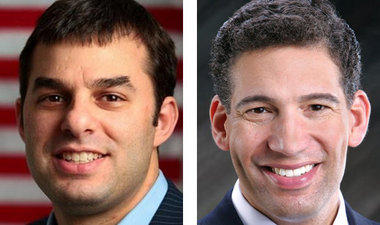
In the article Republicans are claiming that some of the people on the list that Miles has been making an issue aren’t really Republicans and therefore the Democrat’s claims don’t carry much weight.
As of today, the Grand Rapids Press has run a total of 19 articles on the 3rd Congressional race. Here are the articles in chronological order:
9/18 Congressional candidates debate senior issues
9/20 Longtime GOP backers favor Miles
9/25 Congressional candidates debate over debates
9/26 Amash camp says air attack off-target
9/30 Ehlers throws support to Amash
10/4 Miles lands education support
10/6 Business practices help fuel debate
10/7 China connections
10/7 Miles carries fight to Amash’s home turf
10/7 Paul Henry’s widow backs Miles
10/12 Miles sells China fund, issues challenge
10/15 Amash named rising star
10/17 Amash keeps financing edge over Miles
10/17 Pat Miles – profile
10/20 Miles touts more GOP supporters
10/21 Congressional candidates spar over TV claims
10/24 Justin Amash – profile
10/27 Republicans question Miles’ list of GOP support
Of these 19 articles 8 of them are about endorsements, 6 deal with the candidate’s claims about personal finance in China, 2 are profile pieces, 2 are about debates and one article is about campaign finances.
Therefore, the Grand Rapids Press has not reported once on where the candidates stand on the US economy, environmental issues, immigration, US foreign policy, health care or any other major issues of the day. Another example of the Press practicing horse-race coverage and not actual journalism.
Introducing the Corporate Reform Action Pack (CRAP)
This short video is an excellent response to the claims of the Waiting for Superman film that claims to have a solution to the public education crisis in the US. The video is produced by members of the online project called Failing Schools.
 Grand Rapids Institute for Information Democracy
