Bloom Collective to host Zine making workshop this Saturday
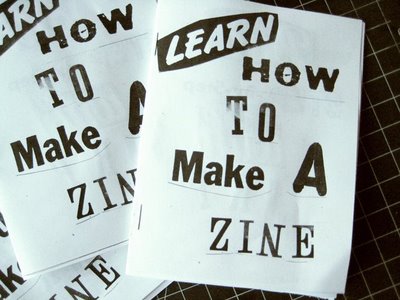
Zines have been around since the 1970s, as an effective way to protest the idea that information can be “owned” or copyrighted.
In the 1980s and 90s zine making became popular within the DIY and punk scene as a way of self-expression and a form of resistance against commercial culture and even official left magazines, which tend to rely on a small sector of experts who can tell us all what to think.
In order to promote more independent media and highlight their zine collection, the Bloom Collective is hosting a “How to” zine making workshop.
Saturday, November 13
Zine making workshop
2 – 4pm
671 Davis NW – in the Steepletown Center building
The Bloom Collective will have supplies needed for the workshop, but if you have markers, scissors, glue and old magazines that you can bring it would be welcomed.
There are lots of good online resources on how to make a zine, such as the Pony Boy Press Blog and this E-how site. Here is a nice video How To by a woman who makes zines and edits other Indy Media.
Conference of the Americas: Climate Justice
On Saturday, John Kroondyk and Jeff Smith presented a session entitled Climate Justice as part of the 11th Annual Conference on the Americas sponsored by Grand Valley State University. While terms like global warming,  climate change and climate crisis are familiar to most, the concept of climate justice rarely makes it into the mainstream. However, in Latin America the issues of climate crisis and social justice collide with very real, drastic and horrific results for the continent’s indigenous peoples. “We’re not here to talk about the science of climate change. We agree it is a real, human-caused climate crisis,” Kroondyk said. “We won’t be talking about how many degrees warmer the earth is but about the broader social, political and cultural factors.”
Raining death on the rain forest
Kroondyk went on to address some of the major contributors to the climate crisis in Latin America. Deforestation of the Amazon River Basin is commonly recognized as one of these. Conservative estimates state that 150 acres of Amazon rainforest are destroyed per minute to accommodate the goals of corporate agri-businesses, cattle ranching (think McDonalds) and dam projects—which produce power and landscapes to meet the needs of capitalist business ventures, not to feed or provide electricity for the people living there. While these dam projects tout themselves as “green” projects, they submerge vast forests under water, where they rot and outgas huge amounts of methane and carbon dioxide. Dam projects also drive indigenous people from their ancestral homes, farms and livelihoods while generating food crops for export, soy for bio-fuels and electricity used to operate industries, such as mining, which further degrade the environment. “The sad part for me is that indigenous communities, poor folks, and farmers, are driven into the forest and given no choice but to slash and burn in order to grow crops for their families,” Kroondyk said. “Then, they are judged as the bad guys.”
The UN-REDD Program, which portends to remedy deforestation, is a false solution that exacerbates climate crisis. By defining “forest” as any land with 10% ground cover, REDD allows corporate profiteers to destroy forests and replace them with mono-culture tree plantations and non-native cash crops.  “It’s really disgusting what their definition of a forest is,” Kroondyk said. “The presence of native species, biodiversity or ecological health are not requirements.”
As mentioned, agri-business is one of the main beneficiaries of deforestation. The market demand for agri-fuels has motivated companies like BP, Shell, DuPont, Cargill and Monsanto to grab Latin American lands away from indigenous peoples in order to grow toxic soy for bio-fuels. One example of the scope of this industry, 85% of the soy grown in Paraguay is for bio-fuel—and is toxic, unsuitable for human consumption. This land grab for bio-fuel production led to the 2008 global food crisis and threatens another 60 million people with hunger and starvation.”Agri-fuels emit just as much CO2 as diesel or petroleum,” Kroondyk pointed out. “They also use water and chemicals for growing. Thinking of bio-fuels as a solution to the climate crisis is ludicrous.”
The carbon boot-print of war
Another cause of global climate crisis as well as climate injustice in Latin America, militarization is rarely cited by environmentalists. Barry Sanders, 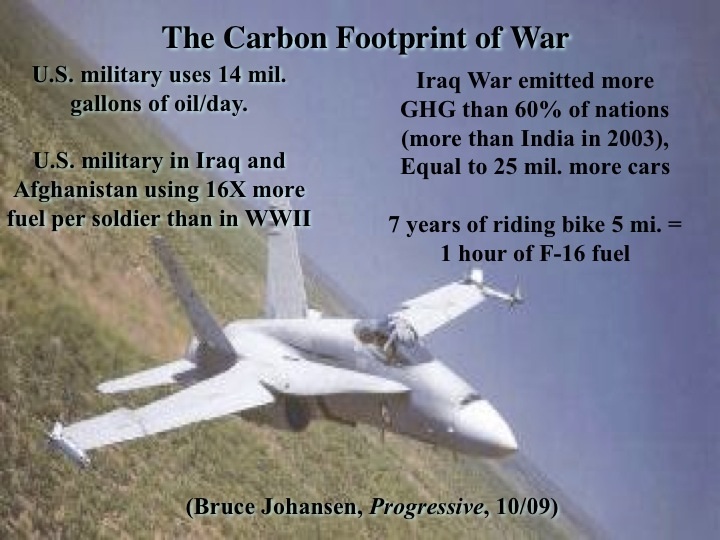 in his book, The Green Zone, shares that the US Military alone consumes 14 million gallons of oil a day—that’s more than is consumed by 85% of the countries of the world.
US military aid to Latin America fuels even more massive military consumption of oil. In addition, specific programs, such as the War on Drugs, cause drastic environmental damage as aerial chemical and manual deforestation is used to destroy coca production. “These efforts haven’t made a dent in coca production but they have contributed to human deaths, impacted human health, destroyed water and killed other trees and plants that produce oxygen,” Jeff Smith said. “The US has spent $1.5 billion on aerial spraying in Columbia alone.”
The US is also in the process of building many new military bases. These not only expand militarization but also displace people and create social instability within communities.
Resource extraction
While America cheered its ingenuity in rescuing the Chilean coal miners, the media wasn’t telling us about the ongoing horrors caused by resource extraction throughout Latin American by US and multinational firms. Oil, coal, gold and other mineral extraction projects continue to devastate ecosystems, displace people and contaminate soil and water. “These projects also result in significant state repression. Not one country in Latin America is untouched by those dynamics,” Kroondyk said. “And, the actual mining of resources also provides fuel for other industrial production that further contributes to the climate crisis.”
One example, a giant wind farm in Colombia has been described as a “green” project. However, the indigenous people living there were kicked off their land and the power generated is being used to power an open pit coal mine. People living in the area are not receiving any of the electricity.
“There is a great deal we can learn from their movements.”
Unlike their counterparts in the US, the people of Latin America have consistently challenged deforestation, militarization and resource extraction causing crisis in their lands. Last summer, 20, 000 people from 70 countries and UN agencies as well as indigenous peoples gathered for the World Peoples’ Conference on Climate Change in Cochabamba, Bolivia. In response to the failures of the 2009 Copenhagen UN Conference on Climate Change, Cochabamba came up with proposals calling for 50% reduction of CO2 emissions by 2017; indentifying the rights of mother earth; respecting indigenous people and climate migrants; lifting the barriers of intellectual property; prohibiting the commodification of forests; forming an international climate justice tribune; and more.
- In 2000, the people of Bolivia took to the streets, demanding that their water rights be returned to them. Bechtel Corporation had bought the rights from Bolivia’s government. They raised prices on water, making it unaffordable—and even preventing people from gathering rain water. Though their peaceful protests were met with military violence and murder, they kept protesting until they won their water rights back.
- In Brazil, one million members of the Landless People’s Movement (MST) have reclaimed lands for homes, schools and health clinics. Since 1985, they have won land titles for 350,000 families; 180,000 more families are awaiting titles.
- The Bolivarian Alternative for Latin America (ALBA) is challenging US trade policy, including FTAA, CAFTA and NAFTA. This is encouraging localized trade and agriculture, i.e. growing food for local consumption and reducing emissions tremendously. Bolivia has also refused US requests to renew a new military base there.”Ecuador did the same thing,” Smith said. “They told the US ‘you can but only if we can put an Ecuadorian base in Miami.”
- Ecuador has taken steps to prevent extraction of oil under Yasuni National Park UNESCO Biosphere.
- In Peru, people are challenging oil extraction with blockades, dismantling pipelines and a variety of tactics.
- In Columbia, the U’wa indigenous peoples fought against Occidental Petroleum through legal action, non-violent direct action such as blockades and dismantling pipelines. FARQ also blew up pipelines. After 17 years, Occidental left.
- Via Campesina a worldwide peasant movement, fights for peasant and family-based farm production, food sovereignty and local food production. This combats climate crisis, emissions from agricultural production and transportation.
- The Zapatistas (EZLN) have specific struggles in Chiapas, an area historically exploited by Mexico’s elite… Currently, they are fighting against a huge agri-business bio-fuel onslaught.
“The Zapatista political ideology goes hand in hand with the climate justice movement. They say no to false solutions, market control and market logic that recreates the same mess we are already in. They say yes to a pluralistic view, respect for biodiversity, indigenous cultures, negotiation of environmental space and social equity between the global north and south,” Smith said. “We need to be looking at ways we can change US policy and asking ourselves what kind of solidarity can we engage in to support the people in these countries. We can be agents of creative change in this process. And, there is a great deal we can learn from their movements.”
Kroondyk ended the presentation with this clip of Bolivian hip-hop artists challenging the system for climate justice.
[S1]LINK?
GVSU conference features speaker from Argentina: Women’s Movements and Democratization in Argentina
The 11th Annual Conference of the Americas wrapped up on Saturday with numerous session, workshops and documentary screenings all that dealt with the theme of “Creative Agents of Change.”
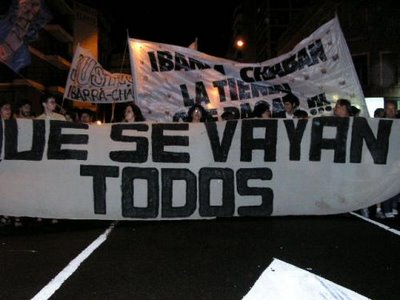
People had the change to hear from local educators and organizers who presented on topics such as immigration, cultural autonomy, youth based media, resource extraction and Latin America literature. There were also Latin Americans who presented on subjects such as the realities of being an immigrant in the US, reclaiming literary history and current popular movements throughout the continent.
The keynote speaker for Saturday was Graciela Di Marco, a professor at the university of San Martin in Argentina and long time participant in popular movements in her country. Professor Di Marco talked about the role that the women’s movement has had on all other popular movements in Argentina.
Prof. Di Marco talked about the evolution of popular movements in Argentina, where there has been a broadening of the scope of citizenship, the promotion of women’s rights, the cultural impact of feminism and joint articulation of these changes amongst academics and activists.
The speaker said, “Radical democracy is the construction of counter hegemonies resulting from the articulation of popular struggles.” She went on to say that this processes is grounded in the “denaturalization and criticism of inequality.” For Di Marco, the democratization process should put its emphasis on the equalization of relations and relationships.
During the military junta years, when 30,000 Argentines were disappeared, the human rights movement created the conditions for “elaborating a critique of all discretionary forms of the exercise of political authority.” This critique was not just of the military dictatorship, but a critique of power relations in the home and in popular movements themselves.
It was in this context that women started to see themselves in significantly different ways. Professor Di Marco said that women continued to see themselves as mothers, but they began to articulate the idea of “social motherhood,” which involves the demands of political power.
The advent of popular feminism at this time was made up of women in unemployed workers movements. Women’s participation in marches for instance, often ended up being festivals for the women who participate, since many of them rarely had the chance to visit the capital or enjoy the interaction with women from all over the country. Popular movement marches provided a forum for women to have those kinds of experiences.
Professor Di Marco then spoke about the picket movement, which has been the strongest movement over the last decade. Roughly 70% of the picket movement is made up of women, who in addition to marching, management community projects and occupy public spaces.
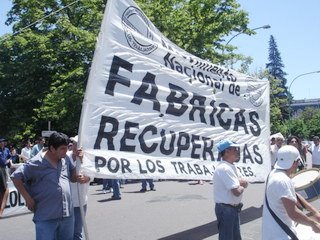
After the economic crash of December 2001 (a topic which is explored in the documentary The Take) the picket movement grew and began to express itself in different ways. Worker occupations and collectives led to greater cooperation between men and women and women were often in leadership positions in the worker co-ops and collectives.
These co-operative groups began creating new cultural models, such as transforming old warehouse spaces into a space for those wanting to learn how to be trapeze artists, day care centers and arts collectives.
Professor Di Marco said that women’s participation showed women that they did not need to be isolated and that tactics such as roadblocks and factory occupations gave them the idea that rights can be obtained through struggle.
However, while it is clear that this movement in Argentina is anti-capitalist, the movement still needs to work on anti-patriarchal dynamics that exist. Women were happy with the push for dignity in work and better education for their children, but they still struggled with domestic abuse and the inherent machismo that permeates institutes.
Professor Di Marco said that patriarchy was manifest in many of the social institutions because of the historical influence of the Catholic Church. She said that one could see this in the government, hospitals, the courts and other social institutions. The speaker also said that Catholic fundamentalism is a key player in the counter attack on women’s rights and the popular movements.
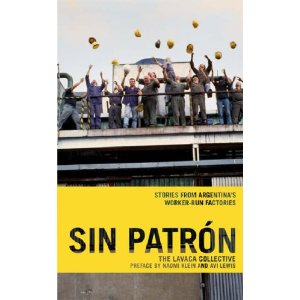
For more information on the worker occupations, worker-run factories, co-ops and collectives that number in the thousands in Argentina, good sources are the book, Sin Patron: Stories from Argentina’s worker-run factories, and Indy Media in Argentina.
MiBiz spreads myth about toilet paper company’s “green” practices

The regional business publication MiBiz recently sent out their sustainability E-newsletter, which is always worth critiquing. Like most business entities they love to highlight so-called “green” corporate practices as a way of taping into the growing green consumer market.
The article in the MiBiz newsletter that caught my attention was a blurb about the toilet paper giant Kimberly-Clark, which has announced they will be putting on the market tubeless toilet paper.
The MiBiz blurb was based on a USA Today article that acts essentially as a PR piece for the Kimberly-Clark. Not only does the article cited a company spokesperson who makes eco-friendly claims, the story also cites someone with the Natural Resources Defense Council who claims this is a positive example of what corporations can do to promote conservation. However, such a business-friendly article from the McJournalism of newspapers (USA Today) should not confuse us with what is fundamentally wrong with equating Kimberley-Clark’s new marketing strategy with concern for eco-systems.
First, citing a spokesperson from the Natural Resources Defense Council makes complete sense once you know that this so-called environmental group is part of what some call the Big Green groups or Gang Green. Big Green groups are those who have abandoned any real grassroots environmental work and have shifted to lobbying in Washington and partnering with Corporate America.

Second, calling Kimberly-Clark’s tubeless toilet paper rolls green is a perfect example of green-washing. The company is the second largest toilet paper company in the world and has contributed to deforestation and soil erosion on a massive scale. Kimberly-Clark owns or controlled hundreds of thousands of acres of land in the US, Spain, Thailand, Mexico, China and 20 other countries.
In addition to the amount of land the company owns it is important to understand that most toilet paper is currently made from trees, which means the industry does not use much in the way of recycled paper. In fact, in the US today, tissue from 100% recycled fibers make up less than 2% of sales for at home use. This is an astounding number and it means that companies like Kimberly-Clark need to cut down more forests for their products.

Third, since Kimberly-Clark is committed to increasing its profits they will do whatever is necessary to make that happen. For instance, the company spent hundreds of thousands of dollars annually lobbying the US Congress. Another tactic the company uses is having representative from other large corporations sit on their board of directors, which gives them greater influence on policy and greater access to natural resources. Some of the board members of Kimberly-Clark also sit on the boards of General Electric, Home Depot and Waste Management.
Lastly, the biggest flaw with corporations claiming to be green is that they don’t have a limit to their growth. Kimberly-Clark, like any other business, wants to expand and develop more markets for their products. Just because they make a minor adjustment to how they manufacture their product doesn’t mean they will end up cutting down fewer trees.
Therefore, just because news agencies like USA Today and MiBiz are fooled by this kind of corporate green-washing, doesn’t mean we have to be.
Adbusters and the Israeli Apartheid Wall
(This article, from Adbusters founder Kalle Lasn, is re-posted from The National Post.)
Why is Shoppers Drug Mart pulling 3,500 copies of Adbusters, my magazine, off its shelves?

A week ago, in the National Post, the Canadian Jewish Congress (CJC) accused Adbusters of anti-Semitism for publishing side-by-side photographs of the Gaza and Warsaw ghettos ( “Anti-Semitism on your magazine rack — courtesy of Adbusters,” Oct. 23). The CJC has since successfully lobbied senior management at Shoppers Drug Mart into pulling our magazine off the Canadian newsstands.
Here is the story from the Adbusters viewpoint.
In October 1939, the German Wehrmacht reached the city of Warsaw, and over the following months, the Jewish population was forced into a small section of the city called “the Jewish quarter.” The situation inside the ghetto was unbearable: Nazis controlled the movement of goods, basic utilities and even food. Each person was allotted a starvation diet of 250 calories per day.
Acts of rebellion were brutally suppressed. When two German soldiers were killed in a local restaurant, 106 men in the ghetto were shot in reprisal. Arrests and random executions were common. In April 1940, the ghetto was walled off on all sides.
Services such as hospitals and schools were derelict, relying on an ever-decreasing stream of supplies allotted by the Nazis. For a while, the supplies were supplemented by goods smuggled in through tunnels, but such services were eventually forced to close.
A resistance movement was organized during the Soviet advance, but it was brutally defeated and the Warsaw ghetto was razed to the ground.

In September 2005, Israel dismantled its settlements in Gaza and withdrew its troops after 38 years of military occupation. For Israel, this marked an end to their occupation. For Palestinians confined in Gaza, however, the occupation had simply progressed into a new phase: the ghetto. The year 2005 marked the establishment of Gaza as an open air prison.
Israel controls the movement of all goods, including food and basic necessities, in and out of the Gaza strip. A study done by Johns Hopkins University in 2002 found that 17% of children aged 6-59 months suffer from chronic malnutrition, and almost half of women and children are anemic. Thirteen percent of children under five are stunted.
Israel controls all of Gaza’s borders and airspace. The long ocean border, once a viable source of income for Gazans through trade and fishing, is now strictly controlled. Humanitarian missions are turned away with lethal force.
Israel responds to every Palestinian provocation with disproportionate force. The Israeli response to the murder of three civilians by Palestinian rockets in 2008 was the wide-scale destruction of Gaza, the use of white-phosphorus munitions in the area of a UN school and the killing of over 1,000 civilians.
Comparing events today with events in Nazi-occupied Europe must never be done lightly. When events are so serious as to lend themselves to such comparisons, however, there is a moral imperative to speak up.

Though the stated goal of Israel has never been the complete destruction of the Palestinian people, many of the tactics and policies supported by the state of Israel are deeply troubling and worthy of an open public discussion.
Last week, in a move to silence criticism of Israeli policies, the Canadian Jewish Congress labelled Adbusters — and anyone who makes the above historical analogy — anti-Semitic. The CJC has lobbied Shoppers Drug Mart not to carry Adbusters. Three-thousand-five-hundred copies of Adbusters will no longer be sold at Shoppers Drug Mart’s 515 Canadian stores.
The Canadian Jewish Congress is not a representative voice of the full spectrum of Jewish perspectives. Last year, prominent Jewish Canadians including Naomi Klein, Ursula Franklin and Anton Kuerti signed an open letter criticizing the CJC’s use of “fear tactics” and condemning the “false charges of anti-Semitism against … groups and people exercising their democratic right to freedom of speech and association regarding legitimate criticism of the State of Israel.”
If you think that publishing side-by-side images of the Gaza and Warsaw ghettos is a valid expression of free speech, email the Canadian Jewish Congress and tell them to back off. And next time you walk by a Shoppers Drug Mart, go in and ask the manager to put Adbusters back on its shelves. In Canada, we should be free to choose from a diversity of viewpoints and decide for ourselves what is anti-Semitic and what is a legitimate critique of Israel’s occupation of Palestine.
Yesterday, we posted the findings of our 56-day study that looked at the Grand Rapids Press election coverage from the day after Labor Day through November 1st.
In that study we also did a comparison to see how much coverage the Press was giving to ArtPrize, since it was taking place in relatively the same time frame as the 2010 Election.
We found that there were almost twice as many ArtPrize articles in the print version of the Grand Rapids Press as there were of election articles, 153 to 87. We also found that comparatively there were 35 ArtPrize stories on the front page of the Press and only 18 election stories.
Big deal. So what’s the point? The point is that this should tell us something about the Grand Rapids Press and news coverage in an age of hyper-capitalism.
First, the most obvious thing about the newspaper’s decision to run more stories about ArtPrize than they did about electoral politics is that it makes clear what their priorities are. And the number one priority of the Grand Rapids Press is not to inform the public, it is to sell newspapers.
Of course this is their number one priority, since they are owned by a for profit company – Advance Publications. But it should be stated that the selling of newspapers is not just about news but about advertising. Indeed, the bulk of the revenue made by the Press is from advertising, not subscriptions and ArtPrize articles, particularly on the front page, helps to create a more positive consumer climate.
As media scholars like Erik Barnouw, Robert McChesney and Lesley Savan have demonstrated in numerous books over the years – newspapers, TV and radio stations always think about the content of their news and its relationship to the advertising. This means that for profit news agencies have to be careful not to provide news that makes us either feel too bad or makes us think in great detail about substantive issues. To do so could limit the public’s ability to be consumers.
Second, despite the fact that news agencies are driven by profits does not necessarily mean they can’t do good journalism. Often journalists and editors will say that they are just giving people what they want. And while it may be true that the public is demanding all ArtPrize all the time, that justification is not part of the widely accepted Principles of Journalism.

Lastly, the data begs the question that if the Press treated election coverage the same way they did ArtPrize coverage would that have an impact of the number and sophistication of voters on November 2nd?
For instance, if there were as many articles about candidate races as there were about ArtPrize, would that make a difference? If there were equally as many front-page stories about the election as there was about ArtPrize would there be more participation in elections? If the Press invited the public to design a front-page cover for the elections like they did for ArtPrize would that have made a difference? If the Press engaged the public in their election coverage the same way it engaged the public who came out to see ArtPrize entries would that encourage people to participate in the electoral process even more?
We may never know the answers to these questions, but it would be worth posing these questions to the Press editor Paul Keep. Send him an E-mail (pkeep@grpress.com) and ask him about the difference in the amount and quality of ArtPrize coverage versus Election coverage. If you get a response let us know and we could add your comments to this posting.
Holy Shit! Amway is a Pyramid Scheme?

Yesterday, it was reported on MLive that Amway has agreed to pay out $56 million to plaintiffs in a “class-action suit alleging the company and some of its top-level distributors operate an illegal pyramid scheme.”
The article goes on to say that the lawsuit, “alleged the company used unfair and illegal business practices that mislead distributors about their ability to make money and how much it would cost to be part of the business.”
However, despite the claims made in the lawsuit, Amway President Doug DeVos still does not want to admit to the allegations in the lawsuit. In an interesting display of journalism, the Grand Rapids Press included a letter that the Amway executives sent to the “Amway Community.”
The letter states that while the company has agreed to pay out $56 million and “the company and its IBO leaders take responsibility for all past issues,” it still denies any real wrong doing.
While one could argue that it shows that the Press is not afraid of exposing the wrong doings of the most powerful company in West Michigan, the way the Press presents the story suggests otherwise.
First, this story is archived in the Business section of MLive and not in general news where other crime stories are found. Make no mistake this is a crime story. It might be a “white collar” crime, but it is definitely crime. And to be realistic, which is worse, the guy who steals a few hundred bucks from the local party store or business practices which steal millions?
Second, the Press does not bother to seek out other sources for this story, but relies on Amway executives to tell us what we should believe. MLive did run a follow up article today, which cited two of the lawyers representing the plaintiffs, but they still don’t go far enough to seek out local or national sources that could speak to the allegations in the lawsuit.
Lastly, the Press fails to question the very nature of Amway’s business practices. So while this lawsuit identifies specific claims from specific plaintiffs about pyramid scheme practices, the Press misses the opportunity to ask the question, “Isn’t Amway fundamentally based on a pyramid scheme system?”
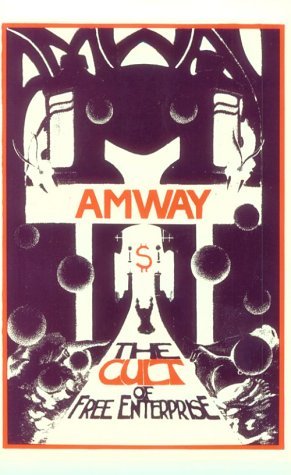
This is exactly what numerous former Independent Business Operators (IBOs) of Amway have been claiming for years. One of those former IMOs is Steve Butterfield who wrote the book Amway: The Cult of Free Enterprise. That the Press chose not to include voices like Steve Butterfield’s and not question how Amway has operated from the very beginning is a clear indicator that the Press is unwilling to challenge the power of the Ada-based company.
Today, GRIID has posted a 20-page report that looks at the Grand Rapids Press coverage of the most recent election.

The study covers the period from Labor Day 2010 through the day before the election. (Sept. 7 – November 1) We tracked all the articles that appeared in the print version of the Grand Rapids Press dealing with candidates and ballot issues specific to West Michigan and would be on the ballot for those voting in this part of the state.
As we have done with numerous other news studies around election coverage we ask the question that if the Grand Rapids Press was the only source that voters relied on, could they make an informed vote? Our conclusion is that for most candidates and ballot proposals the answer would be no. The only issue that the Press did a good job on during the 56-day study period was the statewide ballot proposal to hold another Constitutional Convention. Other than Proposal One, most of the stories were based on polling, attack ads, and horserace coverage, all of which most often did not provide voters with even basic issues on where candidates stood on key issues.
Here is a summary of our findings:
- There were a total of 87 Election articles during the 56-day study period.
- The races that received the most article were: 3rd Congressional (21), Governor’s race (19) and Proposal to have a Constitutional Convention (9)
- Area State races received limited coverage: 29th District Senate race (4 articles), 75th District House race (3) and no articles about the 28th and 30th Senate races or the 72nd, 73rd, 76th, 77th or 86th District House races.
- There was only 1 article about Proposal 2, 1 article about the Michigan Supreme Court candidates, 1 article about Secretary of State candidates and 1 article about the Attorney General candidates.
- Most of the stories about candidates focused on polling, political ads, debate schedules, public appearances, endorsements and personal attacks.
- Consequently, most of the stories had very little information on candidate platforms, issues or voting records for those running as incumbents or a higher office.
- Comparatively, there were 153 articles about ArtPrize during the same 56-day study period and 87 election articles.
- Election stories appeared on the front page of the Press 18 times during the study period, whereas ArtPrize stories were on the front page 35 times.
The entire report can be found on the GRIID site in the Reports section.
Elections and Wedding Dresses: Tuesday at the Grand Rapids Press
In the 1940 film “His Girl Friday,” a send-up of the newspaper business, an editor played by Cary Grant is attempting to make over the front page to fit in a breaking news story. Here’s his string of last-minute decisions:

No, no, never mind the Chinese earthquake for heaven’s sake…Look, I don’t care if there’s a million dead…No, no, junk the Polish Corridor…Take all those Miss America pictures off Page Six…Take Hitler and stick him on the funny page…No, no, leave the rooster story alone – that’s human interest.
Ah, yes, the rooster story. Those of us who have endured 15 months of the Grand Rapids Press under Editor Paul Keep know that rooster story very well. Except in our case, it’s been the arrow-wounded duck story….the injured bald eagle story…and the urban chickens debate, complete with chicken puns galore.
I think we can safely guess that Paul Keep has a thing about birds. What he doesn’t seem very interested in are hard news stories. Or elections, for that matter.
As GRIID has tracked the 2010 election cycle, it has documented the flimsy coverage of candidates, issues, and has also noted problems with individual features such as the Voters’ Guide, rife with paid political advertising and skimpy on information for crucial votes such as the ballot proposals.
What makes the whole thing even more inscrutable is how Keep continues to insist that local news is the Grand Rapids Press’s reason for being, as he explained in his December 24, 2009 column. A reader wrote in, “…the GR Press is failing to cover, let alone investigate, serious issues we now face in America,” and named several current national stories.
Editor Keep responded: While I understand your concerns, the issues you raised were not local issues, which is what the Grand Rapids Press reporters focus on. For coverage of national and international issues, we rely mainly on the Associated Press…The bulk of our news pages are focused on local news and information and it is in-depth local content you cannot find in other area media outlets.
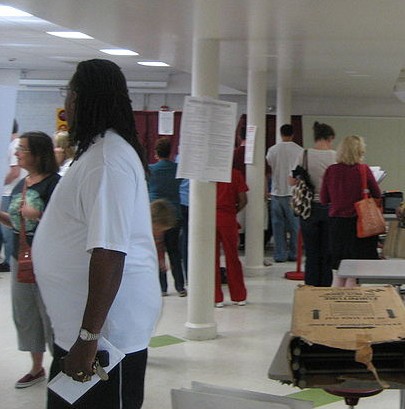
OK. Now let’s talk disconnects. On Tuesday, November 2, Grand Rapids and Michigan voters had a number of important decisions to make. They had to choose a new governor. There were races for local district seats in the House of Representatives. There were critical State Supreme Court races. You’d think that there would be plenty of that “in-depth local content” to be explored in the newspaper that day.
Keep could have chosen to have a reporter recap the races, or print an abbreviated voters’ guide to help people at the polls. He could have done on-the-street interviews, or done a story about volunteers who work at polling places in the area. He could have covered predicted voter turnout, and how the local votes would have statewide or national effect. He did none of those things.
So apparently Paul Keep doesn’t consider local elections “local news.” Or perhaps, unlike the always-appealing rooster story, elections just lack that zing that he looks for in his above-the-fold stories. Elections don’t sell papers. So what does?
Princess Diana’s wedding dress.
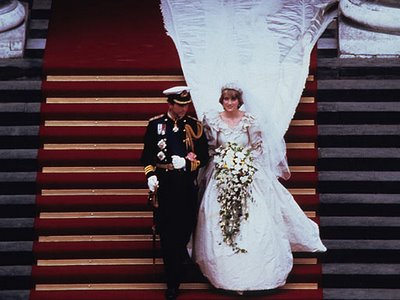
Incredibly, on the day of this long-talked-about midterm election, the front page, above- the-fold story in the Press was “The Most Famous Dress in the World.” Yes, the former Princess of Wales’ wedding dress has arrived in town, with its 25-foot silk train and its own personal attendants. On page 2, not missing a chance for follow-up, the Press ran a second story about die-hard Diana fans. Local fans, that is to say.
The other two front-page stories were about Wyoming banning medical pot and a protest at Central Michigan University.
Paging through the front section, I looked for something—anything—about the election. There were stories about teachers’ contracts. A rape trial. Vandalism by Calvin College students (they beheaded a fiberglass giraffe). Zeeland’s “fog” problem caused by pollution from a power plant cooling tower. Local homes sales falling again. On the always-buried-in-the-back national news page, there was a tiny AP wire story of one paragraph called “Tips for election watchers.” And that was that.
In the early 19th Century, Thomas Jefferson wrote quite a bit about the importance of an informed electorate and how democracy would not work without a free press. In one letter, he said, “The information of the people at large can alone make them safe as they are the sole depository of our political and religious freedom.” He also said, “Whenever the people are well-informed, they can be trusted with their own government; whenever things get so far wrong as to attract their attention, they may be relied on to set them to rights.”
It’s clear that without good, unbiased information, no one has true freedom to make up his or her own mind about how to change our country for the good of the people. But in the mind of Editor Paul Keep, this election was over before a single vote was cast. Time to move on to more “interesting” stories. As a Press headline writer might say, it’s clear our newspaper definitely laid an egg on this year’s election coverage. But you can be assured that it will keep you well informed about any wounded birds in the area for the foreseeable future.
Media Bites: Microsoft and “anti-consumerist” advertising
In this week’s Media Bites we take a look at a new Microsoft cell phone commercial that uses what appears to be an anti-consumerism message to sell us their new phone.
 Grand Rapids Institute for Information Democracy