This Day in Resistance History: A Second Look at Guy Fawkes

On this day in 1570, Guy Fawkes, the most hated man in England, was born in the city of York. A Roman Catholic convert, Fawkes was born during the reign of Queen Elizabeth I, who became gradually more intolerant of Catholics when it became clear that her cousin, Mary Queen of Scots, had designs on the English throne. Elizabeth died childless, and it was Mary’s son, James VI of Scotland, who succeeded her as King James I of England. At the time, Guy Fawkes was a soldier of 33, fighting for Spain.
Fawkes is famous for his role in the Gunpowder Plot, a failed attempt to assassinate King James I and replace him with his Catholic daughter. Reviled in mainstream history texts as a scheming partisan criminal, Fawkes has also been dismissed by many anarchists as being a monarchist—someone who believed that by replacing one ruler with another, he would somehow improve conditions for the common people of England.
But Fawkes and his fellow plotters may well have had a larger vision than just doing away with James I: they may have planned not only for a country of promised religious tolerance, but also of fewer aristocrats and a more democratic style of Parliamentary government.
When James I first took the English throne, he promised the people that there would be no more religious persecution as long as the Catholics remained peaceful and followed the kingdom’s laws. But after he was safely in possession of England and not facing an uprising, he reportedly said, “No, good faith, we do not need the Papists now.”

In some mainstream history lessons in the UK, you will still find the idea that James I practiced religious tolerance right up until the Gunpowder Plot, but that is not the case. A conservative Protestant who was obsessed with witchcraft and satanic possession, not only did James I resume the execution of Catholics for heresy, he also enforced harsh recusancy fines—fines for not attending Protestant services. The fines were affordable for the upper class, but the working class had to pay a shilling a week, onerous for many. He also ordered that all of the Catholic priests in England leave the country. The irony of this is that James’ queen, Anne of Denmark, was a secret Catholic, and was allowed to hold mass at his palace at Whitehall.
But this double standard was far from James’s only shortcoming as a monarch. He believed, much more strongly than his cousin Elizabeth, in the divine right of kings. This was hardly a new idea, but James bumped it up a few notches in his writings. He explained that kings were actually higher beings, more akin to angels than humans. “Kings are justly called gods,” he wrote, and “the state of monarchy is the supremist thing upon earth.” Therefore, they were the perfect stewards of God’s plan on earth. James did not believe in parliamentary government, and told his son, “Hold no parliaments but for the necessity of new laws, which would be but seldom.” It was obvious to James that kings were the true authors of law, since they were divinities in their own right.
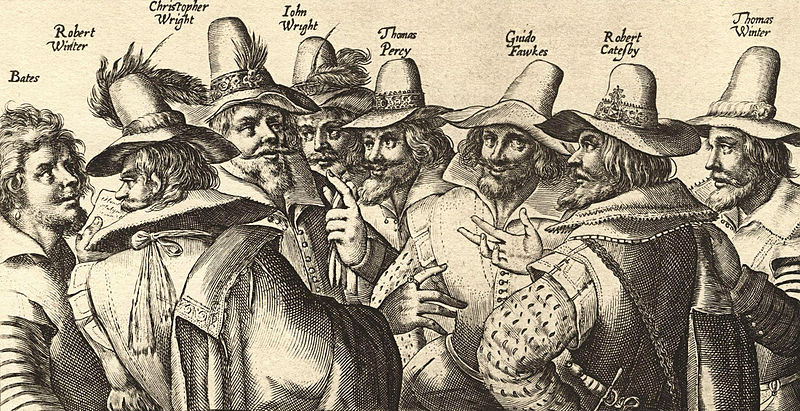
So when Guy Fawkes and his fellow conspirators planned to blow up the House of Lords during a meeting of Parliament with King James I, they were fully aware that although one outcome of success would be placing a more sympathetic monarch on the throne—another was it would weaken the power of the House of Lords. It would take another generation to replace all the dead peers, who had to be succeeded by their heirs. Meanwhile, there would be opportunities for stronger rule by the House of Commons and representatives more closely associated with the working people of England.
Admittedly, the plan was short-sighted because of its limited outlook. Although the Gunpowder Plot participants were searching for a way to a better world, they failed to see how the religious divisiveness that they hated was actually a way for those in power to keep the working class from uniting against those in power.
On the night of November 4, Guy Fawkes was discovered in a cellar beneath the House of Lords’ chamber of Parliament, guarding a large pile of firewood. When he was searched, he was found to be carrying a pocket watch and several “slow matches” or fuses. The firewood was concealing 36 barrels of gunpowder. He was arrested at dawn of November 5 and taken to the Tower of London. Even under torture, Fawkes insisted that he was acting alone, and refused to give up the names of his fellow conspirators. Finally, using information they had obtained from other sources, the torturers created a confession document, dated November 17, which a broken Fawkes finally signed.
On the night of November 5, announcing that he had been delivered from murder, King James I ordered that bonfires be lighted across Europe in celebration. Many towns and villages burned Guy Fawkes in effigy, a custom that continues to this day.

There are indications that King James and his advisors knew about the Gunpowder Plot well in advance of November 5, and allowed it to play out with the intention of using it to whip up more hatred of Catholics in the country. And if that was the intended outcome, it worked very well. Suspicion of Catholics reached an all-time high in the kingdom after November 5, 1605. After the attack, King James I, in addition to setting the “popish recusants” fines even higher, was able to institute an Oath of Allegiance. This required Catholics to swear that the Pope had committed heresy by ruling that Protestant princes (such as James) should be excommunicated.
The King also put “shock doctrine” techniques into play: he used the confusion immediately after the Plot to seize two-thirds of the lands held in his kingdom by Catholics and added them to the crown’s possessions.
A Gunpowder Plot test conducted in 2005, using the same amount of gunpowder in an enclosed space the size of the Parliamentary cellar, found that everyone in the House of Lords and within 300 feet of the chamber would have been killed—even if only half the gunpowder had ignited on that night of Guy Fawkes’ arrest.
Maybe that’s why every year at the opening of Parliament, the Yeomen of the Guard go into the cellar to officially search for kegs of gunpowder. Or perhaps this ceremony is a reminder that no one dare question the power and authority of those controlling the United Kingdom. This year, the members of both Houses should probably be looking in the streets instead of the cellars. Having set aside the manufactured divisions of religious affiliation, workers in Great Britain are planning a general strike to take place this year.
Former Michigan House Member Bart Stupak now a Lobbyist
(This article is re-posted from OpenSecrets.)
 OpenSecrets Blog has previously documented the ease with which former lawmakers and government officials pass through the “revolving door” between public service and the political influence industry, using their insider credentials to land what are often high-paying lobby jobs.
Former Rep. Bart Stupak (D-Mich.) is the latest congressman to follow the path already set by multiple former lawmakers this year, as The Hill reports that Stupak has been hired as a partner at lobbying firm Venable LLP.
While Stupak had served in the House since 1992, he garnered much notoriety during last year’s health care debate. As OpenSecrets Blog reported, Stupak had fought against abortion rights provisions in the health care bill, but he ultimately supported passage of the legislation.
As a result, Stupak drew the ire of abortion rights opponents, and soon after health care reform was enacted, he announced plans to not seek reelection.
At Venable LLP, the former representative will likely be working with multiple high-profile clients. The firm’s employers include companies such as Lockheed Martin, Marriott International and — as Slate’s Dave Weigel pointed out — Planned Parenthood of Maryland.
But since federal lobbying law prohibit House members from registering as federal lobbyists until a year after they leave office, Stupak must for now work as a lobbyist only it its general sense — not as one spending much of his time directly interfacing with government officials.
The “revolving door” also spins just as quickly beyond K Street — New York Magazine’s cover story on Wall Street’s post-bailout optimism features a profile on Peter Orszag, the former Office of Management and Budget director who joined Citigroup in December.
As writer Gabriel Sherman notes, Orszag’s credentials give Citigroup considerable clout:
“Orszag’s wisdom about markets is certainly valuable; but even more valuable is his role as an impeccable ambassador for the bank, a kind of rainmaker, but at the stratospheric level. Just about anyone will take the call of a former White House budget director. “He’s a guy who can be effective in a lot of rooms,” one Democratic financier who knows Orszag told me.”
Local News and Snyder’s Visit to West Michigan
After speaking to a Grand Rapids Chamber of Commerce luncheon crowd, Michigan Governor Rick Snyder was scheduled to address fellow Republicans at a fundraiser in Hudsonville last night.

The major local news sources all reported on Snyder’s visit in one form or another. According to what is posted on their website, WOOD Radio only announced his visit without providing any information or analysis of the visit.
All three local TV stations were at the GR Chamber of Commerce luncheon to report on Snyder’s talk. The Fox 17 story provided a brief summary of Snyder’s talk with 2 excerpts of comments from Snyder, but the report did not question any of the claims that Snyder made.
WZZM 13 also provided a just brief summary of Snyder’s comments and was the only TV news source that included any reaction to the luncheon speech, even thought it was Republican State Senator Arlen Meekhof speaking about the May 31 budget proposal deadline.
The WOOD TV 8 story at least acknowledged that there has been significant opposition across the state to Snyder’s proposals and that this has been some of the largest protests “in recent memory.” Nonetheless, the channel 8 story did not question or verify any of the claims made by Snyder in the talk he gave at noon in Grand Rapids.
The Grand Rapids Press article was by far better than the broadcast news outlets in that they provided a bit more information about Snyder’s talk. The article did include a few hyperlinks, one on the item pricing law that Snyder has passed and another link on the proposed international trade bridge.
MLive also included some video clips (see first of 3) and was the only news outlet to have comments from a few protestors who were outside the Chamber of Commerce luncheon.
Despite doing a better job of covering Snyder’s visit, the Press article left out what the rest of the local commercial media did – any analysis of Snyder’s comments or the first 100 days in office. As we reported yesterday, reporters could have questioned Snyder’s position on increased taxation of senior citizens, the international trade bridge proposal, his Emergency Managers policy or the Governor’s notion of “shared sacrifice.”
Earlier today Michigan Governor Rick Snyder spoke to a crowd of over 600 people at a luncheon hosted by the Grand Rapids Chamber of Commerce.

In the audience were several dozen elected officials from both state and local offices, college officials, non-profit directors and business owners who came to hear what the new Michigan Governor had to say about his first 100 days in office.
One of the Chamber committee members introduced Snyder by stating that the Chamber of Commerce was encouraged by the changes the new Governor has made, a comment that received a standing ovation as Snyder made his way to the podium.
The first comment that the Governor made was to thank the audience for such a warm welcome, which is significantly different from the greetings he has been getting “outside.” Snyder was no doubt referencing the organized opposition to his policies, which have manifested in protests at the Lansing Capitol and around the state.
Snyder began his talk by saying that after the first 100 days in office he has gotten the response he has expected. “We are in a crisis, but the difference though is this is not about a crisis of panic, it is a crisis of resolve,” said Snyder. He then used one of his many catch phrases by saying that Michigan needed to re-invent itself.
In order to “re-invent Michigan” Snyder believes there are some things that were in need of drastic changes. The first change was to eliminate the Michigan Business tax system and to radically alter the state budget. He has made good on eliminating the Michigan Business Tax and is working on significantly altering the state budget.
Snyder then said he knew that he was going to get a negative reaction from some people, but that he is doing what he said he was going to do during the campaign last year. While it is true that Snyder said he would run the state like a business during the campaign he was not that forth coming on everything he has actually done as Governor. However, his comment about doing what he said he would do does beg the question why some so many people were taken in by Snyder during the campaign season?

Snyder then told the audience that what the state needs is “shared sacrifice.” And while this writer saw many people in the audience nod their heads in agreement the Governor never articulated what share sacrifice actually looks like. This would have been particularly relevant considering that it seems less likely that the business crowd is having to make as much of a sacrifice as working people, the unemployed and senior citizens are across the state.
The Governor then spoke about his dashboard concept as a means of measuring what has been done in state as time goes by. Snyder gushed about the dashed board idea and his Emergency Financial Management system, which he called a way to get communities back on their feet. This is not what some people thought of Snyder’s Emergency Financial Management system when he came to Grand Rapids two weeks ago to kick off that policy.
Snyder went back to talking about the “wisdom” of eliminating the Michigan Business tax, a point, which also got an arousing applause. He then addressed one example of what a shared sacrifice would look like when he said that senior citizens need to start paying their share of the tax burden, otherwise it will shift to the current generation This view is not shared by many senior citizens and the AARP of Michigan demonstrated this opposition on March 22 with a rally of over 1,000 people.
Snyder also said that he expects that his upcoming education reform proposal will also be met with opposition. Indeed, it seems that every major proposal Snyder has put forth in his first 100 days has been met by serious public opposition, but according to Snyder those are the people “outside.”
In his closing remarks Snyder said that Michigan needs to train and maintain “talent.” By talent he was referring to young people the state needs to keep here after they get an education and of course that means youth of privilege who will become young professionals. Maintaining talent does not refer to working class youth, which tends to means youth of color.
Snyder also made a plug for the “new International trade crossing,” a bridge that has the support of the State Chamber of Commerce, the Farm Bureau, and the Agri-business community. The Governor said that a proposed bill for this new international trade bridge would be announced within the next week, a proposal that has been scrutinized the by Truth Squad.
Lastly, the Governor said that the state needs to change from a negative culture to one that thinks positively. He said that people are too caught up in a win/lose attitude, with race, geography and partisan politics keeping everyone divided. On the matter of race Michiganders have every right to critique current problems based on race if one looks at unemployment rates for people of color, educational outcomes, poverty, infant mortality and incarceration rates.
Snyder also took a jab at the news media and said that the negative response to his policy has received more coverage. He believes that the vast majority of Michigan is supportive of the policies, but need to speak up and speak out to show that the state can move forward. Snyder even asked the audience the spread the word, to talk to their networks and give feedback. With this closing comment Snyder received another standing ovation.
Q&A
The Chamber of Commerce facilitated the question and answer period by collecting questions from the tables and then selecting which questions to present to Snyder. The questions were often vague and somewhat irrelevant, such as how did you chose your political team?
Another question posed to Snyder had to do with his relationship to organized labor. Snyder said he meets with them regularly and that he is a supporter of collective bargaining. He also shared a story about going to a factory and meeting with workers who all had Wisconsin solidarity t-shirt on and when Snyder showed up they booed him. However, he said that after speaking with the workers he did get a few of them to clap.
When asked what Snyder thought about how to change public education he said that his proposal will definitely look at making changes to the post retirement medical benefits and pensions.
This was just one more indication that Snyder wants to engage in serious austerity measures, where the cuts felt by the working class will be benefits, pensions and shouldering more of the tax burden and cuts for the rich will be less taxes. These were exactly the thing that the audience at the Chamber luncheon wanted to hear as they will certainly be the beneficiaries of such policies.

Sunday’s edition of the Grand Rapids Press featured a big birthday present for Justin Amash: an advertisement for Amash’s birthday-themed money-raising campaign, thinly disguised as an article.
The piece, written by Jeff Cranson, describes how Amash is asking each of his followers for $31 on his 31st birthday this April, so he can continue “fighting for you.”
The so-called “money bomb,” which Amash describes as his birthday wish, is featured on the freshman Representative’s Facebook page. There, Amash elaborates on why he feels he needs extra cash this soon, and so badly: the government is out of control, exhibiting a “reckless disregard for the wise limits on government that our Founders placed in the Constitution.” Amash then reports in a vague statement that he needs more money to “continue [my] efforts on behalf of liberty.”
The $31 is just a gimmick donation, however; he’s willing to take more. A lot more—a maximum gift of $2,500 is flagged for Facebook readers’ attention.

The Press not only reports this as if it were news and worthy of reader attention—in the print version, it is given front-page placement in the Region section. And the online feature obligingly includes a link directly to the site where you can make your donation. The piece falls under the banner of “Polpourri,” which are quick news bites about politics in Michigan. Although some pieces for this section are written like commentaries, this one is not. In the online version, the article is combined with a paragraph about Bill Huizenga and a Tea Party event, but features a large photo of Amash supporters with a caption about his “money bomb” wish.
According to Professor David Niven of Florida Atlantic University, “advertising bias” in news reports like this one, that violates the objectivity of journalism, result in “news stories” that are tantamount to paid political ads. This type of writing, along with other types of media bias, has an agenda so transparent that it has caused Americans to distrust newspaper reporters in the United States more than people in any other profession except used car salesmen, insurance salesmen, and advertising copywriters.
Niven goes on to state that the consequences of this distrust has “drawn down the reservoir of support to a level that it is dangerous to itself and democratic society.” Without actual objective facts, presented without a slant toward a particular political agenda in stories created like news reports, truth becomes obscured by opinion to the point that some people are unable to distinguish one from another. (For proof of this, just read MLive’s comments on any Michigan news story.)
It seems that this Press’s gift to us this Sunday is an outstanding example of why Americans can no longer trust what they read in newspapers.
We Are the People Rally in Lansing – April 13
Another big rally is on to continue the pressure on Michigan Governor Rick Snyder for the anti-worker, anti-union austerity measures that he has proposed since taking office in January.

This rally is primarily being organized by the Michigan AFL-CIO, AFSME and Working Michigan. The rally is scheduled for Wednesday, April 13 from 1 – 6 PM at the Lansing State Capitol, with speakers at 1, 3 and 5 PM.
No other information is provided on the Facebook notice besides regional transportation information, so we don’t know what kind of actions will be planned inside or outside the capitol building beyond speeches.
Considering there have been numerous rallies that have already taken place in Lansing with no evidence that those in power are changing direction it seems time to increase the pressure through an occupation, a general strike or other forms of direct action that could stop business as usual in Lansing. Wisconsin has only been successful to the degree that they have been willing to disrupt business as usual.
We plan to be there to cover this event and will ask questions of the organizers about tactics and strategy.
This morning Grand Rapids Press reporter Dave Murray posted a story on MLive suggestion that Michigan schools ought to consider adopting the model of education restructuring that has taken place in New Orleans since Hurricane Katrina.

The article cites three sources – Paul Vallas, head of what is called the Recovery District in New Orleans, Aesha Rasheed, director of the New Orleans Parent Organizing Network and Margaret Raymond of Stanford University’s Center for Research on Education Outcomes.
Vallas makes the claim that the new educational system is working well and for the schools that do not meet the standards after three years the funding is pulled. Rasheed is quoted as being critical over the lack of parental input and local control, but her remarks are countered by Margaret Raymond from Standford who says parents seem to prefer local control at the expense of performance. What the Press reporter fails to tell readers is that the Center for Research on Education Outcomes is a pro-Charter school entity.
However, an even larger problem exists in this story in that there is no background information on who was behind the shift from public schools to charter schools after Hurricane Katrina.
According to Naomi Klein’s The Shock Doctrine, the New Orleans disaster provided a perfect opportunity for those who sought to privatize education or al least redirect how public funds would be used for education. Just a few months after the hurricane free-market prophet Milton Friedman wrote an article for the Wall Street Journal essentially calling for a vouchers system for education in New Orleans.
 Two years after Hurricane Katrina investigative journalist Bill Quigley wrote an interesting report on the status of the so-called educational reforms that took place in New Orleans. What Quigley found was that this new system that Paul Vallas gushes about is that it has created a two-tiered educational system. Students must apply to the new charter school system and will not be accepted if they do not meet certain standards. Those that are not accepted go to another program that gets less funding and has an outrageous student to security guard ratio.
How would readers negotiate Dave Murray’s MLive article had any of this information been included? Instead of this kind of information Murray ends the article by stating that GRPS Superintendent Taylor is open to working with charter schools and that the Detroit’s new emergency manager hired “the National Association of Charter School Authorizers to help evaluate potential operators as part of a plan to transform 45 city schools into charters.”
It seems that the question raised by the Press article is already being answered by the push for a New Orleans style education shock doctrine. This is certainly what the Mackinac Center for Public Policy has been advocating, as well as two of their largest donors Dick and Betsy DeVos who have a long history of funding an education voucher system that will re-direct public funds away from local control and create an even more race & class divided school system.
On Wednesday, President Obama announced that the US would move forward with trade relations with Colombia even though human rights organizations and unions opposed this policy.

The concern for many unions and human rights organizations has been centered around the brutal campaign to murder union organizers. The Killer Coke Campaign has been documenting these union murders for years, especially since many of the union organizers are in Coca Cola plants. But the AFL-CIO also produced a substantial report in 2008 entitled Workers’ Rights, Violence and Impunity in Colombia.
It is because of this recent history of targeted violence against union organizers in Colombia that unions and human rights groups opposed the current trade relations policy with Colombia. The Obama administration says that this new agreement will address the human right abuses, but AFL-CIO President Richard Trumka said in response, “The action plan does not go nearly far enough in laying out concrete benchmarks for progress in the areas of violence and impunity, nor does it address many of the ways in which Colombian labor law falls short of international standards.”
The Latin American Working Group (LAWG) agrees that the US/Colombia plan does not adequately address human rights abuses. “We could see the same shocking numbers of murders of trade unionists when the FTA is implemented, and there’s nothing in this agreement or the accord itself that would stop it from going forward,” said Lisa Haugaard, executive director of the Latin America Working Group. Fifty-one trade unionists were killed in Colombia in 2010, making Colombia still the world leader in anti-union violence.”
The LAWG response also states, “The plan includes nothing about gross human rights violations by the Colombian armed forces, except in the cases of anti-union violence. The Santos Administration has yet to make advances in bringing to justice those responsible for more than 3,000 civilians murdered, allegedly by members of
Colombia’s own armed forces. And even those who have been convicted of these crimes are often kept in detention centers that appear more like a luxury resort than a prison.”
Not everyone in the US was displeased with the Obama administration. The National Association of Manufacturers and the US Chamber of Commerce applauded the President’s decision.
In an article from The Hill it states, “The AFL-CIO expressed deep disappointment with the decision, which pits Obama against a core part of his political base the same week he announced his 2012 reelection campaign.”
It is interesting that the online publication refers to unions as part of the President’s base, when there is little evidence that the Obama administration has done much for working people or union specifically. The President has completely ignored the Employee Free Choice Act despite his election promise to pass it in the first year. The administration seems poised to enact a NAFTA-style policy with South Korea, which contradicts his campaign promise of revisiting NAFTA with the intent of re-writing it. The President has had no problem bailing out Wall St., bailing out the auto industry (on condition that the UAW make larger concessions) and continue Bush style tax cuts for the rich.
Add to this the announcement from Monday that the Obama camp plans to break their own record and raise $1 billion dollars for the 2012 re-election campaign and one wonders why working people would endorse the President. If one looks at who the top contributors to the Obama campaign in 2008 were you can see why he is more pro-business than pro-worker.
New Media We Recommend
Below is a list of new materials that we have read/watched in recent weeks. The comments are not a “review” of the material, instead sort of an endorsement of ideas and investigations that can provide solid analysis and even inspiration in the struggle for change. All these items are available at The Bloom Collective, so check them out and stimulate your mind.
 BDS: The Global Struggle for Palestinian Rights, by Omar Barghouti – Last week we posted a story about the international Boycott, Divestment and Sanctions campaign that is targeted at the state of Israel. This book is by far to date the best comprehensive look at both the evolution of the BDS campaign and its guiding principles. Barghouti does a great job of providing both a political framework for why BDS is so important and numerous concrete examples of how it is working at the local level. The book is full of stories about how people in churches, universities, unions, artists and other sectors of civil society are putting into practice the tactics of the BDS campaign in order to challenge the illegal occupation of Israel.
 Fields of Resistance: The Struggle for Florida’s Farmworkers for Justice, by Silvia Giagnoni – If you have ever wondered about the living and working conditions of farmworkers in the US, then Fields of Resistance is an excellent way to get your questions answered. The book not only looks at the realities that farmworkers face in Florida, it provides a great deal of inspiration based on the organizing campaigns being waged by the Mexican and Central American migrant workers to improve the conditions they work in. Giagnoni not only provides important analysis on this topic, she put a human face on these forgotten workers. The author’s account of visiting the homes of migrant workers an sitting through numerous meetings with the Coalition of Immokalee Workers (CIW) makes the reader feel as if you were there.
 Popular Resistance in Palestine: A History of Hope and Empowerment, by Mazin Qumsiyeh – In popular US culture where our perceptions have been deeply influenced by commercial news media and entertainment media, the dominant images we have of Palestinians are as terrorists or suicide bombers. Palestinian author and activist Mazin Qumsiyeh provides the perfect antidote for such perceptions in his book Popular Resistance in Palestine. The book demonstrates that there has been popular resistance (mostly non-violent) for centuries by Palestinians against numerous countries that have sought to oppress them. Mazin takes the reader through the resistance to the Ottoman Empire, the British Empire and more recently the State of Israel. What one walks away with after reading this book is that Palestinians have a rich history of resistance where most of the population has actively struggled against oppression and occupation through a variety of means. Popular Resistance in Palestine is an important contribution to understanding the history of the Palestinian people.
Inside Job (DVD) – There have been several documentaries that investigate the 2008 global financial crisis, but few have done it as well as Inside Job. This feature length documentary not only takes us into the halls of power and corruption it provides an important analysis that challenges our understanding of contemporary neo-liberal capitalism. The film will piss you off and it can be a useful popular education tool for those wanting more than to just be mad.
Michigan Messenger reported today that earlier in the week Immigration and Customs Enforcement (ICE) officials targeted the parents of school age children in Detroit.

The article states that even an ICE official admitted that some of the immigration officers may have acted inappropriately where “elements of the operation appear to have been inconsistent with policy and our standards and priorities.”
The immigration rights group America’s Voice issued a statement after this incident that reads in part: Last week, ICE agents targeted parents who were dropping off their children a local elementary school: Hope of Detroit Academy in southwest Detroit.
Detroit ICE agents are known as some of the most aggressive immigration agents in the country. They have engaged in abusive — and often illegal — enforcement tactics before, and once again they’ve gone too far.
Reform Immigration for Michigan also released a statement about the Detroit ICE raids by saying, “These are not the actions of responsible law enforcement officers. They are calculated attempts to throw the immigrant community into a panic, frightening young children and treating immigrant workers like dangerous and violent criminals.
Our Schools should be safe places where students go to learn, not places where rogue ICE agents go to stalk their parents.”
Both America’s Voice and Reform Immigration for Michigan are encouraging people to send messages to ICE officials letting them know that these kinds of actions are unacceptable.
These action are part of a growing trend that should concern anyone who cares about immigration rights. It was reported widely last year that deportations have increased under the Obama administration and despite his electoral campaign promises to reform immigration policy this issue is not even on the table and will not likely be dealt with before the 2012 election.

