The Gentrification of Detroit—Again
The American branch of my family has deep roots—five generations—in Detroit, a city that has been sitting on the narrows of the Detroit River since 1701. Now a comparative ghost town, there are hints of another new cycle of interest in downtown development in the city, and God knows that property there can currently be had for a song.

In 2002, Wayne State University sponsored a symposium on gentrification. Disagreement existed among the participants about whether Detroit could be “revitalized” without driving the current population out, but many admitted, looking at the arc of history in Detroit, that if the capitalists came back, eventually the poor would be displaced.
While a Cass Corridor resident called for change in which “there’s a place for decay,” one Wayne State professor commented, “The dynamics of gentrification, unfortunately, is that housing prices go up…taxes go up. I don’t see how you can avoid the dynamic of the market.”
Recently, Rapid Growth Grand Rapids, an online publication with a parent-company mission “to focus on growth, investment and remarkable people leading communities into the new economy,” put together a road trip. Young Grand Rapidians from a variety of professions, some of whom had never set foot in the state’s largest city, took a look at its “revitalization” efforts. The purpose of the trip, said Rapid Growth’s Tommy Allen, was for attendees to look for ways to “partner on projects to change the face and reality of our state.”
They visited a bakery, a few bars, the College for Creative Studies, the Museum of Contemporary Art Detroit, a pet grooming and day care facility, and an urban farm, among other sites. They were wined and dined at one of downtown Detroit’s best restaurants. And judging from their comments, the attendees did seem to gain a different perspective from their encounters with entrepreneurs they met on the trip.

What was less clear was how much context the visitors had of Detroit’s cycles of gentrification, which have occurred many times since its founding.
Detroit’s history shows population shifts and forced neighborhood changes happening over and over: the ribbon farms of the French settlers being seized up by lumber barons for their huge riverfront mansions, as the farmers are driven out of the city (only to be driven out again by people building summer homes in the Grosse Pointes). Woodward Avenue turning from a collection of workers’ homes and small, owner-run businesses into a Fifth Avenue of large stores, posh churches, and upscale restaurants. The Cultural Center changing from a working class neighborhood to streets with large, upper-class homes, a museum, a library. Improvements? Yes, for those with money. For the workers, it represented a constant challenge—where to live so that one could still be close to one’s work, when neighborhoods became too expensive for them? Where to shop, when affordable greengrocers’, bakeries, and clothing shops transmogrified into lavish department stores filled with furs, pigskin gloves, imported pâté, and French perfumes?
And every time the rich tired of a neighborhood, moving on to places more fashionable, then it was the working class who faced slum landlords, the disappearance of jobs, the increase of crime that occurred in their formerly stable neighborhoods.
Of course, some of this change was inevitable—after all, what major city still has farms within its limits? But what’s significant is that in every case, in every cycle of change, it’s the elite who decided what neighborhood to co-opt and alter, and the workers and poor simply had to accept and somehow adapt, often without the resources to do so successfully.
There were periods when it worked for a short time. A balance was struck, not too many people seemed to be disenfranchised, and uneasy peace was declared. We can see this kind of teetering balance in some Grand Rapids neighborhoods today. But the balance never seems to hold for long, as Detroit’s history proves again and again.

People today are most familiar with the highlights of Detroit’s 20th century transformations—the arrival of immigrant and minority workers, many finding jobs in the car industry; the White flight to the suburbs; and the hilarious early attempts at “renaissance.” When the Renaissance Center was completed, the opening gala in 1977 was attended by 650 people so terrified of being downtown that they only attended on assurances that they would be able to step right from their cars into the security-guarded building, without having to go into the parking lot or set a foot on a Detroit city sidewalk. My cousin, a Detroit activist, later commented, “And these were the people who were going to bring positive change to the city, with that attitude?”
Advertised as a “city within a city,” the tacit message of the Renaissance Center was, “It’s OK, White people—you don’t have to actually go into Detroit itself to work here. You can spend all your time inside a safe, secure, guarded fortress.” The concept was to have the building contain offices, restaurants, hotels, a shopping center. But business after business fled the building and Detroit. The entire complex was finally sold to General Motors for pennies on the dollar. It now serves as GM’s headquarters.
Even the Mackinac Center has admitted that the whole idea was a failure. But not the failure of the business movers and shakers who conceived it—oh, no. Rather, it was the city’s failure—for not having a better school system, better municipal services, and for putting “crushing taxes and regulations” on businesses, all of which hampered the largesse that generous capitalists were willing to rain down upon Detroit.
In a smaller way, we see similar scenarios in Grand Rapids’ history. One example: shortly before the Amway Grand was completed, the leading power brokers on this side of the state insisted on a change with similar economic results as the Detroit Renaissance Center. They deemed it was crucial for the struggling retail presence in Grand Rapids’ city center to take out Monroe Avenue and turn it into a pedestrian mall. This would supposedly let downtown “compete” with suburban malls that were pulling shoppers away. Some long-time, small business owners downtown who had survived the shifts in retail traffic saw that they would lose their car-door-to-store-door advantage in this redesign. But the street was mall-ified in 1980 despite their objections. One by one, the remaining businesses failed.
Did anyone benefit from this Titanic of a decision? Yes, the people who always benefit: those with the economic means to buy properties at fire-sale prices. Later, Monroe Avenue was re-opened and the downtown was “revitalized.”
In the Detroit toured by the Rapid Growth road trip attendees, a number of residents are wearily aware that any improvements they make could, at any moment, be co-opted by capitalists looking to make yet another buck off the backs of the poor, the unemployed, and the low-wage workers left in their largely broken urban landscape. Commenting on a similar scenario in Washington D.C., Natalie Hopkinson wrote,
“In the fanfare over the ‘new D.C.’ and drooling over retail, it’s almost as if poor people and their grievances have been put on mute. That was the problem with [Mayor] Fenty and some of his more strident ‘creative class’ supporters; many of them went about their business as though the poor were invisible or, worse, already gone.”
Rayfield Waller wrote in a Michigan Citizen article that the “creative class” working to reinvent Detroit today are “white elites reoccupying inner cities that have crumbled in the wake of federal abandonment, infrastructure collapse, police brutality, loss of worker rights, government corruption, and joblessness.” He goes on to state that in his opinion, urban or neighborhood collapses like the one in Detroit are engineered economic ploys: “America’s response to rebellion, protest and riots by urban Americans objecting to the same corporate and government elites now funding what is essentially a ‘cool’ class war of ‘creative’ elites against urban have-nots.”
Let’s face it. It’s not Detroit’s recent capitalist ventures—from the redo of the Book-Cadillac Hotel with its spa and $60-per-porterhouse-steak restaurant to the peppering of renovated “hipster” bars and Twitterati-approved coffeehouses—which are going to address the reality that Waller describes. But there are organizations in Detroit that are working for justice for the residents who are there, rather than campaigning to lure “urban pioneers” (read: customers with ready cash) from the suburbs to the city.

One of these is the Garden Resource Program Collaborative, which brings together 189 different organizations to support urban gardening and farming. The collective provides education for people who have never grown gardens before; it teaches beekeeping; it offers seed exchanges and lessons in canning and preserving food. According to its website, this food justice organization provided help and advice to nearly 900 community, school, and family gardens,
The Detroit chapter of the Michigan Welfare Organization is another group working to improve the lives of the city’s residents. The group acts as an advocate between low-income citizens and service organizations that stand in the way of people receiving the Medicaid, food stamps, and other assistance that is rightfully theirs. The chapter also intervenes in landlord-tenant disputes and utility company threats. In addition to fighting poverty, the group’s mission statement says it is building “an army prepared to battle for the economic and human rights of millions of disenfranchised Americans.”
Equally important is Moratorium Now!, a grassroots coalition of activists committed to stopping foreclosures, evictions, and utility shutoffs in the city’s metropolitan area as well as across the state. In a city where foreclosures still number approximately 4.5 the national average, this group is crucial to Detroit’s future. In 2010 alone, over 43,500 people in Detroit lost their homes to foreclosure.
The cost of gentrification—again—in Detroit will come at the expense of its already beleaguered population. At GRIID, we believe that a statement circulated in the city several years ago, printed on flyers and posted everywhere downtown, sums up the issue perfectly. It was titled “Detroit Artists Against Gentrification.” Unlike many observations on this topic, it is untainted by an agenda of promoting capitalist interests. It says, in part:
“Fuck ‘Cool Cities.’ We don’t want our art turning into someone else’s eviction notice….We recognize that the city must develop, the nature of things is change…But we don’t think just any development is good development, and we don’t think the end justifies just any means.
“We have seen what gentrification has done to other cities, displacing working class and poor people…In Detroit, it has faked progress, pretending to cure real issues of racism and poverty with fancy new buildings. Frankly we think it is boring and stupid. It is a cycle of destruction and reconstruction that could go on forever, but only benefits those who already have money. They say a rising tide lifts all boats, but that assumes that you have a boat.
“…We need to know that our voices are heard about the din created by all the bulldozers and the local shuffle of money changing hands. All the people in the city must have a say in what’s going on.”
On Friday, the GVSU student group Students Advocating Freedom & Equality, the student socialist group and the LGBT Resource Center co-hosted author/educator Chris Williams on campus for an Earth Day lecture. Williams is the author of a recent Haymarket book entitled Ecology and Socialism: Solutions to Capitalist Ecological Crisis.
 The theme of Williams’ presentation was building a new mass movement for environmental justice. Chris pointed out that we are at a critical point in our history because of environmental crisis we are faced with particularly with the issue of Global Warming.
Williams also mentioned the Japanese nuclear catastrophe as the most recent manifestation of our unsustainable energy policies, a catastrophe in which we still don’t know what the long-term effects of will be. The 25th anniversary of the Chernobyl nuclear disaster is also just days away and we still have not learned from that catastrophe. The fact that we still think we can deal with nuclear radiation, which will be with us for hundreds of thousands of years, reflects our lack of vision on energy issues, according to Williams. The lack of vision was summed up nicely is a recent Onion headline which read, “Nuclear Energy Advocates Insist U.S. Reactors Completely Safe Unless Something Bad Happens.”
According to Williams, most research shows that nuclear power and nuclear energy is not sustainable and has only survived because of the massive subsidies under both the Bush and Obama administrations.
Williams also stated that the data shows that renewable energy would be more than adequate to meet our existing energy needs, with a combination of wind, solar and other renewable sources. So the issue is not a technological question, rather it is a social question.
Williams said that what needs to take place is a massive systemic change of not only our energy production, but city planning, transportation systems and future housing construction. The US government could subsidize the construction of low energy housing if it diverted from subsidizing the nuclear, oil and coal industry to the tune of hundreds of billions of dollars annually.

According to Williams the root of the problem is Capitalism. First, the purpose of the system is perpetual growth, which means that the use of natural resources is exponential. Secondly, the purpose of Capitalism is to make a profit. Products are just a means of making money, not really to provide necessary goods. This also takes into account of the value of what is produced. As an example he juxtaposes HIV medication production, which provides people with the opportunity to be healthy as opposed to weapons production, which is primarily about making a profit and contributing to more suffering.
The third aspect of Capitalism is the fact that it is only concerned with immediate outcomes and profits as opposed to long-term consequences. Williams went on to say that if you don’t think that Capitalism is the root of the current ecological crisis the solutions will always fail. One of those “solutions” is that technology will save us. A second failure of thinking is to increase the market itself. Williams gives the example of Cap and Trade, where businesses will actually make money off of polluting. The third notion is that we need to change our personal life styles and not the system.
He talks about the concentration of wealth and ecological destruction and says that a radical redistribution of wealth could make the planet more sustainable. For example, the amount of money spent on marketing annually in the US is $1 trillion dollars, which is more than we spend on education from 1st grade through graduate school.
Williams said that in order to build a new movement we need to have some immediate small victories, such as stopping nuclear production, ending mountaintop coal removal and stopping the process of fracking.

He also says we need to wed labor struggles and environmental justice. However, the ultimate challenge is to dismantle Capitalism. We need to learn from the democratic struggles in the Middle East and how it has not only transform the political environment there, but inspired political movements here.
Williams also said that Capitalism is always trying to convince us that you can solve problems like environmental destruction by buying the right products and altering your personal lifestyle. Green Capitalism, according to Williams is just an extension of traditional capitalism and convinces us that the “right” kind of consumerism is all we need to do to save the planet.
The presenter’s analysis was in sharp contrast to the comments a staff person from the West Michigan Environmental Action Council (WMEAC), who stated at a forum on Wednesday, “Today’s top environmental problems are a result of the aggregated accumulation of the behaviors of many. There are fewer and fewer specific villains (I.E. point source polluters…major polluters egregiously dumping their wastes in our natural world). Certainly, there are still examples of this and it still happens, but today’s largest environmental problems can be traced to the behaviors and decisions of individuals and the society we have created.”
Lifestyle activism is not really a solution, according to Williams, even though he said it was important for all of us to try to act responsibly, but ultimately we have to change systems if we want to seriously address the current ecological crisis and that means dismantling Capitalism.

The Bloom Collective is hosting a discussion on water privatization since Grand Rapids has been seriously considering this move in the past 6 months.
We have reported in several previous postings about the ongoing discussion of privatizing the water/sewage system in Grand Rapids. Last fall there was an initial report where the Mayor of Grand Rapids first suggested water privatization.
In February there was another report that the City had already met with two French multi-nationals about water privatization, with one of them being Veolia, a company that is the target of the international Boycott, Divestment and Sanctions (BDS) campaign against the repressive policies of the State of Israel.
The Bloom Collective plans on providing information on this issue along with facilitating discussion on the consequences of water privatization and ways to resist such actions.
Water Privatization discussion
Tuesday, April 26
6:30PM
Bloom Collective
671 Davis NW in Grand Rapids
Corporate Sponsored blog gives Grand Rapids Eco-award
Yesterday, MLive reported that Grand Rapids received an award from Mother Nature News as the “Destination of the Week” city.

MLive writer Troy Reimink gives a summary of the Mother Nature Network (MNN) award story, but writes the summary in such a way as to just gloat in this new award for Grand Rapids. He says that the MNN article refers to Grand Rapids as an impressive city and then concludes the article by writing, “File under: We already know, but it’s nice to be recognized.”
Instead of gloating, maybe the MLive writers should practice some journalism and try to provide a fair assessment of the destination of the week award.
As is the norm these days the first thing the MNN article cites is the number of LEED certified buildings in Grand Rapids as evidence of its commitment to ecological sustainability. While this writer would agree that new buildings should be more energy efficient it does not take into account what happens in these buildings. If the policies and practices of the businesses that inhabit LEED certified buildings engage in ecologically destructive practices then operating in a LEED building seems a bit irrelevant.
The MNN article is broken into four parts: go green, eat green, sleep green and see green. Each section highlights what they have determined to be sustainable practices.
In the go green section we are told about the mass transit system The Rapid, which is hoping to have citizens improve on May 3 with a millage vote. The Rapid has improved significantly over the past 20 years, but Grand Rapids is still a car dominated city, with traffic jams, lots of surface parking lots and all the pollution that comes with a car dominated culture.

Bicycling is also mentioned as a means of green transportation, but the article does state that Grand Rapids is only bike friendly during the “warmer months.” There has been an increase in bicycling as a means of transportation in recent years in Grand Rapids, but the city has very few urban bike lanes and car culture still dominates commuting dynamics, which makes it somewhat dangerous for those who ride bikes as a regular means of transportation in the city.
The eat green section highlights 3 restaurants first – San Chez, the Green Well and Brickroad Pizza, as indications of sustainable eating. While these restaurants serve some locally grown food the menu prices make it somewhat prohibitive for working class people to make those places a meal destination. The article does mention the Fulton Street Farmers Market, which is a far more sustainable food source, since buying and preparing your own food is much cheaper than eating out and you have the opportunity to directly ask the vendors where their food is grown and under what conditions.
In the category of sleeping green we are told that hotels like City Flats in Holland and the JW Marriot are green because of LEED certification and “green features.” Again, one could argue that the cost to stay at hotels like the JW Marriot is probative for most working class people, but more importantly Hotels in the US tend to cater to the business class who are traveling from city to city and conducting work that supports and nurtures a much larger capitalist system, which is inherently unsustainable.
Then there is the question about who Mother Nature Network is and who supports them. If you scroll to the bottom of the MNN webpage you can see who the organization’s sponsors are: AT&T, Miller/Coors, General Electric, Dell Computers, Seimens, Georgia Pacific, AFLAC and Coca Cola. This would be a great list, if we wanted to identify major corporate polluters, but models of ecological sustainability?

According to the Political Economy Research Institute, General Electric is the 13th worst company for creating air pollution. AT&T is a huge corporation that is seeking to further monopolize their control over our communication’s systems. Georgia Pacific has a long history of deforestation for its paper products and was purchased by the arch-conservative Koch brothers in 2005. Coca Cola has been engaged in stealing communal water around the global for decades for its beverage line and is also deeply involved in the assassination of union leaders in Coke bottling plants in Colombia. (See The Coke Machine: The Dirty Truth Behind the World’s Favorite Soft Drink, by Michael Blanding)
Ultimately, the function that the Mother Nature Network serves is to support and promote green capitalism. They do not support or promote true sustainability, but have taken advantage of the growing sector of companies that are trying to position themselves as eco-friendly. This distinction would be more evident to the public if MLive writers bothered to practices journalism instead of acting as cheerleaders.
On Tuesday, April 26 the local group Healing Children of Conflict will host a fundraiser for an Iraqi boy who was seriously wounded by US bombing while playing outside his home in Baghdad.

What follows is a brief account of what happened in 2008 from the boy’s father:
“My son Hamzah was badly injured, covered with blood, stomach and intestines are cut out of his belly, the car was destroyed and part of my house and the houses next to it. I carried my son Hamzah who was in a very bad condition, and ran to the nearest hospital to my home. The doctors told me: “What do you want us to do with him, we cannot do anything; he will die”.
I was crying, begging, they agreed to take him, they took him into the operating room. The operation lasted for 4-5 hours. When he came out, he was in a catastrophic condition; all wrapped in bandages and tubes, and his right leg was plastered.”

Hamzah survived the operation, but he lost one of his legs and has had continuous medical problems since the April 2008 US bombing that changed his family’s life.
Healing Children of Conflict will be bringing Hamazh and his father to Grand Rapids next month for medical treatment and they need your help to cover the costs of the trip and provide other services while they are both in town.
The fundraiser is this Tuesday, April 26, 7:00PM at 25 Kitchen a downtown Grand Rapids restaurant located at 25 Ottawa SW. Tickets are $10 or $25 and there will be a brief informational program along with the meal.
For more information on this event or ways you can support the medical needs of Hamzah contact Healing Children of Conflict at events@healingchildrenofconflict.org.

As a regular practice GRIID makes it a point to monitor local media, whether that is the commercial news media or blogs from the all parts of the political spectrum.
One site we look at regularly is the Acton Institute, a far right organization that philosophically weds Christianity and Capitalism that has its main office in downtown Grand Rapids. The Acton Institute doesn’t believe in global warming and has received significant sums of money from Exxon/Mobil for such a stance. The Acton Institute also has a cozy relationship with the DeVos family and Erik Prince.
Last week the Acton Institute posted a commentary piece on its blog that was attempting to call out a progressive religious leader in the US, Rev. Jim Wallis over the issue of civility. The blog post links to a Democracy Now show where Wallis was a recent guest.
The blog post also makes the claim that there have been vicious and violent attacks against both Governor’s Scott Walker and Rick Snyder. The evidence the Acton writer provides is a video produced by the Michigan branch of Americans For Prosperity.
The video is interesting on many levels. First, this is a classic Media Literacy example of how media is constructed. The person (s) who filmed protestors at the Lansing State Capitol chose to only include footage of signs that convey a certain message, such as “Rick’s Shit doesn’t stink” and others that use Hitler references to Governor Snyder.
The video essentially includes a montage of people with signs that appear to be extreme while viewers listen to piano music. However, the videographer does not talk to those holding the sign to find out what each person really meant by the language of their signs. Are the working class people who are being threatened with layoffs, pay cuts, decreased health benefits and pensions or the senior citizens who are being threatened with increased taxes just expressing anger and frustration? It’s impossible to tell from this highly selective video.
As someone who has been to numerous demonstrations in both Lansing and Grand Rapids over Governor Synder’s proposals I have seen many signs that clearly express anger and frustration and I have talked to many of those with angry signs. What I found out was that while people were angry they were in no way suggesting that the Governor be violently attacked. In fact, the only concrete strategies that people expressed were to either Recall Snyder or to vote him out, both of which could hardly be considered violent attacks.
However, the majority of people that have carried signs at rallies in Lansing and in Grand Rapids have expressed some pretty basic and non-threatening messages such as “Snyder’s policies are an attack on the Middle Class,” “Michigan is not 4 sale” and “Fight the Attack on the American Dream.” Indeed, people have also carried signs using quotes from Dr. Martin Luther King Jr, hardly messages that could be considered violent.
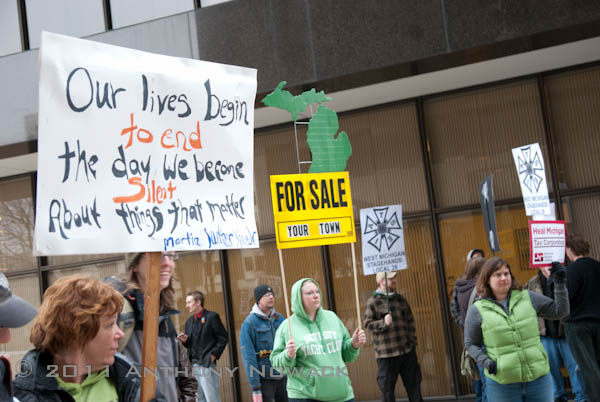
What the Koch brothers funded Americans For Prosperity video is really attempting to do is to discredit unions and working class people who are questioning the shock doctrine policies of Governor Snyder. Making them seem violent or ridiculous is clearly the intent of the video, but anyone who has actually attended these rallies knows that the video only portrays a very narrow representation of those protesting and it provides no context for people’s anger.
GVSU Lavender Graduation honors LGBTQ Students

(Colette Seguin Beighley and Joi Dupler contributed to this article.)
Yesterday, the LGBT Resource Center at Grand Valley State University hosted their fifth Lavender Graduation.
Lavender Graduation builds on the university-wide commencement events as an officially supported ceremony celebrating the academic accomplishments of our graduates. This year’s event featured the largest number of Lavender Graduates to date (31) which included not only members of the LGBTQ communities but also student allies who realize that their own experience of being fully human is deeply tied to the liberation of their lesbian, gay, bisexual, transgender, and queer brothers and sisters.
In the spirit of Audre Lorde who said, “It is not our differences that divide us. It is our inability to recognize, accept, and celebrate those differences,” Lavender Graduation celebrates the beautiful diversity of campus LGBTQ communities.
Opening remarks were offered by University President Thomas J. Haas. This year’s Lavender Graduation featured the first keynote address from one of Grand Valley’s graduating seniors, Joi Dupler. Joi is a Women’s and Gender Studies major and a McNair scholar as well as a member of S.A.F.E. (Students Advocating Freedom and Equality), Pipeline LGBT Leadership group, Gender Neutral Housing Coalition, and a participant in “Change U: Training for Social Justice.” Here is an excerpt from Joi’s speech:

“It was from my work with the Gender Neutral Housing (GNH) Coalition, that I truly understood Audre Lorde’s words of wisdom. Within the past few years, I have heard many personal accounts from LGBT students struggling to find safe and comfortable housing at Grand Valley. Their painful stories struck at the core of my heart. In the fall semester of 2009, a straight-A student and active student leader named Randy decided to finally come out to his roommates as a gay man. They reacted with hostility and disgust, forcing Randy back to his place of silence and shame. As the semester progressed, they played “little tricks” on Randy to embarrass him, and gave him nicknames like “Faggo” to belittle him. His only friend that accepted him and treated him with respect was his lesbian female friend named Josie. After Randy disclosed his living situation with Josie, she offered to let Randy transfer to her Secchia on-campus apartment in the winter semester. Together, they approached GVSU staff to ask for an exception, but were told the best option may be to move off-campus– even through research shows students do better academically and socially by participating in an on-campus living experience. Moving off-campus wasn’t an option for Josie and Randy. Instead, Randy moved into a single-unit, and soon slipped into a deep depression that took a toll on his grades and his social life. He went from being a straight A student and active student leader, to being on academic probation and completely uninvolved.
Although I have been living off-campus for a while, I couldn’t help but to feel it was my responsibility to prevent another experience like this from occurring at GVSU. Apparently, many of my Coalition comrades shared my sentiments, since they too live off-campus. Regardless of whether we directly benefit from establishing GNH at Grand Valley, we still recognize the need, and will not stop fighting until we have it. Today, I hope that you will take the next step of actualizing inclusion at GVSU by adopting a GNH option, because you recognize that the place that you sleep should be the LAST place you should have to educate others around difference. – you should feel safe.”
The Milton Ford Leadership Award was presented to Wendy Wenner, Dean of Brooks College of Interdisciplinary Studies, for her leadership in securing Household Member Benefits as well as her instrumental role in the establishment of an LGBT Resource Center on campus.
The LGBT Faculty and Staff Association presented this year’s Prism Award to President Thomas J. Haas, Vice President of Inclusion and Equity Jeanne Arnold, and Director of Benefits David D. Smith for their roles in bringing Household Member Benefits to campus.
Each of the thirty-one Lavender Graduates was then recognized by name and major as he or she received a rainbow tassel. Following that ceremony, graduates were challenged to use their education in service to others – others who could never dream of having the opportunities these students have experienced at Grand Valley.

Bloom Collective to host screening of film that exposes the fur industry this Saturday

The Bloom Collective is hosting a screening of the new documentary film entitled Skin Trade. Skin Trade, produced by the same people who made Behind the Mask, takes a serious look at the fur industry and what they keep hidden from the public.
The Skin Trade webpage states:
“Fur is sexy, beautiful, sensuous and luxurious. Nothing feels better against your skin, and beautiful, sexy, successful people wear it. Fur is also environmentally friendly and is therefore a sustainable resource.
These are the campaigns the fur industry uses to get people to commit the ultimate atrocities permitted against animals. Consumers are misled by retailers who assure them that animals used for fur are humanely euthanized, intentionally hiding the reality of how the animals are hideously killed.
Step inside the world of SKIN TRADE. Hundreds of hours of interviews with insiders, designers, leaders and celebrities compiled in a heart-punching documentary directed and produced by award-winning director Shannon Keith.
This film lends a voice to the voiceless whose skin is ripped from them while often still alive.
Understand what makes this savage industry tick and what it will take to change it.
Whether you are a fan of fur or repulsed by the thought, you owe it to yourself to watch this moving peek inside the dark world of ugly glamour and painful beauty.”
Following the screening there will be a discussion about the film. This is a potluck film screening, so people are encouraged to bring food to share. The Bloom Collective will have some vegan food options available.
Skin Trade
Saturday, April 23
3:00PM
Bloom Collective
671 Davis NW, Grand Rapids
$3 – 5 suggested donation
New Media We Recommend
Below is a list of new materials that we have read/watched in recent weeks. The comments are not a “review” of the material, instead sort of an endorsement of ideas and investigations that can provide solid analysis and even inspiration in the struggle for change. All these items are available at The Bloom Collective, so check them out and stimulate your mind.

Understanding White Privilege: Creating Pathways to Authentic Relationships Across Race, by Frances Kendall – I have found over the years that White Privilege is one of the hardest things for people to admit to. White privilege can often be quite subtle, but make no mistake it is pervasive and a necessary component to maintaining White Supremacy. In Understand White Privilege, Frances Kendell brings years of work as an anti-racism educator and activist. Kendell conducts workshops on understanding and confronting White Privilege and shares many stories from her work in this book. This book is an important contribution in our understanding of how White Privilege manifests itself in the world and what we can do to combat it.

Oppose and Propose!, by Andrew Cornell – For anyone involved in doing anti-oppression work, organized resistance, is part of a collective or works by the consensus process, your work is no doubt influenced by the efforts of the 1970 – 80s radical group The Movement for a New Society (MNS). The MNS was formed as an outgrowth of all the anti-war, feminist and anti-oppression movements of the 1960s. The people involved in the MNS began adopting more anarchist forms of organizing in their radical revolutionary work that involved collective living and using a consensus decision making model. Oppose and Propose! Is an excellent investigation into this movement with analysis and interviews with many of the founding members. Andrew Cornell make the case that the current anarchist movement in the US owes a great deal to the ground-breaking work of the MNS and he offers up some important criticisms of collectivism, consensus and radical organizing.

The Face of Imperialism, by Michael Parenti – Long time historian and radical writer Micheal Parenti has provided us with yet another important work. The Face of Imperialism not only gives readers important analysis on recent US foreign policy it challenges us to think about this policy as raw imperialism. Parenti takes head on the liberal notion that US foreign policy is benign, misguided or well intentioned. The author thinks that too many “left” writers frame US foreign policy as “bad policy” or policy that has “gone wrong.” Instead, Parenti argues that US foreign policy is blatantly imperialist in nature, both in terms of its economic and military actions. The author provides amble historical cases and emphasizes that the primary mechanism of US imperialism is through its economic policy of neo-liberal capitalism. An excellent investigation into why US foreign policy should be clearly named as imperialism.

The Good War and Those Who Refused to Fight in It (DVD) – We have all been propagandized to view the WWII generation of Americans as the Greatest Generation because of the sacrifices that people made during that period. This documentary challenges that notion by sharing the stories of some of the thousands of men who refused to fight in the so-called “Good War.” The testimonies of surviving conscientious objectors (COs) are both powerful and insightful in terms of what motivate people who did not believe that war is justifiable. In addition, the film provides information on how these COs not only transformed some of the institutions they worked in during their alternative military service but what influence they had on the anti-Vietnam war movement. An important contribution into this country’s rich tradition of anti-war resistance.
Labor Solidarity March Connects Past with Present
Yesterday, about 100 people gathered in the rain at the Spirit of Solidarity Monument in downtown Grand Rapids.
Yesterday, was also the 100th anniversary of the 1911 Grand Rapids furniture workers strike, which involved thousands of workers who walked off the job during a 4 month long strike. GRIID spoke with local labor historian Michael Johnston about that strike and its significance for today.
Along the march people engaged in chants that ranged from worker solidarity to a recall of Rick Snyder. However, the dominant theme of the chants reflected people’s anger over the economic theft of the nations wealth at the hands of Wall Street and other corporate interests. This sentiment was best expressed in the chant, “They got bailout out, we got sold out!”

Once people arrived at the Alabama Street warehouse site they were invited inside to hear a few speeches. The first to talk with State Representative Brandon Dillon who made the point that the forces behind the anti-worker policies and the state austerity measures are claiming that the economy is in trouble and that cuts need to be made because working people have drained the state budget. Dillion did mention the importance of the 1911 strike, but instead of encouraging working people to engage in direct action he emphasized that what people need to focus on is the 2012 election.
The next speaker was Jay Egan, a retiree with the CWA and President of the local Labor Heritage Society. Jay stated that he is from New Jersey and he is not used to working people not walking off the job as a tactical response to labor repression. Egan admitted that the 1911 strike did not win in “the technical sense, but the furniture owners did start to meet the demands of the workers in the years following the strike.”
Egan then made the connection with what is happening today by saying that despite the federal and state governments claiming that the economic cuts to working people is purely a budgetary response. However, Egan noted that this is little more than a diversion. He stated that Wall Street got bailed out, the banks got bailed out and the mortgage companies got bailout out. “Those in power are saying that the problem is working people. Well, what the hell did we do to cause these economic problems? They are diverting the attention away from them and putting on us and we feel compelled to defend ourselves. I say screw you, you’re a God damn liar!”

Tracey with the local government workers union (GREIU) then spoke to the crowd gathered in the old warehouse space. She said that the City management has recently rejected all of the union’s suggested concessions for the current labor contract negotiations. Tracey also said that the City wants them to accept all their demands, which would include giving back the 2.5% pay raise from last year, further cuts to their pensions, they want to alter the worker’s insurance and change the language of the contract to allow for more temp and seasonal workers.
Tracey said that these kinds of cuts will make it very difficult for many of the workers to maintain cutting financial expenses, especially home mortgage payment. She finished by inviting people to join them in a solidarity picket before the weekly City Commission meeting and that they need support on their contract negotiations since the City is claiming these cuts are necessary before the upcoming 2012 budget can be approved.
The last person to address the crowd was Michael David who is both a member of IATSE and the Kent-Ionia Labor Council. David said that the space that people were standing in up until recently had provided union workers in IATSE and the local Teamsters work through the Michigan Film incentives policy. Dozens of local people were able to make a decent living because of this work in the past few years, but since Snyder cut that program he and many others in the area are now unemployed.
Throughout the speeches the crowd remained animated, often interjecting their own thoughts and feelings about the current anti-worker policies and state imposed austerity measures that threaten their financial well being.
There was no clear strategy laid out during the event on how best to respond to the harsh state and local cuts, but there clearly was plenty of worker rage that could be channel into a popular movement for change.
Organizers also mentioned that next week there will be another action of worker solidarity. On April 28 there is a Worker Memorial Day event at the Kent-Ionia Labor Hall at 918 Benjamin NE in Grand Rapids. This day, recognized around the country, is an opportunity to remember workers who have died on the job, quite often due to a lack of worker safety protection, which have increased since funding and staff for OSHA (Occupational Safety and Health Act) has been cut.

