Aquinas College cancels Out Poet/Activist Stacey Ann Chin appearance
Yesterday, GRIID received an anonymous document from someone connected to Aquinas College. The document expresses concerns about a growing pattern of censorship at Aquinas College.
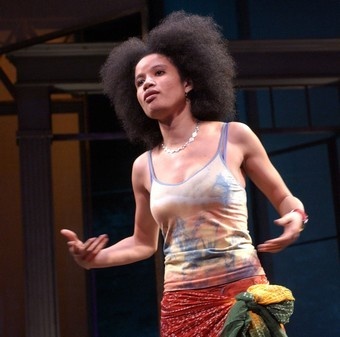
The campus was scheduled to host out poet/activist Stacey Ann Chin on February 24, but her presentation was cancelled. Based on the anonymous letter is appears that Chin was cancelled due to her being an out Lesbian activist. This is consistent with previous speakers who were either from the LGBTQ community or who were going to speak on LGBTQ issues and had their talks cancelled.
In 2008, Dr. John Corvino, an LGBTQ rights activist was scheduled to give a lecture at Aquinas College. The lecture was cancelled and students and community activists found another venue for Corvino to speak.
In March of 2009, Aquinas would not allow the feminist performance of The Vagina Monologues to take place on campus. As a response students and artists organized The Jane Doe Project as a way of challenging silence around violence against women.
This writer contacted the President’s office at Aquinas College, the assistant to the President and the Provost’s office to get a response to why Stacey Ann Chin’s performance was cancelled. None of those people were available and I was forced to leave a voice mail message. I also contact the Women’s Studies Center to see what they might know and was told that I should contact the President’s office.
For people who are concerned about free speech and inclusivity we would encourage you to contact the President’s office at Aquinas by calling 632-2881 or sending an E-mail to sommejan@aquinas.edu. The Anonymous Letter we received can be viewed by clicking here.
There is also a video that the Anonymous Letter included, which is worth looking at.
A New American Workers Movement Has Begun
(This article by Dan La Botz is re-posted from ZNet.)
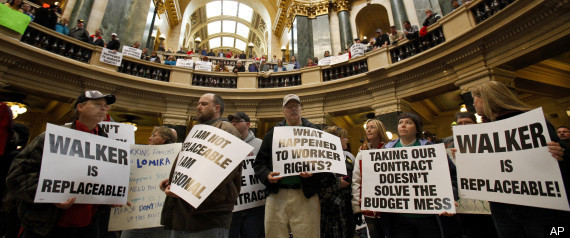
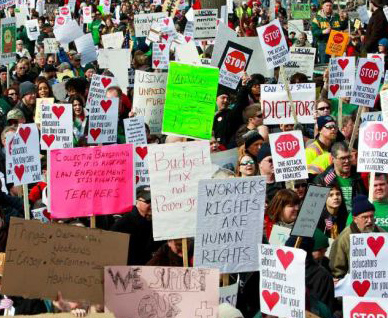
Thousands of workers demonstrated at the state capital in Madison, Wisconsin on Feb. 15 and 16 to protest plans by that state’s Republican Governor Scott Walker to take away the state workers’ union rights. Walker, cleverly attempted to divide the public workers by excluding police and firefighters from his anti-union law, and the media have worked to divide public employees against private sector workers. Yet, both firemen and private sector workers showed up at the statehouse to join public workers of all sorts in what has been one of the largest workers demonstrations in the United States in decades. Only California has seen demonstrations as large as these in recent years.
Many demonstrators in Madison, taking a clue from the rebellions against authoritarian and anti-worker governments that are sweeping the Middle East, carried signs saying, “Let’s negotiate like they do in Egypt.” While the situation in Wisconsin is hardly comparable to the revolution in the Arab world, what we are witnessing is the beginning of a new American workers movement. Because this movement is so different than what many expected, it may take us by surprise.
Not What We Expected
Many of us, myself included, had for years expected a rank-and-file workers movement to arise out of shop floor struggles in industrial workplaces, out of the fight for union democracy, and out of the process of working class struggle against the employers. While that perspective still has much validity, something different is happening. The new labor movement that is arising does not start in the industrial working class (though it will get there soon enough), it does not focus on shop floor issues (though they will no doubt be taken up shortly), it is not primarily motivated by a desire for unions democracy (though it will have to fight for union democracy to push forward the leaders it needs). And it does not, as so many American labor movements of the past did remain confined to the economic class struggle (though that too will accelerate). It is from the beginning an inherently labor political movement.
The new movement that is arising does not focus on the usual issues of collective bargaining—working conditions, wages, and benefits—but focuses rather on the political and programmatic issues usually take up by political parties: the very right of workers to bargaining collective, the state budget priorities, and the tax system which funds the budget. The new labor movement, because it has begun in the public sector, will not be so much about the process of class struggle as it will be about how class struggle finds a voice through political program. This will have tremendous implications for the traditional relations between the organized labor movement and the Democratic Party, especially since the Democrats, from Barack Obama to state governors like Cuomo, are also demanding that public employees give up wages, benefits, conditions and rights.
Not Your Grandfather’s Working Class
We have for decades in this country thought of the working class as being made up of those workers of railroad, mine and mill whose calloused hands produced the material wealth of this nation over 200 years, that is, since the first factories were opened in the Northeast in the 1790s. Industrial workers though have been declining as a percentage of the population since the 1920s and have diminished at an accelerated rate since the 1950s. Since the 1980s the decline of industrial workers as a proportion of the wage earning class has been dramatic.
In the old days, skilled workers, almost all white men, came as immigrants from the countries of Western and Northern Europe, while the unskilled industrial workers were immigrants from the South and East of Europe, whites from Appalachia, and African Americans from the South’s plantations. While most of those industrial workers were male, millions of women also toiled in textile mills, garment shops, and other workplaces. Those workers created the Knight of Labor in 1869, American Federation of Labor (AFL) in the 1886, the Industrial Workers of the World (IWW) in 1905, and finally in the great labor upsurge of the 1930s won the legal right to organize with the Wagner Act of 1935 and built the Congress of Industrial Unions (CIO).
The Rise of the Public Employees
The post-war period saw the expansion of government as millions found jobs not only in streets and sanitation, the water works, and as teachers, but also as social workers, public health nurses, and college professors. Another labor upsurge in the 1960s and 1970s led to the establishment and rapid growth of public employee unions of all sorts: the American Federation of Teachers (AFT), the National Education Association (NEA), the American Federation of State County and Municipal Employees (AFSCME), and the American Federation of Government Employees (AFGE). These public workers were far more racially diverse than many of the private sector unions, made up white, African American, and Latino workers, of men and many women.
Public employees in the 1960s and 70s won the rights to union recognition, collective bargaining, and the strike through hundreds of strikes, large and small during those two decades. The newspapers front page often carried the photo of some teacher or social worker, nurse or secretary, sanitation worker or park employee being carried off to jail for striking with the union. The most famous of these strikes, perhaps, was the AFSCME Local 1733 strike by African American sanitation workers of Memphis, Tennessee. Dr. Martin Luther King, Jr., the leader of the civil rights movement, was there to help those workers with their strike, when he was assassinated.
The Unions at a Turning Point

Today we in the labor movement are at a turning point. American employers, political parties, and government at all levels have decided that the time has come to move against what is the last bulwark of American unionism: the public employee unions. As of the latest count by the Bureau of Labor Statistics, only 11.9 percent of all workers are in unions, and only 6.9 percent in the private sector. In the public sector, however, public employee unions represent some 36.2 percent of all workers, and the number is even somewhat higher among teachers. America’s political and economic elite are looking for the final solution to the labor problem—and we are not getting on the trains and going to the camps.
Public employees, now finding themselves now on the frontline of the labor movement, are fighting back from one end of the country to the other and nowhere at the moment so dramatically as in Madison, Wisconsin. Just as the Arab revolution spread rapidly from Tunisia to Egypt, so we can expect to see this public worker movement spread from one state to another as it resists Republican and Democratic party governors and local officials who want to strip workers of their rights.
What Sort of a Labor Movement Can We Expect?
What does labor history teach us about labor movements? First, we know that when masses of workers go into motion, as they have now begun to do, political consciousness grows and changes rapidly. Workers who today simply fight to defend their union rights will, if they succeed in resisting the right’s attempt to destroy them, go on to fight to expand not only their rights but to improve their working conditions and standard of living. Most important, workers will fight to expand their power. We are just at the beginning.
Second, when workers discover the strategy and tactics of their movement, those quickly spread to other groups of workers in society. When the rubber workers in Akron, Ohio discovered the sit-down strike in 1936, it quickly spread not only to the auto industry leading to the great strikes of 1937 and 38. Remarkably, the sit-down also spread to such unlikely workers as the “shop girls” of department stores. During the 1950s and early 1960s, African American civil rights activists rediscovered the power of the sit-down, transforming it into the sit-in in lunch counters, bus stations, and other private and public places across the South.
Today public workers in Wisconsin are in such of the strategies and the tactics that can defend their rights, and they are using the mass rally and the camp out at the capital. When the discover or rediscover the strategy and tactics that work, those will spread like wildfire across the country to other public workers—and then jump to the private sector.
The Movement is both Economic and Political
Third, real labor movements ignore the artificial separation between economic and political, taking up either or both as they follow the logic of the struggle. Industrial workers struggles for higher wages in the 1930s became transformed into struggle for the employers’ recognition of the unions and labor legislation granting workers the right to organize. Similarly with public employees in the 1960s whose fight for the right to unions and collective bargaining might flow the other way, to a fight for higher wages. What is today primarily a political fight in Wisconsin, that is to defend the right of public employees to have a labor union, bargain collective and enjoy the right to strike, will inevitably become a struggle for better conditions, higher wages, and health and pension benefits.
Fourth, when a real labor movement arises, that is, a movement not merely of thousands or even tens of thousands, but of millions, it necessarily becomes transformative. Labor union officials who hesitate, who waver, or who knuckle under will soon find themselves challenged by new, younger leaders who will either force those officials to fight or push them aside. Such a movement will change the unions—often by changing the leadership first and sometime by changing the very institutions themselves. Such was the case with the rise of the industrial workers movement in the 1930s which broke the shell of the old AFL to create the new CIO.
A Political Alternative
Fifth, and finally, a new American labor movement of millions will challenge the old political relationship between the unions and the Democratic Party. The unions will fight at first to force the Democratic Party to give up its own conservative budget, tax and labor policies, and failing to do that, will seek another vehicle. Unions may first attempt to change the Democrats by running union candidates in Democratic Party primaries, or they may attempt to take over the state party. Whether the new American labor movement will have the power to put forward a political alternative remains to be seen.
Wisconsin though is famous for its long history of political grouping to the left of the Democratic Party which, from time to time, have shown considerable influence: the Socialist Party held power in Milwaukee into the 1960s, the Farmer-Labor Party was once a power in the state, Progressive Dane (county) thrived a couple of decades ago, and the Wisconsin, Green Party has over a score of elected officials throughout the state. None of these was or is what a workers’ movement needs to achieve real political power, but the presence of such political alternatives is indicative of a more tolerant and experimental attitude in the state. American workers have never in their history succeeded in creating a workers’ party of any power, with the exception of the Socialist Party of the early 20th century.
Today, with the Democrats lowering taxes on the rich, cutting budget, and laying off public employees, we may be in for the kind of confrontation between workers and a pro-business Democratic party that can produce a political alternative. Certainly the struggle over politics and government is built into this contest as it seldom is so directly in the private sector. The task at the moment is to build the fight to defend public services and public employees unions and their rights, but it leads directly to political confrontation.
Corporate Multinationals and Grand Rapids water system
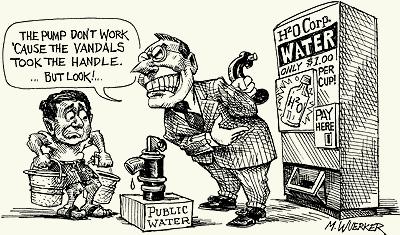
Yesterday, on WGVU radio it was reported that Grand Rapids Mayor George Heartwell is still considering the privatization of the City’s water system.
We have reported in the past that privatization of the City’s water system has been on the table since the fall of 2010 when the Mayor made his first public comment about this issue. The City is still confronted with budgetary issues and continues to consider privatization of the municipal water a way to save money.
In the WGVU radio story Heartwell did clarify where he stands on the matter of privatization by saying, “I have no interest in selling the assets as some other cities have done. I think it’s very important for the city to retain the infrastructure. But I’m very willing to look at privatizing management. If they can manage the costs at a reasonable level and have a profit in doing that, because that’s important for them. I think it’s worth exploring.”
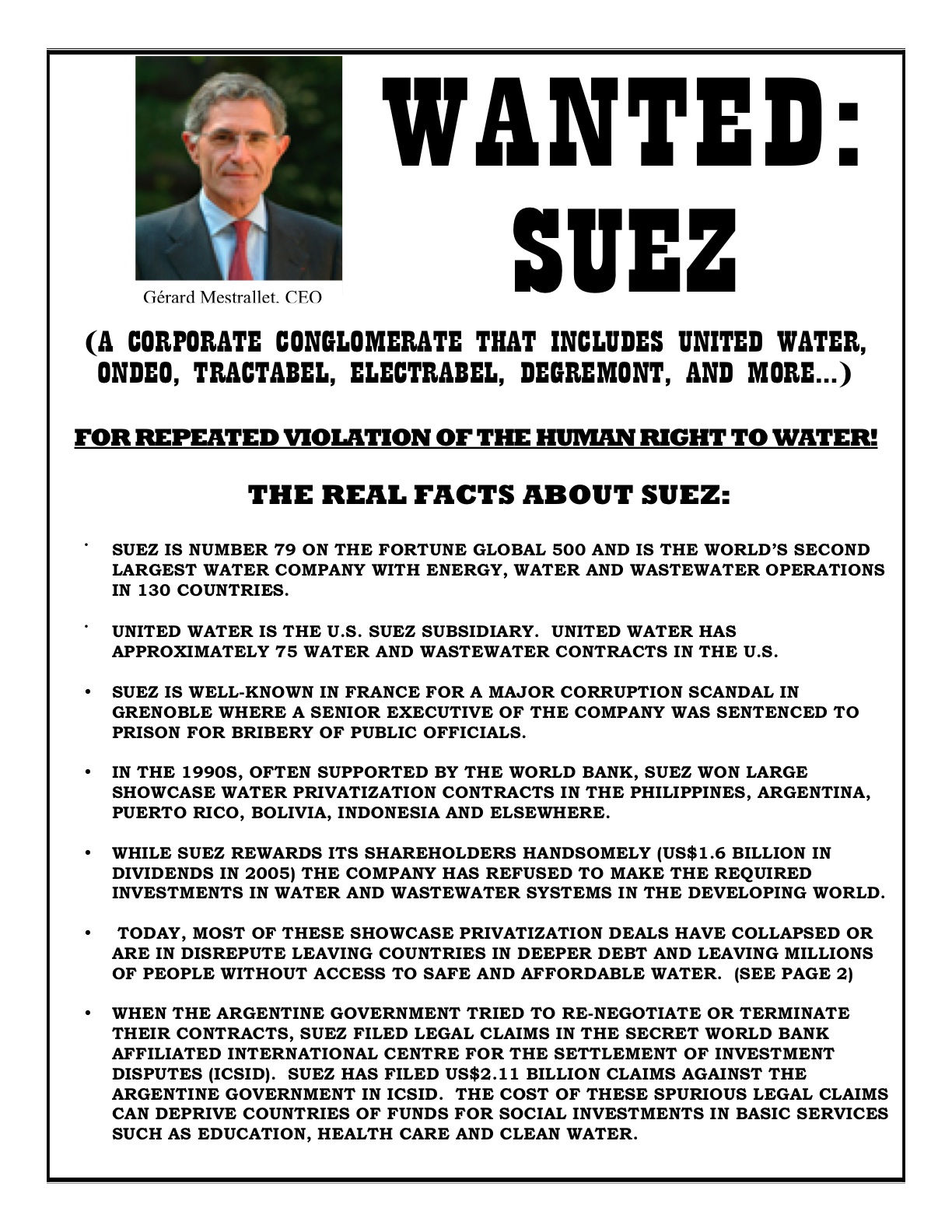
The WGVU reporter also noted that the two companies that the City is negotiating with are United Water (a subsidiary of Suez) and Veolia, two of the largest privatized water corporation in the world.
Suez has a long track record of environmental degradation since they also are involved in coal mining and liquefied natural gas. On the matter of water privatization Suez has been one of the world’s leaders with contracts to run municipal water systems in numerous countries.
According to Food and Water Watch, there is, “A growing international campaign is challenging the policies and practices of Suez, citing the corporation for a range of abusive practices that place profit over the human right to water. These include:
- Refusing to extend services to poor neighborhoods
- Cutting off water if people are unable to pay
- Non-compliance with contractual requirements for maintenance and investment
- Raising rates to unaffordable levels; and
- Threatening legal action when contracts are terminated
For more information on Suez water rights abuses you can download a factsheet.
The other corporation Veolia is the largest water and wastewater company in the world. According to Food and Water Watch they have contracts to operate water and wastewater systems in roughly 650 North American communities. Veolia also operates in 32 US states.
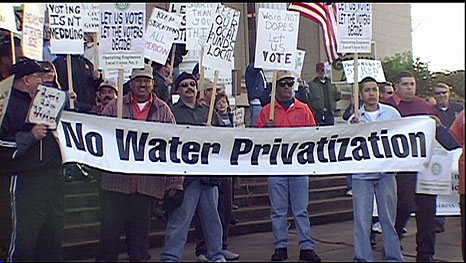
A recent Public Citizen 38-page report on Veolia documents numerous instances of corruption, shutting off people’s water when they can’t pay, diminished services and mistreatment of workers.
In addition to the absurd levels of power that these corporations have over public water systems they also use their wealth to influence legislative policy. According to the Center for Responsive Politics, Veolia spent $115,000 on lobby at the federal level in 2010. Suez has averaged around $130,000 in PAC money they have given to candidates since 2006 which included $2,000 to Michigan Congressman Fred Upton.
Clearly, both of these corporations have a history of influencing public policy and an awful track record of running municipal water systems. Mayor Heartwell claims that if these negotiations move forward with either company that the public will have a chance to comment. However, it would be better for people to voice opposition now and work towards stopping the privatization of Grand Rapids water.
GVSU Students initiate Gender-Neutral Housing campaign
Yesterday, students from Grand Valley State University began a petition campaign to get student, faculty and community support for a campaign to institute gender-neutral housing on campus.

The petition language reads:
The housing proposal would allow any two students, regardless of sex or gender, to live in any GVSU residence building that allows occupants to have their own separate bedroom. The policy would apply only to those who specify on their housing application that they would prefer to utilize this option (blind choices would remain same-sex).
The housing policy seeks to create more options in the room selection process so that ALL students are able to find a compatible roommate and would ease tensions felt by students who struggle to find safe and comfortable living spaces under the current housing requirements, including gay, lesbian, bisexual, transgender, and queer students.
This housing policy change aligns perfectly with Grand Valley’s position found in the “Affirmative Action Statement” which states that our university encourages equal opportunity in the use of its facilities and does not limit access to university activities on the basis of sex/gender, gender identity and expression. It is also consistent to GVSU’s values of inclusiveness and community.

Some of the students involved in the campaign to get gender-neutral housing on campus responded to our request for comment. Fermin Equality Valle stated, “In a university where all voices are heard, I support Gender Neutral Housing because it gives real substance to GVSU’s core values of “inclusiveness” “community” “diversity” and “equity” in the housing arena.”
Joi Dupler said, “Gender-Neutral Housing allows people to choose their most compatible roommate, regardless of gender or sex, because shared living habits, such as cleanliness, is more important in determining a roommate than one’s genitals.”
According to a recent article on Campus Progress, Gender-Neutral Housing now exists on 54 campuses across the country. However, according to the 2010 Campus Equality Index, most of the campuses are located on the east or west coast demonstrating that there is more resistance to the idea of Gender-Neutral Housing in the Midwest.
However, the fact that campuses in the Midwest are lagging behind their counter-parts on the coasts doesn’t mean that students here aren’t committed to making this change happen. Joi Dupler also provided three additional reasons for being involved in this campaign, reasons that are well thought out and articulate the students’ desire for equality and justice on campus.

First, Gender-Neutral Housing (GNH) promotes gender equity by negating gender stereotypes. It is commonly held that men and women can’t co-exist peacefully under the same roof because women are “clean and organized” and men are “messy and irresponsible.” Obviously, such claims are unsubstantiated since research suggests that there is relatively little behavioral difference between genders. Therefore, there isn’t ‘clean’ women or ‘messy’ men, but rather messy people and clean people. If GNH were to be institutionalized, it would break down those gendered assumptions, because students would see functional examples of men and women peacefully living together. This is especially important since anthropological research indicates gender inequality increases as differences between the sexes are socially exaggerated. If we continue to believe men and women are inherently different and can’t co-exist in harmony, we all lose out on an opportunity to develop close friendships.
Second, it serves the unique needs of LGBT students who often struggle to find safe and comfortable housing. Due to the current housing policy, several queer students have often complained of having to deal with the stressful situation of transphobic or homophobic roommates. Some have even been forced to change roommates three to six times in one semester! If a pre-op FtM student would feel more comfortable living with a pre-op MtF student, they should be able to live together–no questions asked. Under the current policy, they cannot because they have different biological sexes, and that’s completely unacceptable! In order to succeed academically, one must first feel safe and comfortable at home; and there’s no way that can be achieved when one’s roommate harasses, ignores, or belittles them based on their gender identity or expression, and sexual orientation.
Lastly, this housing policy change aligns perfectly with Grand Valley’s position found in the “Affirmative Action Statement” which states that our university encourages equal opportunity in the use of its facilities, and does not limit access to university activities on the basis of sex/gender, gender identity and expression. It is also consistent to GVSU’s core values of inclusiveness and community. The university’s best interest is to retain as many students living on-campus as possible. The current housing policy alienates some students that would prefer to live on-campus with a person of a different gender. Therefore, it is suggested that the proper role of the university is not to determine with whom students may or may not live with, but rather empower its students to make healthy decisions, which includes their choice of roommate in their living situation.
GRIID will keep you posted as this effort develops and we encourage people to sign the petition in support of this effort.

MLive announced yesterday that Michigan Senator Carl Levin will be in Grand Rapids on Monday to speak at an event hosted by the World Affairs Council of Western Michigan.
The presentation by Michigan’s senior Senator is based on a recent trip to Afghanistan in which Levin says there has been “significant progress.” Levin returned from a two-day visit to Afghanistan in January and released a statement where he identified the signs of progress as the “regaining of former Taliban strongholds in Helmand and Kandahar” and the increased confidence of the Afghani people in the Coalition forces and the Afghan National Army (ANA).
This “evidence” that Senator Levin provides has been critiqued and challenged from numerous sources. First, the progress or confidence of the Afghan National Army and police forces that the US and Coalition forces have been training has come under question by a major study from the Afghanistan Analysts Network. This study contends that the Afghan security forces often fight against each other, attack civilians and are often infiltrated by Taliban insurgents who gain access to weapons and intelligence.
Senator’s Levin’s suggestion that there is progress being made in Afghanistan is consistent with the position of President Obama who delivered his own assessment of the Afghan campaign at the end of 2010. Foreign Policy analysts Phyllis Bennis and Kevin Martin provided a sharp critique of the President’s claims, pointing out that 2010 saw the largest number of Afghan civilians and US soldier deaths since the 2001 invasion began.

A similar criticism of US policy in Afghanistan was provided by independent journalist Anand Gopal, who spoke in Grand Rapids last year. In an interviewed with GRIID Gopal, who has been reporting from Afghanistan for years, said that the US occupation has only caused more violence and strengthened the Taliban forces.
In recent days there has been further evidence that Levin’s assessment is wishful thinking. The Guardian news reported that there are growing concerns over the Afghan Security Forces. The report states that different security forces have clashed and have even been documented as engaging in illegal drug trafficking. In addition, the United Nations released a report yesterday, which claimed that violence against Afghan children has increased over the past two years. This is further evidence that “the progress” that Senator Levin speaks of is not really benefitting the Afghan people.
GRIID plans to have someone in attendance at the public presentation by Senator Levin and report on his assessment of the 10-year US occupation of Afghanistan. The event will be at noon on the GRCC east campus (former Davenport College) on Fulton Street.
Media Bites – Sobe & Female Objectification

In this week’s Media Bites we look at a new Sobe commercial that was featured on the homepage of YouTube. The commercial uses traditional gender stereotypes where objectification of the female body is not only the norm, but is a male fantasy.
The commercial also uses some of the 2011 Sports Illustrated swimsuit models as a means of cross promotion of both the beverage and the sports magazine, something that appears on YouTube and FaceBook.
We direct people to resources that take a more detailed look at the objectification of the female body in advertising, with both a documentary film and an online resource called About Face.
Media Alert: Congressional vote on funding for public media
(This Media Alert is re-posted from the national media reform group, FreePress.)

Extremists in Congress are pushing for a vote in the House on Thursday to slash all funding for NPR, PBS and other public media.
This is the closest they have ever come to pulling the plug on the news and cultural programming that a vast majority of Americans say they support.
A few brave members of Congress have spoken out against this assault on our media. With your help, we can get more members to take a stand:
Tell Congress: Don’t Take Public Media from the American People
It’s a disgrace to see the extremes to which members of the “People’s House” will go to silence what the public says, in poll after poll, are their most valued sources of news and programming. These outrageous political attacks need to stop. Here’s why:
The proposed bills would zero out the $430 million federal appropriation for the Corporation for Public Broadcasting — a cost that averages a mere $1.39 per person. By comparison, we spent approximately $19.40 per capita to subsidize ethanol production in 2010.
More than 70 percent of that funding goes to local stations around the country, providing the lifeblood for broadcasters in rural or economically hard-hit areas where there are fewer sources of news and programming.
Public media have become a vital resource for Americans at a time when commercial journalism is in decline: U.S. print newsrooms have shrunk by 25 percent in the past three years alone. Local television stations have lost more than 1,500 jobs since 2008. In some parts of the country, public media are the only source of local news and public affairs programs.
A few ultra-partisan members of Congress are pushing an agenda with which the vast majority of Americans disagree. It’s time we came together to stop their plans to kill public media. Here’s how we’re going to do it:
First, sign this letter to your member of Congress.
Once we get enough signatures from your district, we’ll deliver the letter to your representative. After that, we’ll begin a call-in campaign urging your rep to stand with the American people against political efforts to undermine popular programs like PBS NewsHour, Frontline, Point of View and On the Media.
Public pressure works. Last week, Rep. Steve Rothman (D-N.J.) said, “It is critical that Congress continues to support funding for the Corporation for Public Broadcasting… Defunding CPB will significantly hurt National Public Radio news stations in less affluent areas because those communities rely on the vital federal funds set aside for public broadcasting.”
We need to encourage more elected officials to join Rep. Rothman. By signing this letter, you’re putting Congress on notice: Don’t play politics with public media.
Mike Huckabee coming to West Michigan
Evidence that the 2012 Presidential Election is just around the corner was found on MLive today with a short article about GOP candidate Mike Huckabee coming to Holland.

The MLive story tells us that Huckabee will be giving two sermons at a church in Holland and signing copies of his newest book in between. The story also said that Huckabee would be giving a “bible-based” sermon rather than a political speech. In addition the brief article mentioned that Huckabee called Sarah Palin the GOP’s “rock star” last year.
The MLive reporter treated Huckabee’s visit like that of a Hollywood celebrity, only providing readers with minor details and superficial comments about what Huckabee has been up to. However, MLive did provide one hyperlink that was quite instructive to read, a link that said the presidential candidate recently return from a trip to Israel.
The link is to an article from the online DC blog The Hill. In the story we learn that Huckabee was in Israeli to let Israelis know that he is committed to maintaining that country’s security and that he doesn’t believe the Obama administration is doing enough to support Israel.
For instance, Huckabee, “told settlers that Israelis have the right to build anywhere in the land that God gave them.” This comment came in reference to Huckabee’s support of settlement expansion something the Obama administration has voiced concern about. However, voicing concern over settlement expansion is meaningless as long as the US is committed to bankrolling Israel. President Obama in his budget proposal speech yesterday said that he was increasing US aid to Israel to a record-breaking $3.075 billion for fiscal year 2012, according to the group End the Occupation.
The Hill article also says that Huckabee supports the Israeli occupation and control of Jerusalem and the West Bank and he believes that “Palestinian identity is a political construct.” The story ends with a rather interesting comment from Huckabee, who said, “The good news is we ain’t going to Egypt.” Apparently Huckabee doesn’t think much of the Egyptian freedom movement.
It’s too bad that MLive didn’t make these comments part of their story announcing Huckabee’s visit. It would seem to this writer that his position on US foreign policy in the Middle East would be much more relevant than his designation of Sarah Palin as a rock star.
Anti-Mountaintop removal actions: Our Electricity is produced from coal burning too
(This article by Jeff Biggers is re-posted from Common Dreams. This action should be of great interest to folks in Michigan a great deal of the electricity produced in the state is from coal burning, specifically coal from the Appalachians.)
Day 4 of the historic sit-in: Valentine’s Day in the Kentucky governor’s office.

As thousands of protesters descend on the Kentucky capitol in Frankfort today for the “I Love Mountains” march today to end mountaintop removal mining, the 14 sit-in Kentucky Rising protesters inside the governor’s office have electrified the clean energy movement across the nation with an unflinching and inspiring valentine for the country:
This is the year to end mountaintop removal mining.
Talk about “one love.” Across the 48 states that rely on coal-fired electricity, we are all connected to the egregious human rights and environmental crime of mountaintop removal mining.
Every reader can simply go to this website and enter his or her zip code and see their connection to coal-fired electricity supplied by coal strip-mined from mountaintop removal or other strip-mining operations.
Despite limited EPA moves to reduce the damage of mountaintop removal operations to waterways and communities, devastating mountaintop removal mining, which provides less than 5-8 percent of our national coal production, takes place in eastern Kentucky, West Virginia, southwest Virginia and eastern Tennessee. Across the heartland and the Powder River Basin, from Alaska to Alabama, strip-mining operations are at work in 24 states and Native American reservations.
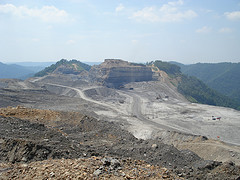
After occupying Gov. Steve Beshear’s office for the weekend, the sit-in protesters have galvanized coalfield residents and clean energy advocates across the nation to revamp the movement to end the 40-year nightmare of mountaintop removal once and for all.
In a joint statement, the Kentucky Rising activists declared: “We find it unacceptable for an elected official to sue a federal agency with taxpayer dollars on behalf of a multi-billion dollar industry that is responsible for poisoning the land, water, and people of Appalachia.”
“It’s disappointing that Gov. Beshear is choosing to play election-year politics with the lives and livelihoods of eastern Kentuckians,” the group said in a joint statement. “Political courage is rare nowadays, and sadly appears to be absent from our Governor’s Mansion. We continue to call on him to engage in a sincere, public dialogue about ending mountaintop removal and beginning a program of economic renewal for our miners and mountain communities.”
The protesters have been staying in the office since talks between them and the governor came to a stalemate on Friday afternoon, when Gov. Beshear finally agreed to meet with them after initially refusing to do so that morning. After repeated requests from group members, he pledged to travel to eastern Kentucky and inspect damage caused by mountaintop removal mining. Despite this, Gov. Beshear continued to express his steadfast support for both mountaintop removal and the coal industry.
A live stream of the sit-in at the governor’s office can be seen here.
Mardi Gras: Made in China screening 2/17
We are a couple of weeks away from Mardi Gras, also known as Fat Tuesday. If you are in New Orleans or right here in West Michigan you are likely to see people wearing bead necklaces.

Like many things we do in our consumer culture, most of us probably don’t know where these beaded necklaces come from and who makes them. This is one of the questions that the directors of Mardi Gras: Made in China are asking. The film does what many documentaries on globalization fail to do…..they get us to think about where the products we consume come from.
Mardi Gras: Made in China presents their case, not in a moralizing way, but in a creative and humanizing fashion. Viewers are first taken to a traditional Mardi Gras scene on the streets of New Orleans. The camera crew films people celebrating and then asks them if they know where the beads they are wearing come from. Everyone says that they don’t and then the film cuts to China, where we meet the young women who work long hours for little pay to thread the necklaces many of us wear.
In addition, the filmmakers show the young Chinese women how the product they are making is used in places like New Orleans. Their reaction is one of astonishment, since these workers had no idea what the Mardi Gras beads were used for.
This is what makes Mardi Gras: Made in China such a powerful film, in that they not only expose the exploitative realities of the globalized economy, they frame it in the context of cultural differences.
The film will be screened this Thursday, February 17, 7pm at the IATSE Labor Hall located at 931 Bridge St. NW in Grand Rapids. The film is hosted by the Grand Rapids branch of the IWW and is free and open to the public. A discussion will follow the film.
Watch the trailer:
 Grand Rapids Institute for Information Democracy