Transit Forum next Monday with area Legislators
On Monday, March 7 people will have an opportunity to engage legislators from Kent County on the matter of public transportation.

Disability Advocates of Kent County, Concerned Citizens for Improved Transportation, Faith in Motion, and Essential Needs Task Force are the sponsoring organizations that have invited various elected officials to provide an opportunity for the public to engage them on what kind of transportation needs there are in the county.
Grand Rapids and the surrounding municipalities will be voting on a transit mileage in early May, but this forum is not limited to that upcoming election.
The legislators who have been invited are: Representatives Lisa Posthumus Lyons, Ken Yonker, Peter MacGregor, Dave Agema, Brandon Dillon, Roy Schmidt, Thomas Hooker and Senators Mark Jansen and Dave Hildenbrand.
The event is a luncheon that costs $10, but scholarships are available for people who cannot afford it. If you need to apply for a scholarship do so before the end of this Monday, February 28 by sending an E-mail to lorie.t@dakc.us. To register you can also call Lorie Tensen at (616) 949-1100 ext. 230 or lorie.t@dakc.us, with the deadline also being tomorrow, February 28.
The event is Monday, March 7 beginning at noon and will take place at LaGrave Avenue CRC, 107 LaGrave SE in Grand Rapids.
Michigan Unions Rally in Lansing Against State Budget Proposals

Yesterday, over 1,000 people gathered in front of the state capitol in Lansing to participate in a solidarity rally with the current struggle in Wisconsin. The Lansing rally was just one of many that were organized across the country, where tens of thousands of people came together in support of working people in Wisconsin.
In addition to this being a solidarity rally for Wisconsin, working people in Michigan expressed their outrage at the budget proposal that Governor Snyder has put forth, which mimics Wisconsin on many levels.
Speakers at the rally addressed issues like tax breaks for the rich, further cuts to state employee benefits and pensions, further cuts to state education programs and the privatization of public services as a means to undermine organized labor.
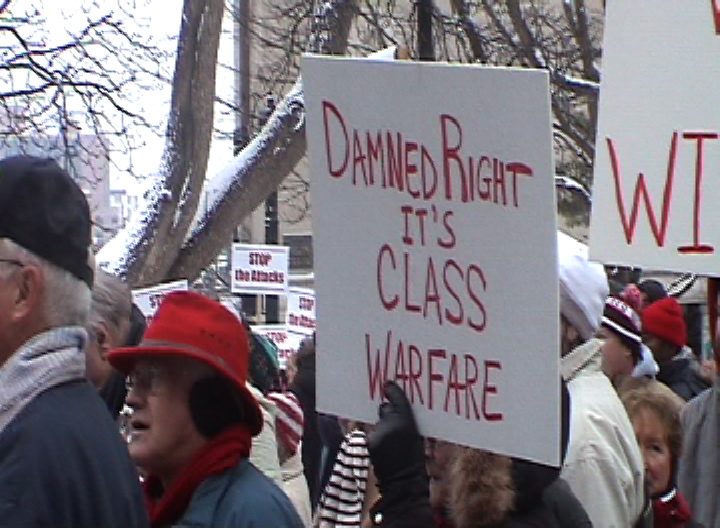
There were numerous unions represented at the rally, many with their own signs representing the UAW, AFSME, SEIU, MEA and the CWA. In additional to unions there were also people there fighting for public education, health care and against the tax cuts that Snyder has proposed, which they believe to be another benefit for the wealthy sectors of Michigan society.
While it was encouraging to see this many people come to Lansing to stand in solidarity with working people in Wisconsin, there was little evidence that this rally and those who organized it have a strategy to take on the State government’s effort to undermine the working class. There also wasn’t a clear enough analysis of what was going on or any indication of next steps from those who organized.
Having a strategy is certainly necessary if Michigan is to mobilize people the same way the Wisconsin has been able to. Michigan needs to have the kind of leadership and commitment from some of the elected officials to not only challenge the budget proposals of Governor Snyder, but also to honestly listen to and be advocates for the citizens of Michigan.
There was one creative element of the protest, where 5 people representing Billions for Billionaires came to thank the working people for allowing them to get richer. They even created their own song for the occasion.
Let’s Pollute: Oscar Nominee with a Conscience
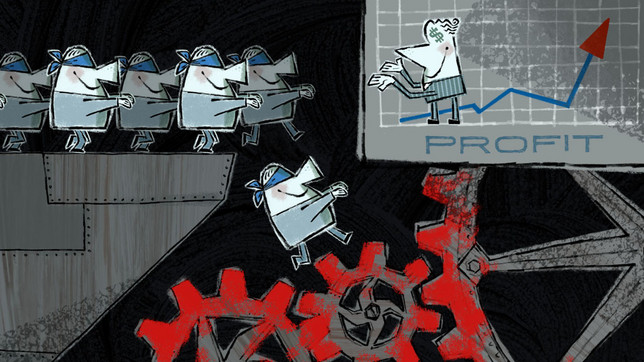
This week I was able to see some of the Oscar-nominated short animation films prior to the award ceremony tomorrow night. The entry from the United States was “Let’s Pollute,” the brainchild of Geefwee Boedoe, a former employee of Pixar. He wrote, directed, and animated the film on a $15,000 budget, editing the final version in a friend’s garage.
Boedoe also wrote jingles for the film and convinced his wife to do recordings of them. It took him three years to finish the six-minute short. After being rejected as an entrant in 10 film festivals, “Let’s Pollute” won an Oscar nomination last month.
The film is about the economic and social devastation of pollution in our society, but it’s presented in the artificial, upbeat style of 1950s and 60s educational films for children. “Pollution is our heritage and keeps our economy going strong,” the peppy narrator explains in the opening.
The introduction shows the history of pollution; how we initially tried hard without success to pollute the North American continent. It wasn’t always as “fun and easy” as it is now, the narrator tells us. Then we realized that “man needed a partner, an ally: he needed the machine.” It was this “wonder of waste” that helped us to get serious about pollution at last.
The second part of the film is the instructional part: it explains the simple rules of “how to be better polluters for a better blighted tomorrow.”

“Buy twice as much as you need,” the film advises, showing an American family at a huge discount store. One clip shows how to buy products with optimum packaging, as a man opens a case of chips, takes out box of chips, then a “fun-size” package from the box, and finally a tiny bag containing a single tortilla chip.
The film also instructs viewers to “throw twice as much away”—showing the family on a picnic, disposing of their plates, utensils, tablecloth, napkins, and picnic table. Then they roll up some Astro-turf and two fake trees and throw them away as well.
Moving twice as far away from your job is another piece of advice, showing how you can become a better polluter by having to drive longer to work every day. And you might even total your car in the process, creating even more landfill!
Leaving all the lights on in your house at the same time…shunning recycling…throwing away things instead of fixing them…are all great steps toward maximum pollution. But the really important thing, the film instructs, is to stop caring. “Remember,” the narrator says seriously, “you can always care less.”
The film also offers some wickedly funny glimpses of capitalists. It depicts environmental regulations as a menacing dragon destroying the progress of pollution, as it takes smokestacks in a chokehold. The film then explains why it is much better not to have any regulations at all, assuring us that we can trust the capitalists to always do what’s best for us. As the narrator says this, a group of consumers march like lemmings toward a giant set of crushing cogs. A capitalist stands on a platform in safety, urging them forward, with a chart behind him totaling up more and more profits.
You can read more about “Let’s Pollute” on the film’s official site and see screen shots on Facebook.
Speaker at GVSU addresses Race, Class and the LGBTQ Movement
Yesterday, the LGBT Resource Center at GVSU hosted nationally know activist and author Kenyon Farrow to speak at an open forum and for the ongoing Change U participants.
Kenyon has been involved in organizing, activism and writing around a whole range of topics such as HIV/AIDS, Queer politics, race and economic justice. He has worked for and with groups such as Queers for Economic Justice and the prison abolition group Critical Resistance.
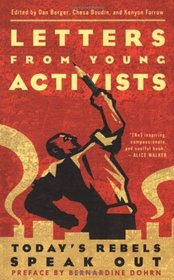
Kenyon’s writings have appear on numerous political blogs, he is co-editor of the book Letters from Young Activists: Today’s Rebels Speak Out and the upcoming A New Queer Agenda. The following article is based upon his afternoon talk on race, class and the LGBT movement.
Kenyon began his talk by saying that the four pillars of mainstream LGBT circles are: defense of marriage, gays in the military, Federal Hate Crime statues and the Employment Non-discrimination Act. Therefore it is important to think about what comes next.
These four issues are what in many ways define the “Gay Agenda” in the public mind. This is important for people to understand because it fits into the popular media construction of the LGBT community, which is epitomized by TV shows Will & Grace. Kenyon calls Will & Grace sort of a well fed and well scrubbed version of Leave it to Beaver, which is often what tends to represent everybody in the LGBT community.

This media construction of the LGBT community however is not rooted in any authentic historical understanding of how queer politics evolved. The lack of understanding about queer history was also seen in 2009, with the 40th anniversary of the Stonewall riots. Kenyon said that many of the upscale celebrations were happening on the heels of Sean Penn winning an Oscar for his role in the film Milk. When Penn accepted the award for his role about the gay liberation activist Harvey Milk he made the point that we all should support marriage equality. Penn statement and the upscale celebrations for Stonewall misrepresents the origins of the LGBT movement, according to Farrow.
The 1969 Stonewall riot was the watershed moment for the current LGBT movement, but much misinformation still surrounds what happened. One of the most commons rumors about the Stonewall riot is that when actress Judy Garland died “all the queens in New York were pissed,” which led to the riot. Kenyon provided people with a more authentic understanding of what took place.
Farrow said that the Stonewall Riots had more to do with how the police were targeting the LGBT community through harassment. Just before the riots New York City Mayor Wagner was lobbying for the city to be the next location for the World’s Fair. In order to make the city more appealing, Wagner decided to “clean up” the streets, even using existing laws to remove certain people from public areas.
Stonewall was one of the main bars that gays frequented. Wagner challenged bars on their liquor licenses. Existing laws also required people to wear at least two items of clothing that would be gender identifiers. Stonewall kept being raided and they eventually fought back. People were able to keep the cops at bay for 3 days during the riots. Kenyon also said that years later FBI documents showed that they thought that either the Black Panthers or the Weather Underground were involved in the Stonewall riots in some way, which demonstrates the power structures perception that the Gay community at that time was perceived as a threat. This, according to Farrow, should signify that the Stonewall riots are not the natural lineage of the current struggle for marriage equality.
After Stonewall groups like the Gay Liberation Front and many others tended to focus on issues like decriminalization and challenging the mental health institutions, which claimed that homosexuality was a mental disorder.
This is not to suggest that there were not more mainstream groups that were operating, but those groups were not calling for liberation. By the late 1970s and early 1980s, with the election of Ronald Reagan, it was seen as an electoral win of the neo-conservatives & the new Right. The Right talked about all the liberation movements of the 60s and 70s as representative of the destruction of the American family and American society. They constructed these movements as a threat to traditional, Patriarchal, normative family structures and as criminal elements.
Ronald Reagan’s election was seen by many as bringing back conservative family values. What was also happening at the same time was the surfacing of HIV/AIDS, what people were calling then the “Gay Cancer.” (Even though heterosexual needle drug users were already dying of AIDS) The right used AIDS as evidence that this was divine punishment for this free love/gay sex behavior.

Kenyons goes on to say that Queer politics at the time were left/radical, but certain factions in the Gay community started to believe the Conservative narrative about their being the cause of AIDS. Another component for the shift from a more radical queer politics was the fact that people of class and racial privilege also became involved because of AIDS. People with money and political clout began to support AIDS education and work, which shifted the politics of the LGBT movement to a more mainstream analysis.
In addition, according to Kenyon, another thing that happened in the late 70s/80s was that marketing data was showing that Gay magazine readers were a targeted group for products and lifestyles, which tended to mean White, Male, wealthier gay people. This is the root of what becomes the Human Rights Campaign and the National Gay and Lesbian Task Force, both of which are the more mainstream and privileged sectors of the LGBT movement.
This evolution of the LGBT movement continues in 1992, where Clinton became the first Presidential candidate to court the gay vote. He targeted them by saying he wanted to lift the ban on gays serving in the military. However, Kenyon points out that why he was courting the Gay vote Clinton was also polling as soft on crime, so he went back to Arkansas before the election to give an executive order to execute a black man on death row. Farrow makes the point that there was a disconnect between race and class issues that affected millions of people in the LGBT community, but it didn’t matter to the national groups since they were representative of a more racially and economically privileged sectors.
So what we begin to see with these new LGBT organizations is that they were making decisions about a national agenda without getting input from the grassroots. The rationale has been that if these issues can be won it will help the Right see that the LGBT community is ok and can be accepted, according to Farrow. He said that the suicide of numerous queer youth last year shatters this notion that they will be accepted.
Another issue that reflects this disconnect, according to Farrow, is the issue of gays in the military. What Kenyon fins problematic about this policy is that the US is immersed in numerous wars abroad where innocent people are being killed, even queer people who live in Iraq and Afghanistan. Farrow points out that since Iraq was a very secular country under Saddam Hussein, many gay Arabs would come to Baghdad, which was seen as the San Francisco of the Middle East.
Kenyon also pointed out that money spent on militarism was a racial and economic justice issue, which also negatively impacts the LGBT community across the country. Lastly, he pointed out that the military in general is not an institution that is about justice and equality. He gave the example of how mainstream LGBT groups missed the boat on this issue by referring to an incident before the US invasion of Iraq when some US soldiers wrote on the side of a bomb, “Die Iraqi faggots!” The Human Rights Campaign made an issue of the use of the word faggot, but said nothing about the use of the bomb.
On the matter of Hate Crimes legislation Kenyon pointed out that it was important to understand that the US has the largest prison population in the world, with the majority being people of color. This is the context of the US prison system, but there is little analysis of this from the LGBT community on the racist nature of the prison system. Hate Crimes legislation is also being abused he said. He gives the example in South Carolina where blacks kids being charged with assault, where the prosecutors are attaching anti-lynching penalties onto the charges, so sentences are increased by misusing hate crimes laws.
Lastly, Kenyon addressed the issue of the Employment Non-discriminatory policies, which do not address the structural problem of how people of color and LGBT folks are excluded from job opportunities. Kenyon said that the Human Rights Campaign (HRC) talked to the Labor movement about this issue, which in turn wanted support for the Employee Free Choice Act. Kenyon says that HRC has a business council, representing some of the largest multinational corporations, which convinced the HRC to not support the Employee Free Choice Act (EFCA). HRC eventually did endorse EFCA, but did not post it anywhere on their website.
Kenyon concluded by saying that this is the LGBT movement that has emerged, one that is mainstream and privileged with little regard for doing broader justice work. Farrow believes that if the LGBT movement is to survive and to be an important component in the liberation of people it will need to develop a more radical critique of society and take a strong stand on issues like economic justice, racial equality, anti-militarism and prison abolition, just to name a few.
Levin and other US Senators targeted with US Military Psy-Ops Effort in Afghanistan
On Monday, we reported on a talk given by Michigan Senator Carl Levin based on his 2-day trip to Afghanistan in January. Levin said that the US military occupation of Afghanistan was showing signs of progress.

Levin did mention in his talk that he met with US military leaders and some Michigan combat troops, but what Levin did not mention and probably did not know is that the US military was engaging on a psychological warfare campaign on him and other visiting US officials who came to Afghanistan for an update on the war.
According to an article by Michael Hastings in Rolling Stone magazine Lt. Gen. William Caldwell, a three-star general in charge of training Afghan troops, was charged with the psy-ops campaign. The Rolling Stone articles states that, “a military cell devoted to what is known as “information operations” at Camp Eggers in Kabul was repeatedly pressured to target visiting senators and other VIPs who met with Caldwell.”
It appears that the US military is becoming more desperate in its attempt to win public opinion on the 10-year US occupation of Afghanistan. Rolling Stone Reporter Michael Hasting notes, “Those singled out in the campaign included senators John McCain, Joe Lieberman, Jack Reed, Al Franken and Carl Levin; Rep. Steve Israel of the House Appropriations Committee; Adm. Mike Mullen of the Joint Chiefs of Staff; the Czech ambassador to Afghanistan; the German interior minister, and a host of influential think-tank analysts.”
This revelation certainly sheds light on the message that Levin delivered to people on Monday at the World Affairs Council hosted event and should give all of us additional cause for concern about what is really happening in the costly and brutal US occupation of Afghanistan.
Private Sector Group Wants to Change Local Government
This morning at the Kent County Commission meeting, the One Kent Coalition presented a proposal to transform the area from a collection of communities into a “powerful metropolitan body.”

These were the words of Nyal Deems, the main spokesperson for the One Kent Coalition. Deems said that the group is made up of private sector individuals who want to foster more economic development and make Kent County more competitive in the global market.
Deems told the County Commissioners, “it is time to update our governmental structure and to foster economic development. We have educational institutions, business leaders, philanthropic support, the medical mile and even Chicago is trying to mimic ArtPrize. But this isn’t enough.”
Deems, a former mayor of East Grand Rapids and a practicing lawyer cited several local elected officials who have suggested that local governments consolidate, officials like County Commissioners Roger Morgan and Sandy Parish, as well as Grand Rapids Mayor George Heartwell. “Corporate leadership is key in helping government leadership act accordingly. If Grand Rapids would merge with EGR, we would move from about 89th to about 25th in the country in terms of city size, which would give us more clout.”
The One Kent Coalition spokesperson then said the group has been working on a draft for proposed legislation that they would like the state legislature to adopt this year, which would allow for a ballot initiative to be put before Kent County residents sometime in 2012.
The responses from the County Commission were mixed, with Roger Morgan first saying that he “is always in favor of enhancing the private sector.” Morgan did say he had concerns about how this is worked out. He thought that consolidation of the core 6 cities is a step in the right direction, but there would need to be an inter-governmental agreement before moving forward.
Commissioner Saalfield raised concerns about drafted legislation and asked who would pay the taxes for the legislation and how will it effect services.
Commissioner Carol Hennessy said she also looked at other communities who have done similar forms of consolidation and cites a study from New York on governmental consolidation that did not work well. Hennessey also expressed concern that the One Kent Coalition folks were using phrases like corporate leadership and entrepreneurship and she wondered if this focus would detract from government delivery of services.
Commissioner Wawee asked where the funds will come from to make this consolidation happen to create a metropolitan government. Deems said they have raised some funds amongst themselves and mentioned that their group had talked to the Governor’s office, which might have money set aside in a pool to help.
This comment from Deems raised other questions and concerns from a few commissioners about the issue of transparency. Commissioner Koorndyk wanted to know who was part of the One Kent Coalition and if Deems could provide them with a list. Deems said that he could do that and this would relieve him from have to list the members at the meeting.
Commissioner Talen also raised the issue of transparency. He asked if there would be complete transparency from here on out, in terms of who is involved with the One Kent Coalition and where the money is coming from that they have raised. Deems said the group is not that formal, doesn’t meet every week and only came up with the drafted proposal near the end of 2010. This is of course did not answer Commissioner Talen’s question about the group’s commitment to transparency.

Grand Rapids Press reporter Jim Harger noted in a story yesterday that, “The West Michigan Policy Forum, a political action committee formed by the Greater Grand Rapids Chamber of Commerce, will be assigned the task of developing the enabling legislation that will lead to One Kent.” Harger also wrote that local lobbyist Jared Rodriguez who has done lobby work for the GR Chamber of Commerce and now works for the West Michigan Policy Forum will be the person who will lobby the state legislature on pushing this proposal forward.
In a story from this morning, Jim Harger with the GR Press does list who is part of the One Kent Coalition:
• Tom Butcher, Grand Valley State University
* Nyal Deems, former East Grand Rapids mayor
• Betsy DeVos, former state GOP chair
• Dick DeVos. former GOP gubernatorial candidate
• Jeanne Englehart, Greater Grand Rapids Chamber of Commerce
• David Frey, Grand Action
• Andy Guy, Wondergem & Associates
• Kurt Kimball, former Grand Rapids City Manager
• David Leonard, Spectrum Health Corp.
• Greg McNeilly, Windquest Corp.
• Marge Potter, former Kent County Commissioner
• Jared Rodriguez, West Michigan Policy Forum
• Milt Rohwer, Frey Foundation
• Peter Secchia, former U.S. ambassador to Italy
• Peter Wege, philanthropist
• Kate Pew Wolters, Steelcase Foundation
• Tim Wondergem, Wondergem & Associates
So, it seems that the same crowd of private business sectors that are part of the Chamber and the West Michigan Policy Forum are behind the One Kent Coalition. This should raise concerns for anyone who doesn’t want to give more power to the private business sector which has made clear that they want to eliminate the Michigan business tax, make Michigan a Right to Work state and make government work in their interests. This doesn’t sound like anything that would enhance democracy, but it does sound like it will benefit private power.
New Media We Recommend
Below is a list of new materials that we have read/watched in recent weeks. The comments are not a “review” of the material, instead sort of an endorsement of ideas and investigations that can provide solid analysis and even inspiration in the struggle for change. All these books are available at The Bloom Collective, so check them out and stimulate your mind.

Exile & Pride: Disability, Queerness and Liberation, by Eli Clare – Eli Clare’s collection of essays was both a refreshing and challenging adventure. Eli forces the reader to come to terms with the limitations of identity around gender, sexual orientation and physical ability. Eli challenges our use of words, our perceptions and our static categorization of how we name people. In addition, the author tackles race, class and environmental degradation in ways that make most attempts at inter-sectionality seem quite sophomoric. Exile & Pride is one of the South End Press Classics that has been revised since its original release in 1999.
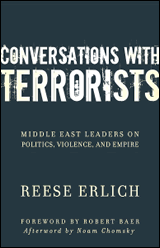
Conversations with Terrorists: Middle East Leaders on Politics, Violence, and Empire, by Reese Erlich – Reese Erlich has been doing investigative journalism for several decades now and each of his books reflect that style of writing. This new book is based on interviews with various political leaders in the Middles East over the past few years. With each chapter Erlich attempts to construct vibrant commentary on what leaders of groups like Hamas, the Taliban and Iran’s democracy movement think about not only the struggles in their respective countries, but how they view the US and other regional powers. Erlich also tries to re-frame our understanding of terrorism and what constitutes terrorism. This collection of essays is an important contribution for those wanting to come to terms with US policy in the Middle East.

Guantanamo: Why the Illegal US Base Should Be Returned to Cuba, by Fidel Castro – While many people who voted for Obama are disappointed that he did not keep his promise to discontinue using the US military base in Guantanamo, Cuba as a place of detention and torture for combatants in the “War on Terror,” Fidel Castro argues us that the land that the base inhabits should be returned to the Cuban people. Guantanamo is a well-documented attempt to argue the historical and legal reasons why the US military base that has inhabited that land for over a century should be closed. Castro teaches us a history lesson on how the land known as Guantanamo was appropriated by the US after they undermined the Cuban independence struggle from Spain at the end of the 19th century. The book also includes numerous source documents and short commentary from other Cuban historians.
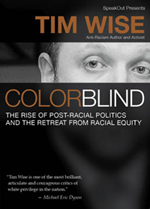
Colorblind: The Rise of Post-Racial Politics and the Retreat from Racial Equity (DVD) – This is a taped lecture by well-known anti-racist writer/activist Tim Wise from early 2010 and is based on his latest book Colorblind. In this lecture Wise confronts the White Liberal and Progressive community who think that the election of Barack Obama has catapulted us into a post-racial era. Wise, who uses biting humor and well sourced data, exposes the White Supremacist nature of US politics and what it really means for people of color, particularly Blacks and Latinos. This DVD is both challenging and inspiring and should be required viewing for anyone who claims to favor racial justice.
Celebrating a Black Radical – W.E.B. Du Bois

On this day in 1868, William E.B. Du Bois was born in Great Barrington, Massachusetts. The son of a Haitian landowner and a Dutch-African mother, he became an important American sociologist and intellectual leader, one of the first to study and address racism from every possible angle—through scholarship about race’s impact on the American culture, through an examination of the potential of integration, through a rejection of differences between the races, as a political issue, and as a pathway to cultural separatism.
The first Black American to earn a Ph.D. from Harvard University, Du Bois became a professor, founding the Department of Social Work at Atlanta University and also teaching at other colleges, including the New School in Greenwich Village. He was the author of thousands of articles and 22 books, including The Souls of Black Folk, John Brown, Black Reconstruction, and The Negro. His theory that African-American issues and the struggle for racial equality had made an indelible mark on the culture and politics of the United States was initially rejected and mocked. Du Bois fired back, writing, “The problem of the twentieth century is the problem of the color line.”
Also discredited at the time was Du Bois’ visionary exploration of the rise of crime among Blacks in the South, which he connected to their struggle to find a footing in a largely White society. Du Bois wrote, “[The] appearance of crime among the southern Negroes is a symptom of wrong social conditions–of a stress of life greater than a large part of the community can bear…To be a poor man is hard, but to be a poor race in a land of dollars is the very bottom of hardships.”
Part of what made Du Bois a target for heavy criticism among reactionary Whites was his attitude about his race. While Booker T. Washington encouraged Blacks to accept discrimination, be humble, and to take a back seat until Whites were ready to give Blacks a full place in society. Du Bois took the exact opposite view. He felt that Blacks should question Whites on every aspect of their attitudes about race, and continually challenge their actions and their sense of entitlement and authority. Only then could society hope to begin to break down to what Du Bois saw as the institutionalized and entrenched racism in American culture.

In 1900, Du Bois was one of the leaders of the first Pan-African Conference, held in London, and worked on four more conferences through 1927. In 1909, Du Bois became one of the founders of the NAACP and its publications director, although later his political views became too radical for the organization. During this same year he started his crusade against eugenics, declaring there were no inherent difference between people of different races. He embraced Communism and attempted to create a Communist wing of the New York State Legislature.
Du Bois was indicted in 1951 as “an unregistered agent for a foreign power.” A federal judge later ordered his acquittal, but his political views were further used in attempts to discredit him and his work among mainstream scholars. Martin Luther King addressed this hypocrisy head-on in a speech he made about Du Bois just four days before his own assasination:
We cannot talk of Dr. Du Bois without recognizing that he was a radical all of his life. Some people would like to ignore the fact that he was a Communist in his later years…In contemporary life, the English speaking world has no difficulty with the fact that Sean O’Casey was a literary giant of the twentieth century and a Communist, or that Pablo Neruda is generally considered the greatest living poet though he also served in the Chilean Senate as a Communist. It is time to cease muting the fact that Dr. Du Bois was a genius and chose to be a Communist.
In 1961, Du Bois was denied a passport to travel with his wife to Ghana. By this time, he had become completely disillusioned with the United States. Du Bois rejected this act of state repression by openly becoming a member of the Communist Party, claiming Ghanaian citizen, and traveling to Accra. He never returned to the U.S., dying in Accra two years later in 1963.
In his prose-poem “Credo,” Du Bois described his beliefs about racism and equality in these two beautiful passages:
I believe in the Devil and his angels, who wantonly work to narrow the opportunity of struggling human beings, especially if they be black, who spit in the faces of the fallen, strike them that cannot strike again, believe the worst and work to prove it, hating the image which their Maker stamped on a brother’s soul…
I believe in Liberty for all men; the space to stretch their arms and their souls; the right to breathe and the right to vote, the freedom to choose their friends, enjoy the sunshine and ride on the railroads, uncursed by color; thinking, dreaming, working as they will in a kingdom of God and love.
Levin talks up progress in Afghanistan, omits serious US war crimes

Earlier today Michigan Senator Carl Levin spoke on the GRCC campus about the current US policy in Afghanistan at an event organized by the World Affairs Council of Western Michigan. Just over 100 people were in attendance, with the audience being made up of World Affairs Council members, GRCC students and the general community.
Senator Levin only spoke for 20 minutes on the topic of Afghanistan and essentially reiterated the same comments he has posted on his website from a statement he made after a 2-day trip to Afghanistan in January if this year.
Levin’s main point of the short presentation was that there are signs of progress as the “regaining of former Taliban strongholds in Helmand and Kandahar” and the “increased confidence of the Afghani people in the Coalition forces and the Afghan National Army (ANA).”
Levin said he toured an area where some of the heaviest fight happened last year and where the Taliban have been defeated. He also emphasized that these areas are being “secured” by the Afghan security forces, which demonstrates the growing confidence that the Afghani people have in this new army.
However, this “evidence” that Senator Levin provided has been critiqued and challenged from numerous sources. First, the progress or confidence of the Afghan National Army and police forces that the US and Coalition forces have been training has come under question by a major study from the Afghanistan Analysts Network. This study contends that the Afghan security forces often fight against each other, attack civilians and are often infiltrated by Taliban insurgents who gain access to weapons and intelligence.

Another problem with Levin’s presentation of the so-called progress in Afghanistan is that he framed it as a debate between the Afghanis who support the Taliban and the Afghanis who support the US/NATO occupation. This leaves out a whole sector of the population that does not support either side in this war, people who are against both the Taliban and the US/NATO occupation. Groups like the Afghan Women’s Mission and RAWA have been organizing against the Taliban since they took power in the mid-90s and they have been consistent critics of the US/NATO occupation.
Another study, which challenges Senator Levin’s assertion that the US is making “progress” in Afghanistan due to the growth of the Afghan National Army, was released by the Afghanistan NGO Safety Office (ANSO). This study states that, “Foreign military assertions that security in Afghanistan is improving are intended to sway Western public opinion ahead of a troop withdrawal and do not reflect the reality on the ground.”
The ANSO report further states, “militant attacks were up 64 percent last year compared with 2009, and an average of 33 incidents had taken place every day. While violence may have decreased in some areas, it had dramatically increased in others.”
Another point that Levin emphasized was the President’s commitment to reduce US troop levels starting this July. “Afghan people have greater confidence in the Afghan security forces in defeating the Taliban and protecting the people as well as finding roadside bombs and disarming them,” said Levin. However, Levin provided no evidence or sources to support both the claims that the Afghani people have confidence in the Afghan Army or that they are providing security other than antidotal stories of Afghanis having picnics in some parts of the country.
Levin did admit that the central government in Kabul is failing the Afghan people, mostly because of their involvement in corruption. However, Levin did not address the inherent contradiction in this fact with the consistent support of the Karzai government even after the last elections were identified as fraudulent.
After Levin finished his presentation he fielded questions from the audience. The first question that dealt with Afghanistan was around the issue of oversight of US funds going to Afghanistan for reconstruction. Levin said we have to do better with oversight, since a lot of our funds have worked against us and not for us. However, Levin failed to mention the amount of US funding for private security forces and other private contractors and the level of corruption that exists. Levin is very familiar with this reality since the Senate Armed Services Committee released a major report in October 2010 on the funding abuses with private contractors.
One questioner asked if the July 2011 data for US beginning troop withdraw could just allow the Taliban to wait it out. Levin didn’t think this was the case since there will be more Afghan Security forces by then. He went on to say, “the Afghans are fighters, they kicked out Soviets.”

It is true that some Afghanis fought against the Soviet occupation in the 1980s, but the main forces fighting the Soviet Army was the Mujehideen, which was made up of Afghanis as well as people from other countries who embraced a more militant form of Islam. The Mujehideen received billions in US aid, but they were some of the most virulently anti-women sectors of Afghan Society, according to Sonali Kolhatkar’s book Bleeding Afghanistan. This is an important point since Senator Levin stated that the Taliban hate women. It is true that treatment of women under the Taliban was brutal, but it ignores the legacy of the US support of the Mujehideen’s treatment of women and the fact that the Karzai government has also perpetrated serious crimes against Afghani women.
Levin also failed to include in his comments the fact that in 2010 more US troops and more Afghani civilians died than in any previous year since the 2001 US occupation began. He also failed to mention the increased US Drones attacks against civilians in both Afghanistan and Pakistan, the ongoing use of torture at the US military base in Bagram and the increased construction of US military installations throughout Afghanistan.
If one were to take into consideration these factors and weigh them against the comments of Senator Levin one would be hard pressed to find “progress,” at least progress that would benefit the people of Afghanistan.
SB-1405 Crumples Under Public Protest

In its ongoing witch hunt against undocumented workers, the Arizona State Legislature introduced another immigration-related bill this month: SB-1405. This bill would require hospital admissions staff to confirm that any person being admitted for care is a U.S. citizen. If you fail to produce the proper documentation (such as your birth certificate—something you’re sure to have on you when you get hit by a bus—or your U.S. passport, or a certificate of naturalization), then an immigrations officer must be contacted.
If you are undocumented, you can get emergency care under SB-1405, but right after that, you will be arrested and deported. If you tried to get admitted to the hospital for some other reason—such as an operation or outpatient procedure—you proceed directly to jail and the deportation process; medical treatment would be forbidden by the new law.
If the hospital admissions staff or an emergency room doctor or nurse does not get a hold of ICE authorities, he or she will be arrested as well.
In explaining his rationalization for this legislation, Senator President Russell Pearce, father of SB-1040, insisted that he was protecting legal citizens, stating, “I get calls from doctors and nurses every day that work in the emergency room, talking about the abuse, the millions of dollars spent for folks who come in for pregnancy tests, sniffles…they [immigrants] use emergency room services as their primary care. When do we stand up for the taxpayers?…Quit inviting people over the border. We give them free stuff, free medical…enough is enough.”
 This is a fascinating claim, but one that doesn’t stand up to statistics. Although in Russell Pearce’s world, it seems only immigrants go to the emergency room rather than to primary care doctors, the fact is that most poor people, citizens or not, do the same. In a study done in the 1990s, folks using ER care because they had no alternative tended to have annual incomes of $10,000 or less (68 percent) and were usually unemployed (62.6 percent). There was no one predominant racial group that used ER facilities more than the others in this way; the conclusion was “members of racial and ethnic minority groups and those of low socioeconomic status often depend upon ERs as a regular source of care,” and cited Blacks and Latino/as as equally frequent visitors to emergency rooms. Blaming undocumented immigrants for over-stressed ER conditions in this country is ridiculous.
Among those who definitely weren’t amused were Arizona doctors’ and nurses’ associations. Dr. Lucas Restrepo of Phoenix went as far as the prestigious New England Journal of Medicine to publish his colleagues’ concerns. First and foremost, he stated it was unacceptable to criminalize doctors and nurses for practicing in a medially ethical fashion and for honoring the tradition of protecting patients, both from injury and from harm by others. Restrepo wrote, “This legislation, if unchallenged, will force health care providers to choose between the dignity of their profession and the indignity of violating the law.”
Arizona medical professsionals were even more vocal about the fact that driving people away from medical care for fear of deportation would create a health care crisis worse than the one already existing in the state. And hospital administrators objected to the idea of forcing their employees to act as unofficial immigration officers engaged in what amounted to a perpetual sting operation.
 Senator Pearce may have anticipated some backlash from the medical world, but nothing like the chorus of objections that poured into the media as soon as the bill was announced. In addition, there was another, more surprising group that immediately rose up to protest the bill: the Arizona church leaders. Reverend Carmen Guerrero, who last year rallied ministers and priests across the country to protest SB-1070, was already organized to decry SB-1405 as soon as it was launched. “[A law] that prevents a person from seeking medical help in any hospital is cruel, and I will not believe that God is not taking these injustices into account,” she said to the press.
The unified front of medical experts and church leaders, all hitting the media at the same time, worked. Legislators backed down, and a preliminary vote count showed that SB-1405 did not have enough support to pass. The bill slunk back into committee for rewriting, tabling, or eventual rejection.
One can only hope that when a bill like SB-1405 comes to Michigan—as it undoubtedly will—that our community, immigration advocates, and medical professionals put up as strong a protest as the one launched last week in Arizona.
 Grand Rapids Institute for Information Democracy