Energy Think Tank Expert unquestioned in Press story

Yesterday, the Grand Rapids Press ran a story headlined, “Dependence on Mideast oil costing U.S. dearly, expert says.”
The article is a preview of a talk that will happen tonight at Aquinas College by Rayola Dougher, the senior economic advisor for the American Petroleum Institute (API).
Dougher makes the claim that gas prices are going up because of the political instability in the Middle East. Press reporter Heidi Fenton does not question this assertion, nor does she seek out another perspective on the matter.
On top of the unquestioning claims about increasing gas prices the article also promotes the API staffer’s position that the US should import more of the petroleum from Canada, particularly from the Alberta Tar Sands. “It could more than double and account for more than one-fourth of all the oil the U.S. will need in the future, Dougher said. In addition the oil expert said importing this oil would create jobs since the petroleum from the tar sands would need to be refined in Texas.
The Press reported missed a huge opportunity here to practice basic journalism and ask questions about the claims made by API. First, there is no background information on the American Petroleum Institute. Readers of the Press did not find out that API organized groups of “energy citizens” to rally against the proposed climate legislation in the US in 2009.
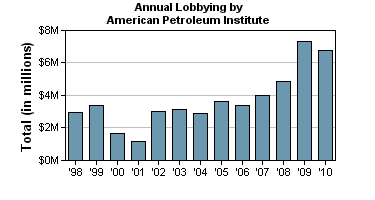 Secondly, there is no information in the Press story about the fact that API is fundamentally a lobbyist for Big Oil. According to the Center for Responsive Politics, API has spent between $4.5 million and $7.5 million on lobbying Congress in the past 3 years, spending $6,750,000 in 2010 alone.
Lastly, the Press article doesn’t tell readers anything about the Alberta Tar Sands project or the proposed Keystone XL Pipeline that would send the tar sands petroleum all the way to Texas. It would be important for people to know that the majority of the pipelines for the tar sands project from Canada to the US are under the operation of Enbridge, the company responsible for the oil pipeline disaster in Michigan last year.
A report from Tar Sands Watch provides some excellent analysis of the human and environmental cost of the Alberta Tar Sands project. You can see from the map all of the interlocking pipelines that are part of the tar sands project.

According to one activist website, “The tar sands are already slated to be the cause of up to the second fastest rate of deforestation on the planet behind the Amazon Rainforest Basin. Currently approved projects will see 3 million barrels of tar sands mock crude produced daily by 2018; for each barrel of oil up to as high as five barrels of water are used.” This source goes on to say that, “The tar sands mining procedure releases at least three times the CO2 emissions as regular oil production and is slated to become the single largest industrial contributor in North America to Climate Change.”
In addition, most of the pipelines that will transport the tar sands petroleum to places like Texas will go through Indigenous territories, according to environmental writer Andrew Nikiforuk.
So, while the premise of the article – that the US is too dependent on Middle East oil may have a bit of truth to it – the Press reporter never questions the claims that importing oil from Canada will benefit the US or how it will negatively impact the environment.
On Tuesday, March 8, women across the world will celebrate the 100th International Women’s Day. In Grand Rapids, the day will include two bridge walks to show solidarity with women in war- and conflict-torn countries.

Beginning at noon, Women for Women International will sponsor a “Join Me On the Bridge” gathering on the pedestrian bridge leading to the Gerald R. Ford Museum.
Then at 5 p.m., the Refugee Services Program in Grand Rapids is sponsoring a “Join Me On the Bridge” event which starts at 5 p.m. at Ferris State’s Riverfront Café, 219 N. Front Street. After events at the café, participants will march across the Fulton Street Bridge.
Originally, the IWD celebration was called International Women Workers’ Day, and was part of socialist countries’ culture to honor the women in their communities. The day had been chosen during the 1910 Second International, where delegates selected May 1 as an international workers’ day and March 8 as a day to honor women’s contributions and their equality in society.
The next year, the first IWD was celebrated by over a million people in Austria, Germany, Switzerland, and Denmark. In 1917, demonstrations by women factory workers on IWD in St. Petersburg triggered city-wide demonstrations the next day. The Tsar was forced to abdicate four days after that, giving a foothold for the first phase of the Russian Revolution. Lenin proclaimed International Women Workers’ Day a holiday in the Soviet Union in 1918.
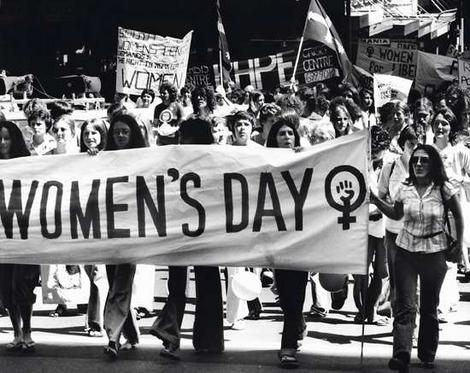 The day of celebration, however, was slow to be taken up by countries of the industrialized West. It was not really recognized in those countries until after the United Nations invited all its member states to proclaim and celebrate the day in honor of social justice and rights for women. That was in 1975.
In the United States, the women of the Socialist Party organized a widely attended IWD demonstration in 1911 after the Triangle Shirtwaist Factory fire in New York City. But regular celebrations were not common here until the 1970s.
Today, social and political awareness events are mixed with personal celebrations in many countries on March 8. In some countries such as Italy, Russia, and Albania, yellow mimosas are given to women to symbolize their sensitivity, hope, and strength. In many Balkan nations, gifts are given to women workers and speeches made honoring their contributions to society. In Portugal, restaurants are often closed to accommodate special women-only dinners and parties. The day was declared a public holiday in the United Kingdom in 2005.
March 8 is also a day of demonstrations of solidarity with women faced with specific challenges. In Poland, for example, women go out on a special strike called a Manifa on IWD every year to demand wage equity and to protest gender inequality. In Canada, there have been demonstrations and protests against the Catholic Church and the lack of separation of church and state on March 8 to raise awareness of the church’s institutionalized repression of women. In Detroit in 1996, 44 women were arrested at an IWD protest to show their solidarity for striking women workers from The Detroit News staff.
 In many countries, International Women’s Day is used to raise awareness of the many social challenges facing women: education, economic security, pay equity, social equality, gender discrimination, homophobia, physical and emotional abuse, and other health and safety issues.
March 8 has also become a day to acknowledge the places in the world where women are suffering in wars or military conflicts, or under religious restrictions and cultural repression.
A relatively new tradition is that of holding a bridge walk on March 8. In 2010, 108 of these walks were held in locations on four different continents. The marches commemorate those who have been killed in wars and military coups. They also honor the survivors who face the daily terror of physical danger, sexual violence, homelessness, intimidation by troops and military contractors, all while struggling to shelter and find food for their children.

Here in Grand Rapids, the first of two “Join Me on the Bridge” gatherings will take place from noon to 3.p.m. on the pedestrian bridge downtown adjoining the Gerald R. Ford Museum property. The purpose is to stand in solidarity with women in war-torn countries, women in the United States who face challenges, and also to meet members of the Grand Rapids community.
For more information on this Women for Women International event, contact Marie Maher Penny at mariemaher65@gmail.com or at (616) 241-5133.
The after-work event sponsored by the Refugee Services Program begins at 5 p.m. at the Riverfront Café. Attendees will listen to live music and hear the survival story of Florence Bish, a refugee from the Congo. Participants will also decorate a banner for use during the march. When the banner is ready, everyone will proceed to the Fulton Street Bridge for the bridge walk.
For more information about this “Join Me On the Bridge” walk, contact Chris Cavanaugh at ccava@lssm.org or at (616) 356-1934.
One Kent Coalition memo and the future of local politics
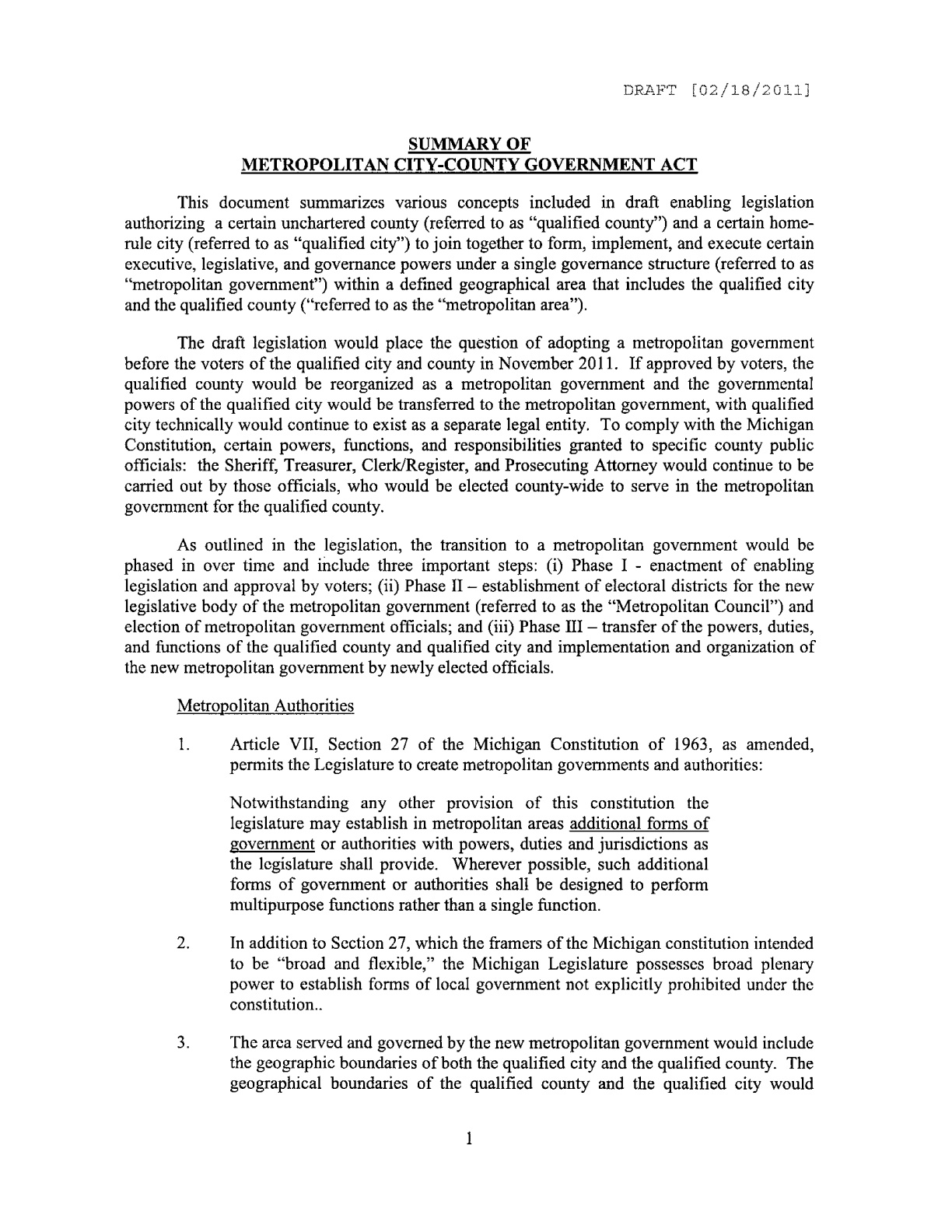
Last week we reported on the presentation by the One Kent Coalition to the Kent County Commission. The private sector coalition was proposing a new form of government that would consolidate Grand Rapids with other municipal bodies to have more of a metropolitan form of government.
At the presentation last week the One Kent Coalition spokes person did not provide many details and avoided the issue of transparency even when asked who was part of the coalition and where their funds are coming from.
The names of those on the coalition were revealed shortly after the meeting. The list includes: Tom Butcher (GVSU), Nyal Deems (former EGR mayor), Betsy DeVos, Dick DeVos, Jeanne Englehart (GR Chamber), David Frey (Grand Action), Kurt Kimball (former GR City Manager), David Leonard (Spectrum Health Corp.), Greg McNeilly (Windquest Corp.), Marge Potter (former Kent County Comm.), Jared Rodriguez (West Michigan Policy Forum), Milt Rohwer (Frey Foundation) Peter Secchia, Peter Wege, Kate Pew Wolters, Tim Wondergem and Andy Guy (Wondergem & Associates).
When asked about a timeline for when this proposed change of local government might happen the One Kent Coalition spokesperson said that they had hoped that the State Legislature would approve an amendment this fall, which would allow for voters in Kent County to decide on the matter in 2012.
Earlier this week Grand Rapids Press reporter Jim Harger did a follow-up story on the One Kent Coalition and even posted a memo from the group that lays out the metropolitan government proposal.

What is revealing about the memo is that it states on three different occasions that the One Kent Coalition envisions a November 2011 vote on this issue, instead of a whole year later. So why the discrepancy? Are people with the One Kent Coalition not wanting to be very forthcoming with their plans?
In addition to the issue of when voters might weigh in on this matter there is one other point from the memo worth mentioning. In the last paragraph it states, “The metropolitan authority would be except from several existing statutes that are viewed as barriers to streamlining the efficiencies of government or the consolidation of departments, offices and personel. However, with respect to existing contracts, and collective bargaining agreements, those contract agreements would continue in place until their cuurent length of term. The legislation would not alter vested pensions or retirement rights or merit system employment benefits but does not restrict future changes.”
It is important to note that this group is thinking about collective bargaining and government employee pensions. Since many of the people on the One Kent Coalition are involved in the West Michigan Policy Forum and that group wants Michigan to be a Right to Work state it is safe to assume that they would not endorse the unionization of employees within this “metropolitan authority.” That they say “but does not restrict future changes” should be seen for what it is, their intention to make the kind of changes that will diminish the rights that union labor has.
Yesterday, MLive ran a story that former Secretary of Defense Donald Rumsfeld will be speaking at the Ford Museum on Monday, March 7.
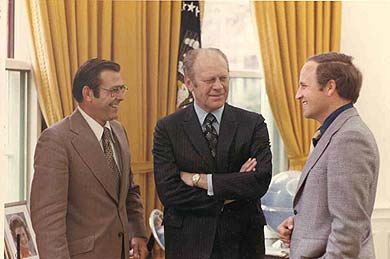
Rumsfeld is on a tour with his book entitled, Known and Unknown. The book title is based on a comment he made during a press conference while he was in the Bush administration, a comment that has been the source of much sarcasm.
The MLive story states, “Rumsfeld’s book has provoked controversy and criticism, most notably from Washington Post editor Bob Woodward, who said Rumsfeld tries to shift blame and whitewash his own errors of judgment.” The article doesn’t clarify what these “errors in judgment” might be or how widespread the criticism of Rumsfeld is beyond Woodward.
Rumsfeld’s History
It is no surprise that Rumsfeld would be speaking at the Ford Museum, since Rumsfeld was the Secretary of Defense under Ford. It was during 1975-76 that Rumsfeld made his mark as a proponent of militarism. Rumsfeld called for a $9 billion increase in the defense budget and began regular Congressional briefings on the growing “threat” of the Soviet Union, according to Andrew Cockburn’s biography of the former Secretary of Defense.
Cockburn also notes that Rumsfeld undermined disarmament talks with the Soviets and his anti-Soviet rumblings led him to a group of far right militarists known as the Committee for the Present Danger (CPD). The CPD had been around since the 1950s, but Rumsfeld and his associates helped to revitalize the organization.
Upon leaving the Ford Administration Rumsfeld turned to the private sector and became the CEO of the pharmaceutical company G.D. Searle & Company. It was during Rumsfeld’s tenure there that the company made millions with the creation of two sweeteners, Equal and NutraSweet.
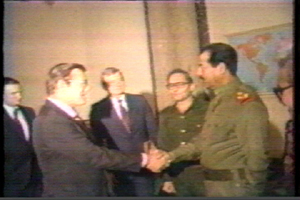
When Ronald Reagan was elected President in 1980, Rumsfeld’s politican connections would pay off and Rumsfeld was invited to be on numerous committees. However, the position that Rumsfeld most coveted during the Reagan years was his appointment as Special Envoy to the Middle East in 1983-84.
As Special Envoy to the Middle East Rumsfeld would solidify a special relationship between the US and Iraq’s leader Saddam Hussein. Rumsfeld made numerous trips to Iraq in 1983-84 to not only solidify relations with Saddam Hussein but to begin talks that would lead to a commitment by the US to provide weapons of mass destruction to the Iraqi dictator, all of which is well sourced in declassified documents by the National Security Archives. This is an important piece of history that was almost completely ignored in the build up to the US invasion of Iraq in 2002-03.
Rumsfeld and War Crimes
Shortly after George W. Bush was given the Presidency by the US Supreme Court in 2000, Donald Rumsfeld received a call to see if he wanted to have another go at being Secretary of Defense. Rumsfeld agrees and was part of the US imperial project from 2001 – 2006.
Rumsfeld was one of the proponents of going after Iraq within days of the 9/11 terrorist attacks, even though there was no evidence that Iraq had anything to do with it. Rumsfeld, like all of the high ranking Bush cabinet members, when on the offensive in 2002 to spread the propaganda that Iraq had WMDs. The Center for Public Integrity collected all of these statements in a report in 2008 to show that the WMD claims were false.
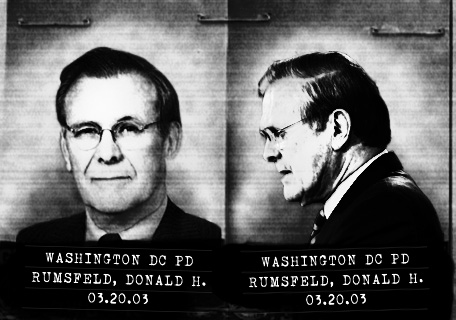
Unfortunately, the damage was done and the US invaded Iraq in March of 2003. The result of that 8-year war has left over a million Iraqis dead and the country in ruins. Rumsfeld and other high ranking officials in the Bush administration have been charged for war crimes because of the actual outcomes of the Iraqi policy from 2003 – 2008.
Numerous groups have filed lawsuits against Rumsfeld and other Bush cabinet members, lawsuits that began with Rumsfeld in 2006 when 21 Iraqi that fled to Germany charged the former Secretary of Defense with war crimes. Those charges and others like them have all made the following claims against Rumsfeld:
- Crime against peace – planning and carrying out a war of aggression.
- Complicity in the commission of a war crime – wanton destruction of cities and villages, devastation not justified by military necessity, ill-treatment of civilian population of or in occupied territory.
- Complicity in the commission of a war crime – torture, ill-treatment of detainees. Planned and executed invasions of Afghanistan and Iraq. Wrote memo instructing use of harsh interrogation techniques at Abu Ghraib.
Rumsfeld has not been back to Germany and even fled France in 2007 for fear of arrest by people who wanted to hold him accountable for authorizing torture in Abu Ghraib and Guantanamo.
Now Rumsfeld is on tour with his memoirs and hoping to re-write history. The Ford Museum will host him at an invitation only event and the local police will be present not to arrest him for war crimes, but to protect him from any public dissent. Such is the madness of the world we live in.
New Media We Recommend
Below is a list of new materials that we have read/watched in recent weeks. The comments are not a “review” of the material, instead sort of an endorsement of ideas and investigations that can provide solid analysis and even inspiration in the struggle for change. All these books are available at The Bloom Collective, so check them out and stimulate your mind.

Food Justice, by Robert Gottlieb and Anupama Joshi – The issue of local food is quickly becoming an issue that has entered the mainstream of American society. However, as the authors of Food Justice correctly observe, local food doesn’t necessarily translate into just food. In this new book the authors not only provide readers with an overview of US food policy since the Civil War, it grapples with the complexities of how we create a food system that is based on justice and not on profits. Their exploration of this issue is timely since agribusiness and food brokers like Wal-Mart are attempting to undermine the grassroots evolution of what can be called the food justice movement. The book provides local examples of what is working across the country and is an invaluable resource for anyone who believes good food is a right.

Crude reflections/Cruda realidad: Oil, Ruin and Resistance in the Amazon Rainforest, by Lou Dematteis and Kayana Szymczak – Crude reflections is part picture book and part inspiration. The authors have created a fabulous visual resource that captures both the beauty of the Amazon and the harsh realities of oil extraction. Add to this the fact that the book is in both English and Spanish and you have a wonderful resource about one of the most important human, environmental and political battles in recent years. The indigenous people living in Ecuadorian part of the Amazon have been involved in a life and death battle with the oil giant Chevron for years. Crude reflections documents this battle and demonstrates in text and with photography the courage of people committed to protecting the land they love.

Crossing Zero: The AfPak War at the Turning Point of American Empire, by Elizabeth Gould and Paul Fitzgerald – In the 10th year of the US occupation of Afghanistan there doesn’t seem to be an end in sight for the disastrous military campaign. Veteran Afghanistan experts Elizabeth Gould and Paul Fitzgerald provide a fresh analysis, with some historical background on why the US policy is doomed to fail. The authors particularly have timely analysis of the Obama administration’s counter-insurgency strategy, the expansion of the war into Pakistan, the Karazi government, the Talilban and a regional outlook on the conflict. For anyone looking for a sharp counter-argument to the White House on Afghanistan, Crossing Zero is an excellent resource.

Gasland (DVD) – Nominated for the 2011 Oscars for best documentary, Gasland is both an informative and moving film by Josh Fox. Fox, who grew up in a small, rural home in Pennsylvania is one day confronted by a large energy company who wants to buy his land to extract natural gas. Fox then discovers that his home sits on top of one of the largest natural gas deposits in the US. In addition, the filmmaker learns that the way that these energy companies extract the gas is through a process called fracking, whereby they drill holes and detonate explosives underground to create cracks that will allow the companies to easily extract the natural gas. However, the process also involves sending a chemical/water mix in the holes, which have created devastating results for anyone who lives nearby. Gasland is a superb film in that in both humanizes the victims of this practice and unwraps the devious web of politicians and corporations that have conspired to make this happen.
Bullying the topic of Forum in Grand Rapids
Yesterday there was an anti-bullying forum hosted by the Michigan Civil Rights Commission at Union High School in Grand Rapids. The forum was organized into two blocks of time, with a series of invited speakers who addressed the issue of bullying first, followed by public comment.
A representative of the Michigan Civil Rights Commission stated up front that they are using these kinds of forums as an opportunity to get input from the public in determining what kind of policy recommendations they will make.
The first person to address the Commission was Josh Lator, with the Michigan State Police. He addressed the emerging trends in technology and how that contributes to the ways in which bullying is manifested today in what is called cyber-bullying. Emerging technology shows that students are bullied not only at school, but throughout the day through digital formats – texting, Facebook, Twitter and other social media tools. Sgt. Lator gives the example of how a news story perpetuated bullying, by doing a story about a form of bullying that was caught on video and posted online. Unfortunately the TV station ran the video and told viewers that it would be linked off of their station’s website.
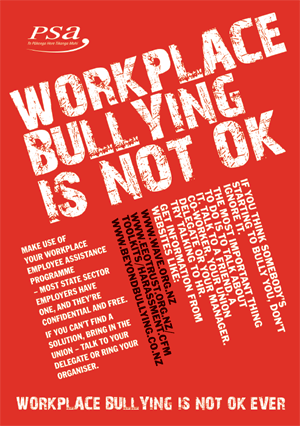
The next speaker to address the Commission was Michele Kominski, who talked about workplace bullying. Workplace bullying can come in the form of intimidating co-workers, harassment, making fun of and demeaning workers, often perpetrated by employers or supervisors. This is quite common and she cited a study that says that 13% of the workforce has been bullied in the past year. It is more common in some occupations, such as nursing where just over 50% of the nurses surveyed said they were bullied. One of the consequences of this for workers is higher absenteeism, which results in economic costs for employers. The speaker said that Healthy Workplace legislation would help to provide some advocacy for workers and a mechanism for accountability.
Another speaker was Martha Cortez Gonzalez, with the Hispanic Center of West Michigan. Their organization does a great deal of work with youth, which serves roughly 350 youth throughout the year. Gonzalez says that there are 5 distinct Latino gangs in Grand Rapids and this is an issue that they have done both research and work around. Of the 100 youth they have interviewed in the last 2 years all have said that bullying was something that they experienced as a tool that was being used by people who want them to either join a gang or because they were the target of gang activity. Martha also said that the local news media needs to make some changes in order to address their role in bullying. She stated that local media is culpable in these dynamics, particularly because of the vicious comments that are allowed online after articles where people can intimidate and harass people without giving an identity. This is an issue we have noted with the Grand Rapids Press online partner MLive.
Julio Woods, from the US Attorney’s Office for West Michigan spoke next. She suggests that schools need to have a protocol that will allow students to file complaints and to prosecute students who are engaged in bullying. This should include both verbal and digital forms of bullying. If there are no protocols it makes it difficult for students to report any incidents and depending on the severity of the bullying it can make it more difficult for students to get these forms of bullying reported to local law enforcement. She also offered those in attendance an online resource that her agency provides.
Dr. Walter Bramme with the Grand Rapids Urban League followed MS. Woods. Dr. Bramme addressed the issue of bullying from the perspective of race. Bramme began by speaking about the social construction of race and racism. Bramme cites Michele Alexander’s book The New Jim Crow as a reality for people of color since so many people of color are in the prison industrial complex. There are more people of color in the criminal justice system than there were enslaved people in 1860, according to Bramme. The Urban League director ended by saying that bullying is manifested towards Black youth because of the socio-economic dynamics that Black youth live under.
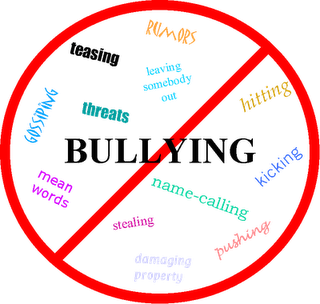
The next speaker was Larry Johnson, Security Manager for the Grand Rapids Public Schools. Johnson said that even if policy or legislation is mandated, resources need to be allocated in order for he policies to be enforced. Johnson makes the point that there are those that are bullied, those that do the bullying and those who are bystanders. He also says that there are schools that allow bullying to take place. Schools are a microcosm of the community, said Johnson, so if bullying is happening in the community, it is happening in the schools. “Therefore it must be a communitywide effort to address this problem.” He also mentions that besides students who bully, there are teachers and coaches who also engage in bullying.
Denise Brogan Kator with Equality Michigan followed Mr. Johnson. Denise made the point that LGBT students are bullied at a significantly higher rate than non-LGBT students in the state. The number one reason that students are bullied in schools is the real or perceived sexual orientation of students. She says that another important issue was how we model negative behavior in how we engage each other, both in our public discourse and on blogs. We need to encourage respectful dialogue around whatever issue that is being discussed. Michigan is only one of five states in the country that do not have any legislation to protect against bullying, according to Kator. She also said that there are those that oppose it because of the specific language about who are the primary targets of bullying, the LGBT community.
A Woman from the Wyoming Community Youth Coalition encouraged people to watch this short video on YouTube, which is about parents of a teenager, which committed suicide after being the victim of bullying.
After the video the Commission opened up the forum for public comment. There were several area students who are all part of the Grand Rapid Mayor’s Youth Council. The first student said that in recent polls she has seen that 2/3rds of kids have reported being bullied. She told how she herself would sometimes stay home from school to avoid bullying. She mentions that there is both verbal and physical bullying, with cyber-bullying being a part of verbal bullying. She also states that there is obvious bullying and what she refers to as secret bullying. An example of secret or subtle bullying is when we call kids names or make up things about kids, which is common on social media.
Another student, Colandra Jones who is a Senior at City High, spoke about examples of bullying at the high school. She also spoke about intervening that was effective and how that it is important for students, particularly older students who can set an example for younger students. She told those present that the Anti-Defamation League came to her school to do a diversity training. Colandra said that it was useful, but needed to be for a longer period of time. She also talked about her own victimization of bullying and stressed the need for eliminating the socio-economic dynamics that contributes to bullying. She also stressed that adults need to take students seriously, to listen to them and support them by engaging other parents, teachers and school administrators on this matter. “Everything you do, or don’t do has an impact!”
Another student on the Mayor’s Youth Council has had lots of experience with bullying, mostly because of his size or because he has been labeled a nerd. He learned to cope, but mostly he felt that people didn’t care because there was no mechanism in place to deal with it. He talked about an upcoming event called Kids Speak and the topic this year is how schools can eliminate bullying. Everyone was invited to attend the event, which will be on April 29th at City Hall in Grand Rapids.
A young Black student who is also part of the Mayor’s Youth Council spoke next. She talked about being bullied in school, which didn’t surprise her. What bothered her more was the inaction of the school despite her and her parents informing the school. She was hit in the face with a broken bottle by another student, which required her to go to the hospital. The perpetrator only got a 3-day suspension, because she verbally responded to the perpetrator. She now sees the same things happening to her younger sister.
Another student on the Mayor’s Youth Council says that he has been the victim of bullying most of his life. He said that the bullying began in kindergarten but it escalated during Middle School. He thought because of his being the target of bullying for so many years that he was the problem. He says that there is negative behavior and bullying in the Catholic Schools, even from the teachers who intimidate students.
After the last student spoke one of the Civil Rights Commissioners asks the audience about witnessing times when bystanders took action. Only a few people in the audience raised their hands.
There were also two women who spoke during the public forum. The first was a woman from Jenison who has kids in the public school system. She says that there have been numerous examples of bullying that her sons have been the target of. She has communicated with the school administration, but has not seen any concrete results. She was forced to go outside of the school system, which finally got their attention. This has been going on for years and the school district would not take action. “Why isn’t there a program, legislation to educate kids about the realities of bullying,” she asked the Commission. She spoke with a great deal of frustration about her kids not being listened to by school officials and even stated that she is considering removing her children from that school district.
The last woman to address the Commission said she has been a victim of bullying in the workplace for the passed four years. She spoke emotionally about her experience, which she has documented over 300 separate examples of being bullied at work. She pleaded with the Commission to help pass legislation in Michigan. She stated that she is currently off work and is afraid to go back for fear of continued bullying.
At the end of the forum the Civil Rights Commissioners let people know that if they or anyone else wanted to submit testimony or statements on the issue of bullying they could send them to this E-mail Millerj31@michigan.gov. People were also encourage to mail in statements to:
Michigan Department of Civil Rights
Attention: Bullying Forum Grand Rapids
Cadillac Place
3054 West Grand Boulevard, Suite 3-600
Detroit, MI 48202
The Story of Citizens United v. FEC: Why Democracy Only Works When People Are in Charge

Annie Leonard is at it again. The creator of the animated series the Story of Stuff just completed her newest short film, which takes a critical look at what is now known as Citizens United v FEC.
Citizens United v FEC was a Supreme Court decisions that essentially gave corporation (or any other entity) the ability to influence electoral politics with no real limited to campaign donations.
In the animated video The Story of Citizens United v FEC Leonard provides us with a fundamental understanding of the growth of corporate power and why this Supreme Court decision was anti-democratic and even provides us with ideas about how to challenge it.

On this day in 1794, Philadelphia shoemakers came together in solidarity to stop the erosion of their industry by greedy factory owners at the start of the Industrial Revolution. The workers formed The Federal Society of Journeymen Cordwainers, a union for leather workers and cobblers. By working together, they managed to regulate machinery use and still allow jobs for craftsmen who took pride in their handwork. For a decade, the organization was highly successful by maintaining a delicate balance: protecting the rights of its members while still allowing the industry to change and grow. In one example, the union helped factory owners cultivate a new market for shoes to the American South.
The union worked peacefully for 12 years, with the only reported problems some scuffles between striking workers and scab employees during a strike in 1805.
But factory owners kept pressuring the union to reduce its piece-rate wages so that they could rake in more profits. That was when the union took action and went out on strike after a proposed wage increase was rejected. The shoe factory owners retaliated by founding a management organization. And then they filed six separate lawsuits, which were heard together as one case, Commonwealth v Pullis. One charge was “criminal conspiracy”: the union, the court papers said, was a price-fixing scheme to raise member wages.
Another charge against the union was that it was a “coercive” and “violent” organization. The violence was a single potato—lobbed at a scab worker during the 1805 strike, it missed and broke a shop window. And the coercion? That was the union’s success at negotiating the first closed shop agreement in the United States. All people working at Society-staffed manufacturing sites had to be members of the union. If a factory owner tried to hire a non-shop employee, the union members working there could strike on the spot and walk out.
During the court case, the factory owners broke the law several times, the worst example of which was that they, not the government, paid the prosecuting attorneys—and at a much higher rate than court-appointed prosecutors usually made. Motivated by their increased takings, the attorneys launched several lines of attack in their six different suits. In addition to the conspiracy charges and charges of coercion and violence, another accusation was that “the workers were transitory, irresponsible, and dangerous,” and needed “the subject of judicial control.”

But the focus taken by the court was that citizens did not have the right to judge their own economic value, and did not have the right to object to any value placed on them by society—with society defined as the factory owners. Commonwealth v. Pullis is one of the first instances on record of the government showing preferential treatment to businesses over citizens. It is also the first American case where the courts were used to bust a union.
After a three-day trial, the Federal Society of Journeymen Cordwainers was found guilty of conspiracy to regulate the price of their labor. It was also noted by the judge that the union members had hampered “the just stewardship of the elite.”
The assessed fines bankrupted the union, so the factory owners were successful in their intent—and continued to use this strategy to their advantage until 1842. That’s when a ruling in the Pennsylvania case Commonwealth v. Hunt affirmed that unions were legal organizations, with the legal right to strike. Between 1806 and 1842, however, any member of a union could be charged and imprisoned on the grounds of conspiracy.
After 1842, capitalists found other ways to attack unions: through anti-trust suits, through court injunctions, through hired thugs who attacked people during union meetings. But a primary strategy in business owners’ line of attack against unions was broken when the judgment against the shoemakers’ union was found to be baseless and unjust
Guerilla Midwife documentary & Future of Birth in Michigan discussion
 Guerilla Midwife &
Future of Birth in Michigan
6 p.m. Doors. Film at 6:30 p.m.
Thursday March 3
Wealthy Street Theater
1130 Wealthy SE, Grand Rapids
Donations to International Cesarean Awareness Network (ICAN) and Bumi Sehat Foundation International
Why is a film about a midwife serving the poor in the Philippines relevant to the Grand Rapids community? A community with its own Medical Mile boasting some of the most high-tech obstetric services available today?
Because birth is not about technology. It is about humanity. Not just the human infant or its immediate family, but about how we weave the very fabric of our culture. That fabric is warped, frayed, weak and unevenly woven. Getting back to humane birth—birth where the mother is empowered by her community to give birth naturally and in connection to herself and her child—is an essential piece to the sustainability of a humane human race.
While US obstetric units boast about the latest in ultrasound imagery, fetal monitoring capability, easy epidurals and a technological answer to every complication that might arise, our infant mortality rates remain embarrassingly high (second highest on the world with African American babies twice as likely to die).
Our infants grow to be preschoolers diagnosed as bi-polar and elementary students medicated for ADHD. Autism is practically an epidemic. And, when technology and prescribed medicines don’t do the trick, our teens turn to illegal drugs. As adults, we struggle not only with a host of health issues but also with dysfunction in our relationships.
What does that have to do with birth? Everything. Come and find out why—and to see the simple alternative that could start us on the path to reclaiming wellness, real community, healthy relationships and a sustainable culture.
View the trailer:
Michigan Lobbyists Spent just short of $32 Million for 2010 in Lansing

The Michigan Campaign Finance Network (MCFN) just released new information on the top 200 Lobbyists in Michigan for 2010.
The Lansing-based watchdog group stated in a Media Release on Thursday, “Reported Lansing lobbying expenditures totaled $31,811,476 in 2010, according to figures compiled by the Michigan Campaign Finance Network from reports filed with the Michigan Department of State. That amount is down by $38,440, or one-tenth of a percent, compared to 2009 figures.”
According to the MCFN, “The top six spenders in 2010, and eight of the top ten, were multi-client firms. Leading spenders among the multi-client firms were; Governmental Consultant Services, Inc. ($1,279,804), Kelley Cawthorne ($1,151,760) and Karoub and Associates ($1,041,575).”
Other notable big spenders in the area of lobbying for 2010 were:
Blue Cross & Blue Shield of MI $259,378
Consumers Energy Co. $190,039
DTE Energy $180,602
MI Retailers Assoc. $160,607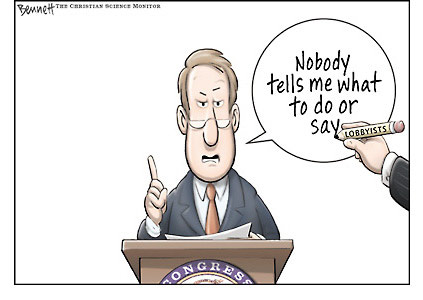
Ford Motor Co. $149,064
MI Beer & Wine Wholesalers $140,194
Michigan Farm Bureau $120,773
MCFN director Rich Robinson noted in the Media Release that there are still serious issues of disclosure and transparency for Lobbyist reporting in Michigan. “Michigan lobbying reports reveal less than those required by the federal government and several other states. The multi-clients report their client list, but they don’t report how much they spend representing each of them. And nobody is required to report travel spending less than $725 on behalf of a lobbyable official. Those are important gaps in disclosure that should be corrected by the legislature.”
 Grand Rapids Institute for Information Democracy