2024 Local News Monitoring Project: Misinformation, omission, denial and the failure to serve the public good
In 2024, GRIID conducted a study of four local daily news agencies – MLive, WOODTV8, WZZM13 & WXMI 17 – from January 1st of 2024, through Friday, December 20th, 2024.
The study looked at four critical community issues:
- Elections in Kent County and Grand Rapids – candidates, ballot initiatives and campaign financing
- Climate Change/Environmental Justice
- The Grand Rapids Public Schools
- Public Safety/GRPD
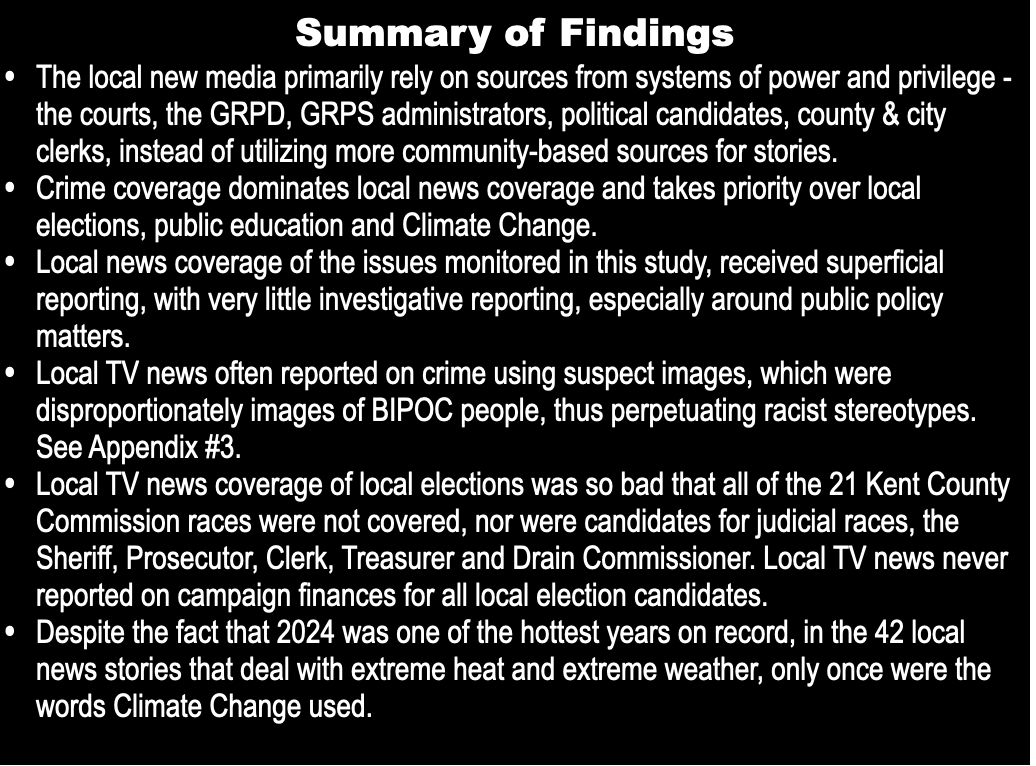
I tracked these four themed news stories from the online portals of each of the four news agencies. All of the hyperlinks to those stories are part of Appendix #1. In addition to monitoring all of these stories, I monitored the sources used in each story, the racial and gender make up of the sources used (only for TV stories) and how the stories were framed. All of this data is included in Appendix #2.
For the Public Safety/GRPD stories that I monitored, I also tracked images of crime suspects that appeared on the three local TV stations, which I include as part of Appendix #3
What follows is a breakdown of each of the four critical community issues that I monitored, with some content analysis.
Monitoring local news media is an important tactic that can help us all think about what kind of information we are receiving. The way stories are reported (or not reported) can influence public opinion, just as the sources that are use and they way local new stories are framed.
It is true that we live in an information saturated world, but what is different about local news media is that they might be the only sources of information we have access to regarding what is happening in our community. Understanding this fact can help us see the tremendous responsibility local news agencies have to serve what the Federal Communications Commission refers to as, “serving the public interest.”
In addition, it is important that we not just focus on individual news stories and what they mean. What media analysis have been saying for years is that we need to pay attention to the cumulative effect of coverage around issues like policing, public education, local elections and climate change. You can access the full 132 page report here.
GRIID Class on the Prison Industrial Complex in Kent County Week #1
I am always grateful for being able to facilitate these kinds of conversations and investigation into systems of power and oppression in this community. I want to share what we will be talking about in the GRIID class over the 8 weeks that it will occur, so here is a summary of week #1.

After everyone introduced themselves and talked about why they wanted to be part of this conversation, everyone then talked about their own lived experience with the PIC. The personal stories were powerful and we talk about the commonalities in each story and the fundamental differences.
After sharing personal stories we began to discuss an article that was written by Angela Davis. Davis was one of the first people to name the Prison Industrial Complex (PIC). The article from Davis was written a few decades ago and I purposely chose this article since it both demonstrates how things haven’t changed that much since the 1980s, but also to get people to think about how important it was for the idea of the PIC to become part of how we think about cops, the courts and jails/prisons.
 The other reading for week #1 was a chapter from the book, Abolition Now!: Ten Years of Strategy and Struggle Against the Prison Industrial Complex. We discussed chapter 12 from longtime activist/author Dylan Rodriguez, entitled, Warfare the terms of Engagement, which you can access here.
Some of the main themes that Rodriguez addresses are the role of the Non-Profit Industrial Complex play in regards to the Prison Industrial Complex, the use of tax money to fund punishment rather than meet the needs of people. Rodriguez also talks about the need for there to be collective resistance to state violence and the PIC. One powerful quote from the chapter is:
Our historical moment suggests the need for a principled political rupturing of existing techniques and strategies that fetishize and fixate on the negotiation, massaging, and management of the worst outcomes of domestic warfare.
I also shared with the participants the graphics included in this post, which are visuals that can help us understand the Prison Industrial Complex in Kent County. These graphics can be used to help us map out what the PIC looks like in Kent County, since the PIC includes cops, the courts, the jail, and the various private contracts that are profiting off of the PIC when they provide resources and technology that are used by cops, courts and jails.
Over the 8 weeks of this class, we will collectively map out what the PIC looks like in Kent County and possibly create popular education resources that organizers can use to educate and mobilize people to dismantle the PIC in Kent County.
A Power Analysis of the Grand Rapids Public Schools
For several years I have been writing about what I refer to as the Grand Rapids Power Structure. Since November, I have been doing some public presentations that provide a power analysis of Grand Rapids. You can access the slides I have been using for these presentations here.
Last Friday, I was invited to present a power analysis of the Grand Rapids Public Schools to a student union known as SALT – (Student Association for Leadership and Transformation). What follows is what I presented to the student union, but a more expanded analysis because of time constraints during the student union meeting. You can download all 6 slides here.
GRPS Power Analysis
In order to begin to talk about a power analysis about the GRPS, we have to start with state education policy and the structures & entities that craft and influence those policies, which is in the first slide below.
First, the Michigan State government holds the most power, since they determine funding for public education throughout the state, along with adopting policies that impact public education and curriculum guidelines. The State House and the State Senate both have Education Committees, which are the first people to discuss proposed legislation or to craft legislation on education matters. If you want to see how state policy makers are voting regarding education policy, you can go to michiganvotes.org, click on votes, then in the topics menu click on education and chose which year you want to look at, then hit the search button. You should never take seriously what politicians say, we should judge them on their voting record.
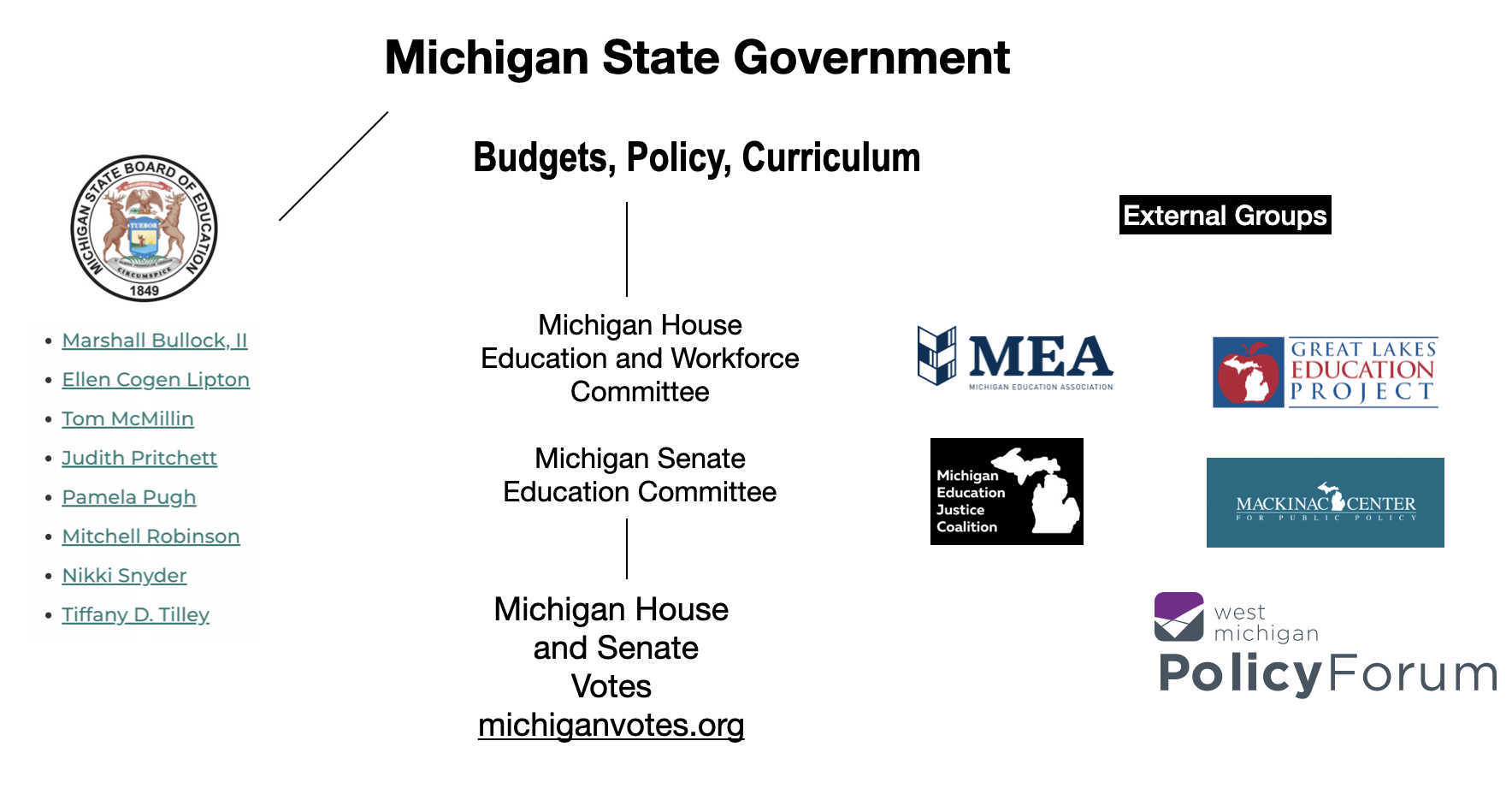
Next, there is the Michigan State Board of Education, which is also included in the slide above. You can access information about the State Board of Education here, along with reading past meeting minutes and learning a bit more about the members of this board.
After the State Education power structure, it is important to look at external groups that also seek to influence Public Education policies in Michigan. There is the Michigan Education Association (MEA), which is the public school teachers union. There is also the Michigan Education Justice Coalition. Both of these groups work to advocate to improve the Public School system in Michigan.
Then you have organizations that inherently oppose public education and work to undermine it. First, there is the Great Lakes Education Project, which was created by Betsy DeVos right after her failed attempt to get a school vouchers ballot initiative passed in 2000. Another organization that seeks to undermine public education is the Mackinac Center for Public Policy, which I have written about over the passed 15 years. Lastly, there is the West Michigan Policy Forum, which has pushed regressive public education policies for more than a decade, along with the fact that it is an organization that grew out of the Grand Rapids Chamber of Commerce and is made up of members of the GR power structure.
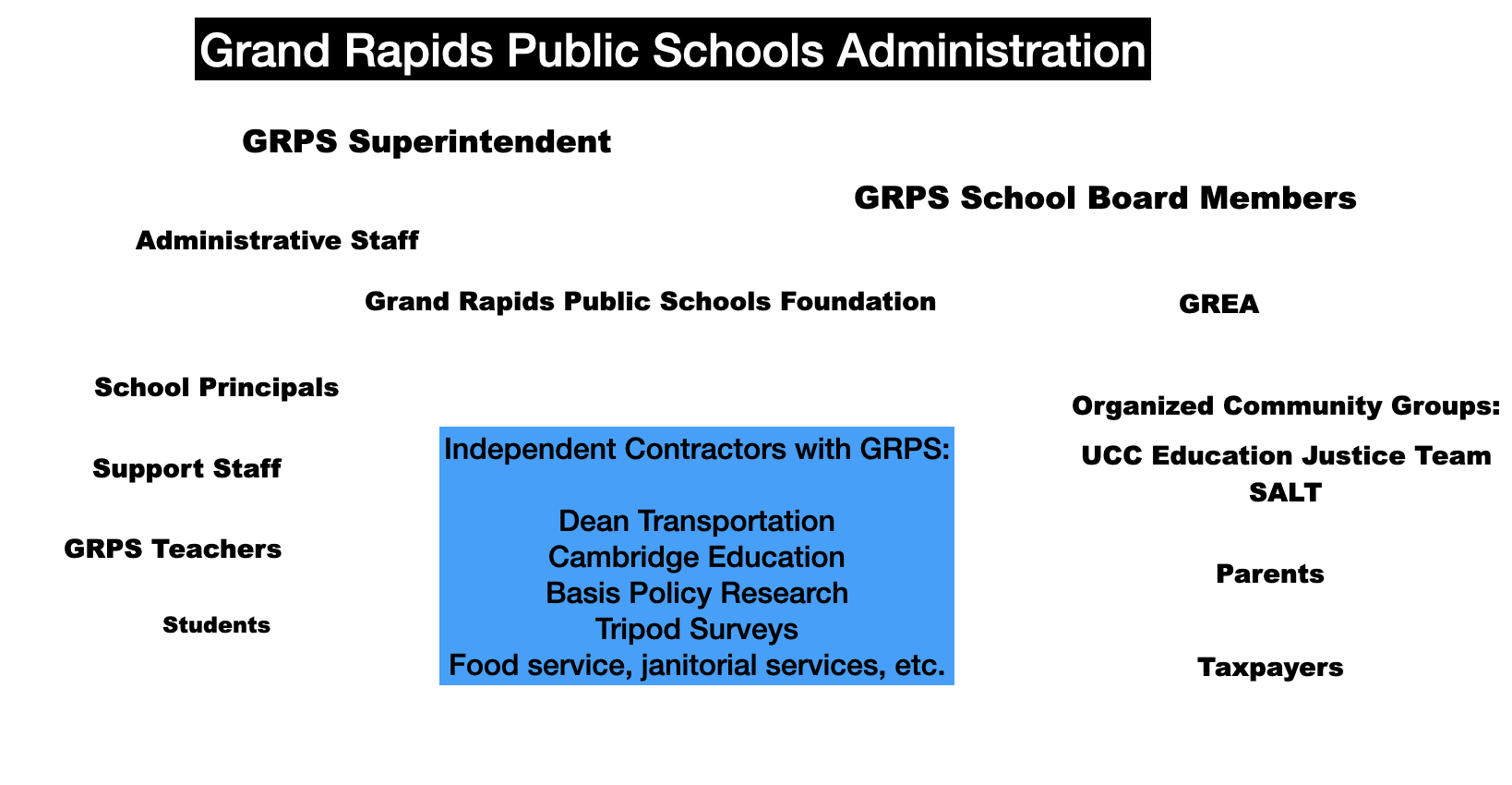
The power of the Grand Rapids Public Schools resides primarily in the Superintendent, which is currently Dr. Roby. Dr. Roby has an administrative staff that works for her, then there are school principals, teachers, support staff and students. The more that teachers and students are organized, the more influence they can have pub school policy.
Next is the GRPS Board of Education, which is a 9 member board that holds public meetings on a regular basis. For anyone who has ever attended school board meetings, you know that they are not the most democratic spaces, where the superintendent and the board members talk, but there is a public comment period, where people get 3 minutes to speak or two minutes if there are lots of people wanting to speak. Like any elected official, we should not judge GRPS board members on their rhetoric, but on their voting record and campaign finances, which you can find in the slide here below.

Then there are organizations in the community and connected to the GRPS, which are inherently attempting to make the Grand Rapids Public Schools not only more democratic but more horizontal, especially when it comes to decision-making. There is the GREA, which is the union that represented teachers in the GRPS. There is also the student union known as SALT, along with the Education Justice Team with the Urban Core Collective (UCC). The UCC group has been organizing for several years in the community and has empowered parents, students and community members to become more involved with the the Grand Rapids Public Schools. GRIID has written about this group, along with providing a link to their most recent community report card on the GRPS district.
There is also the potential for parents, community members and taxpayers in Grand Rapids, all of which have a stake in how the GRPS operates and how it should function to serve students.
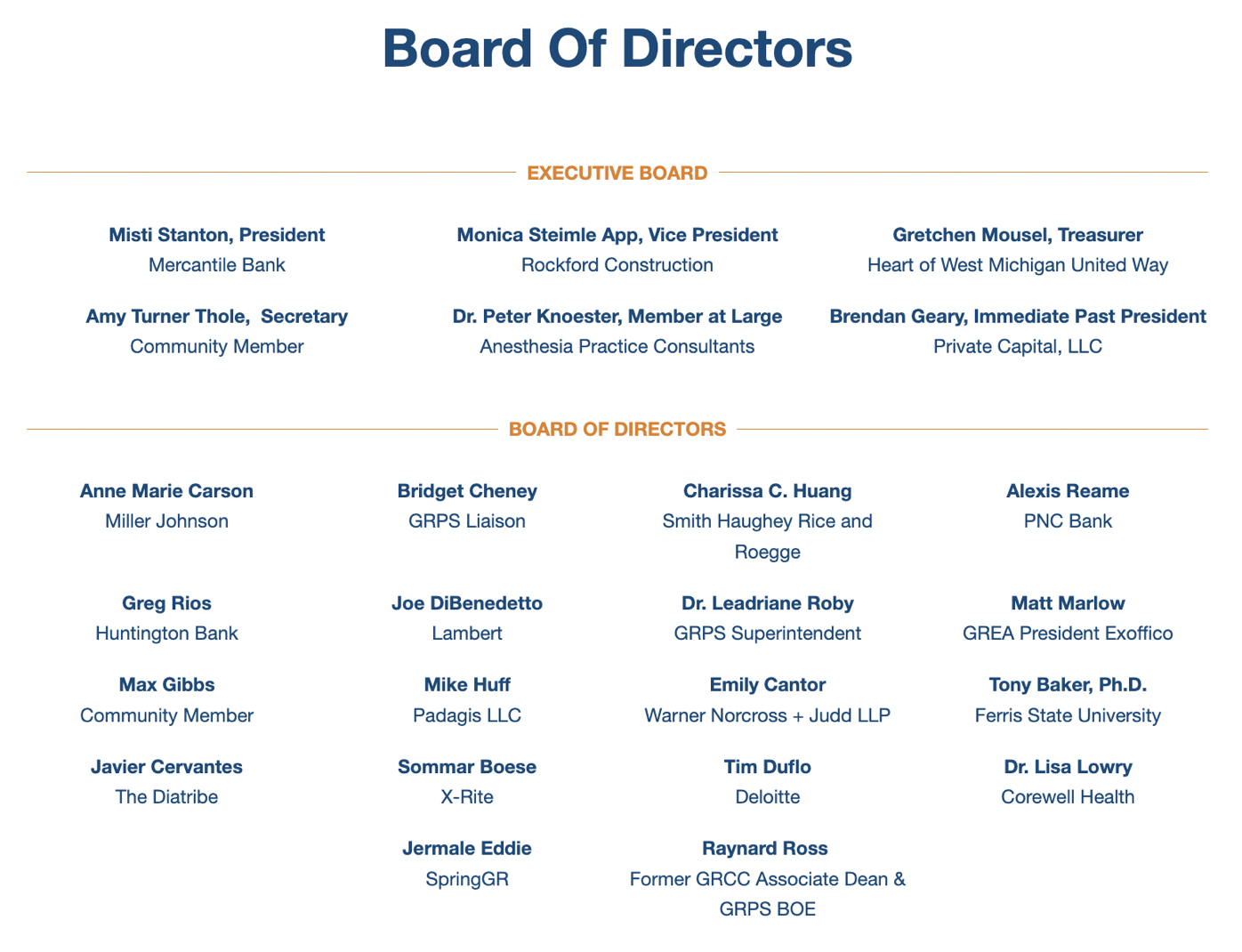
There is also the Grand Rapids Public Schools Foundation, which was created in 1993 for the purpose of raising funds for the school district outside of what the state budget provides and what taxpayers in Grand Rapids contribute. In the slide below, you can see who sits on the board of this foundation, which is primarily represented from people from the professional class and not so much from regular people. The foundation also has a history of receiving large sums of money from members of the GR Power Structure, like the DeVos family foundations, which I have also written about. Unfortunately, the funds raised by the GRPS Foundation are not very transparent and we don’t know what can of influence large donations have on GRPS policy. Several years ago the group Grand Rapids Education for Justice submitted a FOIA request on how private contributions were being used by the GRPS, which you can find here.
Lastly, there are the vendors/entities that the GRPS has contracts with, such as Dean Transportation. It is worth noting that the GRPS has shifted to using more and more privatized services, like transportation and janitorial services over the past few decades. In addition, it has not always been easy to get information about contracts that the GRPS has with private entities, which makes it hard for community groups to engage in accountability.
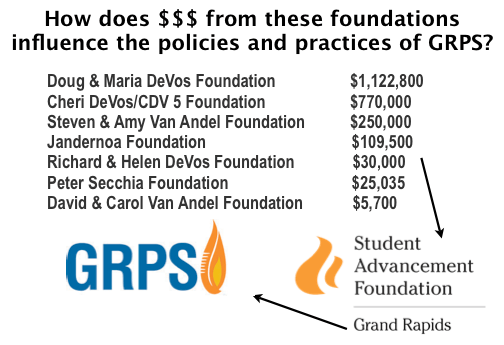
Based on the conversation that I had with the student union on Friday – many of who felt that the GRPS leadership was not paying attention to them, nor acting on their demands – it seems that there needs to be more pressure applied to meet the demands of the various groups that have been presenting in recent years, along with the need to have a more horizontal and inclusive decision making process that doesn’t rely only on the superintendent and the school board.
Palestine Solidarity Information, Analysis, Local Actions and Events for the week of February 9th
It has been 16 months since the Israeli government began their most recent assault on Gaza and the West Bank. The retaliation for the October 7, 2023 Hamas attack in Israel, has escalated to what the international community has called genocide, therefore, GRIID will be providing weekly links to information and analysis that we think can better inform us of what is happening, along with the role that the US government is playing. We will also provide information on local events and actions that people can get involved in. All of this information is to provide people with the capacity of what Noam Chomsky refers to as, intellectual self-defense.

Information
A (Fragile) Ceasefire Begins, the War on Palestine Continues
Columbia students just sued the university for attacks on pro-Palestine activism
US Is Complicit in War Crimes, HRW Warns Ahead of Trump-Netanyahu Meeting
International Fugitive Benjamin Netanyahu Goes to Washington
Israeli genocidal violence reaches West Bank
The BDS movement calls for a Dump Cisco Day of Action, February 11
Analysis & History
The Real Toll of the War in Gaza: A Conversation With Two Doctors
How to protect ourselves from Trump’s Palestine advocacy crackdown
Image used in this post is from the https://bdsmovement.net/Dump-Cisco-Day-Of-Action-Feb-11
I know that there is a lot of activity and anxiety about the Trump Administration’s call for mass deportation of undocumented immigrants. There is also some excellent responses to this threat, especially coming from organized affected community groups like Mijente, the Detention Watch Network, and No More Deaths working across the country.
In the Grand Rapids area there is the immigrant-led organization Movimiento Cosecha GR, and their partner group, GR Rapid Response to ICE.

While it is important that we take action in the present to resist the threat of mass deportation, we need to recognize and come to terms with the history of US immigration policy. US immigration policy has always been rooted in white supremacy and xenophobia, plus the cruel and brutal US immigration policies have been historically bi-partisan.
I put together these 13 books (there are lots more that I could add to this list) because I believe it is crucial that we come to terms with this history for a variety of reasons. However, the main reason is because we can’t abandon the undocumented immigrant community, the affected community, when Democrats occupy the White House. The Obama and Biden Administrations both deported ore immigrants than the first Trump Administration.
What follows are the titles of these 13 books, plus a brief description of what each book talks about.
Unbuild Walls: Why Immigrant Justice Needs Abolition, by Silky Shah – The author has been a longtime organizer around immigrant justice issues and discusses why the immigrant justice movement needs an abolitionist framework moving forward.
All-American Nativism: How the Bipartisan War on Immigrants Explains Politics as We Know It, by Daniel Devir – This book methodically documents the bi-partisan nature of anti-immigration policies in the US, especially since WWII.
Resisting Borders and Technologies of Violence, edited by Mizue Aizeki, Matt Mahmoudi and Coline Schupfer – In this anthology, you will learn about all of the current technology being use to monitor and surveil immigrants across the globe and which corporations are profiting off of the cruelty of immigration policies worldwide.
Storming the Wall: Climate Change, Migration, and Homeland Security, By Todd Miller – The author of this book has done the best job of any writer to show how borders and immigration policy are tied to foreign policy and the Climate Crisis. People flee their countries for political, economic and increasingly climate reasons.
No One is Illegal: Fighting Racism and State Violence on the U.S.-Mexico Border, by Justin Akers Chacon and Mike Davis – The co-authors not only provide a framework for why we shouldn’t see people as illegal, they talk about the context, the reasons why so many people are crossing the US border from Mexico.
American Intolerance: Our Dark History of Demonizing Immigrants, by Robert Bartholomew & Anja Reumschussel – This is an excellent book that looks at how numerous immigrant communities have been treated harshly throughout US history, based on the policies implemented over the past 250 years.
The End of the Myth: From the Frontier to the Border Wall in the Mind of America, by Greg Grandin – Radial Historian Greg Grandin challenges us in this book to look at how US expansionist practices has always determined borders and why they are rooted in an imperialist strategy.
They Take Our Jobs! And 20 Other Myths About Immigration, by Aviva Chomsky – This book methodically deconstructions the anti-immigrant talking points of the past 2 decades and provides hard data and analysis to counter these myths.
Undoing Border Imperialism, by Harsha Walia – A longtime organizer, Walia helps us understand how borders are inherently imperialist and how we can organize to undo border iperialism.
Not “A Nation of Immigrants”: Settler Colonialism, White Supremacy, and a History of Erasure and Exclusion, by Roxanne Dunbar-Ortiz – Indigenous scholar Dunbad-Ortiz provides us with a power critique that dismantles the widely held belief that the US is a nation of immigrants.
The Deportation Machine: America’s Long History of Expelling Immigrants, by Adam Goodman – This is best book on the US practice of deportation since the country began using deportation as a strategy.
No Wall They Can Build: A Guide to borders & migration across North America, by CrimeThink – This CrimeThink book not only deconstructs the absurdity of borders walls, it provide a robust answer to the root causes of immigration from the southern border.
Abolish ICE: A Passionate Plea for a More Humane Immigration System, by Natascha Elena Uhlman
Lastly, for those who are interested in learning about the history of US immigration policy, GR Rapid Response to ICE is hosting a presentation on Thursday, February 27, fro 6:30 – 8pm at Fountain Street Church. The presentation is entitled, A People’s History of US Immigration Policy.
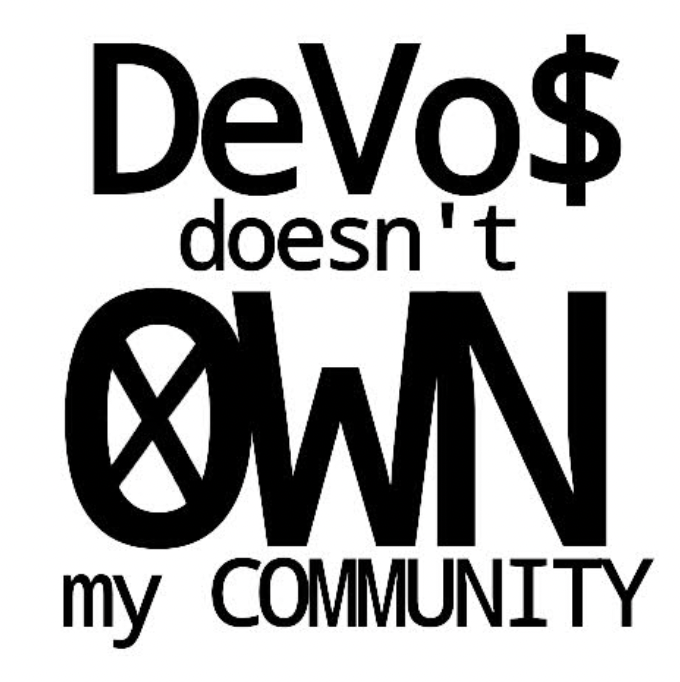
Why are we not more pissed off with the DeVos family regarding the shit show that is the Trump Administration?
 For anyone who is really paying attention to what the Trump Administration has been doing over the past two weeks, it is likely to elicit feelings of anger, depression, frustration and a lack of hope.
While I have been experiencing some of the same feelings, I also have been trying to make distinctions between rhetoric and reality. Trump is a master at rhetoric, but often his rhetoric is not real or even factual. I believe his rhetoric is both ideological, which is meant to speak to his base, but it is also a means to elicit responses from those who have not completely been propagandized……those who haven’t yet drank the KoolAid.
As someone who tries to pay attention to history and learn from it, I am reminded that this is not the first time that members of the Capitalist Class, even those who are billionaires, have inserted themselves into electoral politics. In fact, as Howard Zinn and other radical historians have pointed out, the US political class has been dominated by the Capitalist Class from the very founding of this country, both in terms of campaign financing and running as political candidates.
The group Americans for Tax Fairness published a report late last year, where they documented the 150 families who spent the most during the 2024 Election cycle, with three quarter of the money going to the Republican Party, candidates and Political Action Committees. This same group also published a useful spreadsheet on these 150 families, which you can find here.
If you look down the last, you will see the DeVos family listed at number 49. The combined about of money that the DeVos family members contributed to the GOP in the 2024 Election cycle was $7,038,500.00. The spreadsheet lists 9 different DeVos names, but Betsy and Elizabeth are the same person, as is Cheryl and Suzanne. This is because they both make campaign contributions using different names they go by.
What follows are detailed campaign contributions from the DeVos family members cited in the Americans for Tax Fairness report. The data comes from Open Secrets.
 So why are we not confronting the DeVos family?
Considering the fact that the DeVos family is number 49 of the 150 families from the Capitalist Class in the US that contributed over $7 million to the GOP in the 2024 election cycle, it would be safe to say that they are the member of the Billionaire Class in Grand Rapids that is most responsible for the new Trump Administration locally.
If we acknowledge this fact, then why are there no protests and no rage being directed at the DeVos family? Why are we not organizing a campaign to expose them and to undermine their comfort? What is it going to take before we take action action the people who have imposed upon us this nightmare reality we find ourselves in?
Taxing the rich is a nice sentiment, but that is really low hanging fruit. We need to make members of the Billionaire Class, like the DeVos family, feel uncomfortable and let them know that we will not tolerate their efforts to expand their wealth while so many in this community are just trying to survive. The DeVos family directly contributed to making sure that Donald Trump became President again. Why are we not more pissed off about this family?
8 things you can do right now in Kent County to be in solidarity with immigrant communities
The Trump Administration is continuing to expand the role and function of Immigration and Customs Enforcement (ICE), which is causing tremendous panic in immigrant communities, even fueling xenophobic hatred that resonates with his base of supporters.
Last week Trump announced his intent to use the prison at Guantanamo Bay as an addition place to detain undocumented immigrants. Drop Site News reported on this dynamic and noted that the Biden Administration had paved the way for Trump to use the prison at Guantanamo Bay for this purpose.
In addition, the Trump Administration is developing allies in Latin America, specifically in Panama and El Salvador, as Democracy Now! Has reported.

While it is difficult to have an impact on the anti-immigration policies that involve other countries, we can take steps to do things right here in West Michigan to practice solidarity with affected communities.
- People, particularly allies, should follow Movimiento Cosecha GR, learn from them and support their work, both in person, and financially.
- Those of us who are NOT part of the affected communities, need to find ways to center their voices and their live experiences and not make it about us and what we think is best for those who are being targeted by ICE.
- People should follow GR Rapid Response to ICE, which is Cosecha’s partner organization, which does the defensive work to try and minimize the harm that is being done to immigrant communities. Follow them on Facebook, communicate with them via info@grrapidsreponsetoice.org, and attend one of their monthly trainings. As of right now, the February and March trainings are booked, so be patient with that group as they are an all volunteer organization that has no funding.

- Support the ongoing efforts of Movimiento Cosecha and GR Rapid Response to ICE to get the City of Grand Rapids, the Grand Rapids Public Schools and Kent County to adopt Sanctuary policies. Attend the Kent County Commission meeting on Thursday, February 13th at 8:30am.
- There are Action Alerts for each of these three governing bodies, which you can sign here. For Kent County, for the City of Grand Rapids, and for the Grand Rapids Public Schools.
- If you are part of a faith community, you can declare yourself as Sanctuary and publicly defy the Trump Administration’s plans to engage in mass deportation. GR Rapid Response to ICE has people who have been part of the Sanctuary Movement and can assist in the process of being a Sanctuary. Here are some toolkits for faith communities who are interested in becoming a Sanctuary.

https://neumc-email.brtapp.com/files/fileshare/sanctuary+movement+toolkit+(umc).pdf
https://www.uua.org/files/pdf/s/sanctuary-toolkit-2017.pdf
7. People can also support the Kent Community I-Bond Fund, which provides funds to bond people out of detention while they are waiting for a court date. You can donate to this fund by making checks out to I-Bond Fund Joy Like a River — Kent I bond Fund and mailing them to 33 College Ave Se, Grand Rapids, MI 49503.
 8. You can assist GR Rapid Response to ICE with distributing, “What to Do if ICE shows Up”, cards. These cards, which are in Spanish and English, provide tips to immigrants on what to do when ICE shows up, plus there is a phone number that they can call if they want people who have been trained to mobilize and prevent ICE from arresting, detaining and deporting those in the affected community. 616-238-0081 This number is only to be used by those in the affected community that are being approached by ICE at their home, workplace, etc.
Lastly, you can learn more about the history of US immigration policy. GR Rapid Response to ICE provides presentations and classes for groups that want to explore this history, which is rooted in discrimination and xenophobia. Contact GR Rapids Response to ICE if you are interested at info@grrapidsreponsetoice.org
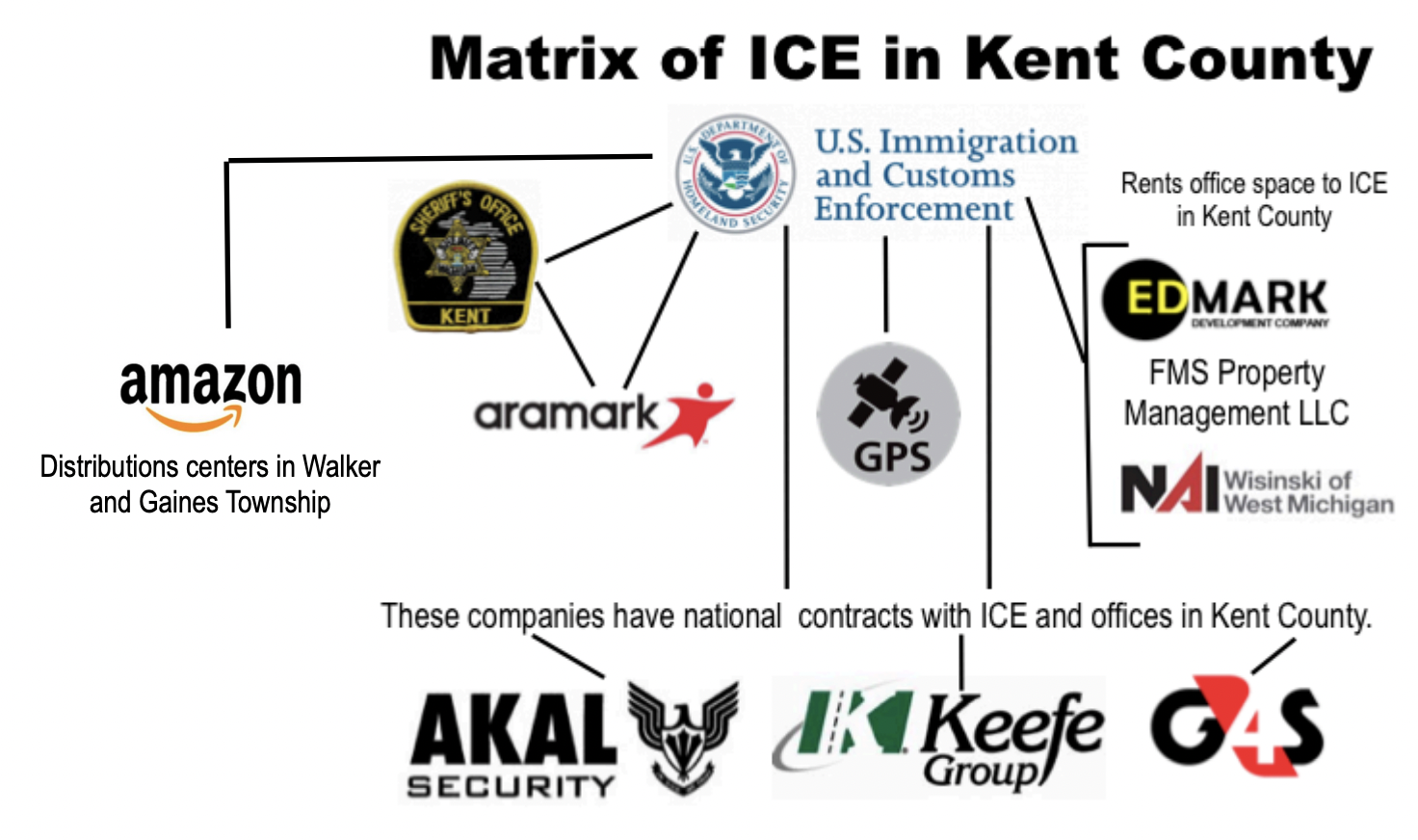
Immigration and Customs Enforcement (ICE) was created in March of 2003. ICE has had a physical presence in Kent County for 20 years, with numerous offices and partners, as is shown in the graphic below.
People first discovered that Kent County had a contract with ICE in the Spring of 2018. That contact, which is linked here, was created in July of 2012, during the Obama Administration. We later found out that when it was being debated at the Kent County Commission meeting, only one commissioner objected to the contract.
The Kent County Sheriff’s Department renewed the ICE contract in 2017, with the extension date continuing until September 30th, 2019.
We also discovered that the Kent County Sheriff at that time, Larry Stelma, signed onto a letter from the National Sheriff’s Association (NSA), a letter dated March of 2018, which said in part:
Congress must act to pass legislation to secure our borders through enforcing immigration laws, tightening border security, support the replacement and upgrades to current barriers and fencing and construction of barriers along the U.S. and Mexico international boundary as requested by those areas where it is needed, suspending and/or monitoring the issuance of visas to any place where adequate vetting cannot occur, end criminal cooperation and shelter in cities, counties, and states, and have zero tolerance and increased repercussions for criminal aliens.
Sadly, today some state and local officials have been enacting policies and giving lawbreakers shelter from being rightfully prosecuted and removed from our communities. In fact, these same laws forbid law enforcement agencies from cooperating with one another, and go as far as forcing the release of dangerous criminals into our communities exposing our citizens and legal residents to be victimized once again.

In response to our learning about Kent County’s contract with ICE, Movimiento Cosecha and GR Rapid Response to ICE began an End the Contract campaign, which was kicked off in June of 2018, where over 200 people showed up to a Kent County Commission meeting, which I wrote about.
Essentially, we shut down the meeting and most of the Commissioners left the meeting, thus allowing us to take it over and create a People’s Commission space, allowing those affect to tell their stories and talk about upcoming actions.

After the County Commission meeting was shut down the group went to the ICE office, which was locked. The group making the decisions about what action we could take next, was to have those of use who were willing to be arrested sit down in front of traffic at the corner of Michigan and Ottawa. The GRPD had their own narrative about what happened that day, which I deconstructed in an article here.
After the action in late June of 2018, we went back to every County Commission meeting for months, with a variety of tactics, which included testimonies from the immigrant community.
In September of 2018, the ACLU and the Michigan Immigrant Rights Center provided some added knowledge of the law and spoke during a Kent County Commission meeting. They provided testimony and a document about how the Kent County Commission was within their rights to not cooperate with ICE.
A former Kent County Commission, who presented himself as a “progressive” wrote a letter that explained why he had a problem with the End the Contract campaign, which you can read here.
Because there was so much going on and the County was not being very transparent, the End the Contract campaign decided to submit a Freedom of Information Act request to the County regarding ICE and our campaign. You can read the 138 pages here.
A great deal more could be said about the campaign to End the Contract. I did write a People’s History version of the End the Contract campaign, which you can read here, but let me include a list of things we did during the 14 months:
- We held dozens of strategy meetings, which always resulted in planning future actions.
- We attended every Kent County Commission Meeting to continue to make our demands, to offer testimony on family separation that was happening by ICE in Kent County and to monitor any comments made by commissioners about the contract.
- Some of the people involved in the campaign met with individual commissioners
- We ran a petition campaign to End the Contract, which we delivered at one of the Commission meetings.
- We held a protest outside of Chairman Saalfeld’s home the night before one of the commission meetings.
- We organized several protests at the Kent County Jail.
- We organized several protest outside of the various ICE offices in downtown Grand Rapids.
- We organized a disruption protest during ArtPrize, on their main stage, drawing attention to family separation in Kent County.
- We created educational materials, which we distributed.
- We created artwork and had sign making parties.
- We spoke to community-based groups about the campaign.
- We utilized social media to education and get the word out about the End the Contract Campaign.
- We held a People’s Commission action during one of the Kent County Commission meetings.
- We worked with the Western Michigan branch of the ACLU and MIRC, who not only obtained their own FOIA documents, but offered their legal expertise on why Kent County was not legally obligated to cooperate with ICE.
In the end, because of all the pressure that the End the Contract campaign was exerting on Kent County officials, along with the local and national press attention it was getting (brought about by the Jilmar Ramos Gomez case), ICE decided to not renew their contract with Kent County at the end of September of 2019. The Kent County Sheriff’s Department nor the Kent County Commission chose to do nothing throughout this process. It was the End of the Contract campaign, popular organizing and Direct Action that forced ICE to end their contract with Kent County. 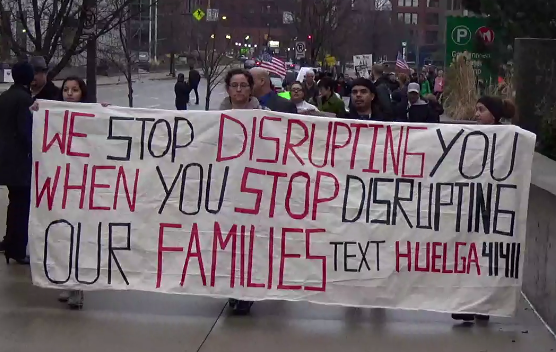
Lessons on the history of US Immigration Policy #3: How we talk about undocumented immigrants matters
With immigration being a major topic of conversation in the US, it is important think about how we talk about immigrants, legal status and borders, particularly the US/Mexican border.
Borders are the results of the creation of nation states, but they are always evolving, especially when imperial powers are always seeking to expand their territory. The US began 13 states in 1776, all of which were part of the eastern shoreline of the Atlantic.
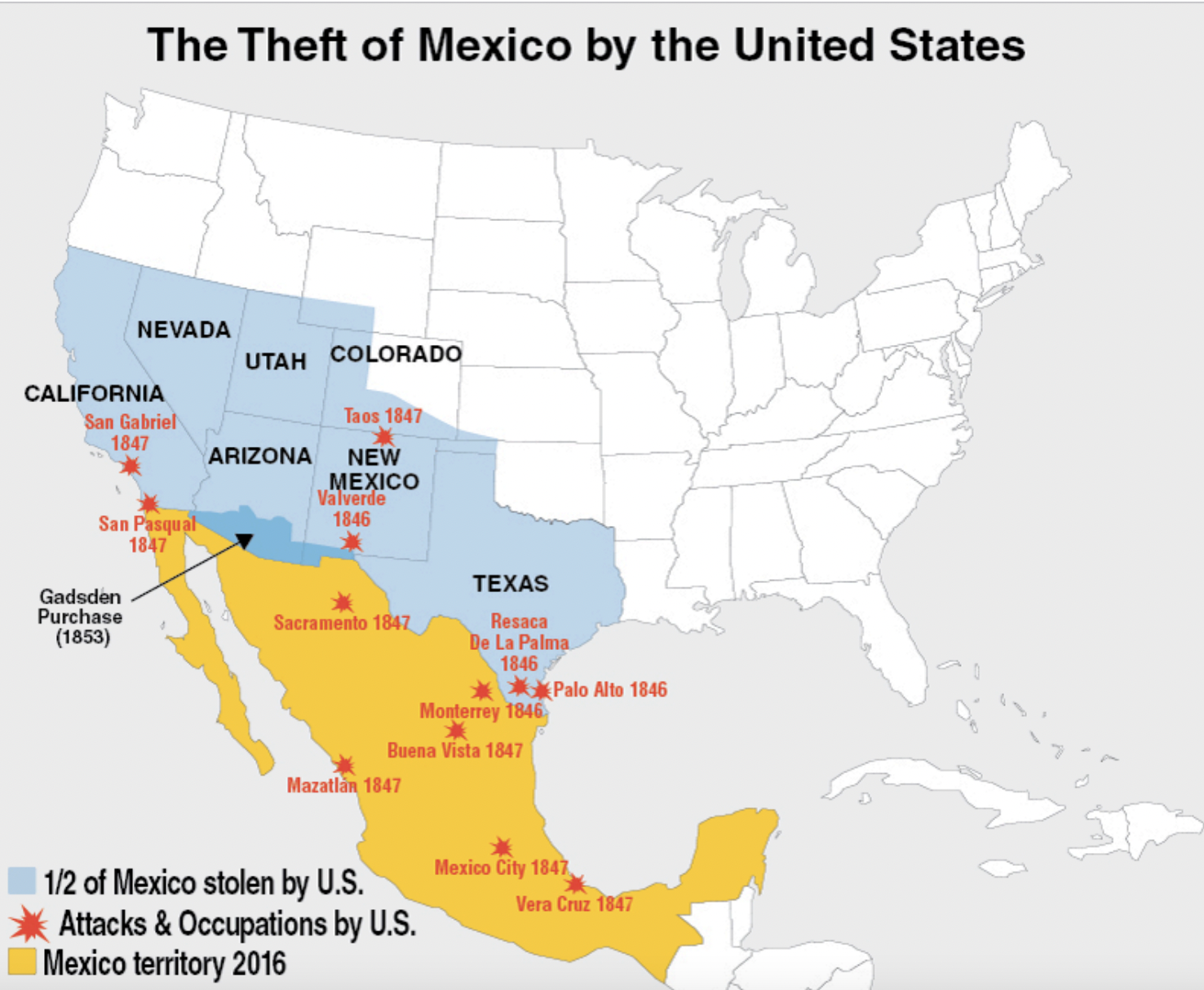
As the US expanded west taking Indigenous land, they also looked south and more than doubled the total landmass of the US after the US/Mexican War. Most of the people who were living in the area of Mexico that became Texas, California and the other states that are now part of the US were never forced to move. Many Mexican nationals will often use the phrase, “We didn’t cross the border, the border crossed us.”
For a deeper understanding of how US borders evolved over time, see Greg Grandin’s excellent book, The End of the Myth: From the Frontier to the Border Wall in the Mind of America.
One interesting fact about how the US dealt with border crossings is the fact that they did not even create a formal border patrol until 1924, when congress passed the National Origins Act, thus establishing the Border Patrol as an agency of the U.S. Department of Labor.
The US/Mexican border evolved over time with the militarization of that border beginning with the Carter Administration and continuing to be more militarized throughout the past few decades. In 2024, the US provided $19.6 billion to Customs and Border Protection (CBP) and $9.6 billion on Immigration and Customs Enforcement (ICE).
Immigrants who cross into the US from Mexico at unauthorized points along the border do so because; 1) they can’t afford the cost of getting visas or other state sanctioned travel documents; and 2) most of them are fleeing military repression, poverty or because they have been displaced from their land because of climate change.
Most immigrants crossing into the US at unauthorized points are desperate and take great risks to come to the US. Every year the group No More Deaths documents the number of undocumented immigrants that die while attempting to enter the US. These immigrants risk their lives in order to find a better life.
Immigration status
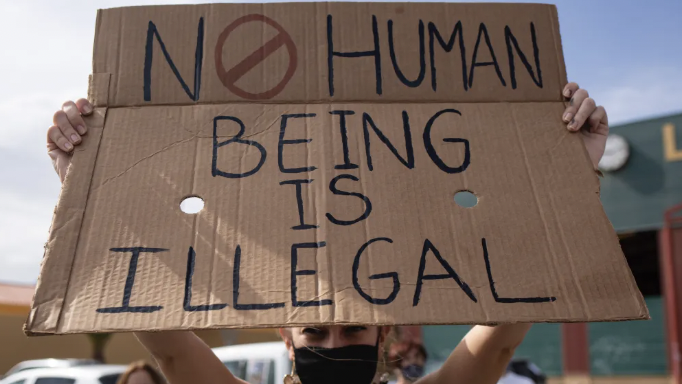
Way before Donald Trump first ran for President in 2016, conservative and far right commentators would refer to undocumented immigrants as “illegal.” Designating immigrants as illegal is not only cruel, it dismisses the humanity of immigrants and it provides no context for why people have decided to enter into the US unauthorized. For a detailed exploration of why calling someone illegal is deeply problematic, see the book, No One is Illegal: Fighting Racism and State Violence on the U.S.-Mexico Border, by Justin Akers Chacon and Mike Davis.
 Over the years we would hear politicians and those with an opinion about undocumented immigrants use the term “illegals” as if it was a fully accept and factual term. As more and more people pushed back on this demeaning label, the journalistic world began to notice.
Since 1953, the Associate Press has been publishing a Stylebook, which provides standards for journalist how how to report on issues and what kind of language reporters should be using.
Since 2012/2013, the Associated Press Style book has taken a position against referring to undocumented immigrants as “illegal,” stating:
- “We should not speak of people violating immigration laws without “reliable information about a person’s true status” — which most commonly means a legal charge against them or a court decision.
- Be especially careful about raids in which police seize large numbers of alleged illegal immigrants. Ask how many have actually been charged, and with what: entering the country illegally, overstaying visas or with non-immigration-related offenses? Were any people found to be legitimately in the country and released? If such details are not available, make that clear in the story.
- Don’t lump together in stories and scripts people who entered the country illegally as adults, and young people who were brought in as children and have spent most of their lives in the country. People have their own stories; respect that. Some people entered the country legally on a tourist or other visa but violated the law by overstaying it. When organizations and politicians talk about “illegal immigrants,” ask them specifically whom they mean.
- Be specific about nationalities. Don’t let terms like “illegal immigrants” be used synonymously with one nationality or ethnic group.
- Make sure you have a clear understanding of immigration-related legal issues in your area, including under what circumstances police have a right or obligation to inquire into a person’s immigration status.
- Our goal is to report fully and carefully on immigration matters without obscuring the fundamental facts of the situation.”
Partisan politics is often ugly and demeaning, especially when dealing with vulnerable and affected communities like immigrants. In recent weeks in the Grand Rapids news media, I have heard reporters use the term “illegal immigrants”, which does not reflect current journalistic standards, nor does it reflect the humanity of all people. We all need to do better when talking about the issue of immigration and make sure to always put a human face to the issue, since how we talk about immigration can often dictate what we do about it.
If your organization or community group would be interested in a presentation or class on the history of US Immigration Police, please contact Jeff at sjeff987@gmail.com.
Over the past several days, there has been a lots of local news coverage concerning an Anglican priest who used a Nazi salute at a recent National Pro-Life Summit.
The Anglican priest in question is Calvin Robinson, who has a long history of being part of the political and religious right, according to a recent MLive piece.
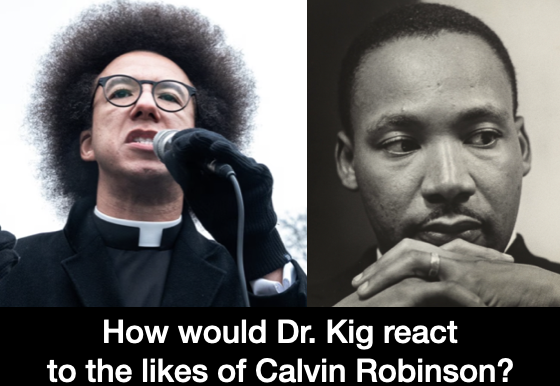
Now, to be clear, I find people like Calvin Robinson disgusting, not just because of what they say, but the political climate it helps to foster that results in violence against individuals – usually those who are most vulnerable in society, along with the systemic violence that institutions and public policy perpetrate, which is even more objectionable.
What Calvin Robinson stands for is nothing new. Robinson is part of a long legacy of people and organizations that have not been shy about their white supremacist views, their colonialist views, their perpetuation of misogyny, their anti-reproductive justice views, and their anti-trans and heterosexist beliefs.
In the US we are all too familiar with organizations like the KKK, the Proud Boys, the Oath Keepers, Right to Life, Voice for the Badge, the American Patriot Council, the Michigan Militia, the State Policy Network, Moral Majority, the Heritage Foundation, the Council for National Policy, Turning Point USA, etc. These groups have very clear ideologies and are often well funded to spew their hate and misinformation.
However, while we definitely should be paying attention to people like Calvin Robinson, we should also be thinking about and paying attention to the religious leaders that remain neutral. Ask yourself, with everything that is happening in this world and in the US, why are there so many religious leaders that are not speaking out? How is it that religious leaders can remain silent on the genocide in Gaza, the climate catastrophe, poverty, militarism, white supremacy, trans-phobia, xenophobia, and capitalism, to name just a few.
How is it that religious leaders can be so married to business as usual, to not rocking the boat, to maintaining order, or to not challenging systems of power and oppression. In some ways it is easy to stand back and condemn the likes of Calvin Robinson, but ignore all the clergy that don’t want to take a prophetic stand on the most pressing issues of the day.
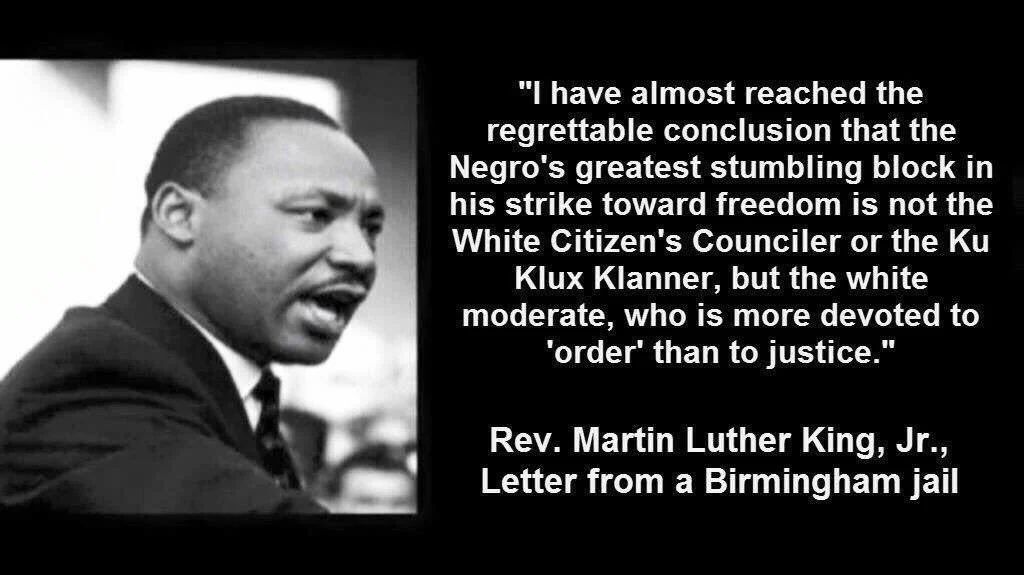
Dr. Martin Luther King Jr. said, “There comes a time when silence is betrayal.” Indeed, being silent in the face of oppression is betrayal, but Dr. King had a much more poignant take on who he thought was more dangerous than the KKK.
While sitting in a jail cell in Birmingham, Alabama, Dr. King wrote a letter to local clergy, stating:
“First, I must confess that over the last few years I have been gravely disappointed with the white moderate. I have almost reached the regrettable conclusion that the Negro’s great stumbling block in the stride toward freedom is not the White Citizen’s Council-er or the Ku Klux Klanner, but the white moderate who is more devoted to “order” than to justice; who prefers a negative peace which is the absence of tension to a positive peace which is the presence of justice; who constantly says “I agree with you in the goal you seek, but I can’t agree with your methods of direct action;” who paternalistically feels he can set the timetable for another man’s freedom; who lives by the myth of time and who constantly advises the Negro to wait until a “more convenient season.
Shallow understanding from people of goodwill is more frustrating than absolute misunderstanding from people of ill will. Lukewarm acceptance is much more bewildering than outright rejection.”
It is time that we all begin to engage in some self-examination regarding Dr. King’s words. It’s time that we become more frustrated and angered by the clergy and other so-called leaders who too committed to maintaining order and business as usual politics. It is time we practice radical imagination and collective liberation.
 Grand Rapids Institute for Information Democracy