New Media We Recommend
Below is a list of new materials that we have read/watched in recent weeks. The comments are not a “review” of the material, instead sort of an endorsement of ideas and investigations that can provide solid analysis and even inspiration in the struggle for change. All these books are available at The Bloom Collective, so check them out and stimulate your mind.
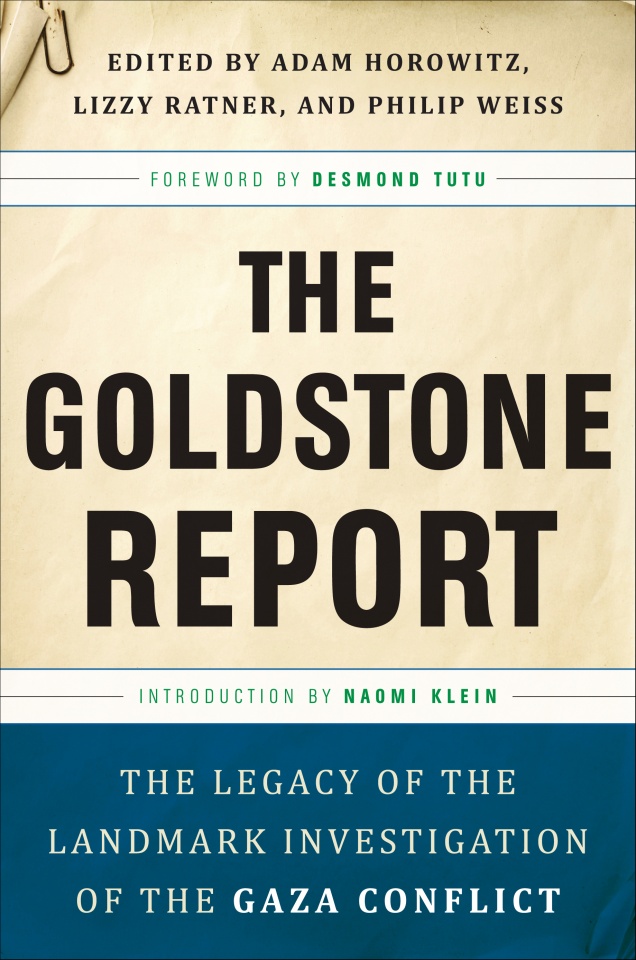
The Goldstone Report: The Legacy of the Landmark Investigation of the Gaza Conflict, edited by Adam Horowitz, Lizzy Ratner, and Philip Weiss – It has been more than two years since the Israeli Assault on Gaza and more than a year since the Goldstone Report was released. This book not only provides us with the content of that report, it includes commentary by South African Bishop Desmund Tutu, Naomi Klein and a numerous other writers and activist who talk about the significance of the record on what Israel did to innocent Palestinian civilians between late December of 2008 and January of 2009. This is an important volume that will add to the international case against Israel’s illegal occupation of Palestine.

23 Things They Don’t Tell You About Capitalism, by Ha-Joon Chang – If you are looking for a thoughtful and non-ideological book that deconstructs capitalism, look no further. Ha-Joon Chang, author of the acclaimed book Bad Samaritans, provides us with a very readable critique of the economic system of capitalism. Chang presents 23 fundamental points for each chapter and then lays out very sound arguments to support each statement. 23 Things They Don’t Tell You About Capitalism may not be an anti-capitalist manifesto, but it certainly provides people with an important critique that does come with a great deal of ideological baggage.
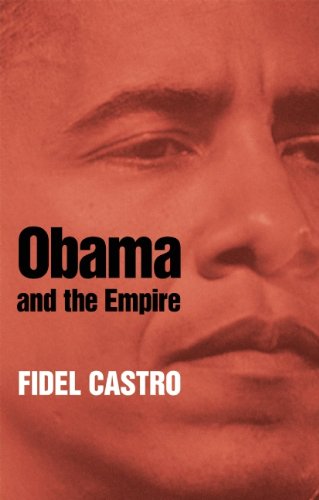
Obama and the Empire, by Fidel Castro – Former Cuban leader Fidel Castro has certainly seen his share of US presidents, but one thing has remained the same….US policy towards Cuba. In this collection of short essays Castro provides an interesting analysis of US foreign policy since Barack Obama became President a little over two years ago. Castro backs up the title of the book by demonstrating that the imperialist policies of the US have not been fundamentally altered since Obama entered the White House. The essays are chronological and cover the period from Obama’s election to the summer of 2010. Obama and the Empire is an important contribution to the growing body of literature that smashes any illusion that US foreign policy would be any different under the current administration.

The Coca-Cola Case (DVD) – This film by German Gutierrez & Carmen Garcia is a must see for anyone who has not been completely numbed by the branded image of the world’s most famous soda. The Coca-Cola Case is based on the work of union members, human rights activists and lawyers who have been fighting to Coca Cola Company over their denial that union workers in Colombia are being assassinated for attempting to organize workers in the Coke bottling plants. Even if you are familiar with the Killer Coke Campaign, this film is still important to see, not just because it deals with corporate crimes, because it shows what the possibilities are of cross-border organizing and solidarity.
Senator Levin and the “use of force” in Libya
The ongoing uprising in Libya has resulted in greater repression from the state under the direction of Muammar Qaddafi. Recent reports show that numerous civilians are being attacked and killed as the long-time leader of Libya is using the military to prevent his country from following Egypt and Tunisia on the road to democracy.

The levels of state repression have caused some in the international community and particularly in the US government to consider military engagement. On Sunday, Senator John Kerry called for a “No Fly-Zone” to be imposed on Libya, with other Senators quickly coming on board.
On Wednesday, Michigan Senator Carl Levin also weighed in on the matter when he addressed the issue in a statement for the Armed Services Committee. Levin said, “Two ships with a Marine Expeditionary Unit of over 1,000 Marines aboard are in the Mediterranean. Missile-launching ships are available should the President choose to use them to strike Libyan targets, including military aircraft, air defenses, airstrips, command centers, and bases. Before exercising any use-of-force option, the President is appropriately seeking support from the international community, in particular the support of other countries in the Arab and Muslim worlds and in the region.”

Now the statement from Levin doesn’t read as a strong endorsement for US military intervention in Libya, but it does demonstrate that the US already has the military capability to intervene if the Obama administration decides to take such action.
Much of the commercial media reporting in the US on the political repression in Libya presents Qaddafi as a brutal dictator, which the historical record would support. However, like much of the recent coverage of popular uprisings throughout the Middle East, there hasn’t been much historical context about the US relationship with Libya and Qaddafi.
Even the most rudimentary reading of the historical relationship between the US and Libya shows that the US supported a plan for the British, French and Italian governments to control Libya after WWII. This plan called for installing a puppet monarch, King Idris, who supported US/NATO strategic interests and access to Libya’s oil after the 1959 discovery of vast oil reserves.
In the 1960s growing civil unrest directed against the King led to a 1969 coup that landed Muammar Qaddafi as the new leader of Libya. Qaddafi has always ruled with an iron fist, but the US has not always objected to his repressive policies. In fact, according to Mark Zepezauer’s book Boomerang, the CIA supported Qaddafi against numerous attempted coups in the 1970s.
In the 1980s, the Reagan administration pushed Qaddafi on his role in regional politics and even bombed the country on numerous occasions in an attempt to take the Libyan leader out. One of those bombing raids resulted in the death of Qaddafi’s daughter. For more on the historical relationship between the US and Libya, particularly during Qaddafi’s reign, check out the chapter on Lybia in Bill Blum’s Killing Hope: US Military and CIA Interventions Since World War II.

Besides having a better historical analysis it is also important to think about what a No Fly-Zone would mean for Libya. Middle East policy analysis Phyllis Bennis has an important article, which provides sound analysis. Bennis argues that while there is some call from within Libya for international intervention that many on the ground don’t want military intervention as it may result in strengthening Qaddafi’s power. Bennis also points out that while the United Nations has imposed targeted sanctions on Libya it did not endorse the use of force.
Another point that Bennis makes is that while US political leaders are using language like “humanitarian intervention” we should not believe that the US interests are with the fate of Libya’s civilian population. This point has also been raised by author Jean Bricmont, who says that the last time the US used “humanitarian intervention” was in Kosovo. That intervention was disastrous for civilians and Bricmont argues caused more of a humanitarian crisis. Bricmont, in a recent article, argues that if the US intervenes in Libya it should more accurately be called humanitarian imperialism.
As the events in Libya unfold we should keep a close eye on what actions the US will take and pay close attention to how they frame those actions so as not to be swayed by their appeals to “humanitarian intervention.”
This Day in Resistance History: The End of the Illegal Imprisonment of the Amistad Passengers
On this day in 1841, the United States Supreme Court admitted that the nation had falsely imprisoned 52 people for two years, due in part to direct interference from the U.S. government. The decision also highlighted startling admissions related to slavery in the United States.
 The ruling was made on behalf of the Mende passengers from the ship La Amistad. They had been jailed since 1839 in New Haven, Connecticut. Sengbe Pieh (called Joseph Cinqué during the trials) and 51 others had been called everything from pirates to property to murderers. Arguments about their fate bounced from one court to another in one of the most complicated cases in the early American justice system.
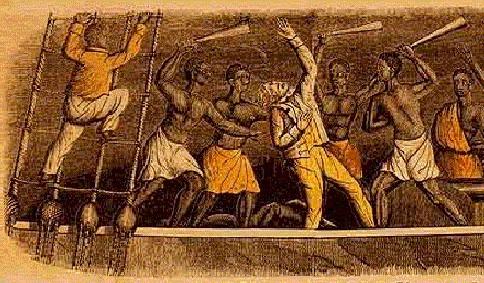
In 1839, the U.S.S. Washington captured the slave ship La Amistad in the waters off Long Island. The Amistad’s senior crew members, José Ruiz and Pedro Montez, told naval officers that they were transporting 52 slaves from a plantation in Cuba, where they had been born, for sale elsewhere in Cuba. But the Black passengers, led by Sengbe Pieh, managed to arm themselves, kill the captain, and take possession of the ship. Ruiz said he was ordered to sail to Africa, but managed to fool the slaves by charting a course north, hoping to find aid in American waters.
The passengers were taken into custody. A district court hearing, scheduled as a courtesy, would formally return the ship and its “contents” back into the hands of Ruiz and Montes.
 Instead of the expected pro forma hearing, however, the courtroom erupted with petitions by a number of claimants. The captain and first mate of the U.S.S. Washington appeared and demanded to have the ship and the slaves given to them as pirate salvage captured on the high seas. The senior Spanish diplomatic counsel marched into the courtroom to announce that Queen Isabella II wanted La Amistad and the slaves. sent to Spain. A local group of abolitionists demanded that the slaves be set free, because Connecticut no longer allowed slavery and the slaves therefore had reached free soil. And Secretary of State John Forsyth delivered a message from President Martin Van Buren, stating that it was in the national interest that the judge comply with the wishes of Spain, honoring a 1795 treaty. Clearly, this case was far more tangled than originally thought.
Then New Haven abolitionist Lewis Tappan hired attorney Roger Baldwin to represent the Amistad passengers. Baldwin hit on a legal point that no one else had even considered. The so-called slaves, he pointed out, could not speak a word of Spanish. If they’d been born on and worked on a Cuban plantation, how could that be possible? And if they had not been born into slavery, then under current U.S. law they could not be sold as slaves. They were free if they had been born free. Baldwin set about to prove it.
He sought help from one of his Yale professors, Josiah Gibbs, a language expert. Gibbs’s job was to try to speak with the imprisoned men and women directly and find out where they had come from. The professor cleverly established a basic vocabulary with the prisoners. Then he went down to the docks and shouted out the words he’d learned from them until he found someone who understood the language and answered him.
That person was James Covey, a native of Sierra Leone who spoke Mende and had become a British sailor. Covey discovered that Senge Pieh had been a landowner and a rice farmer. He and the other Mende passengers had been kidnapped, taken in chains to a slave fortress in Sierra Leone, and sold to slavers who owned the ship Tecora. Ruiz and Montes bought the Mende prisoners from the Tecora captain with the intent of illegally selling them to a Cuban plantation owner.
Meanwhile, Roger Baldwin, obtaining a writ to search La Amistad, found the Tecora manifest hidden on board. It listed the Amistad group, giving each one a false Spanish name and listing their sale prices to the Amistad owners.
Despite this incontrovertible evidence, Baldwin was forced to take the case through three separate courts. Each time he won, the case was appealed by the government. Finally, the case landed in the U.S. Supreme Court. By this time, the situation won the attention of former President John Quincy Adams, an ardent abolitionist, who worked with Baldwin on preparation for the high court hearing. Baldwin presented the case, with Adams giving the closing argument.
 Despite the fact that all but one of the Supreme Court justices of the time were Southern slave owners and despite constant pressure applied by Van Buren on behalf of Spain, the Court found that the Amistad passengers were in fact free men and women. The order secured their immediate release from prison. The Court further ordered that the kidnapped Mende be transported at U.S. government expense back to their homeland.
Justice Joseph Story, who wrote the majority opinion, made a point of addressing demands that Pieh and the male Mende be charged with murder and piracy for killing the captain and a crew member during their uprising on La Amistad. Story wrote that “while we may lament the dreadful acts by which they asserted their liberty and took possession of the Amistad and endeavored to regain their native country,” Pieh and the others could not be charged with murder or insurrection. They had simply attempted to take back the liberty that had been stolen from them. He wrote that they had fallen victim to “a heinous crime” and that any acts they committed to regain their freedom were justified as self-defense.
The Amistad case underscored a basic American hypocrisy. While politicians repeatedly stressed the American idea of natural rights, such as liberty—a point directly addressed in the opinion—the case cast light on the government’s complicity with the institution of slavery. The irony of ruling that the Mende passengers had the right to rise up against those who had deprived them of their freedom did not extend to more than 2.5 million people who were enslaved on plantations and cities across the United States at the time. United States v. Libellants and Claimants of the Schooner Amistad, along with the Dred Scott decision, is considered one of the most important court cases concerning slavery in United States history.

Many of us know the story of Rosa Parks refusing to move to the back of the bus. This story is what many have come to believe was what gave birth to the Civil Rights Movement.
Wayne State University Professor Danielle L. McGuire’s new book, At The Dark End of The Street: Black Women, Rape, and Resistance – New History of the Civil Rights Movement from Rosa Parks to the Rise of Black Power, sheds light on the background of the one of the most important social movements of the 20th century.
McGuire has documented that what led many people to the Civil Rights Movement, particularly Black women, was their collective experience of rape at the hands of White men.
McGuire tells the story of Recy Taylor who was gang raped by White men in 1944. The incident caught the attention of a local NAACP official who sent his best investigator to look into the case and it just happened that this investigator was Rosa Parks. What McGuire came to discover through her research and interviews with Civil Rights veterans was that there was a whole lot of anger and organizing against the White community because of repeated acts of sexual assault against Black women by White men. McGuire says that the bus boycotts were not a surprise, since buses were a place where Black women were often sexually harassed by White men.
Professor Danielle L. McGuire will be speaking about her book this coming Monday, March 14, 4pm in the Loosemore Auditorium on the downtown campus of GVSU. The event is free and open to the public.
This interview with Noam Chomsky was conducted by Dr. Hamid Dabashi and is re-posted from ZNet.
On March 8, 600 protesters swarmed outside the Bank of America branch on Pennsylvania Avenue in Washington D.C. They succeeded in shutting down business at the branch and informed area residents about Bank of America’s shameful record of tax dodging.
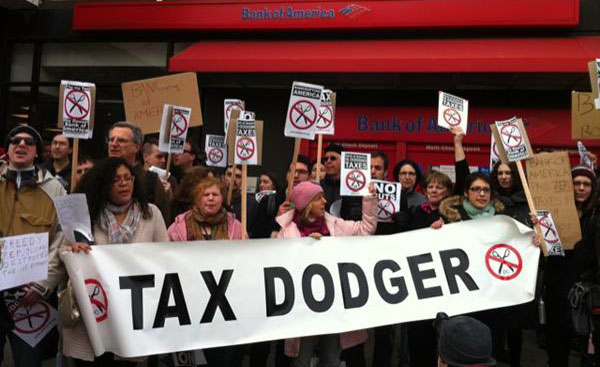 Under federal law, banks such as Bank of America are required to pay 35 percent of their pre-tax earnings in taxes. But the National People’s Action group has issued a report that Bank of America, along with JP Morgan Chase, Goldman Sachs, Morgan Stanley, Citigroup, and Wells Fargo, have all averaged taxes of 11 percent for the past two years, saving themselves a staggering $13 billion in revenue.
In cheating taxpayers, these banks have taken enough tax revenue out of the economy to have paid for three years’ worth of salaries for every American teacher who lost his or her job since the Wall Street bailout.
In 2009, Bank of America pocketed $45 billion in TARP funds and posted profits of $4.4 billion. And the bank did not pay one cent of taxes.
Meanwhile, Bank of America just issued a press release that explains how their new corporate bonuses in the D.C. area are “a plus for the local economy.”
If you’re asking yourself why you haven’t heard of this movement, the shutdown of Bank of America on Tuesday, or other Bank of America protests that have taken place since the end of February, that’s easy. It’s because no mainstream media outlets have covered these events. Only independent journalists have succeeded in getting information about the protests online and on You Tube, while TV networks, financial papers such as the Wall Street Journal, and even area newspapers such as the Washington Post are trying to pretend that nothing has happened.
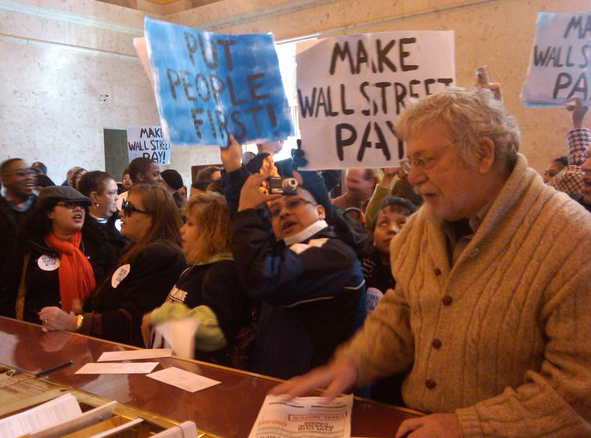 But even during the news blackout, there are still steps you can take. The National People’s Action website has a form you can fill out: it calculates how much you have lost in the economic crisis that followed on the heels of the Wall Street bailout. The site then generates a “bill” that is sent directly to your members of Congress.
Or, stop in at one of the Bank of America locations in Grand Rapids. The main bank, downtown is located at 40 Pearl Street N.W. Other branches are found at:
3886 Plainfield N.E.
6737 S. Division
2000 Lake Michigan Drive N.W.
1750 Michigan Street N.E.
6464 28Th Street S.E.
485 44th Street S.E.
2005 Breton Road S.E.
834 Leonard Street N.W.
Or, call the downtown location at 616-451-7944.
Tell them how you feel about their tax evasion and how you feel it’s hurting the economy—and making life harder for you and your family.
Grand Rapids coalition holds Press Conference against anti-immigration bill in Michigan
Today a coalition of about 15 people gathered today to hold a press conference against the recently introduced legislation in Michigan that seeks to adopt an Arizona-style anti-immigration policy.
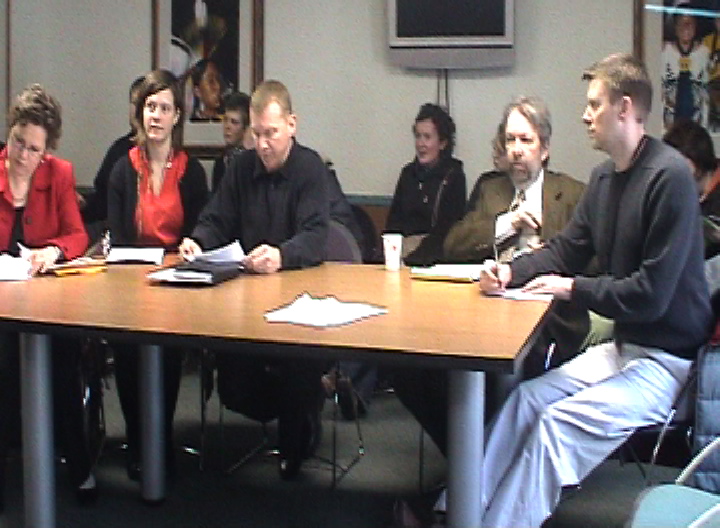
Local immigration attorney Rick Kessler began the press conference by saying, “people in West Michigan will not tolerate an Arizona-type anti-immigration law in Michigan.” Kessler was followed by several other people from different walks of life who also spoke out against the recently introduced legislation; legislation that was introduced by local State Rep. Dave Agema.
Kent County Commissioner Dick Bulkowski said that this law was bad for a variety of reasons, but spoke specifically about how it will divert limited resources of local law enforcement to stopping people looking for immigration status instead of focusing on public safety. Commissioner Bulkowski also objected the legislation because of the expected law enforcement and legal costs that would be at the expense of taxpayers.
Bulkowski was followed by Ryan Bates who addressed the economic costs to the State of Michigan if this legislation were to pass. Bates is with the Alliance for Immigrants Rights and Reform Michigan and he stressed how this anti-immigration law might prevent companies from coming to Michigan because it would make the state unwelcoming. Bates also stressed how Latino, Asian and Arab-American businesses have contributed to job creation and tax revenue to the state.
Miriam Aukerman with the Western Michigan branch of the ACLU focused on the legal and constitutional rights aspects of the proposed HB 4305. Here we’ll share her comments via video.
There were also representatives of both the Christian Reformed Church and the Catholic Church who were present who also express concerns about the recently introduced legislation.
The last speaker was Jessica Ennis with Bethany Christian Services. Jessica shared with those present information about the campaign to get Michigan Governor Rick Snyder to veto HB 4305. Ennis said that they are urging people to contact the Governor’s office by calling 866-957-9069 for English speakers and 866-563-5608 for Spanish speakers.

On Sunday, ABC showcased one of its newest TV shows called Secret Millionaire. The basic premise of the show is that millionaires go and live clandestinely in poor communities and then give money to people who are “deserving.”
On the surface the show is designed to tug on people’s heartstrings and make you feel good about what some people are doing in the world. However, what the show is really about is to communicate the message that anyone can be successful if you just work hard enough. In many ways Secret Millionaire is just a new manifestation of the Horatio Alger story, sort of a rags to riches myth.
Not surprising the first millionaire on the show was Dani Johnson who claims to be a self-made millionaire. Johnson does entrepreneur workshops, Finance consulting, spiritual equipping, which is the theme of her national radio show.
Johnson, who is a tall, busty, White woman, goes from one local program to another in Knoxville in search of people who are worthy of her money. In the process we see Johnson mostly interacting with programs that serve poor black kids. Johnson at one point in the show says that what is so cool about these programs is that they are “grooming these kids for success.”
Secret Millionaire is a glitzy program that is designed to serve two purposes. First, the show gets us to think about individual acts of charity and programs that serve the “poor.” This means that we never are confronted with basic questions about why so many people are poor and why people like Dani Johnson are so rich. We are led to believe that some people are successful because they work hard while others are lazy and worthless.

Secondly, the show promotes what some writers are calling philanthro-capitalism, which is essentially the idea that social change will come about when rich people “share” some of their wealth. In other words, we don’t need to build movements for social change, we just need to find rich people who will give us some of their wealth so we can design more feel good programs that might allow a few people to become “successful.”
Such programming is an insult to working class people of any generation, but it is particularly insulting as some many people are becoming victims of an economic restructuring program that is transferring more and more of the country’s wealth into the hand of the already disgustingly rich.
From the Wall Street Bailout, to tax breaks for the rich to an assault on working class wages, benefits and pensions, we are seeing the application of what Naomi Klein calls an economic Shock Doctrine. ABC’s Secret Millionaire is just one of the tools being used by the capitalist class to wage war on working people and in this case it is psychological warfare.
Today, about 75 people gathered at the LaGrave Avenue Church to hear from area legislators about their thoughts and commitment to public transportation.
 The forum began with Jennifer Kalczuk from the ITP/The Rapid who provided those in attendance with some background information on the current status of transit funding. She mentioned that there is money coming from the State, gas taxes and transit fare sales. Currently about 30% of their operating budget comes from the State.
Under the law ITP is eligible to receive up to 50% of their operating budget from the State, but it has been many years since that has happened. There is also a significant chunk of money coming from the federal government in matching funds for state operations. More details on State and Federal funding for public transit can be found on the website for Michigan Public Transit Association.
Jennifer also mentioned that ridership has been growing in recent years, especially since the ITP was created. Last year there was roughly 9.7 million riders, which includes all of their services.
However, the bulk of the forum was spent listening to the responses from three area elected officials, State Representatives Ken Yonkers, Roy Schmidt and Brandon Dillon. Representative Dave Agema and State Senator Dave Hildenbrand were also invited by unable to attend.
Dave Bulkowski with Disability Advocates of Kent County was the moderator of the forum and asked a series of questions to the state legislators. The first question was, What do you see is the State’s role in transportation infrastructure? Roy Schmidt responded by saying it was to maintain roads, transit and safe streets. Schmidt says that he doesn’t have a problem funding transit because he knows where the money is going, but he didn’t offer any evidence to support this claim.
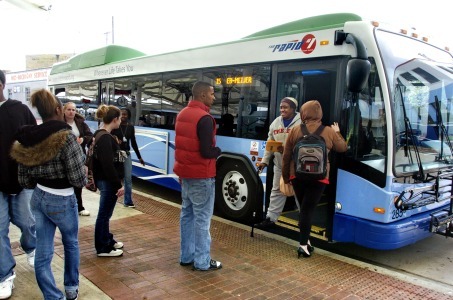
Rep. Yonkers said that transportation includes airports, roads and bus services. “The State’s responsibility is to make sure that both the planning and the funding are there.” However, Yonkers says that we need to have more emphasis on a cultural transformation, since Michigan is still culturally dependent on car transportation. In fact, Yonkers said that if there is not a good State transportation infrastructure then there will be no economic development or real economic recovery.
How do you see public transportation within the transit structure? How much of it is a priority for you? Rep. Dillon says that the biggest investment is for roads and bridges, roughly 90% of the state budget for transportation. However, he does think that we need to raise the profile of public transit and the role that it plays for development and quality of life. Dillon also said there in no plans to cut existing funding levels for transit from Governor Snyder’s proposed budget.
Schmidt said that even while he was a GR City Commissioner he didn’t fully realize how important transit funding is, especially the model that GR is for the rest of the state. Schmidt says it is extremely important for jobs and general infrastructure.
Yonkers added that the State’s actions determine priorities with the bulk going to roads and bridges, but Yonkers said he is working on changing that. He thinks it is a cultural shift and that it has bi-partisan support. We have to grow grassroots interest and have a vision for what we want. Unfortunately, Yonkers did not provide any specifics or examples of how this cultural shift would take place.

What about the future of rail transit? Yonkers said he recently heard a talk from someone with Meijer who said it is cheaper to move goods via rail across the country than it is to move goods via trucks from Chicago to Grand Rapids. Yonkers said he would love to see a hi-speed rail from Grand Rapids to Lansing. “However, this will be a big battle, because it will require a change in the minds of voters.”
Rep. Schmidt addressed the issue of Amtrak and said he recently heard that the tax investment in Amtrak is nothing compared to the economic development it provides. He says that is not the public perception, but he failed to provide any evidence to support the economic data benefits because of Amtrak.
What about the State budget proposal and does it support transportation needs? All three representatives said they would support Snyder’s proposal and Yonkers feels that even though there are questions on the issue of efficiency that it should not detract from what the State Budget will provide for public transportation.
How else can money be raised or redirected at the State level to end up supporting transit? Schmidt said that they are looking at registration fees because he thinks that revenues will decline from the gas tax because of electric vehicles. When asked how big should the transportation budget be, Rep. Dillon says it is a difficult question to answer and it will have to be determined by the voters. “We don’t have the revenues we need to improve public transit in the state.” He kept saying that it depends on the public support for this, which avoided asking the question about what leadership elected officials could provide to push for increases in public transit. Yonkers stressed the need to “market” public transportation services well if you want people to support increased funding for it.
What about funding at the local level? What options to local systems have to generate funding? Schmidt says he thinks that it comes back to credibility, which is why he supports the May 3rd Millage. Dillon says he expressed ideas about how to deal with the loss of revenue sharing saying that local governments should have more control on ways to generate revenue if the State is unable and unwilling to provide adequate revenue sharing funds. Yonkers said that he believes in local government and local control. “If we are going to change how we finance the state then we need to give local governments the tools in order to do that. However, if we are talking rail then we need this issue to be a State effort.”
After the legislators finished their comments a few people got up to let everyone know about the upcoming May 3rd Millage and how people could get involved.
In some ways the forum was a disappointment in that those in attendance did not get to ask questions or voice concerns. Another thing that could have improved the forum would have been to provide some clear information on the voting record of state officials as it relates to transit, which you can access at Vote Smart or Michigan Votes.
Reclaiming the Commons film at the Bloom Collective 3/10

“For more than three decades, transnational corporations have been busy buying up what used to be known as the commons — everything from our forests and our oceans to our broadcast airwaves and our most important intellectual and cultural works.
In This Land is Our Land, acclaimed author David Bollier, a leading figure in the global movement to reclaim the commons, bucks the rising tide of anti-government extremism and free market ideology to show how commercial interests are undermining our collective interests. Placing the commons squarely within the American tradition of community engagement and the free exchange of ideas and information, Bollier shows how a bold new international movement steeped in democratic principles is trying to reclaim our common wealth by modeling practical alternatives to the restrictive monopoly powers of corporate elites.”
This is an important film for anyone who is concerned about local issues such as food, privatization of water, privatization and co-optation of public space and private control of what were once public services.
This Land is Our Land is being shown at the Bloom Collective space, located in the Steepletown Neighborhood Center on the corner of Fifth and Davis on the Westside of Grand Rapids. Refreshments will be available and a discussion will follow the film.
This Land is Your Land (film)
Thursday, March 10 at 6:30 PM
671 Davis NW, Grand Rapids
Suggested donation of $3 – 5
 Grand Rapids Institute for Information Democracy