
June 8, 1809, marked the end of the life of the most revolutionary and radical of the US’s founding fathers: Thomas Paine. Today, there is a movement among the Tea Party to recast the founding fathers as a group of devout, conservative Christians who wanted no separation of church and state; and insists that the United States is a country founded on “Biblical principles.” Thomas Paine’s life and work shatters that fairy tale completely.
Paine was an Englishman whose life as a rebel began in 1772, when he organized an early attempt at unionization by the excise officers of Lewes. They made an attempt to gain better working conditions and more pay, and Paine wrote his first pamphlet about their struggle against the government He was fired from his own excise office job as a result, and had to sell his possessions to pay debts. Benjamin Franklin was in London at the time, and suggested that Paine come to America. Paine arrived in Philadelphia in 1774, just as the heat of public anger was reaching a fever pitch against British rule.
When Paine released his treatise Common Sense in January of 1776, John Adams wrote, “Without the pen of the author of Common Sense, the sword of Washington would have been raised in vain.”
No new publication in America has ever, per capita, outsold Common Sense. Six months after its release, one out of every five people in the colonies owned a copy. People read the book in their homes and at family gatherings. It was read out loud in pubs, in village squares, and at town meetings.
 Common Sense attacked the institutions of monarchy and aristocracy. It declared that Britain’s imperialism held America enslaved. It stated that the monarchy had no “regard” for its subjects in the American colonies. Despite what King George III declared, the king and Great Britain simply used Americans for profit. Paine added dryly, “What at first was plunder assumed the softer name of ‘revenue.’”
The work pointed out that America had, and would again, be dragged into European wars in which it had no stake or interest. And it argued that America, a wealthy colony with shipbuilding capability and trained militias, had enough fighting power to gain its independence.
But what many people today don’t realize is that Common Sense did more. It actually outlined the exact process in which a new republic could be created. It described a “charter” for the United States; suggested a Continental Charter Conference to draft the document, with representatives from each colony present to provide the viewpoints of the entire population. It explained how a Congress could be assembled; it described the division of voting districts; and outlined the concept of an electoral college. This visionary set of instructions was followed almost to the letter after the colonists drove the British out of America.
Benjamin Franklin wrote to Paine after the Constitution was confirmed, “You…are more responsible than any other living person on this continent for the creation of what are called the United States of America.”

After fighting began in the American Revolution, Paine released his series of “Crisis” pamphlets to encourage soldiers and citizens to stay the course even though the beginning of the conflict was disastrous. The most famous of these pamphlets contained the words, “These are the times that try men’s souls…Tyranny, like hell, is not easily conquered; yet we have this consolation with us, that the harder the conflict, the more glorious the triumph.”
Paine also aided the revolutionaries in other ways. He traveled to France in March of 1781 to raise funds for the revolutionary cause. He is credited with securing a loan of 10 million silver livres, and also convincing the French to give 6 million of it as a gift to the American army.
At the end of America’s revolutionary period, Paine returned to Europe. He went first to London, but then spent time during the French Revolution in Paris. There he wrote another major work, The Rights of Man, in defense of revolution and against the concept of the monarchy. Because of this work, he was tried in absentia in England and found guilty of seditious libel. Paine wrote:
“When I contemplate the natural dignity of man; when I feel (for Nature has not been kind enough to me to blunt my feelings) for the honor and happiness of its character, I become irritated at the attempt to govern mankind by force and fraud, as if they were all knaves and fools, and can scarcely avoid disgust at those who are thus imposed upon.”
Despite having defended the French Revolution to the world, Paine was considered dangerous by revolutionaries like Robespierre whose agenda included an eventual takeover of government control. Paine was imprisoned. While he was in prison in Paris, he wrote The Age of Reason. It presented a rejection of Christianity, outlining the corruption in the various Christian churches and damning all of them for attempting to grab political power. While it does not reject the idea of a creator, The Age of Reason presented the idea of “natural religion” which is based on an understanding from personal experience and one’s own sense of reason. This book greatly influenced Americans like Thomas Jefferson, Elihu Palmer, and Mark Twain.

Paine was released from prison in 1794 through the efforts of James Monroe, who was the American Minister to France at the time. In 1795, Paine wrote his most radical work (and ironically, his least well known): Agrarian Justice. This treatise presents Paine’s view of what is meant by a “just society.” He advocated for ownership of all farmland by the entire population of a nation, since land was “the common property of the human race.” He pinpointed what he considered true evil in the world: the ownership of the majority of assets by the elite. “…the landed monopoly that began with [farming] has produced the greatest evil. It has dispossessed more than half the inhabitants of every nation of their natural inheritance.”
If the land was not returned to the general population, Paine went on, then every laborer should be paid an indemnity in compensation for “the loss of his or her natural inheritance by the introduction of the system of landed property.” He advised creating programs of public assistance to help the poor.
In 1803, Paine returned to America, but he found less than a warm welcome. In the intervening years, the Second Great Awakening had created an ardent group of religious fundamentalists who vilified Paine for his anti-church writings. Many Federalists objected to his support of the French Revolution and hated the fact that he had become a close friend of their political rival, President Thomas Jefferson. Even John Adams, who had praised Common Sense on its publication, now said it was a “poor, ignorant, malicious, short-sighted crapulous mass.”
Another factor in Paine’s sudden unpopularity was his publication of Letter to Washington in 1797. This work criticized ignorant military decisions that Washington made which Paine felt had prolonged the war. It described Washington as growing increasingly egotistical and autocratic, alienating European allies. It castigated the first President for not being a true radical and revolutionary, and taking credit away from those who had a genuine belief in radical politics. Washington had just died in 1799 and had reached the status of a demigod in the nation, so this incensed the public.
When Paine died in Greenwich Village in 1809, the New York Citizen wrote an editorial that said, “He had lived long, did some good, and much harm.” Six people went to his funeral.
Today, schoolchildren are taught little about Thomas Paine, although his work triggered the popular support of revolution in this country, and his concepts shaped the initial form of our government. His revolutionary views do not fit neatly into the conservative idea of “patriotism.” And as our teaching materials are revised to present an ever-more-conservative viewpoint, Paine has been relegated to the attic of the 18th Century.
Were he to return to our country today, Paine might well find the same conditions against which he called for direct action in the 1770s. He had already seen in the autocracy of George Washington the shadow of how the founding principles of America could be twisted by those in power. Perhaps he might remind us of his description of life whenever the wealthy and their heirs play profit games with nations and the lives of working class:
Freedom had been hunted round the globe; reason was considered as rebellion; and the slavery of fear had made men afraid to think. But such is the irresistible nature of truth, that all it asks, and all it wants, is the liberty of appearing.
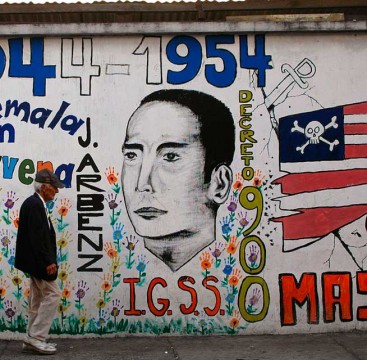
Fifty-seven years ago today the CIA was successful in overthrowing the democratically elected government of Guatemala in a campaign known as “Operation PBSUCCESS.”
This CIA campaign was the first of its kind in Latin America and took place over several years in an attempt to undermine the democratic efforts of the Guatemalan government. The Central American government was guilty of nothing more than trying to utilize the resources of its own country to improve the lives of its citizens.
This self-improvement plan involved a land reform effort where land that was owned by the United Fruit Company (land not being used) was appropriated so that local communities could be self-sufficient. The United Fruit Company was closely connected to the Eisenhower administration with both CIA director Allen Dulles and Secretary of State John Foster Dulles both being former lawyers for United Fruit.
The CIA coup involved many tactics, such as hiring the father of the PR industry Edward Bernays to take US reporters on “fact-finding” trips to Guatemala, collaborating with the arch-conservative Catholic Church, plus arming and training Guatemalan soldiers to defeat the democratic government of Jacobo Arbenz.

One of the legacies of the 1954 CIA coup was decades of political repression that resulted in hundreds of thousands of Guatemalans being murdered, tortured, disappeared and targeted for political assassination. The worst of this repression was in the 1980s, in what Amnesty International called a “genocidal campaign” against the Mayan population in Guatemala.
This brutal repression, which continues to this day (in a lesser form), has also resulted millions of Guatemalans being displaced. Many were displaced within the country, others fled to Mexico and many made their way to the US.
Before the 1980 there were very few Guatemalans living in West Michigan, but as a result of the political repression and economic policies of the last 20 years there are now thousands. The flight of Guatemalans did not end with the end of the war in 1996 and has only been exacerbated with the implementation of the Central America Free Trade Agreement (CAFTA) in 2005.
According to the Guatemalan Human Rights Commission there are an estimated 1.5 million Guatemalans living in the US who collectively send back to Guatemalan about $4 billion annually in remittances.
So what does this legacy actually mean for those of us who live in the Grand Rapids area? First, it means that we have to recognize that there are thousands of Guatemalans here and that many of them have suffered torture, political repression and a life of poverty. Before we are quick to judge or look critically at their behavior here in Grand Rapids we need to realize that they are not here because they thought it would be fun or because they wanted a part of the American dream……they are here because of a 60 year legacy of US support for political repression and economic exploitation.
Second, it means that we have to consider this historical context in relating to the Guatemalans who are here. If you work in the medical field you cannot lump Guatemalans into the “Hispanic” category and assume they speak Spanish. Most of the Guatemalans who are in this community are Mayan and speak one of many Mayan languages such as Qanjobal, Mam or Quiche.
This reality has to be factored in to those who educate Guatemalan children, those who work in social services and the non-profit sector. There are significant linguistic and cultural factors that must be considered.
Third, the Guatemalan Diaspora community is all around us if we would just pay attention. Guatemalans own small shops and restaurants, they have a few of their own religious congregations and several soccer teams. I have attended some of the soccer games and at times it felt like I was back in Guatemala, since the men and women were speaking their native language, they sat on brightly colored, hand-woven blankets and eating elote locos (crazy corn) – a traditional food, which is corn on the cob with lots of toppings.
Once we recognize that they are here we also need to be extremely sensitive to the fact that most Guatemalans live in fear of immigration and other law enforcement officers. This is not to say that most of them are undocumented. In fact, it is difficult to get a handle on the number of those who are here with legal documentation and those that are not, but regardless of their legal status most Guatemalans I know have a well-founded fear of harassment and deportation. This too is a legacy of the CIA coup, in that Guatemalans living in West Michigan are in a position of being a second-class citizen by virtue of their immigrant status, which is a direct result of the economic and military policies the US has imposed on Guatemala for the past 60 years.
The last point worth mentioning is that considering that there are these larger global dynamics that make up the social fabric of the Grand Rapids area those who are gravitate to the recent love affair of localism need to reconsider the limitations of such a philosophy. We do not live in a vacuum and what we do here impacts what happens around the world, even if we are not included in the decision-making process about policies that result in forced relocation of populations from other countries.
The legacy of the 1954 CIA coup in Guatemala is not just a walk down memory lane, it is an acknowledgement of the long term consequences of US foreign policy and its impact at the local level. Grand Rapids is forever impacted by that CIA action.
New Media We Recommend
Below is a list of new materials that we have read/watched in recent weeks. The comments are not a “review” of the material, instead sort of an endorsement of ideas and investigations that can provide solid analysis and even inspiration in the struggle for change. All these items are available at The Bloom Collective, so check them out and stimulate your mind.

Green is the New Red: An Insider’s Account of a Social Movement Under Siege, by Will Potter – What movement in the US is the most targeted for what the US government labels “domestic terrorism?” Answer: environmental and animal rights activists. Now, we don’t mean that all environmentalists and animal rights activists are on an FBI list, but the more radical members of those two movements are the primary targets of US government repression. Green is the New Red is an amazing read that should be a wake up call for anyone concerned about government repression. Potter himself targeted by the FBI provides us with important details and cogent analysis of how the US government has been targeting people who are involved with either the Earth Liberation Front or the Animal Liberation Front. The author also raises important questions about how the US government defines terrorism and how it applies such an interpretation as a mechanism for state repression.

Hot: Living Through the Next Fifty Years on Earth, by Mark Hertsgaard – Long-time investigative reporter Mark Hertsgaard is now a father and this reality has forced him to come to terms with the question: what will the world be like in the future for my daughter? The author is specifically addressing the issue of global warming and attempting to come to terms with what kind of a world he and the current generation will do to prevent catastrophic consequences. Hertsgaard weaves stories of his daughter, communities confronted with global warming and scientific data to present both an urgent and well thought out analysis about the seriousness of global warming. You don’t need to be a parent to feel a sense of urgency, but Hertsgaard does a fine job of translating his parental anxieties into meaningful discourse on the most pressing issue facing humanity.

Anti-Capitalism, by Ezequiel Adamovsky – This book is a cross between a zine and a comic book. However, don’t think it is short on good analysis. Anti-Capitalism provides readers with important foundations for both understanding what capitalism is and the various historical responses to the dominant economic system that cripples the world. What makes the book such a delight to read are the accompanying illustrations provided by the Argentine art collective known as Ilustradores Unidos. This book first appeared in Spanish and was recently translated into English. Anti-Capitalism is an important resource and would be a useful tool for popular education groups wanting to critique capitalism and dismantle it.
Out of Place: Memories of Edward Said/Edward Said: The Last Interview (DVD) – This two-DVD collection provides amazing insight into the life and work of the great Palestinian intellectual Edward Said. Out of Place is sort of a memoire of the life of Edward Said. The first documentary looks at the life and work of this amazing writer, with rare footage of Said that also includes comments from close friends and colleagues. The second DVD is the last interview conducted with Said before leukemia took his life in 2003. It was filmed over three days and includes his comments on his illness, his work and the passions of his life, particularly the fate of Palestine. Both films are an incredible tribute to one of the best intellectuals of the last half-century.
(This article is re-posted from Project Censored and is part of their Top 25 of 2011 Censored Stories)
 The US military is responsible for the most egregious and widespread pollution of the planet, yet this information and accompanying documentation goes almost entirely unreported. In spite of the evidence, the environmental impact of the US military goes largely unaddressed by environmental organizations and was not the focus of any discussions or proposed restrictions at the recent UN Climate Change Conference in Copenhagen. This impact includes uninhibited use of fossil fuels, massive creation of greenhouse gases, and extensive release of radioactive and chemical contaminants into the air, water, and soil.
The extensive global operations of the US military (wars, interventions, and secret operations on over one thousand bases around the world and six thousand facilities in the United States) are not counted against US greenhouse gas limits. Sara Flounders writes, “By every measure, the Pentagon is the largest institutional user of petroleum products and energy in general. Yet the Pentagon has a blanket exemption in all international climate agreements.”
While official accounts put US military usage at 320,000 barrels of oil a day, that does not include fuel consumed by contractors, in leased or private facilities, or in the production of weapons. The US military is a major contributor of carbon dioxide, a greenhouse gas that most scientists believe is to blame for climate change. Steve Kretzmann, director of Oil Change International, reports, “The Iraq war was responsible for at least 141 million metric tons of carbon dioxide equivalent (MMTCO2e) from March 2003 through December 2007. . . . That war emits more than 60 percent that of all countries. . . . This information is not readily available . . . because military emissions abroad are exempt from national reporting requirements under US law and the UN Framework Convention on Climate Change.”
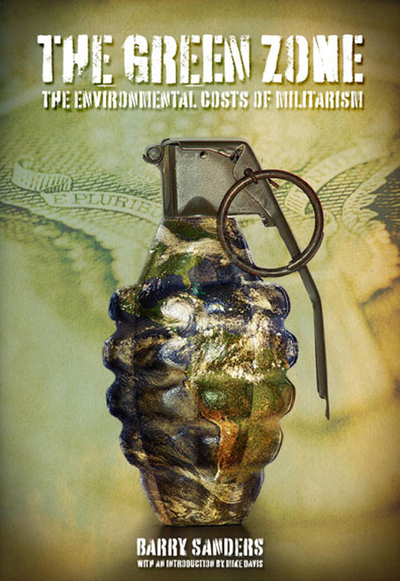
According to Barry Sanders, author of The Green Zone: The Environmental Costs of Militarism, “the greatest single assault on the environment, on all of us around the globe, comes from one agency . . . the Armed Forces of the United States.”
Throughout the long history of military preparations, actions, and wars, the US military has not been held responsible for the effects of its activities upon environments, peoples, or animals. During the Kyoto Accords negotiations in December 1997, the US demanded as a provision of signing that any and all of its military operations worldwide, including operations in participation with the UN and NATO, be exempted from measurement or reductions. After attaining this concession, the Bush administration then refused to sign the accords and the US Congress passed an explicit provision guaranteeing the US military exemption from any energy reduction or measurement.
Environmental journalist Johanna Peace reports that military activities will continue to be exempt based on an executive order signed by President Barack Obama that calls for other federal agencies to reduce their greenhouse gas emissions by 2020. Peace states, “The military accounts for a full 80 percent of the federal government’s energy demand.”
As it stands, the Department of Defense is the largest polluter in the world, producing more hazardous waste than the five largest US chemical companies combined. Depleted uranium, petroleum, oil, pesticides, defoliant agents such as Agent Orange, and lead, along with vast amounts of radiation from weaponry produced, tested, and used, are just some of the pollutants with which the US military is contaminating the environment. Flounders identifies key examples:
– Depleted uranium: Tens of thousands of pounds of microparticles of radioactive and highly toxic waste contaminate the Middle East, Central Asia, and the Balkans.
– US-made land mines and cluster bombs spread over wide areas of Africa, Asia, Latin America, and the Middle East continue to spread death and destruction even after wars have ceased.
– Thirty-five years after the Vietnam War, dioxin contamination is three hundred to four hundred times higher than “safe” levels, resulting in severe birth defects and cancers into the third generation of those affected.
– US military policies and wars in Iraq have created severe desertification of 90 percent of the land, changing Iraq from a food exporter into a country that imports 80 percent of its food.
– In the US, military bases top the Superfund list of the most polluted places, as perchlorate and trichloroethylene seep into the drinking water, aquifers, and soil.
– Nuclear weapons testing in the American Southwest and the South Pacific Islands has contaminated millions of acres of land and water with radiation, while uranium tailings defile Navajo reservations.
– Rusting barrels of chemicals and solvents and millions of rounds of ammunition are criminally abandoned by the Pentagon in bases around the world.
The United States is planning an enormous $15 billion military buildup on the Pacific island of Guam. The project would turn the thirty-mile-long island into a major hub for US military operations in the Pacific. It has been described as the largest military buildup in recent history and could bring as many as fifty thousand people to the tiny island. Chamoru civil rights attorney Julian Aguon warns that this military operation will bring irreversible social and environmental consequences to Guam. As an unincorporated territory, or colony, and of the US, the people of Guam have no right to self-determination, and no governmental means to oppose an unpopular and destructive occupation.
Between 1946 and 1958, the US dropped more than sixty nuclear weapons on the people of the Marshall Islands. The Chamoru people of Guam, being so close and downwind, still experience an alarmingly high rate of related cancer.
On Capitol Hill, the conversation has been restricted to whether the jobs expected from the military construction should go to mainland Americans, foreign workers, or Guam residents. But we rarely hear the voices and concerns of the indigenous people of Guam, who constitute over a third of the island’s population.
Meanwhile, as if the US military has not contaminated enough of the world already, a new five-year strategic plan by the US Navy outlines the militarization of the Arctic to defend national security, potential undersea riches, and other maritime interests, anticipating the frozen Arctic Ocean to be open waters by the year 2030. This plan strategizes expanding fleet operations, resource development, research, and tourism, and could possibly reshape global transportation.
While the plan discusses “strong partnerships” with other nations (Canada, Norway, Denmark, and Russia have also made substantial investments in Arctic-capable military armaments), it is quite evident that the US is serious about increasing its military presence and naval combat capabilities. The US, in addition to planned naval rearmament, is stationing thirty-six F-22 Raptor stealth fighter jets, which is 20 percent of the F-22 fleet, in Anchorage, Alaska.
Some of the action items in the US Navy Arctic Roadmap document include:
– Assessing current and required capability to execute undersea warfare, expeditionary warfare, strike warfare, strategic sealift, and regional security cooperation.
– Assessing current and predicted threats in order to determine the most dangerous and most likely threats in the Arctic region in 2010, 2015, and 2025.
– Focusing on threats to US national security, although threats to maritime safety and security may also be considered.
Behind the public façade of international Arctic cooperation, Rob Heubert, associate director at the Centre for Military and Strategic Studies at the University of Calgary, points out, “If you read the document carefully you’ll see a dual language, one where they’re saying, ‘We’ve got to start working together’ . . . and [then] they start saying, ‘We have to get new instrumentation for our combat officers.’ . . . They’re clearly understanding that the future is not nearly as nice as what all the public policy statements say.”
Beyond the concerns about human conflicts in the Arctic, the consequences of militarization on the Arctic environment are not even being considered. Given the record of environmental devastation that the US military has wrought, such a silence is unacceptable.
Rob Bliss appears to be enjoying a new revenue stream since his Grand Rapids LipDub of “American Pie” caught the attention of the media this past week.

Now you can go to CafePress.com and buy LipDub merchandising. How did I find this out? Because Rob has inserted an advertising line at the opening of the LipDub on YouTube—upping the video’s classiness quotient even more. The message asks for support of “this non-profit organization” and says you can “buy cool merchandise” at the CafePress website
On our very own American Pie promotional site, Grand Rapids fans can buy LipDub 2011 t-shirts; posters and cards featuring Rob’s storyboards for the video; and a t-shirt with a generic office chair on it that simply says, “Grand Rapids.” Or, you can buy a t-shirt with a heart that says, “I Love Grand Rapids.” There are also water bottles, steins, shot glasses, and other tasteful products for sale.
T-shirt prices go up to about $30, but even infants can wear Grand Rapids LipDub bodysuits. A framed print of the storyboard will set you back $39.99, and a pack of 20 storyboard notecards costs $23.99.
Just like the organization of the LipDub itself, it’s impressive that this site was launched with so many products this quickly and efficiently. Advertising copy describes each item in glowing terms: for example, the description for the notecards advises:
A personal note on a beautiful card will make a lasting impression and a touching keepsake.
You can even submit your e-mail address to get updates on “product specials” and other “news.” News of what? New projects by the unnamed non-profit? News of even more merchandise choices? It doesn’t say.
As detailed as the sales copy is, information on the non-profit itself is totally missing in action. There’s no actual explanation of how the money from this “fund-raising” is going to be used or who exactly is collecting it.
The ad line blazoned across the start of the LipDub video makes it clear you are somehow contributing to a non-profit when you buy this stuff, but doesn’t even tell you the name of the non-profit. There’s no “about” statement on the merchandise site explaining who, exactly, is the sales entity behind this cornucopia of Grand Rapids LipDub love.
At the top of each merchandise page is the puzzlingly vague statement: “Support the Grand Rapids LipDub and other public projects with your purchase.”
How does this support the completed LipDub? What other public projects? Is the Grand Rapids LipDub its own charitable organization?
Normally, when you buy something to support a non-profit, there’s information available: The name of the non-profit. Its mission. Why it is raising money, and what the money is going to be used for.
If someone came to your door and said, “Please donate $30 to keep our air and water clean,” without any information on what group they were collecting funds for or why—would you donate?
At Rob Bliss’s merchandising site there is no disclosure—just a demand for money in exchange for merchandise. And the utter absence of any explanation seems to raise more questions than anything else.
New Notice: Attend Training This Weekend Here in Grand Rapids to Help Repeal Public Act 4

In order to encourage more Grand Rapids volunteers for the repeal of Snyder’s EFM law, Michigan Forward has arranged for a Grand Rapids training session this Saturday, June 4 from 10 AM to noon:
Grand Rapids Location
ATUGR (Amalgamated Transit Union Local 836)
918 Benjamin NE
Grand Rapids, Michigan 49503
Phone: (616) 235-9836
You can pre-register for training using this form at the bottom of the page. Or, just go to the training site on Saturday morning.
By collecting signatures this summer, we can stop this law in its tracks before more communities and school systems are taken over by EFMs with unlimited power. Canvassers need to attend one of the training sessions to get started.
As soon as the required number of signatures are collected, the law will be suspended until the 2012 election. Throughout the summer and fall, check Michigan Forward’s website and Reject Emergency Mangers’ Facebook page for up-to-date news on the repeal effort.
Training will cover the campaign goals, training on delivering the message, best practices for volunteer canvassers, and Michigan electoral law.
Grand Rapids is key to collecting enough signatures to place the repeal on the 2012 ballot. Even though this is last-minute information, try to attend if you can.

Michigan Forward, united with other activist organizations across the state, has set training sessions for people volunteering to help topple Public Act 4. This is the Emergency Financial Manager Act which has been called “fiscal martial law.”
By collecting signatures this summer, we can stop this law in its tracks before more communities and school systems are taken over by EFMs with unlimited power. Canvassers need to attend one of the training sessions to get started.
There are two training sessions available to Grand Rapids volunteers this Saturday, June 4. Both are from 10 AM to noon:
Lansing
Michigan AFSCME Council 25 (Lansing)
1034 North Washington Avenue
Lansing, MI 48906
Phone: 517-487-5081
Kalamazoo
Michigan AFSCME Council 25 (Kalamazoo)
3625 Douglas Avenue
Kalamazoo MI 49004
Phone: (866) 405-6800 Toll-free
You can pre-register for training using this form at the bottom of the page.
As soon as the required number of signatures are collected, the law will be suspended until the 2012 election. Throughout the summer and fall, check Michigan Forward’s website and Reject Emergency Mangers’ Facebook page for up-to-date news on the repeal effort.
(This article is re-posted from PRWatch.)
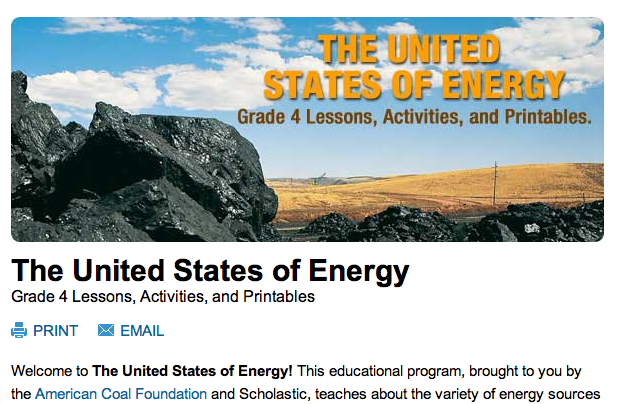
Scholastic, Inc., a leading publisher and distributor of children’s books and teaching materials, agreed to stop selling a coal industry-sponsored curriculum that it has distributed to 66,000 fourth grade teachers since 2009.
The curriculum was sponsored by the American Coal Foundation, which represents the interests of the coal mining industry. A May 11, 2011 New York Times story labeled the coal industry-created curriculum “unfit” for fourth graders because it failed to mention the negative aspects of coal mining and burning on human health and the environment, like removal of Appalachian mountaintops, toxic waste discharge, sulfur dioxide, mercury and arsenic discharges, lung disease and mining accidents.
The Campaign for Commercial-Free Childhood, which drew attention to and opposed Scholastic’s use of the curriculum, has also opposed Scholastic for its “SunnyD Book Spree,” which the company featured its Parent and Child magazine that encouraged teachers to have classroom parties with Sunny Delight, a sugar-fortified drink, and collect labels from the beverage to win free books.
The campaign has also objected to Scholastic’s promotion of Children’s Claritin in materials it distributed about spring allergies. Scholastic is a $2 billion business whose educational materials are in 9 of 10 American classrooms.
For information about efforts in West Michigan to challenge corporate-funded educational materials in schools contact the group STOK.

On Tuesday, Michigan Senator Debbie Stabenow hosted a hearing on the 2012 Farm Bill in East Lanisng that primarily served the interests of the agribusiness sector.
There was limited news coverage of the hearing and what coverage did exist was fairly superficial. The Lansing State Journal ran a very brief story that provided no context or details for readers.
The other stories we came across were not as brief but only provided the perspectives of Senator Stabenow and representatives from the agribusiness sector. A Detroit Free Press article gave one sentence to Senator Stabenow and a few lines to a 400-acre farmer from Midland who also serves as the director of the National Corn Growers Association.
Michigan radio aired a story that was a bit longer and cited a representative from the MSU Extension, Senator Stabenow and a cherry farmer from Leelanau County who is also the chair of the Young Farmers and Ranchers Committee with the American Farm Bureau, which according to SourceWatch is a right wing front group for US agribusiness.
Follow the Money
Since there has been limited reporting on the content of the Farm Bill hearing we can only draw some conclusions based on who attended and the history of the agribusiness sector in Michigan.

According to the online source Michigan Farmer the bulk of those who sat on panels and presented at the hearing were agribusiness people. Agribusiness groups represented were the Michigan Corn Growers Association, Michigan Sugar Company, US Apple Association, Michigan Pork Producers Council and the Michigan Milk Producers Association.
There is no mention of small farmers being present, those from the Community Supported Agriculture (CSA) sector, farm workers, farmers markets or the general public, which continues to have limited options with the food they buy.
One of the main reasons that the hearing was stacked with representatives from the agribusiness sector is because they depend so much on taxpayer subsidies. According to information from the Environmental Working Group, billions of dollars of government subsidies have been given to the large agribusiness sector in Michigan alone.
1 Corn Subsidies** 50,306 $2,030,750,107
2 Soybean Subsidies** 29,147 $556,331,027
3 Wheat Subsidies** 37,099 $327,709,169
4 Conservation Reserve Program 17,786 $310,264,447
5 Disaster Payments 20,085 $299,369,091
6 Dairy Program Subsidies 5,922 $208,146,457
7 Env. Quality Incentive Program 2,752 $76,280,887
8 Apple Subsidies 877 $27,716,155
9 Wetlands Reserve Program 309 $22,718,995
10 Livestock Subsidies 9,490 $22,708,057
This data is based on the amount of times each sector (the first number) has received a subsidy since 1995 and the total amount of government subsidies (second number) since 1995.
This amount of taxpayer provided subsidies raises numerous questions about what benefit there is to the consumer and to long-term sustainability. Small and independent farmers do not get these kinds of subsidies, yet they provide us with more of the fruits and vegetables that we actually eat. The corn and soy sectors often grow their crops for export or as feed for the livestock industry.
Do any of these sectors have to adopt environmental standards in order to receive subsidies? What kind of reporting are they required to do so that the public knows what they are eating and what risks are prevalent in farming communities when it comes to pesticide use?
If the apple industry is getting millions in subsidies why can’t they pay migrant workers a living wage to do the difficult work of picking apples? These are questions that likely were not raised during he hearing based on who spoke, but these are questions we all need to be asking if we are serious about food production serving the greater good.
Mobile Mugging: The AT&T, T-Mobile Merger
(This article by Jenn Ettinger is re-posted from Other Words.)

A recent T-Mobile commercial depicts a cellphone customer being harassed by two thugs in business suits, his pockets emptied, his wallet turned inside out, and every last penny shaken out of him. The gist: He’s being mugged by T-Mobile’s competitors, which all charge higher prices for less service than T-Mobile.
Ironically, T-Mobile is now about to be bought up by one of those muggers. While the commercial is supposed to sell people on T-Mobile, it really gives us a preview of what we can expect if AT&T’s planned $39-billion purchase of T-Mobile goes through. If the deal is approved, there’s reason to believe T-Mobile’s 33 million customers will have a lot in common with that mugged customer.
The deal would eliminate a competitor and leave two wireless giants — AT&T and Verizon — with unprecedented power. The two companies would control nearly 80 percent of the nation’s cellphone market, spelling bad news for consumers across the board.
AT&T’s service is consistently ranked among the worst of all cellphone providers, with a history of complaints about dropped calls, poor reception, and terrible customer service. Worse, it lures customers into long-term, high-cost contracts with exorbitant fees and exclusive deals with phone makers. And, as more of us use our phones to browse the Web or read email, AT&T no longer offers unlimited data plans. If T-Mobile customers who like their unlimited talk, text, and data plans want something like it from AT&T, they’ll have to shell out $50 more every month, with costly penalties for breaching AT&T’s arbitrary limits.

AT&T talks about the benefits of this merger, but for T-Mobile customers it would mean spending more and getting less.
T-Mobile has been able to compete in a market dominated by AT&T and Verizon by offering lower-price services and innovative new phones — all of it at risk with this merger. But AT&T has been using its deep pockets to lobby hard for approval of this takeover, arguing that buying T-Mobile will help it improve its network. But instead of investing its record profits to build a better network, the company has funneled them into its executives’ bank accounts. This merger is about nothing more than eliminating a competitor.
T-Mobile is playing both sides. While its commercials warn about AT&T and Verizon mugging the American people, its lobbyists urge Congress to approve the company’s merger with AT&T. On May 10, T-Mobile CEO Philipp Humm testified before a Senate subcommittee that this merger would increase competition and “lower prices for all customers.” But you can’t have more competition with fewer options. It just doesn’t add up.
At a time when people need to control their spending, AT&T will force them to dig even deeper into their pockets to pad its profits.
The Federal Communications Commission and the Department of Justice are both tasked with reviewing the merger and its potential impact on public interest and competition in the wireless market. Eliminating a competitor from the marketplace certainly doesn’t lead to more competition. Both agencies should recognize that this merger will ultimately lead to higher prices and fewer choices for all wireless customers.

