Draft of One Kent Coalition Legislative Proposal

Yesterday we reported on the June 14 meeting of the advisory group that is tasked with looking at the proposal of local government consolidation from the One Kent Coalition.
This morning we received a copy of a draft of the propose state legislation that the One Kent Coalition has put together that would be necessary for the City of Grand Rapids and Kent County to consolidate as one government entity.
The draft is 38 pages long and is by no means easy to read. The draft legislation is calling for this new metropolitan government to be run by a CEO, a Chief Executive Officer, who would have executive power and would be elected by the public. There would also be a metropolitan commission who would adopt ordinances and budgets and be given legislative powers.
We encourage you to read the entire legislative draft and attend the next meeting of this advisory group, which will be held on Wednesday, June 29 at 4:00PM in room 202 E of the downtown GVSU campus.
Yesterday, the second meeting of the committee to study the One Kent Coalition local government consolidation proposal met in downtown Grand Rapids.

This local group of appointed members was given the task of coming up with recommendations in response to the One Kent Coalition’s local government consolidation proposal……..or maybe it wasn’t.
Much of the meeting was spent by committee members discussing what their actual task was and whether or not the September deadline was an adequate amount of time for them to honestly assess the prospects of local government consolidation.
Steve Crandall, a corporate human resources specialist was the facilitator for yesterday’s meeting. When Crandall stated that the group was tasked to look at the feasibility of the One Kent Coalition proposal, County Commissioner Roger Moran said the charge should be to question the proposal. Cascade Township Manager Bill Cousins agreed with Moran and Harold Hamilton (GR City Planning Comm) said he was “freaked out,” since he thinks that if the proposal passed in would leave Grand Rapids with no functioning central government. He supports consolidating services, but not government.
David Leonard, general counsel for Spectrum Health and a member of the One Kent Coalition, said, “shouldn’t it be up to the voters to decide whether or not this is a good proposal?”
Moran responded and said that the One Kent Coalition met for a year in secrecy with no elected officials so he does not trust what their intent is. Former Grand Rapids City Commissioner Mary Alice Williams said she agreed to come to the table to decide whether this was a good idea, but after the first meeting the mandate is how do we move and implement this proposal. “It seems that from the One Kent group that this study group was a necessary evil, a speed bump in the process of it moving forward.” She said she doesn’t object government consolidation in principle, but that more information needs to be presented.
Wyoming City manager Curtis Holt said the language of the legislation that the One Kent Coalition put forth has been decided so it seemed that the task of this group was somewhat ambivalent He stated that the One Kent folks think government consolidation will be good for economic growth, but they have offered no serious data to support such a claim.

Again, Commissioner Moran spoke up and stated that he thinks that is doesn’t matter that this group says, “since the legislation is so far down the line it has already been decided.”
Harold Hamilton stated that he thinks the process needs to slow down. “The September deadline given to us by Nyal Deems at the last meeting is too quick.” Mary Alice Williams asked what do the One Kent Coalition members think about the issues people are raising, if they are going to go ahead with their endeavor no matter what this group’s decides even if they disagree with the proposal.
One Kent Coalition member Marge Potter avoided the question by talking about how Grand Rapids and Detroit are very similar. She also stated that she had submitted some “research for the group” on what other counties like Kent have done around the issue of government consolidation. Crandall agreed with Potter by saying this process is really about looking at “best practices,” but that did not address the question as to what the intent on the One Kent Coalition was and what they have been doing for the past year.
David Leonard said that the One Kent Coalition has submitted nothing more than a legislative proposal and that there is “no conspiracy.” Other members of the One Kent Coalition group present said that they regard “this group’s work as very important in what will be introduced into legislation.” Again, this sentiment did not address the question of what the group has been doing for the past year, where their funding has come from and whether or not they have hired a lobbyist to push the legislation in Lansing.
Tom Butcher, general counsel for GVSU and a member of the One Kent Coalition spoke in very lofty terms about the importance of thinking about what local government might look like in 25 years from now. He mentioned the economic benefits and the decision-making powers that could come with government consolidation and challenged the group to think about social justice in this community, although he never defined what social justice meant.
Former State Representative Jerry Kooiman says that the next meeting should include information on the history/background of the One Kent Coalition, plus Mayor Heartwell and County Commissioner Sandy Frost Parish should also be there to address their thoughts and concerns on the proposal.
Wyoming City Manager Curtis Holt said, “this group needs to be assured by the One Kent Coalition that the conclusions they come up with need to be respected and that no legislation will move forward before the group comes up with some recommendations.”
There was no commitment to this request from Holt, but there was consensus that the One Kent Coalition would make a presentation to the group at the next meeting. The next meeting is scheduled for the downtown campus of GVSU on Wednesday, June 29 at 4:00PM in room 202 E.
After the meeting this writer spoke with Grand Rapids City Commissioner Rosalynn Bliss who stated that the One Kent Coalition has retained Rusty Merchant to be a lobbyist for their state legislation proposal on local government consolidation, despite claims by some of the One Kent Coalition members that they had not hired anyone at this point. Merchant has a history of lobbying for the Grand Rapids Chamber of Commerce and other business groups at the state level.
After sitting through two hours of discussion it seemed very apparent to this writer that the advisory group was not in agreement on the purpose of this group’s task and there was significant concerns, even mistrust, over what the real intent of the One Kent Coalition was. Whenever these concerns were raised members of the One Kent Coalition present avoided any direct response and failed to provide clear transparency on what the group has done up to this point. The meeting on the 29th might provide some clarification for these concerns and we plan to be there and report on what is presented and discussed.
Cheerleading for corporations in Grand Rapids
Within the so-called free market system that we operate it is worth noting the increased role that corporate capitalism plays in our lives.
There are fewer and fewer aspects of the world where corporate capitalism has not inserted itself. More and more of the world is branded and sponsored by corporations and since many of us embrace the role as consumers more than we do as citizens we often welcome the financial contributions that corporate capitalism make to causes or organizations we like.

Towards the end of last year this writer must have received dozens of facebook messages from people encouraging me to support the campaign to “win” $1 million dollars from Wal-Mart. Some of the people who encouraged me to support this campaign have a history of doing social justice work, so I was surprised by their enthusiasm for what was clearly a PR campaign by Wal-Mart.
Last year we also saw hundreds of area people put on a flash mob to try to get Google Fiber to come to Grand Rapids. People gathered at the Calder Plaza to coax one of the most powerful corporations of the digital age to beg them to pick Grand Rapids in the belief that our lives would be vastly improved. Any time a company grows as fast as Google did and has the control of the amount of information they do, we should not be begging them for anything, we should be doing what author Ken Auletta did in his book, Googled: The End of the World As We Know It.
Just yesterday, the local non-profit housing group Dwelling Place invited people via facebook to an event that would “celebrate the arrival of Verizon 4G network in Grand Rapids!” What was in it for Dwelling Place? According to the facebook posting the local non-profit would get $16,000. Therein lies the dilemma.
Non-profit and grassroots groups are constantly struggling to find financial resources to do what they want to do. Sometimes they can raise the money through memberships, other times through grant money and still other times from corporate underwriting & donations.
The problem with corporate donations is three fold. First, when corporations donate money to non-profit groups we are less likely to ask questions about what role they really play in society. Second, these kinds of corporate donations tend to have a censoring affect on the public and particularly on the organization that received the money, which is to say we are less likely to criticize what they do. Lastly, buy taking corporate money we prevent ourselves from ever asking how these companies acquired the wealth they possess in the first place.
Verizon is the one of the largest phone companies in the country and the second largest wireless provider. Verizon has grown tremendously in recent years because of a lack of regulation on media ownership and no real enforcement of anti-trust laws, which have allowed corporations to acquire more and more.
Verizon of course has played an active role in determining the kinds of corporate friendly media policies we have in the US. According to the Center for Responsible Politics, Verizon has contributed over $16 million dollars to political candidates since 1990 and hundreds of millions of dollars lobbying on Tele-Com policies being decided in Congress.
Along with their political influence Verizon also violates the terms of their FCC license. According to a recent Media Release from the national media group Free Press:
“Verizon’s conduct is bad for the public and bad for innovation. It also appears to be illegal under the FCC’s rules that govern Verizon’s LTE network. Users pay through the nose for Verizon’s LTE service, and having done so, they should be able to use their connections as they see fit. Instead, Verizon’s approach is to sell you broadband but then put up roadblocks to control your use of it.”
Free Press has submitted a formal complaint with the FCC over the company’s failure to comply with the terms of Spectrum Licenses.
Verizon, like any individual within corporate capitalism, is committed to greater and greater profits. Giving away small portions of the wealth they have fleeced from the public is a small price to pay for our silence or willingness to ignore the power they wield in public policy.
News Companies Popular Investments Among Congressmen
(This article is re-posted from Open Secrets.)

As recent political fiascoes involving Rep. Anthony Weiner and ex-Sen. John Edwards have shown, the power of the press carries weight, especially in Washington. Careers of high-rising politicos can be buried or propelled to new heights in a matter of minutes by the media.
But many members of Congress actually have a vested interest — beyond just their political careers — in the performance of the same organizations that are supposed to be their watchdogs, a Center for Responsive Politics investigation indicates.
About 60 U.S. senators and representatives, or their spouses, hold assets in at least 19 different news organizations or media conglomerates, according to the Center’s analysis of federal personal financial disclosure documents. At least seven congressmen have media investments worth a minimum of $100,000, and Sen. John Kerry (D-Mass.) leads the pack with his family’s multi-million-dollar holdings in multiple media companies, including a significant investment in News Corp., which owns Fox News.

The latest casualty of a sex scandal, Weiner (D-N.Y.), who has dominated the news cycle ever since he tweeted a picture of his crotch three weeks ago, is one of the congressmen to own stock in a news company.
Weiner owns New York Times‘ assets valued between $1,001 and $15,000, according to his 2009 personal financial disclosure report, the most recent available. (Members are only required to list the value of their assets in broad ranges.) The Times has been reporting on the congressman’s scandal with multiple stories and blog posts each day. Many members of Congress and editorial boards of news organizations have also asked Weiner to step down. And although the Times has not shown its support for Weiner in any way, congressmen’s interest in media investments should be questioned, said Kevin Smith, chairman of the ethics committee for the Society of Professional Journalists.
“If congressmen are investing in the New York Times, does that filter into the newsroom?,” Smith told OpenSecrets Blog. “What happens is that it does raise red flags.”
Edwards, a former senator and presidential candidate who was recently indicted on six counts of campaign finance violations, may also still have holdings in media companies. Edwards has previously reported investments in Comcast and Viacom, two of the biggest media conglomerates, according to his 2004 disclosure report from his time as a U.S. senator. He also disclosed holdings in Gate House Media, which owns nearly 500 publications nationwide, when he announced his presidential bid during the 2008 election cycle. Gannett Co., Walt Disney (which owns ABC), News Corp., CBS, Washington Post, Thomas Reuters and E.W. Scripps Co. are some of the other news organizations in which members of Congress invest.
Robin Pence, spokeswoman for Gannett, which owns 82 newspapers (including USA Today) and 23 television stations, told OpenSecrets Blog in an email that the company has never looked into whether any members of Congress hold the company’s stock.
“But even if they did, it would have no impact on our news coverage,” Pence said. Almost an equal number of Democrats and Republicans either directly or through their spouses hold investments in media organizations.

They include Kerry, Richard Burr (R-N.C.), Tom Harkin (D-Iowa), Kay Hagan (D-N.C.), Sheldon Whitehouse (D-R.I.), Jon Kyl (R-Ariz.) and Reps. Eric Cantor (R-Va.), Nancy Pelosi (D-Calif.), Rick Berg (R-N.D.) and James Renacci (R-Ohio). Six of the total 60 members of Congress with such stock holdings belong to the Lone Star state. Reps. Michael McCaul (R-Texas), Kenny Marchant (R-Texas), Michael Burgess (R-Texas), Lloyd Doggett (D-Texas), William Flores (R-Texas) and Blake Farenthold (R-Texas) each have thousands invested in media companies.
Smith told OpenSecrets Blog that such investments could be problematic depending on the congressmen’s motives — are they politically strategic or financially strategic decisions?
And with such a large number of politicians having holdings in the media, questions behind their motives will undoubtedly be raised. “Either they are all going to the same investment strategist, or they have some sort of game plan,” Smith said.
OpenSecrets Blog contacted the offices of more than a dozen politicians who reported owning stock in media companies. Many did not return messages, and some stated that they were not allowed to comment on their congressmen’s personal investments.
Whitney Smith, spokeswoman for Kerry, who reported investments in News Corp., Comcast, Walt Disney and E.W. Scripps, told OpenSecrets Blog in an email that the senator himself did not personally purchase media stocks. ”All of his holdings are in inherited family trusts that he has no investing control over whatsoever, nor is Senator Kerry a beneficiary of any of his wife’s trusts,” Whitney Smith said.
For the purposes of this analysis, investments in certain large conglomerates, such as General Electric, which partially own certain media organizations, were not included. The research is also based on congressmen’s filings from 2009, meaning that some of them may no longer own the stock in question. Members of Congress are scheduled to report their 2010 personal finances today, although many members typically file for extensions, meaning their information won’t be available for weeks or months.
Below is a list of congressional members’ media investments, according to the Center‘s analysis of their most recent personal financial disclosures:
|
Name |
Asset |
Min |
Max |
| Rep. Gary Ackerman (D-N.Y.) | Tribco LLC |
$250,001 |
$500,000 |
| Rep. Jason Altmire (D-Pa.) | Walt Disney Co. |
$1,001 |
$15,000 |
| Sen. Mark Begich (D-Ark.) | Westwood One |
$1,001 |
$15,000 |
| Rep. Rick Berg (R-N.D.) | Viacom Inc. |
$9,483 |
$9,483 |
| Comcast Corp. |
$4,290 |
$4,290 |
|
| CBS Corp. |
$2,599 |
$2,599 |
|
| Walt Disney Co. |
$2,580 |
$2,580 |
|
| Rep. Howard L. Berman (D-Calif.) | Walt Disney Co. |
$4,837 |
$4,837 |
| Rep. Gus Bilirakis (R-Fla.) | Walt Disney Co. |
$1,001 |
$15,000 |
| Sen. Jeff Bingaman (D-N.M.) | Centennial Broadcasting |
$0 |
$1,000 |
| Rep. Dan Boren (D-Okla.) | Walt Disney Co. |
$1,001 |
$15,000 |
| Rep. Vernon Buchanan (R-Fla.) | Comcast Corp. |
$1,001 |
$15,000 |
| Rep. Michael Burgess (R-Texas) | Walt Disney Co. |
$1,001 |
$15,000 |
| Citadel Broadcasting |
$1 |
$1,000 |
|
| Sen. Richard Burr (R-N.C.) | Walt Disney Co. |
$25,993 |
$25,993 |
| Rep. Eric Cantor (R-Va.) | CBS Corp. |
$15,001 |
$50,000 |
| Walt Disney Co. |
$15,001 |
$50,000 |
|
| Rep. Shelley Moore Capito (R-W.Va.) | Walt Disney Co. |
$1,001 |
$15,000 |
| Sen. Tom Carper (D-Del.) | News Corp. |
$0 |
$1,000 |
| Rep. Ben Chandler (D-Ky.) | Woodford Sun |
$15,001 |
$50,000 |
| Rep. Stephen Ira Cohen (D-Tenn.) | Walt Disney Co. |
$15,001 |
$50,000 |
| Comcast Corp. |
$1,001 |
$15,000 |
|
| Rep. Gerry Connolly (D-Va.) | Walt Disney Co. |
$1,001 |
$15,000 |
| Rep. Jim Cooper (D-Tenn.) | Comcast Corp. |
$1,001 |
$15,000 |
| Rep. Ted Deutch (D-Fla.) | Walt Disney Co. |
$2,002 |
$30,000 |
| Rep. John D. Dingell (D-Mich.) | Comcast Corp. |
$1,001 |
$15,000 |
| Rep. Lloyd Doggett (D-Texas) | CBS Corp. |
$1,001 |
$15,000 |
| Comcast Corp. |
$1,001 |
$15,000 |
|
| Rep. David Dreier (R-Calif.) | Viacom Inc |
$101,002 |
$265,000 |
| Rep. Blake Farenthold (R-Texas) | Walt Disney Co. |
$2,002 |
$30,000 |
| Rep. William Flores (R-Texas) | Comcast Corp. |
$37,692 |
$37,692 |
| Rep. Rodney Frelinghuysen (R-N.J.) | Comcast Corp. |
$1,001 |
$15,000 |
| Gannett Co. |
$1,001 |
$15,000 |
|
| Sen. Kay R. Hagan (D-N.C.) | Walt Disney Co. |
$1,001 |
$15,000 |
| Sen. Tom Harkin (D-Iowa) | Walt Disney Co. |
$1,001 |
$15,000 |
| Rep. Andy Harris (R-Md.) | Comcast Corp. |
$1,001 |
$15,000 |
| Sen. Ted Kaufman (D-Del) | News Corp. |
$0 |
$2,628 |
| Sen. John Kerry (D-Mass.) | Comcast Corp. |
$1,750,003 |
$2,500,001 |
| News Corp. |
$600,002 |
$1,250,000 |
|
| EW Scripps Co. |
$0 |
$1,000 |
|
| Walt Disney Co. |
$0 |
$2,000 |
|
| Sen. Jon L. Kyl (R-Ariz) | Viacom Inc |
$5,173 |
$5,173 |
| Comcast Corp. |
$4,930 |
$4,930 |
|
| Walt Disney Co. |
$2,741 |
$2,741 |
|
| Rep. Leonard Lance (R-N.J.) | Comcast Corp. |
$1,001 |
$15,000 |
| Rep. Kenny Marchant (R-Texas) | Gannett Co. |
$155,405 |
$155,405 |
| CBS Corp. |
$6,744 |
$6,744 |
|
| Comcast Corp. |
$5,916 |
$5,916 |
|
| Walt Disney Co. |
$5,031 |
$5,031 |
|
| Viacom Inc |
$3,716 |
$3,716 |
|
| Rep. Carolyn McCarthy (D-N.Y.) | Thomson Reuters |
$252 |
$252 |
| Rep. Michael McCaul (R-Texas) | Comcast Corp. |
$81,004 |
$215,000 |
| News Corp. |
$32,004 |
$130,000 |
|
| Walt Disney Co. |
$32,004 |
$130,000 |
|
| CBS Corp. |
$30,002 |
$100,000 |
|
| British Sky Broadcasting |
$2,002 |
$30,000 |
|
| ITV Plc |
$2,002 |
$30,000 |
|
| Rep. Jim McDermott (D-Wa.) | Comcast Corp. |
$7,587 |
$7,587 |
| Sen. Ben Nelson (D-Neb.) | Viacom Inc |
$15,001 |
$50,000 |
| Rep. Frank Pallone Jr (D-N.J.) | Walt Disney Co. |
$1,001 |
$15,000 |
| Rep. Nancy Pelosi (D-Calif.) | Comcast Corp. |
$100,001 |
$250,000 |
| Morningstar Inc. |
$100,001 |
$250,000 |
|
| Rep. Gary Peters (D-Mich.) | New York Times |
$1,001 |
$15,000 |
| Rep. Tom Petri (R-Wis.) | Washington Post |
$100,001 |
$250,000 |
| Rep. Nick Rahall (D-W.Va.) | Gannett Co. |
$5,940 |
$5,940 |
| Rep. James B. Renacci (R-Ohio) | Viacom Inc |
$10,565 |
$10,565 |
| Comcast Corp. |
$9,321 |
$9,321 |
|
| Walt Disney Co. |
$3,003 |
$45,000 |
|
| Citadel Broadcasting |
$1 |
$1,000 |
|
| Rep. Hal Rogers (R-Ky.) | Comcast Corp. |
$1,693 |
$1,693 |
| Rep. Linda Sanchez (D-Calif.) | Walt Disney Co. |
$1,001 |
$15,000 |
| Citadel Broadcasting |
$1 |
$1,000 |
|
| Rep. Kurt Schrader (D-Ore.) | Walt Disney Co. |
$15,001 |
$50,000 |
| Rep. F. James Sensenbrenner Jr. (R-Wis.) | Comcast Corp. |
$1,001 |
$15,000 |
| Rep. Jackie Speier (D-Calif.) | Walt Disney Co. |
$15,001 |
$50,000 |
| Comcast Corp. |
$1,001 |
$15,000 |
|
| Citadel Broadcasting |
$1 |
$1,000 |
|
| Rep. John F. Tierney (D-Mass.) | Walt Disney Co. |
$1,001 |
$15,000 |
| Rep. Scott Tipton (R-Colo.) | Walt Disney Co. |
$1,001 |
$15,000 |
| Rep. Michael R. Turner (R-Ohio) | Viacom Inc. |
$1 |
$1,000 |
| Sen. Tom Udall (D-N.M.) | CBS Corp. |
$0 |
$1,000 |
| Rep. Fred Upton (R-Mich.) | Walt Disney Co. |
$50,001 |
$100,000 |
| Comcast Corp. |
$1,001 |
$15,000 |
|
| News Corp. |
$1,001 |
$15,000 |
|
| Sen. David Vitter (R-La.) | Comcast Corp. |
$1,001 |
$15,000 |
| Rep. Greg Walden (R-Ore.) | Columbia Gorge Broadcasters |
$100,001 |
$250,000 |
| Sen. James Webb (D-Va.) | Walt Disney Co. |
$16,002 |
$65,000 |
| Rep. Anthony D. Weiner (D-N.Y.) | New York Times |
$1,001 |
$15,000 |
| Sen. Sheldon Whitehouse (D-R.I.) | Walt Disney Co. |
$30,002 |
$100,000 |
| Comcast Corp. |
$15,001 |
$50,000 |
|
| Rep. Ed Whitfield (R-Ky.) | Walt Disney Co. |
$1,001 |
$15,000 |
The Irony of some news in Grand Rapids
This morning while looking at the headlines on MLive.com I was delighted to see a reasonably good article on Hamzah Al Daeni, the Iraqi boy who came to Grand Rapids to get a prosthetic leg.
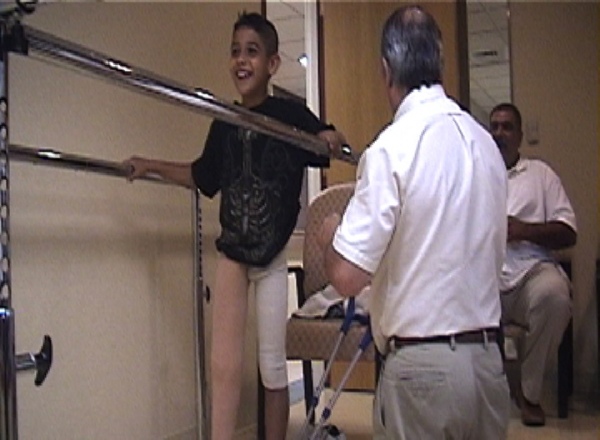
Hamzah lost his right leg in 2008 when a US missile exploded just outside his home, killing several relatives and neighbors. The local group Healing Children of Conflict (HCC) raised funds to bring Hamzah and his father here so that he could get the medical treatment necessary, treatment that is not available in Iraq.
The Press article on Hamzah came out of a send-off event last night where volunteers and supporters of HCC came together to say goodbye to Hamzah and his father Imad who returned to Iraq today.
Just a few headlines away from the story about Hamzah was an article about an event hosted the Economics Club of Grand Rapids, which featured both Colin Powell and Madeline Albright. The irony, to anyone who has even the slightest sense of history, was that some of the very people who caused so much devastation and suffering in Iraq were in Grand Rapids at the same time as Hamzah and his father.
Lets talk about Colin Powell first. Powell was part of Ronald Reagan’s national security team in the 1980s at a time that the US was funding Iraq in its war against Iran. This policy of supporting Saddam Hussein was not so much because the US wanted to defend Iraq, rather the policy was designed to weaken Iran. In addition, having Iraq expend so much of their own financial and human resources during those 8 years of war also left that country less stable.
Then in 1990, the US claimed that Iraq was violating international law by invading Kuwait in what Iraq was claiming was a dispute over national boundaries. The US not only condemned Iraq’s actions they quickly mobilized hundreds of thousands of US troops in Saudi Arabia in preparation for an invasion.
Using a fabricated story, which claimed that Iraqi soldiers were taking Kuwaiti babies out of their incubators, the Bush administration was able to convince Congress to support a 1991 US attack on Iraq.
For six weeks the US bombed Iraq into submission. Colin Powell was the Chairman of the Joint Chiefs of Staff during the 1991 war/occupation of Iraq. The US bombing campaign in Iraq was one of the most devastating in history and declassified documents showed that much of Iraq’s social infrastructure was targeted. Once the bombing campaign was over the US, through the United Nations, imposed the most severe sanctions campaign ever seen in history.
During the more than a decade of sanctions Iraq could not import thousands of items, many of them medical, which contributed to the deaths of hundreds of thousands of Iraqi children. UNICEF reported in 1999 that half a million Iraqi children had died because of the US/UN sanctions. The sanctions were so devastating on Iraq that former United Nations envoy Dennis Halliday referred to the sanctions as “genocidal.”
This fact was not hidden at the time and even US Secretary of State Madeline Albright at the time acknowledged what had happened to Iraqi children as a result of the sanctions. Albright was the guest of a 60 minutes show where she was asked if the death of half-a million Iraqi children was worth it. Her response was, “I think this is a very hard choice, but the price–we think the price is worth it.”
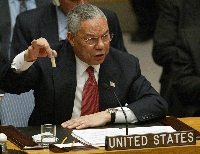
In 2002, the Bush administration began to fabricate the claim that Iraq possessed weapons of mass destruction (WMD). Colin Powell went to the United Nations in February of 2003 to present “proof” of the WMD claim, a presentation, which had tremendous influence on public opinion. Powell’s presentation has been hotly contested as a fabrication and in 2005 Powell himself even admitted that the information provided to him was not accurate.
The 2003 US bombing campaign and the ongoing US occupation of Iraq have caused irreparable harm to Iraq and some estimates put civilian deaths near 1.5 million. Hundreds of thousands of other Iraqi civilians have been wounded and more than a million have become refugees.
To put this into perspective, Iraq has been suffering from war & sanctions since 1980. Their public infrastructure has been devastated to the degree that basic services are not being met. The irony of the MLive coverage today is that there is no acknowledgement of the fact that the Iraqi boy who came to Grand Rapids to get a prosthetic leg could not get that treatment in Iraq because of the violent US policy over the past 30 years and that two of the architects of this policy (Powell & Albright) were in Grand Rapids at the same time.
Campaign transparency hit new lows in Michigan in 2010
(This article is re-posted from Michigan Campaign Finance Network.)
Decade of lost accountability saw $70 million off the books
LANSING – Nearly $23 million in unreported television advertising in 2010 statewide election campaigns pushed the state total of undisclosed candidate-focused “issue” advertising to almost $70 million since 2000.

Those data were compiled by the Michigan Campaign Finance Network in a new report released today titled, $70 Million Hidden in Plain View – Michigan’s Spectacular Failure of Campaign Finance Disclosure, 2000 – 2010.
Three candidates won television-driven statewide elections in 2010 without buying broadcast advertising of their own. They are Secretary of State Ruth Johnson, Supreme Court Justice Mary Beth Kelly and Democratic gubernatorial nominee Virg Bernero. All three were totally dependent on their political party for their advertising campaign, and the parties reported nothing about the Johnson campaign or the Bernero primary campaign. The Michigan Republican Party reported $650,000 of its $3.4 million television campaign supporting now-Justice Kelly and her fellow Republican nominee, now-Chief Justice Robert P. Young, Jr.
The Michigan Department of State does not require advertisers to report their spending or the sources that enable it unless the advertisements explicitly suggest voting. Despite the fact that neither the words nor the concept of “express advocacy” are found in the Michigan Campaign Finance Act, the interpretation that says only express advocacy is a campaign expenditure allows campaign advertisers to report nothing and the Department of State to turn its blind eye.
“The United States Supreme Court recognized that there is a functional equivalent of express advocacy in its 2007 decision in Federal Election Commission v. Wisconsin Right to Life,” said Rich Robinson of the Michigan Campaign Finance Network. “The Department of State’s interpretation remains firmly rooted in the jurisprudence of the last century, to the extreme delight of the interest groups and individuals who want to buy election outcomes without leaving fingerprints.”
Among the major 2010 statewide campaigns, only the Republican gubernatorial primary had a disclosure rate above 55 percent. Ninety-two percent of the Republican primary spending was reported.
“When Congressman Pete Hoekstra was being knee-capped by Americans for Job Security – whoever they were, I’ll bet he never dreamed he was in the midst of the best-disclosed state campaign of 2010,” Robinson said.
The gubernatorial general election, like the Supreme Court campaign, was a case where there was more spending off the books than was disclosed. The Michigan Democratic Party spent $4.3 million on ads supporting Bernero while the Republican Governors Association spent $3.6 million supporting now-Gov. Rick Snyder. Unreported spending in the gubernatorial general election overshadowed that which was reported, $7.9 million to $6.9 million. The RGA’s ads supporting Snyder included B-roll of Snyder recycled from the candidate’s own primary ads. California-based Target Enterprises was Snyder’s ad agency for the primary and the RGA’s agency for the general.
“The gubernatorial general election was not a different kind of politics,” Robinson noted. “It was the same old same old: Secret spenders, no accountability.”
The Republican Governors Association pressured several television stations around the state to withhold records of its ads from their public files. MCFN estimated those stations’ sales based on a decade’s worth of market-share data.
The Michigan Campaign Finance Network supports full disclosure of all campaign spending and the contributions behind it. Polling consistently shows that voters do, too.
“Disclosure helps voters to evaluate the messages they receive in the course of a campaign, and disclosure is critical for controlling the corruption of quid pro quo politics,” said Robinson.
“Disclosure is particularly critical in Supreme Court campaigns, so all parties can be sure that their due process rights to an impartial court hearing have not been usurped by some unreported campaign expenditure by an unidentified participant in their case. With over half the money flowing off the books in our Supreme Court campaigns, the exposure to that sort of problem is enormous.”
The 2010 case of Citizens United v Federal Election Commission included an 8-1 vote that thoroughgoing disclosure is constitutionally permissible, whether the requirement is applied to express advocacy, the functional equivalent of express advocacy or authentic issue advocacy.
Authentic issue advocacy, which involves an effort to evoke grassroots lobbying of an official who can affect a public policy, is an obvious fiction in Supreme Court campaigns. Judges are not lobbyable officials under Michigan law.
“Our campaign finance disclosure system is highly dysfunctional,” Robinson said. “Citizens should demand that elected officials fix it.”
Note: Denise Langford Morris, a 2010 Supreme Court candidate, amended her campaign finance reports on June 6, when $70 Million Hidden in Plain View was at the printer. Morris now reports having raised $250,000 more than she had previously reported. While this is a substantial change in Morris’s campaign profile, it makes a limited difference in the profile of the overall 2010 Supreme Court campaign. The revised Dashboard of Campaign Finance Accountability will show 44.7% disclosure for the overall campaign, rather than 43.5%. The changes reported by Morris will be reflected in revisions to the pdf version of the report in the coming days.
The Grand Rapids Chapter of the IWW and the Bloom Collective will host a joint screening this Thursday for a new documentary film COINTELPRO 101.
 Here is an excellent review of the film from Black Agenda Report:
COINTELPRO 101, the latest film release from The Freedom Archives, is nothing like the all-too-common soft, liberal documentary, which tells of worse and distant horrors so as to lessen the pain or awareness of those still occurring. It is not a film that imposes a happy ending by suggesting that its subject is somehow past. It is a film that makes plain the fact that all of your problems of today, from war, to incarceration, to banking crises, joblessness and environmental catastrophe, still exist because movements to do away with them suffered and continue to suffer the greatest levels of repression from the most powerful state apparatus in world history. And worse still, as Black Panther Party veteran Kathleen Cleaver states unequivocally, unlike the official Counter Intelligence Program of previous decades, today’s version is perfectly legal.
COINTELPRO 101 is just that. It is an introduction to the often omitted history of the FBI’s illegal wars of terror waged against the full spectrum of radical Left movements in this country. The Counter Intelligence Program, which emerged in the post-WWII era of international struggles for human rights and national liberation, simply focused internally to the United States all that had been carried out against populations abroad. It turned so-called U.S. citizens in the 20th century into insurgent rebels to be dealt with as any foreign army or movement. Assassination, imprisonment, surveillance and encouraged internal strife were employed to forcibly dissolve these movements. But, as this film so skillfully demonstrates, this all was merely an extension of a continuing state project of enslavement, genocide, theft of land, culture and humanity that pre-dates even the official declaration of U.S. nationhood.
The film’s brilliance is not simply its nicely styled aesthetic elements. They are there of course. Strong interviews, rarely seen clips, high quality audio and video production across the board with equally strong narration from Liz Derias. But it is the film’s ability to force new confrontation with the political reality of today, as much as with the past, that truly demonstrates its value. The simple point made by Geronimo Pratt is also its strongest; that COINTELPRO made official the illegality of politics, the “criminalization of positions” represented by its targets. COINTELPRO was the political and legal descendant of its ancestors, slavery and genocide, and is now itself an ancestor to the still-implemented policies of, for instance, the Patriot Act. This central theme of the film is its most important because it forces us to put in context the current and horrific state of peace, freedom and labor movements.
Thursday, June 16
7pm
IATSE Labor Hall
931 Bridge St. NW
All are welcome to this screening. A discussion will follow the 56-minute film.
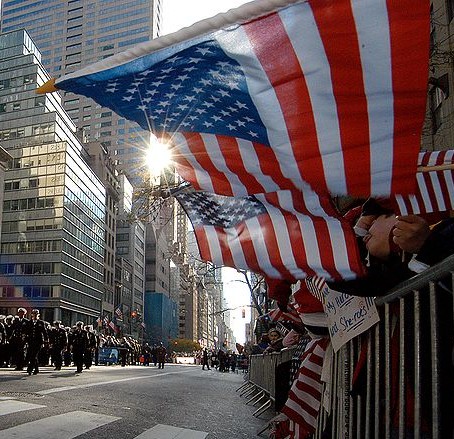
June 14 is Flag Day. This strange little non-holiday marks the day in 1777 when the stars-and-stripes version of the flag was declared our country’s official symbol. Prior to that, the Revolutionary army used a number of different flags, such as the “Don’t Tread on Me” snake banner, the “Liberty or Death” flag, and different star/field configurations.
Flag Day is observed in some U.S. cities, from Quincy, Massachusetts to New York City. It is a state holiday in Pennsylvania. At the beginning of June, most states have a mandated lesson sequence on patriotic symbols that requires students to color flag pages, listen to flag-related stories, and memorize poems, such as this one written for the first Flag Day. It begins: “Your Flag and my Flag!/And, oh, how much it holds/Your land and my land/Secure within its folds!”
The intent of Flag Day is to “carry out a program of a patriotic order, praying for the success of the Federal arms, and the preservation of the Union.”
Our nationalist sentiment on Flag Day apparently used to run on higher octane than it does in most places today. On one of the most famous Flag Days, in 1908, Theodore Roosevelt used a stick to beat a man he saw in the street in Philadelphia because he thought the pedestrian had blown his nose on an American flag. In the midst of the fight, Roosevelt realized his victim’s hankerchief was a blue bandanna with white stars on it. Roosevelt immediately apologized, but then hit the man again for causing the President to become so “riled up with national pride.”

There are people on this day who feel something other than “national pride,” however, and don’t want to pray for the success of Federal arms or the patriotic order. June 14 is also known as Flag Burning Day. Across the country, U.S. citizens are choosing to burn the American flag in protest on this day—their right under the First Amendment of the Constitution.
Or at least, for now. At a number of points in our recent history, usually right before an election, there is a grandstanding move to pass an amendment to the Constintution prohibiting the burning of the U.S. flag. One of the closest near-misses was in 2003-2004. At that time, the Washington Post published a commentary about the emergence of flag burning on Flag Day.
The commentary was anti-burning, calling it “a particularly unpleasant form of expression.” But it advised not to tamper with First Amendment rights, and it also noted that hyper-conservative Supreme Court Justice Antonin Scalia had actually voted down a statutory ban on flag burning. Scalia found himself unable to defy the cornerstone principle of the First Amendment, by which he found himself “handcuffed.”
Reasons for burning an American flag? For the same reason that hundreds of thousands of people around the world burn it: to protest the imperialist policies behind the symbol. As historian Howard Zinn said, “There is no flag large enough to cover the shame of killing innocent people.”
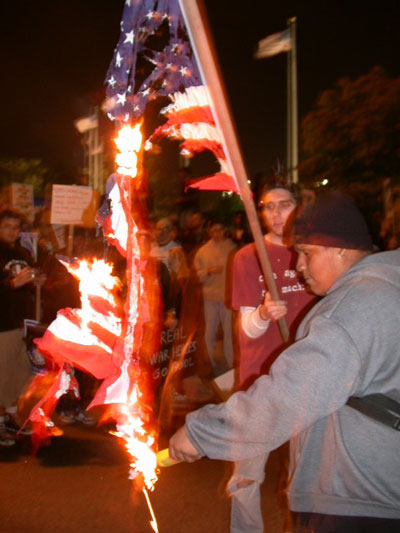
During the 2003 amendment attempt, when the House passed the change to the Constitution (it was later struck down in the Senate), Friction Magazine presented an article by Rev. Nathan Callahan which outlined specifics about the emergence of Flag Burning Day and the reasons for it. Callahan wrote:
Flag Burning Day. It began as a day of national decontamination…A day to end warped notions of patriotism, gaudy jingoist sound-bites, and simple-minded shoulder graphics. A day to end puritanical smugness and preemptive war.
We — the people — refused to allow our rights to be taken away by color-coded fears. We refused to condemn others simply for their beliefs. We defended freedom, not its emblem on a stick…
Let us again strike a match and burn a flag in tribute to those who lit the fire of freedom. We are not only survivors of a dark era in our nation’s history, but inheritors of new emancipation — an emancipation of mind and spirit….When spirit becomes symbol, heart becomes dogma. Today, we are free. Long may it burn. Long may it wave.
So today, some people will be putting on parades and waving American flags to honor this national symbol. Other people will be getting out the lighter fluid, striking matches, and burning a flag to protest this nation’s policies. Both observences are uniquely—and equally—American.

For the past several months GRIID has been working with the LGBT Resource Center at GVSU on a People’s History project focusing the LGBTQ community in the greater Grand Rapids area.
So far we have conducted dozens of interviews and plan on doing many more over the next 6 weeks. GRIID we be at the annual West Michigan Pride Festival on Saturday, June 18 and the Network’s Neighborhood Bash on July 16. However, most of the interviews are being conducted in a film studio and we are inviting people to contact us (jsmith@griid.org) to set up an interview time.
Listening to the stories from the interviews we have already done has been amazing and inspiring. As was expected with any People’s History project we are discovering that there is a rich history of organizing and struggle in the LGBTQ community. We have heard about the Grand Rapids response to the 1980s AIDS crisis, the creation of organizations and the campaign to pass an anti-discrimination ordinance in the mid – 90s.

We are also hearing painful stories of discrimination, bias and violence against the LGBTQ community. Many of those we have interviewed so far state that the ultra-conservative Christian element creates a climate of fear, ignorance and hatred. There are numerous individuals, families and institutions that are overtly homophobic and can be seen in their words and funding of anti-gay policies.
GRIID has also been doing research in preparation for this project. One area of research is to look at other People’s History projects with an LGBTQ focus. We read Vicki Eaklor’s Queer America: A People’s GLBT History of the United States and found it very useful for framing some of the questions used during the interviews. We are also doing a project that looks at the Grand Rapids Press coverage of the LGBTQ community.
In addition, GRIID is looking for any archival material that people might have – old articles, photos, video, newsletters – anything that would help to tell the history of the LGBTQ community in Grand Rapids.
The goal is to have a documentary completed this fall and to do numerous public screenings. In addition to the screenings we will be posting online all the interviews in their entirety and all archival material we have been given permission to use.
This has been an amazing project so far and we anticipate that the outcome will be equally amazing. Again, if anyone wants to participate in this project please contacts us to set up interview times, to speak with us, to provide archival material or to volunteer. We will announce the completion of the project this fall and invite the public to the screenings.
(This article is re-posted from NarcoNews.)
A Pentagon document has come to light that confirms the U.S. has put special operations troops on the ground in Mexico as the drug war there continues to escalate, notching some 40,000 murders since late 2006.
The document is a Department of Defense briefing presented in mid-May 2009 in Washington, D.C., to a group of business and political leaders from northwest Florida. The “Unclassified/For Official Use Only” briefing reveals the 18 Latin American nations where 7th Special Forces Group soldiers [Airborne Green Berets] were deployed as of fiscal year 2009, which ended Sept. 30, 2009.
Among those nations, according to the briefing document, was Mexico.
The document also indicates a 7th Special Forces unit was deployed in Mexico in 1996 as well, as part of a “counter-narcotics” mission.
The revelations in the briefing material are important because, to date, neither the Pentagon nor the State Department has confirmed that U.S. special forces have been deployed inside Mexico — a politically volatile subject in that Latin American nation given the rising drug-war death toll there and the “Yankee” history of U.S. Gunboat Diplomacy in the region.
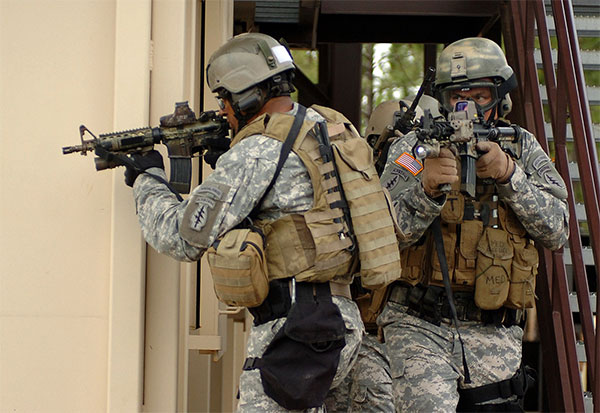 From the vantage point of U.S. policymakers, the deployment of covert Pentagon special forces inside Mexico also is fraught with political peril, given the discovery of such operations by the targets, narco-traffickers in this case, could result in blowback against U.S. agents and interests in Mexico. It also could strain relations with Mexican President Felipe Calderon, who is already feeling increasingly isolated due to his disastrous drug-war policy.
The 7th Special Forces Group (SFG) has played a key role since the 1980s in the bellicose history of Latin America, according to the briefing document and other sources. The 7th SFG has participated in numerous “counter-insurgency” missions in Central America as well as in the invasion of Panama in late 1989. It also has been quite active over the years in counter-narcotics missions in the South America Andean Ridge Countries of Colombia, Venezuela, Peru Ecuador and Bolivia; and more recently in hostage rescue operations in Colombia.
The latter operation, according information in the briefing document, involved the participation of the 7th SFG in the July 2008 rescue of three DoD contractors and noted Colombian activist and politician Ingrid Betancourt, among others, who were being held as hostages by the leftist FARC guerrillas.
Narco News reported on that rescue at the time, indicating then, against the tide of mainstream reporting, that a U.S. special-forces unit was deeply involved in the rescue — a report now seemingly confirmed by this briefing document.
Narco News also reported in detail last year about the activities of U.S. special forces operating covertly inside Mexico.
From that June 12, 2010, story:
The U.S. unit [operating inside Mexico], dubbed Task Force 7, since early 2009, according to the CIA operative, has helped to uncover a warehouse in Juarez packed with U.S. munitions and under the control of drug traffickers; provide critical intelligence that led to the raid of a Juarez sweatshop that was manufacturing phony Mexican military uniforms; worked with the Mexican military in uncovering a mass grave near Palomas, Mexico, just south of Columbus, New Mexico; and, behind the scenes, cooperated with the Mexican Navy in hunting down a major narco-trafficker, Arturo Beltran Leyva — who was killed by Mexican Navy special forces last December [2009] during a raid on a luxury apartment complex in Cuernavaca, Mexico.
That information was provided to Narco News at the time, according to the source, Tosh Plumlee, a former CIA contract pilot who still has deep connections in the covert world, because the members of Task Force 7 believed they had been compromised by leaks.
In fact, Plumlee had relayed some information to Narco News about the task force and its security concerns as early as April of 2009 on the condition we not publish that information then for fear it might jeopardize the lives of the unit’s members.
By June of 2010, however, when Narco News published its story, Plumlee told Narco News the “bad guys” already knew the task-force members were in-country and, as a result, they had become targets. Coming forward in the media, Plumlee says, provided the task force with some cover that made it more difficult for bureaucrats in Washington, D.C., to avoid addressing the security breach — a tendency on the part of some who might wish to avoid the complications that come with accountability.
The stakes of the covert game are quite high, for all those on the ground who are touched by it, including innocent citizens – and are made even steeper when politics and special interests (including careerism) start dictating the shots, literally.
The whistleblower organization WikiLeaks recently released a State Department cable revealing that the Mexican Navy unit that conducted the operation against narco-capo Beltran Leyva “received extensive U.S. training” — which serves as further evidence supporting Narco News’ original reporting on the involvement of U.S. special forces in that operation.
The same cable, however, also points out that the killing of Beltran Leyva will, in the short-term (a period not defined precisely) result in a “spike” in narco-related violence “as inter- and intra-cartel battles are intensified by the sudden leadership gap in one of the country’s most powerful cartels.”
That ramped up violence was still playing out as recently as this past March, when the son of Mexican poet and journalist Javier Sicilia, along with six of his compadres, none of them involved in narco-trafficking, were brutally tortured and murdered near Cuernavaca (just outside Mexico City) – the same region where Beltran Leyva was killed. The senseless murder of those innocents has sparked a mass movement in Mexico, one that is currently marching toward Juarez, the most violent city on earth, where a collective, non-violent action in opposition to the drug war is planned for June 10.
The confirmation that U.S. special forces are now in the mix of the drug-war violence, which Mexican citizens by the millions now see as senseless and resulting in far too much collateral damage (the death and disappearances of thousands of innocent victims), is certain to enhance the public outrage in that land — given the quite visible U.S. role as the major consumer of the drugs and the major exporter of weapons and policies fueling the drug war.
Given this madness, and the inherent duplicity, treachery and buffoonery marking the drug war, it should come as no surprise to anyone, even if their sympathies are not with the U.S. special-forces in Mexico whose lives are jeopardized due to leaks and other security lapses, that the source of those transgressions (intentional or not) is, in part, traceable to the U.S. side of the border.
The briefing document revealing the extent of the 7th SFG operations in Latin America in fiscal 2009 – in 18 countries involving 21 missions and 165 soldiers, including Mexico — was made public by a Florida business group whose membership includes a number of defense contractors. That group, the Economic Development Council for Okaloosa County (EDC), via its Defense Support Initiative, made the May 14, 2009, briefing available on its Web site for all to see and download — including WikiLeaks and some media in Latin America who made it available in Spanish to their audiences (almost assuring that the narco-trafficking organizations being targeted by covert U.S. special forces also were tipped off to their presence in Mexico).
This occurred despite the fact that the briefing document was marked “For Official Use Only,” which, according to Ken McGraw, spokesman for the Pentagon’s U.S. Special Operations Command, means the document was “not to be released publicly.” McGraw adds that he does not “know the specifics” of the 7th SFG operation referred to in the briefing document, explaining that “by the end of the year, we [USSOCOM] will have operations in 120 countries.”
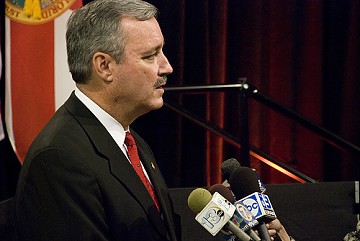
That briefing was prepared by the 7th SFG at the request of U.S. Rep. Jeff Miller, a far-right Republican with Tea Party leanings whose Florida district is about to become the new home for the 7th SFG (which is relocating from Ft. Bragg in North Carolina to Elgin Air Force Base in Florida’s panhandle).
Dan McFaul, chief of staff for Congressman Miller, stressed, when contacted by Narco News, that his boss did not attend the May 14, 2009, 7th SFG briefing.
“That was a non-classified briefing,” McFaul said. “The Congressman is on the [House] Intelligence Committee … and he is briefed at the classified level. … We request briefs on different issues affecting District 1 [Miller’s Congressional area] for chambers or economic development groups [and others], and so this [the 7th SFG briefing] could have been for something like that.”
Both the briefing document and a letter drafted by the EDC’s Defense Support Initiative chairman appear to indicate that was the case. McFaul said he had not received any other media inquiries about the restricted briefing document being made public prior to being contacted by Narco News.
Calls to the Okaloosa County EDC were not returned by press time.
However, someone as of Saturday, June 4, had removed the link on the EDC’s Web site that directs readers to the site where the briefing document can be downloaded. [See screen shot here of material removed]. The EDC Web-site download link for the document is still active, though, and can be accessed here — as well here should that EDC download link be deactivated in the future, with a screen shot here of the EDC download link as it exists as of the publish date of this story.
It is important to stress that there is no evidence that the Okaloosa County EDC, Congressman Miller or members of the 7th SFG intentionally included or made public information that might compromise the security of the U.S. special-forces operations in Mexico.
But it seems clear that somewhere along the line, some bad calls were made — beginning with the decision to include country and date-specific specific information about supposedly covert troop deployments in a non-classified briefing and to then put those briefing materials online, even though the document is marked “For Official Use Only.”
In fact, Narco News contacted the press office for the U.S. Army Special Operations Command, which oversees the 7th SFG, seeking comment on how the sensitive mission information ended up in a non-classified briefing, but was told no one was available to comment until next week, after Narco News’ deadline for this story.
Narco News also contacted USNORTHCOM, which has command control over DoD missions involving Mexico. Lt. Commander William Lewis, USNORTHCOM spokesman, said he would look into the matter and get back to Narco News after “finding out what can and cannot be released” about the matter.

