This morning Grand Rapids Press reporter Dave Murray posted a story on MLive suggestion that Michigan schools ought to consider adopting the model of education restructuring that has taken place in New Orleans since Hurricane Katrina.
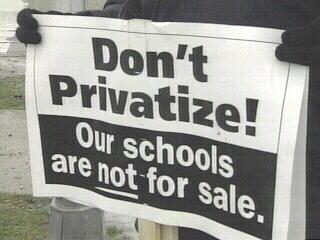
The article cites three sources – Paul Vallas, head of what is called the Recovery District in New Orleans, Aesha Rasheed, director of the New Orleans Parent Organizing Network and Margaret Raymond of Stanford University’s Center for Research on Education Outcomes.
Vallas makes the claim that the new educational system is working well and for the schools that do not meet the standards after three years the funding is pulled. Rasheed is quoted as being critical over the lack of parental input and local control, but her remarks are countered by Margaret Raymond from Standford who says parents seem to prefer local control at the expense of performance. What the Press reporter fails to tell readers is that the Center for Research on Education Outcomes is a pro-Charter school entity.
However, an even larger problem exists in this story in that there is no background information on who was behind the shift from public schools to charter schools after Hurricane Katrina.
According to Naomi Klein’s The Shock Doctrine, the New Orleans disaster provided a perfect opportunity for those who sought to privatize education or al least redirect how public funds would be used for education. Just a few months after the hurricane free-market prophet Milton Friedman wrote an article for the Wall Street Journal essentially calling for a vouchers system for education in New Orleans.
 Two years after Hurricane Katrina investigative journalist Bill Quigley wrote an interesting report on the status of the so-called educational reforms that took place in New Orleans. What Quigley found was that this new system that Paul Vallas gushes about is that it has created a two-tiered educational system. Students must apply to the new charter school system and will not be accepted if they do not meet certain standards. Those that are not accepted go to another program that gets less funding and has an outrageous student to security guard ratio.
How would readers negotiate Dave Murray’s MLive article had any of this information been included? Instead of this kind of information Murray ends the article by stating that GRPS Superintendent Taylor is open to working with charter schools and that the Detroit’s new emergency manager hired “the National Association of Charter School Authorizers to help evaluate potential operators as part of a plan to transform 45 city schools into charters.”
It seems that the question raised by the Press article is already being answered by the push for a New Orleans style education shock doctrine. This is certainly what the Mackinac Center for Public Policy has been advocating, as well as two of their largest donors Dick and Betsy DeVos who have a long history of funding an education voucher system that will re-direct public funds away from local control and create an even more race & class divided school system.
On Wednesday, President Obama announced that the US would move forward with trade relations with Colombia even though human rights organizations and unions opposed this policy.

The concern for many unions and human rights organizations has been centered around the brutal campaign to murder union organizers. The Killer Coke Campaign has been documenting these union murders for years, especially since many of the union organizers are in Coca Cola plants. But the AFL-CIO also produced a substantial report in 2008 entitled Workers’ Rights, Violence and Impunity in Colombia.
It is because of this recent history of targeted violence against union organizers in Colombia that unions and human rights groups opposed the current trade relations policy with Colombia. The Obama administration says that this new agreement will address the human right abuses, but AFL-CIO President Richard Trumka said in response, “The action plan does not go nearly far enough in laying out concrete benchmarks for progress in the areas of violence and impunity, nor does it address many of the ways in which Colombian labor law falls short of international standards.”
The Latin American Working Group (LAWG) agrees that the US/Colombia plan does not adequately address human rights abuses. “We could see the same shocking numbers of murders of trade unionists when the FTA is implemented, and there’s nothing in this agreement or the accord itself that would stop it from going forward,” said Lisa Haugaard, executive director of the Latin America Working Group. Fifty-one trade unionists were killed in Colombia in 2010, making Colombia still the world leader in anti-union violence.”
The LAWG response also states, “The plan includes nothing about gross human rights violations by the Colombian armed forces, except in the cases of anti-union violence. The Santos Administration has yet to make advances in bringing to justice those responsible for more than 3,000 civilians murdered, allegedly by members of
Colombia’s own armed forces. And even those who have been convicted of these crimes are often kept in detention centers that appear more like a luxury resort than a prison.”
Not everyone in the US was displeased with the Obama administration. The National Association of Manufacturers and the US Chamber of Commerce applauded the President’s decision.
In an article from The Hill it states, “The AFL-CIO expressed deep disappointment with the decision, which pits Obama against a core part of his political base the same week he announced his 2012 reelection campaign.”
It is interesting that the online publication refers to unions as part of the President’s base, when there is little evidence that the Obama administration has done much for working people or union specifically. The President has completely ignored the Employee Free Choice Act despite his election promise to pass it in the first year. The administration seems poised to enact a NAFTA-style policy with South Korea, which contradicts his campaign promise of revisiting NAFTA with the intent of re-writing it. The President has had no problem bailing out Wall St., bailing out the auto industry (on condition that the UAW make larger concessions) and continue Bush style tax cuts for the rich.
Add to this the announcement from Monday that the Obama camp plans to break their own record and raise $1 billion dollars for the 2012 re-election campaign and one wonders why working people would endorse the President. If one looks at who the top contributors to the Obama campaign in 2008 were you can see why he is more pro-business than pro-worker.
New Media We Recommend
Below is a list of new materials that we have read/watched in recent weeks. The comments are not a “review” of the material, instead sort of an endorsement of ideas and investigations that can provide solid analysis and even inspiration in the struggle for change. All these items are available at The Bloom Collective, so check them out and stimulate your mind.
 BDS: The Global Struggle for Palestinian Rights, by Omar Barghouti – Last week we posted a story about the international Boycott, Divestment and Sanctions campaign that is targeted at the state of Israel. This book is by far to date the best comprehensive look at both the evolution of the BDS campaign and its guiding principles. Barghouti does a great job of providing both a political framework for why BDS is so important and numerous concrete examples of how it is working at the local level. The book is full of stories about how people in churches, universities, unions, artists and other sectors of civil society are putting into practice the tactics of the BDS campaign in order to challenge the illegal occupation of Israel.
 Fields of Resistance: The Struggle for Florida’s Farmworkers for Justice, by Silvia Giagnoni – If you have ever wondered about the living and working conditions of farmworkers in the US, then Fields of Resistance is an excellent way to get your questions answered. The book not only looks at the realities that farmworkers face in Florida, it provides a great deal of inspiration based on the organizing campaigns being waged by the Mexican and Central American migrant workers to improve the conditions they work in. Giagnoni not only provides important analysis on this topic, she put a human face on these forgotten workers. The author’s account of visiting the homes of migrant workers an sitting through numerous meetings with the Coalition of Immokalee Workers (CIW) makes the reader feel as if you were there.
 Popular Resistance in Palestine: A History of Hope and Empowerment, by Mazin Qumsiyeh – In popular US culture where our perceptions have been deeply influenced by commercial news media and entertainment media, the dominant images we have of Palestinians are as terrorists or suicide bombers. Palestinian author and activist Mazin Qumsiyeh provides the perfect antidote for such perceptions in his book Popular Resistance in Palestine. The book demonstrates that there has been popular resistance (mostly non-violent) for centuries by Palestinians against numerous countries that have sought to oppress them. Mazin takes the reader through the resistance to the Ottoman Empire, the British Empire and more recently the State of Israel. What one walks away with after reading this book is that Palestinians have a rich history of resistance where most of the population has actively struggled against oppression and occupation through a variety of means. Popular Resistance in Palestine is an important contribution to understanding the history of the Palestinian people.
Inside Job (DVD) – There have been several documentaries that investigate the 2008 global financial crisis, but few have done it as well as Inside Job. This feature length documentary not only takes us into the halls of power and corruption it provides an important analysis that challenges our understanding of contemporary neo-liberal capitalism. The film will piss you off and it can be a useful popular education tool for those wanting more than to just be mad.
Michigan Messenger reported today that earlier in the week Immigration and Customs Enforcement (ICE) officials targeted the parents of school age children in Detroit.

The article states that even an ICE official admitted that some of the immigration officers may have acted inappropriately where “elements of the operation appear to have been inconsistent with policy and our standards and priorities.”
The immigration rights group America’s Voice issued a statement after this incident that reads in part: Last week, ICE agents targeted parents who were dropping off their children a local elementary school: Hope of Detroit Academy in southwest Detroit.
Detroit ICE agents are known as some of the most aggressive immigration agents in the country. They have engaged in abusive — and often illegal — enforcement tactics before, and once again they’ve gone too far.
Reform Immigration for Michigan also released a statement about the Detroit ICE raids by saying, “These are not the actions of responsible law enforcement officers. They are calculated attempts to throw the immigrant community into a panic, frightening young children and treating immigrant workers like dangerous and violent criminals.
Our Schools should be safe places where students go to learn, not places where rogue ICE agents go to stalk their parents.”
Both America’s Voice and Reform Immigration for Michigan are encouraging people to send messages to ICE officials letting them know that these kinds of actions are unacceptable.
These action are part of a growing trend that should concern anyone who cares about immigration rights. It was reported widely last year that deportations have increased under the Obama administration and despite his electoral campaign promises to reform immigration policy this issue is not even on the table and will not likely be dealt with before the 2012 election.
New report on Koch brother’s vast political influence
In recent months one family name that seems to keep popping up in political discussions around budget cuts and anti-union legislation is Koch.
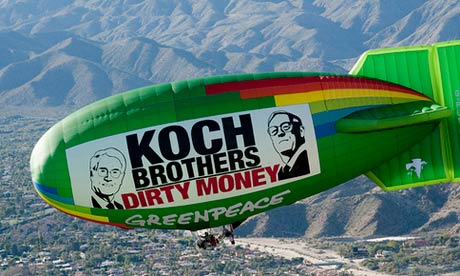
There have been a series of stories written about the influence peddling that the Koch brothers are engaged in since they were exposed as funders of Wisconsin Governor Walker by the Center for Media and Democracy.
In addition, SourceWatch has done a fine job of providing lots of background information on one of the Koch family’s favorite front groups, Americans for Prosperity. Americans for Prosperity has been funding numerous other Astroturf groups and even has a hand in organizing the Tea Party.
Just two weeks ago Andy Kroll, writing for Mother Jones magazine, posted a solid investigative piece about what the Koch brothers are up to in Michigan. Kroll wrote that along with the Mackinac Center for Public Policy and the DeVos/Price families, the Koch’s are also funding the anti-worker/pro-business policies of Michigan Governor Rick Snyder.
When you thought that there influence couldn’t go any further, the Center for Public Integrity (CPI) has just published a new report entitled Koch’s web of influence.
The report looks at the Koch family industries and what affect they have had on public policy on issues such as the environment and EPA rulings, federal financial and tax policies, ethanol fuel production, global warming policies, energy industry tax breaks, national security policies and financial regulation.
Their influence is far reaching and the new CPI report demonstrates that we ignore their influence at our own peril. We encourage you to read the entire report and to watch this short video on the lobbying influence of Koch Industries.
2011 Reportcard on Banks and Mountaintop Removal
(This article is re-posted from the Rainforest Action Network)
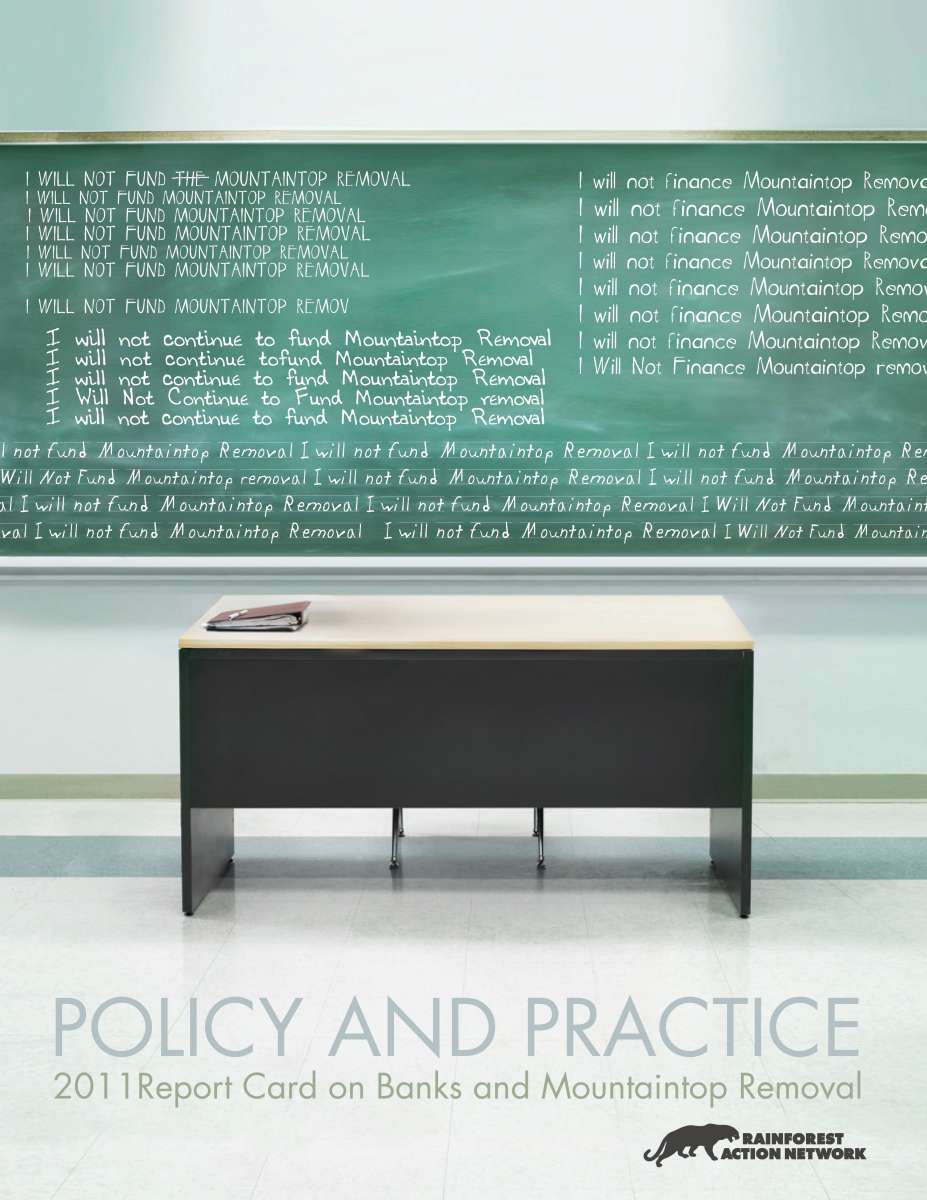
Rainforest Action Network and the Sierra Club’s 2011 report card, Policy and Practice, ranks ten of the world’s largest banks on their financing of mountaintop removal (MTR) coal mining projects and lending policies. The report card reviews the financing practices of Bank of America, Citi, Credit Suisse, Deutsche Bank, GE Capital, JPMorgan Chase, Morgan Stanley, PNC, UBS and Wells Fargo.
Mountaintop removal is a mining practice where explosives are used to remove the tops of mountains to expose thin seams of coal. Once blasted, the earth from the mountaintop is typically dumped into neighboring valleys, which poses significant threats to water quality in Appalachia and undermines the objectives and requirements of the Clean Water Act. According to a 2005 environmental impact statement, nearly 2,000 miles of Appalachian streams have already been buried or contaminated.
Several banks in the U.S. and in Europe have adopted policies that limit, and even end their financing of this environmentally devastating practice. However, what impact do these policies have in practice? In 2010, Rainforest Action Network and Sierra Club took a first look at these MTR policies. This year’s version of the report card takes a second look at these banks and their mountaintop removal policies to see how they’ve progressed from 2010 to 2011. The report card reviews each bank’s current position on MTR coal mining and awards a ‘grade’ based on the strength of the performance threshold, scope of due diligence and public transparency.
The report card calls for the ten banks reviewed to strengthen their policies and cease their financial support for MTR. The ‘best practice’ recommended in the report card is a clear exclusion policy on commercial lending and investment banking services for all coal companies who practice mountaintop removal coal extraction.
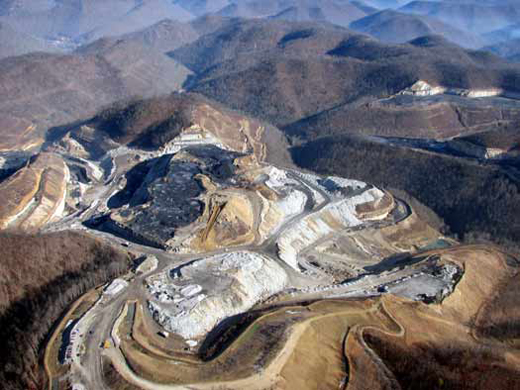
Banks and financial institutions are key sources of financing for companies that practice mountaintop removal. However, with growing public opposition as well as regulatory and legislative scrutiny of the practice banks have been forced to address the issue with enhanced lending policies.
Regulatory & Financial Risk of MTR
From a regulatory perspective, the report shows that of all the MTR permits reviewed in 2010 by the EPA, 99 were denied or withdrawn, 84 are still pending and 18 have been approved. The report also finds that in 2010 coal production figures for the MTR sector declined; with mining giants, like Arch coal, moving away from Central Appalachia coal production, and focusing on new opportunities in Wyoming’s Powder River Basin and on the West Coast with export terminals.
Key findings:
Top Three Financiers of MTR: PNC, Citi, UBS (in first, second and third place respectively).
Number of Deals in 2010 Between Banks and MTR Operators: Since January 2010, the ten banks examined in this report card have provided financing for 16 loan and bond underwriting deals to companies practicing mountaintop removal coal mining. This represents more than $2.5billion.
Best Performing Bank: Credit Suisse. In 2010 the bank made its policy public and transparent. The bank has no exposure to coal-mining companies that practice mountaintop removal extraction.
Worst Performing Banks: Citi—despite announcing a public policy on MTR extraction in 2009, the bank has since doubled its exposure to the sector. UBS—immediately after announcing a policy stating that it “needs to be satisfied that the client is committed to reduce over time its exposure to this form of mining,” the bank acted as an advisor on the Massey-Alpha combination deal. That deal created the largest single mountain top removal company in the country, responsible for fully 25% of coal production from MTR mines.
CEO Pay Soars While Workers Pay Stalls
(This article by Paul Street is re-posted from ZNet.)
A recent article in USA Today (the thin nationwide paper that gets distributed for free with your “continental breakfast” at Comfort Inn) epitomizes the limits of what right-wing, paranoid-style propagandists like Sean Hannity and Glenn Beck call “left wing bias” in American mass media. Titled “CEO Pay Soars While Workers’ Pay Stalls,” the story seems calculated to spark left-populist outrage across the country. It reports that:
“CEOs didn’t have to cry poor for long. The heads of the nation’s top companies got the biggest raises in recent memory last year after taking a hiatus during the recession.”
“At a time most employees can barely remember their last substantial raise, median CEO pay jumped 27% in 2010 as the executives’ compensation started working its way back to pre-recession levels…Workers in private industry, meanwhile, saw their compensation grow just 2.1% in the 12 months ended December 2010….”
“Two years of scaling back amid tough economic times proved temporary as three-quarters of CEOs got raises in 2010 — and, in many cases, the increases were substantial.”
“….The big increases in executive compensation are difficult for workers to swallow, given that many Americans are struggling just trying to find a job or make ends meet…”
Here are some of the most remarkable American 2010 CEO incomes reported on USA Today’s web version of the report: P. Daummon (Viacom) – $84,469, 515; Ray Irani (Occidental Petroleum) – $76,107, 101; Michael White (DirectTV) – $32,932, 618; John Lundgren (Stanley Black&Decker) – $32,570,596; Robert Iger (Walt Disney)- $28,017, 414; Samuel Palmisano (IBM) – $25,180,681; Howard Schultz (Starbucks) – $21,733,013….all quite remarkable to glean when it is understood that 19 million Americans (6.3 percent) live in extreme poverty, with cash incomes of less than half of the federal government’s notoriously inadequate poverty level – at less than roughly $11,000 for a family of four.
USA Today reporters Matt Krantz and Barbara Hansen explain that part of the outsized CEO compensation has to do with significant increases in the value of stock share prices in a period when executive pay is significantly comprised of company stock options. “Many CEOs receive roughly the same number of shares or options each year, “Krantz and Hansen note, “so when the value of those shares rises, so do pay packages.” But this only deepens the reporters’ seeming sense of discomfort with the gap between what working people get and what top corporate officers “earn,” since company profits (and stock prices) are rising out of proportion to actual economic activity/growth: “Yet the fact that CEOs’ pay is rising along with stock prices underscores the disconnect between pay and companies’ true underlying performance… While companies in the S&P 500 boosted profit 47% last year, much of that was due to cost-cutting and layoffs, not from the creation of businesses and growth….Revenue, a gauge of the money flowing into businesses for selling goods and services, grew at a much slower pace than profit — and ended the year up just 7%.”

I am glad that USA Today reported this disturbing data, but this last statement goes to the nub of the story’s deep, capitalist conservatism, consistent with the private ownership of the mass media. It reflects a core false assumption that no seriously radical left journalist would accept: that a working American capitalist profits system is one that produces good paying jobs and economic growth for all Americans, including the nation’s working class majority. But when has Hannity and Beck’s (and Obama’s) cherished capitalism ever been about the creation of good jobs and lives for working people and the broad mass of citizens in the U.S. or any other specific country? My Webster’s New Twentieth Century Dictionary (unabridged) usefully defines cap/i-tal-ism, n. as: “the economic system in which all or most of the means of production and distribution as land, factories, railroads, etc., are privately owned and operated for profit, originally under fully competitive conditions; it has been generally characterized by a tendency toward concentration toward concentration of wealth, and, in its later phases, by the growth of great corporations, increased government control, etc.” Notice, please, the absence of any reference in that definition to various things that are routinely identified with capitalism in American political and intellectual discourse – democracy, human freedom, free trade, trade per se, and/or a “free market,” characterized by widespread competition and/or little or no government interference. Notice also the absence of any reference to any commitment to job creation in any specific nation or indeed in any location at all. Capitalism is about profit for the owners of capital, period, to be attained through any number of un-specified means, including simple and complex dispossession of land and materials, chattel slavery (for centuries prior to its outlawing in 1863-65 in the U.S.), the hiring of workers, the firing of workers, the slashing of wages, the “out-sourcing” of labor tasks across nations, the de-skilling of workers, the automation of labor tasks, purely speculative investment, monopoly-/oligopoly formation and pricing, the dismantlement of competing firms, sectors, and industries, the endless eco-cidal pollution and perversion of the natural environment, the appropriation of public assets, the cutting and theft of wages and benefits, … etc…the list goes on.
When the profits system (capitalism) is properly understood for what it is really and only about (investor profit and nothing more) at the end of the day, then there is nothing paradoxical about its failure to serve working people and the common good in the U.S. or anywhere else. If corporate profits are high, the system is working for its architects and intended beneficiaries – capitalists. Its great capital-agglomerating corporations are working as they are supposed to under U.S. law, which holds (under the terms of the Michigan Supreme Court’s ruling in the Dodge v. Ford Motor Company 204 Mich. 459, 170 N.W. 668. [Mich. 1919]) that “managers have a legal duty to put shareholder’s interests above all others and no legal authority to serve any other interests.”

That is what the profits system’s “true underlying performance” is all about: the bottom line for the investor class. As the great American Marxist Paul Sweezy noted in a 1989 essay titled “Capitalism and the Environment,” the direct “purpose of capitalist enterprise has always been to maximize profit, never to serve social ends.” Benefits to the broader community flowing from such enterprise have always been incidental, contingent, and subject to reversal when those who might have momentarily and indirectly gained from its operation become obstacles to its “single-minded pursuit of profit, in which [no capitalist] can refuse to join on pain of elimination” – thanks to inter-capitalist competition that compels businesses who wish to survive and thrive to accumulate ever more capital.
In an article last January bearing the curious title “Profits are Booming, Why Not Jobs?” the New York Times reported that corporate “earnings” had exploded “even as 15 million Americans remain mired in unemployment, a number without precedent since the Great Depression,” and while the citizenry experiences “record levels of foreclosures and indebtedness.” Times business writer Michael Powell found numerous logical reasons for the American profits-jobs disconnect:
* Some big American firms were showing higher profits simply because their competition had collapsed. (Following the financial collapse of 2008, for example, the Wall Street giants Goldman Sachs and Morgan Chase no longer had to compete with Bear Stearns, Lehman Bros. and Merrill Lynch. Many jobs disappeared with the departure of the defeated firms.)
* Many companies were sitting on capital and storing up liquidity like never before in the wake of the financial collapse, Powell found. Firms who no longer believe they can borrow quickly had decided to keep a lot more cash on hand for precautionary purposes. Low interest rates produced by the recession create an incentive for many companies to simply “exploit the spread between a zero funds rate and rates on Treasury bonds” and thereby to “mark profits without selling much or hiring anyone.”
*Many companies were producing abroad, in order to garner the profits dividend afforded by dramatically lower wages, salaries, and benefits in “developing” counties like India and China.
* A large reserve army of unemployed workers was a profits boon for corporate America. Desmond Lachman, a former managing director at Salomon Smith Barney who works as a “scholar” at the influential right-wing policy group the American Enterprise Institute, spoke about this in candid terms. “Corporations,” Lachman told Powell, “are taking huge advantage of the slack in the labor market — they are in a very strong position and workers are in a very weak position,” he said. “They are using that bargaining power to cut benefits and wages, and to shorten hours.”
That’s not unemployment as an anomaly for capitalist profits, its joblessness as a source of them, straight out of Karl Marx. There is contradiction in the American profits-jobs disconnect, but the contradiction is not internal to the profits system. It exists, rather in the conflict between the selfish, amoral, and borderless logic of capital and the material and social needs of ordinary people within the U.S.

The Bloom Collective is hosting a public screening of the award winning documentary film Gasland this Saturday 3pm. Gasland was nominated for an Oscar for best documentary and exposes the practice of what is called fracking.
US energy companies are extracting natural gas through a process called fracking. They drill holes, detonate explosives underground to create cracks and send a toxic chemical/water mix into the holes creating devastating results for anyone who lives nearby. Gasland humanizes the victims of this practice and unwraps the devious web of politicians and corporations that have conspired to make this happen—even right here in Michigan.
Following the film there will be a discussion. People are invited to bring food and there is a suggested donation of $3.
Gasland at the Bloom Collective
Saturday, April 9
3 PM
671 Davis NW, Grand Rapids (lower level)

Earlier today about 400 people gathered near the State building in Grand Rapids as part of the national We Are One demonstrations against federal and state policies attacking working people and local communities.
People gathered on the corner of Michigan and Ottawa street holding a variety of signs attempting to draw attention to the austerity measures that are being imposed upon people in Michigan by Governor Snyder.

There were people representing the teachers unions, firefighters, environmental groups, UAW, SEIU, government employees, the Kent-Ionia Labor Council, students and faculty from GVSU and the IWW.
Most people stayed on the sidewalk trying to get the attention of those driving past, with many motorists honking horns in support. Some people chanted and others sang solidarity songs.
This writer spoke with some union members who are upset with the Snyder administration for ending the State film industry incentives, which had provided some union workers with jobs either in film production or stage/set building.
There were also people handing out flyers from a variety of interests. On flyer from the We Are One group was advertising another march scheduled for Tuesday, April 19 at 4:30 PM beginning at the Spirit of Solidarity Monument (by the entrance to the Ford Museum). This action will coincide with the 100th Anniversary of the Grand Rapids furniture workers strike of 1911.
Another flyer was being circulated by the Grand Rapids branch of the IWW. Their flyer provided some analysis of the anti-worker policies being enacted by Governor Snyder. In addition, the flyer was advocating for a General Strike to take place as a means of making our demands and fighting against the draconian policies of the government and its corporate paymasters.
We also had the chance to interview a few people to get their response to what is happening in Michigan. We interviewed students representing GVSU and the LGBT contingent of GVSU, Greg Shotwell with Soldiers of Solidarity and Shannon Williams with the IWW.
In February we posted a third article on the possibility that Grand Rapids may privatize the water and sewage system. In that article we noted that Grand Rapids Mayor George Heartwell had already had conversations with two French multinational corporations with regard to water privatization.

We also noted that the two companies Veolia and Suez both have a long track record of making profits more important that environmental integrity and human access to clean water. We now have yet another reason to oppose signing over our local water rights to Veolia.
Last week we noted that March 30 was an international day in support of the Boycott, Divestment and Sanctions (BDS) campaign against the state of Israel. Upon further investigation into the BDS campaign we discovered that Veolia, one of the two French multinationals in conversation with the City of Grand Rapids, is the target of the BDS campaign.
Veolia has several divisions besides water, one of which is transportation. Veolia is one of several companies that are collaborating on a rail project in Israel/Palestine called the Jerusalem Light Rail Project (JLR). The JLR is being targeted by the international BDS campaign because the rail will serve as another tool in Israel’s illegal occupation of Palestinian land.
According to one BDS website the JLR project would, “link illegal settlements in East Jerusalem with Israel. Not only do the settlements contravene article 49 of the 4th Geneva Convention forbidding an occupier transferring its own civilians into the territory it occupies, but in most cases the establishment of the Israeli settlements involved war crimes too. The tramway tightens Israel’s hold on occupied East Jerusalem, ties the settlements more firmly into Israel and undermines chances of a just peace for the Palestinian people.” In addition, Veolia operates bus lines for Israeli settlers, running them between illegal settlements and Israel.

Derail Veolia
With mounting evidence against Veolia’s role in project that violates the Geneva Convention (In April 2010 the UN Human Rights Council declared the JRL and its operation to be illegal A/HRC/RES/13/7) a specific campaign to stop the project (Derail Veolia) has emerged.
This campaign not only has the support of numerous national and international organizations, the campaign has also sought to end other transportation and water contracts. For instance, a Swedish faith-based coalition was able to get the city government of Stockholm to end its contract with Veolia after the company had operated the metro in that city for 10 years.
This campaign has also won other victories by getting communities in places like the UK, Australian, Ireland and even the corporation’s home country of France to end contracts with the multinational.
The Derail Veolia campaign has been effective at some level, but more pressure needs to be put on the company in order for them to pull out of the Jerusalem Rail Line project all together.
People who live and work in the Grand Rapids community can support this kind of action for solidarity with the people of Palestine. We should tell the Grand Rapids City officials that we not only do not want our water to be privatized, we also object to Grand Rapids contracts with a corporation that contributes to the oppression of Palestinians and violates the Geneva Convention.
 Grand Rapids Institute for Information Democracy