Re-envisioning the Revolutionary Body
Yesterday, the LGBT Resource Center at GVSU hosted the last speaker in its Change U series, Mia Mingus. Mia identified herself as a queer, disabled, Korean, adoptee who has worked for organizations such as Spark Reproductive Justice Now and is a critical voice in the Disability Justice Movement.

Mia began her comments by acknowledging those who have done the work to bring her to town, those who maintain the space, those who have suffered in order to allow us to use the resources that have been taken from communities around the world and for indigenous people who’s land we occupy today.
She also acknowledges and recognizes all those who have influenced her and come before her to allow a queer disable woman to speak to this audience. She tells the audience that she can only speak about her own experience and that she does not speak for the entire disability justice movement, the entire adoptee movement or the entire queer movement, even though these are movements that she is part of.
Mia said she wants us all to be fellow movement builders, to grow together to challenge each and to hold each other accountable.
Mia then invites people to have a moment to breathe and to include our bodies into the moment, because we often have a tendency to exclude the body and focus on the mind when we do anti-oppression work. This is one of the things that the disability justice movement has challenged us to come to terms with, what does justice work mean for our entire bodies.
She talks about her identity as a queer, Korean, disabled, adoptee, all of which informs who she is as a human being and a political activist. Mia talks about the inter-sectionality of all these aspects of who she is and how it informs her analysis.
Mia believes that sharing our collective stories is a powerful and necessary tool for liberation. The stories of those who are oppressed and those that are privileged are both necessary, according to Mia. She says we need to hear them and share them all in order to achieve equality and liberation.
Mia talks about how we are queer in lots of ways – politically, socially, in relationships, in love and in friendship. She says the same thing about disability, which for her means that she embraces her disability and loves who she is. She doesn’t need to be healed nor does she desire to become able bodied. This is an ongoing fight for her and many in the disability community, since they are often pitied and viewed as “less than whole.”

“My disability queered me,” Mia said. People assume that she is queer because she is part of the disability community, as if she is more likely to find people who are different in that community. Mia says that Ableism contributes to this notion, because Ableism dictates the norm, what it is we should all be trying to obtain.
Ableism set the stage for people to be further marginalized, to be institutionalized, to be experimented on and to be despised. Ablesim contributes to the foundation of war, where people’s bodies are destroyed or disabled because of the violence in war.
Mia challenges those of us in the able-bodied community to look at what ways we recognize how we are privileged and how we will use that privilege to become allies with the disability community. How does the work that we all do take into account disability justice? We cannot ignore this form of oppression just because we are not disabled or queer or an immigrant. We need to push ourselves to re-think our privilege and fight for a deeper sense of inclusivity.
Redefining and reclaiming home is some of the most political work that can be done, particularly in the disability justice movement. She said it is extremely important for people who are queer and disabled to create community and build relationships in order to sustain themselves in the fight against oppression.
She talked about the need to create homes that have no barriers, homes and spaces that really reflect the kind of world that is counter to an able-body dominant world.
What does it mean to have collective and accessible spaces for those in the disabled, queer, people of color and immigrant communities? Mia shared the story about whether or not she and another disabled women would go to a party, which was not accessible, but was altered to allow them some accessibility. Mia said it is not enough to have a wheelchair ramp for spaces to truly be accessible, it how we interact with people and make assumptions about what people want and what people need. She said we have to radically challenge these very limited notions of accessibility and create truly inclusive spaces and obtain liberation.
What kinds of radical communities do we really desire? For her being queer is about bringing people closer to liberation. To be disabled is to be free. For Mia we are not all the same and it is precisely our differences that make us whole.
Mia also spoke about the difference between the Disability Rights and Disability Justice Movement. The Disability Rights movement did the work to pass the Americans with Disabilities Act(ADA). However, Mia said that those who have gotten the recognition for the work has mostly been able-bodied people or white men in the disability movement. There has also been an emphasis with the Disability Rights Movement to say, “We want to be just like you.”
The Disability Justice Movement wants justice for all people without looking to the courts and the government for protection. The Disability Justice Movement takes a different approach, where people want to figure out ways to challenge the oppression of everyday life that benefits those that are privileged. The disability justice movement is about community and community organizing, which are broader than disability rights work, which gains rights for individuals. The disability rights movement has also historically colluded with the medical industrial complex and other sectors that have taken advantage of those who are disabled.
As someone who has a younger brother with a disability I found Mia’s presentation both inspiring and challenging. As someone who aspires to work for justice I have a greater understanding of why disability justice is critical for all movements and why those of us in the able-bodied community need to listen to and become allies with those in the disability justice movement.
America’s Unelected Dictatorship of Money
(This article by Paul Street is re-posted from ZNet.)

Imagine if the reigning American media-politics culture approached U.S. policy and society with the same criteria it applies to other countries and governments. Dominant American media regularly evokes moral outrage in response to crimes perpetrated by official enemies like Iran, Syria, Hamas, and Libya. By contrast, it has little to say about Washington’s mass-murderous bombing and drone-missile demolition of wedding parties, schools, and hospitals in Afghanistan, Pakistan, Yemen, or about the fact that three million Iraqis died prematurely because of the United State’s criminal invasion and occupation of their country (2003-present) – an ugly little detail deemed unfit to print in the New York Times’ recent front-page reporting of the following remarkable comment from Barack Obama’s “defense” secretary Robert Gates: “Iraq has been an extraordinary success story for the United States military.”1 The torture and murder of democracy and social justice activists continues free of significant or outraged comment from North American media and political elites in Honduras, site of a vicious right wing coup that the Barack Obama administration briefly pretended to oppose and then sharply supported.2
“The People Need Real Change”
Double standards are also clear in how the dominant media describes the internal politics of different nations. Here is a passage on the struggle for democracy in Egypt on the front page of the Times last Friday:
“‘The people need change, real change,’ Mr. [Sherif] Nafie [a teaching assistant in Cairo University’s journalism department] said…. ‘People are anxious that this post-revolutionary moment will end without them gaining their rights,’ said Ehab al-Kharat, a psychiatrist organizing a new party, the Egyptian Social Democratic Party. “
“‘It is the first time in Egyptian history that people are taking part in running their own institutions and organizations,” he said. “Democracy is not just about electoral ballots and politics at the national level — it is about how you run your organization, how you run your small neighborhood, it is about having a say in every aspect of your life. ‘ ”
“The problem, as both he and Mr. Nafie noted, is that Egyptians lack experience in the give and take of democracy, so the push for change is marked by accentuated hostility and mistrust.”3
“The Wealthy Call the Tune”
Poor Egypt — its struggle to achieve “American-style democracy” will be long and hard! The Times had nothing to say about the critical role that U.S. foreign military and economic “assistance” has long played (to this day) in deterring democracy in Egypt, across the Middle East, and indeed throughout the world. At the same time, the Times report reflected the deeply entrenched and reflexively expressed assumption that American citizens (very few of whom have ever been consulted about U.S. sponsorship of authoritarian regimes in Egypt and elsewhere) enjoy functioning democracy. But do they?
Contrary to the dominant notion of U.S. as a center right country, Americans hold a slew of progressive and democratic opinions. A vast amount of polling data contradicts the widespread assumption and dominant media trope that the United States is a “center-right nation”— even a conservative country. National opinion polls suggest that Tea Partiers are clearly projecting their values upon a largely reluctant public, which views the lack of government support for progressive policies, rather than “big government” itself, as the major problem plaguing the political system. Public opinion is quite progressive in terms of majority support for social democracy and the left hand of the liberal state [4]:
* Sixty-nine percent of U.S. voters agree that “government should care for those who cannot care for themselves” (Pew Research, 2007).
* Fifty-four percent of voters agree that “government should help the needy even if it means greater debt” (Pew Research, 2007
* Fifty-eight percent believe the U.S. government should be doing more for its citizens, not less (National Elections Survey, 2004).
* Twice as many Americans back more government services and spending (even if this means a tax increase) as do those who support fewer services and reduced spending (National Elections Survey, 2004).
* Sixty-four percent of Americans would pay higher taxes to guarantee health care for all U.S. citizens (CNN/Opinion Research Corporation Poll, May 2007).
* Sixty-nine percent think it is the responsibility of the federal government to provide health coverage to all U.S. citizens (Gallup Poll, 2006).
* Eighty percent support a government-mandated increase in the minimum wage (Associated Press/AOL Poll, December 2006).
* Eighty-six percent want Congress to pass legislation to raise the federal minimum wage (CNN, August 2006).
* Seventy-one percent think that taxes on corporations are too low (Gallup Poll, April 2007).
* Sixty-six percent think that taxes on upper-income people are too low (Gallup Poll, April 2007).
* Fifty-nine percent are favorable toward unions, with just 29 percent unfavorable (Gallup Poll, 2006).
* 61 percent of Americans support the right of public sector unions to exist and collectively bargain on behalf of government workers (USA Today-Gallup, 2011).
* Fifty-two percent generally side with unions in labor disputes, whereas just 34 percent side with management (Gallup Poll, 2006).
* A strong majority of American voters think that the nation’s “most urgent moral question” is either “greed and materialism” (33 percent) or “poverty and economic injustice” (31 percent). Just 16 percent identify abortion and 12 percent pick gay marriage as the nation’s “most urgent moral question” (Zogby, 2004). Thus, 64 percent of the population thinks that injustice and inequality are the nation’s leading “moral issues.”
* Just 29 percent of Americans support the expansion of government spending on “defense” (a curious term for the Pentagon, which accounts for nearly half of the human race’s military spending and maintains more than 1000 military bases spread across more the 120 nations the world over). By contrast, 79 percent support increased spending on health care, 69 percent support increased spending on education, and 69 percent support increased spending on Social Security (Chicago Council on Foreign Relations, “Global Views,” 2004)
* Seventy-eight percent of Americans support using “tax dollars…to help pay for…food stamps and other assistance to the poor,” while 80 percent support appropriating tax funding for “retraining programs for people whose jobs have been eliminated” (National Inequality Survey, 2007).
* 67 percent of adult Americans support “having a third political party that would run candidates or President, Congress, and state offices against the Republicans and Democrats” (CNN/Gallup/USA Today 1999).
But so what? In the U.S. today, politics often seems to be little more than how it was described by the Progressive Age American philosopher John Dewey: “the shadow cast on society by business.” Actual public policy moves in very different, often enough diametrically opposed directions from mere public opinion in “the world’s greatest democracy.” Contrary to democratic theory’s identification of government with the people (the popular majority), none of the opinions bullet-pointed above seem to matter all that much when it comes to policy. As the former Times columnist Bob Herbert recently and quietly noted in his very last column for the nation’s “newspaper of record,” the nation’s “levers of real power have been all but completely commandeered by the financial and corporate elite. It doesn’t really matter what ordinary people want” in the U.S., Herbert candidly acknowledged – a remarkable statement. “The wealthy call the tune, and the politicians dance…Ordinary Americans have no real access to the corridors of power, but you can bet your last Lotto ticket that your elected officials are listening when the corporate money speaks.”
That is a remarkable statement nearly two-and-a-half years after a presidential election that Herbert and many other establishment liberals hailed as a victory for progressive transformation. The American people in 2008, like the Egyptian people today, wanted “change, real change” – something that Obama’s advisors anticipated well in advance as a problem requiring the proper elitist “expectation management” and “expectation calibration” – tasks that Obama’s advisor Samantha Powers called “essential at home and internationally” in February of 2008.5
The Obama administration quickly and boldly became a great monument to the old French saying plus ca change plus c’est la meme chose (the more things change the more they stay the same). With its monumental bailout of hyper-opulent financial overlords, its refusal to nationalize and cut down the parasitic too-big (too powerful)-to-fail financial institutions that have paralyzed the economy, its passage of a health reform bill that only the big insurance and drug companies could love (consistent with Rahm Emmanuel’s advice to the president: “ignore the progressives”), its cutting of an auto bailout deal that rewarded capital flight, its epic undermining of serious global carbon emission reduction efforts at Copenhagen, its refusal to advance serious public works programs (green or otherwise), its disregarding of promises to labor and other popular constituencies, and other betrayals of its “progressive base” (the other side of the coin of promises kept to its corporate sponsors), the “change” and “hope” (corporatist Bill Clinton’s campaign keywords in 1992) presidency of Barack Obama has brilliantly demonstrated the stealth power of what Edward S. Herman and David Peterson call “the unelected dictatorship of money.” [5A] As Bill Greider noted in The Washington Post early in the Obama presidency, “People everywhere [have] learned a blunt lesson about power, who has it and who doesn’t. They [have] watched Washington run to rescue the very financial interests that caused the catastrophe. They [have] learned that government has plenty of money to spend when the right people want it.”[5B] The “right people” are found among an elite segment within the top 1 percent that owns roughly 40 percent of America’s wealth and a probably larger share of its “democratically elected officials,” making the U.S. by far and away the industrialized/post-industrialized world’s most unequal, wealth-top-heavy, and (even before the Supreme Court’s much progressive-bemoaned Citizen United decision) openly plutocratic society.
“If it Were Only Republicans Out to Destroy Us”
At least now Americans get to learn Greider’s “blunt lesson” with Democrats at the nominal helm of the corporate-managed fake democracy. It’s an essential tutorial on the richly bipartisan nature of state-capitalist rule that holds special for “millennial” (18-29 year old) voters and citizens, for whom the election of John McCain would have reinforced the notion that American empire and inequality is just all about Republicans being in power.
The lesson has been deepening this year. Claiming falsely that the American people spoke in the Republicans’ electoral triumph of November 2010, the ever more right-wing Obama has made a number of moves calculated to win the more heartfelt allegiance of top business players. He has continued his pattern of coldly disrespecting his liberal and progressive “base” (comprised of people that Obama’s initial chief of staff Rahm Emmanuel called “fucking retard[s]”) by agreeing to sustain George W. Bush’s deficit-fueling tax cuts for the rich beyond their original sunset date of 2010. Accepting the false business and Republican Tea Party claim that “overpaid” public sector workers are a leading force behind rising government deficits and economic stagnation, Obama ordered a two-year freeze on federal worker salaries and benefits. He published an Op-Ed in the plutocratic editorial pages of The Wall Street Journal – an essay that praised “free market capitalism” as “the greatest force for prosperity the world has ever known”) and said that government often places “unreasonable burdens on business” that have a “chilling effect on growth and jobs.” The tone of his editorial suggested that it wasn’t neoliberal deregulation that sparked the financial collapse of 2008, but all those nasty little government rules and guidelines that stifle innovation and growth. 6
Obama signed an executive order calling for a government-wide review of regulations to remove or revise those that supposedly inhibited business. He appointed JPMorgan Chase’s William Daley – a leading agent of the corporate-globalist North American Free Trade Agreement (NAFTA) under Bill Clinton – as his chief of staff. He put Goldman Sachs’ Gene Sperling (another legendary neoliberal) at the head of the National Economic Council. He tapped General Electric (GE) CEO Jeffrey Immelt to head his new “President’s Council on Jobs and Competitiveness.” The new council’s title referred to specifically American jobs and competitiveness – something that made Immelt’s appointment more than a little darkly ironic: with fewer than half its workers employed in the United States and less than half its profits coming from U.S. activities, New York Times columnist and Princeton economist Paul Krugman noted, “G.E.’s fortunes have very little to do with U.S. prosperity.” 7
Consistent with these rightward moves, Obama’s late January 2011 State of the Union Address (SOTUA) claimed that American business was plagued by the highest corporate tax rate in the world. Obama opened the door to lowering that rate, cautioning – in language that seemed previously approved by the American Enterprise Institute – that he hoped to slash it “without adding to our deficit.” He offered no bold, large-scale economic stimulus, antipoverty or public works programs to address the mass unemployment and economic destitution still stalking the land two years into his presidency. Whether out of political necessity, ideological preference or both, Obama appeared to have pinned his hopes for an expanded economic recovery (vital for his chances of re-election) on appeasing the right and the business class. The former high profile left-liberal Obama supporter (an early member of “Progressives for Obama”) and Princeton professor Cornel West has now quite belatedly acknowledged that the president is “in the process of becoming, very sadly, a pawn of big finance, and a puppet of big business.”7A
As political scientist Michael David Green recently wrote in an epic and jaundiced rant on CommonDreams.org, “we’d be in bad enough shape if it were only Republicans out to destroy us.” Green elaborated:
“Then there’s the ‘Democrats,’ including the ‘socialist’ leader of the party, Barack Obama…..today’s Obama, the former anti-war community organizer, is to the ideological right of yesterday’s Dwight Eisenhower, former five-star general, leader of the Normandy invasion, commander of NATO and head of the Republican Party. As today’s worst elements of the Republican Party (that is, almost all of them) seek to do exactly the things that Eisenhower called ‘stupid’, there is Obama, facilitating their efforts.”
“There are the Democrats, continually adding to the pile of tax giveaways for the rich, and therefore adding to the pile of debt which is now being used as a cudgel to force cuts on essential government services, programs despised by the oligarchy since the beginning. There are the Democrats, continually adding to the pile of stupid Middle Eastern wars being fought using resources so scarce that medical care must now be cut for the poor and elderly. There are the Democrats going even further than Republicans in smashing civil liberties and shredding the Bill of Rights. There are the Democrats, as absolutely unwilling as Republicans to remotely face the very real planetary peril of global warming. There are the Democrats, continuing to promulgate the failed Bush education policy of No Child Left Behind. There are the Democrats, turning yet again to corporate ‘solutions’ to health care, which enrich parasitical insurance companies but do nothing for sick people other than to deny them care. There are the Democrats (led by a black man, no less!), joining the chorus of Jesus Freak freaks in denying civil rights to gays…I think the conservative Eisenhower would sooner have become a German storm trooper than a modern Democrat, let alone a Republican – and on far too many days I’m not sure I can see the difference.”8
The recent weekend budget showdown and “deal” (resulting in the right-leaning meat-axing of $38 billion dollars from the 2011 federal outlay – corporate welfare survived intact) defies majority progressive public opinion by slashing social expenditures for working people and the disadvantaged while sustaining plutocratic tax cuts for the wealthy. The “government shutdown” extravaganza’s theatrical display of partisan rancor disguises Obama abd the corporate-captive political class’s forthcoming, bipartisan assault on senior citizens’ medical benefits and other dastardly social “entitlements” that are supposedly bankrupting America – this is as the media refuses to seriously cover the disturbing fact that a large number of leading American corporations (including GE) manage to pay no federal taxes at all.[9] The Times led off the week with a story on Obama’s plan to reduce the deficit by making unspecified “changes” to Medicare, Medicaid and Social Security – changes the moneyed elites can believe in, no doubt. Change the rest of can bereave in.
“The Pentagon is Never Threatened With ‘Insolvency’”
Funny how we never hear ominous warning about the terrible possibility that the “defense” department might go bankrupt because of its egregious waste and inefficiency in the use of taxpayer dollars. As Edward S. Herman noted in July of 2009: “The Pentagon has regular gigantic overruns in its payments for weapons systems and fraud and waste are endemic. But the Pentagon is never threatened with ‘insolvency.’ Its overruns and waste are simply passed on to taxpayers…the taxpayer funds the Pentagon on an open-ended basis without any trust funds or limits beyond what logrolling can produce. After all, it is protecting our ‘national security,’ using the phrase with its usual infinite elasticity to cover anything the Pentagon, its contractors, their lobbyists, and the congressional servants of the military-industrial complex want.”[10] The “right people” (Greider) include the top military contractors and the Pentagon, of course. The “new” White House has escalated Superpower violence in South Asia, passed a record-setting “defense” (Empire) budget, rolled over George W. Bush’s not-so counter-terrorist assault on human rights (in the name of “freedom”), extended the imperial terror war to Yemen and Somalia, disguised escalated U.S. occupation of Haiti as humanitarian relief, aided and abetted a thuggish right wing coup in Honduras, expanded the Pentagon’s reach in Columbia/Latin America, and now we have Obama’s fake-humanitarian missile intervention in Libya, costing U.S. taxpayers $100 million a day in cruise missile costs alone in the early days, much to the cost-plus profit of the owners of Raytheon – this in a nation (the U.S.) where 19 million citizens (6.3 percent of Americans) live in extreme poverty, with cash incomes of less than half of the federal government’s notoriously inadequate poverty level – at less than roughly $11,000 for a family of four.
The irrelevance of the citizenry is especially pronounced at the level of foreign policy. In an uncommonly candid and comprehensive survey of the domestic interests the shape U.S. foreign policy, the elite political scientists Lawrence Jacobs (Northwestern) and Benjamin Page (same school) found that public opinion has “little or no significant effect on government officials” and that the primary influence on policy is “internationally oriented business corporations” (American Political Science Review 99, no.1, February 2005).
“CEOs Didn’t Have to Cry Poor for Long”
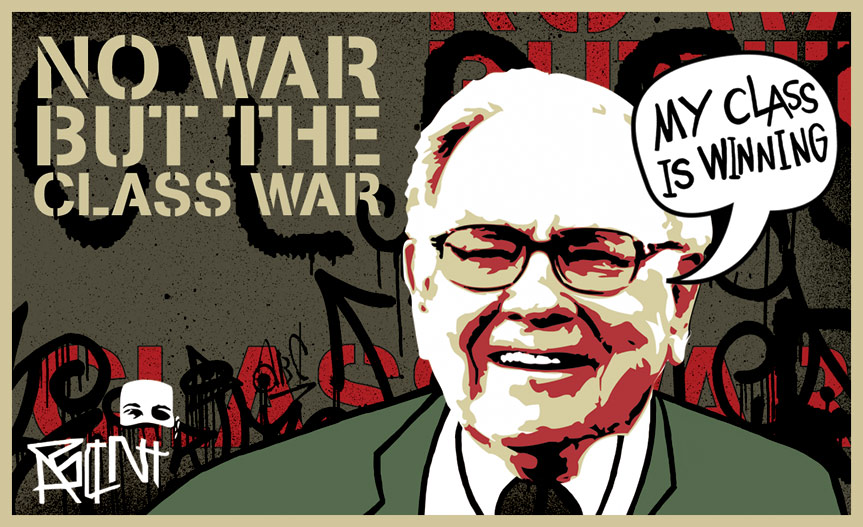
The corporate masters, meanwhile, are doing very nicely for themselves, in standard defiance of irrelevant majority popular opposition to excessive and grotesque disparities of wealth and income. A recent article in USA Today reports that, “CEOs didn’t have to cry poor for long…At a time most employees can barely remember their last substantial raise, median CEO pay jumped 27% in 2010 as the executives’ compensation started working its way back to pre-recession levels…The big increases in executive compensation are difficult for workers to swallow, given that many Americans are struggling just trying to find a job or make ends meet…” Here are some the most remarkable American 2010 CEO incomes reported on USA Today’s web version of its report: P. Daummon (Viacom) – $84,469, 515; Ray Irani (Occidental Petroleum) – $76,107, 101; Michael White (DirectTV) – $32,932, 618; John Lundgren (Stanley Black&Decker) – $32,570,596; Robert Iger (Walt Disney)- $28,017, 414; Samuel Palmisano (IBM) – $25,180,681; Howard Schultz (Starbucks) – $21,733,013. How’s that for “executive compensation”? These obscene “earnings” reflect the fact that the S&P Fortune 500 enjoyed a stunning 47 percent profits increase last year [11]. They are certain to stir the entrepreneurial ambitions of the more than 50 million Americans who live in “food insecure” households (homes experiencing recurrent and involuntary lack of access to sufficient food) in the U.S. today – unworthy victims of an officially invisible top-down class war.
Epidemic Depression: A “Not Unreasonable Response” to American Authoritarianism
But let us turn from the commanding heights of national and global policy to everyday institutions and organizations in American life. “Democracy,” the New York Times reminds us with the words of a Cairo teaching assistant in the Egyptian context, “is not just about electoral ballots and politics at the national level — it is about how you run your organization, how you run your small neighborhood, it is about having a say in every aspect of your life.” Indeed, and this is a big problem in the U.S., where citizens ubiquitously report feeling powerless and isolated within and in relation “their” workplaces, schools, local communities and state and local governments. Everyday Americans widely sense that they what they think, know, and feel is of no consequence in how and what decisions are made in the institutions with which they are most directly and regularly (if often passively and involuntarily) engaged. With good reason: those organizations and the communities tend to be strictly hierarchical, with unforgiving internal authority structures, and are often no less beholden to the nation’s “unelected dictatorship of money” than the nation’s dominant “two” parties.
That closet despotism crushes democracy and human vitality at the individual, family, and community levels. It penetrates, destroys, and limits the daily experience and consciousness of hundreds of millions of Americans, creating artificial consumer “needs,” and stealing the leisure time, mental balance and material security that genuine popular governance requires. It forces us to spend the lion’s share of our waking time in the endless pursuit of currency and commodities and threatens us with the loss of basic necessities including food, shelter and (to a distinctive degree among industrialized states in the U.S.)health care if we dare to question the authority of our bosses and others who have more money and hence more power. The relentless neoliberal marketization and monetization of the commons and daily life turns us into money and hence wage and salary slaves, buried in debt and beholden to the insatiable and fickle profit lust of amoral capital and its many hired servants and enforcers. The rising mass of poor and deeply poor always are there, as George Carlin used to say, to scare the shit out of working and middle class people: to keep the employed trudging off to their often alienating and authoritarian workplaces, and, also, it should be added, to reduce the fee that employed people can charge capital for the privilege of renting out and distorting their human productive capacity (labor power). This is all no small part of why “the world’s greatest democracy” the United States is plagued by an ongoing epidemic of mass psychological depression, what the clinical psychologist and social critic Bruce Levine portrays as a “not unreasonable” response to the pressures of corporate authoritarianism in a “market fundamentalist” state wherein government has merged in totalitarian fashion with transnational corporations, breeding mass feelings of hopelessness and helplessness among tens of millions of (ex-) citizens[12]. Along with an endemic stealth societal racism that remains deeply entrenched and more cloaked than ever in the time of the nation’s first black president, it is also part of why and how the United States is the world’s leading prison state, home to nearly two and half million incarcerated persons. Another curious marker of greatness for the nation that U.S. Senator Kay Bailey Hutchinson (in her speech in support of George W. Bush’s invasion of Iraq) once described as “the beacon to the world of the way life should be.” 13
“Put Down Those Posters and Pick Up Those Clipboards”
It is exciting that Wisconsin’s messianic right-wing maximalist governor Scott Walker’s Koch brother-backed assault on public sector unions sparked a massive outpouring of popular resistance in February and March of 2011. But look how quickly the masses who poured into the streets – more than a few of them carrying posters that likened “imperial Walker” to the U.S.-backed Egyptian dictator Hosni Mubarak (the Egyptian trade union leader Kamal Abbas reciprocated by sending Wisconsin workers a statement saying that “We Stand With You as you Stood With Us” [14]) – have been de-mobilized by union officials eager to bid down the price of public sectors’ labor power as long as the governor can be forced to relent in his assault on the labor bureaucrats’ right to enjoy comfortable coordinator class salaries on the basis of the automatic union dues check-off. Labor “leadership” has succeeded in squelching talk of a general strike, getting workers back on the job, and encouraging union members and their supporters to focus their anger and energies on the effort to recall Walker and return the other state-capitalist austerity party (the Democrats, whose top official Obama actually opposed the Wisconsin protests[15]) to nominal power. “Put down your posters and pick up a clipboard” was the actual command issued by one state Democrat speaking to tens of thousands of workers and their supporters outside the Madison Capitol Rotunda last March 12th. Taking orders from one wing of the unelected money dictatorship (the Koch brothers, the Bradley Foundation and other of the hard right business class ilk) at the top, the G/Tea.O.P. governor Walker has been counting on other expressions of that dictatorship – capitalist media’s limited toleration for labor rebellion and the cash credit, and employment-based health care dependency of working people, many of whom live one paycheck to the next – to combine with the moral weakness and corruption of union leadership to tamp down the Wisconsin protests. Meanwhile, the Republican governor and legislature of Ohio have passed an even more vicious assault on public sector union power that affects considerably more workers without meeting one tenth the poplar protest seen in Wisconsin. Democratic governors across the nation have joined their Republican counterparts in trying to balance state budgets on the backs of the poor and working class and failing to try to make the rich and powerful continue pay an adequate share[16]. The struggle against the U.S.-backed post-Mubarak military dictatorship has continued in the streets and factories of Egypt[17] even as the Wisconsin struggle has been significantly channeled safely back into that timeworn “coffin of class consciousness” (to quote the late radical American historian Alan Dawley) the American two party ballot box. Along with the suppression of popular democracy movements against U.S-supported authoritarian regimes across the Middle East (most notably in Bahrain and Yemen) and the horrors of nuclear power epitomized by the ongoing disaster at Japan’s Fukushima plant, both the ongoing Egyptian revolution and the Wisconsin workers’ struggle have been booted off prime time media coverage by Obama and NATO’s imperial adventure in Libya [18]and the kabuki theater of imminent and averted “government shutdown” in Washington.

There should of course be political options beyond the narrow confines of the corporatist “one and half party system” (Sheldon Wolin). That’s how most Americans have long felt about the slim range of electoral and policy choices served up by the national political establishment. Too bad! The Supreme Court, closely allied with unelected dictatorship, has spoken on this matter more than once, saying in essence: “no, subjects, you shall have just two relevant [business] parties because we say so and what we say goes.”19
The Democratization of the United States?
A recent public opinion poll conducted by the Anwar Sadat Chair for Peace and Development and the Program on International Policy Attitudes (PIPA) at the University of Maryland finds that a preponderant majority of Americans think that “it would be positive for the United States if the Middle East were to become more democratic and a solid majority would favor this happening” even if this resulted in the region being more likely to oppose US policies and “U.S. interests.” The “American public,” World Public Opinion.org reports in a recent headline, “sees [the] democratization of [the] Middle East as positive for US” [20]. That’s good to know, but, of course, the American people have little to do with the shaping of those policies and the definition of those interests. Americans looking for democracies to create, support, protect, and repair would do well to focus on “the homeland,” the world’s only superpower, where domestic authoritarianism – potentially a new and dangerous form of totalitarianism (“corporate-managed democracy”)in the view of some dark observers[21] – carries particularly grave consequences to democratic possibilities the world over. The people need change, real change, at home, no less than abroad. My sense is that the American public would see the democratization of the United States as a very positive development indeed.
(To see all footnotes for this article go to ZNet.)
Thousands rally in Lansing against Snyder’s budget plan
Yesterday, thousands of people gathered in front of the Lansing state capitol for yet another rally against the budget proposals and anti-worker policies of Michigan Governor Rick Snyder.

Like previous rallies there were scheduled speeches outside to get the crowd excited, while others went into the building to make noise. Those in attendance were mostly from organized labor, with some representation from student organizations, NGOs and the Democratic Party.
The speakers addressed mostly the issues at hand and roundly condemned the austerity measures that Snyder has been pushing for since taking office in January. Lansing Mayor and former gubernatorial candidate Virg Bernero also addressed the crowd but avoided talking about his failed candidacy or even mentioning Snyder. Instead, Bernero talked about unions and about the need to save the middle class.
I spoke with several people from around the state about their feelings on the direction that the Snyder administration is taking the state. I asked Dan, a teacher from the Detroit area, what he thought about Snyder’s notion that what he is asking people of Michigan to do is to engage in shared sacrifice. Dan said that he felt that “teachers have been making sacrifices for years in terms of wage and benefit concession.” He also said that he could accept the idea of share sacrifice if there was evidence that “the wealthy business sectors were also making the same kinds of sacrifices.”

Shirley, a retired UAW worker from the Lansing area shared the same sentiment. She said, “What the hell kind of sacrifices are the rich making in this state? Snyder wants to tax more of my pension and things are already tight for me and my family.”
I also said to people that when Snyder was in Grand Rapids on Monday he said he believed that most Michiganders were in support of his policy proposals. Most people laughed when they heard that this is what Snyder believed. Mel, a sheet metal worker from DeWitt said that he doesn’t know anyone who is happy with what Snyder is doing. “Everyone one at work, all my neighbors and friends all say the same thing……they are either angry or afraid of what is going to happen to them if Snyder gets his way and takes more and more from working people.”
At one point I asked to speak with organizers of the event to talk with them about short term and long term strategy they have to oppose Snyder’s policies. I was told that it was not possible to speak with the event organizers. I also asked how it was decided who got invited to speak at these rallies, but was told that I would have to speak to the event organizers to get an answer to that question.
In many ways it seemed frustrating that there was little discussion or indication that the growing opposition to Snyder’s policies would be encouraged to engage in a direct action campaign and try to shut down the state government. The comes from the speakers and several of the tables at the rally yesterday seemed to indicate that people can either join a Recall Snyder campaign or get ready for the 2012 elections. None of the people I spoke with at the rally suggested that people should occupy the capitol building as a next step in the opposition to Snyder’s policies and no one was advocating for a general strike or even debating it like they have been in Wisconsin.
However, I did get a sense that many people were frustrated with these rallies in that there was no clear plan of action beyond announcing when the next rally would be. As one nurse from Kalamazoo said, “we can’t put our hopes in just rallies, we need something else that will send a message to the Governor and the Legislators that we mean business.”
Corporate Interests Give More Than Their Two Cents in Financial Reform Implementation, New Public Citizen Report Says
(This article is re-posted from Public Citizen.)

Corporate interests eager to weaken the new Wall Street reform law are a strong force when commenting on specific rules to implement the law. For instance, four groups working to undermine a new executive pay rule before it is even proposed publicly spent more than $4.5 million on lobbying last year on a variety of issues and made $660,180 in campaign contributions, a new Public Citizen report reveals.
Public Citizen’s report, titled “Two Cents,” helps demonstrate the intense battle by corporate interests to disguise their pay packages. Publication coincides with the annual spring meeting season when companies disclose executive compensation as part of required shareholder votes on pay packages and the board directors who approve them.
The provision that’s subject to this scuffle would require companies registered with the Securities and Exchange Commission (SEC) to reveal how much their CEOs make in comparison to their average employees. The SEC has asked the public to comment on its responsibilities generally but has not yet formulated a specific pay ratio proposal for public comment.
“Regulators are asking for people’s two cents, but big corporations are giving more like $2 million worth of opinion,” said Negah Mouzoon, a researcher for Public Citizen’s Congress Watch division and one of the report’s authors.
The report is the first in a series that Public Citizen plans to release over the next few months. The series will document Wall Street’s efforts to weaken the rules that will implement the Dodd–Frank Wall Street Reform and Consumer Protection Act, signed into law on June 22, 2010. Public Citizen will analyze lobbying expenditures, campaign contributions and revolving door connections of Dodd-Frank opponents.

“Publishing the ratio of pay won’t cure the problem of excessive executive compensation, nor did sponsors in Congress hold such aspirations,” said Bartlett Naylor, financial policy advocate in Public Citizen’s Congress Watch division and another report author. “But it could help determine whether the CEOs’ pay is appropriate.”
Not surprisingly, businesses and business trade associations have deployed their highly paid lobbyists and complained that the provision is burdensome, cost-prohibitive and difficult to calculate, and involves too much paper.
Among the 23 people and organizations that commented on the provision as of April 1, Public Citizen focused on the extensive lobbying operations of four of the rule’s top critics: the Retail Industry Leaders Association; Davis, Polk & Wardwell (which acted as counsel for six of the largest U.S. banking organizations and other financial institutions); the Center on Executive Compensation, and the American Benefits Council (a lobbying firm that represents Fortune 500 companies).
These four groups in 2010 spent more than $4.5 million lobbying on financial regulation and other issues, a sum that accounted for half of the total lobbying expenditures by those commenting on the pay reporting provision. Although the groups didn’t lobby exclusively on the executive pay rule, the money they spent provides an indication of their clout in Washington. They deployed 46 individuals – 37 of whom are former government employees – to lobby specifically on financial regulation issues. Employees and political action committees (PACs) of the commenting entities collectively gave $660,180 in political contributions in the 2010 election cycle. Their former government affiliations are listed in the report’s appendix.
As federal financial regulators ask the public to put in its two cents on recent financial rulemakings, Wall Street has over-invested, Naylor said. In total, Wall Street dispatched 2,533 lobbyists and spent $251 million in 2010 to sway Congress about issues including financial reform.
“Public Citizen encourages people to continue to submit comments to increase the chances that the final rules reflect the reforms Congress intended,” Naylor said.
This Day in Resistance History: A Second Look at Guy Fawkes

On this day in 1570, Guy Fawkes, the most hated man in England, was born in the city of York. A Roman Catholic convert, Fawkes was born during the reign of Queen Elizabeth I, who became gradually more intolerant of Catholics when it became clear that her cousin, Mary Queen of Scots, had designs on the English throne. Elizabeth died childless, and it was Mary’s son, James VI of Scotland, who succeeded her as King James I of England. At the time, Guy Fawkes was a soldier of 33, fighting for Spain.
Fawkes is famous for his role in the Gunpowder Plot, a failed attempt to assassinate King James I and replace him with his Catholic daughter. Reviled in mainstream history texts as a scheming partisan criminal, Fawkes has also been dismissed by many anarchists as being a monarchist—someone who believed that by replacing one ruler with another, he would somehow improve conditions for the common people of England.
But Fawkes and his fellow plotters may well have had a larger vision than just doing away with James I: they may have planned not only for a country of promised religious tolerance, but also of fewer aristocrats and a more democratic style of Parliamentary government.
When James I first took the English throne, he promised the people that there would be no more religious persecution as long as the Catholics remained peaceful and followed the kingdom’s laws. But after he was safely in possession of England and not facing an uprising, he reportedly said, “No, good faith, we do not need the Papists now.”

In some mainstream history lessons in the UK, you will still find the idea that James I practiced religious tolerance right up until the Gunpowder Plot, but that is not the case. A conservative Protestant who was obsessed with witchcraft and satanic possession, not only did James I resume the execution of Catholics for heresy, he also enforced harsh recusancy fines—fines for not attending Protestant services. The fines were affordable for the upper class, but the working class had to pay a shilling a week, onerous for many. He also ordered that all of the Catholic priests in England leave the country. The irony of this is that James’ queen, Anne of Denmark, was a secret Catholic, and was allowed to hold mass at his palace at Whitehall.
But this double standard was far from James’s only shortcoming as a monarch. He believed, much more strongly than his cousin Elizabeth, in the divine right of kings. This was hardly a new idea, but James bumped it up a few notches in his writings. He explained that kings were actually higher beings, more akin to angels than humans. “Kings are justly called gods,” he wrote, and “the state of monarchy is the supremist thing upon earth.” Therefore, they were the perfect stewards of God’s plan on earth. James did not believe in parliamentary government, and told his son, “Hold no parliaments but for the necessity of new laws, which would be but seldom.” It was obvious to James that kings were the true authors of law, since they were divinities in their own right.
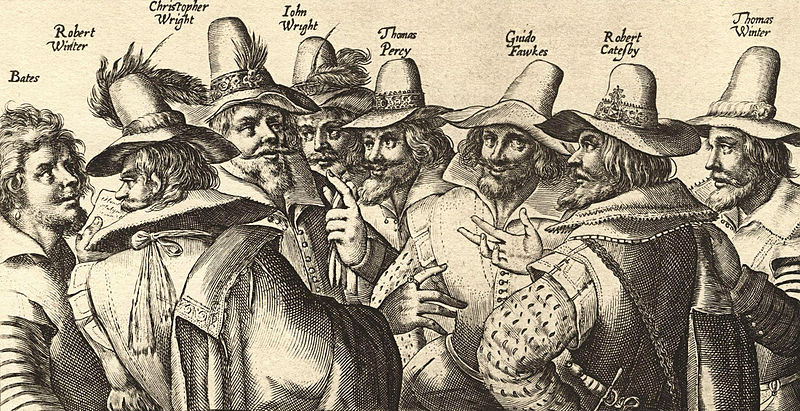
So when Guy Fawkes and his fellow conspirators planned to blow up the House of Lords during a meeting of Parliament with King James I, they were fully aware that although one outcome of success would be placing a more sympathetic monarch on the throne—another was it would weaken the power of the House of Lords. It would take another generation to replace all the dead peers, who had to be succeeded by their heirs. Meanwhile, there would be opportunities for stronger rule by the House of Commons and representatives more closely associated with the working people of England.
Admittedly, the plan was short-sighted because of its limited outlook. Although the Gunpowder Plot participants were searching for a way to a better world, they failed to see how the religious divisiveness that they hated was actually a way for those in power to keep the working class from uniting against those in power.
On the night of November 4, Guy Fawkes was discovered in a cellar beneath the House of Lords’ chamber of Parliament, guarding a large pile of firewood. When he was searched, he was found to be carrying a pocket watch and several “slow matches” or fuses. The firewood was concealing 36 barrels of gunpowder. He was arrested at dawn of November 5 and taken to the Tower of London. Even under torture, Fawkes insisted that he was acting alone, and refused to give up the names of his fellow conspirators. Finally, using information they had obtained from other sources, the torturers created a confession document, dated November 17, which a broken Fawkes finally signed.
On the night of November 5, announcing that he had been delivered from murder, King James I ordered that bonfires be lighted across Europe in celebration. Many towns and villages burned Guy Fawkes in effigy, a custom that continues to this day.

There are indications that King James and his advisors knew about the Gunpowder Plot well in advance of November 5, and allowed it to play out with the intention of using it to whip up more hatred of Catholics in the country. And if that was the intended outcome, it worked very well. Suspicion of Catholics reached an all-time high in the kingdom after November 5, 1605. After the attack, King James I, in addition to setting the “popish recusants” fines even higher, was able to institute an Oath of Allegiance. This required Catholics to swear that the Pope had committed heresy by ruling that Protestant princes (such as James) should be excommunicated.
The King also put “shock doctrine” techniques into play: he used the confusion immediately after the Plot to seize two-thirds of the lands held in his kingdom by Catholics and added them to the crown’s possessions.
A Gunpowder Plot test conducted in 2005, using the same amount of gunpowder in an enclosed space the size of the Parliamentary cellar, found that everyone in the House of Lords and within 300 feet of the chamber would have been killed—even if only half the gunpowder had ignited on that night of Guy Fawkes’ arrest.
Maybe that’s why every year at the opening of Parliament, the Yeomen of the Guard go into the cellar to officially search for kegs of gunpowder. Or perhaps this ceremony is a reminder that no one dare question the power and authority of those controlling the United Kingdom. This year, the members of both Houses should probably be looking in the streets instead of the cellars. Having set aside the manufactured divisions of religious affiliation, workers in Great Britain are planning a general strike to take place this year.
Former Michigan House Member Bart Stupak now a Lobbyist
(This article is re-posted from OpenSecrets.)
 OpenSecrets Blog has previously documented the ease with which former lawmakers and government officials pass through the “revolving door” between public service and the political influence industry, using their insider credentials to land what are often high-paying lobby jobs.
Former Rep. Bart Stupak (D-Mich.) is the latest congressman to follow the path already set by multiple former lawmakers this year, as The Hill reports that Stupak has been hired as a partner at lobbying firm Venable LLP.
While Stupak had served in the House since 1992, he garnered much notoriety during last year’s health care debate. As OpenSecrets Blog reported, Stupak had fought against abortion rights provisions in the health care bill, but he ultimately supported passage of the legislation.
As a result, Stupak drew the ire of abortion rights opponents, and soon after health care reform was enacted, he announced plans to not seek reelection.
At Venable LLP, the former representative will likely be working with multiple high-profile clients. The firm’s employers include companies such as Lockheed Martin, Marriott International and — as Slate’s Dave Weigel pointed out — Planned Parenthood of Maryland.
But since federal lobbying law prohibit House members from registering as federal lobbyists until a year after they leave office, Stupak must for now work as a lobbyist only it its general sense — not as one spending much of his time directly interfacing with government officials.
The “revolving door” also spins just as quickly beyond K Street — New York Magazine’s cover story on Wall Street’s post-bailout optimism features a profile on Peter Orszag, the former Office of Management and Budget director who joined Citigroup in December.
As writer Gabriel Sherman notes, Orszag’s credentials give Citigroup considerable clout:
“Orszag’s wisdom about markets is certainly valuable; but even more valuable is his role as an impeccable ambassador for the bank, a kind of rainmaker, but at the stratospheric level. Just about anyone will take the call of a former White House budget director. “He’s a guy who can be effective in a lot of rooms,” one Democratic financier who knows Orszag told me.”
Local News and Snyder’s Visit to West Michigan
After speaking to a Grand Rapids Chamber of Commerce luncheon crowd, Michigan Governor Rick Snyder was scheduled to address fellow Republicans at a fundraiser in Hudsonville last night.

The major local news sources all reported on Snyder’s visit in one form or another. According to what is posted on their website, WOOD Radio only announced his visit without providing any information or analysis of the visit.
All three local TV stations were at the GR Chamber of Commerce luncheon to report on Snyder’s talk. The Fox 17 story provided a brief summary of Snyder’s talk with 2 excerpts of comments from Snyder, but the report did not question any of the claims that Snyder made.
WZZM 13 also provided a just brief summary of Snyder’s comments and was the only TV news source that included any reaction to the luncheon speech, even thought it was Republican State Senator Arlen Meekhof speaking about the May 31 budget proposal deadline.
The WOOD TV 8 story at least acknowledged that there has been significant opposition across the state to Snyder’s proposals and that this has been some of the largest protests “in recent memory.” Nonetheless, the channel 8 story did not question or verify any of the claims made by Snyder in the talk he gave at noon in Grand Rapids.
The Grand Rapids Press article was by far better than the broadcast news outlets in that they provided a bit more information about Snyder’s talk. The article did include a few hyperlinks, one on the item pricing law that Snyder has passed and another link on the proposed international trade bridge.
MLive also included some video clips (see first of 3) and was the only news outlet to have comments from a few protestors who were outside the Chamber of Commerce luncheon.
Despite doing a better job of covering Snyder’s visit, the Press article left out what the rest of the local commercial media did – any analysis of Snyder’s comments or the first 100 days in office. As we reported yesterday, reporters could have questioned Snyder’s position on increased taxation of senior citizens, the international trade bridge proposal, his Emergency Managers policy or the Governor’s notion of “shared sacrifice.”
Earlier today Michigan Governor Rick Snyder spoke to a crowd of over 600 people at a luncheon hosted by the Grand Rapids Chamber of Commerce.

In the audience were several dozen elected officials from both state and local offices, college officials, non-profit directors and business owners who came to hear what the new Michigan Governor had to say about his first 100 days in office.
One of the Chamber committee members introduced Snyder by stating that the Chamber of Commerce was encouraged by the changes the new Governor has made, a comment that received a standing ovation as Snyder made his way to the podium.
The first comment that the Governor made was to thank the audience for such a warm welcome, which is significantly different from the greetings he has been getting “outside.” Snyder was no doubt referencing the organized opposition to his policies, which have manifested in protests at the Lansing Capitol and around the state.
Snyder began his talk by saying that after the first 100 days in office he has gotten the response he has expected. “We are in a crisis, but the difference though is this is not about a crisis of panic, it is a crisis of resolve,” said Snyder. He then used one of his many catch phrases by saying that Michigan needed to re-invent itself.
In order to “re-invent Michigan” Snyder believes there are some things that were in need of drastic changes. The first change was to eliminate the Michigan Business tax system and to radically alter the state budget. He has made good on eliminating the Michigan Business Tax and is working on significantly altering the state budget.
Snyder then said he knew that he was going to get a negative reaction from some people, but that he is doing what he said he was going to do during the campaign last year. While it is true that Snyder said he would run the state like a business during the campaign he was not that forth coming on everything he has actually done as Governor. However, his comment about doing what he said he would do does beg the question why some so many people were taken in by Snyder during the campaign season?

Snyder then told the audience that what the state needs is “shared sacrifice.” And while this writer saw many people in the audience nod their heads in agreement the Governor never articulated what share sacrifice actually looks like. This would have been particularly relevant considering that it seems less likely that the business crowd is having to make as much of a sacrifice as working people, the unemployed and senior citizens are across the state.
The Governor then spoke about his dashboard concept as a means of measuring what has been done in state as time goes by. Snyder gushed about the dashed board idea and his Emergency Financial Management system, which he called a way to get communities back on their feet. This is not what some people thought of Snyder’s Emergency Financial Management system when he came to Grand Rapids two weeks ago to kick off that policy.
Snyder went back to talking about the “wisdom” of eliminating the Michigan Business tax, a point, which also got an arousing applause. He then addressed one example of what a shared sacrifice would look like when he said that senior citizens need to start paying their share of the tax burden, otherwise it will shift to the current generation This view is not shared by many senior citizens and the AARP of Michigan demonstrated this opposition on March 22 with a rally of over 1,000 people.
Snyder also said that he expects that his upcoming education reform proposal will also be met with opposition. Indeed, it seems that every major proposal Snyder has put forth in his first 100 days has been met by serious public opposition, but according to Snyder those are the people “outside.”
In his closing remarks Snyder said that Michigan needs to train and maintain “talent.” By talent he was referring to young people the state needs to keep here after they get an education and of course that means youth of privilege who will become young professionals. Maintaining talent does not refer to working class youth, which tends to means youth of color.
Snyder also made a plug for the “new International trade crossing,” a bridge that has the support of the State Chamber of Commerce, the Farm Bureau, and the Agri-business community. The Governor said that a proposed bill for this new international trade bridge would be announced within the next week, a proposal that has been scrutinized the by Truth Squad.
Lastly, the Governor said that the state needs to change from a negative culture to one that thinks positively. He said that people are too caught up in a win/lose attitude, with race, geography and partisan politics keeping everyone divided. On the matter of race Michiganders have every right to critique current problems based on race if one looks at unemployment rates for people of color, educational outcomes, poverty, infant mortality and incarceration rates.
Snyder also took a jab at the news media and said that the negative response to his policy has received more coverage. He believes that the vast majority of Michigan is supportive of the policies, but need to speak up and speak out to show that the state can move forward. Snyder even asked the audience the spread the word, to talk to their networks and give feedback. With this closing comment Snyder received another standing ovation.
Q&A
The Chamber of Commerce facilitated the question and answer period by collecting questions from the tables and then selecting which questions to present to Snyder. The questions were often vague and somewhat irrelevant, such as how did you chose your political team?
Another question posed to Snyder had to do with his relationship to organized labor. Snyder said he meets with them regularly and that he is a supporter of collective bargaining. He also shared a story about going to a factory and meeting with workers who all had Wisconsin solidarity t-shirt on and when Snyder showed up they booed him. However, he said that after speaking with the workers he did get a few of them to clap.
When asked what Snyder thought about how to change public education he said that his proposal will definitely look at making changes to the post retirement medical benefits and pensions.
This was just one more indication that Snyder wants to engage in serious austerity measures, where the cuts felt by the working class will be benefits, pensions and shouldering more of the tax burden and cuts for the rich will be less taxes. These were exactly the thing that the audience at the Chamber luncheon wanted to hear as they will certainly be the beneficiaries of such policies.

Sunday’s edition of the Grand Rapids Press featured a big birthday present for Justin Amash: an advertisement for Amash’s birthday-themed money-raising campaign, thinly disguised as an article.
The piece, written by Jeff Cranson, describes how Amash is asking each of his followers for $31 on his 31st birthday this April, so he can continue “fighting for you.”
The so-called “money bomb,” which Amash describes as his birthday wish, is featured on the freshman Representative’s Facebook page. There, Amash elaborates on why he feels he needs extra cash this soon, and so badly: the government is out of control, exhibiting a “reckless disregard for the wise limits on government that our Founders placed in the Constitution.” Amash then reports in a vague statement that he needs more money to “continue [my] efforts on behalf of liberty.”
The $31 is just a gimmick donation, however; he’s willing to take more. A lot more—a maximum gift of $2,500 is flagged for Facebook readers’ attention.

The Press not only reports this as if it were news and worthy of reader attention—in the print version, it is given front-page placement in the Region section. And the online feature obligingly includes a link directly to the site where you can make your donation. The piece falls under the banner of “Polpourri,” which are quick news bites about politics in Michigan. Although some pieces for this section are written like commentaries, this one is not. In the online version, the article is combined with a paragraph about Bill Huizenga and a Tea Party event, but features a large photo of Amash supporters with a caption about his “money bomb” wish.
According to Professor David Niven of Florida Atlantic University, “advertising bias” in news reports like this one, that violates the objectivity of journalism, result in “news stories” that are tantamount to paid political ads. This type of writing, along with other types of media bias, has an agenda so transparent that it has caused Americans to distrust newspaper reporters in the United States more than people in any other profession except used car salesmen, insurance salesmen, and advertising copywriters.
Niven goes on to state that the consequences of this distrust has “drawn down the reservoir of support to a level that it is dangerous to itself and democratic society.” Without actual objective facts, presented without a slant toward a particular political agenda in stories created like news reports, truth becomes obscured by opinion to the point that some people are unable to distinguish one from another. (For proof of this, just read MLive’s comments on any Michigan news story.)
It seems that this Press’s gift to us this Sunday is an outstanding example of why Americans can no longer trust what they read in newspapers.
We Are the People Rally in Lansing – April 13
Another big rally is on to continue the pressure on Michigan Governor Rick Snyder for the anti-worker, anti-union austerity measures that he has proposed since taking office in January.

This rally is primarily being organized by the Michigan AFL-CIO, AFSME and Working Michigan. The rally is scheduled for Wednesday, April 13 from 1 – 6 PM at the Lansing State Capitol, with speakers at 1, 3 and 5 PM.
No other information is provided on the Facebook notice besides regional transportation information, so we don’t know what kind of actions will be planned inside or outside the capitol building beyond speeches.
Considering there have been numerous rallies that have already taken place in Lansing with no evidence that those in power are changing direction it seems time to increase the pressure through an occupation, a general strike or other forms of direct action that could stop business as usual in Lansing. Wisconsin has only been successful to the degree that they have been willing to disrupt business as usual.
We plan to be there to cover this event and will ask questions of the organizers about tactics and strategy.
 Grand Rapids Institute for Information Democracy