Film looks at how US Deportations separate families

One aspect of the current US immigration policy that is rarely discussed in commercial media is the harsh reality of how families get separated because of this inhuman policy.
Touring the US right now is the director of the film Tony & Janina’s American Wedding, a new documentary that puts a human face on how the current US immigration policy impacts families. The group Alliance for Immigrant Rights has organized the film tour in Michigan and Justice for Our Neighbors will host viewings in Holland and Grand Rapids on Tuesday, May 17.
“Tony & Janina’s American Wedding is a feature length documentary that gets to the heart of the broken, red tape ridden U.S. immigration system. After 18 years in America, Tony and Janina Wasilewski’s family is torn apart when Janina is deported back to Poland, taking their 6 year old son Brian with her. Set on the backdrop of the Chicago political scene, and featuring Illinois Congressman Luis Gutierrez at the heart of the immigration reform movement, this film follows the Wasilewski’s 3-year struggle to be reunited, as their Senator Barack Obama rises to the Presidency. With a fresh perspective on the immigration conversation, this film tells the untold human rights story of Post-9/11, that every undocumented immigrant in America faces today, with the power to open the conversation for change.”
The two West Michigan screenings are:
Tuesday, May 17th at noon Herrick District Library in Holland
Tuesday, May 17th – 7pm Woodland Celebration Cinema in Grand Rapids
(This article is re-posted from Reuters.)
The crown prince of Abu Dhabi has hired the founder of private security firm Blackwater Worldwide to set up an 800-member battalion of foreign troops for the United Arab Emirates, The New York Times reported on Sunday.

The Times said it obtained documents that showed the unit being formed by Erik Prince’s (pictured here) new company Reflex Responses with $529 million from the UAE would be used to thwart internal revolt, conduct special operations and defend oil pipelines and skyscrapers from attack.
The newspaper said the decision to hire the contingent of foreign troops was taken before a wave of popular unrest spread across the Arab world in recent months, including to the UAE’s Gulf neighbors Bahrain, Oman and Saudi Arabia.
The UAE itself has seen no serious unrest. Most of its population is made up of foreign workers.
Blackwater, which once had lucrative contracts to protect U.S. officials in Iraq, became notorious in the region in 2007 when its guards opened fire in Baghdad traffic, killing at least 14 people in what the Iraqi government called a “massacre.”
One former Blackwater guard pleaded guilty to manslaughter charges in those killings, and a U.S. court reinstated charges against five others last month. Prince has since sold the firm, which changed its name to Xe. The firm denies wrongdoing.
The newspaper said the Emirates, a close ally of the United States, had some support in Washington for Prince’s new project, although it was not clear if it had official U.S. approval.
Two UAE government officials contacted by Reuters declined immediate comment on the New York Times report, and the U.S. embassy in the UAE also had no immediate comment. It was not possible to locate Prince for comment.
The Times quoted a U.S. official who was aware of the program as saying: “The Gulf countries, and the U.A.E. in particular, don’t have a lot of military experience. It would make sense if they looked outside their borders for help.”
State Department spokesman Mark Toner told The Times the department was investigating to see if the project broke any U.S. laws. U.S. law requires a license for American citizens to train foreign troops.
Toner also pointed out that Blackwater, now known as Xe Services, had paid $42 million in fines in 2010 for training foreign forces in Jordan without a license, the Times said.
According to former employees of the project and U.S. officials cited by the Times, the troops were brought to a training camp in the UAE from Colombia, South Africa and other countries, starting in the summer of 2010.
They were being trained by retired U.S. military, and former members of German and British special operations units and the French Foreign Legion, the Times said.
Prince had insisted the force hire no Muslims, because they “could not be counted on to kill fellow Muslims,” the paper said.
Former employees also told the newspaper the Emirates hoped the force could be used to counter any threat from Iran, which the Arab states in the Gulf consider a foe.
Although The Times said the documents it obtained did not mention Erik Prince, former employees had told the newspaper he had negotiated the contract with Abu Dhabi Crown Prince Mohammed bin Zayed al-Nahyan.
Emiriati officials had proposed expanding the force to a brigade of several thousand if the first battalion was successful, the newspaper said.
Spectacle in the Service of Capital
Yesterday, MLive posted yet another article about the latest Rob Bliss “event.” Bliss and company will be filming a lip dub in downtown Grand Rapids to the Don McLean song “American Pie.”

While Bliss is hoping for another huge turnout he has also lined up numerous people who along with Bliss want people to come to downtown Grand Rapids and spend money. I have argued in previous postings about the Bliss phenomenon that while these events may be fun and engage lots of people, they ultimately serve capital interests.
Bliss only organizes these events in downtown Grand Rapids, which only benefits a small sector of the business community. Many of the businesses downtown are upscale and disproportionately benefit people who are already well off. Imagine if a zombie walk were to happen in the Burton Heights neighborhood or the Creston neighborhood or along the Grandville Avenue corridor. If people were buying food the money would surely land in the hands of small restaurants and grocery stores, many of which are owned by people of color.
However, the Bliss events are downtown and serve the businesses interests of some of the same people that Bliss has invited to be part of the lip dub. Among those involved who benefit from money being spent in downtown GR are Dick DeVos, Peter Seechia, Jim Dunlap (banker), Ryan Slusarzy (Amway Hotel), Jay Harnish (DeVos Hall) and Randy Finch (Ice Sculptures Ltd.).
On top of that there are numerous media personalities that also fit into this downtown spectacle in the service of capital model. You have 2 members of WOOD TV 8 (where Bliss works), a WXMI 17 reporter, an on air personality from WTNR, the entertainment website GRNow and a writer for Rapid Growth Media. All of these media entities promote this kind of activity (entertainment that makes money) disproportionately more than news and events that benefit working class people.
Rob Bliss has often been asked why he won’t do events for a cause and he says that he wants to remain apolitical and just promote fun in Grand Rapids. While it would be hard to question the fun that people have at Bliss events it is dishonest of him to say that his events are apolitical, especially when they serve the capital interests of so few.
Purely Upscale Grand Rapids

Earlier this year the Michigan Legislature voted to not only continue using taxpayer money to fund the Pure Michigan ad campaign, they increased it.
The funding was $15 million, but the state’s elected officials voted to add another $10 million bringing the total to $25 million, which Gov. Snyder signed onto in late March. This obviously raises numerous questions, particularly how the state can justify spending so much money to promote Michigan as a tourist destination, when so many public services and jobs are being cut.
Group Tour Magazine noted that much of the additional funding comes from Michigan’s 21st Century Jobs Fund, which again is taxpayers money being directed to benefit the private sector. The Group Tour Magazine article also noted that the TV ads will run 4,500 times just during this TV buying slot on numerous cables stations such as the Golf Channel, the Weather Channel, Fox, MSNBC and the Food Channel.
Just a few days ago the Michigan Policy Network posted a lengthy article provided some interesting analysis on the partisan aspect behind the funding of the Pure Michigan Campaign. The article acknowledges that there are differences between the state Republicans and Democrats, but the differences are only tactical in that both parties support using taxpayer funds to bankroll the ad campaign.
Pure Grand Rapids
The ads themselves focus on specific places throughout the state. One of the ads even features Grand Rapids and is worth deconstructing considering the content and representation of the commercial.

The GR Pure Campaign ad begins with a tight shot of someone playing the piano, which then cuts to a riverfront/skyline scene. From there we see people sitting outside on downtown Grand Rapids, followed by a tight shot of someone painting on a canvas and then a view from inside the public museum.
The next scene shows people walking in front of shops on Monroe Center, followed by an areal shot of downtown and then a couple dinning in an upscale restaurant. These images are followed by two different images of ArtPrize and then the commercial ends with video footage from Meijer Garden.
Like all the other Pure Michigan TV ads the voice is that of Tim Allen and the narrative in the Grand Rapids ad is positioning Grand Rapids as a place for “artful living” and “where food is art.” There are indeed some interesting things in Grand Rapids happening around both art and food, which has been the case for years. However, when the images of art are limited to ArtPrize or institutions such as Meijer Garden the commercial presents a very narrow view of the kinds of art experiments taking place in Grand Rapids. Why not highlight the Avenue for the Arts, ArtPeers, or the Festival of the Arts, which is celebrating 42 years in June?
Like the Fortune Magazine article on Grand Rapids from a year ago and many other promotional pieces about Grand Rapids, the Pure Grand Rapids commercial is focused on all things downtown and Meijer Gardens. Don’t these venues already have huge budgets to promote themselves? If people come to Grand Rapids and only visit downtown they would be missing out on the diverse neighborhoods in the city, all of which have interesting places to visit. Instead we get beautiful images of upscale people in downtown Grand Rapids……not exactly reflective of the majority of people who live in this community.
The focus on downtown GR in the Pure Grand Rapids commercial makes complete sense in terms of tourism promotion. Unfortunately, the people who will benefit from such tourism is a small sector of this community who are already well off while thousands of residents in this town are struggling to make a living.
Media Alert – Say No to the Comcast – FCC Merger
(This Media Alert is re-posted from Free Press.)

FCC Commissioner Meredith Attwell Baker is leaving the FCC to become a lobbyist for Comcast – just four months after she voted to approve the Comcast-NBC merger.1
This is just the latest – but perhaps most blatant — example of so-called “public servants” cashing in on companies they are supposed to be regulating. But Baker’s jump to Comcast is particularly egregious. As recently as March, the commissioner was giving speeches complaining that the Comcast-NBC deal “took too long.”
And you wonder why the American people are disgusted with Washington.
Stop the Revolving Door: Demand Congress Investigate Baker’s Conflict of Interest
Congress is already concerned about how the FCC conducts itself. Rep. Darrell Issa, chair of the House Oversight and Government Reform Committee, has been making a lot of noise recently about alleged ethical violations at the agency. By signing this letter to Congressman Issa, you’re urging him to launch an investigation of Commissioner Baker’s seemingly blatant conflict of interest.
Outside of Washington, people of every political stripe have expressed near unanimous contempt for a system of government that favors powerful corporations at the expense of the many. Sadly, the complete capture of government by industry barely raises an eyebrow inside the Beltway anymore. That’s why Congress needs to hear from you.
Urge Congress to Investigate this Conflict of Interest at the FCC
The revolving door at the FCC erodes any prospect for common-sense public policy — such as strong Net Neutrality rules or a rigorous review of mega-deals like AT&T’s proposed takeover of T-Mobile.
A new campaign by Brave New Films/Cuentame is now operating with the intent of providing updated information on both anti-immigration policies around the country and to expose the corporations profiting from immigrant detention.
 The campaign states, “Immigrants are for sale in this country. Sold to private prison corporations who are locking them up for obscene profits!
Here are the top 3 things YOU need to know about the Private Prison money scheme:
- The victims: Private prisons don’t care about who they lock up. At a rate of $200 per immigrant a night at their prisons, this is a money making scheme that destroys families and lives.
- The players: CCA (Corrections Corporation of America), The Geo Group and Management and Training corporations—combined these private prisons currently profit more than $5 billion a year.
- The money: These private prisons have spent over $20 million lobbying state legislators to make sure they get state anti-immigrant laws approved and ensure access to more immigrant inmates.
The campaign is also enlisting people across the country who will be part of the nationwide network of Prison Watchers that will follow and expose the players, the money and the victims in this corrupt money making racket. You can sign up to be part of this campaign.
Here is the video they created that is part of the campaign.
Heartwell says No to Privatizing GR’s Water for Now
Yesterday, it was announced by Grand Rapids Mayor George Heartwell that privatizing the water services was no longer on the table. The Mayor made this announcement on the blog of the West Michigan Environmental Action Council (WMEAC).

Hear is what Heartwell had to say about how he came to the decision to take privatizing the water off the table.
“After Commissioners individually considered this idea they concluded that it is not an option they wish to pursue. And so, rather than bringing the idea to the community for consideration, I have withdrawn it. There is much work remaining for us to do in our journey toward sustainability; none of us can afford to take precious time and energy exploring an option that has little chance of succeeding. There are many other opportunities for transforming local government and we will vigorously pursue those that have the greatest possibility of success.”
What is missing from the Mayor’s comments is the fact that there has been numerous efforts to stop the privatizing of the City’s water system. A Facebook page was created several months ago in opposition to the possibility of water privatization in Grand Rapids, GRIID has been posting numerous articles on the matter and last month the Bloom Collective hosted a forum on the issue. Out of that forum people crafted a letter and got people to sign on demanding that Heartwell take a public stance on this issue. The letter read as follows:
It was brought to our attention that you have recently engaged in communication with the companies Veolia and Suez regarding the potential privatization of Grand Rapids’ water services. We find such communication to be deeply alarming.
In communities where water privatization has occurred, water quality has gone down, water bills have gone up, and control over our most precious natural resource has been removed from the hands of the people to the hands of corporations. This distribution of power places top priority in profit rather than the health and happiness of the people and the environment. This is not something we want for our city and our water. While we understand the gravity of the current economic situation, tampering with the condition and control of our water is absolutely not a solution, and will simply not be tolerated by the people of Grand Rapids.
In our attempts to contact your office and city council members, it has been communicated to us that water privatization is no longer being considered in our city. While we find this moderately relieving, we are requesting an official public statement from you specifically so that we can rest assured that you are committed to keeping water services in the public hands. Pledge yourself and our city to accessible clean water for everyone.
We await your prompt and positive response. In the meantime, we will continue to educate ourselves and our neighbors, and maintain open and probing dialogue regarding the privatization of our water supply. We are prepared to take further action if it is not made explicitly clear by you that Grand Rapids will no longer be considering this option and that negotiation of such has been permanently removed from the table.
It seems that the public opposition has worked and that for now water privatization in Grand Rapids is off the table.
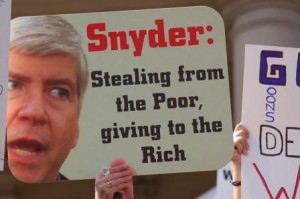
The Economics Club of Grand Rapids is hosting a luncheon on Monday, May 16 and has invited Michigan Gov. Rick Snyder to speak to its members. No details of the luncheon talk are posted on the Econ Club’s website, but one would have to assume that Snyder will talk about his policies and proposals that have been met with a tremendous amount of dissent.
In response to Snyder’s noon visit at the Amway Grand Hotel there will be a protest beginning at 11:30am and continuing until 2:00pm outside the Econ Club event. At least three groups are involved in putting together the protest – We Are the People, Michigan Citizens United and We Are One. Michigan Citizens United is behind the Recall Snyder campaign.
The Press Release for the protest stated that groups “will be showing up to protest against many of the proposals that have come out of the Legislature since the beginning of the year.” The accompanying flyer says that people should bring “appropriate” signs.

As he walked a parade route in Benton Harbor on Saturday, May 7, Governor Rick Snyder was greeted with loud booing, chants of “Recall Rick!” and angry cries of “Fascist!” “Get him out of here!” and “You’re an asshole, Rick!”
It was not business as usual at Benton Harbor’s Blossomtime celebration.
This year, an emergency financial manager, appointed by Snyder under HB 4214, the newly expanded EFM law, had just gagged the entire city council. He also suspended all elected boards in the city government. EFM Joseph Harris also fired Planning Commission members and the Brownfield Development Commission, replacing them with hand-picked choices from the governor’s office.
At risk: Our democratic process. And to illustrate that fact, citizens of the city fear specifically that Jean Klock Park, a significant piece of public lakefront property with a beach, is about to be seized. A $500 million development of summer homes with a private golf course is being planned—right on the Jean Klock Park property.
The largest investor in this new elite development is Whirlpool. The company completed its phasing-out of all manufacturing plants in Benton Habor this year. Now it has sets sights on a new cash cow, the luxury vacation development. And the city employees who would have been the most likely to block a public facility from being turned into a multi-millionaires’ enclave are, of course, the Planning Commission and the Brownfield Development Commission members…now staffed by Snyder appointees.
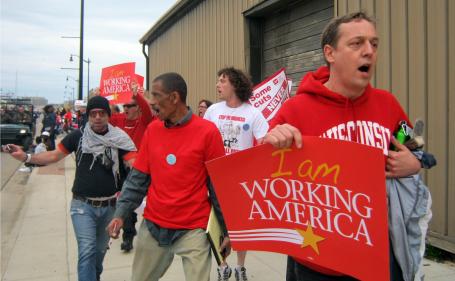
Under HB 4214, Snyder’s greatly expanded EFM law, emergency financial manager Joseph Harris has the right to sell the beachfront park to private investors, just as he has the right to seize any city asset—without citizen input.
Interestingly, Harris was recommended as an appointee by legislator Al Pscholka, the same state representative that sponsored HB 4214.
Asked about the development plan, Pscholka said, “Capital flows to places that are stable. I think we can all agree on that.” Perhaps Pscholka learned that philosophy in his last private-sector job: as the vice president of the development company working on the “Harbor Shores” golf-course-luxury-home plan for Jean Klock Park.
Pscholka was going to be a featured participant in the Blossomtime Parade, but announced on May 6 that he would not be involved in the event after he learned about the potential number of protesters.
Perhaps he made a wise decision. Outraged citizens of Benton Harbor were joined by other Michigan residents. They lined the parade route and barraged Snyder, the Grand Marshal of the event, with unrelenting shouts of protest. At first, Snyder marched while staring straight ahead, but later he attempted smiling and waving, which led to some bizarre film footage (see below).
Some of the attending protesters were organized by Rainbow PUSH Coalition. Its founder, Reverend Jesse Jackson, met with Michigan’s assistant attorney general about the Benton Harbor situation. Later, Rev. Jackson announced that the Coalition is setting up a headquarters in Benton Harbor and intends to launch a lawsuit against the governor and the State of Michigan concerning HB 4214’s unconstitutionality.

The opening salvo of the lawsuit was issued via a petition to the governor on May 3. Benton Harbor’s mayor and City Commission stated that HB4214 violates the Michigan Constitution. It suspends the right of citizens to petition the government for redress of grievances. It takes away the right of Benton Harbor citizens to frame, adopt, and amend their city charter. It violates citizens’ rights to taxation with representation. The petition demands the removal of Joseph Harris on these grounds.
Earlier this year, when HB 4214 went into effect, analysts worried that minority areas and school systems would be specifically targeted by the law. Benton Harbor seems to be a case in point: it is 85 percent Black, and the average income—now that major employer Whirlpool has moved its factories out of the area—has fallen below $9,000 a year. Not only are these citizens vulnerable to power grabs, they tend not to vote for conservatives. Driving them from the state, intimidating them or silencing them through the EFM law allows this financial class warfare to be conducted without obstruction.
Plus, seizing city assets and transforming them into private profit centers benefit those who paid to put Snyder and his team into power in Lansing.
But judging from the reaction of the crowds last Saturday, Michigan citizens are currently refusing to stand silent while their rights are stripped from them. As one protester said, “… unless we the people start getting engaged and make our voices heard, we’re going to lose what we thought we had.”
Here’s a look at the parade and protest:
(This article by Paul Street is re-posted by ZNet.)
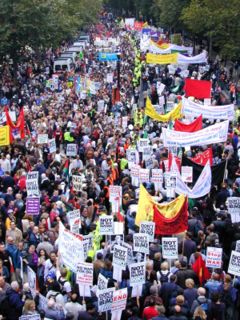
I was never quite as excited as some of my fellow leftists seemed to be about the antiwar movement that developed in response to George W. Bush’s planned and then implemented occupation of Iraq. True, the anti-invasion turnouts in Europe and the United States were remarkable even before the actual fact of the “war.” On February 17, 2003, more than a month before “Operation Iraqi Liberation” (quickly changed to “Operation Iraqi Freedom” [O.I.F] because the original brand name’s acronym [“O.I.L.”] was too suggestive of the invasion’s petro-imperial ambitions) was formally launched, the New York Times was so impressed by the global antiwar outpourings that it said the following: “there may still be two superpowers on the planet: the United States and world public opinion.” Times analyst Patrick Tyler referred with respect to Bush’s “tenacious new adversary: millions of people who flooded the streets of New York and dozens of other world cities to say they are against war based on the evidence at hand.” 1
The people were out in mass opposition before the war actually commenced. This was a notable difference with the popular campaign that helped end the Vietnam War. The Vietnam-era peace demonstrations started out tiny. It took the 1960s peace movement years of hard and dedicated organizing to become a genuinely mass movement and a force to be reckoned with in the corridors of power. It did not develop the capacity to put substantial numbers in the streets until long after the Washington had (under the John F. Kennedy administration in fact [2]) launched its attack on Vietnam.
Don’t get me wrong. I was one of Tyler’s millions on the eve of O.I.F, pinching myself in downtown Chicago on Lake Shore Drive (LSD) on March 19, 2003 as I took in the endless sea of humanity (quite ethno-racially and otherwise demographically diverse on the first night) chanting and marching against Bush’s criminal war. It brought tears to my eyes. There was another huge march the following night, after Bush unleashed his sickening campaign of “Shock and Awe” on Baghdad. It was a heady experience of popular, democratic activity in George W. Bush’s post-9/11 United States. I still remember the CTA (Chicago Transit Authority) buses marooned on LSD by the flood of peace marchers on the 19th. The black female bus drivers smiled and made the peace sign with both hands out of their windows. It almost brought tears to my eyes. Still, it all seemed too good to be true.
It was, in a sense. With all due respect for the dedicated work of many left activists across the country, the early pre- and anti-Iraq War marches of March 2003 were a largely spontaneous outpouring of middle class Democrats who sincerely wanted to prevent a Republican president’s stupid and criminal war from happening in the first place but who had little interest in fighting a difficult, long-term battle against that war and the broader culture and system of militarism once the invasion took place. I’ll never forget the comment of one nice, teary-eyed 50-something lady in the elevator of my mother’s downtown Chicago condominium complex after the second straight night of anti-war marching in the city: “Oh well, we tried. We lost.” It was back to real life for this peace marcher, who harbored the fantastic belief that demonstrating against Bush’s war might have prevented it.
The marches of March 2003 were organized as much by the televised images of the boorish Bush and his loathsome, transparently arch-authoritarian Vice President (Darth Cheney) and Defense Secretary (Donald Rumsfeld)as by any sophisticated, impressive, in-place, and battle-steeled peace movement. And, as I worried at the beginning, it was all too partisan and Democratic, insufficiently able and/or willing to grasp the imperial and militaristic nature of the Democratic Party in connection with the Iraq War and more broadly. It was opposed not so much to criminal militarism as such as to the clumsy and boorish, and translucently blatant cowboy imperialism of a Texas Republican president, leaving one to suspect that many of its members would be far less likely to be hitting the streets if the wars they claimed to oppose were being conducted by supposedly kinder and gentler imperialists like Al Gore or John F “Reporting for Duty” Kerry.

This dark suspicion was born out by the retreat of the contemporary “antiwar movement” after the election of the militantly imperialist Democratic president Barack Obama. As Cindy Sheehan noted in 2009, thinking of all the liberals she could no longer interest in opposing Washington’s imperial policies, “Wars that were wrong under Bush become acceptable under Obama.” Alexander Cockburn chimed with the observation that numerous supposedly left and liberal Americans who opposed criminal wiretappings, immoral and illegal wars, plutocratic bankers’ bailouts and other vile policies when they were implemented in the name of a white Republican moron from West Texas but who became all too strangely silent when those same policies were enacted under the portrait of an eloquent black Democrat from Chicago. Democrats can be very dangerous.
There is some new evidence on just how bad this problem was and remains. Consistent with Sheehan and Cockburn’s complaint and my own voluminous warnings on what Tariq Ali calls “the Obama syndrome,” a recent major study by University of Michigan political scientist Michael Heany and his colleague Fabio Rojas of Indiana University finds that the antiwar movement in the United States “demobilized” as Democrats withdrew from antiwar protests when the Democratic Party achieved electoral success, first with Congress in 2006 and then with the presidency in 2008. Democrats had been sparked to participate in antiwar activities when the war (the invasion and occupation of Iraq) they purported to oppose was being conducted by a Republican president. “As president,” Heany notes, “Obama has maintained the occupation of Iraq and escalated the war inAfghanistan…The antiwar movement should have been furious at Obama’s ‘betrayal’ and reinvigorated its protest activity. Instead, attendance at antiwar rallies declined precipitously and financial resources available to the movement have dissipated. The election of Obama appeared to be a demobilizing force on the antiwar movement, even in the face of his pro-war decisions.” 3
Looking at Heany and Rojas’ study the other day, I was reminded of my futile counsel to the local campus antiwar activists with the University of Iowa Antiwar Committee (UIAC) in Iowa City in the summer of 2008: “protest at the [Obama-nominating] Democratic national convention in Denver, Colorado, not the [McCain-nominating] Republican national convention in St. Paul, Minnesota. Obama,” I told disbelieving students, is “the next president, the empire’s next and new clothes. He is very militaristic and imperial, as you would know if you studied his speeches and writings for the power elite. He will continue the war on Iraq and expand the one in Afghanistan.” The students were convinced that Obama could not win because of his skin color and what they thought was his “antiwar” position. We know what happened on that score.

There is no longer an antiwar group of any relevance in Iowa City. The UIAC is dead, thanks to the departure of the best activists, the nefarious activities of an FBI informant, internal squabbles over personalities and Israel, and – last but not least – the significant demobilizing impact of a Democratic president who deceptively ran as an antiwar candidate. The kids in UIAC loved Howard Zinn’s People’s History of the United States but did not seem to grasp the radical historians’ counsel that “The Democratic Party has broken with its historic conservatism, its pandering to the rich, its predilection for war, only when it has encountered rebellion from below, as in the Thirties and the Sixties.” 4
The anti-Vietnam War movement may have started out small and weak but it built and expanded hard-earned capacity and legitimacy over time. And the popular struggle againstWashington’s Indochina wars did not discriminate between the two imperial parties, the Republicans and Democrats. The biggest mobilizations followed the Republican war monger Richard Nixon’s bombing of Cambodia in the spring of 1970, but the movement reached critical mass and emerged as a truly mass phenomenon in opposition to a Democratic presidential war monger named Lyndon Baines Johnson, the most socially liberal U.S. president in American history. Had the Democratic war hawk Hubert Humphrey defeated Nixon in the 1968 presidential election, the movement would have continued to expand through the end of the decade and beyond.
But, of course, the 1960s and early 1970s antiwar movement was the creation and creature of a different war and time. Negative comparison between contemporary peace movement failures and antiwar triumphs in the 1960s and 1970s can be significantly unfair. The earlier antiwar organizers both fed into and fed off broader and related currents of social protest and organization around race, poverty, sexuality, culture and the role of the modern university in American life. They drew heavily on the fact that the Vietnam era-military drafted middle and even some upper class teenagers and young men into its ugly campaigns abroad. While the primary victims by far were Indochinese, the Vietnam War much more lethal for U.S. citizens than O.I.F, killing more than 58,000 Americans.
The U.S. imperial establishment learned from Vietnam to never again fight bloody colonial wars with a citizens’ army that includes the children of privileged classes. It now kills official enemies in more technology-/capital-intensive ways and fills its mercenary (both uniformed and private-corporate) ranks with specialized, multi-tour gendarmes who are recruited mainly from the working class and who constitute something of a separate element – people who kill, torture, and maim to earn a living – within American society. To make matters worse for would-be antiwar organizers, the mass corporate war and entertainment media today is more consolidated and more adept at deleting, misrepresenting, mocking, and otherwise marginalizing those who dare to raise their voices in opposition to the U.S. imperial project [5]. And American “higher education” is now even more captive to the corporate and military establishment than it was in the 1960s. Last but not least, Americans have much less free time and are more deeply in debt than they were in the 1960s – two related facts that work against mass participation in protest movements of any kind.
On a positive note, I wanted Obama to win the presidential election in 2008 for what might seem to some as a strange reason. I thought there was radical potential in U.S.voters and citizens, especially younger ones, experiencing life under a Democratic administration. I wanted Americans to come into more direct and visible contact with the bipartisan nature of the American imperial and business system and to confront the gap between their rising and ridden expectations and the harsh reality of persistent top-down corporate, financial and military rules with supposedly antiwar (in-fact highly militaristic) Democrats at the nominal helm of the ship of state. I wanted them to be subjected in a very dramatic war to the cold reality that (in Marxist writer Doug Henwood’s words) “everything still pretty much sucks” [6] when Democrats hold the top political offices – that the basic institutional reality stays the same. As the antiwar activist, author, and essayist Stan Goff put it on Facebook last year: “I’m glad Obama was elected. Otherwise, people would blame the war on McCain and the Republicans and continue with the delusion that elections can be our salvation. The modern nation-state was created by war, of war, and for war. That is its only real purpose, and all others are subordinate to it. You can change the executive director but he/she is still the commander in chief. That’s the job description.”
Call me crazy, but I’m still clinging to this ironic version of Obamanistic hope. We’ve yet to see much of what I (along with Henwood and Goff) dialectically dreamed of yet, but two years and four months is not a long period of time on the historical scale and my hope springs eternal in a time when surprises (e.g. the Republic Door and Window workplace occupation of December 2008 and the Arab democracy uprising of 2011) still take place and revolutions must occur if humanity is going to survive in a desirable form. In Madison, Wisconsin, we did briefly get to see a significant number of workers and citizens seem to momentarily grasp the wisdom of Zinn’s counsel in 2009 that the really critical thing isn’t “who’s sitting in the White House” but rather “who is sitting in—in the streets, in the cafeterias, in the halls of government, in the factories. Who is protesting, who is occupying offices and demonstrating—those are the things that determine what happens. It is becoming clearer and clearer to many, after the first year of Obama’s presidency,” Zinn added, “that it is going to require independent action from below to achieve real change.”[7] Dialectics aside, that is an existential fact that needs to be acted upon on a significantly expanded scale in the world’s only superpower if humanity is going to enjoy a desirable future.
Selected Notes
1. Patrick Tyler, Patrick E. Tyler, “Threats and Responses, News Analysis; A New Power in the Streets,” New York Times, February 17, 2003 at http://www.nytimes.com/2003/02/17/world/threats-and-responses-news-analysis-a-new-power-in-the-streets.html
2. Noam Chomsky. Rethinking Camelot: JFK, Vietnam , and U.S. Political Culture (Boston: South End Press, 1999).
3. Michael T. Heaney and Fabio Rojas, “The Partisan Dynamics of Contention: Demobilization of the Antiwar Movement in the United States, 2007-2009,” Mobilization: An International Journal, 2011, 16 (1): 45-64, read at www-personal.umich.edu/~mheaney/Partisan_Dynamics_of_Contention.pdf. As the University of Michigan press release explains: “Heaney and Rojas analyzed the demobilization of the antiwar movement by using surveys of 5,400 demonstrators at 27 protests mostly in Washington , D.C. , New York , Chicago and San Francisco from January 2007 to December 2009. The surveys asked questions on basic demographics, partisan affiliations, organizational affiliations, reasons for attending the events, histories of political participation, and attitudes toward the movement, war and the political system…In addition, the researchers observed smaller, more informal events at which antiwar activists gathered, including Capitol Hill lobby days, candlelight vigils, fundraisers, small protests, planning meetings, training sessions, parties, the National Assembly of United for Peace and Justice and the U.S. Social Forum. They also interviewed 40 antiwar leaders about their personal backgrounds, the inner workings of the antiwar movement, political leaders and the Democratic Party…Their study found that the withdrawal of Democratic activists changed the character of the antiwar movement by undermining broad coalitions in the movement and encouraging the formation of smaller, more radical coalitions…After Obama’s election as president, Democratic participation in antiwar activities plunged, falling from 37 percent in January 2009 to a low of 19 percent in November 2009, Heaney and Rojas say. In contrast, members of third parties became proportionately more prevalent in the movement, rising from 16 percent in January 2009 to a high of 34 percent in November 2009….’Since Democrats are more numerous in the population at large than are members of third parties, the withdrawal of Democrats from the movement in 2009 appears to be a significant explanation for the falling size of antiwar protests,’ Heaney said. ‘Thus, we have identified the kernel of the linkage between Democratic partisanship and the demobilization of the antiwar movement.’…Using statistical analysis, the researchers found that holding anti-Republican attitudes had a significant, positive effect on the likelihood that Democrats attended antiwar rallies. The results also show that Democrats increasingly abandoned the movement over time, perhaps to channel their activism into other causes such as health care reform or simply to decrease their overall level of political involvement. ‘Overall, our results convincingly demonstrate a strong relationship between partisanship and the dynamics of the antiwar movement. While Obama’s election was heralded as a victory for the antiwar movement, Obama’s election, in fact, thwarted the ability of the movement to achieve critical mass.’”
4. Howard Zinn, “Election Madness,” The Progressive (March 2008)
5. On the U.S. mass media’s terrible treatment of U.S. antiwar protest in the first decade of the 21st century, see Anthony DiMaggio, When Media Goes to War: Hegemonic Discourse, Public Opinion and the Limits of Dissent (New York: Monthly Review, 2010); Anthony DiMaggio, Mass Media, Mass Propaganda: Understanding the News in the War on Terror (Lexington, 2009); Sheldon Wolin, Democracy Incorporated: Managed Democracy and the Specter of Inverted Totalitarianism (Princeton, NJ: Princeton University Press, 2008).
6. Doug Henwood, “Would You like Change With That?” Left Business Observer, No. 117 (March 2008).
7. Quoted in “The Legacy of Howard Zinn,” SocialistWorker.org (November 2, 2010) at http://socialistworker.org/blog/critical-reading/2010/11/02/legacy-howard-zinn.
 Grand Rapids Institute for Information Democracy