
A new report from the Center for Responsive Politics shows that there has been an increase of former lobbyists now working as staff for members of Congress.
From Hired Guns to Hired Hands “details the pervasiveness of former lobbyists working in some of the most powerful staff positions in the 111th and 112th Congresses. These lobbyists — some of whom previously represented upward of 100 clients — can be found in the offices of Republicans and Democrats, senior and junior congressional members and in the staff offices of many powerful congressional committees.”
The report shows that the number of former lobbyists more than doubled from the 111th Congress to the 112th Congress – from 68 lobbyists turned Congressional staff in the 111th Congress to 128 in the 112th Congress. Along partisan lines, Republicans have a slight edge.
Based on the research from the Center for Responsive Politics, one can see that there are certain committees with an influx of ex-lobbyists (page 8 of the report) and certain companies (page 13 of the report) that have former lobbyists now representing those corporate interests as is shown in the following 2 charts.
Michigan
In looking at ex-lobbyist coming to Congress and working for Michigan members we see that Congressman Bill Huizenga has hired a former lobbyist for the National Association of Mutual Insurance Companies.
Senator Carl Levin has hired a former lobbyist from the American Forest & Paper Association and the law firm of Lockridge, Grindal & Nauen. Michigan Senator Debbie Stabenow has hired an ex-lobbyist from the Pharmaceutical Research and Manufacturers of America and the National Breast Cancer Coalition.
The obvious conclusion to draw from this new report is that corporate power and corporate interests will be better represented in Congress.
The Meaning of Bastille Day

Today is le quatorze juillet, the French national holiday which English-speaking people call “Bastille Day.” This celebration marks the day in 1789 when French peasants and the workers of Paris stormed the King’s prison. By doing so, they symbolically rejected the monarch’s power and authority over the lives and welfare of his subjects. Although only seven prisoners were freed in the bloody battle, afterward an army of peasants destroyed the prison itself. This symbolic act sparked the true beginning of the French Revolution. It created a platform for the people’s Declaration of the Rights of Man. It also launched the “reign of terror,” a period of time when aristocrats who had subjected peasants and farm workers to poverty and slave-like working conditions were put to death on the guillotine.
The clueless King Louis XVI had gone hunting that 14th of July and wrote the word “nothing” as his diary entry—meaning he had not bagged any game. When he heard about the destruction of the Bastille, Louis asked an advisor if the act could be considered a revolt. The minister replied, “No, Majesty—this is a revolution.”
Today, the 1789 toppling of elitist power is celebrated throughout France and particularly in Paris. A parade down the Champs-Elysees is a popular event. A spectacular fireworks display in the evening is televised across the nation. People in towns and villages hold dances to memorialize the revolutionaries, who broke into spontaneous dancing when their siege of the prison was successful. French families often put together “peasant” meals on which to picnic: rustic bread, cheeses, wine, and clafoutis, a bread pudding made with cherries.
But not everyone in France celebrates Bastille Day. Wealthy French families, particularly those with titles, often quietly leave Paris and even France, vacationing in Tuscany or Seville until the holiday is over. The reason is obvious: as the descendants of the courtiers and aristocrats who once held all of France’s power, they would be participating in celebrating the beheadings of their own ancestors. Le quatorze juillet serves as a yearly reminder of the power of a united working class, something that many upper-class French would prefer to forget.
In recent years, conservative French politicians have joined in this snubbing of Bastille Day to cater to their elitist base. The most visible boycotter is France’s current president, Nicolas Sarkozy.
Sarkozy, a hyper-conservative, has attempted since his election to shift power to capitalists and the wealthiest French citizens via policies that include the cutting of worker health care, the lengthening of work weeks without additional pay, and the raising of the retirement age. He has launched anti-immigration policies and advocates for stronger homeland security. He has also declared that France, a republic, is intended to be a “Christian nation.” Under this rationalization, Sarkozy has acted against French Muslims by attempting to take over Islamic mosques and place them under government control. He has labeled protesters against his policies “thugs” and “scum.” Many of his policies and beliefs will be familiar to Americans: here, a similar agenda is supported by conservative elements like the Tea Party, the Koch Brothers, the DeVos and Prince families, and Snyder’s Mackinac Center-fueled regime in Michigan.
Traditionally on Bastille Day, the French president participated in three events: a garden party for his political supporters; a speech to the people of France (similar to the U.S.’s state of the nation speech); and the public pardoning of prisoners. Sarkozy continues to hold the garden party. But he has refused to give the speech or to pardon any prisoners since his election in 2007. These choices send a message to his wealthy and titled supporters about his alliance with the elite and his lack of interest in the working-class citizens of France.

But far from being successful in launching Draconian policies in his country, Sarkozy has been met at every turn by strong resistance. Parisian streets have been swamped with workers who went out on general strikes to protest the lengthening of the work week. In 2009, hundreds of thousands of workers protested Sarkozy’s policies to aid capitalists instead of ordinary French citizens duriug their “economic crisis.” An article in the UK’s Guardian explained:
Train drivers, airport staff, teachers, postal workers and tax inspectors joined private-sector employees including bank clerks, car workers, ski-lift operators, supermarket check-out staff and even employees from the company that operates France’s stock exchange [are all participating]…With lawyers and journalists from state TV and radio also walking out, the various groups are protesting for job protection and better wages and against a raft of Sarkozy’s reforms, ranging from justice to hospital and school reforms, and changes to the running of state TV.
Another paralyzing strike by transportation workers occurred in 2010, and a huge general strike protesting the raising of the retirement age shut down high schools across France, as students took to the streets to show solidarity with workers. These and other general strikes have drawn the approval of up to 70 percent of French citizens, with a conservative minority of 30 percent consistently against—a breakdown of power brokers versus workers that is similar to the one in this country.
Why have the French been so successful in their resistance, while in America we allow a minority to continue transferring public wealth in to private hands?
Perhaps one reason is Bastille Day: a celebration which reminds people across France that they have destroyed an elitist, authoritarian power base before…and they can do it again.
The Limits of Green Capitalism in West Michigan
For the past year we have been looking at the limitations of Green Capitalism, particularly as it relates to what is being promoted in West Michigan. We have dissected stories about Dow Chemical, Whirlpool, Kellogg and other corporate claims of being green as well as what the public sector is doing that promotes Green Capitalism.
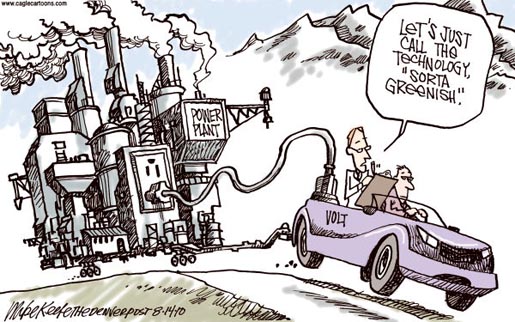
We subscribe to e-newsletter from MiBiz, which tends to provide plenty of examples of why Green Capitalism not only has limitations, it is deceptive and ultimately unsustainable. The most recent edition from MiBiz is a perfect example of the flawed thinking behind the idea that Capitalism can somehow be sustainable.
The first story worth looking at was about the public/private effort to get electric car charging stations installed throughout West Michigan. The article sites both private and public officials who make claims that providing electric car charging stations will make cities cleaner.
While there will be less air pollution from electric cars than fossil fuel based cars, there are serious limitations to promoting this kind of transportation. If you are using electricity in the Grand Rapids area you are most likely going to be using electricity that was generated from the burning of coal. Not exactly a sustainable energy source. Secondly, there is generally no discussion about the ecologically unsound practice of electric car battery production, which includes mining and all the energy needed to manufacture such items.
Lastly, there is the problem of perpetuating this individual consumer mentality, which says we can purchase our way out of the global warming dilemma. If there is a shift from fossil fuel cars to electric cars, it will mean more mining for materials to build the cars, continual need for road and parking construction and for people to have to spend roughly a quarter of their annual income on the cost of owning a car. As Bianca Mugyenyi and Yves Engler make clear in their recent book Stop Signs: Cars and Capitalism, if we are serious about ecological sustainability then we need to shift from cars to mass transit, bicycling and walking.
A second story that merits some attention was about a “Go Green” golf outing that was being hosted by the West Michigan Sustainable Business Forum (WMSBF). The golf outing is a fundraiser for education scholarships for future students who want to pursue a career in “sustainable business.” The WMSBF promotes the “goal to encourage the adoption and implementation of sustainable development business practices aimed at improving corporate profitability.” The notion that one can be sustainable and profitable is one of the most basic flaws of Green Capitalism in that it is premised on perpetual growth.

In addition to the flawed green capitalism message in this second story the fact that this group is having a fundraiser at a golf course should raise red flags for everyone. Golf courses require a tremendous amount of maintenance, which means the use of fossil fuels for mowing, often pesticides and toxic fertilizers for maintaining the grass and a tremendous amount of water is consumed in order to keep the golf course perfectly green. Plus, golf courses are one of the most inefficient uses of land, land that could be left alone for wildlife habitat or transformed into nature preserves.
The last article worth looking at was about Cascade Engineering and their “sustainable” water filter product. The article talks about the daughter of the company who was in Honduras and how she was able to provide some assistance to people who hand no access to clean water.
Cascade Engineering, which is traditionally an auto parts manufacturer, has now added water filters to their product line. The company made this decision a few years ago when they made a financial partnership with the WindQuest Group, a private investment firm of the DeVos family. Now Cascade and WindQuest can promote their humanitarian efforts around the global. However, this sustainable effort is not so simple.
Nowhere in the article are readers provided with any analysis or historical context to why so many people around the world don’t have access to safe drinking water. Humans have been contaminating water for centuries, but with the onset of industrial capitalism the amount of water contamination has skyrocketed.
Industrial capitalism has contaminated water through mining, deforestation, road building, toxic dumping, pesticide and fossil fuel fertilizer use and the creation of a consumer culture that has brought with it the increase of garbage.
Cascade Engineering has made its money from the production of car & truck parts, one of the most insidious aspects of industrial capitalism and now they want to cash in on trying to make a product that will solve the problem of water contamination…..or are they?
One basic premise of ecological sustainability is to be able to do something that will not harm the ecological integrity of any ecosystem. Providing water filters to people, who live near water systems that are contaminated, is not sustainable. Addressing the root of the problem – the source of the water contamination – would be a sustainable outcome. This might mean the elimination of toxic dumping by factories or the elimination of pesticide and fossil fuel fertilizer use from industrial agriculture. The only problem with these kinds of solutions is that there is no profit to be made. Why stop the problem when you can make a new product and more profits by providing people with what only seems like a solution?
If we are serious about the future of the planet then we cannot afford to support the claims of sustainability that Green Capitalism offers. Green Capitalism simply isn’t sustainable.
The Neighborhood Network Bash this Saturday – July 16

This Saturday, (July 16) The Network will host its Second Annual Neighborhood Network Bash in the street by their office at 343 Atlas in Eastown.
The event runs from 1pm – 10pm with information booths, a silent auction and entertainment from 2pm til 9:30pm.
Entertainment Stage
2-3pm- DJ DigiMark
3-4pm- Music Entertainment
5pm- Grand Illusions Drag Show
5-6pm- Carnivalette Dancers
6-7:30pm- Miss West Michigan Equality Pageant
7:30pm-8:30pm- Fashion Show
8:45pm-9:30pm- Girlz on Fire
We will also be there conducting more interviews for the Grand Rapids LGBTQ People’s History Project from 1 – 5pm, so if you haven’t had a chance to tell your story, here is another chance. If you want to do an interview on our studio just send us an e-mail to schedule a time – jsmith@griid.org.
(This article by Dave Zirin is re-posted from The Nation.)

Over the last year, civil rights organizations, politicians, sportswriters and baseball players have asked Major League Baseball Commissioner Bud Selig to move Tuesday’s 2011 All-Star Game out of Arizona. He chose not to listen and now I choose not to watch. If I lived within a day’s travel of Arizona, I’d be choosing to protest at the stadium gates. Ever since Arizona passed its darkly punitive racial profiling law SB 1070, thousands of people have pleaded with Selig to do the right thing and move the game. Baseball is 27.7 percent Latino.
It’s a sport dependent on Latin American talent from the baseball academies of the Dominican Republic to today’s biggest stars, Albert Pujols and Adrian Gonzalez. Even more, Major League Baseball has prided itself—and marketed itself—on historically being more than just a game. Bud Selig, in particular, is a man who publicly venerates the game’s civil rights tradition. Jackie Robinson’s number is retired and visible in every park and the great Roberto Clemente in death has become a true baseball saint. But Selig’s inaction makes his tributes to the past look as hollow as Sammy Sosa’s old bat.
Selig clearly loves the symbolism of civil rights more than the sacrifice. The presence of the game will mean a financial windfall for the state as well as for Arizona Diamondback owner Ken Kendrick. Kendrick is a first-tier right-wing money bundler who has let the state politicians behind SB 1070 use his owner’s box for fundraisers. The game will also mean a national spotlight for the vile Sheriff Joe Arpaio of Arizona’s Maricopa County, our twenty-first-century Bull Conner. Arpaio has been threatening to bring down his pink-clad chain gang to clean up outside the stadium.
Selig is not the only one backing down from the moment. The Major League Players Association issued a very strong statement last year against SB 1070 and hinted that a boycott might be in the cards, saying they would “consider additional measures to protect the interests of our members.” Earlier this week, after months of silence, Executive Director Michael Weiner, said, “SB 1070 is not in effect and key portions of the law have been judged unlawful by the federal courts. Under all the circumstances, we have not asked players to refrain from participating in any All-Star activities.” To say SB 1070 “is not in effect” is sophistry. Only a section of SB 1070 has been judged unlawful: the extension of police powers to demand papers without cause.
Other aspects are now on the books including stiffer penalties for “illegals” and giving citizens the right to sue any city that sets up safe havens for immigrants. In addition, State Governor Jan Brewer is currently appealing the pruning of SB 1070 directly to the US Supreme Court. Also, the law has spawned copycat legislation in states around the country. My own discussions with Arizona activists tells me that racial profiling has been rampant since the law passed, with Latinos, legal and illegal, in fear to call the police or the fire department, or even attend church. Even if you agree with the Michael Weiner, as he writes that immigration matters “will not be resolved at Chase Field, nor on any baseball diamond,” the MLBPA is being remarkably cavalier about its responsibility to “protect its members.”

As for the players, a massive number are bowing out of this year’s game. Is this because of SB 1070? We don’t know, but either way a weakened product will be on display Tuesday night. If the spotlight shifts to anyone on the field, it will be centered on Boston’s All-Star first baseman Adrian Gonzalez, who changed his position a year ago that he wouldn’t play if the game were in Arizona. There is a movement to have players like Gonzalez, sympathetic to the cause, to wear a ribbon or make some kind of statement. We will see if Adrian Gonzalez takes advantage of the spotlight.
But in the end, responsibility for this debacle rests with Selig. NFL owners, whom no one would confuse with the NAACP, threatened to pull the 1993 Super Bowl out of Arizona if the state continued to refuse to recognize Martin Luther King Jr.’s birthday as a national holiday. Now, twenty years later, baseball’s commissioner does nothing. Yes, Bud Selig would undoubtedly have received an avalanche of criticism it he had moved the game. That’s what it means to actually sacrifice something for the sake of the civil rights he claims to hold so dear. Instead, his legacy will bear another blot, joining the steroid boom, the cancellation of the 1994 World Series and the gouging of state economies with taxpayer-funded stadiums. Now Bud Selig can always be remembered as the Seinfeld of sports commissioners: the man who did nothing; the man who, with the game on the line, kept his bat on his shoulder and took a called third strike.

Ninety-four years ago today thousands of workers, many of them IWW members, were arrested for participating in a strike at a copper mine in Bisbee, Arizona.
The onset of World War I made demands on global powers, both militarily and economically. The war necessitated that more raw materials be used for armament production and copper was an essential mineral for that cause.
Copper production increased dramatically from the time WWI began (1914) and the year of the strike (1917). This increase in production required more copper to be mined and thousands of workers were hired in Arizona. The price of copper also increased during this same period, going from 13 cents a pound in 1914 to 37 cents in 1917. However, the profits from this increase did not translate into better wages or changes in working conditions for the miners.
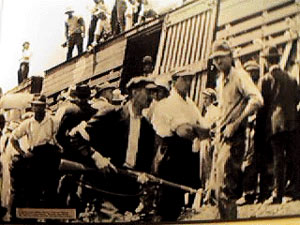
The Industrial Workers of the World (IWW) had been organizing in mines for years and were the primary union organizing in Bisbee. Many of the workers were recent immigrants from Europe and Mexico. Since the IWW did not discriminate along racial or ethnic lines they were effective in organizing many of the miners.
In June of 1917, the IWW organized workers gave the mining company a list of demands, which included:
“…….improvements to safety and working conditions, such as requiring two men on each machine and an end to blasting in the mines during shifts. Demands were also made to end discrimination against members of labor organizations and the unequal treatment of foreign and minority workers. Furthermore, the unions wanted a flat wage system to replace sliding scales tied to the market price of copper.”
The mining company refused the demands and on June 27 the workers went on strike. The company responded by bringing in vigilantes from all around the state to intimidate and arrest the workers.
Over 1,000 workers were rounded up and forced onto a train where they were herded like cattle into rail cars with floors covered in manure. The train was to take them to New Mexico, but authorities turned them away, so the train stopped in the desert and left the men there for days with little food and water. Eventually, US troops arrived and the workers were escorted to a prison where they awaited trial.
The Wilson administration finally investigated the matter and found that the forced relocation of the workers was illegal, but the federal government did nothing to hold the mining company accountable. The state of Arizona also seemed reluctant to challenge the power of the mining company and there was no favorable news coverage as the Bisbee newspaper was also owned by the mining company.

Many of the workers filed lawsuits against the mining company, but these cases moved slowly in the courts and no guilty charges were ever levied against the mining company.
Ultimately, the strike was broken, but word spread across the country of the brutal treatment of workers and the deportation to the desert. This outrage provided a perfect opportunity for the IWW to recruit new members across the country.
The mining companies today in the US are abusing workers with harsh conditions and a lack of concern for worker safety as was the case a year ago with Massey Energy’s mine disaster that resulted in 29 miners being killed. This disaster brought renewed attention to both the conditions of miners and the horrendous environmental track record of the mining industry.
On the anniversary of the Bisbee worker deportation it would do us well to reflect on the condition of working people today, where wages are at poverty level, conditions are unsafe and intimidation tactics are used by the business class. We need to develop solidarity with all workers and not tolerate the gross injustices committed by the business class in the mines, on the shop floor, in restaurants and in the classroom. Solidarity Forever!
Hearing to confront repression of human rights and civil liberties by the criminal justice system.
Saturday, July 16, 3:00-6:00pm Location: The Shrine of the Black Madonna Cultural Center and Bookstore 13535 Livernois Avenue Detroit, MI 48238

The panel presentation will focus on how the ‘War on Terror’ climate and its repressive legal practices in the criminal justice system have affected civil liberties and human rights of Arab, Muslim, African American, South Asian, and all immigrant communities and the broader social justice movement.
Representatives from the National Coalition to Protect Civil Freedoms (NCPCF), Project Salam, CAIR-MI, Michigan Emergency Committee Against War and Injustice (MECAWI), and Committee to Stop FBI Repression-MI will be having a panel discussion about their political, social and legal campaigns around these very important issues to address how we can counter and change oppressive policies.
Included in the panels are families who will share personal stories of struggles for justice. The goal of the program is to shed light on the conditions of families and communities suffering under the war on terror, establish alliances across all communities for support, and mobilize our communities to eradicate these oppressive political and legal injunctions.
PANEL I: Prosecutorial Persecution in the Criminal Justice System
Shahid Buttar, Key not speaker, Bill of Rights Defense Committee
Steve Downs, National Coalition to Protect Civil Freedoms (NCPCF)
Abayomi Azikiwe, Editor Pan-African News Wire, Michigan Emergency Committee Against War and Injustice
Dawud Walid, CAIR-MI
VIDEO PRESENTATION
Mel Undebakke, National Coalition to Protect Civil Freedoms
PANEL II: Impact of Preemptive Prosecution on Families
Hedaya Jayyousi, Dearborn, MI
Tamer Mehenna, Boston, MA
Tom Burke, Grand Rapids, MI
Co-Sponsors Include: National Coalition to Protect Civil Freedoms (NCPCF), Bill of Rights Defense Committee (BORDC), Michigan Emergency Coalition Against War and Injustice (MECAWI), Families United For Justice In America (FUJA), Council on American Islamic Relations-CAIR-MI, Justice For Shifa and Haris Support Committee, Project SALAM, Friends of Human Rights
To participate and co-sponsor the event contact civilfreedoms@gmail.com
Local Contacts: panw@africamail.com or freeshifa@gmail.com or call 517-505-1697
A member of the Grand Rapids branch of the IWW was fired on Friday when he came into the 648 Monroe Street location of Jimmy John’s.
Matthew Bair says he was fired for alleged customer complaints. When Bair asked to see any formal complaints the Jimmy John’s manager refused to show him anything. Bair stated that he had great customer service and would often get good tips from customers during his shift.
Bair and other local IWW members believe he was fired because of his involvement with the IWW, which has been engaged in an organizing campaign with wage – workers in the fast food company.
On Sunday, the IWW organized a phone zap to have as many people as possible call Jimmy John’s and put pressure on them to reinstate Matthew Bair.
Today, several IWW members, including Bair, went to the 648 Monroe Street location to hand out flyers and to put Jimmy John’s employees and customers know that this firing is unacceptable and unjust. Many customers look flyers and listened to Bair who asked them to go inside, talk to the manager and ask that he be reinstated.
At one point IWW members went in the store to hand out flyers to customers sitting down, but also to attempt to engage the workers on what had happened. Most workers would not respond, but those that did were defensive and uncomfortable with the presence of their now fired fellow worker.
We spoke with both Matthew Bair and fellow IWW member Cole Dorsey who were at the Jimmy John’s store today in an attempt to get Bair’s job back. Bair talked about what happened and Dorsey spoke about the IWW response.
It has been several days since the murder of seven Grand Rapids residents and the community has had time to mourn publicly – at a candlelight vigil, in churches over the weekend and through social media.

Every day more information is reveal about the circumstances and the history of the man who killed 7 people and then took his own life. As the news coverage unfolds it is important for all of us to think about certain dynamics that not only are relevant to this case, but are central to the issue of violence in this culture. We need to look at this issue through a gender lens and ask ourselves what significance gender played in the recent killings.
What seems obvious in many ways has not been stated yet in the news coverage we have looked at. The killer was male. This may not seem like much of a revelation, but it does tell us a great deal about violence and how gendered violence has become so normal in our culture that we don’t even think about it.
A man kills 7 people, 6 of which are females. Two of the females killed were girls and one was his wife. News coverage has revealed that Rodrick Dantzler had a history of assault, property damage and domestic violence. That Dantzler had a history of domestic violence was the focus of a July 8 story on MLive, which included comments form local domestic violence prevention specialists who noted that one in four women is affected by domestic violence. In fact, according to local data for Kent County in 2009, there were over 1,000 reported cases of domestic violence – reported. There are roughly three times as many incidents of domestic violence, but the majority is never reported.
Across the country the data is even more alarming. According to the National Network to End Domestic Violence, which publishes an annual snapshot report of an average day in the US, reports that 70,648 cases of domestic abuses happens every day. In Michigan the number is 2,737 per day. When looking at the number of female domestic partners that are murdered by men the number is 3 every day in the US.

Looking at Rodrick Dantzler’s history of domestic violence is certainly important, but the coverage to date has really avoided discussing the fact that a man killed 6 women and one man. The gender of the perpetrator seems to be irrelevant so far in the coverage, even though what is consistent with these murders and murders across the country is that men perpetrate most of them. So why is there limited news coverage about this fact and why are we not having a community conversation about why men commit so many acts of violence? Do you think that if a woman who was victimizing her male partner, who then killed him and several other men and boys, that people would not be talking about the gender of the perpetrator?
These are questions that many feminists have been asking for decades as well as pro-feminist male writers and activists like Jackson Katz. For the past ten years Katz has been making it a point to expose the flaws in our news coverage and public discourse whenever men rape or commit murder, particularly gun murder. Katz explores this issue in his documentary Tough Guise as well as his more recent book The Macho Paradox: Why Some Men Hurt Women and How All Men Can Help.
Again, the community has responded with lots of sympathy and public displays of morning. However, if we are to avoid similar incidents in the future it is critical that we honestly confront the cultural norms about masculinity and work to end male violence against women. This is a teachable moment. Let us hope the Grand Rapids community will learn a lesson.

A member of the Grand Rapids branch of the IWW was fired yesterday after working at a local Jimmy John’s.
Matt Bair was fired for “alleged customer complaints” on July 8. Bair told us that he was never told of any “complaints and always received praise and good tips from costumers.” Bair believes he was fired because of his membership in the IWW.
The IWW has been targeting Jimmy John’s for over a year in an organizing campaign that started in Minneapolis and led to solidarity pickets throughout the country, including one in Grand Rapids last September.
The Grand Rapids branch of the IWW is calling on people to take action with a phone zap. People are urged to call Jimmy John’s owner Tom KirkPatrick and demand, “That fellow worker Matthew Bair be reinstated and to continue work at Jimmy Johns. That they stop their campaign against Jimmy Johns workers organizing for a better future.”

Call (616) 617 3773 all day Sunday!
The IWW also included this statement as a suggestion for what to say to Jimmy John’s owner Tom KirkPatrick:
Hello Mr. KirkPatrick, I am calling to insist that fellow worker Matthew Bair be reinstated at Jimmy Johns. It is illegal to terminate someone for their organizing activity. Please join the consensus of working people around the nation and stop the union busting efforts against your workers.
For more information on the Grand Rapids branch of the IWW go to this link.
 Grand Rapids Institute for Information Democracy