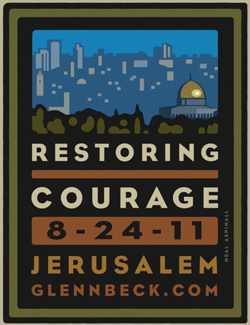
Last night in downtown Grand Rapids several hundred people gathered for a rally in support of Israel. The Stand With Israel rally was one of many happening across the US, rallies that were coordinated with Glen Beck’s visit to Israel.
Last Saturday, the Grand Rapids Press announced this rally and cited one of the organizers as saying, “Israel tends to garner much negative press in the U.S.” Neither the organizer or the Press reporter verify such a claim. This is not the conclusion that Richard Falk and Howard Friel come to in their book Israel-Palestine on Record: How the New York Times Misreports Conflict in the Middle East. In fact, Israel tends to receive favorable coverage in the US media, which is the conclusion we made in a GRIID report entitled Roadmap to Nowhere.
The rally took place in Rosa Parks Circle and included music and singing of both US patriotic music and the Israeli national anthem. The MC for the event was retired military officer and radio show host Denny Gillem. Gillem was himself a US military analyst on the Middle East and has harassed anti-war protestors in Grand Rapids during Iraq war protests in recent years.

In addition to introducing speakers, Gillem made his own observations about the US and Israel. Gillem said that only England and Israel have been “dependable allies of the US since WWII.” Gillem also said at one point that “this rally was like a Tea Party event, because it focused on an issue not on partisan politics.”
Such a statement flies in the face of what we know about the Tea Party’s endorsement of purely Republican candidates and it ignores the fact that virtually every member of the US Congress votes in favor of continued US military, economic and diplomatic support. In fact, Gillem himself said there was a petition that people could sign at this event, which would deny the Palestinians desire to be recognized as a state at next month’s United Nations meeting in New York.
The first speaker of the evening was former Congressman Pete Hoekstra. Hoekstra was an ardent supporter of Israel during his time in Congress and he made that clear in his comments, which we filmed.
After Hoekstra spoke, Gillem invited to the stand State Representative Dave Agema. Agema spoke about being a military veteran and how in 1973, while in the Air Force, his squadron was asked to loan their fighter planes to the Israelis in their war against Egypt and the Palestinians. Agema also mentioned that he has introduced legislation in Michigan (House Bill 4769), which he said was to deny foreign laws to be introduced into US law. Critics of this legislation are saying that it is really a veiled attempt to marginalize and attack Muslims in the US.
Following Agema was Rabbi Schadick, a local Rabbi who is a member of the Grand Rapids chapter of the Zionist group the Jewish Federation. Schadick spoke in mostly theological terms, but at one point he said, “the US and Israel has each others’ back.” He acknowledged the fact that the US and Israel share weaponry, intelligence and training of troops. Schadick also quoted President Obama who said, “Israel is the best friend the US has in the world.”
Before the featured speaker stepped up to the stage, a local African American minister addressed the crowd. Pastor Thomas Wilson of the Word of Faith Christian Center said he supports Israel because it was the only nation founded “as a sovereign act of God.” It should be noted that Wilson’s church hosted another Stand with Israel event last year at his church where Israeli soldiers spoke.
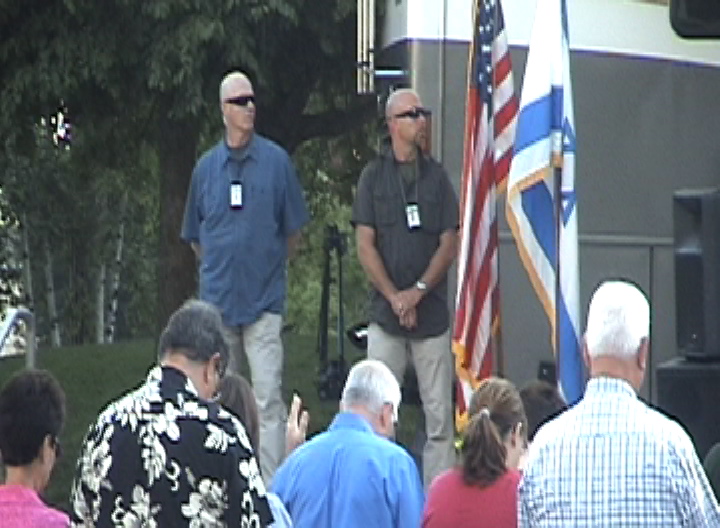
The featured speaker for this event was Elliot Chodoff, a former member of the Israeli Defense Forces and now a military analyst. As a was making my way to this event I saw Chodoff being escorted by 2 body guards, which stood at the stage the who night.
Chodoff, like the rest of the speakers, did not source his claims about Israel or Palestinians. He said that 9/11 has its origins in the ideology of groups like Hamas. In fact, Chodoff spent most of the time talking about Islamic groups like the Muslim Brotherhood, Hamas, al Qaeda and Hezbollah. In many ways what Chodoff had to say was very similar to the argument made in the documentary Obsession: Radical Islam’s War Against the West.
Chodoff went on to say that some of the “terrorist tactics being used in Afghanistan today were developed by Hamas.” In fact, Chodoff’s assessment of the countries that border Israeli were such that it was like “being in a room filled with gunpowder and the only light was from candles placed throughout the room. You never knew when there was going to be an explosion.”
Chodoff also continued many Israeli talking points, such as they only respond to attacks and that “since 2001 there have been 10,000 rockets fired at Israel from Gaza.” If this was indeed the case, why does the Israeli human rights group B’Tselem document that there have been a grossly disproportionate amount of Palestinians killed since 2000 compared to Israelis killed.

By the end of the rally it was clear that this event was nothing short of a propaganda event, filled with lies and half-truths. There were numerous information tables set up around Rosa Parks Circle with information such as a booklet entitled Israel 101, published by Stand With US. Another table, featured information by the group Christians United for Israel, the Christian Zionist group founded by Pastor John Hagee. Hagee is such an ardent supporter of Israel that he was quoted as saying in 2006 that Israel should have dropped a nuclear bomb on Lebanon after the 33-day Israeli assault on that country. Hagee and Chodoff were two of the many speakers that headlined the Christians United for Israel summit last month in DC.
There were some people who were opposed to the Israeli occupation of Palestinian land who came with posters and handouts, but their views were not heard from the stage. The only commercial media we saw at the event was the Grand Rapids Press, which ran a short article about the rally.
This Day in Resistance History: Remembering the Dublin Lock-Out
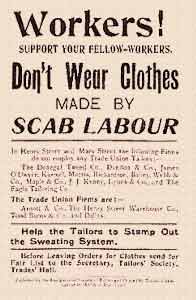
On August 26, 1913, the Dublin Lock-Out began. This was one of the longest and most difficult strikes in modern history, and its story is one of struggle, solidarity, betrayal, and bloodshed.
The Dublin Horse Show, held in August by the Royal Dublin Society, was one of the elite’s favorite yearly events. The workers of Dublin’s extensive tram service went on strike just as the show was starting, in order to get the attention of wealthy capitalists and cause the greatest disruption to the elite class.
The union workers were protesting horrific working conditions set by William Martin Murphy. He was the owner of the tram corporation as well as Dublin’s largest department store, Ireland’s major newspapers, and the Imperial Hotel. He was also the major stockholder in Ireland’s railway system. His tram employees worked on schedules of 11 to 17 hours a day. Murphy paid workers to be informers on their peers and harsh discipline was handed out to anyone who violated even the most minor rule. The week before the lock-out, Murphy had met with 300 tram employees and got them to agree not to join or aid any union members. He then fired 340 workers he suspected of belonging to the newly founded union.
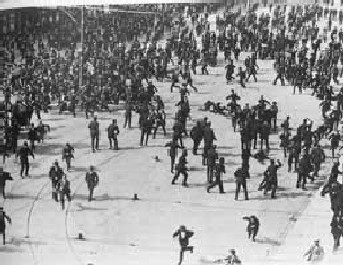
On August 26, trams were stopped along their lines and abandoned by their drivers. Murphy snapped into action. He rallied 400 of Dublin’s employers to threaten their own workers against unionizing and to force them to sign anti-union and anti-strike pledges. To make sure that their shops remained non-union, Murphy struck a deal with the business owners. They each deposited a large sum into an account called “The Employers’ Federation.” Murphy then went to the bank and arranged that if a shop was unionized, the employer would lose his deposit.
Murphy also controlled the media, and the message, about the strike. He published a series of articles stating the resistance was about to collapse. He depicted the unionized workers as debauched and slovenly, claiming that even if their wages were raised, they would just drink it all away. Employers who were keeping wages low were therefore protecting public safety and helping to keep the “lower classes” sober.
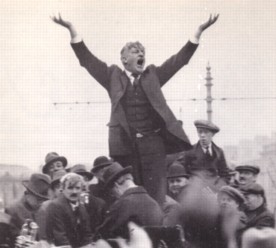
These preliminary tactics failed, and thousands of workers joined the tram workers in their strike. They were locked out of their jobs as a result. Within a month, 27,000 workers in Dublin were on strike. By mid-October, 32 unions representing more than 30,000 workers had shut down nearly all of Dublin’s businesses.
On August 31, Jim Larkin, leader of the tram workers’ union, was let out of jail on bail. A rally was planned, and hundreds of police officers stood nearby, looking to re-arrest Murphy. They were unprepared when he turned up to speak—from the balcony of Murphy’s own Imperial Hotel, having slipped past guards in disguise. He was arrested before he start his speech, and the police attacked the crowd. Hundreds ended up in city hospitals with injuries. Two workers were killed in the streets, and a third was tortured to death in a jail cell. A fourth worker was shot as she returned home from the rally.
But perhaps the cruelest intervention by William Murphy against the strikers came that fall, and it involved the most powerful of his allies: the Roman Catholic Church. Union workers in Ireland had corresponded with British trade union groups, who agreed to shelter the Irish workers’ children until the end of the strike. Without wages, many families were starving, and the union had run out of money for its food kitchens.
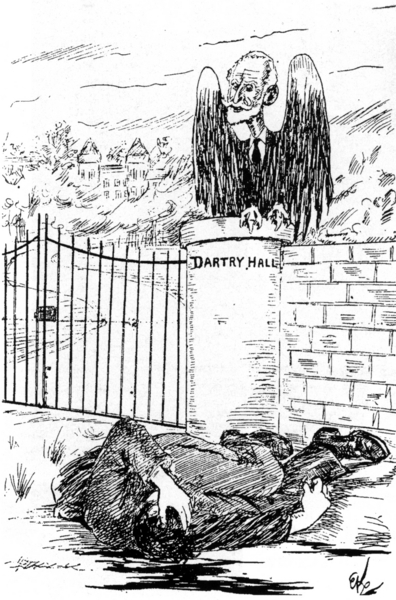
Dublin’s Archbishop Walsh wrote a letter that Murphy published in all of his newspapers. The letter claimed that that the entire plan was a scheme to turn the children into Protestants. It said, in part, “… they can no longer be worthy of the name of Catholic mothers if they so far forget that duty as to send away their little children to be cared for in a strange land, without security of any kind that those to whom the children are to be handed over are Catholics or…persons of any faith at all.”
Walsh also argued that once the children had lived in comfortable homes with three meals a day, they would be unfit to return to their lives in Dublin and its much lower standard of living (due, of course, to the “debauched natures” of the Irish working class).
Some mothers were convinced by the letter or by their own priests not to send their children away. Others faced harsher manipulation. As children were taken to the waiting boats, Irish priests organized groups of weapon-carrying men to block them from boarding. Some children did manage to escape to England, but many were left in Dublin where their parents had no money to care for them. Murphy’s newspapers portrayed Jim Larkin as the villain in this action, a man who had to be stopped as he attempted to steal Ireland’s youth and future.
British trade unions responded by sending ships of food supplies to the Dublin workers. This made it possible for the strike to continue, and for families to at least provide a subsistence level of food for their children. By January, two meetings had been held with the Employers’ Federation without any positive outcome. Many workers could hold out no longer and began accepting individual offers to return to their jobs.
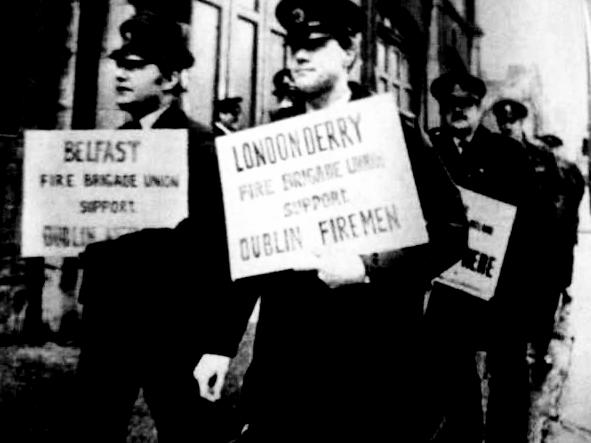
A core group of 5,000 union members tried to keep the strike alive, even after it had been officially broken. They launched court challenges, and in October 1915 they won a case against the Dublin Steam Packet Company. But most workers were forced at some point to return to non-union shops to find jobs.
William Butler Yeats wrote a scathing poem, “September 1913,” which attacks the Employers Federation, the colluding banks and press, and the Catholic Church in the parts they played in thwarting the unions of Dublin. He pictures the capitalists as they “fumble with their greasy till” adding “halfpence to the pence,” while depriving the working class of a decent living. Of the strikers and other Irish revolutionaries, he wrote:
Yet they were of a different kind,
The names that stilled your childish play,
They have gone about the world like wind,
But little time had they to pray
For whom the hangman’s rope was spun And what, God help us, could they save?
Yeats’ poem reflects the demoralized feeling of many after the collapse of the strike. The rebuilding of the broken union system was slow, and it was not until 1919 membership in unions in Dublin finally reached levels matching those of 1913, when the lock-out began.
But for seven months, Dublin’s working class had put everything on the line in an attempt to face down the wealthy who controlled their lives and their right to reasonable working conditions. And Irish employers, many of whom had lost money and even gone bankrupt during the lengthy strike, never again tried to break a union the way that William Martin Murphy had in 1913. Today, 37 percent of Ireland’s full-time workers belong to a union.
Trading Jobs for Torture in Saudi Arabia

In the August 25 e-blast from MiBiz, under the “News You Can Use” section, there was a story about a new General Dynamics contract to rehab military tanks for the Kingdom of Saudi Arabia.
Actually, it wasn’t much of a story, it was really just a link to a General Dynamics Media Release, which states in part that the $42.4 million contact will upgrade the entire Saudi fleet of 314 tanks.
It is interesting that MiBiz puts this under their News You Can Use section of their weekly e-mail news bulletin, but not surprising since they are only interested in promoting news that promotes the economic bottom line.
However, a more honest look at what this $42.4 million dollar contract for a Michigan-based company really means would require the business press to ask questions about the value of the jobs and economic investment trade off will mean in Saudi Arabia.

While Saudi Arabia has been a US ally since WWII, the country has no relationship to democracy or freedom. Beyond the absence of an electoral system the country is run by the Saudi Royal Family, which has a long tack record of human rights violations.
According to the 2011 Amnesty International report on human rights in Saudi Arabia, the country engages in systemic violations, including illegal detentions, lack of rights for women, labor abuses and torture. Even a recent US State Department report acknowledges that Saudi Arabia has an atrocious human rights record, that includes:
“torture and physical abuse; poor prison and detention center conditions; arbitrary arrest and incommunicado detention; denial of fair and public trials and lack of due process in the judicial system; political prisoners; restrictions on civil liberties such as freedoms of speech (including the Internet), assembly, association, movement, and severe restrictions on religious freedom; and corruption and lack of government transparency. Violence against women and a lack of equal rights for women, violations of the rights of children, trafficking in persons, and discrimination on the basis of gender, religion, sect, and ethnicity were common. The lack of workers’ rights, including the employment sponsorship system, remained a severe problem.”
Human Rights Watch (HRW) has also pointed out that the Saudi government has recently crafted new anti-terorism legislation that will further violate basic human rights and legalize various forms of abuse and torture. The HRW analysis of the new anti-terrorism laws suggests that these will be adopted to prevent an “Arab Spring” from happening in that country.
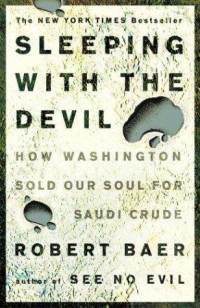
The lack of human rights begs the question why the US would continue to sell them military equipment. The answer is that the US is more interested in the geo-political role that Saudi Arabia plays, a role that supports long-term US plans for the region. This is the conclusion that former CIA operative Robert Baer provides in his book “Sleeping with the Devil: How Washington Sold Our Soul for Saudi Crude.” (This book is what the 2005 film Syriana is based on.)
The regional role that Saudi Arabia plays in support of US policy was seen in 2009 when the Saudi military attacked armed insurgents in Yemen, an action that fits in with the larger US War on Terror.
So it seems that in exchange for some jobs and increased profits for General Dynamics the world gets more violence and human rights violations. General Dynamics doesn’t seem bothered by the consequences of their desire for greater profits, since they subvert the democratic process in the US by buying political power in Washington to the tune of $11,534,452 (over the last 20 years).
The One Billion Dollar Question: Who Are the Libyan Rebels?
(This video is re-posted from Democracy Now.)

Libyan rebels have consolidated their grip on the capital of Tripoli by capturing Col. Muammar Gaddafi’s main compound, but the whereabouts of the Libyan leader remain unknown, and he has vowed his forces would resist “the aggression with all strength” until either victory or death. Reporters in Tripoli say heavy gunfire could still be heard nearby the area of the Rixos Hotel, where dozens of international journalists guarded by heavily armed Gaddafi loyalists are unable to leave.
The Arab League said on Tuesday it will meet this week to consider giving Libyan rebels the country’s seat at the League, after it was taken away a few months ago from the Gaddafi government. Today Britain’s National Security Council is meeting to discuss unfreezing Libyan assets to financially assist the National Transitional Council. We speak with Gilbert Achcar, a professor at the School of Oriental and African Studies in London. “Who are the rebels? Well, this is actually the $1 billion question,” says Achcar. “Even in NATO circles, you find the same questions.”
New Media We Recommend
Below is a list of new materials that we have read/watched in recent weeks. The comments are not a “review” of the material, instead sort of an endorsement of ideas and investigations that can provide solid analysis and even inspiration in the struggle for change. All these items are available at The Bloom Collective, so check them out and stimulate your mind.

What Every Environmentalist Needs to Know About Capitalism, by Fred Magdoff & John Bellamy Foster – With issues like global warming, species extinction and global deforestation, environmentalists have a great deal to fight against. However, unless we are willing to confront the fact that there can be no real sustainable solution under the current economic system of capitalism there will be no viable future. This is the basic argument that the co-authors of this book make, that at the root of our current environmental crisis is capitalism. Magdoff and Foster make a strong case in not only pointing out the current state of the environment, they make clear that global capitalism is not only the root of the major environmental problems we face today, it is incompatible with sustainability. Highly recommended for anyone who really wants to promote and practice environmental justice.

An Unfinished Revolution: Karl Marx and Abraham Lincoln, by Robin Blackburn – Did you know that Karl Marx was assigned by the Tribune to write about the US Civil War and slavery? Marx wrote quite a bit as a journalist and for the International Workingmen’s Association and he even sent a letter to Lincoln while he was President. Historian Robin Blackburn juxtaposes the writings of Marx with the evolution of Lincoln’s position on slavery and industrial capitalism in this intriguing book. Blackburn also looks at the US period of reconstruction and how both abolitionists and labor groups responded to the adjustments that capitalism made with the abolition of chattel slavery. In addition to the analysis the author provides the book also includes the writings of Marx and the proclamations and letter of Lincoln in the appendix, which makes for very interesting historical reading.

Goldstone Recants, by Norman Finkelstein – South African jurist Richard Goldstone was appointed by the UN along with other jurists to investigate the Israeli assault on Gaza in 2009. Goldstone and his colleagues published a fairly scathing report that indicted Israel with war crimes for its deliberate attack against a predominantly civilian population in Gaza. Then in April of this year, Goldstone recanted his position and said there was new evidence that caused him to change his mind. Israel/Palestine scholar Norman Finkelstein provides an important analysis of why Goldstone recanted in this 40-page booklet. Finkelstein asserts that Goldstone was pressured into making this reverse decision by both the Israeli power elite and Israeli apologists who reside in the US. Goldstone Recants is a timely and important response to Israeli propaganda, especially since their illegal occupation of Palestine continues with frequent military incursions.
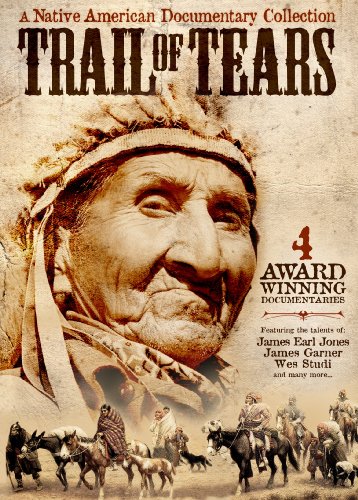
Trail of Tears (DVD) – Produced by a Native American film company and using archival material, this documentary is an interesting investigation into the US government’s forced removal of the Cherokee Nation. What is now famously called the Trail of Tears is not only explored in this film it is put in proper context of what the larger US response to the “Indian problem” was throughout much of the 19th Century. The film uses recreated scenes, narration and commentary in the Cherokee language in order to better tell the story of one of the most brutal and inhumane actions against Native Americans. An excellent resource for educators and anyone interested in US history through the eyes of the indigenous inhabitants.
Qaddafi Has Lost, But Who Has Won?
(This article by Patrick Cockburn is re-posted from Counter Punch.)
 The civil war in Libya went on longer than expected, but the fall of Tripoli came faster than was forecast. As in Kabul in 2001 and Baghdad in 2003, there was no last-ditch stand by the defeated regime, whose supporters appear to have melted away once they saw that defeat was inevitable.
While it is clear Colonel Muammar Gaddafi has lost power, it is not certain who has gained it. The anti-regime militiamen that are now streaming into the capital were united by a common enemy, but not much else. The Transitional National Council (TNC) in Benghazi, already recognized by so many foreign states as the legitimate government of Libya, is of dubious legitimacy and authority.
There is another problem in ending the war. It has never been a straight trial of strength between two groups of Libyans because of the decisive role of NATO air strikes. The insurgents themselves admit that without the air war waged on their behalf – with 7,459 air strikes on pro-Gaddafi targets – they would be dead or in flight. The question, therefore, remains open as to how the rebels can peaceably convert their foreign-assisted victory on the battlefield into a stable peace acceptable to all parties in Libya.
Precedents in Afghanistan and Iraq are not encouraging and serve as a warning. The anti-Taliban forces in Afghanistan won military success thanks, as in Libya, to foreign air support. They then used this temporary predominance arrogantly and disastrously to establish a regime weighted against the Pashtun community.
In Iraq, the Americans – over-confident after the easy defeat of Saddam Hussein – dissolved the Iraqi army and excluded former members of the Baath party from jobs and power, giving them little choice but to fight. Most Iraqis were glad to see the end of Saddam Hussein, but the struggle to replace him almost destroyed the country.
Will the same thing happen in Libya? In Tripoli, as in most oil states, the government provides most jobs and many Libyans did well under the old regime. How will they now pay for being on the losing side? The air was thick yesterday with calls from the TNC for their fighters to avoid acts of retaliation. But it was only last month that the TNC’s commander-in-chief was murdered in some obscure and unexplained act of revenge. The rebel cabinet was dissolved, and has not been reconstituted, because of its failure to investigate the killing. The TNC has produced guidelines for ruling the country post-Gaddafi, which is intended to ensure that law and order should be maintained, people fed and public services continued.

It is far too early to know if this is a piece of foreign-inspired wishful thinking or will have some beneficial effect on developments. The Libyan government was a ramshackle organization at the best of times, so any faltering in its effectiveness may not be too noticeable at first. But many of those celebrating in the streets of Tripoli and cheering the advancing rebel columns will expect their lives to get better, and will be disappointed if this does not happen.
Foreign powers will probably push for steps towards forming a constituent assembly of some sort to give the new government legitimacy. It will need to create institutions, which Colonel Gaddafi largely abolished and replaced with supposedly democratic committees that, in effect, policed his quirky one-man rule. This will not be easily done. Long-term opponents of the regime will find it difficult to share the spoils of victory with those who turned their coats at the last minute.
Some groups have been empowered by the war itself, such as the long-marginalized Berbers from the mountains south-west of Tripoli, who put together the most combat-effective militia. They will want their contribution to be recognized in any new distribution of power.
Libya does have several advantages over Afghanistan and Iraq. It is not a country with a large and desperate part of the population destitute and living on the margins of malnutrition. It does not have the same blood-soaked recent history as Afghanistan and Iraq. For all the demonization of Colonel Gaddafi over the last six months, his one-man rule never came near rivaling that of Saddam Hussein for savagery.
In Afghanistan and Iraq, the outside powers reacted to military success by overplaying their hands. They treated their opponents vindictively and assumed they had been defeated never to rise again. They convinced themselves that their local allies were more representative and effective than they really were. It is in the heady moment of victory that the ingredients are created which produce future disasters.
Amash targeted by environmental group
Yesterday MLive reported on a campaign by the Environmental Defense Action Fund (EDAF) to target Republican lawmakers who voted against new clean air rules.

The campaign is targeting several GOP Congressmen in Michigan, including 3rd Congressional Representative Justin Amash. The campaign is targeting these lawmakers with both billboard and radio ads.
The MLive article cites part of the radio ad narrative and a Media Release from EDAF, which states that the group is spending $300,000 on this campaign to target 8 Republican Congressmen from six different states.
The article states, “EDAF spokesman Keith Gaby said Amash and the other targeted congressmen were chosen because of previous votes and statements that indicate they may attempt to block the new clean air regulations.” However, the article does not source any of the statements or which votes that Rep. Amash made that they consider detrimental to clean air rules.
The EDAF webpage sites a Congressional vote in March that would have potentially cut EPA funding by $3 billion. The final vote in the House was actually on April 7 and the bill was HR 910. The actual legislation is problematic in that it guts some of the regulation on what are considered Greenhouse gases. Amash voted for the bill, which was introduced by Michigan Rep. Fred Upton. Anyone can follow the voting records of members of Congress at the site Vote Smart, including Rep. Amash’s voting record in his first year in DC.
What is disturbing about the MLive story is that it does not investigate any of the claims made by the EDAF ad campaign, nor does the reporter provide information about the actual voting record of Rep. Amash.
The MLive story also does not ask why the Environmental Defense Action Fund campaign only targets Republicans when 19 Democrats also voted for the HR 910. It is not enough to report that there is a campaign targeting Rep. Amash, the public deserves more information on the vote and what the EDAF has with political parties. According to the Center for Responsive Politics, the EDAF gave more to Republicans during the 2010 election cycle. This kind of information is what the public needs in order to make an informed decision about the political process, something that MLive rarely does.

On Saturday, August 27, a rally to repeal Governor Snyder’s Public Act 4 will be held, with a canvass effort to follow. Public Act 4 is the augmented Emergency Financial Manager law for Michigan.
Plan on attending the rally, which starts at 10AM at 918 Benjamin Street NE. You can sign a petition there. Afterward, volunteers will head out to canvass for more signatures until 3PM. Michigan Forward is holding this event in partnership with the Amalgamated Transit Union of Michigan. Contact Claudia Hudson at chudson@atu.org for more information.
Participation and your signature are both vital, because few petition events have been held in Grand Rapids, and the EFM battle is heating up.
In EFM-run cities and school systems, the privatization of services is becoming a clear pattern. This dangerous trend takes long-term control out of the citizens’ hands completely and will be hard to reverse.
Detroit Public School employees were recently forced to take extra pay cuts and accept 20 percent of the cost of their health insurance in order to begin work in the new school year. A large number of DPS employees now make approximately $20,000 for a full-time salary, placing them below the poverty line.
Meanwhile, EFM salaries under Snyder go up to about $425,000 per year.

Even more troubling is Snyder’s demand to fast-track a court challenge to Public Act 4’s constitutionality. A citizen group represented by the Sugar Law Center of Detroit filed a lawsuit in June. Last week, Snyder asked that the lower courts be bypassed and that the suit be heard in Michigan’s State Supreme Court—one of the most conservative legal bodies in the United States.
Snyder doesn’t admit he wants the case in the hands of hyper-conservative judges; his issue is “that this lawsuit may take years to reach finality” without the shortcut. What this represents is one more example of Snyder’s total disregard for the democratic process.
It’s unclear whether the man himself can be recalled, but the EFM law is on its way to the ballot. But it needs Grand Rapids to push the signature drive over the top.
Song for Bradley Manning
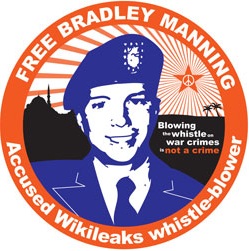
(This video was re-posted from ZNet.)
Song for Bradley Manning was written and performed by David Rovics. Bradley E. Manning is a United States Army soldier who was arrested in May 2010 in Iraq on suspicion of having passed restricted material to the website WikiLeaks.
For information on the campaign to free Bradley Manning check out http://www.bradleymanning.org/
Is Stabenow really defending farmers?

Yesterday, MLive reported that Secretary of Agriculture Tom Vilsak and Michigan Senator Debbie Stabenow were touring Michigan as part of an effort to reassure farmers that they would not allow “rookie members of Congress” to make significant cuts to farm subsidies.
Stabenow made it a partisan issue by saying that the GOP wants to cut $48 billion from farm programs, but that she will fight to make sure there is funding for bad-weather related crop damage.
Ag Secretary Vilsak said that farmers need migrant workers and that the current immigration system is broken. Unfortunately, Vilsak nor the Press reporter bothered to follow up with this statement on how the former Governor of Iowa would “fix” the current immigration policy.
The rest of the article included comments from two of the farmers in attendance. One was a Suttons Bay grape grower who is also Chairman of the Michigan Agriculture Commission, Donald Coe. The only other voice was an apple farmer from Oceana County, both of which spoke in favor of maintaining subsidies in the upcoming 2012 Farm Bill.
There are farmers and then there are corporate welfare recipients
As we reported in early June, Senator Stabenow held a hearing on the 2012 Farm Bill in Lansing, that was essentially a forum for agri-business representatives to beg for a continuance of millions in subsidies for Michigan.
According to the Environmental Working Group, $4.35 billion in taxpayer subsidies have gone to Michigan farmers in the past 15 years. What is meant by “farmers” has primarily been large agri-business operations that grow mono-crops like soy & corn and big livestock operations. In other words the small farmers who are growing food for local consumption are generally not the recipients of the Farm Bill Subsidies.

The 2012 Farm Bill is being lobbied heavily by agri-business, but what should be happening is a national dialogue on the kind of food system we want. This is exactly what the group Food and Water Watch has been doing, a cross-country tour where they talk with local communities and farmers about what a real food system would look like. Here are the major talking points they have come up with so far:
-Level the playing field for farmers
-Make markets fair for farmers and consumers
-Ensure food security by restoring the grain reserve
-Make healthy food accessible for all people
-Rebuild local infrastructure for regional food systems
-Make smart government food purchases
-Support new sustainable farming programs
-Promote environmental stewardship
-Require full safety reviews and labeling of GE foods
-Stop subsidizing factory farms and dangerous technologies
This is the kind of information the public needs, not surface coverage of politicians telling agribusiness people what they want to hear.
 Grand Rapids Institute for Information Democracy