VIDEO: The High Price of Materialism
This video is re-posted from the Center for the New American Dream.
In this short animation, psychologist Tim Kasser discusses how America’s culture of consumerism undermines our well-being. When people buy into the ever-present marketing messages that “the good life” is “the goods life,” they not only use up Earth’s limited resources, but they are less happy and less inclined toward helping others.
The animation both lays out the problems of excess materialism and points toward solutions that promise a healthier, more just, and more sustainable life.
We Can Stop the Kent County Sheriff Department’s “Bag a Fag” policy action planned for Tuesday, December 13

It has been known for the past year that the Kent County Sheriff’s Department has been targeting gay men at public parks in the area and arresting them. The ACLU became involved earlier this year requesting documents from the Sheriff’s Dept. The ACLU has discovered that no formal complaints have been filed against men wanting to meet other men. The Sheriff’s Department had agreed months ago to meet with the ACLU to discuss this matter. However, to date, the Sheriff’s Dept has failed to make themselves available for that meeting.
Therefore, we are asking as many people as possible to join us Tuesday, December 13 at 9:30 am at the Kent County Commission meeting to voice our opposition to this policy of harassing and arresting gay men.
Here is a link to a document that the ACLU sent to the Sheriff’s department, which lays out why their policy of targeting gay men is unjust and a violation of people’s rights.
In addition, there is an excellent report written by Rudy Sera on the history of “Bag a Fag” operations in Michigan, which you can find on the LGBT People’s History Project site.
The Kent County Commission meets in the County building, room 310. Everyone has an opportunity to speak about this issue during public comment, which is at the beginning of the meeting. Please help us spread the word and join us if you can to speak out about this injustice in our community.
We Can Stop the Kent County Sheriff Department’s “Bag a Fag” policy action
Tuesday, December 13
9:30 AM
Kent County Building
Room 310
Downtown Grand Rapids
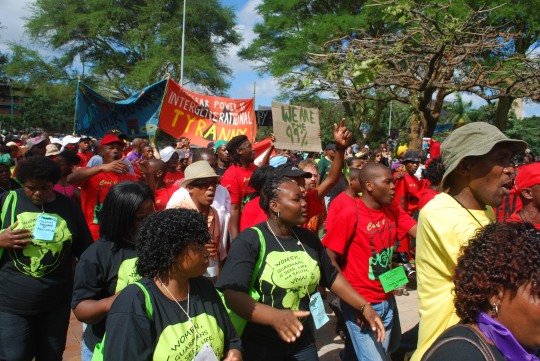
The two-week UN Climate Conference taking place in Durban is at mid-point and its prospect for success is not looking bright.
The political leaders have started to arrive to confront a range of problematic issues. It is likely that compromises will be worked out and a few successes will be claimed. The reality is that they won’t be enough to tackle the worsening climate situation on the ground.
On the ground over the weekend there were numerous protests held, including one outside the US Embassy in South Africa. At that protest, people confronted the US on its role as the primary polluter and policy maker that is the major obstacle to climate justice.
“We won’t let the U.S. off the hook,” says Ahmina Maxey of the East Michigan Environmental Action Coalition, a lead organization of GGJ. “As members of communities disproportionately affected by U.S. pollution and land grabs, we will be holding dirty U.S. corporations and the State Department accountable for the global mess they have made.”

The major protest involved a march of roughly 12,000 people, a march led by the Rural Women’s Assembly. The Rural Women’s Assembly released a statement about rural women in Africa and climate justice that people in the US need to read. The statement says in part, “Women produce 80 per cent of the food consumed by households in Africa. Seventy per cent of Africa’s 600 million people are rural. Financial support for women farmers must be commensurate to their numbers and crucial role.”
On Sunday, there was an educational forum hosted by TimberWatch. The forum was entitled Fake Forest Day and featured numerous sessions that critiqued both plantation style tree-planting programs and the idea of a green economy, which is the ideological justification for tree plantations and agro-fuels.
Lastly, here is a follow-up interview with the former Bolivian Ambassador to the Un, Pablo Solon with his assessment of the Climate Summit so far.
Drag Show this Saturday is a fundraiser for the LGBT group Tolerance, Equality & Awareness Movement (TEAM)
This Saturday, there is a fundraising event for the Tolerance, Equality & Awareness Movement (TEAM) at the Pyramid Scheme in downtown Grand Rapids.
T.E.A.M. is a human rights organization that seeks to eradicate discrimination against those of different races or sexual orientations. T.E.A.M.’s mission is that a 21st century human rights agenda begins with the creation of environments of diversity, inclusion, and acceptance.
When asked about what the funds will be used for, TEAM founder Chris Surfus responded, “some of the funds will be used for our Diversity and Inclusion program.” Other funds, according to Surfus will be to make TEAM merchandise as a mechanism to generate an ongoing source of funding.
Saturday’s event will feature several bands along with numerous performers, including Britney Storm, Dalylah Desmond, Ariez Iman, and Kaurora Fox who will be performing a drag show for the event.
Saturday, December 9
8:00 PM – 1:30 AM
Pyramid Scheme
68 Commerce SW, Grand Rapids
$5 suggested donation
Grand Rapids LGBTQ History Project: Video of the 1988 Pride Celebration in Grand Rapids
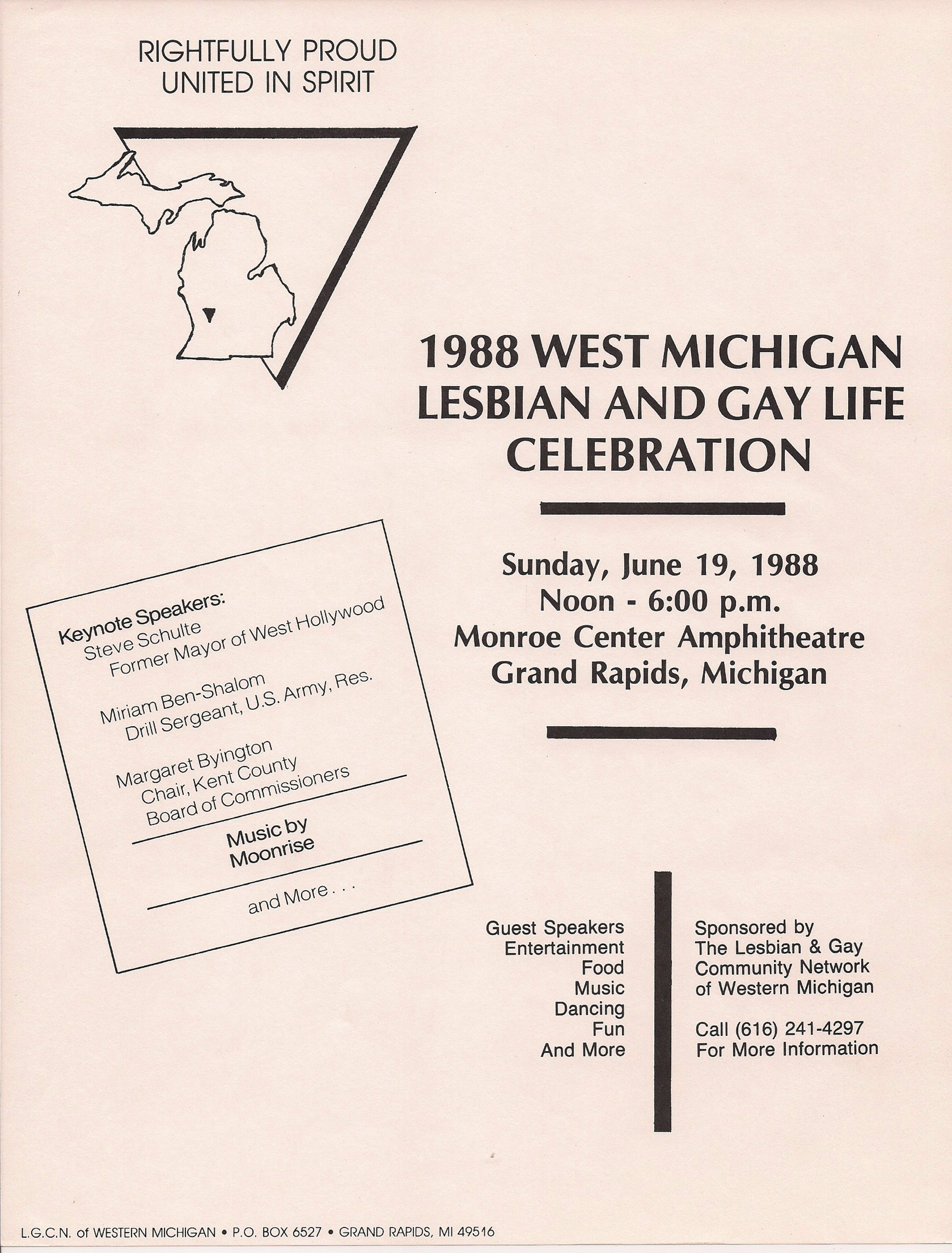
The Lesbian and Gay Community Network of Western Michigan, along with Dignity and Aradia organized the first ever Pride Celebration in Grand Rapids in June of 1988.
The event featured speakers, poetry, music and numerous Lesbian and Gay organizations, which were tabling at the event. The Pride Celebration was held at the old Monroe Amphitheater in downtown Grand Rapids.
In this video you will hear Bryan Ribbons read a proclamation, since the Mayor at that time, Gerry Helmholt, refused to recognize and support the first ever Pride Celebration.
The video also documents that there were a small group of religious extremists, which came to the event to harass and intimidate those who came to celebrate with pride.
This video is archived on the Grand Rapids LGBTQ People’s History Project site and is 90 minutes in length.
What’s Next for the Occupy Movement?
This commentary by Brian Tokar will appear in the winter issue of Broadcast, the newsletter of SEEDS, the Social Ecology Education and Demonstration School, based in Seattle and Vashon, Washington.
Since mid-September, actions inspired by the Occupy Wall Street encampment in New York have awakened the imaginations of people worldwide. Just as the movement approached its two-month anniversary in mid-November, several of the founding Occupations across the US fell victim to apparently highly-coordinated police raids. While the coming of winter was long-predicted to shift the focus of the Occupy movement, the expulsion of iconic tent encampments in New York, Oakland, and other cities has invigorated and intensified discussions about the movement’s next steps and its longer-term strategies.
Inspired in part by the Arab Spring events in Tahrir Square and beyond, the Occupy movement initially focused on the physical occupation of public space. But it’s always been about much more than that. The transcendent quality of the physical occupations was elaborated in a recent commentary by the Cincinnati-based author/activist Dan LaBotz, originally written for the journal New Politics. He described in rich detail how this fall’s Occupations resonate with the long history of popular revolts and occupations of public squares that, since ancient times, were often rooted in the utopian dimensions of the city itself. His outlook strongly resonates with social ecologist Murray Bookchin’s efforts, beginning in the mid-1960s, to reclaim the city’s historic legacy of freedom for today’s revolutionaries.
“We are witnessing something that goes beyond the symbolic,” LaBotz wrote, “something that both threatens the deep foundations of our social structure and, equally important – no, more important – something that touches our deepest spiritual yearnings. The occupation is utopian in the best sense. Whatever its political program, its practice says: ‘We will no longer live in hatred and competition. We will live in love and community.’”
Even the Occupy movement’s oft-criticized resistance to focusing on achievable, short-term “demands” speaks to its long-range, utopian character. Rolling Stone reporter and long-time critic of Wall Street’s excesses, Matt Taibbi describes how, after some initial skepticism, he was soon won over by Occupy Wall Street:
“Occupy Wall Street was always about something much bigger than a movement against big banks and modern finance. It’s about providing a forum for people to show how tired they are not just of Wall Street, but everything. This is a visceral, impassioned, deep-seated rejection of the entire direction of our society, a refusal to take even one more step forward into the shallow commercial abyss of phoniness, short-term calculation, withered idealism and intellectual bankruptcy that American mass society has become… We want something different: a different life, with different values, or at least a chance at different values.”
For some 30 years, the progressive Left in the US has been on the defensive. Against a unified, ideologically-driven assault against all of the social progress of the twentieth century, we’ve learned to fight one battle at a time, to “frame” our issues carefully and often circumspectly, and to try not to rock the boat too much. We have been up against a sometimes frightening confluence of neoliberal economic policies – privatization, deregulation, shredding safety nets, reorienting economies toward global trade – and a fundamentalist “culture war” that has mobilized significant numbers of disenfranchised people in a reactionary crusade to defend “traditional values.” We’ve insisted that “another world is possible,” but often only believed it in the most abstract of terms.
Now, for the first time in decades, the terms of the conversation are shifting. People are fed up, and no longer too timid nor too defeated to speak out loudly against the status quo, and for a different kind of society. We have learned that we can challenge financial elites, defend labor rights, call to overturn capitalism, and our numbers continue to grow. In cities large and small, we experience the exhilaration of direct democracy, of reclaiming public spaces, and of reinventing our future. And we know that we are not going to disappear when elites respond with too many police, or even with small victories.
This movement, with its unbounded creativity, is going to decide its own future. Some trade unionists, Move-On bloggers, and people tied to the Democratic establishment want it to be about the 2012 congressional elections and about reclaiming the long-discredited “American dream.” Some movement participants will, understandably, choose to become involved in the elections. But, for the first time in recent memory, the election may not turn out to be the center of our attention. Instead of a movement narrowing its sites to elect candidates, the candidates may just have to listen to the much farther-reaching demands of this movement. If they don’t – if they instead continue to harp on deficits, budget cuts, and reforms constrained by the demands of Wall Street – they’ll simply make themselves irrelevant.
Occupy Wall Street and its counterparts across the country and around the world have exposed the underside of an economic system that only benefits the wealthiest 1 percent – or less – and begun a new, potentially revolutionary conversation. With the coming of winter, it will evolve in many directions: toward occupying abandoned urban spaces, confronting politicians and CEOs, intervening against foreclosures, organizing university campuses, and more. The movement – and its emerging vision of a different kind of world – will continue to grow and evolve.
In a recent ZNet column, activist scholar Marina Sitrin described what it’s like in Spain today, in the aftermath of their summer 2011 uprising. “[W]hile the indignado movement no longer has encampments, its presence is felt everywhere,” she wrote, most notably in a new flowering of cooperatives in all spheres of life. It has evolved “to the point that in some places in Spain it is almost possible to live without having to depend on the resources hoarded by the 1 percent.” Perhaps not since the anti-nuclear power actions of the 1970s have we seen a movement so dedicated to uniting the oppositional and reconstructive dimensions of radical politics. As snow begins to blanket the North (and the rainy season arrives in the Northwest), we can already feel the anticipation of the Spring awakenings to come.
Film will explore response to hate crimes & violence this Wednesday in Grand Rapids

A coalition of community groups are hosting a PBS produced film entitled, Not in Our Town, this Wednesday in Grand Rapids. The film looks at how communities of people have responded to hate crimes and violence, by devising creative, community-based initiatives.
After the film, there will be a facilitated discussion about what is happening in Grand Rapids and what could be done to respond to hate.
Wednesday, December 7
5:30 PM
Grand Rapids Community College – Applied Technology Center
151 Fountain St. NE
This film/event is free and open to the public.
Reporting and not reporting on EPA standards in Michigan
This morning, MLive reported that the Evangelical Environmental Network (EEN) is running radio ads in Michigan calling on lawmakers to adopt tough EPA standards on mercury emissions from coal burning power plants.
The article sources both a spokesperson from the EEN and the EPA and briefly touches on the Obama administration’s position on EPA regulation.
The radio ads are targeting Senators Carl Levin and Debbie Stabenow to “embrace new EPA rules aimed at reducing mercury emissions from power plants.”
However, the article falls short on numerous points that would have better provided the public with what is at issue.
First, the EPA recently released a watch list of companies and municipalities that are the worst polluters in the US in terms of violations of the Clean Air Act, the Clean Water Act and the Hazardous Waste Act. None of this information, which included companies from Michigan, was mentioned in the MLive story.
Second, the article does not source any local environmental groups that have been working to reduce coal burning and fighting the proposed construction of several new coal burning power plants throughout the state.
Third, there is no acknowledgement of which communities are disproportionately impacted from mercury contamination. It has been known for years that Native communities have been impacted the most from mercury contamination in Michigan, both because of proximity and because of fish being a large part of their diet.
Fourth, there is little context for the larger issues on mercury poising in Michigan and what this means for human health and environmental protection. SourceWatch has some good information and data, which would give people the opportunity to further explore the seriousness of mercury poisoning in Michigan and regulatory issues.
Lastly, since the add campaign from EEN is targeting Senator’s Levin and Stabenow, it would be useful for the public to know what their track record is on coal regulation up to now. VoteSmart.org has voting records for all members of Congress and you can search how Senator Levin and Senator Stabenow have voted on these issues.
Resisting the Pornification of Women
This article by Gail Dines and Julia Long is re-posted from ZNet.
“Sexualization” has become a much-debated issue in recent years, and a noticeable feature is the assumption that feminists who oppose sexual objectification are generating a “moral panic”. Ever since sociologist Stanley Cohen introduced the term in 1972 it has been used as a shorthand way of critiquing conservatives for inventing another “problem” in order to demonize a group that challenges traditional moral standards.
So apparently feminists are now the conservatives fomenting unnecessary panic about the proliferation of “sexualized” images while the corporate-controlled media industry that mass produces these images is the progressive force for change being unfairly demonized. What a strange turn of events.
To suggest feminists who oppose the pornification of society are stirring up a moral panic is to confuse a politically progressive movement with rightwing attempts to police sexual behavior. We can, of course, identify just such a conservative strand in current debates in Britain: interventions of the coalition government include calls for girls to be given lessons in how to practice abstinence and attacks on abortion rights. But feminists who organize against pornification are not arguing that sexualized images of women cause moral decay; rather that they perpetuate myths of women’s unconditional sexual availability and object status, and thus undermine women’s rights to sexual autonomy, physical safety and economic and social equality. The harm done to women is not a moral harm but a political one, and any analysis must be grounded in a critique of the corporate control of our visual landscape.
The left has a long history of fighting capitalist ownership of the media. From Karl Marx to Antonio Gramsci to Noam Chomsky, leftist thinkers have understood the corporate media to be the propaganda machine for capitalist ideas and values. By mainstreaming the ideologies of the elite, corporate-controlled media shapes our identities as workers and consumers, selling an image of success and happiness tied to the consumption of products that generate enormous wealth for the elite class. Alternative views are at best marginalized and at worst ridiculed.
No one in progressive circles would suggest for a moment that criticism of the corporate media is a moral panic. Chomsky has never, as far as we know, been called a “moral entrepreneur”, yet those of us who organize against the corporations that churn out sexist imagery are regularly dismissed as stirring moral panic.
The industry-engineered image of femininity has now become the dominant one in western society, crowding out alternative ways of being female. The clothes, cosmetics, diets, gym membership, trips to the hair salon, the waxing salon and the nail salon add up to a lot of money. Even in these dark economic times, when women are experiencing the most severe financial hardship, the UK beauty business is booming.
Women’s self-loathing is big business, and supports a global capitalist system that, ironically, depends heavily on the exploitation of women’s labor in developing countries. Adding insult to injury, many of these underpaid women are spending a significant proportion of their wages on skin-whitening products that promise social mobility out of the sweatshops.
In the west, cosmetic surgery is increasingly normalized. Last year in the UK, almost 9,500 women underwent breast augmentation surgery, and the number of labiaplasties has almost tripled in five years. One plastic surgeon helpfully explains on his website that labiaplasty “can sculpture the elongated or unequal labial [sic] minora (small inner lips) according to one’s specification … With laser reduction labiaplasty, we can accomplish the desires of the woman”. If this is not evidence of living in a sexualized culture, what is?
The emotional cost of conforming to hypersexualization is enormous for girls and young women who are in the process of forming their gender and sexual identities. We construct our identities through complex processes of interaction with the culture around us, but today images of hypersexualization dominate. Where is a girl to go if she decides Beyoncé, Miley Cyrus, Lady Gaga, Rihanna or Britney Spears aren’t for her?
An American Psychological Association study on girls’ sexualization found that it “has negative effects in a variety of domains, including cognitive functioning, physical and mental health, sexuality, and attitudes and beliefs”. Some of these effects include risky sexual behavior, higher rates of eating disorders, depression and low self-esteem, and reduced academic performance. Of course, there are girls who resist, but there are real social penalties to be paid by those who do not conform to acceptable feminine appearance.
This weekend feminist campaigners are hosting a conference on the pornification of culture. In the buildup, mass protests were held outside the London Playboy Club and Miss World beauty contest to highlight the relationship between corporate interests and the objectification of women. The fight against the increasingly narrow and limiting image of femininity is inextricably connected to the progressive fight for democratic ownership and control of the media. This is a political struggle. Feminists are rightly concerned, but we’re not panicking. We’re organizing.
Active resistance to the countries of the world that refuse to significantly reduce carbon emissions and those that promote reformist positions continued at the United Nations Climate Summit in Durban, South Africa.
Activists and organizers recognize that part of the problem with a lack of any substantive change in global carbon reduction is that financial institutions still fund projects that are inherently built on ecological destruction and growth.
The World Bank is one of the main culprits in the financing of global warming, so people occupied the World Bank meeting that was taking place at the Climate Summit. The occupation was led by activists dressed as clowns, which called themselves Corporate Clowns. Armed with noisemakers the clowns called for the World Bank to get out of Climate Finance. The clowns issued a statement that read in part as:
“The role of private investment in financing climate activities must be decided at the national and sub-national levels in line with countries’ priorities, not corporate bottom lines. The move to allow the private sector to go directly to the Green Climate Fund for money undermines the possibility of a democratic, participatory process for meeting the needs of communities struggling to fight climate change.”
Some good analysis articles have also surfaced in the past day. One of those stories was from Reuters, which pointed out that there are many countries who have bought into the notion that nuclear energy is safe and a viable way to reduce coal consumption.
Another solid article can be found on Science for Peace, written by Patricia Hynes. Her article looks at how militarism is one of the main global warming culprits. Here are some alarming facts Hynes presents:
- The projected full costs of the Iraq War (estimated $3 trillion) would cover “all of the global investments in renewable power generation” needed between now and 2030 to reverse global warming trends.
- Between 2003-2007, the war generated at least 141 million metric tons of carbon dioxide equivalent (CO2e)4, more each year of the war than 139 of the world’s countries release annually.5 Re-building Iraqi schools, homes, businesses, bridges, roads, and hospitals pulverized by the war, and new security walls and barriers will require millions of tons of cement, one of the largest industrial sources of greenhouse gas emissions.
- In 2006, the U.S. spent more on the war in Iraq than the entire world spent on renewable energy investment.
- By 2008, the Bush administration had spent 97 times more on military than on climate change. As a presidential candidate, President Obama pledged to spend $150 billion over 10 years on green energy technology and infrastructure — less than the United States was spending in one year of the Iraq War.
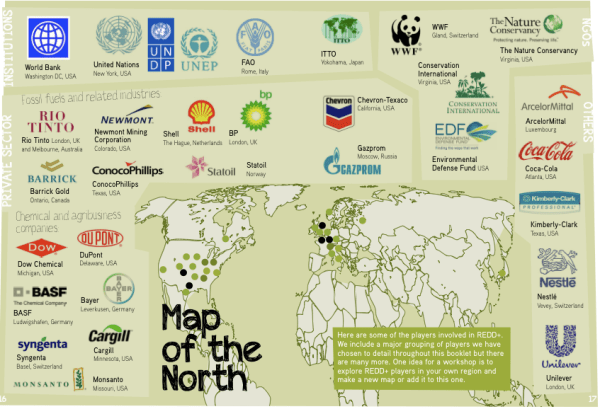

We also came across some amazing educational resources for anyone wanting to do climate justice work. The first is a great online zine that identifies those who benefit from the UN program known as REDD – Reducing Emissions from Deforestation and forest Degradation. While the name sounds like it is committed to climate justice, indigenous groups and farming communities around the world have exposed REDD as another corporate-friendly project. The Indigenous Environmental Network and Carbon Trade Watch have put together this fabulous resource, which you can download here.
Lastly, there is an amazing documentary called The Carbon Connection, which takes a close look at the fallacy of carbon trading. Carbon trading is just another scheme by global capitalists to keep polluting and pretend to actually reduce carbon emissions. You can watch the film online here.

