Occupy Humanity, Abolish Whiteness
This article by Mike King is re-posted from CounterPunch.
 We can only truly transform ourselves through the process of transforming social relationships and social structures. We can only transform those social relationships and structures collectively – across race, across class, across gender and sexuality, across nation as well. Transforming those relationships collectively means evolving ourselves in struggle along with other people. For white people this means engaging in struggle with other people we don’t ordinarily work with, people we don’t necessarily live near, people we may not feel we understand, people subjected to forms of oppression the most experienced of us have only a very partial understanding of.
White people have power by default in this society (in ways they usually take for granted or do not recognize). This privilege is unavoidable in the present, an accumulation of past injustices that we are born into. It is a crown we never earned, but also a dead weight on our spirit that we all feel, whether we are successful at tracing its source or not. The potentially liberating part of this is the fact that that power gives you a choice – the choice to either muddle along cocooned in comfort and privilege or to cast off whiteness, embrace humanity and build a new day. This is only possible by making yourself vulnerable, by recognizing, actively engaging and overcoming your own limitations and discomforts, and shedding the accumulated muck of the present society that now hangs off of us – by pursuing common struggle with people of color. This process revolves around trust – trusting others as well as trusting ourselves. James Baldwin puts this as clearly as possible, in a way that helps white people see themselves historically and to understand race in a way that doesn’t revolve around guilt and shame – but in a plain understanding:
“The person who distrusts himself has no touchstone for reality – for this touchstone can only be oneself. Such a person interposes between himself and reality nothing less than a labyrinth of attitudes. And these attitudes, furthermore, though the person is usually unaware of it (is unaware of so much!), are historical and public attitudes. They do not relate to the present any more than they relate to the person. Therefore, whatever white people do not know about Negroes (sic) reveals, precisely and inexorably, what they do not know about themselves.”

– James Baldwin, The Fire Next Time (1962)
Baldwin encapsulates the problem of whiteness and identifies distrust as a key – distrust of oneself and distrust of others. Recognizing white privilege is a first step to simply being aware of the world and this distrust. Using that privilege to undermine the social relations that create that inequality is a radical act we must take up as white people within this movement if we are to become a real threat to the established order.
Widespread anger at social conditions, periodic rebellions and protests around discrete injustices, isolated movements, various forms of counter-culture, small-scale utopian projects or lifestyle politics always exist, but rarely transform society by themselves. Moments that have transformative potential are products of intense crisis coupled with broad based movements that feed off of each other. We are living through one of these crises now, and the Occupy movement seems to be a first step down what will be a very long road that will hopefully lead to a different society. As the Zapatistas say, we learn that road by walking it together. This requires openness, humility, the desire to learn from the most oppressed, and a commitment to becoming something greater than you are now.
The process of making social change is always a learning process, in this country it is always white people that have the biggest learning curve. As a white man this is a curve I am familiar with, and one I am most definitely still on, one that is longer than I thought it would be when I started to climb it. By no means do I fancy myself some kind of Sherpa, I write this out of a simple frustration at the contradictions that I see, to a certain extent within myself as well. There is a need to address white privilege within the movement in a way that seeks the overall transformation of the movement by abolishing white privilege through struggle and the development of a praxis that builds a deeper humanity starting today.
The Occupy movement needs to make the demands of people of color the core demands of the movement. Police violence, profiling, over-policing in certain neighborhoods and the war on drugs, as well as economic, educational and health inequalities, and an overall lack of social power – all of these issues and more – need to be paramount in the Occupy movement. White people need to make these their issues, because they are their issues if we want to create a just society. These are the forms of oppression that are primary in maintaining the existing order, more than student loan debt, more than a lack of middle class jobs, more than alienation. This is not to say that the concerns of white people are not important because they are white – that is not the argument. We need to build bridges with communities of color by supporting their demands and putting in work to address white supremacy and racialized inequality. The call for Jubilee – or universal debt cancellation – that came out of Occupy Chicago, is an example of demands that affect people across class and race. We need to work together while remaining aware that this doesn’t mean we are all in the same position in society.

It is important to try and understand the experiences of others and the need to build active solidarity without trying to equate our struggles or ignore inequality or difference. So, say you are college educated and you are unemployed, I can empathize, I have been in that position. I can bear witness to the fact that that sucks. I now have an advanced degree and for the moment have pretty precarious employment opportunities. But because I have words like “precarious” in my fucking vocabulary, I have the ability to do things besides make minimum wage. I, like you, am pissed off about my current state of affairs nonetheless. I have caught enough whiffs of Suze Orman to know that putting groceries on unpaid credit card bills all the time and having unpaid monthly student loan interest that exceeds my monthly income is not a long-term strategy for “life success.” With all of that said, I know other people have it worse. It is not a matter of silencing yourself, it is a matter of not silencing others. It is a matter of becoming more than you are by not treating people like less than your equal.
The point is that we need to transform ourselves, and we can only transform ourselves through trusting others to lead with us and to put the demands of people of color, and the most oppressed generally, at the head of our agenda. A lot of us are anti-authoritarian or anarchists or people who believe in direct democracy. We are often suspicious of anything that alludes to leadership. We are often distrustful of demands for voice and power that come from people that may or may not share our political self-definitions, or organizing style or speaking style, or meeting and facilitation style, etc. I feel that way sometimes, sometimes there are reasons to be concerned. I don’t see anything that vaguely suggests such a concern here. I don’t see any people of color trying to take over Occupy spaces, or impose any form of authoritarianism, or liberalism. In fact I see very much the opposite.
Consensus as it exists in many Occupies that are mostly white spaces are a form of tyranny in that they silence minority voices and demands, in the same unspoken and normalized way that white privilege usually operates, to the extent that parliamentary procedures, ill-defined hand gestures, and unending meetings don’t push people of color away first. I think we need to be aware of the historical attitudes that Baldwin speaks of. These attitudes aren’t yours unless you make them yours. I think we also need to be aware of the fact that people of color are trusting us just by being here, they are showing a degree of faith in us and putting themselves out there just by showing up to these spaces and engaging. We need to be reciprocating that trust.

The history of the white Left’s relation to the struggles of people of color are complicated, in many cases undermining those struggles or failing to make common cause. The trade union movement was largely a white man’s movement for much of its history, getting themselves the American Dream at the same time that Chicano labor was brought here for exploitation without the possibility of citizenship in the Bracero Program and black people were fleeing 100 years of post-slavery sharecropping in the South. The women’s movement in the 70s was largely framed around the needs of middle class white women. When the FBI started assassinating and framing Black Panther leaders a far-too-large swath of the white Left failed to come to their side, making apologies for the State in their wanton destruction of the black struggle. Older people of color have taught me this history – that white people get pissed off about this or that, but when the draft board is no longer after them, or when they get bored, or when things get risky, or when the graduate, or when they get older, or when they have kids, get married, whatever – they fall out and they leave people hanging – oftentimes literally. We don’t need to replicate this or to nip a necessary de-colonial struggle in the bud with our privilege and blindness.
On the other end are white people who shed their self-ignorance in struggle. People like John Brown. People like Andrew Goodman and Michael Schwerner, who were killed by the KKK alongside James Chaney, simply trying to register black Mississippians to vote. David Gilbert is doing life in prison for his efforts in the Black Liberation struggle. No one is asking you to give your life or to go to prison. If we are trying to build a new society that eradicates inequality then we need to start by putting the demands of the most oppressed at the top of the list. Nobody is asking you to go on a John Brown suicide mission against white supremacy, but it is only by killing off your whiteness that you give yourself the ability to grow and we give ourselves the collective capacity to win. Again, I don’t write this from some exalted position. Several white radicals older than me, far better people than me, have told me repeatedly that this means constant work that does not end. Whiteness is not abolished in a workshop, it is abolished in struggle. Even if we eventually win, the struggle against the baggage of history will continue. All of this talk of struggle, transformation, new societies and winning is but a naïve fantasy if we don’t take up this struggle with all of our effort now. On the other hand, we have been handed the perfect circumstances for building a new society, so long as we draw from the best of our history, and push this struggle farther.
No one is asking you to blindly submit to other people’s wishes. But, so long as white people continue to wear the historical attitudes that Baldwin speaks of and so long as we continue to see and treat each other in terms of the existing social relations with their accompanying unaddressed privileges, so long as we have the worst expectations of people, then we will continue to mire in this mess of a society that we say we want to leave behind. We can only walk down this road to a better world if we trust each other, if we trust ourselves. Treason to whiteness is loyalty to humanity.
Super Congress hauls in super donations as special interests try to influence budget cuts
This article is re-posted from iwatchnews.org.

Members of the congressional Super Committee have received more than $300,000 from 93 special interests in just six weeks since they were appointed, according to an analysis of FEC data by iWatch News. More than a third of the money came from health-related interests as the committee of 12 debates serious cuts to Medicare and Medicaid.
The donations from political action committees slightly favored the Republicans on the panel (officially titled the Joint Select Committee on Deficit Reduction; unofficially dubbed the Super Congress). Republicans got 84 donations for $181,000; Democrats received 63 donations totaling $121,000.
The analysis covered Aug. 11, the day the committee was formally announced, through Sept. 30, the end of the third quarter reporting period. And those dollar amounts will likely increase when the Senate contributions, which are not filed electronically, are submitted to the FEC.
Formed as part of a compromise in late July between Republicans and Democrats in Congress, the committee faces a serious uphill task: they must come up with $1.5 trillion or more in budget savings, enough to match increases in the government’s ability to borrow enough money to pay its bills through the beginning of 2013. It requires a bipartisan majority of at least seven of the committee’s 12 members to recommend legislation to be presented to the whole Congress for an up-or-down vote by Dec. 23.
The select panel has until the day before Thanksgiving to finish its work.
As the committee seeks trillion-dollar spending cuts, interest groups have weighed in heavily with letters, lobbying efforts and, of course, campaign cash.
Of the 93 special interest groups who donated via their PACs to the members during this period, seven gave at least $10,000. They were:

FedEx, the shipping giant — $10,500
Pfizer, the pharmaceutical manufacturer — $10,000
The National Beer Wholesalers Association, a trade association for beer companies — $10,000
The American Dental Association, the trade association for dentists around the nation — $10,000
Walt Disney Productions, the entertainment conglomerate — $10,000
Chevron, the oil giant — $10,000
The Associated General Contractors of America, the trade association of the construction industry — $10,000
Fresenius Medical, a major dialysis provider— $10,000
A mix of health and pharmaceutical companies made up at least $111,500 of the donations, by far the biggest business sector. One focus of the Super Committee is to find ways to save money on health care, which many have speculated means potential cuts into Medicare and Medicaid.
Fresenius Medical provides a good example for how companies may be attempting to influence the Super Committee members. Fresenius is one of the largest dialysis providers in the world, operating over 1,800 clinics in the U.S. alone.
With the number of Medicare patients receiving dialysis (and, accordingly, the Medicare expenses for renal disease treatment) going up in recent years, the reimbursement rules and procedures for these treatments have already been a hot topic among those seeking to improve Medicare. A CMS rulemaking process is already under way for a quality incentive program. Should the Super Committee propose changes to Medicare, Fresenius and other dialysis companies could see a major impact to their bottom lines.
In the six weeks since the committee was announced, Fresenius made three donations to committee members Reps. Chris Van Hollen ($1,000) and Jim Clyburn ($5,000), along with Sen. Max Baucus ($4,000). The last time the company had donated to either Van Hollen or Clyburn was in June of 2008; in January of this year the company gave $5,000 to Baucus’ Glacier PAC.
Fresenius is a member of the Kidney Care Partners trade group and donated $5,000 in June to the group. Abbott Laboratories, another member in the kidney association, made six donations for $7,500 to Super Committee members during this time period.
Shortly after the Super Committee was launched, Kidney Care Partners wrote a letter to the committee, urging Congress to allow kidney patients enrolled in the new health exchanges to have their dialysis paid for by private, primary insurance for up to 30 months. Currently, when a patient is diagnosed with kidney failure, they are automatically enrolled in Medicare, regardless of age. “It is incumbent upon all Americans to work towards a more cost efficient and intelligent health care system,” reads the letter . “Public health care dollars are precious and should be wisely and efficiently spent.”
Kidney Care Partners spokesman John Jonas said Medicare cuts affect the dialysis industry more than other areas because upwards of 80 percent of its business is from Medicare. “We feel Medicare cuts very strongly. We’re particularly vulnerable, and there’s no alternative.”
Jane Kramer, vice president for public affairs and communications at Fresenius, told iWatch News in a statement that the company “frequently engages members of Congress and Administration representatives to ensure that they understand the unique nature of dialysis and the various issues that impact the treatment of individuals with end stage renal disease.”
“By engaging with policy makers directly, we are able to provide them with a perspective to which they may not otherwise have access. In turn, this helps better inform their decisions on critical issues such as access to quality care for all Americans, including those with chronic kidney disease,” the statement said.
Not all members of the committee are raising big bucks around their committee membership. Sen. John Kerry, a Massachusetts Democrat, promised last month that he would raise no money until the committee’s work is completed in late November. Meanwhile, Sen. Jon Kyl announced in February that he will not seek re-election when his term ends in 2012.
Total received from PACs to Super Committee members, 8/11-9/30:
Rep. Dave Camp, R-Mich. — $90,000
Rep. Xavier Becerra, D-Calif. — $38, 500
Rep. Jim Clyburn, D-S.C. — $36,500
Rep. Fred Upton, R-Mich. — $36,150
Sen. Max Baucus, D-Mont. — $29,000*
Rep. Jeb Hensarling, R-Texas — $22,500
Sen. Pat Toomey, R-Pa. — $18,000*
Rep. Chris Van Hollen, D-Md. — $17,500
Sen. Rob Portman, R-Ohio — $10,000*
Sen. John Kyl, R-Ariz. — $5,000*
Sen. Patty Murray, D-Wash. — $0*
Sen. John Kerry, D-Mass. —
What ‘Diversity Of Tactics’ Really Means For Occupy Wall Street
This article by Nathan Schneider is re-posted from E News.

Even as Occupy Wall Street shapes the public conversation about high finance, political corruption, and the distribution of wealth, it has also raised anew questions about how resistance movements in general should operate. I want to consider one of the matters that I’ve returned to over the past month, as I’ve watched the occupation up close and its means of making its presence felt on the streets of New York and in the media.
“Diversity of tactics,” in the context of political protests, is often treated as essentially a byword for condoning acts of violence. The phrase comes by this honestly; it emerged about a decade ago at the height of the global justice movement, especially between the 1999 demonstrations that shut down a WTO meeting in Seattle and those two years later in Quebec. While all nonviolent movements worth their salt will inevitably rely on a variety of tactics—for instance, Gene Sharp’s list of 198 of them—using the word “diversity” was a kind of attempted détente between those committed to staying nonviolent and those who weren’t. Consider this characterization by George Lakey:
“Diversity of tactics” implies that some protesters may choose to do actions that will be interpreted by the majority of people as “violent,” like property destruction, attacks on police vehicles, fighting back if provoked by the police, and so on, while other protesters are operating with clear nonviolent guidelines.
Those who extoll the importance of total nonviolent discipline—as Lakey eloquently goes on to do—might be disappointed to learn that Occupy Wall Street has made “diversity of tactics” its official modus operandi. However, the way that the occupiers have carried out this policy might actually lead us to think of its meaning and implications in a more compelling way.
Since the early stages of the movement, it is true, those taking part have been in a deadlock on the question of making a commitment to nonviolence. At a planning meeting in Tompkins Square Park prior to September 17, I recall one young man in dark sunglasses saying, knowingly, “There is a danger of fetishizing nonviolence to the point that it becomes a dogma.” In response, a woman added a “point of information,” despite being in contradiction to what Gandhi or King might say: “Nonviolence just means not initiating violence.” The question of nonviolence was ultimately tabled that night and thereafter. “This discussion is a complete waste of time,” someone concluded.

Property damage and self-defense, therefore, have remained on the table. The main points of the march guidelines subsequently promulgated by the occupation’s Direct Action Committee are these:
Stay together and KEEP MOVING!
Don’t instigate cops or pedestrians with physical violence.
Use basic hand signals.
Empowered pace keeps at the front, back and middle of every march. These folks are empowered to make directional decisions and guide the march.
We respect diversity of tactics, but consider how our actions may affect the entire group.
In practice, however, the occupiers have kept nonviolent discipline quite well, even if they don’t entirely preach it. Their self-defense against police violence has been mainly with cameras, not physical force. (In fact, they have often responded to intimidation by chanting, “This! Is! A Nonviolent Protest!&rdqo;) There have been no cases of intentional property destruction that I know of. One reason for this is surely common sense; when facing an essentially paramilitary institution like the NYPD, there’s little hope that a few hundred or a few thousand protesters could stand much of a chance with violence. Another reason is the point made in the second clause of guideline 5, qualifying the “diversity of tactics”: an act of violence, the occupiers realize, would reflect on everyone in the movement, the vast majority of whose participants would not condone it.
So far, at least, what “diversity of tactics” has meant to the occupiers is not simply openness to violence but actually a richer interpretation of the phrase—indeed, a whole philosophy of direct action that comes out of anarchist thought. In this, “diversity of tactics” shares the same heritage and logic of the open assemblies that are the heart of the occupation movement. Take this passage from a pamphlet on hand at occupied Liberty Plaza, Anarchist Basics:

Affinity groups [“of 5 to 20 people”] decide on their own what they want to do and how they want to do it, and aren’t obliged to take orders from any person on top. As such, they challenge top-down decision-making and organizing, and empower those involved to take direct action in the world around them. Affinity groups can make decisions in whatever way they see fit, but they generally use some form of consensus or direct democracy to decide on goals and tactics. Affinity groups by nature are decentralized and non-hierarchical, two important principles of anarchist organizing and action.
Small groups acting more or less autonomously toward common goals is a matter of principle as well as of pragmatism. These groups, in turn, can voluntarily coordinate with each other in spokescouncils. Operating this way reflects the kind of values that many in the occupation movement insist on: individual autonomy, consensus decision making, decentralization, and equality.
“For us to go around and police everyone in the march is not respecting their way of expressing how they’re participating in this movement or this action,” says Sandy Nurse of Occupy Wall Street’s Direct Action Committee. She is describing a philosophy of organizing, primarily; violence and forms of property destruction are, at best, secondary to this approach, and they’re not really necessary for it to be practiced effectively.
Consider, for instance, the two main events which brought public attention and sympathy to the movement: the arrest of nearly 100 on a march near Union Square on September 24 (which included an infamous pepper-spraying incident), and the approximately 700 arrested a week later on the Brooklyn Bridge. In both cases, the arrests directly followed instances of autonomous action by small groups, which splintered away from the plan established by the Direct Action Committee. (At Union Square, there was a dispute about whether to take the march back to Liberty Plaza or to the United Nations; at the Brooklyn Bridge, hundreds of marchers chose to spill onto the roadway rather than remaining on the narrow pedestrian walkway.) In both cases, too, the police responded to such autonomous action with violent overreaction, which in turn garnered tremendous interest from the media.
I have previously called for the movement to adopt more orderly kinds of civil disobedience actions, ones targeted specifically at the laws they oppose—on the model of lunch-counter sit-ins in the civil rights movement, for instance. However, I’ve been forced to recognize that the chaotic stuff seems to work.
My sense of the dynamics at play here is something like the following. The NYPD, as a hierarchical, highly-structured organization, operates according to certain plans and procedures arranged in advance. Its commanders gain the best intelligence they can about what protesters intend to do and act accordingly. When the protesters act outside the plans police prepared for, or their plans aren’t unified, the police feel they have no choice but to resort to a violent crackdown, which in turn highlights the protesters’ own nonviolence in the media reports, and their movement grows. The net effect is that it almost seems as if the police are intentionally trying to help the movement, for that’s what their every action seems to do.
We already know that power structures which rely on violence are helpless against coordinated nonviolent action. During the civil rights movement, a highly structured and disciplined action in a segregated city like a sit-in or Freedom Ride had the capacity to confront the system in a very direct way, presenting the powerful a dilemma between violent overreaction and capitulation. Such actions, however, have since turned ritualized and generally ineffective in American protest movements. But Occupy Wall Street commends to us the anarchist insight that, in much the same way, hierarchical command structures are highly vulnerable to non-hierarchical action.
If this is true, the real strength of the 1999 Seattle WTO mobilization was not so much the particular tactics used—least of all the window-breaking antics of “black blocs”—but the decentralized way in which activists organized and deployed them. (A subsequent RAND Corporation study on what it called “swarming” made note of this.) Wrote nonviolence trainer Betsy Raasch-Hilman, in mid-2000:
In terms of numbers, many demonstrations have been larger than the actions in Seattle. The difference between the WTO protests and the Million Man March on Washington, D.C., (for example) was that people did not all do the same thing at the same time in Seattle. Spontaneity ruled the day(s). As in the physics of chaos, seemingly random events emerged into a pattern, and almost as quickly dissolved into a less-identifiable pattern.
A major reason why traditional forms of civil disobedience aren’t well-suited to Occupy Wall Street is the fact that the occupiers aren’t even capable of breaking the relevant laws in the first place. While those in the civil rights movement could sit in the wrong part of a segregated bus, the occupiers at Liberty Plaza can’t exactly flout campaign finance laws, or laws regarding the regulation of banks. Such laws are simply beyond the reach of most Americans—which is exactly the problem. Consequently, the movement is being forced to resort not to civil disobedience but to what political scientist Bernard Harcourt has proposed we call “political disobedience”:
Civil disobedience accepted the legitimacy of political institutions, but resisted the moral authority of resulting laws. Political disobedience, by contrast, resists the very way in which we are governed: it resists the structure of partisan politics, the demand for policy reforms, the call for party identification, and the very ideologies that dominated the post-War period.
Diversity of tactics is a form of political disobedience par excellence, as its emphasis on autonomy rather than authority represents a direct contradiction to the kind of order that ordinary politics presupposes.
This idea takes on a further dimension as Occupy Wall Street expands from a single action to a nationwide occupation movement. There is perhaps no better case in point than in Washington, D.C., where there are currently two dueling occupations underway—one that’s mainly young people practicing the non-hierarchical ideal of Liberty Plaza, and another, organized by a group of older activists for months in advance, which began with a somewhat more structured decision-making process. They’re located at McPherson Square and Freedom Plaza, respectively. Both consider themselves to be part of the occupation movement, though, as has been rather exaggerated in some media reports, they’re not always on exactly the same page.
The occupation at Freedom Plaza, for instance, has focused on more traditional disobedience actions with purposeful targets, such as the Hart Senate Office Building and the Supreme Court. Those at McPherson, on the other hand, have used more generally disruptive tactics like blocking traffic during commutes. Together, though, and in different ways, they contribute to a net effect of making the Nation’s Capital feel “occupied.” While some have argued that Freedom Plaza is an aberration to the movement as a whole, it is probably best understood as having a legitimate place in a movement that employs a diversity of tactics. Those at Freedom Plaza, moreover, have explicitly stressed a commitment to resisting nonviolently.
If it is true, as I’ve come to think, that a diversity of tactics has been meaningfully practiced by the occupation movement even while remaining nonviolent, then a definition of the phrase like George Lakey’s is in need of revision. Rather than being merely a license to use violence, respecting a diversity of tactics is in its own right a robust approach to conducting resistance—and one that is arguably all the more powerful when it remains nonviolent. This was highlighted in the part of Naomi Klein’s recent speech at Liberty Plaza that earned the loudest applause:
Something else this movement is doing right: You have committed yourselves to non-violence. You have refused to give the media the images of broken windows and street fights it craves so desperately. And that tremendous discipline has meant that, again and again, the story has been the disgraceful and unprovoked police brutality. … Meanwhile, support for this movement grows and grows. More wisdom.
The data seem to support her. A widely-cited Freedom House report from 2005 found that movements which rely on nonviolent methods are considerably more likely to result in democratic outcomes, rather than simply replacing one authoritarianism with another. This, especially, should carry weight for the occupation movement, which strives so much to embody the ideals of a more democratic society in the means it uses to achieve one. If a permissive attitude toward violence is not a feature of the world one is working for, nor should it be welcomed in one’s movement. Activist and writer Starhawk, who has been doing nonviolence trainings at Freedom Plaza, also notes that a commitment to nonviolence reduces the need for “security culture” among organizers and fosters transparency.
Erica Chenoweth and Kurt Schock have found through statistical studies that the effects of having a so-called “radical flank” in a resistance movement—having a violent minority—include a slightly lower success rate and a significantly lower level of public involvement. Canadian activists Philippe Duhamel and David Martin recognize this in their call for “a diversity of nonviolent tactics.” They argue that “some tactics don’t mix”; once violence enters the picture, it monopolizes the landscape of the conflict, co-opting other tactics and alienating potential participants. Rather than representing a true “diversity,” actions that people perceive as violent monopolizes public attention and lends sympathy to the agents of repression. This certainly was the case this past weekend, when a small number of people doing property destruction in Rome caused headlines like “Protests Turn Violent” to dominate the perception of an overwhelmingly nonviolent day of action in cities all over the world.
Only a month into the occupation, and less than three months since planning began in earnest, Occupy Wall Street is just beginning to have the robust affinity groups that a diversity of tactics approach requires. Such groups have led targeted actions like the disruption of a Sotheby’s auction and a sit-in at a JPMorgan Chase bank branch. It is tactics like these—rather than mass arrests for obstructing traffic—that will begin to directly undermine the legitimacy of the powers the occupiers seek to target. And when causing such disruptions, remaining nonviolent will be crucial to ensuring that the disrupters keep their own legitimacy in the public eye.
The committee responsible for media relations for Occupy Wall Street has already begun preparing messaging—down to specific tweets—to use in case someone in the movement ends up using violence. (When tensions escalate during confrontations with the police, one sometimes sees a few protesters coming very close to the precipice.) Even those in the committee who aren’t ultimately opposed to violence in principle recognize that such acts would be a serious challenge to the movement’s credibility, both in the media and among those taking part in it. Given the commitment to a diversity of tactics, though, just about anything can happen, and the committee often learns about it only after the fact.
Let’s hope those tweets go unneeded.
New Media We Recommend
Below is a list of new materials that we have read/watched in recent weeks. The comments are not a “review” of the material, instead sort of an endorsement of ideas and investigations that can provide solid analysis and even inspiration in the struggle for change. All these items are available at The Bloom Collective, so check them out and stimulate your mind.

Consensus: A New Handbook for Grassroots Social, Political and Environmental Groups, by Peter Gelderloos – With the recent Occupy Wall Street movement it is clear that more people are being introduced to the idea of using a consensus model of decision making instead of voting or majority rules. While consensus is becoming known to a broader audience, there is always the danger of misunderstanding or misusing the process. This new handbook on consensus is a wonderful tool for people who want to explore the decision-making power of this truly democratic process known as consensus.

Against Equality: Queer Critique of Gay Marriage, edited by Ryan Conrad – The LGBT community has expended a great deal of energy in recent years over the legal fight to allow same sex couples to marry. This new collection of essays and interviews provides fiery and compelling arguments against expanding the state sanctioned institution of marriage to the LGBTQ community. All of the authors identify as queer and argue that state sanctioned marriage is a dead end to assimilation within a hetero-dominant culture. Many of the essays also argue that marriage is the perfect institution for promoting and extending the dominance of capitalism. More importantly, the authors argue that gaining the legal right to marry does nothing to stop the level of suicide amongst LGBTQ youth, homelessness, lack of work place rights or immigration policies. This book is so important that it should be given to every LGBTQ organization/organizer and straight allies.

Zombie Capitalism: Global Crisis and the relevance of Marx, by Chris Harman – This new book by Chris Harman is not only timely it is an important contribution to the ongoing discussion about the current economic crisis. Harman provides substantial historical background of Marxism, but then extends that critique to the 20th and 21st Centuries. The author then provides an analysis of the 2008 financial crisis within this historical framework to make the point that capitalism is not just in crisis, it is the crisis. Harman looks at how capitalism has evolved and adapted in recent decades, but he ultimately argues that because of certain ecological and human limits that it is a system that is doomed to fail. Zombie Capitalism is a useful contribution to the current collective discussion about what is wrong with the economic system and how we can create a new one.

If A Tree Falls: A Story of the Earth Liberation Front (DVD) – Beyond the headlines and the state propaganda, there is a story about the people who have decided to take a stand for the planet and actually try to stop the current ecological rampage. This film investigates some of the people involved with the Earth Liberation Front (ELF), what motivated them to take stronger actions and how they have been labeled domestic terrorists. If A Tree Falls is a powerful film that not only confronts viewers with the seriousness of the current ecological catastrophe, but sheds light on the repressive tactics of the state being used to protect corporate power. An important film that could influence the future of activism.
This post originally appeared on the Our Kitchen Table website.
On Monday Oct. 17, Grand Valley State University screened the documentary film Dive! Living Off America’s Waste as part of its Sustainability Week activities. The film opens with a group of young adults helping themselves to gourmet cheeses, choice meat cuts, organic produce and brown eggs from their local Trader Joe’s dumpster. One dumpster diver quipped, “We have so much food that it’s a chore to take care of it the next day.”

Timmy Vatterott of the film DIVE! talks to OKT's Yvonne Woodard about her work before the film
In fact, with the help of a donated chest freezer, one family featured was able to amass enough meat to last a year within one week of dumpster diving.
The documentary goes on to illustrate just how much food is wasted by the current agriculture and food distribution systems. Here are some fast facts shared during the film:
- Food makes up 20% of landfill waste.
- 50% of food harvested never makes it into anyone’s stomach
- 96 billion pounds of food is wasted in the US annually… enough to fill 453,257 box cars (a train that would stretch from LA to New York City and back again).
- The US wastes 40 million acres of wheat every year – enough wheat to cover the whole state of Oklahoma.
- The food wasted in the US could feed all of Haiti for five years
- 35.5 million people in the US don’t know where their next meals coming from. 11 million are hungry. They simply aren’t going to eat today.
The film narrates the tale of the dumpster divers’ efforts to get Trader Joe’s to donate edible food waste to local food pantries. After Trader Joe’s refuses to engage in conversation about the matter, the dumpster divers organize to deliver truckloads of dumpstered food to a very appreciative LA food pantry on New Year’s Eve.
While Trader Joe’s and other chain supermarkets do donate some “waste” foods to food pantries, it seems these items are usually breads or packaged dry goods that are simply past their stamped expiration dates. Most produce, meat, eggs and the other nutritious components of a healthy diet are simply trashed. Reasons cited were logistics and cost.
Our current system of food delivery lives for profits, not people – wasting food is simply more profitable than feeding the hungry. One of the dumpster divers in the film made the astute observation, “We weren’t always like this. There was a time when food was much more than a commodity. Food was life itself. Food was community.”
In conclusion, the film asks its audience to join its Eat Trash Campaign, a project aimed at convincing more supermarkets to donate edible foods to pantries rather than dumping them.

When Vatterott heard Grand Rapids prohibited laying hens, he exclaimed, "There's an ordinance against chickens here? Down with the chicken laws!"
Panel reacts
After the film, two women form Our Kitchen Table, executive director Lisa Oliver King and evaluater Inez Adams were part of a panel that discussed the film. The panel also included Elianna Bootzin of Feeding America West Michigan,Emma Rosauer of Access of West Michigan and Timothy Vatterott, Dive’s producer and composer. Cynthia Price, the panel moderator, asked the panel about their reactions to the film and their thoughts on our “insane, corporate controlled food system.”
Rosauer shared that the film resonated with her and her agency’s work, especially these days in West Michigan when more and more families are turning to food pantries to stave off hunger. She shared that one in four Kent County children experiences hunger, ”People who used to give to food pantries now they are receiving from them.”
Good Samaritan legislation initiated under the Clinton administration legally protects businesses that donate food, but that many in the food industry are not aware of the legislation. Rosauer made a call out for volunteers to build relationships with their local grocer and arrange pick up and distribution of dumpster-destined food to local food pantries.
Bootzin explained the work of Feeding America and went on to say that the amount of food waste is increasing, raising from 30% in 1974 to 40% 2009.
In her reaction to the film, Inez Adams, OKT, commented, “The movie said we don’t value food. I think we do value it but we value it as a commodity and not as a right. Lots of Americans think only certain people are entitled to food. ‘They don’t have a job so they don’t deserve food.’ ‘I work hard so I can feed my family.’ The discussion needs to change from ‘food is an entitlement if you are a productive citizen’ to food is a human right.”
Lisa Oliver King talked about OKT’s work in providing resources to people who wanted to build their own food system and food security through growing and sharing food and foraging within their own neighborhoods. She encouraged the audience to approach the city and demand that fruit and nut trees be planted ion the parks and greenways.
“We are talking about preserving nature so that it not only pleases us aesthetically but provides for us nutritionally,” she said. She also asked, “How do people define hunger?” Much emphasis is put on feeding belies rather than preventing malnutrition through providing people nutritious foods. “ People in Grand Rapids have access to food pantries that provide substandard, high calorie, high fat, high sugar, high sodium and nutrient deficient food.”
Oliver King also mentioned the media-driven mindset that makes people crave meat at every meal when a vegetable and grain based diet could feed them just as adequately, at a lower cost and with less impact upon the environment. She called for citizens to demand local policy changes that would not only encourage sharing dumpster-destined foods but also make it easier for people to grow their own food, compost food scraps and keep laying hens.
Vatterott agreed heartily. “That really empowers people to understand where food comes from. That places a value on it and strengthens community bonds,” he said. “I really admire the work you do. That kinds of thing really needs to happen, people taking ownership of their food.”
In all, the message of the film Dive! and the campaign that it promotes are good steps towards recognizing the prevalence of food waste here in the US and in other wealthy nations. However, there was no critical conversation about the economic system that perpetuates this kind of waste and injustice—the same economic system that fails working class and lower class people when it comes to health care, housing, education and in the courts.
The Grand Rapids Press and Its Published Comments on Immigrants
Remember when the Grand Rapids Press announced it was going to be “tough on trolls”? Supposedly, the Press was going to use a three-pronged attack to remove racist, homophobic, and defamatory commentary on its MLive website. First, the reporter who wrote the article was supposed to review it and remove posts that violated the MLive terms of use for comments. Second, the Press hired a “sweep team” that was going to do searches of their articles for red-flag words that indicated racism, sexist comments, homophobic hate speech, and defamation. Third, readers could report individual comments for violations.
This much-touted policy might leave readers with the impression that anything left on the site was there with the approval of the Grand Rapids Press. If that were the case, then comments which are supposedly reviewed twice by people paid by the newspaper and which are still online must be there because the Press sees nothing wrong with them….right?
If so, this places the Press in seeming support of some pretty interesting opinions. Take a look at an article covering a presentation by distinguished author and professor Marcelo Suárez-Orozco, founder of the Harvard Immigration Project. Some of the commentary left after this article—in other words, passing the approval of both the “sweep team” and reporter Garret Ellison—offers extreme suggestions about immigrants. Here’s a small selection:
1. It’s OK to shoot undocumented immigrants when they are found in the United States.
Quite frankly, we don’t want any new citizens. If there here illegally, ship them home or shoot them.
2. It’s OK to use a White Supremacist website as a preferred source for information on immigration in the States. This site, the name of which I’ve blanked out in the quote, has been cited as a hate group by the Poverty Law Center.
Good internet sites [sic; he only cites one] with the truth about immigration are. http://www.xxxxx.xxx. read what the real costs are to our schools , hospitals, prison system and your freedom.

3. Having a child in the United States if you are not a citizen or a documented worker is a criminal act.
I don’t care if they had a child here, that was the commission of fraud. They had no right to come to this country and everything they did was a crime because of their illegal status.
4. It’s OK to present as facts the false claims that no undocumented immigrants are paying taxes or Social Security (they are); all collect welfare (they are unable to do so—only citizens can collect welfare); and that they supplement their illegal wages via drug dealing and theft.
They work, get paid under the table,(no social security No. means no legal job) and collect welfare at the same time. So they pay no taxes, take jobs, take our tax dollars, and then send the money home to Juan. How great is that? Plus they deal drugs and steal on the side if necessary.
5. It’s journalistically sound to use a debunked quote by a Latino leader as if were true—and then, in a move worthy of the Darwin Awards, use the very website that shows how these and other fictitious quotes by Gutierrez were circulated in racist emails as “proof” that he said it.
Jose Angel Gutierrez, professor, University of Texas, Arlington; founder of La Raza Unida political party; and beneficiary of American generosity: “We have an aging white America. . . . They are dying. . . . !” “We have got to eliminate the gringo, and what I mean by that is if the worst comes to the worst, we have got to kill him. http://www.snopes.com/politics/quotes/hispanicleaders.asp scroll down

6. We should murder any immigrants that attempt to cross our borders, because they are not human beings but “vermin.”
They are a vermin that eats away the the fabric of the american way of life. They want nothing but a free ride. Mine the border. Stop this madness of thinking they contribute to this country in any usefull way except tucking in a bed sheet in a motel or picking an apple.
This is only a small sampling of what the Press presents on its website on any given day. Press staff and paid contract workers have allowed remarks like these to remain “published” (that is, made available to the public) at the paper’s expense and under the proud banner of the Grand Rapids Press.
As a side note: I did not bother to contact Press diva and non-stop Tweeter Garret Ellison; he has taken even requests by various readers to fix typos in his headlines and incorrect names in his articles as personal insults. I did report each of these racist comments, and about two dozen more on various articles, to the so-called sweep team. As of this writing, all comments still remain on the site. I also emailed the above comments and a few more to Press Editor Paul Keep and Online Editor Meegan Holland to make them aware of the remarks. If the comments are removed after this point, it will be because of my unpaid time in reporting them, not due to any Press staff or contractors.
Visitors to the site tend to read articles on the same day they’re posted. These remarks have gotten five days’ worth of viewing by the Press readership…because no one at the Press seemed to have found anything wrong with them.
Speaker addresses Climate Denial at GVSU

Yesterday, as part of their Sustainability Week, GVSU hosted Michigan native Peter Sinclair, who talked about the issue of global warming.
Sinclair stated that several years ago he became increasingly bothered by the amount of bad and misleading information on global warming. With an interest in media, Sinclair started a video blog called Climate Crocks of the Week.
Here is an example of one of his videos:
As a response to his videos, now numbering around 80, Sinclair says that he knows that many climate scientists and educators are using his videos and several have stepped forward to be advisors for the media work he is doing.
Sinclair then provided some basic data to support the global scientific community’s claim that humans are causing the planet to warm in such a way that it is causing tremendous ecological stress and unnecessary human suffering.

One of the claims of the climate deniers is that not only is the planet not warming, but we are entering into a global cooling period. It is true, as Sinclair noted, that because of the historical cycles of planetary orbiting we should be in a cooling period, but the exact opposite is happening.
Sinclair then showed a map dealing with the Arctic polar region and demonstrated how polar ice caps are melting. In addition to scientific data he says that numerous governments, particularly Russia, is constructing shipping facilities near the Arctic region, because new shipping routes are developing as the ice melts.
Sinclair also says that the two largest ice packs, Greenland and Antarctica, have both been decreasing in size since 2007. Sinclair even cites the US Navy’s chief oceanographer, Admiral Titley, who agrees that the ice packs are melting. Titley’s assessment falls on the conservative estimate side, but Sinclair says that the analysis by James Hansen is most likely more accurate.
Sinclair followed with comments about how there is a growing concern over the impact that global warming will have on places like Greenland and Antarctica, which have ice as much as a mile thick that is holding in a tremendous amount of carbon. The thawing of these areas, which are also referred to as permafrost, would be devastating, since it would release a great deal of carbon and humans would not be able to stop that process once it began. Here is a video with Steven Chu talking about permafrost.
The information that Sinclair shared was solid and in many ways alarming, considering the small window we have as humans to actually prevent cataclysmic outcomes.
However, when Sinclair got to talking about solutions, he responded with the business as usual model. Sinclair said that many large corporations understand the predicament we are in and are making a difference, such as Dow Chemical. Sinclair even showed a slide on how Dow Chemical is reducing its Carbon foot print.
In many ways hearing him talk about Fortune 500 corporations as part of the solution was quite disheartening, considering how much ecological destruction and human harm Dow has perpetrated. On top of that, by saying that Dow Chemical was reducing its Carbon foot print, it diverts attention to what they do and what there primary motive is. Dow Chemical doesn’t make products in order to promote sustainability, they make products to make a profit within the capitalist model.
Sinclair went on to talk about solar shingles, wind energy and how Michigan could be a leader in green energy jobs creation. When talking about solar shingles he played a commercial from Sungevity, to illustrate a business model that could be a solution.
So, if we save money on home energy costs we should take several trips to a tropical country? This absurdity underscored the extremely flawed solutions part of his presentation. It was most disappointing to know that the students who were in attendance were not exposed to a more systemic critique of what has contributed to global warming and how we can possibly avert a disastrous outcome. Sinclair did not even address the need to stop the main forces of global warming, the oil & coal industries, militarism, agri-business and so much of industrial capitalism.
Black Is Back Coalition: Defining Our Own Place in the 99%
This article by Glen Ford is re-posted from Black Agenda Report.
It’s been two years since the formation of the Black Is Back Coalition for Social Justice, Peace and Reparations. The original coalition of fifteen organizations was formed in the close quarters of a Washington, DC, apartment in late September 2009, and in just seven weeks pulled together the first national Black march and rally against President Obama, at the White House.

Back then, the Black Is Back Coalition occupied a very lonely place, not just in Black America, but in the larger spectrum of the U.S. Left. Sisters and brothers who had long opposed U.S. imperial wars and the rule of the rich, who had for decades proudly proclaimed themselves fighters in the Black liberation struggle, turned their backs on their own lives, their own words, their own experiences and on the historical wisdom of our greatest leaders, to become apologists and cheerleaders for a Black corporate Democratic warmonger. It was, possibly, the lowest point in Black political history, a comprehensive collapse of the last remnants of what had once been a mighty movement.
Twenty-four months later, the Black Is Back Coalition prepares to hold its national conference, on November 5, in a vastly different political environment. The Obama delirium has broken, like a fever that has spent itself. The First Black President has proven with sickening consistency to be a tool of Wall Street and the Pentagon, and as contemptuous of Black people in word and deed as any president in modern times. His verbal attacks on Black culture and Black character have been vicious in the extreme, a series of egregious, hurtful harangues cynically designed to signal to whites that he, too, rejects the legitimacy of Black grievances – both historically, and in the here and now.
Those of us in the Black Is Back Coalition have a right to say “I told you so” – and we do. But it takes more than just being right, to win the battle. One must constantly take advantage of changes on the battlefield.
The political terrain has changed, decisively. People’s “occupations” are the watchword all across the nation and the world, there is a general disgust and rejection of the rule of finance capital, and for the first time in four decades the word “revolution” is heard outside the context of the newest consumer product. There is a ferment, a great stirring, that has Black Americans speaking in a language that was once so familiar we thought we owned it: “All power to the people!” Variations of the old war cry are on everyone’s lips. But achieving the meaning of the phrase “Power to the people” requires new strategies and tactics to suit new conditions on the ground.
The sudden appearance of a still very amorphous movement under the loose heading “Occupy” presents a huge challenge. That is especially true for those of us at the Black Is Back Coalition, whose analysis was essentially correct in 2009. We should be a lot smarter now, and share our insights and experiences with the new forces that have suddenly emerged. The slogan “the 99% versus the 1%” is fine and catchy and quite effective, for now, but real revolutions are made up of their constituent parts. In the United States, especially, homogenization always tends, in practice, to result in a whitening of the process. And that would be a tragedy for the emerging movement.
The Black Is Back Coalition’s responsibility, on November 5 in Philadelphia, is to put forward a strong, unabashedly Black analysis and program for the world revolution, and share it with everybody.

Many North Americans claim to have known nothing about the insidious control that the United States asserted in Central American countries in the 20th century. Our insular tendency to only study American and European history and literature is partly to blame. But so is our distaste for the bald truth. Because since the 1930s, we have had the truth in the form of Miguel Angel Asturias’s work as our guide.
On June 19, 1899, Miguel Angel Asturias was born in Guatemala City. His father was the magistrate of the Guatemalan Supreme Court, and his mother was a teacher. Asturias himself became many things: a voice of clarity about the corrupt dictators of Guatemala and U.S. imperialism in his native land; a poet of remarkable skill; an attorney, a professor, and a diplomat; and a novelist of tremendous power. And yet, his work still goes almost completely ignored in the United States.
Asturias attended college and law school in Guatemala, and then, with a group of friends, founded the Popular University of Guatemala, offering courses to citizens who couldn’t afford tuition at the traditional colleges. He later taught at the university. But in 1923, Asturias left to study in Paris, and because of the incendiary nature of his writing, he spent much of the next decade there.
Among the works that Asturias wrote in Paris were beautiful reworkings of Mayan legends, collected under the title Legends of Guatemala; a volume of his poetry; and El Señor Presidente, his first political/social justice novel. It was a thinly veiled indictment of Estrada Cabrera, one in a line of infamous dictators. Both Asturias’s father and mother were arrested and lost their jobs during the Cabrera regime. His whole family, along with the rest of the country, suffered under Cabrera’s harsh policies. It was unsafe for Asturias to even bring his manuscript into Guatemala, so he left it with friends in Paris. Completed in 1933, it was not published until 1946.
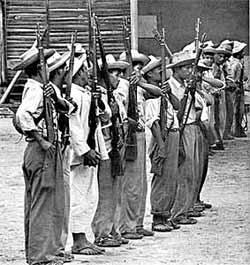
Asturias was reluctant to return to Guatemala, and El Señor Presidente makes it clear why. The book portrays the daily fear under which the people of Guatemala lived, never knowing if they would be arrested or shot for some “crime” of which they were ignorant. At one point in the novel, a character says to a military commander, “Whether you’re guilty or innocent is irrelevant, General; what matters is whether you’re in favor or not with the President. It’s worse to be an innocent man frowned on by the government than a guilty one!” The novel closes as the main character watches a group of people he knows being marched away by El Presidente’s soldiers. Then he returns home, where his mother is saying rote Catholic prayers for their leader and also protection for those who are persecuted by the law. The irony of the moment is a bitter conclusion to the book. Clearly, to pray for both is no longer possible in Guatemala.
Asturias returned to Guatemala at the urging of a Parisian friend, who told him, “You are writing about things about which we Europeans don’t even dream,” and said that it was Asturias’s duty to be a truth-teller, reporting on events in his homeland.

Asturias took that duty seriously. In addition to El Señor Presidente, he wrote his famous trilogy (sometimes referred to as the Banana Trilogy) about American imperialism devouring Guatemala. These three novels, Viento Fuerte (1950), El Papa Verde (1954), and Los Ojos de Los Enterrados (1960), show what was happening to Guatemalan farmers when large U.S. companies moved in. They captured land, turned the former farmers into virtual slaves, and burned whole villages down with the approval of the current dictator. The United Fruit Company in these novels stands for all early corporations that invaded Central America and impoverished farmers who had made a living on their land for centuries.
Asturias brilliantly lampoons the American corporate representatives as affable, somewhat slow-witted, but amiable people who initially seem kind and generous to the native workers. But this is a façade that hides their actual agenda to overpower and control. Across four decades, more than 200,000 Guatemalans died just because, as Gabriel Maria Marquez summed it up, some gringos wanted to eat bananas.
Hombres de Maíz, which Asturias originally finished in 1946, is perhaps his best-known work in Central America. It tells the story of a tribe of Indians in Guatemala who begin to rebel as their tribal mountain lands are invaded by U.S. corporations that start planting corn there. The army is sent in to destroy the tribe on the orders of the U.S.-approved dictator in power. Asturias evoked all of his knowledge about Mayan myths and legends and wrote this story as if it were an ancient myth, using the same storytelling devises. The format, familiar to Guatemalans, made the book less accessible to North Americans and Europeans. It was not until after the novelist’s death that the book was understood by these audiences as his masterpiece.
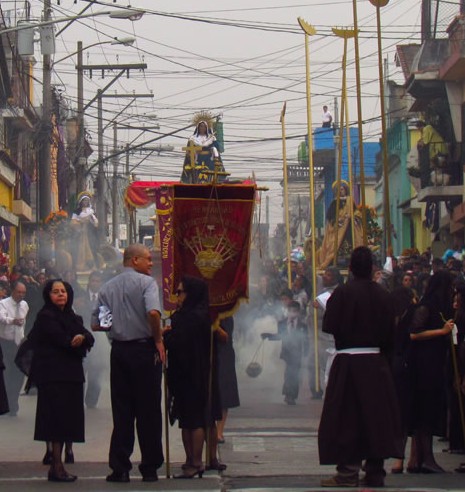
The struggle of the “men of maize” takes on epic proportions, with the Indians led by a populist leader, Gaspar. He represents the voice of truth itself. When he is ultimately silenced as he’s shot by the soldiers, the tribe loses both its land and its former power to do magic. Asturias intended these losses to represent the death of a life that had once nurtured the people of Guatemala before new regimes of puppet dictators and creeping U.S. control replaced it.
Asturias’s politically charged writing came with a price: when Castillo Armas came into power in 1954, the novelist was forced to flee Guatemala. He traveled to Chile, where he lived with poet Pablo Neruda. Later, he moved to Buenos Aires where he wrote for the state newspaper. But another political coup there forced Asturias to move again, this time to Italy. Shortly afterward, the new president Méndez Montenegro of Guatemala named him ambassador to France.
Miguel Angel Asturias was awarded the Nobel Prize for Literature. He was honored with the Lenin Peace Prize, the el Primo Galvez Award, the Chavez Prize, and the Sylla Monsegur Prize for his own translation of Legends of Guatemala into French. Asturias died in 1974 while on a lecture tour of Spanish universities.
Asturias’s view on his writing was wholly activist in nature; he once told students in a lecture, “If you write novels merely to entertain…then burn them!” Someday, maybe students in the United States will become more familiar with this great author and voice for social justice. They’ll read, from a Central American viewpoint, about the ugly side of U.S. domination in other countries, routinely presented here in America as our charitable desire “to bring democracy to the world.”
Feliz cumpleaños, Miguel Angel Asturias…que se recuerdan.
Farm worker advocate to speak at GVSU Wednesday

Jaime P. Martinez was born in 1946 in San Antonio, Texas and was reared by his Mexican migrant worker grandparents in the Westside barrio, a Spanish speaking community.
His involvement in activism began in 1966 as a member of his local union in San Antonio, Texas IUE-AFL-CIO Local 789, Friedrich workers. He marched and fasted for justice for the farm workers alongside Cesar Chavez, President of the United Farm Workers of America.
Mr. Martinez has defended the rights of workers and marches for civil rights throughout America and has worked with community leadership such as Rev. Abernathy, right hand man of Dr. Martin Luther King Jr., and Rosa Parks.
Jaime P. Martinez will speak about his experience working for social justice and human rights in the United States.
Wednesday, October 19, 2011
4:30 – 6:00PM – Reception following lecture
Cook-DeWitt Center, GVSU Allendale Campus
 Grand Rapids Institute for Information Democracy