Active resistance to the countries of the world that refuse to significantly reduce carbon emissions and those that promote reformist positions continued at the United Nations Climate Summit in Durban, South Africa.
Activists and organizers recognize that part of the problem with a lack of any substantive change in global carbon reduction is that financial institutions still fund projects that are inherently built on ecological destruction and growth.
The World Bank is one of the main culprits in the financing of global warming, so people occupied the World Bank meeting that was taking place at the Climate Summit. The occupation was led by activists dressed as clowns, which called themselves Corporate Clowns. Armed with noisemakers the clowns called for the World Bank to get out of Climate Finance. The clowns issued a statement that read in part as:
“The role of private investment in financing climate activities must be decided at the national and sub-national levels in line with countries’ priorities, not corporate bottom lines. The move to allow the private sector to go directly to the Green Climate Fund for money undermines the possibility of a democratic, participatory process for meeting the needs of communities struggling to fight climate change.”
Some good analysis articles have also surfaced in the past day. One of those stories was from Reuters, which pointed out that there are many countries who have bought into the notion that nuclear energy is safe and a viable way to reduce coal consumption.
Another solid article can be found on Science for Peace, written by Patricia Hynes. Her article looks at how militarism is one of the main global warming culprits. Here are some alarming facts Hynes presents:
- The projected full costs of the Iraq War (estimated $3 trillion) would cover “all of the global investments in renewable power generation” needed between now and 2030 to reverse global warming trends.
- Between 2003-2007, the war generated at least 141 million metric tons of carbon dioxide equivalent (CO2e)4, more each year of the war than 139 of the world’s countries release annually.5 Re-building Iraqi schools, homes, businesses, bridges, roads, and hospitals pulverized by the war, and new security walls and barriers will require millions of tons of cement, one of the largest industrial sources of greenhouse gas emissions.
- In 2006, the U.S. spent more on the war in Iraq than the entire world spent on renewable energy investment.
- By 2008, the Bush administration had spent 97 times more on military than on climate change. As a presidential candidate, President Obama pledged to spend $150 billion over 10 years on green energy technology and infrastructure — less than the United States was spending in one year of the Iraq War.
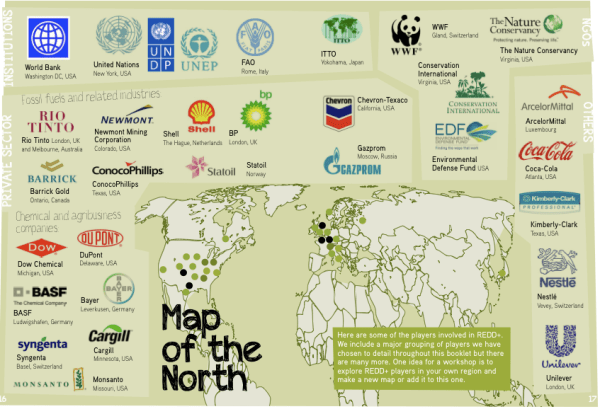

We also came across some amazing educational resources for anyone wanting to do climate justice work. The first is a great online zine that identifies those who benefit from the UN program known as REDD – Reducing Emissions from Deforestation and forest Degradation. While the name sounds like it is committed to climate justice, indigenous groups and farming communities around the world have exposed REDD as another corporate-friendly project. The Indigenous Environmental Network and Carbon Trade Watch have put together this fabulous resource, which you can download here.
Lastly, there is an amazing documentary called The Carbon Connection, which takes a close look at the fallacy of carbon trading. Carbon trading is just another scheme by global capitalists to keep polluting and pretend to actually reduce carbon emissions. You can watch the film online here.
Public Health Concerns, Urban Neoliberal Racism, Mass Poverty, and the Repression of Occupy
This article by Paul Street is re-posted from ZNet, which has all the sources cited in the article.
Consistent with recommendations they received from experts in domestic population control at the FBI and the Department of Homeland Security, big city mayors and police chiefs across the United States have uniformly cited concerns for “public health” and “public safety” in justifying their armed force assaults on and evictions of the Occupy Movement in mid and late November of 2011. [1] This shared and coordinated pretext for urban repression reeks of bad faith and rich irony. The assaults themselves have been monuments to public un-safety, amounting in many cases to militarized state-terrorist raids on peaceful and democratic free speech and public space.[2] The Occupy Movements have been clean, peaceful (nonviolent), safe and healthy, reflecting their determination to prefigure a positive, people-friendly and cooperative future (beyond the rule of the rich and powerful, what the movement has famously labeled “the 1 percent”) and their knowledge that city officials have wanted reasons to close them down. To be sure, given the ubiquity of homelessness and extreme misery among a significant and rising share of the nation’s urban population and the refusal of many idealistic young Occupiers to simply shun the long-demonized urban “underclass,”[3] it was inevitable that the camps would attract a certain number of city residents plagued by addiction, criminal records, mental instability, chronic joblessness, and the like. Still, the Occupy Movement has dealt well and sensitively with the problems of these forgotten and oppressed people, problems that Occupiers hardly created and which Occupiers seek to alleviate and would like to end through positive government action.
Beneath the officially stated reasons for the often vicious and over-the-top, military-style municipal assaults on and break ups of Occupy’s camps lay a cold reality: city officials and police are beholden to overlapping metropolitan financial, corporate, and real estate elites, that is, to members, allies, and servants of the upper 1 percent that Occupy has with no small reason identified as the primary threat to public health, safety and democracy in the U.S. and the world. The masters and their metropolitan servants do not like to see enduring visible and attention-grabbing symbols of popular opposition to the nation’s “unelected dictatorship of money” (Edward S. Herman and David Peterson[4]), whose rule and austerity agenda (imposing increased poverty and insecurity on the Many while profits soar and wealth and power is further concentrated upward in the Few) is widely resented by ordinary U.S. citizens even if only a tiny share of the American populace is willing or able to camp out in cold and grimy city parks. The big city fat cats do not appreciate high profile symbols of how much their system has failed the American people (modern day “Obamavilles” that hark back to the ignominious “Hoovervilles” of the early Great Depression) or vibrant gatherings of energized people who seem to threaten to develop a life and culture beyond the wage- and salary- (and debt- and time-) slavery that is expected of the populace under the rule of capital.
If They Were Serious
City officials who were serious about advancing and protecting public health and safety would divert resources from the repression of their downtown Occupy Movements to meeting the needs of the rising mass of poor and deeply poor citizens stuck in ghetto neighborhoods that wallow in the shadows of urban America’s shining financial districts. A recent chilling study issued on the eve of the holiday season by the Brookings Institution paints a terrifying picture of deepening and increasingly concentrated destitution across the supposed national homeland and headquarters of global “freedom.” “As the first decade of the 2000s drew to a close,” Brookings researchers report on the even of the nation’s holiday season, “the two downturns that book-ended the period, combined with slow job growth between, clearly took their toll on the nation’s less fortunate residents.” Further:”Over a ten-year span, the country saw the poor population grow by 12.3 million, driving the total number of Americans in poverty to a historic high of 46.2 million [emphasis added]. By the end of the decade, over 15 percent of the nation’s population lived below the federal poverty line—$22,314 for a family of four in 2010—though these increases did not occur evenly throughout the country.”[5]
The researchers might have added that the 2010 Census reveals that a record-setting 1 in 15 Americans now lives in what poverty researchers have recently resorted to calling “deep poverty”[6] – at less than half the federal government’s notoriously miserly and inadequate poverty measure (that would at less than $11,157 for a family of four). Furthermore, a recent Census report commissioned by the New York Times shows that 1 in 3 Americans lives either in official poverty or in “near poverty,” either officially poor or at less than 150 percent of the poverty level.[7] Shockingly enough, half of all U.S. children and 90 percent of black U.S. children now depend on Food Stamps at some point during their childhood.[8]
The Race and Geography of Extreme Poverty, Subprime Lending, and Depression Era Unemployment
Nothing is more consistently and positively correlated with poor health, crime, illness, educational failure – with threats to public health and safety – than poverty, a great destroyer of lives and opportunity. At the same time, poverty’s negative impact on its most immediate victims and the broader society is magnified and intensified by the extreme spatial concentration of the poor in high poverty neighborhoods. As the Brookings researchers note in their report The Re-Emergence of Concentrated Poverty: Metropolitan Trends in the 2000s: “Rather than spread evenly, the poor tend to cluster and concentrate in certain neighborhoods or groups of neighborhoods within a community. Very poor neighborhoods face a whole host of challenges that come from concentrated disadvantage—from higher crime rates and poorer health outcomes to lower-quality educational opportunities and weaker job networks .A poor person or family in a very poor neighborhood must then deal not only with the challenges of individual poverty, but also with the added burdens that stem from the place in which they live.” [9] Enduring poverty in a very poor neighborhood subjects poor residents to obstacles and difficulties reaching beyond the costs of individual poverty.
It is one thing to be technically poor but live in a safe “middle class” neighborhood with well-maintained homes, good schools, green space, thriving shops, accessible quality health care, regular public transportation, full-service grocery stores, and other amenities. It is another thing to be poor in a dangerous, crime-ridden, high-poverty neighborhood with boarded up and dilapidated homes, where: the schools feel like jails; intact families are rare; nutrition is purchased under bullet-proofed plastic windows at inflated prices from combination food-liquor stores that lack fresh vegetables and specialize in starchy high sugar and salt items; gangs are prevalent; diabetes, hepatitis, and HIV are near epidemic; prison histories are more common than jobs; more than 40 percent of the men have been saddled with the lifelong mark of a criminal record; incarceration is an almost routine experience for young males; parks are scarce and/or too precarious to visit; doctors and dentists are absent and small shops are rare; taxies never go and public transit is irregular and hard to reach.[10] As sociologist Douglas Massey noted in 1994, “housing markets…distribute much more than a place to live; they also distribute any good or resource that is correlated with where one lives. Housing markets don’t just distribute dwellings, they also distribute education, employment, safety, insurance rates, services, and wealth in the form of home equity; they also determine the level of exposure to crime and drugs, and the peer groups that one’s children experience.”[11]
Massey’s observation notwithstanding, U.S poverty remains highly and (by the Brookings researchers’ finding) increasingly concentrated. After declining somewhat during the long economic boom of the 1990s, Brookings reports, the number of Americans living in “extreme poverty neighborhoods” – where 40 percent of the residents live below the poverty line – rose by one third between 2000 and 2009. Currently in the U.S., 10.5 percent of poor people live in such neighborhoods, up from 9.1 percent in 2000. New York City, where the financial titan turned Mayor recently spent $7 million repressing and finally evicting Occupy from the city’s affluent financial district, is home to 1,575, 032 officially poor people and to 174 extreme poverty census tracts that house 697,375 people, including 375,876 poor. Chicago, where the rugged hippie-punching corporate mayor Rahm Emmanuel (Barack Obama’s former White House chief-of-staff) has consistently denied Occupiers a campsite, is home to 593,000 poor people and to 124 extreme poverty tracts that together house 304,139 people including 140,574 poor. Los Angeles, where Antonio Villaraigosa recently evicted his city’s Occupy Movement over mass public protest, is home to 844,712 poor people and to 65 extreme poverty tracts that house more than a quarter million (264,888) residents. Philadelphia, where Occupy was recently evicted, is home to 352,265 poor people and 58 extreme poverty census tracts that house 222,434 people.[12]
The recently increased concentration of poverty reflects among other things the disastrous impact of two recessions (the most recent one constituting the biggest economic downturn since the 1930s). Unfolding due to the capitalist profits addiction[13] of the Occupation Movement’s official enemy the One Percent, the crises have taken a terrible toll on the employment prospects, net worth, and geographic mobility opportunities for the nation’s disproportionately nonwhite poverty population.
Racial oppression is critical here, beneath the movement’s sometimes simplistic division between the super-rich and “the rest of us” (the 1 Percent and the 99 Percent). The Brookings study’s online version includes a link to maps showing the location of the extreme poverty tracts dozens of American cities.[14] As is obvious to anyone familiar with the racialized geography of these highly segregated metropolises, the maps demonstrate that America’s zones of concentrated urban misery are very disproportionately black and Latino. And indeed, while blacks make up 12.6 percent of overall U.S. population, the Brookings reports that blacks comprise 45 percent of the population (by far and away the largest share) that lives in the nation’s extreme poverty neighborhoods.[15]
The mortgage crisis created by the financial elite and the collapse of the housing market has been particularly devastating in Black and Latino neighborhoods. This is because those households’ net worth is more proportionately tied up in home equity, thanks to the broad absence of financial wealth in the Black and Latino communities. As the leading wealth and power analyst G. William Domhoff explains on his Web site Who Rules America?: “In 2007, the average white household had 15 times as much total wealth as the average African-American or Latino household. If we exclude home equity from the calculations and consider only financial wealth, the ratios are in the neighborhood of 100:1. Extrapolating from these figures, we see that 70% of white families’ wealth is in the form of their principal residence; for Blacks and Hispanics, the figures are 95% and 96%, respectively.”[16] To make matters worse, the predatory home lending practices (carried out by the leading financial institutions owned and run by the One Percent) that did do much to precipitate the mortgage and financial collapse of 2007 and 2008 particularly targeted people of color. As David McNally notes:
“By 1998…subprime mortgages composed one-third of all home loans made to African-Americans and a fifth of those made to Latinos. And the numbers just kept rising. By 2005, 70 percent of all subprime loans made in Washington, D.C. went to African-Americans. A year later, African-Americans received 41 percent of all sub-prime mortgages in New York, while 29 percent went to Latinos. Women of color were especially vulnerable to subprime extortion Inevitably, as the mortgage rates kicked higher it became increasingly difficult for the borrowers to make payments, especially as job loss soared, especially among workers of color, reducing peoples’ capacity to pay.”[17]
Incredibly enough but consistent with longstanding racial patterns in U.S. labor markets, four of every ten black Americans experienced unemployment during the 2008-09 Great Recession. As McNally elaborates: “Throughout the first half of 2010, official unemployment among blacks was over 16 percent, while among Latinos, it hovered around 13 percent. In thirty-five of America’s largest cities, official jobless rates for blacks were between 30 and 35 percent- levels equal to the worst days of the Great Depression [emphasis added]….Not surprisingly, blacks and Latinos are almost three times more likely to live in poverty than whites.”[18]
In today’s New York Times (I am writing on the morning of Thursday, December 1, 2011), liberal columnist Nicholas Kristof reflects on the recollections of former Chase Home Finance regional vice president James Theckston, who told Kristof how he won company accolades for high sales in 2006 and 2007. Theckston “says that some account executives earned a commission seven times higher from subprime loans, rather than prime mortgages. So they looked for less savvy borrowers — those with less education, without previous mortgage experience, or without fluent English — and nudged them toward subprime loans…These less savvy borrowers were disproportionately blacks and Latinos, he said, and they ended up paying a higher rate so that they were more likely to lose their homes. Senior executives seemed aware of this racial mismatch, he recalled, and frantically tried to cover it up,” Kristof writes. “If you want to understand why the Occupy movement has found such traction,” Kristof comments, “it helps to listen to a former banker like Theckston. He fully acknowledges that he and other bankers are mostly responsible for the country’s housing mess.”[19]
Militarized Policing in the “Free Market” Era:
According to a recent Associated Press report, 18 U.S. cities including New York City spent 13 million taxpayer dollars on the policing and repression of their local Occupy Movements between the rise of Occupy Wall Street in mid-September and Bloomberg’s recent quasi-totalitarian police-state tear-down[20] of the original Occupy Wall Street (OWS) camp in the New York City financial district’s Zucotti Park.[21] Urban policymakers who were actually serious about protecting public health and safety would have spent that money (itself a small drop in the bucket of the vast taxpayer expense of public service to corporate and financial America[22]) instead on various forms of direct social service (health and child care, drug counseling, education, food and nutrition, recreation, and …the list of unmet needs to address goes on) to the many and growing number of primarily nonwhite extreme poverty neighborhoods that have been struggling for many decades in the invisible and painful shadows of the profits system – the system that Occupy has tried in its own imperfect ways to oppose. The needs of those communities and the broader mass of the rising American poverty and near-poverty populations do not jibe with the longstanding corporate neoliberal agenda that serves and protects “the One Percent” – the top hundredth of disproportionately Caucasian corporate and financial masters who own more than a third of the nation’s wealth and a larger share of its elected officials while an increasing share of the citizenry slips into the nation’s disproportionately nonwhite misery class.[23]
In the dominant public discourse shaped by that agenda, the nation’s “pervasive racial hierarchies collapse,” in the words of the prolific social critic Henry Giroux, “into power-evasive strategies such as blaming minorities of class and color for not working hard enough, refusing to exercised individual initiative, or practicing reverse racism.” Even as an insidious, increasingly invisible racism “functions” as “one of the deep and abiding currents in everyday [American] life,” this discourse works “to erase the social from the language of public life as to reduce all racial problems to private issues [of]…individual character and cultural depravity.” This “neoliberal racism,” as Giroux calls it, “can imagine public issues only as private concerns. It sees “human agency as simply a matter of individualized choices, the only obstacle to effective citizenship being the lack of principled self-help and moral responsibility” on the part of those most victimized by structural oppression and the amoral agency of those super-empowered actors who stand atop the nation’s steep and interrelated hierarchies of class and race. Under its rule, “human misery is largely defined as a function of personal choices,” consistent with “the central neoliberal tenet that all problems are private rather than social in nature.” [24] Government efforts to meaningfully address and ameliorate (not to mention abolish) sharp societal disparities of race and class are deemed alternately futile, counterproductive, and inappropriate. Government’s functions are progressively concentrated on “making war,” “enhancing opportunities for the investor class,” “suppressing wages for everyone else,” and “suppressing dissent.”[25]
Over the last generation, the dominant U.S. neoliberal ideology advanced by and for the elite has masterfully disseminated a fantasy struggle between the allegedly evil state and the supposedly virtuous (and supposedly free) “free market.” At its “conservative” (radically regressive) extremes, the ideology’s proponents have proclaimed a desire to “starve the [government] beast” and “cut government down to the size where we can drown it in the bathtub” (leading Republican anti-tax guru Grover Norquist). Beneath quasi-libertarian discourse about the epic conflict between “stultifying government bureaucracy” (bad) and “free market” capitalism (good), however, neoliberalism’s corporate sponsors and beneficiaries have unfailingly sought to wield and profit from government policy of a particular sort. Consistent with a state-capitalist Western profits system and corporate order that has always relied heavily on government protection and assistance, they have only targeted certain parts of the public sector for malnourishment. They have de-funded and de-legitimized what the late French sociologist Pierre Bourdieu called “the left hand of the state”: programs and services won by past popular struggles and social movements for social justice, equality, and inclusion. They do not wish to take the budgetary or policy axe to the “right hand of the state”: the parts that provide service and subsidy (corporate welfare) to concentrated wealth and dole out punishment (including rampant mass incarceration and felony-marking[26]) for the poor. They do not wish to dismantle America’s military-industrial and imperial complex, a form of massive public transfer to, and protection for “private” high-tech firms like Exxon, Boeing, Lockheed-Martin, and Raytheon.[27]
State-capitalist neoliberalism’s disingenuous “anti-government” rhetoric cloaks the actual and core policy question. During the last three and half decade as through all of American history, the real issue is NOT whether government can or should “work.” It’s who government should work for: the US public and the common good or the nation’s leading centers of concentrated wealth and power?[28] Along the way, the not-so “free market” neoliberal era has hardly abolished the wealthy Few’s longstanding reliance on the state’s repressive functions to control the Many who must understand that they have no option but to rent themselves out at a properly profitable price to the capitalist employer class. As McNally notes:
“when capitalist market relations become widely normalized, states do not regularly have to behave in…blatantly brutal ways to keep their work forces in line. Much can be left to the quiet violence of the capitalist economy in which dispossession (owning no productive assets except for one’s ability to work) compels people to submit to the unyielding disciplinary regimes of wage labor.”
“But while much can be left to the market discipline, not everything can. That is why law, police, prisons, and direct force remain omnipresent. Indeed, the intensified disciplinary regimes of the neoliberal period – punitive laws against panhandling or sleeping in parks, widespread incarceration of those found with small bits of drugs, harsher street-level policing and jail terms, and ever more people stuffed into prisons – are sharp reminders that the coercive powers of the state will be regularly mobilized every time the ‘work ethic’ and social discipline seem to be waning…..[Thus]…Under the guise of a so-called ‘war on drugs,’ militarized policing has been imposed on poor and racialized communities across the U.S. as well countries like Mexico and Columbia….imprisonment has become the preferred form of social control of largely racialized ‘surplus populations.’ It is prisons – not schools or even job training programs – that secure the disciplinary ethos of neoliberalism.”[29]
The punitive right-handed function of the state in relation to the mostly Black and Latino urban and suburban poor actually grows in proportion to the assault on the left hand of government. The less authorities are willing or able to offer inclusion and protection for those at the bottom of the nation’s steep pyramids of class and race, the more those authorities must respond to the “underclass’s” plight with the iron fist of repression.
“Government Writ Large is Not the Problem”
To its credit, despite the problematic presence in its ranks of some from the “libertarian” right, the genuinely populist Occupy Movement has never opposed government as such but rather the capture and control of government by the rich and powerful. The fake-populist “Tea Party”[30] and the broader reactionary trend of elite-managed U.S. political culture more generally directs popular ire (quite disingenuously) at “government” per se and trumpets the deceptive virtues of self-reliance and the unalterable rectitude of the so-called free market. As Time’s Ishaan Thoroor noted in a thoughtful early response to media commentators who quickly labeled OWS “the Tea Party of the left,” Occupy has sought not to demonize and destroy the state but rather to democratize government by taking it back from economic elites and building its positive possibilities from the bottom up:
“The answer, for many of the protesters I’ve spoken with, is never the wholesale dismantling or whittling away of the capabilities of political institutions (except, perhaps, the Fed), but a subtler disentangling of Wall Street from Washington. Government writ large is not the problem, just the current sort of government….. Occupy Wall Street, like most idealistic social movements, wants real political solutions. Excited activists in Zuccotti Park spoke to me about the advent of ‘participatory budgeting’ in a number of City Council districts in New York — an egalitarian system, first brought about in leftist-run cities in Latin America, that allows communities to dole out funds in their neighborhoods through deliberation and consensus-building. It’s the same process that gets played out every day by the activist general assemblies held in Zuccotti Park and other occupation sites around the U.S. To the outside observer, that may seem foolishly utopian — and impracticable on a larger scale — but it’s a sign of the deep political commitments of many of the motley protesters gathering under Occupy Wall Street’s banner. They want to fix government, not escape from it [emphasis added].” [31]
A democratic and participatory budgeting system in urban America would surely find something better to do with $13 million in eighteen poverty-ridden U.S. cities than the high-tech authoritarian-cleansing of youthful and populist dissenters on false public safety and health pretexts by the likes of Michael Bloomberg, the twelfth richest person in the U.S.
Given the corporate and financial stranglehold on U.S. urban governments, it is hardly surprising that the mostly white (but consistently non- and anti-racist) sleep-and eat-in-the-urban-park Occupy Movement has itself come face-to-face (well face-to-Darth-Vader-visor) with the right and militarized police hand of the repressive state that has been so ubiquitous in the nation’s urban communities of color throughout the long mass-incarceration-ist neoliberal era. Large numbers of young white progressive and radicals have been given an instructive new taste of what many Black and Latino youth have been experiencing for decades in the disingenuous name of “the free market.” Let the lessons be learned as we build toward ever more epic, multiracial and many-sided struggles with the rich and powerful Few who are crucifying, our cities, our civil rights and social justice ideals, and livable ecology[32] on a cross of capitalistic greed.
As we mentioned in a previous posting, there was a World AIDS Day event at the downtown campus of GVSU.
The event featured two speakers, but we were only able to hear part of the presentation by Todd Heywood who entitled his talk, Viral Apartheid.
Todd himself has been HIV positive since 2007, is a senior reporter for the American Independent News Network and a leading reporter on HIV/AIDS, with emphasis on the policy aspects of HIV/AIDS.
Heywood spoke about the two types of criminalization those with HIV/AIDS and the historical factors, which have contributed the social marginalization of people with HIV/AIDS. Todd talked about Michigan law and federal law both and gave some specific examples of how these laws impact people with HIV/AIDS.
Heywood spoke about how there is still a tremendous amount of ignorance and misinformation about the virus, despite it being with us in the US for roughly three decades. The independent reporter mentioned a report by the Kaiser Family Foundation, AIDS at 30, which reflects the attitudes and opinions of American about HIV/AIDS.
We were not able to stay for the bulk of the presentation, but we were able to do a short interview with Todd, before he addressed a crowd of roughly 70 people in the Eberhard Center at the downtown GVSU campus.
Does MoveOn work for the 99% or the Democrats?
Today, MoveOn.org was calling for 99% Congressional Speak-Out actions, but encouraging people to go to the offices of members of Congress all across the country.
An action was planned today for 1:00 PM at the Federal building in Grand Rapids, with less than 10 people showing up during the time this writer was there. The local MoveOn.org group also was encouraging people to sign an online petition calling on Rep. Amash to support job creation legislation. Part of the petition language reads as follows:
Unemployment remains at 14 million Americans and a stubborn 15% in Michigan. While Rep. Amash and the Republicans refuse to compromise on raising taxes on the 1% and balancing the budget at the cost of Medicare and Social Security, working Americans are slipping further and further into debt. While balancing the budget should be a long-term concern, the needs of the 99% should take precedence in any legislation before Congress.
The language clearly indicates that MoveOn wants to lay the blame for the current unemployment crisis at the feet of Republicans, since as numerous writers have pointed out for years, MoveOn.org is an operative of the Democratic Party.
The MoveOn 99% Congressional Speak-Out text also says, “On December 1, we’ll organize hundreds of “99% Congressional Speak-Outs” at local congressional offices to express our disgust that Washington has done nothing for the struggling majority. We’ll tell Democrats to act like Democrats and fight for Jobs Not Cuts—and we’ll expose the GOP’s all-out effort to give tax breaks to millionaires.”
Again, the bulk of the blame for our economic crisis is laid at the feet of the GOP, which is simply not true. The current financial crisis and economic policies that support the 1% have been a bi-partisan affair.
What is also objectionable about the MoveOn action is that it attempts to co-opt the language of the Occupy Movement by using terms like the 99% and the 1%. Their new add, Be Democrats, also uses the occupy language, but ignores the fact that the occupy movement has been clearly opposed to the bi-partisan support for Wall Street, political corruption and complicity in systemic exploitation. To watch the Be Democrats ad, one gets the impression that Democrats are generally for working class people. The ad spokesperson says that Democrats support welfare policies, which completely ignores the fact that much of the welfare system in the US was gutted under the Clinton administration.
The co-optation of the occupy movement by the Democrats and their operatives like MoveOn is dissected clearly in a recent article by Kevin Zeese, which points out that MoveOn has a history of undermining grassroots efforts for radical change since the beginning of the George W. Bush administration. And lest we forget, MoveOn started as an effort to stop any impeachment proceedings against former President Bill Clinton. Zeese ends his criticism of MoveOn, Rebuild the Dream and the Democrats by stating:
MoveOn and Rebuild the Dream can prove us wrong if they come forward with a non-partisan statement saying they will fight against any elected official, of any party, in any office, who has not lived up to the anti-militarism and anti-corporatist agenda, especially the president.
Until that statement is made Democratic Party operatives and their allied groups should back off the Occupy Movement. You have a different strategy – working inside the Democratic Party, working inside the limits of the corrupt machine while we want to transform American politics.
Get out of our way.
It’s Time to Occupy the FCC
This article by Bruce Dixon is re-posted from Black Agenda Report.
You’d have to look long and hard to find a government agency more transparently devoted to serving greedy corporate interests at the public expense than the Federal Communications Commission. According to the Federal Communications Act of 1934, the FCC is supposed to regulate the broadcast airwaves, telephony, the Internet and cable industries in the public interest. It’s not even a bad joke. For decades, virtually every top level FCC staffer and commissioner has left the through the revolving door that leads straight to lucrative work for the broadcasters, Big Cable, or the telecoms.
Here’s a look at the tiniest tip of the iceberg, the post-FCC careers of its past several chairs.
| FCC Chairman | From | Who they work for now… and who the current one served before this |
| Julius Genachowski | 2009 -present | A former AT&T lobbyist and Clinton White House counsel, helped write the Telecommunications Act of 1996, which gave the internet backbone, built with hundreds of billions of taxpayer dollars to AT&T and other telecoms for pennies on the dollar. |
| Kevin Martin | 2005-2009 | Now works at Patton Boggs, a bipartisan DC lobbying firm that represents telecoms, broadcasters, the recording industry and Big Cable. |
| Michael Powell | 2001-2005 | First appointed to FCC by Clinton in 1997, Powell now heads theNational Cable & Broadcasters Association, the front group for Comcast and the rest of Big Cable |
| William E. Kennard | 1997-2001 | Currently US Ambassador to the European Union, where he insists that Europe privatize its internet backbone and municipal wifi services and let US cellular carriers in to saddle customers with US style multiyear contracts and penalties. |
| Reed Hundt | 1993-1997 | Works for management and private equity firms that represent or own cable companies, broadcasters, the recording industry and blocks of telecom stock. |
The FCC is supposed to manage the broadcast frequencies in the public interest. But it grants the enormous, greedy corporations that own most radio and TV stations monopoly licenses to operate their highly profitable businesses upon the scarce publicly owned spectrum with absolutely no obligations to provide local news, local voices or meaningful public service.
When digital technology increased the number of possible broadcast stations several fold, the FCC never considered offering those frequencies to new women and minority nonprofit broadcasters who would be eager to air the voices and provide the news and public service commercial broadcasters won’t. Incredibly, the FCC gave the new station frequencies to the same old broadcasters, as if they owned them instead of the public! These old TV frequencies are excellent for penetrating walls, and could also be used to deliver municipal broadband to communities, eliminating the digital divide once and for all.
Instead, now that licensees have no use for the frequencies the FCC has begun to permanently privatize them by auctioning them off to telecoms.
The FCC regulates the land line and cell phone industries as well, but not in the public interest. The US has some of the highest cell phone rates in the world, with multiyear contracts and penalties that are illegal in much of the world. In Europe, for example, cell phone customers looking for a better deal can change contracts and companies every month with no penalties or credit checks and keep their existing phones and numbers. The FCC never challenges the arbitrary and deceptive billing practices of phone and cable companies or bothers to educate the public on things like the fact that text message delivery, excluding the cost of billing, costs them absolutely nothing.
In recent years, the FCC has decided that regulating the cable industry was something it just didn’t want to do, and that was that, leaving millions of us at the tender mercies of Big Cable. The FCC has stood aside and refused to challenge dozens of state laws like Pennsylvania’s which ban cities and towns from constructing their own cable, broadband and wifi networks to compete with Comcast, Verizon, AT&T and others whose preference for serving only premium customers is the origin of the digital divide.
Fast, cheap and ubiquitous broadband will be as key to community economic development, to people accessing education, medical care, government services and entrepreneurship in the 21st century as paved roads. But the FCC’s preference for private profits over the public good has meant that in the US, where the internet was invented, internet speeds are slower and more expensive than in more than a dozen other countries, and that high speed internet is available to proportionately fewer here than in 12 to 20 other countries, depending on how this is measured.
The FCC has failed to protect network neutrality, the notion doctrine that would forbid Comcast, AT&T and “owners” of the internet from discriminating against or banning outright content, devices or software they don’t like, or favoring some content with faster and more reliable service for a higher price, as AT&T, Verizon, T-Mobile, Boost Mobile and other carriers are already doing.
The FCC’s commissioners, staff and advisors are ludicrously out of touch, and seem perfectly happy that way. So when the FCC gave short notice that two commissioners would visit Atlanta this week for three hours on a single day during the evening rush hour, allegedly “to assess the communications needs” of metro Atlanta, they were operating as they normally do. But we also hope they get something they normally don’t, like a rude surprise.
We can’t promise, but we hope, that local residents in Atlanta tomorrow make their voices heard when the FCC shows up, at GA Tech’s auditorium, 250 14th St. NW from 5 to 8 PM.
We hope that local residents will demand that the broadcast frequency privatization auctions be halted.
We expect locals will demand that the frequencies be given to new nonprofit broadcasters — many of them women and minorities who will undertake the missions of serving local communities, gathering and broadcasting local news, showcasing local artists and local voices. Metro Atlanta has five and a half million people, and a single community radio station. It should and can have a dozen fully funded community radio and TV stations.
We imagine that since the commercial broadcasters, according to the 1934 law, do have a public service obligation, hold their broadcast licenses as a public trust, and have made buckets of money for decades, that local residents will demand that all commercial broadcasters and cable operators be forced to pay the costs of the nonprofit community broadcasters.
We imagine that legislators, FCC commissioners, their judge and lobbyist buddies and bosses will all think these sensible and equitable demands are politically beyond the pale and “off the table.” So we can’t ask their permission. They’re not listening anyway. It’s time for us to occupy that table, and demand what we really need —- a media regime, a broadcast regime that serves the needs of the people. It’s time for the people to withdraw their consent from rules that serve the fraction of one percent at the expense of the rest of us.
It’s time to occupy the FCC.
Climate Summit Day Four: Anti-capitalist analysis, Protests against Shell and Occupy COP17
While no real action has taken place with the government representatives in the first few days of the UN Climate Summit, there has been plenty of activity from the grassroots.
The Indigenous Environmental Network spent time protesting at a Shell oil refinery near Durban as heads of state continue to be influenced by Big Oil on the direction of the Climate Summit talks. Africans are well aware of the deadly practices of companies like Shell oil, which has destroyed much of the Ogoni land in Nigeria and was complicit in the deaths of anti-Shell activists.
The Occupy COP17 has also been active in the first few days, hosting forums with speakers from around the world and developing an action plan to confront the Climate Summit leaders. Besides the discussions and planning the Occupy COP 17 group displayed lots of donated art work and even participated in some guerrilla gardening, planting food and flowers near the location where the Summit is being held.
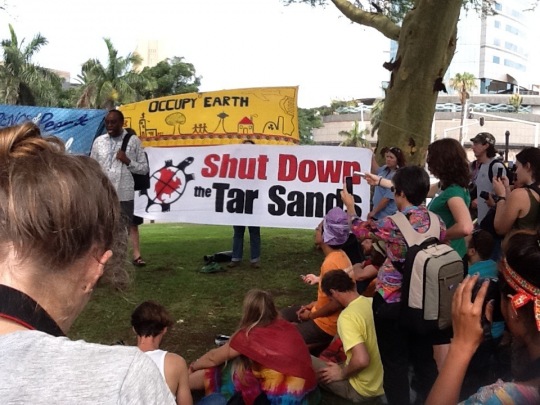
In addition to acts of resistance there have been several new articles, which provide important analysis and give context to the Climate Summit talks.
Longtime South African activist and writer Patrick Bond posted an excerpt from a recent book on Climate Justice on ZNet. The post critiques the African National Congress (ANC) and its role in caving in to the interests of multinational corporations, particularly energy companies who have pillaged South Africa in recent years.
In addition, Chris Williams, author of Ecology and Socialism: Solutions to Capitalist Ecological Crisis, has an excellent article on Counter Punch. Williams discusses the current data on global warming based on numerous sources and recent reports and much of that data concludes that global warming is actually worse than was originally projected.
Williams goes on to talk about the lack of any real action from countries like the US and the European Union. These rich countries, in Williams’ assessment, are determined to derail any serious efforts to get an international agreement on carbon emission reduction that would actually make a difference.
Williams concludes his article by arguing that the major reason for the positions taken by the US and the European Union are their adherence to capitalism, which necessitates imperialist policies towards the rest of the world in order to control their energy resources.

In 1991, the Lesbian and Gay Network of West Michigan had begun its campaign to get the City of Grand Rapids to pass an ordinance that would provide anti-discrimination protections for the LGBT community.
The ordinance did not pass until 1994, but for three years people were talking about this issue, organizing and raising awareness.
A Grand Rapids City High student named Gene Sampson hosted a show on the Grand Rapids Cable Access Channel GRTV in 1991, which featured two members of the Lesbian and Gay Network, Dr. Holly Van Scoy and Bryan Ribbens. The other two guests on the show were Bill & Jan Van Oosterhout, who at the time were members of PFLAG – Parents, Families and Friends of Lesbians and Gays.
The show is in two parts, where Gene and his guests talk about homophobia, the ordinance campaign and challenging attitudes and stereotypes about the LGBT community.
Both of these videos are now on the Grand Rapids LGBTQ People’s History Project site, thanks to Bryan Ribbens.
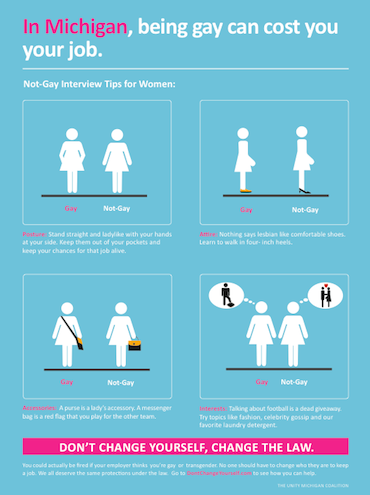
The group Unity Michigan has created some rather humorous resources to “help” protect you from being perceived as being LGBT, which could cost you your job in Michigan.
The campaign is definitely funny, but this issue is very serious. However, satire can sometimes be an effect tool of resistance. Here is one of their posters on how men and women can change their appearance so as to not look “gay.”
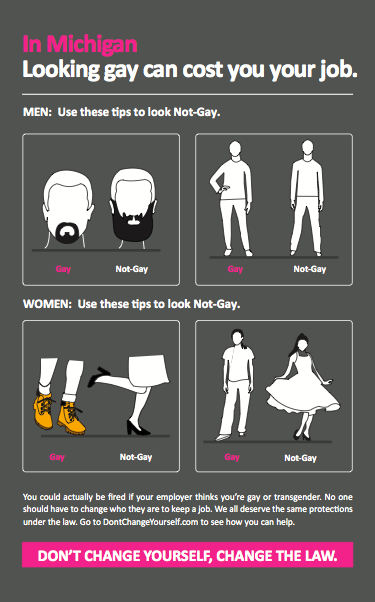
Here is another posted that provides women interview tips.
Lastly, you don’t want to give any indication that you are LGBT, so use appropriate screen savers so that your co-workers think you are a “real man” or “real woman.”

LGBTQ History Project: Grand Rapids Front Runners & Walkers film
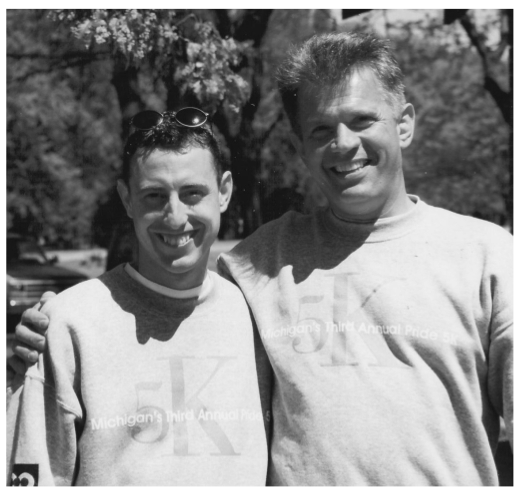
The Grand Rapids LGBTQ People’s History Project has just added some new resources, with particular emphasis on the Grand Rapids Front Runners and Walkers group.
There is a 21-minute documentary done about the group you can now view online (and below) and a booklet that was produced for their 15th year anniversary from 1993 – 2008.
There is also an interview with David Morris, one of the co-founders of Grand Rapids Front Runners and Walkers.
Event this Saturday will present information on the function of a Grand Jury in State Repression
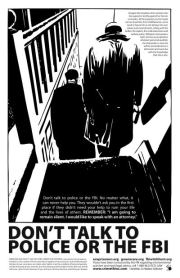
This Saturday, the Bloom Collective is hosting a potluck/discussion on “the political function of a Grand Jury in State Repression, with historic and contemporary examples. The discussion will present Know Your Rights information and ways that we can collectively resist the political use of Grand Juries.”
Considering that several local people have been summoned before a Grand Jury in recent months surrounding the issue of property destruction in the East Hills neighborhood, this discussion might provide people with useful information to Know Their Rights.
Some resources that are worth looking at ahead of time or if you can’t make this discussion can be found at the Grand Jury Resistance Project and this White Paper from the Center for Constitutional Rights.
What do you do when you are summoned before a Grand Jury?
Saturday, December 3
1 – 3:00PM
Bloom Collective
671 Davis, NW Grand Rapids
 Grand Rapids Institute for Information Democracy