Noted author Norman Finkelstein spoke to audience at GVSU
Last night, author Norman Finkelstein addressed a crowd of roughly 250 at the downtown campus of GVSU. The event was hosted by the student group Peace M.E.ans, which is committed to education and dialogue around the conflict between the Palestinians and Israel.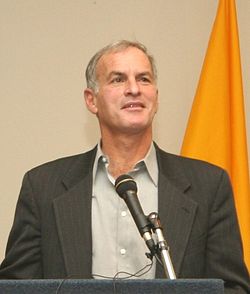
Finkelstein began by talking a bit about his own history of being involved in the Israeli/Palestinian conflict. He said that the June 1982 Israeli invasion of Lebanon was what motivated to pursue this issue both academically and politically.
He next addressed the notion that some people believe that he is obsessed with the topic of Israel/Palestine, but Finkelstein clearly stated that this issue is still a serious problem and that since the Palestinians can’t give up, neither should we.
Finkelstein spoke about the longevity of this conflict and stated that its origin was with the Balfour Declaration of 1917, the same year as the Russia Revolution. However, unlike communism, the Israeli/Palestinian conflict still continues. In some ways, Finkelstein says, the conflict seems rather “insane.”
The speaker stated that with the ongoing discussion about jump starting the peace process, Finkelstein thinks that the conflict needs to truly be resolved and we should do away with ridiculous clichés like “Peace Process.”
Finkelstein also believes that the majority of Americans at least are aware of the fact that there is a serious problem between Israelis and Palestinians. What has changed in recent years is that more people recognize that Israel has a greater burden of responsibility for the conflict.
The noted author then stated that he believes that there is a greater chance to resolve this conflict than there has been in recent years. First, some of their strongest allies in the region, such as Turkey, have distanced themselves from Israel. The current President of Turkey recognizes that the population of his country supports the Palestinian struggle. Another traditional ally of Israel, Egypt, has also shifted its position since the overthrow of the three decades dictatorship of Mubarak.
Finkelstein then said another reason why there is a strong chance for resolving the conflict is because Israel’s political stock has declined. He referred to an annual BBC poll of worst countries in the world and the list always includes Iran, North Korea, Pakistan and Israel.
Another reason why the timing is ripe for resolving the conflict is the fact that virtually every country supports the Palestinians right to have their own state. Finkelstein even said that the majority of US citizens polled agreed to a Palestinian state. Despite the public support for Palestinian statehood, President Obama opposes it, both major parties, the US House and Senate and all the major news agencies in the US. Finkelstein believes that with all the major political institutions and major media in opposition to Palestinian statehood it is amazing that the majority of Americans think otherwise.
Finkelstein also stated that there has been a shift amongst American Jews who are having a difficult time justifying Israeli policy.
The speaker then shifts to this notion of how Israel continues to engage in war and devastation, citing the Israeli support for the US invasion of Iraq in 2003, the bombing of Lebanon in 2006, the Israeli war on Gaza……..and now they want a war with Iran. Finkelstein, speaking as if he is utterly astounded, spoke about the audacity of Israel’s desire to go to war with Iran, despite the fact that they are still burying bodies in Gaza.
To illustrate the brazen disregard for human rights that Israel has, he mentions a resolution the UN passed, implementing a ceasefire in Lebanon. For the next three days after this ceasefire resolution Israel drops 1 million cluster bomblets on civilians. In 2009, Finkelstein also said Israelis dropped phosphorous bombs on Palestinians, even hospitals.
Finkelstein said the time is now to present reasonable and uniform solutions to the American people before you lose them. A one state, two state or a secular state solution? Finkelstein says this seems very confusing to many people, so we need to present a reasonable goal to the public.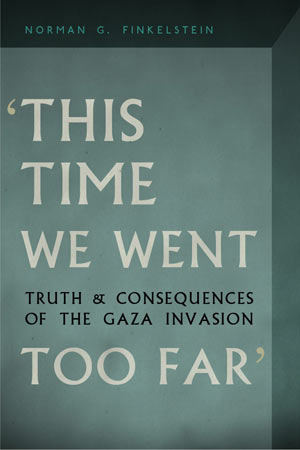
The solution that Finkelstein presented is in part based on what others have thought about a solution. Finkelstein says he looked to Gandhi, who faced a similar situation, when the British was occupying India. Gandhi thought that the only thing that would work in India was a non-violent revolution, which Finkelstein believes is the only viable strategy that Palestinians can use to end the Israeli occupation.
Gandhi said that politics is not about influencing public opinion it is about getting people to take action because they already known what is wrong. Therefore, when people engage in civil disobedience it can motivate others to want to do the same. Finkelstein said that we have to move beyond our collective indignation and take action against injustice.
First, politics is not about what you support, it is about what the public is willing to support. Politics is not about you personal moral code, especially if you want to build a political movement.
The obvious answer to what should be done about the Israel/Palestinian conflict is a full Israeli withdrawal from the territories occupied since 1967 and a resolution to the Palestinian refugee right of return. There is virtually a global consensus on these matters based on UN General Assembly Resolutions. Everyone votes for it with the exception of the US, Israel and sometimes a few island nations in the south Pacific.
If you turn to the International Court of Justice it is clear what should be done, since they clearly state that you cannot obtain land through violence and force. Also, under international law you cannot transfer one population to the land of the occupied group, such as what the Israelis have done with the settlements. Both Amnesty International and Human Rights Watch have stated that the Palestinian refugees have a legal right of return to the lands now occupied by Israel.
You can draw three conclusions from this matter. First, despite the claim of these dynamics being controversial, they are not controversial within the international community. Secondly, from a legal point of view Israel doesn’t have a leg to stand on. International law is behind the Palestinians on these major aspects of the conflict. Third, and related to the first two, is the fact that Israel is a state. This means they have the same rights and responsibility as all states to follow international law. So, if you want to assert the illegal occupation of Israel, the illegality of the settlements and the right of refugee return, you must also recognize the right of Israel to exist and maintain its pre-1967 borders.
Therefore, Finkelstein believes that the only realist position to take is to stand behind international law and accept the pre-1967 borders. There is no point to take the position that the 1948 means in which Israel won statehood was unjust, so we want them to leave that land altogether. So, the Palestinians need to accept the Israeli state, is the argument. However, Finkelstein states that Israel signed peace agreements with Egypt in 1979 and Jordan in 1994 and both those countries did not agree to acknowledge Israel’s right to exist. So why are they doing this with the Palestinians.
Finkelstein spoke for over 2 hours straight, which seemed hard on many of the audience members. For this writer, what was difficult to hear was a different kind of argument and focus from Finkelstein. He strayed from his usual assault on Israeli and US policy towards Palestinians and he didn’t spend adequate time on the current US administration’s policies that have continued Israel’s assault on Gaza, construction of settlements and pushing for war with Iran.
It was a side of Finkelstein that one would not get from his books and his previous lectures and it left this writer a bit confused.


This was pretty interesting… I enjoyed the event even though I am not as up to date on the issues as I should be… I scored a copy of the book to get educated better… I really enjoyed capturing video of Norman talking with a few of us after the discussion… some very cool conversation went down
Glad to hear you did some filming. Can you let us know when that footage gets posted?