1% Art: Who are the patrons of contemporary art today?
This article by Andrea Fraser is re-posted from Adbusters. Editor’s Note: On the local level it is worth noting who sits on the board of directors for the two major year-round art facilities in Grand Rapids, UICA and GRAM.

Who are the patrons of contemporary art today? The ARTnews 200 Top Collectors list is an obvious place to start. Near the top of the alphabetical list is Roman Abramovich, estimated by Forbes to be worth $13.4 billion.
He has admitted to paying billions in bribes for control of Russian oil and aluminum assets. Bernard Arnault, listed by Forbes as the fourth richest man in the world with $41 billion, controls the luxury goods conglomerate LVMH, which, despite the debt crisis, reported a sales growth of 13 percent in the first half of 2011. Hedge fund manager John Arnold, who got his start at Enron–where he received an $8 million bonus just before it collapsed–recently gave $150,000 to an organization seeking to limit public pensions. MoMA, MoCA and LACMA trustee Eli Broad is worth $5.8 billion and was a board member and major shareholder of the now notorious AIG. Steven A. Cohen, estimated to be worth $8 billion, is the founder of SAC Capital Advisors, which is under investigation for insider trading. Guggenheim trustee Dimitris Daskalopoulos, who is also chairman of the Hellenic Federation of Enterprises, recently called for a “modern private initiative” to save the failing Greek economy from a “bloated and parasitic” “patronage-ridden state.” Another Guggenheim trustee, David Ganek, recently shut down his $4 billion Level Global hedge fund after an FBI raid.
Noam Gottesman and former partner Pierre Lagrange (also on the ARTnews list) earned £400 million each on the sale of their hedge fund GLG in 2007, making them “among the world’s biggest winners from the credit crunch,” according to the Sunday Times. Hedge fund manager Kenneth C. Griffin supported Obama in 2008 but recently gave $500,000 to a political action committee created by former Bush adviser Karl Rove and was also seen at a meeting of the right-wing-populist Koch Network. Andrew Hill’s $100 million in compensation in 2009 led Citigroup to sell its Philbro division, where he was the top trader, after pressures from regulators to curtail his pay on the heels of Citigroup’s receipt of $45 billion in US federal bailout funds (he subsequently moved the company offshore). Damien Hirst, estimated by the Sunday Times to be worth £215 million, is one of a handful of artists who have now made rich-lists alongside their patrons. Peter Kraus collected $25 million for just three months’ work when his exit package was triggered by Merrill Lynch’s sale to Bank of America with the help of US federal funds. Henry Kravis’s income in 2007 was reported to be $1.3 million a day. His wife, economist Marie-Josée Kravis, who is MoMA’s president and a fellow at the neoconservative Hudson Institute, recently defended “Anglo-Saxon capitalism” against “Europe’s ‘social capitalist politics’” in Forbes.com. Daniel S. Loeb, a MoCA trustee and founder of the $7.8 billion hedge fund Third Point, sent a letter to investors attacking Obama for “insisting that the only solution to the nation’s problems … lies in the redistribution of wealth.” Dimitri Mavrommatis, the “Swiss-based” Greek asset manager, paid £18 million for a Picasso at Christie’s on June 21, 2011, while Greeks were rioting against austerity measures. And of course, there is Charles Saatchi, who helped elect Margaret Thatcher. The firm of MoMA chairman Jerry Speyer defaulted on a major real estate investment in 2010, losing $500 million for the California State Pension Fund and up to $2 billion in debt secured by US federal agencies. Reinhold Würth, worth $5.7 billion, has been fined for tax evasion in Germany and compared taxation to torture. He recently acquired Virgin of Mercy by Hans Holbein the Younger, paying the highest price ever for an artwork in Germany and outbidding the Städelsche Kunstinstitut in Frankfurt/Main, where the painting had been on display since 2003.
In the midst of an economic crisis, the art world is experiencing an ongoing market boom which has been widely linked to the rise of High Net Worth Individuals (HNWI) and Ultra-HNWIs (people worth over $1 million or $30 million respectively), particularly from the financial industry. A recent report by Art+Auction even celebrated indicators that these groups were rebounding from their 2008 dip to precrisis wealth. Until recently, however, there has been very little discussion of the obvious link between the art world’s global expansion and rising income disparity. A quick look the Gini index, a measure of income inequality, shows that the countries with the most significant art booms of the past two decades have also experienced the steepest rise in inequality: the United States, Britain, China and India. Further, recent economic research has established a direct connection between skyrocketing art prices and income inequality, showing that “a one percentage point increase in the share of total income earned by the top 0.1% triggers an increase in art prices of about 14 percent.” It is now painfully obvious that what has been extraordinarily good for the art world over the past decades has been disastrous for the rest of the world.
In the United States it is difficult to imagine any arts organization or practice that can escape the economic structures and policies that have produced this inequality. The private nonprofit model–which almost all US museums as well as alternative art organizations exist within–is dependent on wealthy donors and has its origins in the same ideology that led to the current global economic crisis: that private initiatives are better suited to fulfill social needs than the public sector and that wealth is best administered by the wealthy. Even outside of institutions, artists engaged in community-based and social practices that aim to provide public benefit in a time of austerity simply may be enacting what George H. W. Bush called for when he envisioned volunteers and community organizations spreading like “a thousand points of lights’ in the wake of his rollback in public spending.
Progressive artists, critics and curators face an existential crisis: how can we continue to justify our involvement in this art economy? At minimum, if our only choice is to participate or to abandon the art field entirely, we can stop rationalizing that participation in the name of critical or political art practices or–adding insult to injury–social justice. Any claim that we represent a progressive social force while our activities are directly subsidized by, and benefit from, the engines of inequality can only contribute to the justification of that inequality. The only true “alternative” today is to recognize our participation in this economy and confront it in an open, direct and immediate way in all of our institutions, including museums and galleries and publications. Despite the radical political rhetoric that abounds in the art world, censorship and self-censorship reign when it comes to confronting our economic conditions, except in marginalized (often self-marginalized) arenas where there is nothing to lose–and little to gain–in speaking truth to power.
Indeed the duplicity of progressive claims in art may contribute to the suspicion that progressive politics is just a ruse of educated elites to preserve their privilege. In our case, this may be true. Increasingly it seems that politics in the art world is largely a politics of envy and guilt, or of self-interest generalized in the name of a narrowly conceived and privileged form of autonomy, and that artistic “critique” most often serves not to reveal but to distance these economic conditions and our investment in them. As such, it is a politics that functions to defend against contradictions that might otherwise make our continued participation in the art field, and access to its considerable rewards–which have ensconced many of us comfortably among the 10 percent, if not the 1 percent or even the 0.1 percent–unbearable.
A broad-based shift in art discourse may help precipitate a long overdue splitting off of the market-dominated subfield of galleries, auction houses, and art fairs. If a turn away from the art market means that public museums contract and ultra-wealthy collectors create their own privately controlled institutions, so be it. Let these private institutions be the treasure vaults, theme-park spectacles and economic freak shows that many already are. Let the market-dominated art world become the luxury goods business it already basically is, with what circulates there having as little to do with true art as yachts, jets, and watches. It is time we began evaluating whether artworks fulfill, or fail to fulfill, political or critical claims at the level of their social and economic conditions. We must insist that what art works are economically determines what they mean socially and also artistically.
If we, as curators, critics, art historians and artists, withdraw our cultural capital from these markets, we have the potential to create a new art field where radical forms of autonomy can develop: not as secessionist “alternatives’ that exist only in the grandiose enactments and magical thinking of artists and theorists, but as fully institutionalized structures, which, with the “properly social magic of institutions,’ will be able to produce, reproduce and reward noncommercial values.
1968 saw revolution happening across the global, from France to Mexico and Prague to the US. Some of these revolutionary moments were spontaneous and some were part of ongoing opposition to global capitalism and war.
Anti-war and student organizing began as early as 1965 at Columbia University. An SDS chapter (Students for a Democratic Society) had been formed and was one of the main entities in the 1968 student uprising.
However, there were two main issues that led to the student uprising at Columbia in 1968. First, in 1961 the university had announced plans to build a gymnasium at the edge of campus, which would create a physical form of separation between Morningside Park and Harlem. Many of the Black community saw this not only as a sign of gentrification, but a form of segregation. By 1967, the Black community was now referring to the proposed gymnasium as “Gym Crow.”
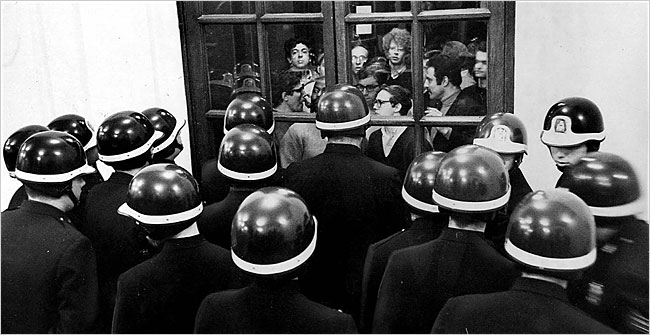
The other major catalyst for the student uprising was the 1967 discovery of a Columbia University think tank that was working with the Institute for Defense Analysis (IDA), which was part of the Department of Defense. Students at Columbia saw the IDA as a direct connection the collaboration of the US military through the IDA and the university to further weapons research that contributed to the brutal war in Vietnam.
Thus, the growing opposition to the war and the racist gentrification of the gymnasium were major factors that contributed to the growing radicalization of the students at Columbia University.
Beginning in April of 1968, students began protesting on campus drawing attention to the university’s role in the war and promoting racism against the residents of Harlem. The protests escalated to building occupations that, according to a documentary, resulted in students taking over 100 university buildings.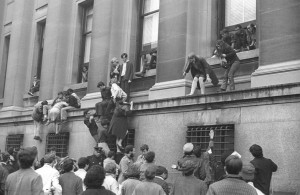
On April 23rd, some students who had occupied one of the buildings, then took the acting Dean, Henry Coleman, hostage until their demands were met. As was expected the New York Police responded with violent force resulting in hundreds of people being beaten and several dozen needed to be hospitalized.
In response to the police brutality the students called for a general strike, which included the participation of many faculty members. Classes and other university activities were shut down because of the student occupations and solidarity that emerged from the larger community.
Many of the Black students occupied Hamilton Hall and made the focus of their occupation the proposed gymnasium that would promote racist gentrification and segregation. The Black student occupation with the support of the Harlem community actually won the battle and the gymnasium was never built.

The rest of the student occupations eventually ended, but many of the students continued resisting the university policies and demanding justice for all those brutalized during the student uprising. This resistance continued through til graduation, where most of the 1968 graduation class walked out of the commencement ceremony and gathered to hold a counter-commencement action as a further protest against the university.
The Student Uprising at Columbia University in 1968 was one of the more radical student actions in the US during that period and it demonstrated the power of organized resistance that informed some of the anti-war and anti-establishment actions that took place in the ensuing years.
Much has been written about the April 1968 Student Uprising at Columbia University, but an excellent resource in this documentary that was produced in 1969 that utilizes lots of footage of the events from April of 1968.
For the third year in a row, the Grand Rapids branch of the IWW (Industrial Workers of the World) will host its May Day celebration at Martin Luther King Park.
The celebration is a commemoration of the historic event known as the Haymarket Affair, which took place in 1886 in Chicago where the state engaged a brutal labor suppression that led to the execution of several labor organizers.
The May Day Celebration is also a way that working people celebrate their power as workers, build mutual aid between each other and resist the capitalist class, which will stop at nothing to expand their profits at workers expense.
This years’ event will include numerous information tables, a Really, Really Free Market, children’s activities, a community potluck and local live music from noon until 9pm. For a listing of the bands, check out the facebook event page. There will also be several people from the community speaking on a variety of justice issues between bands and several poets.
May Day Celebration
Saturday, April 28
Noon – 9pm
Martin Luther King Jr. Park
Corner of Franklin & Fuller in Grand Rapids
Nobel Laureate Rigoberta Menchu speaks in Kalamazoo
On Friday night several hundred people came out to hear the 1992 Nobel Peace Prize winner, Rigoberta Mench Tum. The Nobel Laureate and Guatemalan Mayan spoke on the campus of Western Michigan.
Rigoberta began by talking about the Mayan calendar and Mayan cosmology and its relation to our ability to see the present and the future.
The Nobel Laureate cautioned that we not just look into the future less we become utopic. If we are paying attention to the present we will be able to concentrate on the work we need to do. Rigoberta encouraged the audience to do both, so that we not lose sight of what we want while we do the work we need to do.
Rigoberta continued by talking about the importance of seeing ourselves as a continuation of our ancestors, those who came before us millions of years ago. We are their continuation. “In our ceremonies we celebrate this lineage by always going back seven generations. My name is the same as my grandmother and her grandmother, which in Mayan culture is a way of continually remembering those who came before us.”
Rigoberta then talked about when she won the Nobel Peace Prize 20 years ago. She was living in exile at the time, working with refugees, while the country was in the midst of a war that no one knew when it would end. The country was suffering from a genocidal policy at the hands of the Guatemalan military. Looking back she sees how much has changed, but that so much work needs to continue.
She acknowledged that today the poverty is pervasive in Guatemala, effecting millions. When she goes into the villages she tries to encourage people to do something to change that reality. “We try to encourage each other to contribute something, no matter how small.”
“The solidarity amongst ourselves, and that which we develop with our youth, is a tremendous gift for the future. We have to enthusiastically support education for our youth, we cannot put our faith in the government to fulfill that goal.”
The first question asked of Rigoberta, during the Q&A, was if she would ever consider running for president in her native country of Guatemala. She said she has always fought in two systems, the Mayan system and the Western system, which is full of rules. “Our struggle is between these two systems, where the one does not recognize our traditions and our ancestral system. Another tradition is to not take our land, our water and the other natural resources that we rely on for sustenance.”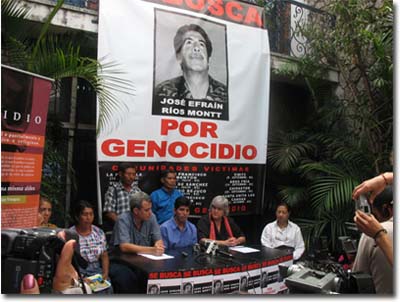
“So, if I was President these two systems would still be fighting, so until there is no conflict between these systems, then real change will come. I consider myself as a political person and was part of the first Mayan political party, which did not come about until after the civil war ended. This party is not only Mayan, but it is made up of lots of women, Mayan women who are in leadership positions. It will be a process that will not come quickly to end racism and sexism, but I believe it will happen.”
The next person asked the question about the claim that the Mayan calendar predicts that the world will come to an end in 2012. Rigoberta responded by saying she began her talk by recognizing the Mayan calendar, but she never talked about an end to this world.
She said that this fear mongering is a product of Hollywood to make money. She also said that this hype around the Mayan calendar has political motives of some in order to control the actions of others. She did acknowledge that this is “a time of no time,” where humans live in spiritual, social and material decadence. Therefore,” we need to bring about equilibrium and balance. This is how we prevent the end of the world.”
While it was delightful to hear Rigoberta Menchu speak again, especially after doing human rights work with her in Guatemala, it was somewhat disappointing that there was little information about what is happening in that Central American country today, especially the recent genocide cases.
This article by Jordan Flaherty is re-posted from Dissident Voice.
On April 20, 2010, a reckless attitude towards the safety of the Gulf Coast by BP, as well as Transocean and Halliburton, caused a well to blow out 5,000 feet below the surface of the Gulf of Mexico. As the world watched in horror, underwater cameras showed a seemingly endless flow of oil – hundreds of millions of gallons – and a series of failed efforts to stop it, over a period of nearly three months. Two years later, that horror has not ended for many on the Gulf.
“People should be aware that the oil is still there,” says Wilma Subra, a chemist who travels widely across the Gulf meeting with fishers and testing seafood and sediment samples for contamination.
Subra says that the reality she is seeing on the ground contrasts sharply with the image painted by BP. “I’m extremely concerned on the impact it’s having on all these sick individuals,” she says. Subra believes we may be just at the beginning of this disaster. In every community she visits, fishers show her shrimp born without eyes, fish with lesions, and crabs with holes in their shells. She says tarballs are still washing up on beaches across the region.
While it’s too early to assess the long-term environmental impact, a host of recent studies published by the National Academy of Sciences and other respected institutions have shown troubling results. They describe mass deaths of deepwater coral, dolphins, and killifish, a small animal at the base of the Gulf food chain. “If you add them all up, it’s clear the oil is still in the ecosystem, it’s still having an effect,” says Aaron Viles, deputy director of Gulf Restoration Network, an environmental organization active in the region.
The major class action lawsuit on behalf of communities affected by the spill has reached a proposed 7.8 billion dollar settlement, subject to approval by a judge. While this seems to have brought a certain amount of closure to the saga, environmentalists worry that any settlement is premature, saying they fear that the worst is yet to come. Pointing to the 1989 Exxon spill off the coast of Alaska, previously the largest oil spill in US waters, Viles said that it was several years before the full affect of that disaster was felt. “Four seasons after Exxon Valdez is when the herring fisheries collapsed,” says Viles. “The Gulf has been a neglected ecosystem for decades – we need to be monitoring it closely.”
In the aftermath of the spill, BP flooded the Gulf with nearly 2 million gallons of chemical dispersants. While BP says these chemicals broke up the oil, some scientists have said this just made it less visible, and sent the poisons deeper into the food chain.
It is widely agreed that environmental problems on the coast date back to long before the well blew open. The massive catastrophe brought into focus problems that have existed for a generation. Land loss caused by oil company drilling has already displaced many who lived by the coast, and the pollution from treatment plants has poisoned communities across the state – especially in “cancer alley,” the corridor of industrial facilities along the Mississippi River south of Baton Rouge. “The Gulf is a robust ecosystem and it’s been dying the death of a thousand cuts for a long time,” says Viles. “BP is legally obligated to fix what they screwed up. But if you’re only obligated to put the ecosystem back to where it was April 19, 2010, why would we?”
In the aftermath of the spill, BP flooded the Gulf with nearly 2 million gallons of chemical dispersants. While BP says these chemicals broke up the oil, some scientists have said this just made it less visible, and sent the poisons deeper into the food chain.
Fishing is a huge part of the economy for the Gulf Coast. Around 40% of the seafood caught in the continental US comes from here. Many area fishermen were still recovering from Hurricane Katrina when the spill closed a third of Gulf waters to fishing for months. George Barisich, president of the United Commercial Fisherman’s Association, a group that supports Gulf Coast fishers, says many fishers still had not recovered from Hurricane Katrina when the oil started flowing from the BP spill. Now, he says, many are facing losing their homes. “Production is down at least 70 percent,” compared to the year before the spill, he says. “And prices are still depressed thirty, forty, sixty percent.”
In a video statement on BP’s website, Geir Robinson, Vice President of Economic Restoration for BP’s Gulf Coast Restoration Organization, says that the company believes the legal settlement will resolve most legitimate economic claims. “We do have critics,” adds Robinson. “And we’re working hard every day to show them that we will meet our responsibilities.”
Environmentalists and scientists also complain that Obama administration has let down the Gulf Coast. Viles is critical of the role the US government has played, saying that by inaction they seemed to protect BP more than coastal communities or the environment. “The coast guard seems to empower the worst instincts of BP,” Viles says. “I don’t know if it’s Stockholm Syndrome or what.”
International environmental groups have also joined in the criticism. Oceana, a conservation group with offices in Europe and the Americas, released a report on Tuesday criticizing the US government’s reforms as being either ineffective or nonexistent, saying “offshore drilling remains as risky and dangerous as it was two years ago, and that the risk of a major spill has not been effectively reduced.”
Theresa Dardar lives in Bayou Pointe-au-Chien, a Native American fishing community on Louisiana’s Gulf Coast. Dardar and her neighbors have seen their land vanish from under their feet within their lifetimes due to canals built by the oil companies to access wells. The canals brought salt water into freshwater marshes, helping cause the coastal erosion that sees Louisiana lose a football field of land every 45 minutes. The main street that runs through the community now disappears into the swamps, with telephone poles sticking out of the water.
Now, in addition to worries about disappearing land and increasing risk of hurricanes, she fears that her family’s livelihood is gone for good.“It’s not going to be over for years,” she says, expressing a widely held concern among fishers here. “We’re just a small Native American fishing community. That’s all they’ve done their whole lives. Some of them are over 60. What are they going to do? If BP gives them money for the rest of their lives, that’s one thing. But if not, then what can they do?”
Defending Reproductive Justice: An Activist Toolkit

During the 2012 election cycle we have certainly seen plenty of examples of what many might refer to as a war on women and women’s rights in the US.
While this is certainly true both rhetorically and legislatively, it is not a new dynamic. Susan Faludi makes the case in her book, Backlash: The Undeclared War Against American Women, a book that was written in 1992.
Faludi and many other feminist writers have been arguing for decades that the patriarchal institutions in US society – governmental, religious and private – have been responding to the gains made by women during the 1960s and 70s and won’t stop until they can undo those gains.
Unfortunately, many progressive sectors have limited the fight to partisan politics, which often ignores how both major parties have been eroding women’s rights, in particular reproductive rights, since the Reagan years.

Fortunately, there are some very good resources available to people who want to fight to protect and expand women’s rights.
One such resource is Defending Reproductive Justice: An Activist Toolkit, produced by the group Political Research Associates. The toolkit was originally published in 2000, but was updated in 2009 and made available online for easier access.
In the reproductive justice toolkit you will find an excellent overview of what the Right Claims about reproductive issues. This information is both disturbing and valuable for anyone who wants to come to terms with what the Right is advocating.
There is a second section that presents a progressive analysis of the Right’s claims, which is highly informative in understanding the evolution of tactics used to undermine reproductive rights.
Another section in the activist toolkit is a list of tips for challenging the Right’s assault on women’s reproductive rights. Some of these tips include the importance of understanding the complexity of this right movement and that we should mostly focus on the issues and not the characters involved.
Lastly, the toolkit provides a solid bibliography for further reading and a resource list of groups across the country that are dedicated to Reproductive Justice.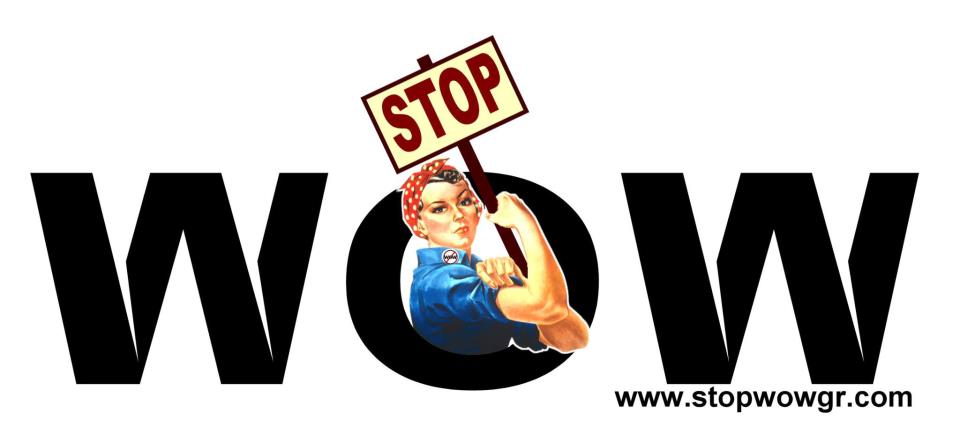
Stop the War on Women Rally in Grand Rapids
In addition to the activist toolkit, we would encourage people to participate in a public rally being billed as the Stop WOW Rally GR. The rally is being organized by several area women’s groups and will take place on Saturday, May 24 from 6 – 8pm at the Rosa Park’s Circle in downtown Grand Rapids.
New Media We Recommend
Below is a list of new materials that we have read/watched in recent weeks. The comments are not a “review” of the material, instead sort of an endorsement of ideas and investigations that can provide solid analysis and even inspiration in the struggle for change. All these items are available at The Bloom Collective, so check them out and stimulate your mind.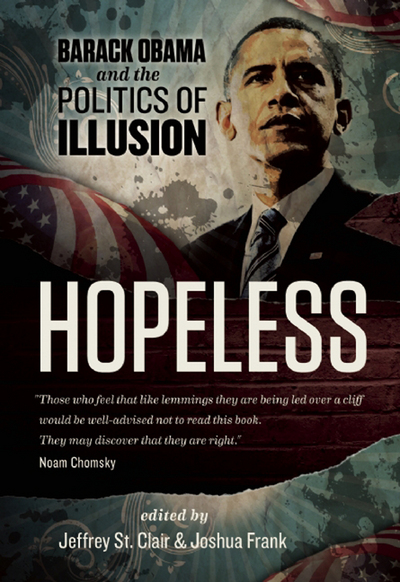
Hopeless: Barack Obama and the Politics of Illusion, edited by Jeffrey St. Clair and Joshua Frank – This collection of essays, that cover from the 2008 election to the present, is a perfect antidote for the pressure those of the left get from Democrats to vote for the “lesser of evils.” Hopeless offers clear analysis and well-documented evidence that the despite all the 2008 hype, real change has not come with the Obama administration. For those who still want to blame the GOP, they ought to sit down and read this collection of essays that deal with war, foreign policy, reproductive rights, labor issues, the economy, government surveillance, environmental devastation, media policy, immigration, corporate power, lobbying, energy policy, Wall Street, housing foreclosures and racism. The co-editors end the volume with a simple message of……..occupy everything.
 Waiting for an Army to Die: The Tragedy of Agent Orange, by Fred Wilcox – What the US government did to the people of Vietnam and to its own soldiers by using Agent Orange is one of the most tragic chapters in the history of US foreign policy. Fred Wilcox presents this history through well-researched information and the testimony of US soldiers and their family members who continue to live with the consequences of this chemical weapon. Wilcox also chronicles the history of how the US government denied the harmed caused by Agent Orange to US soldiers. Waiting for an Army to Die is a powerful book that would cause any reasonable person to have nothing but contempt towards the company that manufactured this deadly chemical, Michigan’s own, Dow Chemical.
The Arabs and the Holocaust: The Arab-Israeli War of Narratives, by Gilbert Achcar – One of the justifications that Zionists will use for Israel’s ongoing occupation of Palestine and its treatment of Palestinians is the Nazi Holocaust. Middle East scholar Gilbert Achcar looks at this contentious history and the narratives used on both sides as it relates to the Nazi Holocaust. Achcar divides his analysis into two main section; the period from 1933 – 1947 and from 1947 to the present. In both periods, Achcar looks at how the Arab community viewed the Nazi Holocaust and the clear differences from what he calls the pre-Nakba. The Nakba is what the Palestinians refer to as the ethnic cleansing done by the Israelis against the Palestinians just prior to the creation of the state of Israel. The Arabs and the Holocaust is an important contribution to the historical understanding of ideological differences between Israelis and Arabs, an understanding that is essential for anyone concerned about the future of the Middle East.
Visions of Abolition: From Critical Resistance to a New Way of Life (DVD) – A new documentary that introduces the history, theory and practices of the contemporary prison abolition movement. Weaving together the voices of women entangled in the criminal justice system, along with leading scholars on prison abolition (Angela Davis and Ruth Wilson Gilmore), this film provides a critical analysis of the disfunctionality and violence of the prison system. The film focuses on the life story of Susan Burton demonstrating how her work at “A New Way of Life” is an inspiring example of abolition in practice. The film provides both a strong critique of the prison industrial complex and the importance of organizing for prison abolition. A great organizing tool!
Yesterday, MLive ran a story based on a brief conversation that several Michigan reporters had with Michigan Governor Rick Snyder, while visiting with US troops in Afghanistan.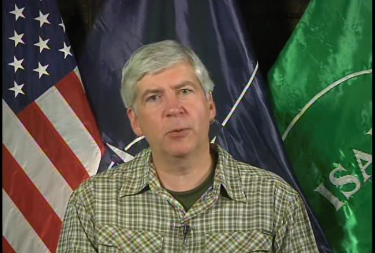
“This has been a tremendous experience,” Snyder said. “This is a fabulous opportunity to say ‘thank you’ to the troops in person. There’s great pride. These men and women are making a great sacrifice, putting their lives at risk and service us wonderfully.”
The article also stated that Governor Snyder was on a trip organized by the Department of Defense and that he was traveling with other Governors. What the MLive story did not report was that these trips were no doubt part of a military psy-ops campaign to gain additional support for the US occupation of Afghanistan from US politicians, as was reported last year.
These visits are designed to show a controlled aspect of US military operation in Afghanistan and to communicate key points to visiting officials from the US. Michigan Governor Snyder seems to be embracing their message based on the MLive story and the embedded video, where Snyder is responding to questions from several Michigan reporters.
Snyder stated several times that he was there to “thank the troops and learn about the sacrifices the soldiers are making for us.” Snyder said he was taken to a forward operating base and that the “progress the soldiers were making was amazing.”
Snyder also stated that he was there to talk to Michigan soldiers and to let them know he would be working to find jobs for them when they came back. Unemployment rates for US veterans has always been a problem and last year Business Week reported that unemployment for young veterans was as high as 30%.
During the video interview, WOOD TV8 reporter Rick Albin asked Governor Snyder about the moral of the US troops, particularly in light of the recent pictures of troops holding up body parts of Afghanis the soldiers had killed. Albin did qualify his question by stating that this action was only done by a few of the US soldiers, a qualification which speaks to how well the channel 8 reporter accepts the State Department’s explanation for yet another documented incident where US troops are celebrating the brutality of war. This kind of framing minimizes and marginalizes the level of violence that occurs on a daily basis at the hands of US soldiers, NATO troops and Afghan military personnel working in conjunction with the US operation.
Snyder’s response to Albin’s question avoided talking about the US troops holding up body parts. Instead, the Michigan Governor stated that the “service they were giving was incredible. I wish more Americans could see what our soldiers are doing for us.”
None of the Michigan reporters question this claim or asked how the US occupation of Afghanistan actually served Americans.
It will be interesting in the coming weeks to see how much Governor Snyder makes a point of publicly supporting the US war in Afghanistan, especially now that he has had the official tour provided by the Department of Defense.
Mutual Aid GR produces Zine in preparation for People’s Assembly on Radical Sustainability this Saturday
This Saturday, people with gather to discuss and organize around ways that people can both resist the current environmental catastrophe and create models of living that do not perpetuate the capitalist model, green or otherwise.
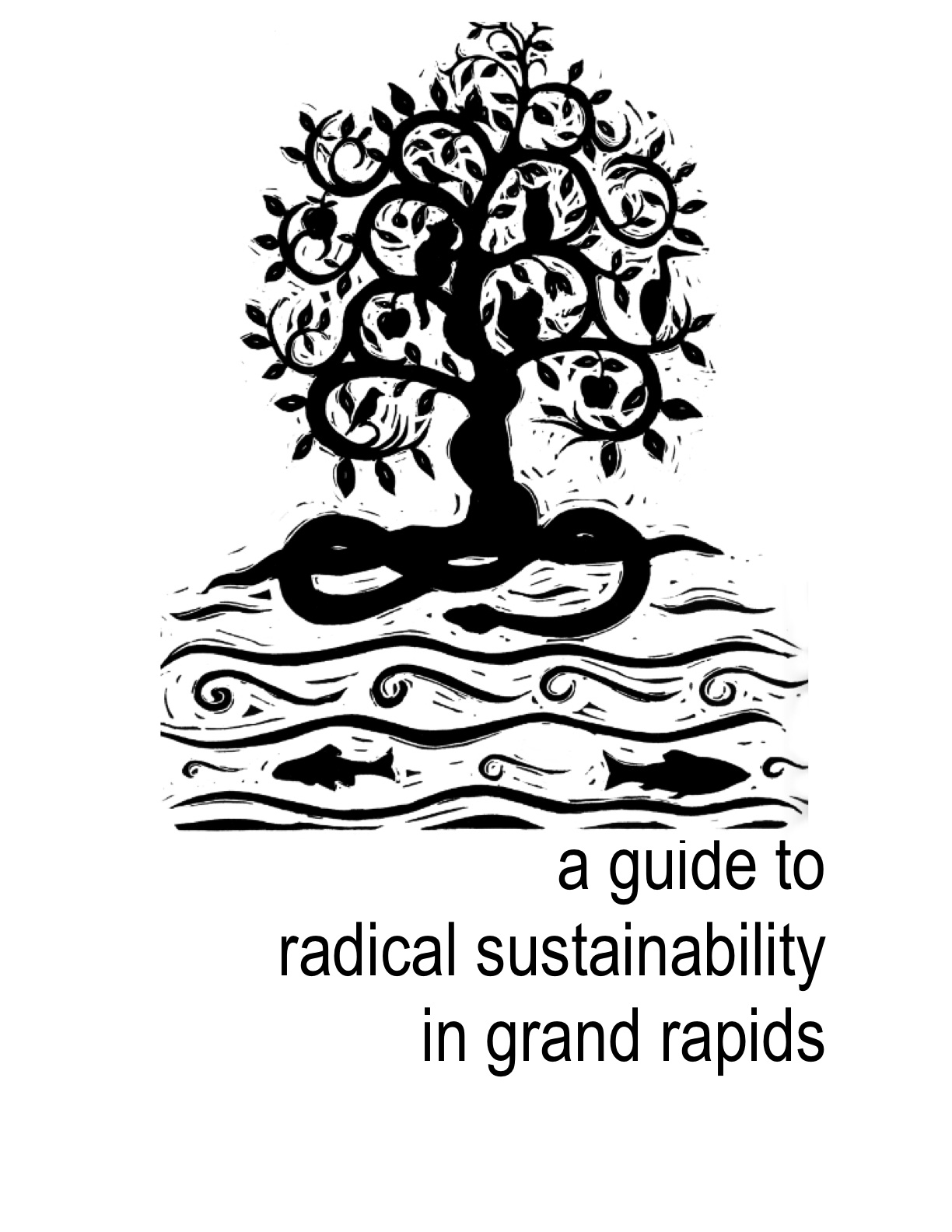
People involved with Mutual Aid GR have created a zine they plan to distribute to people who attend the gathering on Saturday. The zine, A Guide to Radical Sustainability in Grand Rapids, provides a framework of the group’s analysis, points of unity to describe how they will operate, resources and tactics and strategies for dealing with food, transportation and energy issues.
The 16 – page document is not a blueprint nor does it have all the answers, instead it is a mechanism to broaden the discussion about how we avert continued ecological destruction.
The zine makes it clear that the current capitalist model is inherently unsustainable and that in order for there to be a future for all species there must be a radical shift from how we live currently. The zine advocates both resistance against global capitalism and the creation of economic models that are truly sustainable.

“We believe that the realities of global warming are real and very urgent. The Inter-governmental Panel on Climate Change, which consists of thousands of the top climate scientists from around the world, estimates that humanity needs to collectively and globally reduce current levels of carbon emissions by 80% by 2050. There is no indication that this reduction is happening, in part because the US and other wealthy nations are blocking any real efforts to have global standards put in place immediately.
In addition, most of the so-called “solutions” operate on the assumption that humanity can achieve necessary carbon emission reductions within a capitalist framework. We whole- heartedly reject this framework and believe we need a radical restructuring of society in order to avoid further ecological catastrophe. For us, a “Green Jobs” plan will not work because it does not challenge the current economic system and it enables the worst polluters to continue to make incredible amounts of profit. If there were a massive redistribution of wealth we would not need a “jobs program.”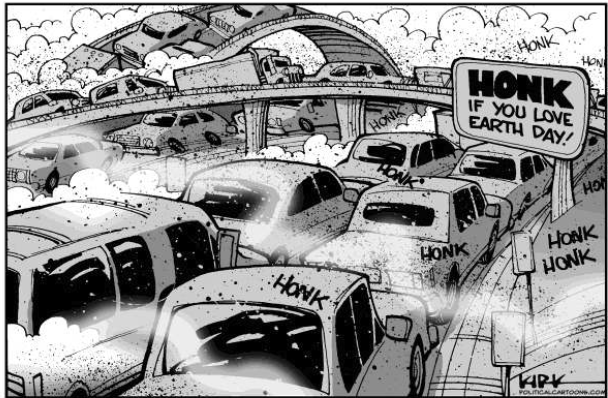
These issues and more will be discussed at the People’s Assembly on Radical Sustainability this Saturday. There will be breakout sessions to both look at the tactics already suggested with the hope that there will be more ideas that people will bring to the table on Saturday.
A People’s Assembly on Radical Sustainability in GR
Saturday, April 21
11 – 3:00pm
Trinity United Methodist Church
1100 Lake Dr. SE, Grand Rapids
Lunch will be provided by Food Not Bombs. There is no cost to attend and childcare is available upon request grpeoplesassembly@gmail.com.
This article from Glen Ford is re-posted from Black Agenda Report.
The Obama administration’s indifference to the plight of foreclosed homeowners, and total subservience to the banks, is once again on public display. According to a report by the Special Inspector General of the TARP program, the administration has spent only a tiny fraction of the money it was allocated to help those most negatively impacted by the housing collapse. In two years, only a little over 30,000 households have been helped, at a cost of $217 million. That’s only 3 percent of the $7.6 billion TARP is authorized to spend through its Hardest Hit Fund.
No wonder most people think TARP – the Troubled Asset Relief Fund – is only concerned with bailing out the banks. The Obama administration has treated it that way, even though Congress intended a portion of that money to help homeowners recover from the damage the banks had done.
From the day he was sworn in – and even before that, on the campaign trail – Obama has behaved as if the welfare of the banks is all that matters. Tim Geithner, the man he appointed to head the Treasury Department, which in turn runs the TARP program, is a former president of the Federal Reserve Bank of New York. A previous Inspector General of TARP reported, back in the summer of 2009, that the bank bailout might cost as much as $24 trillion – approaching twice the size of the gross domestic product of the United States. $7.4 trillion of that was to come out of TARP and other Treasury Department programs. That’s more than a thousand times more money than the $7.6 billion set aside for the hardest hit homeowners – but Geithner couldn’t even bring himself to spend that paltry sum on TARP’s Hardest Hit Fund, so almost all of the money has been sitting there, doing nothing for anybody, for the last two years.
Obama apologists will probably claim the president didn’t know that his Treasury Secretary was withholding billions of dollars in aid to the worst hit victims of the housing crisis – which means, they’ll believe anything.
The reason Geithner didn’t spend the Hardest Hit Fund money is because he, like other bankers, believes that helping homeowners in crisis amounts to tampering with “the market” – a euphemism for Wall Street. Obama thinks that way, too. In early 2008, Obama alone, among the three Democratic presidential candidates in the running, rejected out of hand proposals for a moratorium on home foreclosures. He didn’t want to put a cap on mortgage rates, either. Candidates John Edwards and Hillary Clinton supported mandatory or voluntary moratoriums, respectively – but not Obama. He had already made his deal with Wall Street – and he’s kept his promises to the super-rich. Treasury Secretary Geithner sat on the homeowners’ relief money for two years, because his boss wanted it that way.
The Congressional Black Caucus begged Obama to target foreclosure relief funds to areas that were hurt worst by the meltdown – which overlaps with the geography of Black America. That’s what the $7.6 billion dollars in the Hardest Hit Fund was supposed to do. The Black Caucus was shamelessly betrayed by the First Black President. The homes of hundreds of thousands of their constituents could have been saved, but the Obama Team outright refused to spend money lying right there in the accounts. What will the Caucus do? Pretend that it never happened.

