Young Women making a difference in Grand Rapids
Last night the group Young Women for Change of Kent County hosted a screening of the film Miss Representation on the campus of GRCC.
Miss Representation is a fairly new film that has already been shown in Grand Rapids at least twice in the past 3 months. The film explores how the media’s misrepresentations of women have led to the underrepresentation of women in positions of power and influence.
About 70 people attended the screening and the majority of people stayed after the film to be part of the discussion. The high school students, who are in Young Women for Change, facilitated the discussion and did an amazing job. In fact, this writer was quite impressed with not only their knowledge of the issue, but how confident and articulate they were in addressing the issues raised in the film.
The discussion also raised some important points. Several older women talked about their involvement with the feminist movement in the 1960s and 70s, but also expressed concerns about how there has been a backlash against the gains made by women. Some felt that this backlash was not only a result of reactionary centers of power pushing back against feminism, but that the current generation of young women were not “carrying the torch.”
If the young women who hosted the event last night are any indication of the current generation, then it would seem to this writer that they are quite capable of carrying the message of equality and liberation forward.
Several women also spoke about how difficult it was to move to Grand Rapids and realize that the level of discrimination against women was profound. One woman said this was the case particularly from those who identified as conservative Christians and expressed to these women that their place is in the home. There certainly are strong anti-feminist entities in West Michigan that welcome the male dominant ideology of groups like the Promise Keepers, Focus on the Family and the American Family Association……all of which receive substantial funding from wealthy families in West Michigan.
The Young Women for Change members did say that they will be working on looking at issues of concern over the next several months and then be making funds available for projects that empower women and girls in Kent County. Young Women of Change is a project of the Michigan Women’s Foundation.
The White Savior Industrial Complex
This article by Teju Cole is re-posted from The Atlantic. This is the second article we have re-posted on this topic because we think it is important that people listen to these criticisms, but that those of us in the US come to terms with our privilege and US foreign policy.
A week and a half ago, I watched the Kony2012 video. Afterward, I wrote a brief seven-part response, which I posted in sequence on my Twitter account.
These tweets were retweeted, forwarded, and widely shared by readers. They migrated beyond Twitter to blogs, Tumblr, Facebook, and other sites; I’m told they generated fierce arguments. As the days went by, the tweets were reproduced in their entirety on the websites of the Atlantic and the New York Times, and they showed up on German, Spanish, and Portuguese sites. A friend emailed to tell me that the fourth tweet, which cheekily name-checks Oprah, was mentioned on Fox television.
These sentences of mine, written without much premeditation, had touched a nerve. I heard back from many people who were grateful to have read them. I heard back from many others who were disappointed or furious. Many people, too many to count, called me a racist. One person likened me to the Mau Mau. The Atlantic writer who’d reproduced them, while agreeing with my broader points, described the language in which they were expressed as “resentment.”
This weekend, I listened to a radio interview given by the Pulitzer Prize-winning journalist Nicholas Kristof. Kristof is best known for his regular column in the New York Times in which he often gives accounts of his activism or that of other Westerners. When I saw the Kony 2012 video, I found it tonally similar to Kristof’s approach, and that was why I mentioned him in the first of my seven tweets.
Those tweets, though unpremeditated, were intentional in their irony and seriousness. I did not write them to score cheap points, much less to hurt anyone’s feelings. I believed that a certain kind of language is too infrequently seen in our public discourse. I am a novelist. I traffic in subtleties, and my goal in writing a novel is to leave the reader not knowing what to think. A good novel shouldn’t have a point.
But there’s a place in the political sphere for direct speech and, in the past few years in the U.S., there has been a chilling effect on a certain kind of direct speech pertaining to rights. The president is wary of being seen as the “angry black man.” People of color, women, and gays — who now have greater access to the centers of influence that ever before — are under pressure to be well-behaved when talking about their struggles. There is an expectation that we can talk about sins but no one must be identified as a sinner: newspapers love to describe words or deeds as “racially charged” even in those cases when it would be more honest to say “racist”; we agree that there is rampant misogyny, but misogynists are nowhere to be found; homophobia is a problem but no one is homophobic. One cumulative effect of this policed language is that when someone dares to point out something as obvious as white privilege, it is seen as unduly provocative. Marginalized voices in America have fewer and fewer avenues to speak plainly about what they suffer; the effect of this enforced civility is that those voices are falsified or blocked entirely from the discourse.
It’s only in the context of this neutered language that my rather tame tweets can be seen as extreme. The interviewer on the radio show I listened to asked Kristof if he had heard of me. “Of course,” he said. She asked him what he made of my criticisms. His answer was considered and genial, but what he said worried me more than an angry outburst would have:
There has been a real discomfort and backlash among middle-class educated Africans, Ugandans in particular in this case, but people more broadly, about having Africa as they see it defined by a warlord who does particularly brutal things, and about the perception that Americans are going to ride in on a white horse and resolve it. To me though, it seems even more uncomfortable to think that we as white Americans should not intervene in a humanitarian disaster because the victims are of a different skin color.
Here are some of the “middle-class educated Africans” Kristof, whether he is familiar with all of them and their work or not, chose to take issue with: Ugandan journalist Rosebell Kagumire, who covered the Lord’s Resistance Army in 2005 and made an eloquent video response to Kony 2012; Ugandan scholar Mahmood Mamdani, one of the world’s leading specialists on Uganda and the author of a thorough riposte to the political wrong-headedness of Invisible Children; and Ethiopian-American novelist Dinaw Mengestu, who sought out Joseph Kony, met his lieutenants, and recently wrote a brilliant essay about how Kony 2012 gets the issues wrong. They have a different take on what Kristof calls a “humanitarian disaster,” and this may be because they see the larger disasters behind it: militarization of poorer countries, short-sighted agricultural policies, resource extraction, the propping up of corrupt governments, and the astonishing complexity of long-running violent conflicts over a wide and varied terrain.
I want to tread carefully here: I do not accuse Kristof of racism nor do I believe he is in any way racist. I have no doubt that he has a good heart. Listening to him on the radio, I began to think we could iron the whole thing out over a couple of beers. But that, precisely, is what worries me. That is what made me compare American sentimentality to a “wounded hippo.” His good heart does not always allow him to think constellationally. He does not connect the dots or see the patterns of power behind the isolated “disasters.” All he sees are hungry mouths, and he, in his own advocacy-by-journalism way, is putting food in those mouths as fast as he can. All he sees is need, and he sees no need to reason out the need for the need.
But I disagree with the approach taken by Invisible Children in particular, and by the White Savior Industrial Complex in general, because there is much more to doing good work than “making a difference.” There is the principle of first do no harm. There is the idea that those who are being helped ought to be consulted over the matters that concern them.
I write all this from multiple positions. I write as an African, a black man living in America. I am every day subject to the many microaggressions of American racism. I also write this as an American, enjoying the many privileges that the American passport affords and that residence in this country makes possible. I involve myself in this critique of privilege: my own privileges of class, gender, and sexuality are insufficiently examined. My cell phone was likely manufactured by poorly treated workers in a Chinese factory. The coltan in the phone can probably be traced to the conflict-riven Congo. I don’t fool myself that I am not implicated in these transnational networks of oppressive practices.
And I also write all this as a novelist and story-writer: I am sensitive to the power of narratives. When Jason Russell, narrator of the Kony 2012 video, showed his cheerful blonde toddler a photo of Joseph Kony as the embodiment of evil (a glowering dark man), and of his friend Jacob as the representative of helplessness (a sweet-faced African), I wondered how Russell’s little boy would develop a nuanced sense of the lives of others, particularly others of a different race from his own. How would that little boy come to understand that others have autonomy; that their right to life is not exclusive of a right to self-respect? In a different context, John Berger once wrote, “A singer may be innocent; never the song.”
One song we hear too often is the one in which Africa serves as a backdrop for white fantasies of conquest and heroism. From the colonial project to Out of Africa to The Constant Gardener and Kony 2012, Africa has provided a space onto which white egos can conveniently be projected. It is a liberated space in which the usual rules do not apply: a nobody from America or Europe can go to Africa and become a godlike savior or, at the very least, have his or her emotional needs satisfied. Many have done it under the banner of “making a difference.” To state this obvious and well-attested truth does not make me a racist or a Mau Mau. It does give me away as an “educated middle-class African,” and I plead guilty as charged. (It is also worth noting that there are other educated middle-class Africans who see this matter differently from me. That is what people, educated and otherwise, do: they assess information and sometimes disagree with each other.)
In any case, Kristof and I are in profound agreement about one thing: there is much happening in many parts of the African continent that is not as it ought to be. I have been fortunate in life, but that doesn’t mean I haven’t seen or experienced African poverty first-hand. I grew up in a land of military coups and economically devastating, IMF-imposed “structural adjustment” programs. The genuine hurt of Africa is no fiction.
And we also agree on something else: that there is an internal ethical urge that demands that each of us serve justice as much as he or she can. But beyond the immediate attention that he rightly pays hungry mouths, child soldiers, or raped civilians, there are more complex and more widespread problems. There are serious problems of governance, of infrastructure, of democracy, and of law and order. These problems are neither simple in themselves nor are they reducible to slogans. Such problems are both intricate and intensely local.
How, for example, could a well-meaning American “help” a place like Uganda today? It begins, I believe, with some humility with regards to the people in those places. It begins with some respect for the agency of the people of Uganda in their own lives. A great deal of work had been done, and continues to be done, by Ugandans to improve their own country, and ignorant comments (I’ve seen many) about how “we have to save them because they can’t save themselves” can’t change that fact.
Let me draw into this discussion an example from an African country I know very well. Earlier this year, hundreds of thousands of Nigerians took to their country’s streets to protest the government’s decision to remove a subsidy on petrol. This subsidy was widely seen as one of the few blessings of the country’s otherwise catastrophic oil wealth. But what made these protests so heartening is that they were about more than the subsidy removal. Nigeria has one of the most corrupt governments in the world and protesters clearly demanded that something be done about this. The protests went on for days, at considerable personal risk to the protesters. Several young people were shot dead, and the movement was eventually doused when union leaders capitulated and the army deployed on the streets. The movement did not “succeed” in conventional terms. But something important had changed in the political consciousness of the Nigerian populace. For me and for a number of people I know, the protests gave us an opportunity to be proud of Nigeria, many of us for the first time in our lives.
This is not the sort of story that is easy to summarize in an article, much less make a viral video about. After all, there is no simple demand to be made and — since corruption is endemic — no single villain to topple. There is certainly no “bridge character,” Kristof’s euphemism for white saviors in Third World narratives who make the story more palatable to American viewers. And yet, the story of Nigeria’s protest movement is one of the most important from sub-Saharan Africa so far this year. Men and women, of all classes and ages, stood up for what they felt was right; they marched peacefully; they defended each other, and gave each other food and drink; Christians stood guard while Muslims prayed and vice-versa; and they spoke without fear to their leaders about the kind of country they wanted to see. All of it happened with no cool American 20-something heroes in sight.
Joseph Kony is no longer in Uganda and he is no longer the threat he was, but he is a convenient villain for those who need a convenient villain. What Africa needs more pressingly than Kony’s indictment is more equitable civil society, more robust democracy, and a fairer system of justice. This is the scaffolding from which infrastructure, security, healthcare, and education can be built. How do we encourage voices like those of the Nigerian masses who marched this January, or those who are engaged in the struggle to develop Ugandan democracy?
If Americans want to care about Africa, maybe they should consider evaluating American foreign policy, which they already play a direct role in through elections, before they impose themselves on Africa itself. The fact of the matter is that Nigeria is one of the top five oil suppliers to the U.S., and American policy is interested first and foremost in the flow of that oil. The American government did not see fit to support the Nigeria protests. (Though the State Department issued a supportive statement — “our view on that is that the Nigerian people have the right to peaceful protest, we want to see them protest peacefully, and we’re also urging the Nigerian security services to respect the right of popular protest and conduct themselves professionally in dealing with the strikes” — it reeked of boilerplate rhetoric and, unsurprisingly, nothing tangible came of it.) This was as expected; under the banner of “American interests,” the oil comes first. Under that same banner, the livelihood of corn farmers in Mexico has been destroyed by NAFTA. Haitian rice farmers have suffered appalling losses due to Haiti being flooded with subsidized American rice. A nightmare has been playing out in Honduras in the past three years: an American-backed coup and American militarization of that country have contributed to a conflict in which hundreds of activists and journalists have already been murdered. The Egyptian military, which is now suppressing the country’s once-hopeful movement for democracy and killing dozens of activists in the process, subsists on $1.3 billion in annual U.S. aid. This is a litany that will be familiar to some. To others, it will be news. But, familiar or not, it has a bearing on our notions of innocence and our right to “help.”
Let us begin our activism right here: with the money-driven villainy at the heart of American foreign policy. To do this would be to give up the illusion that the sentimental need to “make a difference” trumps all other considerations. What innocent heroes don’t always understand is that they play a useful role for people who have much more cynical motives. The White Savior Industrial Complex is a valve for releasing the unbearable pressures that build in a system built on pillage. We can participate in the economic destruction of Haiti over long years, but when the earthquake strikes it feels good to send $10 each to the rescue fund. I have no opposition, in principle, to such donations (I frequently make them myself), but we must do such things only with awareness of what else is involved. If we are going to interfere in the lives of others, a little due diligence is a minimum requirement.
Success for Kony 2012 would mean increased militarization of the anti-democratic Yoweri Museveni government, which has been in power in Uganda since 1986 and has played a major role in the world’s deadliest ongoing conflict, the war in the Congo. But those whom privilege allows to deny constellational thinking would enjoy ignoring this fact. There are other troubling connections, not least of them being that Museveni appears to be a U.S. proxy in its shadowy battles against militants in Sudan and, especially, in Somalia. Who sanctions these conflicts? Under whose authority and oversight are they conducted? Who is being killed and why?
All of this takes us rather far afield from fresh-faced young Americans using the power of YouTube, Facebook, and pure enthusiasm to change the world. A singer may be innocent; never the song.

We reported last month on West Michigan residents that have given large sums of money to candidates and political parties in an attempt to influence the 2012 elections.
A new report from the Center for Responsive Politics shows that President Obama is ahead of all Presidential candidates in terms of PAC money raised and Obama has raised more than double than any GOP candidate, with $157 million at the last campaign finances reporting date on February 1st.

In Michigan, there are candidates who have a commanding leading in terms of money raised so far. In the Senate race, the incumbent Debbie Stabenow has raised nearly $9 million, with the next closest candidate (Pete Hoekstra) raising just over $2 million.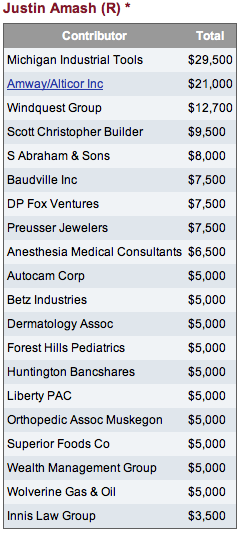
Stabenow has raised the bulk of her funds from corporations such as Blue Cross/Blue Shield, DTE Energy, GM, Ford, Goldman Sachs, JP Morgan Chase and the women’s PAC known as EMILY’s List. Hoekstra on the other hand is relying on money specific to West Michigan with major donors like Amway, Autocam, Meijer, Gentex and DP Fox Ventures.
In the 3rd Congressional race, incumbent Justin Amash has raised just shy of half a million dollars and no reporting as of yet from either of the two Democratic challengers, Trevor Thomas or Steve Pestka. You can see from this chart here who the main contributors are to Amash to date.
In the 2nd Congressional race, Rep. Bill Huizenga has raised $440,420 so far, with no reported Democratic challengers listed. The bulk of Huizenga’s money is coming from West Michigan as well and a large percentage of it coming from the DeVos family businesses, such as Amway/Alticor, Windquest Group, DP Fox Ventures and the Orlando Magic.
Michigan Legislation expected to include gay and transgender residents in Civil Rights Law
A coalition of LGBT groups from around the state, including the ACLU of Michigan, Affirmations, Equality Michigan, KICK, the Michigan Roundtable for Diversity and Inclusion, and the Ruth Ellis Center have been working on getting Michigan legislators to introduce legislation which would update the Elliot-Larsen Civil Rights Act (1976).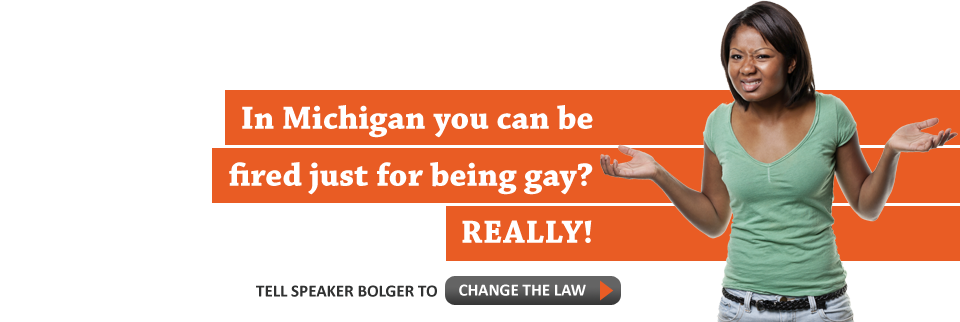
According to this coalition of group, the new legislation “would ensure that no Michigander could be discriminated against, or fired from their job, just because of their sexual orientation or gender identity.”
Some of the organizing around this issue at the local level has paid off in that cities like Flint successfully “signed off on including transgender people in Flint’s human rights ordinance. A week later, the White House came to Detroit to address housing discrimination against gay and transgender folks with the Ruth Ellis Center. And this past week, allies in Muskegon worked with the City Commission to make progress on protecting gay and transgender people from discrimination.”
Considering there is all this movement at the local level and that some Michigan legislators want to overturn local ordinances, it seems like an important time for people to support statewide legislation that would prevent the continuation of existing legal forms of discrimination against those who identify as Lesbian, Gay, Bisexual and Transgender.
The coalition of groups are asking people to get people to support such legislation and invite 5 friends to join the campaign. The campaign is being hosted at the online site Don’t Change Yourself, Change the Law, where you can join the campaign and get 5 friend to get involved.
Book Traffickers Smuggle Banned Books Into Tucson, Arizona
This video is re-posted from the Real News Network.
Students and activists set up “Underground Libraries” of books prohibited in suspended Mexican American Studies classrooms
On Friday, March 16th, a caravan of students, teachers, and activists calling themselves “librotraficantes,” or book traffickers, rolled into Tucson, Arizona bringing boxes of “smuggled” books that have been prohibited in the classrooms of the Tucson Unified School District following the controversial suspension of its Mexican American Studies program.
The caravan traveled more than 1,000 miles over the span of 5 days after departing from Houston, Texas, with additional caravans arriving from other locations like Los Angeles. On Saturday, lead librotraficante organizer Tony Diaz and others staged a literary teach-in at the John Valenzuela Youth Center in South Tucson, where they also established one of several new “Underground Libraries” where the banned books will be available to community members.
Assassinations at Home and Abroad
This article by Jemima Pierre is re-posted from Black Agenda Report.
Trayvon Martin was a slim, seventeen-year-old Black boy callously murdered on February 26, 2012 by George Zimmerman, an unhinged, racist vigilante. Zimmerman, a neighborhood watch volunteer, claimed that he shot the young Martin in self-defense. The recently released 9-1-1 calls show that Zimmerman, without any evidence but Martin’s Blackness, assumed that Martin was drugged, up to no good, and on his way to commit a crime in the gated community in a suburb of Orlando, Florida. By all indications, Zimmerman got out of his car, ran after Martin, accosted him, cornered him, and shot him.
The reaction to Trayvon Martin’s killing has been swift. Most people are outraged, and rightly so. For us in the Black community, Trayvon Martin’s death is both the latest incident in a long history of racial profiling and racist murders and another manifestation of a steadily-increasing anti-Black racism. The calls for a federal investigation are growing—including those from the muted and lethargic Congressional Black Caucus. And while Obama has refused to comment on the case, calling it a matter for the local police, the Civil Right’s Division of Eric Holder’s Department of Justice has decided to open an investigation. For most of us, this is a good start.
As of today, Zimmerman has not been arrested or even charged for the murder. The reason? The Sanford police department accepted Zimmerman’s claim that he was acting in self-defense. In a recent article on MotherJones.com, Adam Weinstein has argued that the Florida self-defense and “stand your ground” laws will be key to this case—and may very well keep Zimmerman out of jail. Zimmerman, he says, “may have benefited from some of the broadest firearms and self-defense regulations in the nation.” These regulations make it extremely easy for Florida citizens to obtain permits to carry concealed weapons while those who already hold permits are exempted from mandatory waiting periods when purchasing new guns. Furthermore, the “stand your ground” law allows residents to use deadly force against a perceived threat without having to back down. “Stand your ground” is the most pernicious part of the law, as it allows anyone to use deadly force if they perceive a threat of death or “great bodily harm,” with the assurance that those claiming self-defense will be given civil and criminal immunity.
But if we are angry that Zimmerman’s non-prosecution is an effect of the Florida “stand your ground” laws allowing – indeed, encouraging – “justifiable homicides” on the basis of perceived threat, we should also be angry about another claim for justifiable homicides that also hides under legal cover: the US government’s targeted assassination program. In a speech to Northwestern University law student in early March, Eric Holder argued that the Obama administration has the authority to secretly target and kill U.S. citizens and non-citizens perceived to be threats without the target knowing s/he is a target, without the target being charged, without the target being given an opportunity to respond to the charges, and without any judicial oversight. “The President and his underlings are your accuser, your judge, your jury and your executioner all wrapped up in one,” Glenn Greenwald has written on this policy, “acting in total secrecy and without your even knowing that he’s accused you and sentenced you to death, and you have no opportunity even to know about, let alone confront and address, his accusations.” How is this policy of targeted assassination different from the Florida “stand your ground” law? At least Zimmerman confronted Martin before killing him.
For those of you who will chastise me as being insensitive to Martin’s horrible death — or who will insist that the two cases are distinct, let me remind you of the story of Adbulrahmana al-Awlaki. Adbulrahmana al-Awlaki was the sixteen year old American-born US citizen killed by a US drone strike in Yemen in early October 2011. The young al-Awlaki was walking with his seventeen year old cousin and seven other people when he was killed in a “trio of drone attacks,” according to a CNN report. At first, the Western press reported al-Awlaki’s age as 21, ignored the fact of his citizenship, and implied that he was a legitimate “terrorist” target. When the truth of the young boy’s citizenship and age emerged, a US official said, without apology, that he “was in the wrong place at the wrong time.” TIME magazine later asked if the young al-Awlaki was “paying for the sins of this father.” His father, Anwar al-Awlaki had been killed weeks earlier by another US drone attack. While he was well known to Western audiences through US Homeland Security propaganda as a radical cleric and dangerous terrorist, Anwar al-Awlaki’s assassination was carried out without public evidence or due process. But these assassinations were justified by Eric Holder – whose office is now tasked to investigate Trayvon Martin’s murder.
We should be outraged at all of these deaths. Trayvon Martin, Adbulrahmana al-Awlaki, his cousin, and the countless civilians – so-called terrorist targets — who are victims of a US policy of drone strikes and who have no recourse to the law, and no appeal to human decency.
Our righteous indignation and anger over the Trayvon Martin murder has to stretch beyond our community to consider a global humanity – and especially the nonwhite victims of US militarism and racism. We must pause and reflect on the injustice of the US government’s extrajudicial assassinations, and the fact that the Obama administration has claimed the right to kill people in multiple countries around the world whenever it wants. And we also should ask ourselves the question recently posed on twitter by @public_archive: “Trayvon was executed because of a perceived threat; US launches target assassinations because of perceived threats. Both are somehow legal?” Unfortunately, they are. And they are related: the Florida laws are the local articulation of a US foreign policy that deploys murder and mayhem at any sign of a threat—even as our officials generate these threats behind closed doors and without any pretentions of legality. And both Trayvon and Abdulrahmana, Black boy and brown, were victims of a culture of vigilantism masking itself through false appeals to white security.
Dump Rush Protest will coincide with anti-reproductive rights rally on Friday in Grand Rapids
The Dump Rush on WOOD Radio campaign continues with a third protest planned for this Friday, March 23 at 1:00 pm outside the Clear Channel office in downtown Grand Rapids.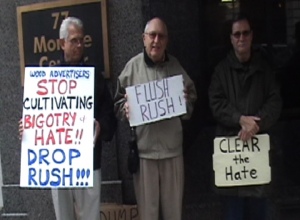
This protest will happen at the same time that those opposed to contraceptives and reproductive rights will be holding a rally on Calder Plaza. Those organizing this event are framing at a religious freedom gathering, but the MLive story makes it clear that those organizing this rally are reacting to the nationwide protest against Rush Limbaugh for his misogynist comments and contempt for reproductive rights for women in this country.
People are invited to bring signs, handouts and letters to deliver to WOOD Radio demanding that they remove Limbaugh’s program from their regular lineup of syndicated shows.
For those who cannot attend we are asking them to do the following things, which are absolutely necessary for this campaign to be effective:
1. Send e‐mails to WOOD Radio Station Manager Tim Feagan at TimFeagan@clearchannel.com or write letters to: WOOD Radio 77 Monroe Center Grand Rapids, MI 49503.
2. Pressure local businesses that advertise on WOOD Radio to pull their funding until WOOD Radio removes the Limbaugh show. Here is a list of local companies and their contact information:
Grand Rapids Lighting
616-949-4931
Kyper College
kcapisciolto@kuyper.edu 616-988-3676
Kent Equipment
(616) 675-5368 http://www.kentequipment.com/contact.htm
River City Reproductions
616.464.1220 info@rivercityreproductions.com
Life EMS
1-888-543-3367 info@lifeems.com
Mercantile Bank of Michigan
616.406.3604 https://www.mercbank.com/contact.asp
Silver Bullet Firearms
(616) 249-1911 silverbulletfirearms@gmail.com
West Michigan Office Interiors
(800) 964.0201 sales@wmoi.com
Granite Transformations
(866) 400-1594
http://grandrapids-granitetransformations.aiprx.com/grandrapids/contact-us/
AMR-West Mi
(616) 459-8228
http://www.ems-education.com/page5/
AAA Turf
616-669-7715
sales@aaaturf.com
West Michigan Glass Block
616.243.3700
http://www.wmgb.com/contact.asp
Bartlett Tree Experts
616-245-9449
Spectrum Health
(616) 391-1382
http://www.spectrumhealth.org/body.cfm?id=57
Family Fare
616-878-8350
http://familyfare.spartanstores.com/contact-us
3. Share this campaign information with as many people and organizations you are affiliated with.
This article is based on a presentation I did last night at CMU with Dee Ann Sherwood.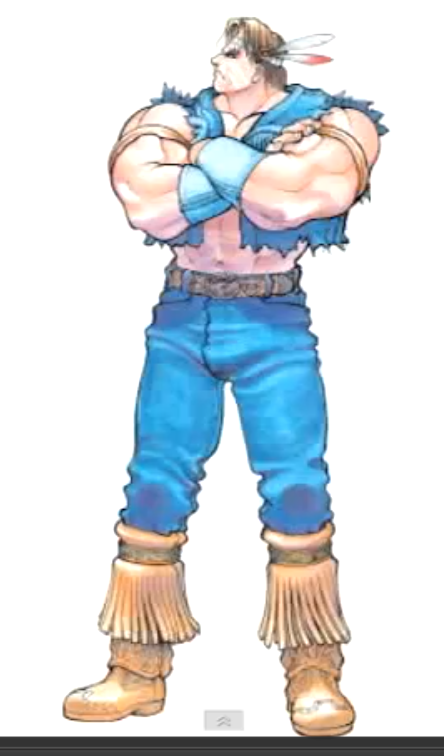
In thinking about Native American representation in media it is important to think about both how Native identity has been constructed in the dominant US culture and what the cumulative effect that has on non-Native people.
The dominant or hegemonic view that many Euro-Americans have of Native people is “the Noble Savage,” an image that has Native people frozen in time from the 19th century. This imagine is not only from the past, but it is often a distorted image, because much of the Native representation by the dominant culture is not accurate. People often think that all Native people wore buckskin and had feathers on their head, but this is purely the result of the dominant culture’s construction of what we want Native people to look like.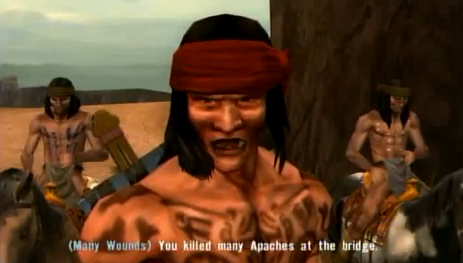
This constructed notion of Native Americans has been taking place for more than 2 centuries in the US, a construction that began with newspapers and continues through today in video games.
In fact, most of the video game industry’s depiction of Native people fits into the noble savage identity, where Indians are generally depicted in 19th century settings. While there are a variety of characters, the most dominant is that of the violent Indian, those that hold the pose of someone who seems dangerous.
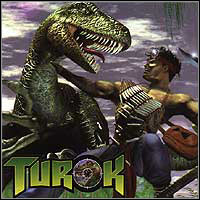
The first video game to have a Native American as the main character was Turok. Turok looked like the iconic Native American, but he fought and killed dinosaurs. Again, this is an image of Native people frozen in time, even if it is thousands of years ago.
For Native women, the representation is equally troubling. Native women are often depicted in a hyper-sexual way, vulnerable and available to be taken. In fact, there are Native women who appear in video game porn, such as the game Custer’s Revenge, where Colonel Custer rapes Native women that he captures. This narrative is not only extremely sexist, but is continues a conquest narrative, where Native land and Native people are for the taking by the dominant culture.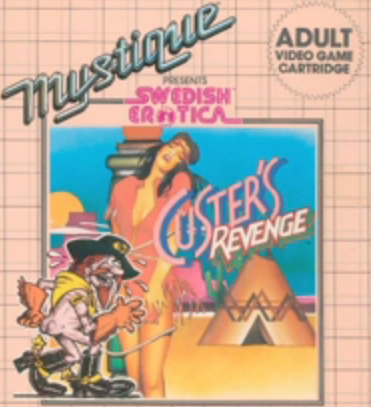
I highly recommend as a resource this great video deconstruction of video games narrated by Irish, Anishinaabe, Metis writer Beth Aileen Lameman and edited by Beaver Lake Cree filmmaker Myron Lameman.
In the land of Television, the dominant representation of Native people has historically been juxtaposed with cowboys, again as savages that the dominant culture must protect themselves from. In recent years, while there have been more diversity in how Native people are depicted it is still extremely limited. This limited representation is clearly evident in children’s TV programming. In 2003, GRIID conducted a research project on local educational TV shows and found that not one of those programs had a Native character in them during the month of May.
The national organization Children Now has also conducted similar studies, where the conclusions was similar to the GRIID study. What was different about the 2003 – 2004 Children Now study is that they looked a Prime Time TV shows that youth watched. In this study, Native characters were almost non-existent.

Turning to Hollywood movies, we see a similar pattern. The book Hollywood’s Indian: The Portrayal of the Native American in Film, edited by Peter Rollins, demonstrates that the bulk of Native representation in films has been as savages living in the 19th century. In more recent years, there have been some shifts and films that have been directed by Native people are radically different from the dominant culture’s depiction, with films such as Smoke Signals and Pow Wow Highway. For more on Native produced films check out the fabulous book Wiping the War Paint off the Lens: Native American Film and Video, by Beverly Singer.
In 2003, GRIID conducted a film study looking at the first 50 films released on DVD that were also major releases across the country. Only one film in that study had Native characters. In the film Snow Dogs, there is a Native female bartender who is presented as a male sexual fantasy and one Native male character that almost never talks and is seen as the stoic Indian.
Again, in 2010 GRIID conducted another film study, looking at 40 of the top films released in the first six months of that year. In this study, again we only found one depiction of a Native character in the animated movie Ponyo.
Shifting to an investigation of how the news media presents Native Americans, we find that there is not a huge shift from how entertainment media has depicted Native people.
Historically, if one looks at the print media and particularly newspapers it is clear that there has been a very narrow depiction. One important resource that looks at Native portrayal in US newspapers is News for All the People: The Epic Story of Race and the American Media, by Juan Gonzalez and Joseph Torres.
One example in News for All the People states, “Before the Revolutionary War the Colonial Press in the mid – 18th Century began to demonize Native people as Euro-Americans began to expand westward. In South Carolina, once the war with the Cherokees began, an astounding 30% of all stories in the South Carolina Gazette were about violence by Native Americans.” Just to be clear they are saying that 30% of all stories, not stories about Native Americans, but 30% of all stories.
The depiction of Natives as being violent and a danger to the expanding colonial communities of Euro-Americans makes complete sense if one is operating from the viewpoint of the dominant culture, which the majority of US-based newspapers did and still do. Newspaper editors in the US at that time clearly believed in the notion of Manifest Destiny, where the land and resources were there for the taking.
Another blatant example of this type of thinking amongst US newspaper editors is reflected in the following editorial comment:
“The proud spirit of the original owners of these vast prairies inherited through centuries of fierce and bloody wars for their possession, lingered last in the bosom of Sitting Bull. With his fall the nobility of the Redskin is extinguished, and what few are left are a pack of whining curs who lick the hand that smites them. The Whites, by law of conquest, by justice of civilization, are masters of the American continent, and the best safety of the frontier settlements will be secured by the total annihilation of the few remaining Indians. Why not annihilation? Their glory has fled, their spirit broken, their manhood effaced; better that they die than live the miserable wretches that they are.”
This statement was made in an editorial in the Aberdeen Saturday Pioneer, by Frank L. Baum, the creator of the highly popular story, The Wizard of Oz. Several years later Baum made a similar comment in his editorial column, which said:
“The Pioneer has before declared that our only safety depends upon the total extermination of the Indians. Having wronged them for centuries, we had better, in order to protect our civilization, follow it up by one more wrong and wipe these untamed and untamable creatures from the face of the earth.”
At this point I think it is important to be clear that Baum was not the except, but the norm in terms of how US newspapers depicted Native people and what attitudes they presented in their publications. An excellent investigation into how US newspapers reported on Native people is The Newspaper Indian: Native American Identity in the Press 1820 – 1890, by John Coward.
The current depiction of Native people is significantly different, since the Native populations have been drastically reduced and many of them relocated to reservations. Because of population reduction and the dominant culture’s hegemonic view of Native people, news coverage of Native people is minimal or limited in the type of coverage.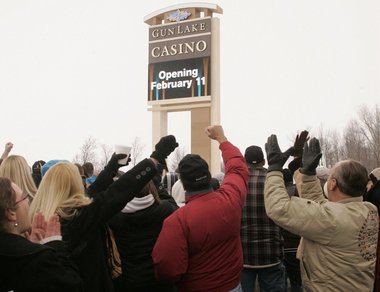
For instance, in the studies that GRIID has done in the past on race representation on local TV news, there has been very limited coverage of Native people. When there is coverage it tends to be from a very narrow perspective and race specific. What we mean by that is that the typical stories we see are the annual Pow Wow stories, stories about Native Casinos and sometimes, Native protests.
These limited kinds of stories serves the purpose of freezing Native people in this narrow stereotype that fits the hegemonic view of the dominant culture. It also says indirectly that Native people do not have opinions on larger policy issues, the economy, environment, public health, education or a how array of other topics that are relevant to that community. This type of news coverage acts as a form of racial profiling by the news media, whether it is intentional or not.
There is a great deal more that could be said about Native representation in media, but the analysis presented here provides enough information to make it clear that Native people are under represented and misrepresented in the dominant news and entertainment media.
Media Justice
People who attended the presentation last night asked what can be done to challenge this hegemonic view?
First, I think it is important to both expose and attempt to hold the media accountable for how they represent and report on Native People. This means that we need to do some quantitative analysis and monitor media in whatever form we chose. This would provide people with additional evidence of the bias, but it also provides you with hard data to engage media makers.
A second tactic could be to provide some cultural/historical training for news agencies by Native communities. Native people could provide the necessary information and insights in to local Native communities that could lead to improved and increased coverage. 
However, the most important strategy I would recommend that I learned from Native scholar Beverly Singer while she spoke in Grand Rapids last year, was that Native people need to make more of their own media. “Instead of relying on the dominant culture to tell their stories Native people,” Dr. Singer said, “should tell their own stories.”
This of course is already happening with online sources like Indian Country Today, National Native News, Native American Times or Indian Country News. However, in the US most Native media is online, with limited ownership or programming in broadcast media.
According to a 2007 report from Free Press, while racial minorities make up 33% of the US population, they only own 7.7% of all broadcast media. Of that 7.7% less than .5% is Native owned broadcast stations. To push for greater media justice, what if Native communities went to local radio and TV stations and said they wanted a regular time slot to produce their own show. Radio companies in Grand Rapids, like Clear Channel, which owns 8 stations could surely provide a 1-hour a week slot to the Native community to produce their own show and tell their own stories.
TV station, now that the digital spectrum has increased their programming could also easily give up 1 hour a week (for starters) to the Native community to produce their own show. I mean, why does FOX 17 need to broadcast re-runs of The Flying Nun, when Native people have no voice on local TV?
This will not happen without a fight, but if this is what Native people want, those of us in the non-Native community owe it to them to fight with them and demand that Native people have the resources to portray themselves the way they want to be portray. It would at least be an important step against challenging the hegemonic and highly constructive depiction of Native people in commercial media all over the US.
Michigan gets an F on Campaign Finance Disclosure
This article by Chris Andrews is re-posted from iwatchnews.org.
The campaign finance system here has more holes than I-94 after a spring thaw. Big spenders and special interests can easily shovel millions of dollars into election activities — secretly if they choose. The lobby law is so weak that it was nearly impossible to determine which companies were spending millions to oppose construction of a new bridge. And the financial disclosure system for state elected officials?
Well actually, there isn’t one.
Welcome to Michigan, the “Trust Us” State when it comes to transparency. Reform efforts are frequently launched, sometimes debated, always shelved. Meanwhile, special interests continue to make greater use of loopholes that allow them to influence the system without leaving fingerprints on the money spent doing it.
“It appears we’re living with an honor system in an environment where there isn’t much honor,” said Rich Robinson, executive director of the Michigan Campaign Finance Network, a nonpartisan watchdog group that tracks campaign spending and lobbying records.
All those factors help explain why the state earns a grade of 58 — an “F” — from the State Integrity Investigation, a collaborative project of the Center for Public Integrity, Global Integrity and Public Radio International. Overall, Michigan ranks 43rd among the 50 states.
The analysis of 330 indicators of state accountability measures shows that this state of almost 9.9 million residents has major flaws in tracking money spent to elect officials and shape policy. The set of laws regulating campaign spending, lobbyist activity, and financial disclosure guarantee essentially says to the public: Mind your own business.
Even so, Michigan’s state government is not known for scandal. It gets many things right.

It is not plagued by pay-to-play allegations in procurement, or by nepotism or cronyism in the civil service system. Its Freedom of Information Act usually, if not always, works to give journalists and others the information they request at a reasonable cost. The sort of corruption that is common in Detroit rarely finds its way 90 miles north to Lansing. And Gov. Rick Snyder’s new push for transparency is giving residents greater online access to information about how the state spends billions of dollars annually than ever before.
But there are glaring holes, especially when it comes to the millions of dollars spent to wine and dine lawmakers, elect or defeat candidates and pass or kill legislation. Efforts at reform are frequent; and they almost uniformly fail.
Following the money: Good luck with that
The Michigan Campaign Finance Act was enacted as a post-Watergate reform in 1976 to limit the impact a few rich individuals or well-heeled special-interest groups can have on elections, as well as to shine light on who is spending how much.
More than thirty-five years later, the law misses the mark in at least three ways. In the real world of politics, individuals and groups can spend as much as they want to elect or defeat a candidate, or ballot issue. A growing share of the money goes, legally, unreported. Enforcement efforts are modest at best.
Campaign finance law does limit how much individuals, political action committees, and political parties can contribute to candidates’ campaign committees. For instance, individuals can give no more than $3,400 to a candidate for governor; political action committees can give no more than $34,000 and political parties are limited to $68,000.
But for political high-rollers, these restrictions are nothing more than speed bumps. They can make unlimited contributions to political parties and political action committees, which turn around and make unlimited independent expenditures on television ads and other communications to support or defeat a candidate.
The only restriction is that the independent expenditures cannot be under the control of the candidate committee.
In practice, this has allowed wealthy individuals and powerful PACs to funnel huge amounts of money into campaigns.
In 2006, Republican businessman Dick DeVos contributed nearly $35 million to his own unsuccessful campaign for governor. That same year, Kalamazoo philanthropist Jon Stryker and his wife contributed more than $5 million to the new Coalition for Progress political action committee, which spent more than $3 million supporting Democrats or opposing Republicans. Democrats captured numerous swing seats to take control of the Michigan House of Representatives. Some Republicans think Stryker’s money was the difference.
Stealthy issue ads
At least those contributions were reported, and journalists and voters could track the money on the Secretary of State’s website. That can’t be said for issue-advocacy ads, which have emerged as the loophole of choice in the 21st century.
The ads look, sound and feel like standard candidate ads, but because they don’t directly ask voters to vote for or against a candidate, they don’t fall under the campaign finance act, according to the Secretary of State’s interpretation of the law.
Over the past several election cycles, the amount of money pumped into campaigns through issue-advocacy ads has grown enormously. Between 2000 and 2010, nearly $70 million in campaign advertisements for state office were not disclosed under the Michigan Campaign Finance Act. The figure comes from the Michigan Campaign Finance Network, which inspects the public files at television stations. There is no information available on money spent on radio ads, robo-calls or other issue-advocacy communication.
The Michigan Democratic Party spent $4.3 million on issue ads supporting Democratic candidate Virg Bernero in the 2010 gubernatorial election, and voters don’t know who gave the money to the party. Because these ads aren’t regulated by the campaign finance act, the donors aren’t disclosed. The Republican Governors Association pitched in $3.6 million for ads to elect Rick Snyder.
The Secretary of State’s Office is charged with enforcing the Campaign Finance Act but has relatively little power and little history of aggressive enforcement. The law directs elections officials to try to resolve disputes rather than prosecute. When Baxter Machine & Tool Inc. made an illegal contribution of $25,000 to a political action committee (state law prohibits corporate contributions to PACs) in 2004, the Secretary of State dismissed the complaint against the company “because this matter occurred in error,” and imposed a $1,000 fine, while allowing the political action committee to keep half the money.
Conciliation over punishment
The lack of subpoena power is a barrier to investigation of violations.
In 2010, the state was prepared to reach a $10,000 conciliation agreement with former Detroit Mayor Kwame Kilpatrick, who spent nearly $1 million of his campaign funds on legal services. The agreement fell through. In 2011, new Secretary of State Ruth Johnson took a tougher stand, citing Kilpatrick’s testimony in a civil suit that he paid his lawyers to defend himself against perjury charges related to an affair. Armed with information it could not get on its own, the secretary of state then filed suit seeking fines totaling $976,000.
In a state slowly pulling out of a decade-long recession, lobbying is a big and thriving business. In the first seven months of 2010, lobbyists spent nearly $20 million, up 12 percent from 2010, according to an analysis by the Michigan Campaign Finance Network.
Enacted in 1978, the Michigan Lobbyists Registration Act was designed to let the public know who is lobbying legislators and top administration officials, and how much they are spending to wine, dine and otherwise influence decision-makers. But the disclosure requirements are so weak that linking spending to political outcomes is virtually impossible.
“Frankly, lobbying reports themselves are almost meaningless,” said Robert LaBrant, general counsel for the Michigan Chamber of Commerce and one of the state’s leading authorities on the lobbying law.
The law requires lobbyists to list their clients, but not a whole lot more. Michigan’s major lobbying firms represent many clients with a variety of interests. From the reports, you can’t tell whether lobbyist expenditures are intended to shape business taxes, teacher tenure laws, movie industry incentives or a new bridge to Canada, all of which came up during the 2011 legislative session.
The Michigan Campaign Finance Network reported that the Detroit International Bridge Company spent $4.7 million on advertising opposing a second bridge that would present competition to the one it owns. But MCFN Executive Director Rich Robinson said he couldn’t find any evidence that the DIBC had registered to lobby, or paid a firm to lobby on its behalf.
Gift loophole
And then there’s the gift loophole. Lobbyists are barred from giving gifts to legislators or other officials. But what is a gift? According to the lobby law, it is something that cost more than $57 in 2012. (The threshold is adjusted annually for inflation.) So if a lobbyist gives a senator a ticket to a Michigan State University basketball game, it isn’t a gift after all.
A few years ago, several lobbyists attempted to enhance their generosity by pooling their money to give theater tickets to legislators and spouses without exceeding the threshold. The Secretary of State said no, in response to a ruling request from LaBrant, of the Michigan Chamber, and Robinson, of the Michigan Campaign Finance Network, two of the state’s leading experts on campaign finance and lobby regulation.
Similarly, lobbyists don’t have to identify the legislators they are taking out to breakfast, lunch or dinner as long as the cost is less than $57 in a month or $350 in a reporting period. “Generally, only if you are going out for a real night on the town with the wine and hors d’oeuvres and a nice dessert do you get over the financial threshold,” said LaBrant.
And Michigan is one of only three states without asset disclosure laws for top elected officials.
Unlike members of Congress, and lawmakers in 47 states, they aren’t required to let the public in on their personal wealth or financial holdings, which leaves voters unable to detect potential conflicts of interest. Governors and candidates for governor often voluntarily release their tax returns or summaries of them, but those disclosures are not required.
Various proposals have been made dating back to at least the 1980s to establish financial disclosure laws, similar to those required for candidates for Congress. But none have been enacted into law, so the public can only hope that legislators will disclose any conflicts and abstain when there are conflicts.
Conflicted about conflict
But there are no clear guidelines about what constitutes a conflict, and in reality, lawmakers almost never abstain for ethical reasons. Former Attorney General Mike Cox, who supported financial disclosure in 2009 when he was preparing to run for governor, researched House and Senate records between
2003 and 2009 and found there wasn’t a single instance when a state senator abstained from voting because of a conflict of interest. There were only 33 abstentions in 6,495 votes in the House.
In May 2011, Democrats in the state Senate formally challenged whether senators who had direct interests in limited liability corporations (and stood to benefit under a tax reform plan) should be required to abstain from voting. Republican Lt. Gov. Brian Calley, who serves as president of the Senate, ruled that senators must decide for themselves whether there are conflicts of interest. Everyone voted.
Michigan state law establishes a state ethics board designed to investigate wrongdoing. The members of the seven-person panel are unpaid volunteers, many of whom are former politicians with allegiance to one party or the other. The board has no budget, and its only staff is a civil service official who serves as executive secretary, and an assistant attorney general who is assigned to the board.
Over the years, the board has had little impact. It cannot accept anonymous complaints, which creates a barrier for anyone to come forward who might fear reprisal. Its authority extends to the executive branch but not the judiciary or Legislature. Lynn Jondahl, a former state representative who chaired the ethics board during the administration of Gov. Jennifer Granholm, said lawmakers occasionally approached him in search of guidance, but he had to tell them they were not within the board’s purview.
Even with its executive branch investigations, the ethics board has no power to take action other than to make recommendations to the agency where the alleged violation occurred. “It [the board] is very limited both in terms of its coverage of the executive branch and in terms of the sanctions, or lack of sanctions,” Jondahl said.
Legislator to lobbyist
Ethics reform advocates frequently call for legislation to establish “cooling off periods” before legislators and top administration officials become lobbyists or work in industries they oversaw, usually between six months and two years. But Michigan lawmakers have not been inclined to limit their future career options.
In fact, it is commonplace for legislators and other leading state officials to become lobbyists after their terms expire. Term limits restrict legislators to three two-year terms in the House and two four-year terms in the Senate. Former House Speakers Rick Johnson, Chuck Perricone, Lewis Dodak and Gary Owen are just a few of the legislators who turned lobbyist.
Former Michigan Insurance Consumer Advocate Melvin Butch Hollowell said that most of the state’s insurance commissioners have taken jobs in the industry after leaving government service. It raises questions about whether some of their decisions as commissioner were influenced by the desire to please their future bosses, he said.
Gov. Snyder is a strong proponent of transparency in government, and he proposed an ethics package when he was running for governor in 2010. Among other things, he called for banning all gifts from lobbyists, cooling-off periods, and regulation of issue advertising.
But while Snyder achieved many of his campaign goals after taking office in 2011, these reforms were put on the back burner. Robinson said lawmakers are unlikely to take action unless the public demands it, and so far citizens have shown little interest.
“The Legislature fundamentally is a position between interest groups and the citizens,” Robinson said, “and it’s easier to just throw in your lot with the interest groups.”
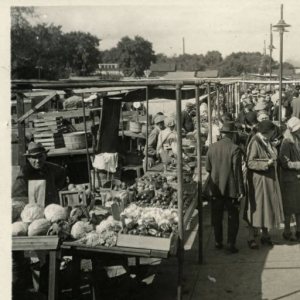
Leonard Street Farmers' Market
On Thursday March 8, anthropologist Jayson Otto shared the history of Grand Rapids’ farmers’ markets as part of the Greater Grand Rapids Women’s History Council “Grand Rapids Women and the Politics of Agriculture” series. From 1800 through 1946, the number of farmers’ markets steadily rose throughout the US. Grand Rapids was very much a part of this trend, especially from 1914 through 1928, when food costs soared due to the rising dominance of industrialized food production and distribution.
While industry leaders heavily influenced city government to quash the rise of farmers’ markets here, two forces prevented this from happening: farmers resisting through civil disobedience and women working together in a local movement to keep the markets open.
The other sources for food in the city were the many neighborhood grocers as well as the hucksters, underclass folks who sold produce from their carts. The grocers had the power to approve which hucksters could sell this food–and often it was not very fresh.
Around the turn of the century, grocers and food brokers influenced City Hall to outlaw farmers from retailing their wares along stretches of downtown streets, as was their custom. Retailing was discouraged at the wholesale market, which was a food distribution hub to all of Michigan and beyond. However, the small farmers continued to set up their illegal retail stalls–and people continued to go to them for fresh produce for some time. A woman vegetable grower from Wyoming, Mrs. Stall, was among those who resisted.
According to history that Otto was able to unearth, one tough market advocate who made the press of that day, August Raditz, was a white working class woman living on South Division Avenue. She was known for being handy with a scythe and standing up to city hall.
However, upper class white “club” women, Eleanor Nickleson, Helen Russell, Eva Hamilton and Emily Chamberlain were the identified leaders of the woman-led movement. They gathered momentum to establish retail farmers’ markets through a “High Cost of Living” campaign that eventually garnered support from the local Cabinetmakers union, businessman, Charles Leonard, of refrigerator fame, and the mayor of Grand Rapids. (Hamilton went on to be Michigan’s first woman senator). I n spite a strong opposition by male civic leaders, the result was three permanent farmers’ markets in the city: Leonard Street Market, South Division Market (at Cottage Grove) and Fulton Street Market.
When the farmers’ markets were met with threats of being closed in 1934 and 1955, women-led initiatives kept them open. While Otto was able to find photos and information about the Leonard Street Market up to its destruction in the 60s by urban renewal, the demise of the South Division market s seems to be undocumented. He guessed that the 1968 racial uprising may have been the cause.
The encouraging part of Otto’s presentation was the radical role that women have taken in establishing food security in Grand Rapids in the past. The discouraging piece was the lack of historical data around the role that people of color played in Grand Rapids farmers’ market history.
Do you have any recollections of the South Division Market or other farmers’ markets serving Grand Rapids people of color? If yes, please contact the local, women’s grass roots organization, Our Kitchen Table (OKT), OKTable1@gmail.com. The women of OKT are working for food security in Grand Rapids neighborhoods through the Southeast Area Farmers’ Market and food gardening programs. Knowing this history could bring another lost bit of important Black history to well deserved light.
 Grand Rapids Institute for Information Democracy