Closer Than You Think: Top 15 Things Romney and Obama Agree On
This article by Bruce A. Dixon is re-posted from Black Agenda Report.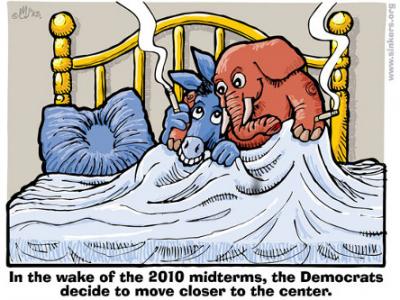
Too much agreement between Republicans and Democrats has always been bad news for those at the bottom of America’s class and racial totem poles.
Back in 1875, Frederick Douglass observed that it took a war among the whites to free his people from slavery. What then, he wondered, would an era of peace among the whites bring us? He already knew the answer. Louisiana had its Colfax Massacre two years earlier. A wave of thousands upon thousands of terroristic bombings, shootings, mutilations, murders and threats had driven African Americans from courthouses, city halls, legislatures, from their own farms, businesses and private properties and from the voting rolls across the South. They didn’t get the vote back for 80 years, and they never did get the land back. But none of that mattered because on the broad and important questions of those days there was at last peace between white Republicans and white Democrats — squabbles around the edges about who’d get elected, but wide agreement on the rules of the game.
Like Douglass, the shallow talking heads who cover the 2012 presidential campaign on corporate media have noticed out loud the remarkable absence of disagreement between Republican and Democratic candidates on many matters. They usually mention what the establishment likes to call “foreign policy.” But the list of things Republicans and Democrat presidential candidates agree on, from coddling Wall Street speculators, protecting mortgage fraudsters and corporate wrongdoers to preventing Medicare For All to so-called “foreign policy,” “free trade,” “the deficit” “clean coal and safe nuclear power” and “entitlement reform,” is clearly longer and more important than the few points of mostly race and style, upon which they disagree.
| 15 | Although unemployment is the highest it’s been since the Great Depression, the federal government should NOT enact any sort of WPA-style program to put millions of people back to work. Under Democrat Franklin Roosevelt in the 1930s, Depression-era unemployment was tackled head on by direct federal hiring to dig subways, build roads, schools, parks, sewers, recreational facilities and public buildings. Oblivious of this history, Democrat Barack Obama maintains that only the private sector can or should create jobs. |
| 14 | Medicare, Medicaid and social security are “entitlements” that need to be cut to relieve what they call “the deficit.” Republicans have been on record for this since forever, though they claim not to want to mess with the Medicare people already over 65 are getting. One of the first acts of the Obama presidency was to appoint a bipartisan panel stacked with “deficit hawks” like Republican Allan Simpson and Democrat Erskine Bowles to recommend raising retirement ages and cutting back Medicaid, Medicare and social security, and pass a law directing Congress to have an up or down no-amendments vote on its recommendations. Fortunately the “cat food commission”, as it was called, was deadlocked and offered none. But Obama and top Democrats, most recently House Democratic leader Nancy Pelosi continue to express their readiness for some kind of “grand compromise” with Republicans on this issue. |
| 13 | Climate change treaties and negotiations that might lead to them should be avoided at all costs. The differences between them are only style. Democrats admit that climate change exists and is man-made, Republicans say it’s a myth. But both ignored the Kyoto protocol and Obama like Bush before him, has worked tirelessly to delay, derail and boycott any actual talks that might lead to constructive international climate change agreements. |
| 12 | NAFTA was such a great thing it really should be extended to Central and South America and the entire Pacific rim. Again, there are differences in style. On the 2008 campaign trail, Obama sometimes mumbled about renegotiating parts of NAFTA, and such. But even before the primaries were done, press reports had him assuring the Canadian government this was only campaign rhetoric, raw meat for the rubes. In four years he has pushed NAFTA-like “free trade” corporate rights agreements with South Korea, most of Central America and is now secretly hammering out something called the Trans-Pacific Partnership Agreement. |
| 11 | Banksters and Wall Street speculators deserve their bailouts and protection from criminal liability, but underwater and foreclosed homeowners deserve nothing. Well, maybe not exactly nothing. Republicans think underwater homeowners deserve blame for forcing banksters to offer millions of fraudulent high-interest loans were then re-sold to investors around the world. Democrats think underwater homeowners deserve empty promises of help that never quite arrives for most of the foreclosed, the about-to-be foreclosed, their families and communities. But both agree on free money for banksters and speculators but no moratorium on foreclosures and no criminal investigations of mortgage and securities fraud. |
| 10 | Palestinians should be occupied, dispossessed and ignored. Iran should be starved and threatened from all sides. Cuba should be embargoed, and Americans prohibited from going there to see what its people have done in a half century free of Yankee rule. Black and brown babies and their parents, relatives and neighbors should be bombed with drones in Pakistan, Yemen, Somalia and similar places. The politicians and corporate commentators have a misleading name for this. They call it “foreign policy.” The realistic term for it is global empire. |
| 9 | Africa should be militarized, destabilized, plundered and where necessary, invaded by proxy armies like those of Rwanda, Ethiopia, Burundi or Kenya, or directly by Western air and ground forces, as in Libya. President Georgia Bush announced the formation of AFRICOM, the US military command for the continent which has officially swallowed all US civilian diplomatic presence. But only a black US president, even under the cover of “humanitarian war” could have invaded an African nation and openly dispatched special forces to Central Africa. |
| 8 | US Presidents can kidnap citizens of their own or any nation on earth from anyplace on the planet for torture, indefinite imprisonment without trial or murder them and neighboring family and bystanders at will. To be perfectly fair, there are distinctions between Republicans and Democrats here that don’t amount to differences. Republicans Cheney and Bush got their lawyers to say these things were OK and did them. Democrat Obama got Congress to enact “laws” giving these acts a veneer of fake legality, something a Republican probably could not have done. |
| 7 | Oil and energy companies, and other mega-polluters must be freed to drill offshore almost everywhere, and permitted to poison land and watersheds with fracking to achieve “energy independence”. The Republicans say “drill baby drill” but it seems only Democrats can chill out enough supposed “environmentalists” to make this happen. Obama campaigned on restricting offshore drilling four years ago, and reversed himself just before the BP oil disaster in the Gulf. The White House cooperated with BP in lying to the public about the extent of the disaster and has shielded BO from paying anything like the value of actual damages incurred to livelihoods, human lives and the environment. |
| 6 | The FCC should not and must not regulate telecoms to ensure that poor and rural communities have access to internet, or to guarantee network neutrality. Republicans have always been in favor of digital redlining, against network neutrality. Barack Obama claimed on the campaign trail he’d take a back seat to nobody in guaranteeing network neutrality. But he appointed as FCC chair a man who helped write the infamous Telecommunications Act of 1995, which gave away the government-built internet backbone to a handful of immensely powerful telecoms like AT&T and Comcast, and flatly reversed himself on network neutrality. The Department of Justice was forced to stop the ATT-T-Mobile merger by a storm of public outrage, but approved the Comcast-NBC deal. |
| 5 | Of course there really ARE such things as “clean coal” and “safe nuclear energy”. Again these are things Republicans have always pretended to believe. At the 2008 Democratic convention Democrat Barack Obama joined them, declaring he intended to be the president of “clean coal and safe nuclear energy.” Obama is building a wave of 33 nuclear plants across the country, the first two in mostly black and poor communities of Georgia and South Carolina where leaky existing nukes are causing cancer epidemics. The people know these things are myths. But Republican and Democratic candidates for office, all the way down to state and county officials seem not to. |
| 4 | Immigrants must be jailed and deported in record numbers. To be really fair, one should note that on this issue Republicans talk a mean game about sending them all back and jailing tens or hundreds of thousands along the way. But only President Obama has walked the walk, deporting over a million immigrants in his term in office, often with little or no due process and after housing many for months in atrocious privatized immigration prisons. |
| 3 | No Medicare For All. Forget about it eliminating the Medicare age requirement so that all Americans would qualify.. Republicans never wanted Medicare even for seniors, let alone everybody. Six or seven years ago Illinois State Senator Obama was telling audiences that if they elected Democrats to Congress, the Senate and the White House, they’d get single payer health care. But once in office he excluded Medicare for All from the proposals on the table, and enacted a national version of Massachusetts RomneyCare, requiring everybody to purchase private health insurance or be penalized. |
| 2 | No minimum wage increases for you, no right to form a union, no right to negotiate or strike if you already have a union, and no enforcement or reform of existing labor laws. Again, Republicans have always opposed minimum wage laws. Obama promised to boost the minimum wage his first two years in office, while he still had majorities in the House and Senate. But he didn’t do this, or pass legislation beefing up the right to organize unions, which has been eroded under Democrat and Republican administrations alike. |
| 1 | The 40 year war on drugs must continue, and even mention of the prison state is unthinkable. There are 2.3 million people in US prisons and jails today, a per capita total that beats the world. Politicians of both parties wag their fingers in multiple directions. But as Michelle Alexander points out, if the US prison population were rolled back to say, only 1 million, the level it was about 1980, this would mean one million jobs, as contractors, sheriffs, cops, bailiffs, judges and functionaries of all kinds would have to go out and find real jobs. |
The rabbit hole goes still deeper. We didn’t have to stop at these fifteen points of Democrat-Republican agreement, but you get the idea. Just as in Frederick Douglass’s day, the more Democrats and Republicans agree, the worse it is for the rest of us.
There was a time when black America had its own principles, and formed the immovable leftmost rock of the American polity. But in the 21st century, that rock has been dissolved by a tide of corporate money. With the rise of a cohort of black corporate Democrats and a right wing black Democrat in the White House there is no longer even any vaguely leftish influence on Democratic party politics. The House Progressive Caucus is the biggest in Congress, with over seventy members, but is powerless and irrelevant. Except for stylistic flourishes, the music they listen to and the color of some faces, the differences between Republicans and Democrats seem to exist mostly in political marketing campaigns and inside our own heads.
New Video kicks off campaign to challenge the US prison system
The following information is re-posted from Brave New Films.
Think about this. The United States is spending over $200 billion a year on a justice system that locks up more people than any country on earth. We have more prisoners than China. More than Russia. More than anyone. This colossal system is hitting our communities with staggering financial and human costs.
That’s why we’re launching a major new campaign here at Brave New Foundation — like Koch Brothers Exposed, Rethink Afghanistan, Walmart, Outfoxed, and others we’ve done. This campaign is called Beyond Bars. It aims to change Americans’ thinking and inspire action through short videos and shareable graphics exposing the U.S. system of mass incarceration.
This system is a beast — gobbling up resources that should be going to communities. WATCH THE VIDEO.
Beyond Bars will investigate corporations that profit off incarceration and politicians that use “tough on crime” rhetoric to scare voters. But we won’t just expose the negative; we’ll also show better ways to achieve public safety: things like prevention, rehabilitation, and job opportunity. Such solutions would save untold billions of dollars every year while making communities safer.
Amway, part of coalition that opposes Michigan Energy, Michigan Jobs ballot initiative
Last week, MLive ran a story with the focus on West Michigan groups that oppose the Michigan Energy, Michigan Jobs November ballot proposal.
The story tells readers that Amway and other West Michigan businesses and business associations are formally opposed to the Michigan constitution mandating that 25% of Michigan’s energy must be renewable energy by 2025. This business group believes that is a bad approach and that it will not result in the amount of jobs the ballot initiative proponents are claiming.
The only source used in the MLive article was an Amway spokesperson, although the article does link to a previous article about Ottawa County Democrats who support the ballot initiative.
The MLive article fails on many levels. First, it does not explore the main reasons for organized opposition to the November ballot initiative. Anyone who knows the philosophical nature of the Chamber of Commerce and many businesses like Amway, would know that they are opposed to most forms of government intervention in the economy. This is an ideological issue, which the MLive writer does not acknowledge or explore.
Second, there is no indication that this is an organized effort to opposed the Michigan Energy, Michigan Jobs November ballot initiative. The West Michigan entities identified in the MLive article are part of a coalition known as CARE – Clean, Affordable, Renewable, Energy. This coalition is made up of more than just West Michigan businesses and business association, including:

• Acemco Inc. • Agape Plastics • Amway • Betz Industries • Eagle Alloy • The Frederick Douglass Foundation of Michigan • Grand Rapids Area Chamber • Great Lakes Die Cast • Master Finish Co. • Metal Components, LLC. • Montcalm Alliance • Montcalm Commission on Aging • Montcalm County Panhandle Area Chamber of Commerce • Muskegon Lakeshore Chamber of Commerce • Rothbury Steel • Steve’s Antique Auto Repair • Sunrise Acre Farms • Trendway Corp. • Wyoming-Kentwood Area Chamber of Commerce.
In addition, there are numerous current and former politicians in Michigan who oppose this ballot initiative such as Ken Sikkema, Frank Kelly, Bill Schuette and local state Rep. Dave Agema. Agema has this to say about his opposition to the Michigan Energy, Michigan Jobs ballot initiative:
This will lead to huge increases in your energy bills. Once again, someone will be subsidized with your tax dollars making huge profits at your expense and not producing the jobs they claim. It’s an artificial stimulus program that will not work. Since our energy costs will skyrocket, businesses will locate elsewhere to avoid these costs. Instead of creating jobs, we’ll lose them. This does not create an environment for businesses to want to come to Michigan. This is a recipe for lost jobs and higher energy costs for all involved. Follow the money and watch who gains.
Lastly, the MLive article fails readers in that is does not seek out any independent or third party voices/perspectives. The lack of a third perspective limits the debate to whether or not to support this particular ballot initiative and omits any possible discussion about any serious energy policy that might operate outside of the current industrial mindset. Serious environmental consequences are not even part of how the debate between these two opposing forces has been framed.
Pro-business group releases second propaganda video

Earlier this year we told you about a video that went viral on Earth Day. Starting last week, the group that produced the first video, Free Market America, has released a second video entitled We Fight.
This second video from Free Market America was designed to coincide with the beginning of the GOP Convention in Florida and follows in the footsteps of Frank Capra’s series of WWII propaganda films with the title Why We Fight.
The video begins with a montage of comments from US presidents and then the narrator begins by tossing about terms like liberty and freedom. The narrator also makes the point that “we live in turbulent times and that “our generation is being called not to win a revolution, but to preserve one,” while the footage shows the Founding Fathers.
The propaganda spot says that this century has the potential to be another American Century, without any clarification or context. That some writers refer to the 20th Century as the American Century is because of the political and economic power of the US. However, most apologists for the US will not acknowledge that the US peak of political and economic power came at the expense of the rest of the world and many of its own people. The 20th Century saw numerous US wars, invasions and occupations, primarily motivated by economic interests, whether it was the CIA coup in Iran in 1953 or the 2003 invasion and occupation of Iraq. For more details see A Century of US Military Interventions from Wounded Knee to Libya.
At one point in the video when the narrator is again pontificating about liberty and how there are some that do not understand how liberty can be lost, the video footage shows occupy actions around the country, a clear jab at this grassroots movement disgusted with the system of power in this country.
The video ends with several “regular people” saying that they will fight, some for freedom, some for liberty and some for the free market. It is telling that it ends with someone saying they will fight for the free market, since this is what the group behind the video is all about. We Fight really means, we fight to maintain the US system of power.
The Free Market America is instructive and worth watching, not only to see the propaganda message they wish to inject into the public consciousness just prior to the election, but also the media production techniques and the meta-narrative they use, which make for a useful example of contemporary propaganda.
We’re #1: US sets record arms sales in 2011
This article is re-posted from the Center for Public Integrity.
2011 was a very good year for U.S. arms sales, with more than triple the business from the year before. 
According to a new report to Congress, worldwide sales of U.S. weapons last year added up to $66.3 billion. That accounts for more than three-quarters of 2011 arms sales worldwide, which is “the highest single year agreements total in the history of the U.S. arms export program.”
The report was prepared by the Congressional Research Service (CRS) as part of their annual study of arms sales.
In 2010, the U.S. authorized $21.4 billion in sales, which led CRS to describe the jump as “extraordinary.” In terms of overall sales, Russia was distant second to the United States, having moved $4.8 billion. The previous record was in 2009, when the U.S. did almost $31 billion in sales.
Since the start of 2008, 81.4 percent of U.S. arms sales agreements have gone to the Middle East while 16.04 percent have gone to Asian countries.
In the report, CRS notes that sales to developing nations were a major driver in lifting 2011 U.S. sales, jumping from $14.3 billion in 2010 to $56.3 billion in 2011. CRS points to Saudi Arabia and the United Arab Emirates as countries that bolstered their arms purchasing in 2011, which CRS says could be linked to concerns over Iran. Saudi Arabia purchased more than $33 billion in arms from the U.S., including 84 new F-15 jets and upgrades for 70 older models.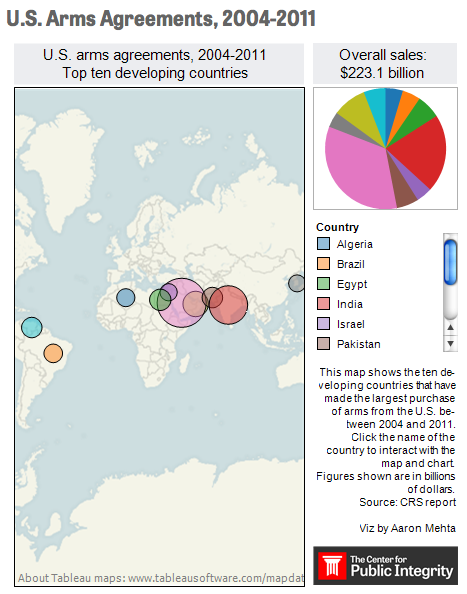
The Saudis were not alone in purchasing weaponry in the region. The United Arab Emirates purchased 16 Chinook helicopters for just under $1 billion total; Oman shelled out $1.6 billion for 18 F-16 fighters. Egypt added land forces, spending $1 billion on M1 Abrams tanks, a sale that the Pentagon has used to argue for freezing domestic production of the Army’s signature land vehicle.
But “the U.S. arms agreements with Saudi Arabia were extraordinary,” concluded the report, as they “represent, by far, the largest share of U.S. agreements with the world or the developing world in 2011.”
The selling of arms to Saudi Arabia is not without controversy. As the Center reported in June, the country has continued to receive steady flows of arms from the United States despite being on a State Department watchlist for human rights violations. Since the start of 2004, Saudi Arabia has purchased $75.7 billion in arms.
Another country which has received weapons despite human rights abuse concerns is the tiny nation of Bahrain. Earlier this year, the Center reported that the U.S. lifted a freeze on arm sales that had been put into effect due to human rights abuses during the “Arab Spring” uprising. Like Saudi Arabia, Bahrain is a major strategic partner for the U.S. The Persian Gulf nation received $80.4 million in military financing from the U.S. between 2005 and 2010 and is home to a 60-acre U.S. naval base which houses the U.S. Fifth Fleet.
No law requires that U.S. arms be exported only to countries that the State Department — in its annual human rights assessments — determines are treating their citizens well. Instead, a more narrow restriction known as the so-called “Leahy Law,” named for author Sen. Patrick Leahy (D-Vt.) and passed in 1997, prohibits U.S. assistance to specific military and police units deemed responsible for human rights abuses.
While the United States was clearly the leader in weapons transactions, a number of other countries took part in the global arms trade, including France, the United Kingdom, Germany, and Italy — traditional Western European arms suppliers. China has also begun to rise to prominence in this area, although they still lag significantly behind the U.S. and Russia.
Immigrant Rights groups in Michigan are taking action
Two different immigrant rights groups in Michigan are taking action on behalf of immigrants who are faced with increasing public hostility and abuse by the system.
In West Michigan, the group Justice For Our Neighbors (JFON) is offering resources, along with other agencies, for young immigrants under the Deferred Action for Childhood Arrivals (DACA) act. The group, known as Michigan Coalition for Immigrant and Refugee Rights (“MCIRR”), developed a two-step process of intake sessions followed by larger form preparation workshops.
Each agency will use a common intake form and work together to host the workshops. Applicants need to participate in the intake session to ensure they understand the risks and benefits of their application. The participants will meet with an attorney to confirm they are eligible for DACA. There is a nominal fee for an intake and the workshop. Costs for the intake is $30, but JFON’s intake is free of charge (by appointment only).
On Thursday, September 20th, JFON will host its first intake session at their Holland Clinic Site. To make an appointment, find information about this event, or to view a DACA information sheet, visit their website www.jfonwestmichigan.org.
To find a comprehensive list of DACA events across Michigan go to www.michiganimmigrant.org.
The other major news in immigrant rights has to do with the issue of border patrol abuses. The Michigan Alliance for Immigrant Rights sent out this media release yesterday:
Today, immigrant advocate groups and 11 members of Congress called for an independent investigation into reports of abuse at the hands of Border Patrol. Congressman Hansen Clarke’s office represented the other U.S. Representatives and joined immigrant groups representing states from New York to Washington requesting Government Accountability Office (GAO) audit of Border Patrol practices. 
“When Border Patrol targets people based solely on their race or religion, rather than their behavior, they are weakening our national security and undermining our civil rights,” said Dawud Walid, Executive Director Council on American-Islamic Relations – Michigan, “We need Border Patrol to play by the rules, and act like professionals.”
The letter calling for the GAO investigation of Border Patrol comes after a number of reports of abuse by Border Patrol ranging from detaining people based on nothing but their skin color or apparent religion to denying food and water to those detained. Most notable among these reports is a a two-part PBS “Need to Know” documentary that includes eyewitness testimony of from a Border Patrol agent whistle blower . ”After years of internal investigations, it’s become clear that Border Patrol can’t police itself. Even former agents have come forward to confirm the problems with abuse,” Ryan Bates, Director, Alliance for Immigrants Rights – Michigan. “It’s time for an independent watchdog to help get Border Patrol under control, which is why we’re so glad that eleven Members of Congress have called on the GAO to begin an investigation.”
The media release also cites several recent reports of border patrol abuse, such as A Culture of Cruelty and the One America Northern Border Report.
This Day in Resistance History: IWW members sentenced to 20 years in 1918 for “obstructing the war”
Despite constitutional claims to supporting free speech, the US federal government has a long history of criminalizing speech, especially during times of war.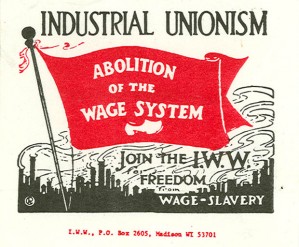
The Espionage Act was passed in 1917 as a means of prosecuting anyone who publicly opposed World War I, which included opposing military recruitment and interfering with military operations.
However, the Espionage Act, like today’s Patriot Act, was really designed to target dissident groups and individuals in the US that the power structure determined with a threat to that power.
One such group that was targeted by the US government during the US involvement in WWI was the Industrial Workers of the World (IWW), a radical labor group also known as The Wobblies.
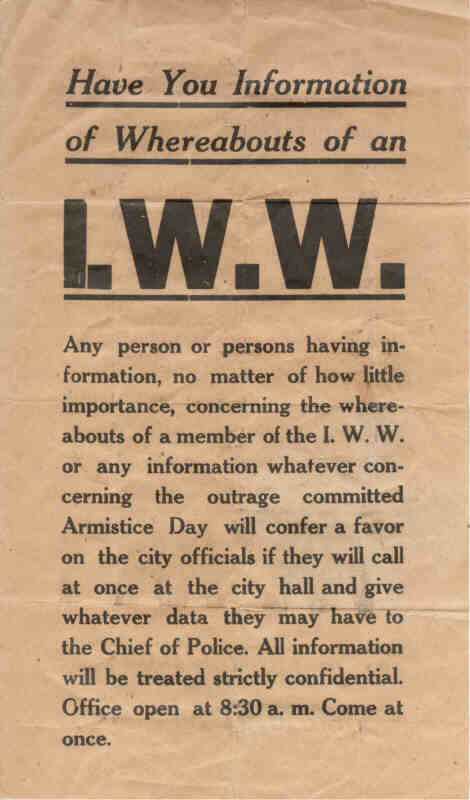
The Wobblies were engaged in radical labor organizing that was different than most other unions, since they allowed Blacks, women and recent immigrants to be part of their union. The IWW also was unique in their mission as workers in that they outwardly oppose capitalism and sought to create an economic system that was run by workers for the benefit of all.
Many of the Wobblie chapters were also critical of the US involvement in WWI, since they saw it as a capitalist war, where working class people were forced to fight against other working class people in order to benefit the capitalist class. The IWW passed a resolution at their national convention in 1916 and in their newspaper, the Industrial Worker, they wrote: “Capitalists of America, we will fight against you, not for you! There is not a power in the world that can make the working class fight if they refuse.”
Such a critique got the attention of the federal government, which began a campaign to turn public opinion against them. This campaign involved the cooperation of various news agencies throughout the country, which would print editorials damning the IWW for speaking out against the war and accused them of being “a threat to the nation’s security.”
This attack against the Wobblies is well noted by James MacGregor Burns and Stewart Burns, who state: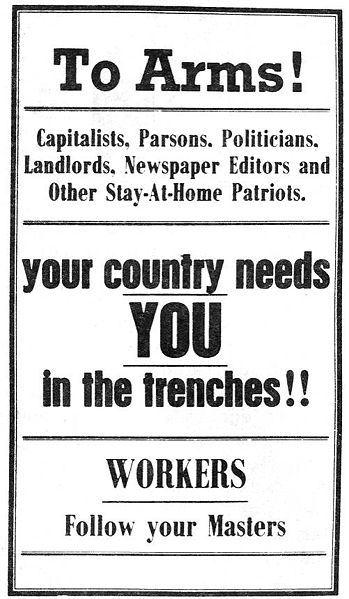
In September 1917, despite an intensive investigation that failed to substantiate allegations that the Wobblies were paid German agents or had violated the espionage or conscription acts, the Justice Department took action against them. Its agents swept down on union offices and the private homes of union members from Chicago to Spokane and seized every document they could find—including the love letters of Ralph Chaplin, the editor of Solidarity. From the several tons of “evidence” collected in the raids, the government constructed charges that the IWW—if not directly paid by the Germans—was at any rate a criminal conspiracy to obstruct the war effort, advocating draft refusal and military desertion. Federal indictments were brought in Chicago and four other cities. When the Chicago trial opened in April 1918, more than 100 Wobbly leaders were in the dock—Big Bill Haywood among them. Each faced more than a hundred separate charges. The government did not intend, nor did it have evidence, to prove the guilt of every individual on all counts. Instead, for a month and a half prosecutors took turns reading from the captured documents and lecturing the jury on the subversive and atheistic nature of Wobbly doctrine. The defense attempted to put its accuser—the capitalist system—on trial. A succession of union members took the stand to testify about their experiences in the struggle against the exploitation of man by man.
The Wilson administration ordered the Justice Department to raid 48 IWW branch offices across the country. Of those that were put on trial, most of them were found guilty on August 28, 1918 and sentenced to 20 years in prison, plus heavy fines. Although they appealed the sentences, most did serve several years in federal prison until they were pardoned by President Harding.
However, the result of the raids, arrests and incarceration of hundreds of Wobblies, along with deportation of hundreds more, diminished the ranks of the radical union in such a way that it never recovered until decades later.
The resistance to US militarism and capitalism by the Wobblies should be a lesson for those resisting today. Such radical politics will not be tolerated by the power structure, but resisting such policies are unavoidable if we want a truly free society.
Our Hunger Games
This article by Vandana Shiva is re-posted from Common Dreams.
Hunger and malnutrition are man-made. They are hardwired in the design of the industrial, chemical model of agriculture. But just as hunger is created by design, healthy and nutritious food for all can also be designed, through food democracy.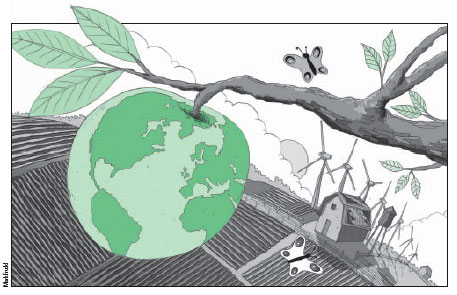
We are repeatedly told that we will starve without chemical fertilisers. However, chemical fertilisers, which are essentially poison, undermine food security by destroying the fertility of soil by killing the biodiversity of soil organisms, friendly insects that control pests and pollinators like bees and butterflies necessary for plant reproduction and food production.
Industrial production has led to a severe ecological and social crisis. To ensure the supply of healthy food, we must move towards agro-ecological and sustainable systems of food production that work with nature and not against her. That is what movements that promote biodiversity conservation, like our NGO Navdanya, are designing on the ground.
Industrialisation of agriculture creates hunger and malnutrition, and yet further industrialisation of food systems are offered as solution to the crisis. In the Indian context, agriculture, food and nutrition are seen independent of each other, even though what food is grown and how it is grown determines its nutritional value. It also determines distribution patterns and entitlements. If we grow millets and pulses, we will have more nutrition per capita. If we grow food by using chemicals, we are growing monocultures — this means that we will have less nutrition per acre, per capita. If we grow food ecologically, with internal inputs, more food will stay with the farming household and there will be less malnutrition among rural children.
Our agriculture policy focuses on increasing yields of individual crops and not on the output of the food system and its nutritional value. The food security system — based on the public distribution system — does not address issues of nutrition and quality of food, and nutritional programmes are divorced from both agriculture and food security.
The agrarian crisis, the food crisis and the nutrition and health crisis are intimately connected. They need to be addressed together. The objective of agriculture policy cannot be based on promoting industrial processing of food. The chemicalisation of agriculture and food are recipes for “denutrification”. They cannot solve the problem of hunger and malnutrition. The solution to malnutrition begins with the soil.
Industrial agriculture, sold as the Green Revolution and the second Green Revolution to Third World countries, is chemical-intensive, capital-intensive and fossil fuel-intensive. It must, by its very structure, push farmers into debt and indebted farmers off the land. In poor countries, farmers trapped in debt for buying costly chemicals and non-renewable seeds, sell the food they grow to pay back debt. That is why hunger today is a rural phenomenon. Wherever chemicals and commercial seeds have spread, farmers are in debt. They lose entitlement to their own produce and hence get trapped in poverty and hunger.
Industrial chemical agriculture also creates hunger by displacing and destroying the biodiversity, which provides nutrition. The Green Revolution displaced pulses, an important source of proteins, as well as oilseeds, thus reducing nutrition per acre. Monocultures do not produce more food and nutrition. They take up more chemicals and fossil fuels, and hence are profitable for agrochemical companies and oil companies. They produce higher yields of individual commodities but a lower output of food and nutrition.
Industrial chemical agriculture’s measures of productivity focus on labour as the major input while externalising many energy and resource inputs. This biased productivity pushes farmers off the land and replaces them with chemicals and machines, which in turn contribute to greenhouse gases and climate change. Further, industrial agriculture focuses on producing a single crop that can be globally traded as a commodity. The focus on “yield” of individual commodities creates what I call a “monoculture of the mind”. The promotion of so-called high-yield crops leads to the destruction of biodiversity.
Biodiverse systems have higher output than monocultures, that is why organic farming is more beneficial for farmers and the earth than chemical farming.
Industrial chemical agriculture also causes hunger and malnutrition by robbing crops of nutrients. Industrially produced food is nutritionally empty but loaded with chemicals and toxins. Nutrition in food comes from the nutrients in the soil. Industrial agriculture, based on the NPK mentality of synthetic nitrogen, phosphorous and potassium-based fertilisers, lead to depletion of vital micro-nutrients and trace elements such as magnesium, zinc, calcium, iron.
The increase in yields does not translate into more nutrition. In fact, it is leading to malnutrition. To get the required amount of nutrition people need to eat much more food.
The most effective and low-cost strategy for addressing hunger and malnutrition is through biodiverse organic farming. It enriches the soil and nutrient-rich soils give us nutrient-rich food.
Earthworm castings, which can amount to four to 36 tons per acre per year, contain five times more nitrogen, seven times more phosphorus, three times more exchangeable magnesium, 11 times more potash and one-and-a-half times more calcium than soil. Their work on the soil promotes the microbial activity essential to the fertility of most soils. Soils rich in micro organisms and earthworms are soils rich in nutrients. Their products, too, are rich in nutrients. On an average, organic food has been found to have 21 per cent more iron, 14 per cent more phosphorous, 78 per cent more chromium, 390 per cent more selenium, 63 per cent more calcium, 70 per cent more boron, 138 per cent more magnesium, 27 per cent more vitamin C and 10-50 per cent more vitamin E and beta-carotene. And the more biodiversity on our farms, the more is the nutrition per acre, at little cost.
Plants, people and the soil are part of one food web, which is the web of life. The test of good farming is how well it works to increase the health and resilience of the food web.
Not “Disappointed” With Obama
This interview between Diego Viana (Valor Econômico) is re-posted from ZNet.
As you show in your books, Obama’s achievements fare quite disappointingly when compared to the progressive agenda his candidacy was associated with. Given his personal history and political connections, particularly within the Democratic Party, to what extent was all this surprising? How disappointing was Obama, in your view? On the other hand, given the American political landscape, could he really have done much more?
Street: The first of the two books I’ve published with “Barack Obama” in the title was researched and published well before his election to the White House. That book (Barack Obama and the Future of American Politics – June 2008) predicted that an Obama presidency would disappoint those who naively bought into the notion that his election heralded progressive change. I had no progressive expectations and thus was not disappointed. My prediction was based on my understanding of Obama’s centrist, neoliberal, business- and empire-friendly record in the Illinois legislature and the U.S. Senate and on the actual content of his presidential campaign. My second “Obama book,” bearing the title The Empire’s New Clothes: Barack Obama in the Real World of Power, illustrated in detail the different ways in which the prediction was born out over the first 14 months of Obama’s presidency.
Obama rose to power in Washington with remarkable and in-fact record-setting financial backing from Wall Street and K Street election investors and with the strong approval of the nation’s foreign policy establishment. Those elites are NOT in the business or promoting or tolerating politicians who seek to challenge the nation’s dominant domestic and imperial hierarchies and doctrines. “It’s not always clear what Obama’s financial backers want,” the progressive journalist Ken Silverstein noted in Harpers’ Magazine in the fall of 2006, “but it seems safe to conclude that his campaign contributors are not interested merely in clean government and political reform – a reasonable judgment given well-known facts on the purposes behind election finance at the upper levels. On condition of anonymity,” Silverstein added, “one Washington lobbyist I spoke with was willing to point out the obvious: that big donors would not be helping out Obama if they didn’t see him as a ‘player.’ The lobbyist added: ‘What’s the dollar value of a starry-eyed idealist?'”
For those who chose, against mountains of contrary evidence, to believe that Obama was in fact a progressive idealist. Obama has been, yes a great disappointment. Like many other Left thinkers including Noam Chomsky, John Pilger, Adolph Reed Jr., the late Alexander Cockburn, Glen Ford, Doug Henwood, Ralph Nader, Laurence Shoup, Edward Herman, and Chris Hedges, I found it fairly easy to foresee the corporatist and militarist direction of the Obama presidency. That direction is consistent with Obama’s conservative, power-serving essence (cloaked in deceptive progressive rebel’s clothing for electoral purposes) and with the deeper subordination of the nation’s two reigning political parties and political culture to the unelected and interrelated dictatorships of money and empire.
Could he have done more in a progressive way, had he wanted do, given the political context of the U.S.? It’s hard to know since he never tried. I think a genuinely progressive, anti-poverty, and populist president might have been able to rally a very angry populace to push back against the nation’s concentrated wealth and power structures by pushing aggressively for a number of policies: a much larger stimulus with major public works jobs programs; a real (single-payer) health insurance reform (the reform he passed should be called “The All Power to the Big Insurance and Drug Companies Act”); the disciplining and even nationalization of key financial institutions; and passage of the Employee Free Choice Act (which would have re-legalized union organizing in the U.S.). Would such a fighting and progressive President Obama have succeeded on any or all of this? We’ll never know because he never remotely tried. He does not believe in confronting existing power structures and dominant ideologies. He never did. He came into office determined to tamp down dangerous popular and progressive expectations associated with his election – something that is very clear in his Election Night speech and Inaugural Address.
I think even the moneyed elite itself was somewhat surprised at the extent to which president Obama was determined to shield them from citizen rage. In his book Confidence Men: Wall Street, Washington, and the Education of a President (2011), the PulitzerPrize-winning author Ron Suskind tells a remarkable story from March of 2009. Three months into Obama’s supposedly “transformative” presidency, popular rage at Wall Street was intense and the leading financial institutions were weak and on the defensive. Obama called a meeting of the nation’s top thirteen financial executives at the White House. The banking titans came into the meeting full of dread only to leave pleased to learn that the new president was in their camp. For instead of standing up for those who had been harmed most by the crisis – workers, minorities, and the poor – Obama sided unequivocally with those who had caused the meltdown.
“My administration is the only thing between you and the pitchforks,” Obama said. “You guys have an acute public relations problem that’s turning into a political problem. And I want to help…I’m not here to go after you. I’m protecting you…I’m going to shield you from congressional and public anger.”
For the banking elite, who had destroyed untold millions of jobs, there was, as Suskind puts it, “Nothing to worry about. Whereas [President Franklin Delano] Roosevelt had [during the Great Depression] pushed for tough, viciously opposed reforms of Wall Street and famously said ‘I welcome their hate,’ Obama was saying ‘How can I help?’”
As one leading banker told Suskind, “The sense of everyone after the meeting was relief. The president had us at a moment of real vulnerability. At that point, he could have ordered us to do just about anything and we would have rolled over. But he didn’t – he mostly wanted to help us out, to quell the mob.”
When the Occupy Wall Street movement came along, many people thought it would empower president Obama in promoting reforms. Is it possible to determine why that didn’t happen?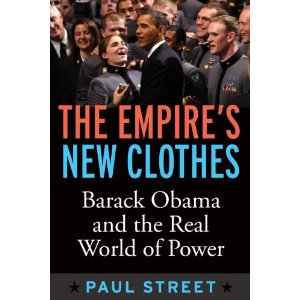
Street: Obama hasn’t been interested in passing reforms beyond a deeply flawed and absurdly complex health insurance bill (recently approved by Republican Supreme Court Chief Justice John Roberts) that serves the nation’s leading insurance and pharmaceutical corporations above all. During the summer 2011 debt ceiling crisis that preceded and helped spark Occupy Wall Street (OWS), Obama offered the right wing a “grand bargain” that included regressive cuts in Social Security and other social programs far beyond what the Republicans were demanding. Even as it has sought to co-opt the movement’s populist spirit for partisan electoral purposes, the Obama administration was very standoffish towards OWS (it took the same distant posture towards the labor rebellion in Madison, Wisconsin months earlier). The White House helped coordinate the repression and dismantlement of the Occupy Movement in October and November of last year.
For its part, Occupy was not really into pressing Obama or any other major party politician for reforms. It seemed more interested in advancing and embodying or prefiguring radical system change – a “world turned upside down,” so to speak. And once the Democrats determined that the Occupy Movement was not something that they could easily co-opt, they decided to crush it.
The Democrats do seem to find Occupy’s language of the “1%” versus “the 99%” useful in running against the Republicans and especially against Mitt “Mr. 1%” Romney. But this is about electoral advantage – the standard U.S. manipulation of populism by elitism – and has little to with any specific policies or reforms.
Before Obama was elected, did you expect him to be the bringer of change?
Street: Well, let me put a “dialectical” twist on what I said above. I expected change of a curiously ironic and indirect kind. I expected first an elite-directed white-nationalist “right wing populist” rebellion to emerge in the progressive vacuum created by Obama’s initial success in muting liberal and left forces. Then I expected a more genuinely grassroots and left-leaning rebellion to emerge as more and more “disappointed” American received a great lesson from Obama on who really rules the United States (the aforementioned “unelected dictatorships”) beneath and beyond the quadrennial big money-big media-candidate-centered “electoral extravaganzas” (Chomsky’s term) that are sold to us as “politics” – the only politics that matters. Consistent with the pre-election reflections of a smart, Brooklyn-based Marxist named Doug Henwood, I expected many Americans to get it that it’s a fantasy to expect democratic or progressive change to come from electing another ruling class-sponsored candidate. I expected some of those people to act accordingly by joining social movements for radical progressive change.
The first expectation was born out with the emergence of “the Tea Party,” which helped fuel the historic right wing sweep in the mid-term Congressional elections of 2010. The second expectation was born out with the rise of Occupy Wall Street, which reflected participants’ realization that American democracy (or what’s left of it) is no less crippled by the dark cloud of big money and the machinations of capital when Democrats hold nominal power than when Republicans do. True, Occupy was crushed but it was a start beyond candidate- and major party-captive electoralism and towards a more Latin American style of social movement politics. I expect the populist, radically democratic Occupy spirit to inform the rebuilding of a U.S. Left that matters in coming years.
When Obama campaigned in campus towns like Madison, Wisconsin in 2007 and 2008, he proclaimed that “change doesn’t come from the top down, it comes from the bottom up.” He stopped saying that once he got into the nation’s top job, as I expected. Still, the confrontation between (a) dreamy candidate Obama and (b) the harsh reality of Obama in the real world of power was very instructive in ways that did create some welcome shifts in the populace.
In 2008, then candidate Obama’s name was associated with hope (as in the famous Shepard Fairey piece) and change; he was considered as the candidate who would change the US completely, reversing Bush’s imperialism and very strong penchant for the plutocracy. How deeply do the last four years change this image among the American people and electors? Can president Obama still mobilize people’s emotions?
Street: Obama’s predictable (and predicted) transition from outwardly progressive, anti-war and expectation-raising candidate to centrist, imperial, and expectation-managing president has (quite predictably) created a significant “enthusiasm gap” among the Democratic Party’s “progressive base.” His image and popularity have suffered. While he is doing his best to present himself as a progressive people’s critic of “Mr. 1%” (more like Mr. 001%) Mitt Romney, he cannot mobilize poor, minority, and working class constituencies to anything like the same degree as he could in 2007 and 2008 or to the degree that might be able to had he taken a progressive direction in the White House. He’s been on the inside making policy from the top down on behalf of the ruling class for more than three years now and that often makes it difficult for him to pose credibly as a champion of the people in their struggle with the Establishment. This does not necessarily mean that he will lose to Romney. If he wins re-election (and he may well – the election seems likely to be close as in 2000 and 2004), it will have more to do with negative attack campaign ads and a sense of Obama being the lesser and known evil (compared to the doltish aristocratic arch-plutocrat and wild card Romney) than with any successful rallying of progressive hopes and expectations around the banner of “hope” or “change.”
As for “reversing Bush’s imperialism,” just ask the survivors of the many Pakistanis, Afghans, Libyans, Yemenis and others killed by Obama’s drones, bombs, missiles, bullets, and invasions. The president has kept the imperial machine set on kill (as Alan Nairn put it a couple of years ago) and has actually expanded the scope of the U.S. global imperial war on/of terror. He has also pushed the military closer to conflict with China. And ask the people of Honduras (and Paraguay) if Obama has reversed the imperial U.S. policy of encouraging and assisting right wing coups in Latin America. Meanwhile, the Obama administration has been considerably more aggressive than its predecessor in attacking and violating the civil liberties of antiwar protestors at home.
But anyone who thought Obama was going to reverse U.S. imperialism wasn’t paying serious attention to his speeches, writings, and Senate voting record before the election. U.S. Senator and presidential candidate Obama advertised his commitment to empire and the use of force quite clearly to those willing and able to look and listen.
Obama’s election was also expected to impact lastingly on racial relations within the US, since he’s the first black president. Can such changes be identified? Is it possible to assess that America (or maybe even not just America, but the world) has become less racist? Has there been any real change at all?
Street: Well, not really – nothing much beyond the superficial. To quote Frantz Fanon in his book Black Skin, White Masks: “What matters is not so much the color of your skin as the power you serve and the millions you betray.” Having black conservatives Colin Powell as Secretary of State, Condolleeza Rice as top National Security Advisor, and Clarence Thomas as a Supreme Court Justice under George W. Bush did not alter the fundamental nature of U.S. race relations and neither did electing the conservative Obama to the White House.
Racism and white supremacy are very deeply entrenched in U.S. institutional and cultural life (a topic I have written about at some length in the third chapter of Barack Obama and the Future of American Politics and in my 2007 book Racial Oppression in the Global Metropolis: A Living Black Chicago History). Anyone who thinks that to put a very cautious and conservative, “race-neutral,” and half-white black politician into the White House is to seriously confront white racism in the U.S. has a superficial understanding of racial oppression in this country.
In some ways, Barack Obama’s election and administration seems to have worsened the nation’s racial problems. The ascendancy of Obama has been seen by many whites as proof positive that the only meaningful remaining barriers to black advancement and equality in the U.S. are internal to “black culture” and the black community itself. Along with other widely white-heralded “race neutral” black American elites like Oprah Winfrery and Colin Powell, Obama has been widely perceived as an epitome of the cultural-Darwinian thesis – as the “good” “guess-who’s-coming-to-dinner” black whose internalization of respectable white values and behavioral codes leads to success that demonstrates that a “color blind” America has answered the call for racial equality of opportunity and that impoverished “ghetto blacks” are victims of their own “bad choices” and “bad culture.”
It is a narrative that Obama has been unwilling to remotely question and more than happy to exploit to his advantage with the majority white racism-denying electorate. As the astute black left commentator Glen Ford recently noted on Black Agenda Report:
“a clear white consensus favors ‘race neutral’ government policies – which, in practice, reject Black grievances based on past discrimination and disadvantage, and set an extremely high bar for complaints of current bias. Such dismissal of essential – and irrefutable – contemporary and historical data can only be rooted in a general white belief that African American culture is what holds Blacks back. Barack Obama either shares this white attitude, or pretends he does for political gain. His singling out of ‘irresponsible’ Black fathers and hectoring of Black parents for feeding their kids Popeye’s chicken for breakfast was a shout-out to white folks that he shared their assessment of Black ‘culture.’ ”
It goes back a long way in Obama’s career. Before and since his election to the presidency, Obama has repeatedly criticized blacks for failing to think and act right and thereby to take advantage of the great opportunities supposedly afforded them by the “magical place called the United States.” He has distanced himself from the supposedly “dysfunctional” and obsolete notion that white supremacy and societal racism continue to oppress black Americans. Claiming that “a rising tide will lift all boats” and explicitly denying the need to address the specific needs of blacks, he has refused to advance any policies that might specially address harsh racial disparities resulting from racist realities – this even as already terrible black poverty, joblessness, foreclosure, homelessness, and abuse-by-police numbers have significantly worsened during his administration. A cheerleader for Newt Gingrich and Bill Clinton’s neoliberal-racist elimination of poor families’ entitlement to public family cash assistance (for s-called “welfare reform”), Obama chides blacks for supposed personal and cultural failure but has nothing to say about the Caucasian culture of white supremacy that creates a living (if dangerously cloaked) reality of anti-black racial oppression in the contemporary U.S.
The kind of opposition president Obama has faced is very particular: “birthers”, “accusations” of being a Muslim, the Tea Party, and so on. What does this tell us about the historical figure of Obama?
Street: Well, it tells us less about Obama than it does about how deeply racist and nativist much of the United States remains, even if a majority of the predominantly white electorate (though not a majority of white voters) was ready to select a certain (bourgeois and “post-racial”) kind of black presidential candidate with a technically Muslim name over the terrible John McCain-Sarah Palin ticket in 2008. It tells us that the country is dangerously mired in identity politics, that American racism and nationalism after 9/11 is especially noxious in relation to Islam and the Muslim world; that the Republican Party (what I now half-jokingly call the Teapublican Party and Tea.O.P.) has gone very far to the extreme right; and that popular anger remains all too susceptible to being captured by viciously racist right-wing forces in the absence of a sustained and organized Left political opposition. The fact that people who bizarrely think that Obama is a foreign-born Muslim and radical are commonly cited as at “the opposition” to Obama speaks volumes about how incredibly far U.S. political culture has titled to the right. Majority public opinion on numerous key policy issues (jobs, inequality, social spending, labor rights, taxes, the role of money in elections, the power of corporations and the rich and more) stands well to the progressive left of Obama and the Democrats but the aforementioned dictatorships tolerate no parties to the left of the corporate and imperial U..S. Democrats – “history’s second most enthusiastic capitalist party” (after the U.S. Republicans). As a result there are no real progressive, even mildly social-democratic political institutions to relevantly capture progressive majority sentiments and the role of the angry and vocal “opposition” falls to the racist, white nationalist and arch-plutocratic paranoids of the ever more viciously right-wing Republican Party. It’s not a pretty situation.
A silent Election issue: The Cost of War to Grand Rapids
We are entering the last leg of the 2012 election cycle and as with all presidential election cycles there is limited discourse on issues of substance.
One issue that has received virtually no attention to date is the current US wars abroad, particularly Afghanistan, and the cost of war. The Obama administration has made claims about a withdrawal timeline for Afghanistan, much the same way the Bush administration did for Iraq. However, the term withdraw is tremendously misleading.
First, focusing the “idea” of withdraw negates or downplays the devastation wrought by the US occupations of both Iraq and Afghanistan. On top of the several thousand US troops that have been killed or permanently disabled, there have been over a million Iraqi deaths as a result of the US occupation and tens of thousands of Afghan deaths.
There have also been tens of thousands more wounded and over a million displaced in each country. The level of radioactive waste created because of the use of depleted uranium in US weapons will impact Iraq and Afghanistan for generations to come and political instability has not manifested.
Then there is the long term US interests, such as resource extraction and regional geopolitics. Western oil companies continue to reap massive profits since they now control the majority of oil production in Iraq, while Afghanistan and Iraq both play a significant role in the future of that region, particularly the isolation of Iran. The economic and geopolitical interests are exactly why troop withdrawal is misleading, especially since the US will continue to use private military contractors and maintain military bases on both of those countries for decades to come.
These imperialist policies are not being debated or discussed or investigated during the 2012 election, especially since the two major parties are in agreement on maintain the larger imperial plan.
However, all of the troops, weapons, bases, private contractors, etc., costs a shit ton of money. The US military budget is the largest in the world and roughly half of the entire US government budget is allocated towards military spending.
According to the data from the National Priorities Project, the monetary cost of the wars in Iraq and Afghanistan since 2001 have cost $1.36 trillion and counting. The data shows that $806 billion has been spent on Iraq and another $560 billion on Afghanistan.
Breaking that data down by state shows that over $31 billion has left the state of Michigan to fund these two wars. Closer to home, the same data shows that $491 million has left Grand Rapids to fund murder, torture and theft in Iraq and Afghanistan.
If we were looking at how much money has left the 3rd Congressional District since 2001, the total would be $2.2 billion and counting. This issue was not part of the discourse before the Democratic Primary in early August and it is not likely to be part of the debate between Steve Pestka and Justin Amash before the November 6 Election, since both candidates are committed to the current US military policy. There is nothing on Justin Amash’s re-election site about US military spending, not does Steve Pestka. In fact, Peskta does not even mention foreign policy as part of his platform.
This silence on such a critical issue is instructive in that it exposes the bi-partisan nature of the US imperial project and it demonstrates the clear fallacy that either candidate or political party really wants to divert funds to public policy like education, mass transit, public health or environmental protection. In order to fund those policies the military budget would have to be radically reduced and that is not likely to happen without a revolution.
The 2012 election, no matter who is elected, will not change the fundamental nature of US militarism abroad and the massive amounts of military spending that is provided by US taxpayers.

