Chicago Teachers Draw A Line
This article by Lee Sustar is re-posted from Socialist Worker. Editor’s note: This is an important struggle, not just for the Chicago Teachers Union, but for teacher unions everywhere that are under constant threat of cut backs and privatization of eduction.
CAN THE scrappy band of outsiders that now heads the Chicago Teachers Union (CTU) lead the kind of high-stakes fight that most labor unions have ducked?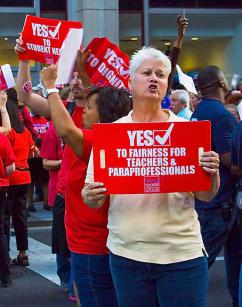
That question looms large–not just for the city’s teachers, students and their parents, but for the entire labor movement. Because while both private- and public-sector unions are taking a pounding across the U.S. with layoffs, pay cuts and pension rollbacks, the CTU is gearing up for a showdown with America’s most politically connected mayor, Rahm Emanuel–and it will come to a head in September.
At a time when most union officials are shamefacedly selling concessions as “the best we can do,” Chicago teachers are defiant. Just ask anyone who encountered the giant inflatable rat that accompanied the spirited CTU picket outside the Chicago Public Schools (CPS) offices August 22 a few hours before a school board meeting.
“We would like to have a fair compensation package that includes acknowledgement of our teachers’ experience and their educational attainment,” CTU President Karen Lewis said at a press conference after the picket. “That’s number one. Number two, our health care that they’re asking us will eat up the little bitty, tiny, miniscule raise that they’re offering.”
An arbitrator earlier this year recommended a pay increase of 14.85 percent, much closer to the union’s initial demand for a 30 percent raise to cover the additional hours teachers were expected to work in the new longer school day. CPS, however, has offered only a 2 percent raise, which doesn’t even make up for the teachers’ previously negotiated 4 percent raise that was cancelled by the board last year.
Later on August 22, CTU delegates held a meeting at a high school where they picked up freshly printed picket signs and got a sober update on contract negotiations.
While CPS and Emanuel bowed to a union demand in July to hire nearly 500 more teachers to staff a longer school day, school negotiators have refused to budge on what the union considers to be strike issues. Those include merit pay, the cancellation of raises based on seniority, and higher health insurance costs.
The city’s aggressive posture led to a strong turnout for informational picket lines at CPS’s early-start schools, about one-third of the more than 600 in the system. While some pickets were modest, many more were large and spirited, and most got strong support from parents and community members.
– – – – – – – – – – – – – – – –
THE MOBILIZATION is quite an achievement for the CTU leadership, which took office in June 2010 on the slate of the Caucus of Rank-and-File Educators (CORE). Taking over a budget-strapped and dysfunctional union machine, the new leadership began by cutting officers’ pay and putting the money into organizing.
In its first round of negotiations, the CTU leadership spurned the usual union strategy of taking pay cuts to avoid layoffs, arguing that concessions would lead to only further concessions. The new CTU also plunged into the fight against school closures despite the small chance of prevailing in that struggle. Win or lose, the CTU was determined to deepen the union’s connection to the wider fight for education justice in the city.
In April 2011, the CTU leadership overcame an internal crisis over whether to support an anti-union law known as SB 7, which requires 75 percent of all union members to vote to authorize a strike. Little more than a year later, nearly 90 percent of all CTU members–and 98 percent of those who cast a ballot–supported giving union leaders strike authorization.
That vote–which followed an inspiring May 23 rally of more than 5,000 union members–showed the city that the CTU was mobilizing its members not simply through the union’s organizational machinery, but as part of a wider working-class movement to defend public education from corporate-backed education reformers and charter school operators.
What began as a vision of a small group of CORE activists a few years earlier had come to life in a fighting CTU, a union that embodies the best hopes not only for teachers’ unions, but all of organized labor.
The stakes are high for Rahm Emanuel, too. The former White House chief of staff under Barack Obama got his political start as an operative for former Mayor Richard M. Daley, and now, he wants to make his own mark as the city’s boss.
But where Daley and his father, Richard J. Daley, used patronage jobs to bind labor to the Democratic machine, Emanuel wants to gut public-sector unions while dangling jobs to keep others on board. Emanuel’s message to union leaders: Do it the easy way by selling concessions to your members, or expect the hard way, where City Hall proceeds to crush you.
As a result, most Chicago unions have already rolled over for Emanuel without a fight. For example, the Teamsters, who backed Emanuel for mayor, signed off on the mayor’s privatization of waste collection, bought off by a promise that their lower-paid union members at private companies would get the work.
The building trades are on board with Emanuel’s Infrastructure Trust plan to fund public works, even though it will put the city in hock to big banks at unspecified rates of interest for decades to come. And the Chicago Federation of Labor signed on to Emanuel’s “wellness” plan that empowers monitors to track city employees’ weight loss, smoking habits and other personal information–and raises their health insurance costs by $600 per year if they don’t sign up for the program.
Next, Emanuel’s operatives at CPS moved to drive a wedge between the CTU and the other main unions that represent school employees. Service Employees International Union (SEIU) Local 73 and UNITE HERE Local 1–usually seen as progressive within the local labor movement–signed early contracts with the school board.
This could set the stage for SEIU and UNITE HERE members being contractually forced to cross teacher picket lines and staff proposed “student centers” that CPS plans to run in case of a strike, at a cost of $25 million. The International Union of Operating Engineers, whose members keep the school buildings running, also cut a separate deal.
Emanuel’s latest effort to isolate the CTU is an early contract with the faculty at the city’s community colleges, who belong to a sister union to the CTU.
The deal, which is being pushed to a ratification vote on a week’s notice, is made to City Hall’s specifications–it eliminates raises based on experience and education, establishes the principle of merit pay, and includes the onerous wellness program. Those are precisely the concessions that Emanuel wants to impose on the CTU.
– – – – – – – – – – – – – – – –
BUT DESPITE Emanuel’s efforts to peel away Chicago labor leaders, backing for the CTU is strong among union members and at least some officials.
AFSCME Council 31, which tangled with Emanuel to defend library jobs and other public employees, has endorsed a CTU Labor Day march that will conclude with protesters joining hands around City Hall.
And support for Chicago teachers goes far beyond the ranks of organized labor.According to a Chicago Tribune opinion poll in May, far more people trust the CTU on education issues than Rahm Emanuel.
That’s in part because the mayor overplayed his hand over the course of this year, ramming through the closure and “turnaround” of 17 schools, while pushing a longer school day without adequate funding. A City Hall-connected effort to pay preachers to organize pro-Emanuel protests backfired when the media caught wind of the scheme.
In recent weeks, the CTU has been holding public meetings in neighborhoods around the city to receptive audiences. Community alliances forged by CORE to fight an earlier round of school closings years ago laid the basis for a strong CTU alliance with key community organizations in African American and Latino communities. A CTU float at this year’s Gay Pride march got big cheers. The union has also backed the effort byCommunities Organized for Democracy in Education to replace Emanuel’s handpicked school board with an elected one.
More recently, the Chicago Teachers Solidarity Campaign (CTSC) was launched to bring together a range of labor and social movement activists, linking ongoing battles over public education in the city with the CTU’s struggle. The solidarity campaign is building a August 29 town hall meeting to bring together the CTU’s allies, as a possible strike looms.
Thus, while Emanuel will try to portray the CTU’s struggle as one of greedy teachers versus needy kids, there’s a growing movement to defend public education that sees justice for teachers as essential for the education of Chicago’s children.
– – – – – – – – – – – – – – – –
WHILE THE CTU is resolved to do what it takes to win–including a strike–questions remain over the role of its parent union, the American Federation of Teachers (AFT).
The AFT convention in Detroit held in July gave a powerful statement of solidarity for its members in Chicago. Delegates also gave backing to AFT teachers in Douglas County, Ariz., where school authorities have imposed a contract on the union, as well as Detroit, where an emergency financial manager unilaterally cut pay by 10 percent on top of previous rounds of concessions and job losses.
Michael Mulgrew, president of the United Federation of Teachers in New York City,captured the mood when he said, “You come after one of us, you deal with all of us.”
But the union’s policies of collaboration, highlighted earlier in convention proceedings, undermined that call to action.
For example, the AFT affiliate in Cleveland worked with anti-union Republican Gov. John Kasich to craft a contract eliminating seniority protection in layoffs while backing legislation that allows charter schools to compete with traditional schools for taxpayer dollars. Instead of pointing to the agreement as a disastrous setback, AFT President Randi Weingarten portrayed it as a gain in her opening speech.
In fact, Weingarten, who two years ago proposed a strategic retreat for the union by announcing a partnership with school reformers like Bill Gates, now finds herself presiding over a rout of the union in some of its historic bastions, such as Philadelphia, where the mayor and school officials are in the process of turning over the entire school system to academic institutions and charter school management organizations.
As a result, the convention proceedings veered between sober recognition of the scale of the assault and the high-production videos and feel-good presentations typical of U.S. unions at their stage-managed meetings–crowding out any lengthy discussion of the major issues facing teachers.
The resolution books were skimpy for a union that claims 1.5 million members–a figure that includes retirees–and largely avoided mention of issues like merit pay, which the AFT folded on years ago. Also largely ignored was the union’s surrender on job security based on tenure–a posture that has only encouraged the school reform crowd to step up their attacks.
AFT delegates did pass resolutions with policies well to the left of mainstream Democratic Party election programs. But those feel-good votes gave way to practical politics when Weingarten welcomed Vice President Joe Biden to the podium, despite the Obama administration’s anti-union Race to the Top legislation.
Notably, CTU President Karen Lewis refused to join the other AFT vice presidents on stage to greet Biden, and the Chicago delegations made a point of wearing their red union t-shirts rather than the Obama-Biden ones handed out by AFT officials.
The result was a convention in which the AFT came across as progressive in general political terms, but at best incoherent on the bread-and-butter issues dear to teachers–a union unable or unwilling to take a consistent stand on what had been fundamental union positions.
That’s why the CTU’s struggle in Chicago is so important. Four years after the financial crash of 2008, politicians and employers are still using high unemployment and tight budgets to try to permanently cripple organized labor while dismantling what remains of decent social services–and public education is in the crosshairs.
High-stakes battles that put the union on the line are inevitable. The Chicago Teachers Union is stepping up to that challenge–and it deserves our full support.
Israel’s Policy of Displacement: An Infographic
This information is re-posted from Visualizing Palestine. Editor’s note: The ongoing repression of Palestinians by the State of Israel has been supported by both Democrats and Republicans. There has been no fundamental difference, beyond rhetoric, between either party when it comes to policy or funding the ongoing repression.
Since 1967, the Israeli government has destroyed over 25,000 Palestinian homes in Gaza and the West Bank. In this time, Israeli policies such as home demolitions have internally displaced at least 160,000 Palestinians. The Israeli Committee Against House Demolitions (ICAHD) with the help of Visualizing Palestine tells the devastating history in graphic detail.

U.S. is the Worst Police State in the World – By the Numbers
This article by Glen Ford is re-posted from Black Agenda Report.
When U.S. corporate media operatives use the term “police state,” they invariably mean some other country. Even the so-called “liberal” media, from Democracy Now to the MSNBC menagerie, cannot bring themselves to say “police state” and the “United States” without putting the qualifying words “like” or “becoming” in the middle. The U.S. is behaving “like” a police state, they say, or the U.S. is in danger of “becoming” a police state. But it is never a police state. Since these privileged speakers and writers are not themselves in prison – because what they write and say represents no actual danger to the state – they conclude that a U.S. police state does not, at this time, exist.
Considering the sheer size and social penetration of its police and imprisonment apparatus, the United States is not only a police state, but the biggest police state in the world, by far: the police state against whose dimensions all other police systems on Earth must be measured.
By now, even the most insulated, xenophobic resident of the Nebraska farm belt knows that the U.S. incarcerates more people than any country in the world. He might not know that 25 percent of prison inmates in the world are locked up in the U.S., or that African Americans comprise one out of every eight of the planet’s prisoners. But, that Nebraska farmer is probably aware that America is number one in the prisons business. He probably approves. God bless the police state.
For the American media, including lots of media that claim to be of the Left, it is axiomatic that China is a police state. And maybe, by some standards, it is. But, according to United Nations figures, China is 87th in the world in the proportion of its people who are imprisoned. China is a billion people bigger than the United States – more than four times the population – yet U.S. prisons house in excess of 600,000 more people than China does. The Chinese prison population is just 70 percent of the American Gulag. That’s quite interesting because, non-whites make up about 70 percent of U.S. prisons. That means, the Black, brown, yellow and red populations of U.S. prisons number roughly the same as all of China’s incarcerated persons. Let me emphasize that: The American People of Color Gulag is as large as the entire prison population of China, a country of nearly 1.4 billion people.
However, police states must be measured by conditions behind the bars, as well as raw numbers of inmates. And, by that standard, the American Gulag is even more monstrous.
Civilized people now recognize that solitary confinement is a form of torture. The United Nations Special Rapporteur on Torture, Juan Mendez, reports that solitary confinement beyond 15 days at a stretch crosses the line of torture, yet, as Al Jazeera recently reported, it is typical for hundred of thousands of U.S. prisoners to spend 30 or 60 days in solitary at a stretch. Twenty thousand are held in perpetual isolation in so-called supermax prisons – that is, they exist in a perpetual state of torture. Studies now show that, all told, 80,000 U.S. prisoners are locked up in solitary on any given day.That’s as many tortured people as the entire prison system of Germany, or of England, Scotland and Wales, combined.
If that is not a police state, then no such thing exists on planet Earth.
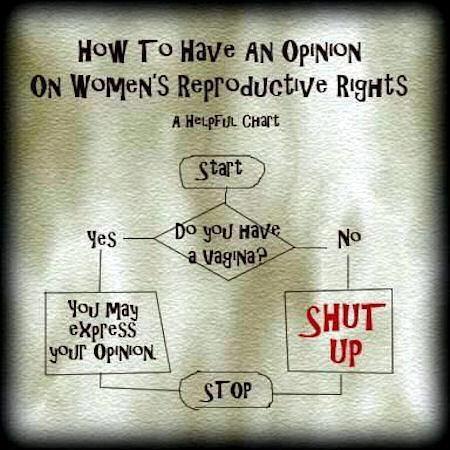
How to have an opinion on women’s reproductive rights
This article is re-posted from PR Watch. For those interested in opposing fracking in West Michigan you can contact Mutual Aid GR grpeoplesassembly@gmail.com and http://banmichiganfracking.org/.
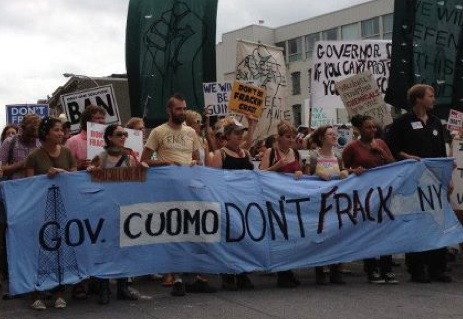
The future of New York’s water supplies and the health of its millions of citizens hang in the balance as Governor Andrew Cuomo decides whether to end the state’s moratorium on new wells to drill for “natural” gas through the controversial industrial process of hydraulic fracturing or “fracking.” Activists estimated that over two thousand concerned citizens joined the march in Albany Monday to try to persuade Cuomo not to lift the moratorium — statewide or in some counties — a decision expected to be announced some time after Labor Day.
The process of fracking involves pumping large quantities of fresh water, along with chemicals and sand, into shale formations in order to crack the rock and extract gas. The “proprietary” blend of chemicals used by corporations in this process is largely kept hidden from the public, but the formulae that have been analyzed have been revealed to contain numerous toxic substances, including known carcinogens and volatile organic compounds (VOCs).
Fracking has the documented potential to contaminate drinking water sources, and has been shown to contaminate both water and land — in addition to spoiling millions of gallons of fresh water as part of the drilling process. Fracking has rapidly expanded across the U.S. as new technology has allowed the drilling to cost companies less money, plus the relative lack of regulation has also allowed corporations to tap some aquifers and rivers without paying any usage fees, and some drillers cheaply “dispose” of the resulting contaminated water by injecting it into the ground, a practice that a new study suggests can cause earthquakes. New York has been heavily targeted by the industry because the state sits atop a piece of the Marcellus Shale formation.
As part of a growing global resistance movement to fracking, New Yorkers marched Monday to the state capitol building and the New York Department of Environmental Conservation (DEC). Protestors also delivered a pledge, signed by thousands, calling for a ban to fracking in New York. The pledge — which noted that any approval of fracking would go against the advice of numerous scientists, economists, and medical professionals — stated that the risks associated with fracking cannot be mitigated through regulation. Those who signed the pledge promised to engage in non-violent acts of protest in the event that the Cuomo’s administration allows new wells to be fracked in the state.
Industry Calls Protestors “Extreme Fringe,” a Claim Sen. Avella Rejects as “Laughable”
The expected decision from state officials will conclude a regulatory and environmental review, which has been heavily criticized by state residents who accuse government regulators of having an overly cozy relationship with the gas industry. One example of this collusion came from emails obtained by the Environmental Working Group (EWG), which found that the New York Department of Environmental Conservation gave the industry early access to a set of proposed permit and regulations for fracking last year, access that was not given to the general public to weigh in on and help shape.
In an article by a local news outlet, an industry spokesperson, John Conrad, labeled Monday’s protestors as part of an “extreme fringe.” Conrad operates a consulting firm, Conrad Geoscience Corp., and is a member of the “Independent Oil and Gas Association of New York.”
New York state Sen. Tony Avella, who has pushed for a ban on fracking in the Empire State, told the Center for Media and Democracy that Conrad’s claim was “laughable” and that there “is nothing fringe about the everyday citizens, neighbors, farmers, scientists and environmentalists” who have expressed their legitimate concerns about fracking.
John Armstrong, of the organization “Frack Action,” one of the 60-some organizations that organized the demonstration, said that the state’s review has neglected to take into account independent reviews of the environmental and health risks that fracking poses. “There is nothing radical about citizens aligning themselves with groups like the New York Breast Cancer Network and American Nurses Association, some of the major groups which have come out against fracking,” he said.
The protest, which included street theatre and an effigy of Cuomo with an angel and devil on either shoulder, came on the heels of other recent demonstrations directed at the governor. Hundreds of concerned residents showed up at a policy summit Cuomo recently held in New York City and at “Governor’s Day” at the State Fair, both last week.
Industry Front Group Called “Energy in Depth” Attacks Critics
As the gas industry touts the number of jobs it claims it will create in New York, in neighboring Pennsylvania an estimated 70 percent of gas rig jobs are going to people from out of state, according to Laura Fisher, senior vice president of the Allegheny Conference on Community Development.
But with its deep pockets, the industry has been able to push its talking points not just on its economic claims but also on its assertion that fracking is “clean” and “safe.” One of the ways they have done this is through Energy in Depth (EID), a front group for gas companies that is connected to the “American Petroleum Institute” and the “Independent Petroleum Association of America.”
As documented by blogger Dory Hippauf, EID consists of several interrelated fronts in several states, with ties to various PR firms, gas companies, and political lobbyists. The group has worked extensively to try discredit those who express concerns about fracking, which has included targeting the New York Times and the Oscar-nominated documentary film “Gasland,” and its director Josh Fox.
Fox recently released a new short film that exposes oil and gas industry internal documents which show that some companies have privately expressed concerns about well safety and water contamination, despite the industry’s PR campaign to claim the public’s concerns are misplaced. In response, EID attacked the film, but failed to address the leaked documents. Fox has compared EID to an “attack dog” that “drank too much Red Bull.” Fox was at Monday’s rally, along with other well-known individuals such as environmentalist Bill McKibben and actress Debra Winger.
EID’s tactics in its efforts to discredit concerned citizens were highlighted by one of the speakers at the rally, acclaimed author and ecologist Sandra Steingraber who has been a leading voice on the risks that fracking presents to New York communities. In its blogs, EID has made personal attacks on Steingraber, for example, calling her the “most emotional of all anti-natural gas opponents on the battlefield,” and commenting on her prior cancer diagnosis, the fact that she wears makeup, and the size of her home, as well as mocking her last name, in addition to other comments irrelevant to the scientific studies she uses to defend her concerns about fracking.
“Hey, gas industry: I am not afraid of you. And that’s not because I’m fearless. It’s because I am so scared for the future of my children on a fracked-up planet that I have no fear left over for you,” Steingraber said.
In her speech, Steingraber called the growing resistance towards fracking the “greatest human rights movement in New York State since abolition and suffrage” and said that “I choose to believe in a vision of an unfractured New York that turns its back on nineteenth-century thinking and fossil fuels and leads the world in the creation of a clean energy economy.” Sandra held a sign made by her son which read “I Don’t Want to Move to Vermont,” a neighboring state that has banned fracking, like Germany and France. Steingraber is author of “Raising Elijah: Protecting Our Children in an Age of Environmental Crisis.”
Resistance to Fracking Is Growing and Some Turn to Direct Action
Monday’s demonstration in Albany is part of a widespread, global movement against fracking that is gaining momentum. In June, Pennsylvania citizens occupied a mobile home camp to temporarily stave off eviction of families that were told their land was being sold to a private water corporation which will pump millions of gallons of water from the Susquehanna River to be used in fracking. In July, Ohio citizens blocked access to a fracking injection well, shortly after 1,000 gallons of chemical-laden fracking wastewater spilled along five miles of road in a nearby residential area. In the same month that activists blockaded entry to a drill site in a Pennsylvania state forest, UK residents chained themselves to the fence surrounding an exploratory drilling site in Chesterfield, among other actions.
This summer, Yoko Ono and Sean Lennon also launched “Artists Against Fracking,” which includes over 130 artist who have called on Cuomo to ban fracking, including Leonardo DiCaprio, Julianne Moore, Alec Baldwin, Lady Gaga, Zooey Deschanel, The Strokes, The Flaming Lips and Beastie Boys.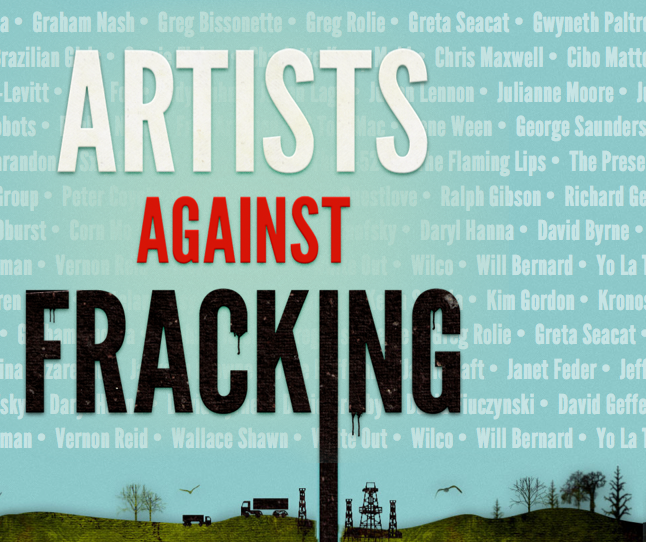
In an op-ed published in the New York Times Tuesday, Lennon highlights the disinformation campaign funded by the oil and gas industry, noting that America’s Natural Gas Alliance has spent $80 million in PR campaign that includes the help of Hill and Knowlton, a PR firm that in the 1950s and 1960s tried to convince Americans that tobacco had no links to cancer.
“Natural gas has been sold as clean energy. But when the gas comes from fracturing bedrock with about five million gallons of toxic water per well, the word ‘clean’ takes on a disturbingly Orwellian tone. Don’t be fooled. Fracking for shale gas is in truth dirty energy. It inevitably leaks toxic chemicals into the air and water. Industry studies show that 5 percent of wells can leak immediately, and 60 percent over 30 years. There is no such thing as pipes and concrete that won’t eventually break down. It releases a cocktail of chemicals from a menu of more than 600 toxic substances, climate-changing methane, radium and, of course, uranium,” Lennon said in his op-ed titled “Destroying Precious Land for Gas.”
 The Possibility of Political Consequences for Giving In to the Industry
According to one of the organizers of Monday’s demonstration in New York, Corinne Rosen with Food and Water Watch, fracking fluid and its waste are not only laden with toxics but a decision by the governor to approve fracking in the state could be toxic to Cuomo’s reputation, who is an otherwise generally popular governor.
“People are going to hold the governor accountable for this decision. The fact that he sees people coming to these rallies, and calling his office may be why the decision has not yet been made,” Rosen said. “You see regular New Yorkers, who might not be typically involved in these types of issues, standing up because the health of their families is at stake.”
Closer Than You Think: Top 15 Things Romney and Obama Agree On
This article by Bruce A. Dixon is re-posted from Black Agenda Report.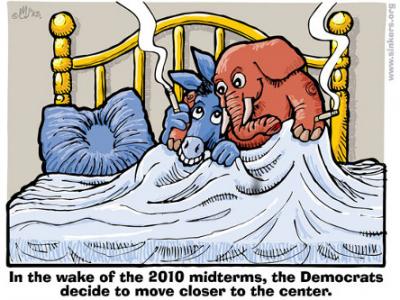
Too much agreement between Republicans and Democrats has always been bad news for those at the bottom of America’s class and racial totem poles.
Back in 1875, Frederick Douglass observed that it took a war among the whites to free his people from slavery. What then, he wondered, would an era of peace among the whites bring us? He already knew the answer. Louisiana had its Colfax Massacre two years earlier. A wave of thousands upon thousands of terroristic bombings, shootings, mutilations, murders and threats had driven African Americans from courthouses, city halls, legislatures, from their own farms, businesses and private properties and from the voting rolls across the South. They didn’t get the vote back for 80 years, and they never did get the land back. But none of that mattered because on the broad and important questions of those days there was at last peace between white Republicans and white Democrats — squabbles around the edges about who’d get elected, but wide agreement on the rules of the game.
Like Douglass, the shallow talking heads who cover the 2012 presidential campaign on corporate media have noticed out loud the remarkable absence of disagreement between Republican and Democratic candidates on many matters. They usually mention what the establishment likes to call “foreign policy.” But the list of things Republicans and Democrat presidential candidates agree on, from coddling Wall Street speculators, protecting mortgage fraudsters and corporate wrongdoers to preventing Medicare For All to so-called “foreign policy,” “free trade,” “the deficit” “clean coal and safe nuclear power” and “entitlement reform,” is clearly longer and more important than the few points of mostly race and style, upon which they disagree.
| 15 | Although unemployment is the highest it’s been since the Great Depression, the federal government should NOT enact any sort of WPA-style program to put millions of people back to work. Under Democrat Franklin Roosevelt in the 1930s, Depression-era unemployment was tackled head on by direct federal hiring to dig subways, build roads, schools, parks, sewers, recreational facilities and public buildings. Oblivious of this history, Democrat Barack Obama maintains that only the private sector can or should create jobs. |
| 14 | Medicare, Medicaid and social security are “entitlements” that need to be cut to relieve what they call “the deficit.” Republicans have been on record for this since forever, though they claim not to want to mess with the Medicare people already over 65 are getting. One of the first acts of the Obama presidency was to appoint a bipartisan panel stacked with “deficit hawks” like Republican Allan Simpson and Democrat Erskine Bowles to recommend raising retirement ages and cutting back Medicaid, Medicare and social security, and pass a law directing Congress to have an up or down no-amendments vote on its recommendations. Fortunately the “cat food commission”, as it was called, was deadlocked and offered none. But Obama and top Democrats, most recently House Democratic leader Nancy Pelosi continue to express their readiness for some kind of “grand compromise” with Republicans on this issue. |
| 13 | Climate change treaties and negotiations that might lead to them should be avoided at all costs. The differences between them are only style. Democrats admit that climate change exists and is man-made, Republicans say it’s a myth. But both ignored the Kyoto protocol and Obama like Bush before him, has worked tirelessly to delay, derail and boycott any actual talks that might lead to constructive international climate change agreements. |
| 12 | NAFTA was such a great thing it really should be extended to Central and South America and the entire Pacific rim. Again, there are differences in style. On the 2008 campaign trail, Obama sometimes mumbled about renegotiating parts of NAFTA, and such. But even before the primaries were done, press reports had him assuring the Canadian government this was only campaign rhetoric, raw meat for the rubes. In four years he has pushed NAFTA-like “free trade” corporate rights agreements with South Korea, most of Central America and is now secretly hammering out something called the Trans-Pacific Partnership Agreement. |
| 11 | Banksters and Wall Street speculators deserve their bailouts and protection from criminal liability, but underwater and foreclosed homeowners deserve nothing. Well, maybe not exactly nothing. Republicans think underwater homeowners deserve blame for forcing banksters to offer millions of fraudulent high-interest loans were then re-sold to investors around the world. Democrats think underwater homeowners deserve empty promises of help that never quite arrives for most of the foreclosed, the about-to-be foreclosed, their families and communities. But both agree on free money for banksters and speculators but no moratorium on foreclosures and no criminal investigations of mortgage and securities fraud. |
| 10 | Palestinians should be occupied, dispossessed and ignored. Iran should be starved and threatened from all sides. Cuba should be embargoed, and Americans prohibited from going there to see what its people have done in a half century free of Yankee rule. Black and brown babies and their parents, relatives and neighbors should be bombed with drones in Pakistan, Yemen, Somalia and similar places. The politicians and corporate commentators have a misleading name for this. They call it “foreign policy.” The realistic term for it is global empire. |
| 9 | Africa should be militarized, destabilized, plundered and where necessary, invaded by proxy armies like those of Rwanda, Ethiopia, Burundi or Kenya, or directly by Western air and ground forces, as in Libya. President Georgia Bush announced the formation of AFRICOM, the US military command for the continent which has officially swallowed all US civilian diplomatic presence. But only a black US president, even under the cover of “humanitarian war” could have invaded an African nation and openly dispatched special forces to Central Africa. |
| 8 | US Presidents can kidnap citizens of their own or any nation on earth from anyplace on the planet for torture, indefinite imprisonment without trial or murder them and neighboring family and bystanders at will. To be perfectly fair, there are distinctions between Republicans and Democrats here that don’t amount to differences. Republicans Cheney and Bush got their lawyers to say these things were OK and did them. Democrat Obama got Congress to enact “laws” giving these acts a veneer of fake legality, something a Republican probably could not have done. |
| 7 | Oil and energy companies, and other mega-polluters must be freed to drill offshore almost everywhere, and permitted to poison land and watersheds with fracking to achieve “energy independence”. The Republicans say “drill baby drill” but it seems only Democrats can chill out enough supposed “environmentalists” to make this happen. Obama campaigned on restricting offshore drilling four years ago, and reversed himself just before the BP oil disaster in the Gulf. The White House cooperated with BP in lying to the public about the extent of the disaster and has shielded BO from paying anything like the value of actual damages incurred to livelihoods, human lives and the environment. |
| 6 | The FCC should not and must not regulate telecoms to ensure that poor and rural communities have access to internet, or to guarantee network neutrality. Republicans have always been in favor of digital redlining, against network neutrality. Barack Obama claimed on the campaign trail he’d take a back seat to nobody in guaranteeing network neutrality. But he appointed as FCC chair a man who helped write the infamous Telecommunications Act of 1995, which gave away the government-built internet backbone to a handful of immensely powerful telecoms like AT&T and Comcast, and flatly reversed himself on network neutrality. The Department of Justice was forced to stop the ATT-T-Mobile merger by a storm of public outrage, but approved the Comcast-NBC deal. |
| 5 | Of course there really ARE such things as “clean coal” and “safe nuclear energy”. Again these are things Republicans have always pretended to believe. At the 2008 Democratic convention Democrat Barack Obama joined them, declaring he intended to be the president of “clean coal and safe nuclear energy.” Obama is building a wave of 33 nuclear plants across the country, the first two in mostly black and poor communities of Georgia and South Carolina where leaky existing nukes are causing cancer epidemics. The people know these things are myths. But Republican and Democratic candidates for office, all the way down to state and county officials seem not to. |
| 4 | Immigrants must be jailed and deported in record numbers. To be really fair, one should note that on this issue Republicans talk a mean game about sending them all back and jailing tens or hundreds of thousands along the way. But only President Obama has walked the walk, deporting over a million immigrants in his term in office, often with little or no due process and after housing many for months in atrocious privatized immigration prisons. |
| 3 | No Medicare For All. Forget about it eliminating the Medicare age requirement so that all Americans would qualify.. Republicans never wanted Medicare even for seniors, let alone everybody. Six or seven years ago Illinois State Senator Obama was telling audiences that if they elected Democrats to Congress, the Senate and the White House, they’d get single payer health care. But once in office he excluded Medicare for All from the proposals on the table, and enacted a national version of Massachusetts RomneyCare, requiring everybody to purchase private health insurance or be penalized. |
| 2 | No minimum wage increases for you, no right to form a union, no right to negotiate or strike if you already have a union, and no enforcement or reform of existing labor laws. Again, Republicans have always opposed minimum wage laws. Obama promised to boost the minimum wage his first two years in office, while he still had majorities in the House and Senate. But he didn’t do this, or pass legislation beefing up the right to organize unions, which has been eroded under Democrat and Republican administrations alike. |
| 1 | The 40 year war on drugs must continue, and even mention of the prison state is unthinkable. There are 2.3 million people in US prisons and jails today, a per capita total that beats the world. Politicians of both parties wag their fingers in multiple directions. But as Michelle Alexander points out, if the US prison population were rolled back to say, only 1 million, the level it was about 1980, this would mean one million jobs, as contractors, sheriffs, cops, bailiffs, judges and functionaries of all kinds would have to go out and find real jobs. |
The rabbit hole goes still deeper. We didn’t have to stop at these fifteen points of Democrat-Republican agreement, but you get the idea. Just as in Frederick Douglass’s day, the more Democrats and Republicans agree, the worse it is for the rest of us.
There was a time when black America had its own principles, and formed the immovable leftmost rock of the American polity. But in the 21st century, that rock has been dissolved by a tide of corporate money. With the rise of a cohort of black corporate Democrats and a right wing black Democrat in the White House there is no longer even any vaguely leftish influence on Democratic party politics. The House Progressive Caucus is the biggest in Congress, with over seventy members, but is powerless and irrelevant. Except for stylistic flourishes, the music they listen to and the color of some faces, the differences between Republicans and Democrats seem to exist mostly in political marketing campaigns and inside our own heads.
New Video kicks off campaign to challenge the US prison system
The following information is re-posted from Brave New Films.
Think about this. The United States is spending over $200 billion a year on a justice system that locks up more people than any country on earth. We have more prisoners than China. More than Russia. More than anyone. This colossal system is hitting our communities with staggering financial and human costs.
That’s why we’re launching a major new campaign here at Brave New Foundation — like Koch Brothers Exposed, Rethink Afghanistan, Walmart, Outfoxed, and others we’ve done. This campaign is called Beyond Bars. It aims to change Americans’ thinking and inspire action through short videos and shareable graphics exposing the U.S. system of mass incarceration.
This system is a beast — gobbling up resources that should be going to communities. WATCH THE VIDEO.
Beyond Bars will investigate corporations that profit off incarceration and politicians that use “tough on crime” rhetoric to scare voters. But we won’t just expose the negative; we’ll also show better ways to achieve public safety: things like prevention, rehabilitation, and job opportunity. Such solutions would save untold billions of dollars every year while making communities safer.
Amway, part of coalition that opposes Michigan Energy, Michigan Jobs ballot initiative
Last week, MLive ran a story with the focus on West Michigan groups that oppose the Michigan Energy, Michigan Jobs November ballot proposal.
The story tells readers that Amway and other West Michigan businesses and business associations are formally opposed to the Michigan constitution mandating that 25% of Michigan’s energy must be renewable energy by 2025. This business group believes that is a bad approach and that it will not result in the amount of jobs the ballot initiative proponents are claiming.
The only source used in the MLive article was an Amway spokesperson, although the article does link to a previous article about Ottawa County Democrats who support the ballot initiative.
The MLive article fails on many levels. First, it does not explore the main reasons for organized opposition to the November ballot initiative. Anyone who knows the philosophical nature of the Chamber of Commerce and many businesses like Amway, would know that they are opposed to most forms of government intervention in the economy. This is an ideological issue, which the MLive writer does not acknowledge or explore.
Second, there is no indication that this is an organized effort to opposed the Michigan Energy, Michigan Jobs November ballot initiative. The West Michigan entities identified in the MLive article are part of a coalition known as CARE – Clean, Affordable, Renewable, Energy. This coalition is made up of more than just West Michigan businesses and business association, including:

• Acemco Inc. • Agape Plastics • Amway • Betz Industries • Eagle Alloy • The Frederick Douglass Foundation of Michigan • Grand Rapids Area Chamber • Great Lakes Die Cast • Master Finish Co. • Metal Components, LLC. • Montcalm Alliance • Montcalm Commission on Aging • Montcalm County Panhandle Area Chamber of Commerce • Muskegon Lakeshore Chamber of Commerce • Rothbury Steel • Steve’s Antique Auto Repair • Sunrise Acre Farms • Trendway Corp. • Wyoming-Kentwood Area Chamber of Commerce.
In addition, there are numerous current and former politicians in Michigan who oppose this ballot initiative such as Ken Sikkema, Frank Kelly, Bill Schuette and local state Rep. Dave Agema. Agema has this to say about his opposition to the Michigan Energy, Michigan Jobs ballot initiative:
This will lead to huge increases in your energy bills. Once again, someone will be subsidized with your tax dollars making huge profits at your expense and not producing the jobs they claim. It’s an artificial stimulus program that will not work. Since our energy costs will skyrocket, businesses will locate elsewhere to avoid these costs. Instead of creating jobs, we’ll lose them. This does not create an environment for businesses to want to come to Michigan. This is a recipe for lost jobs and higher energy costs for all involved. Follow the money and watch who gains.
Lastly, the MLive article fails readers in that is does not seek out any independent or third party voices/perspectives. The lack of a third perspective limits the debate to whether or not to support this particular ballot initiative and omits any possible discussion about any serious energy policy that might operate outside of the current industrial mindset. Serious environmental consequences are not even part of how the debate between these two opposing forces has been framed.
Pro-business group releases second propaganda video

Earlier this year we told you about a video that went viral on Earth Day. Starting last week, the group that produced the first video, Free Market America, has released a second video entitled We Fight.
This second video from Free Market America was designed to coincide with the beginning of the GOP Convention in Florida and follows in the footsteps of Frank Capra’s series of WWII propaganda films with the title Why We Fight.
The video begins with a montage of comments from US presidents and then the narrator begins by tossing about terms like liberty and freedom. The narrator also makes the point that “we live in turbulent times and that “our generation is being called not to win a revolution, but to preserve one,” while the footage shows the Founding Fathers.
The propaganda spot says that this century has the potential to be another American Century, without any clarification or context. That some writers refer to the 20th Century as the American Century is because of the political and economic power of the US. However, most apologists for the US will not acknowledge that the US peak of political and economic power came at the expense of the rest of the world and many of its own people. The 20th Century saw numerous US wars, invasions and occupations, primarily motivated by economic interests, whether it was the CIA coup in Iran in 1953 or the 2003 invasion and occupation of Iraq. For more details see A Century of US Military Interventions from Wounded Knee to Libya.
At one point in the video when the narrator is again pontificating about liberty and how there are some that do not understand how liberty can be lost, the video footage shows occupy actions around the country, a clear jab at this grassroots movement disgusted with the system of power in this country.
The video ends with several “regular people” saying that they will fight, some for freedom, some for liberty and some for the free market. It is telling that it ends with someone saying they will fight for the free market, since this is what the group behind the video is all about. We Fight really means, we fight to maintain the US system of power.
The Free Market America is instructive and worth watching, not only to see the propaganda message they wish to inject into the public consciousness just prior to the election, but also the media production techniques and the meta-narrative they use, which make for a useful example of contemporary propaganda.
We’re #1: US sets record arms sales in 2011
This article is re-posted from the Center for Public Integrity.
2011 was a very good year for U.S. arms sales, with more than triple the business from the year before. 
According to a new report to Congress, worldwide sales of U.S. weapons last year added up to $66.3 billion. That accounts for more than three-quarters of 2011 arms sales worldwide, which is “the highest single year agreements total in the history of the U.S. arms export program.”
The report was prepared by the Congressional Research Service (CRS) as part of their annual study of arms sales.
In 2010, the U.S. authorized $21.4 billion in sales, which led CRS to describe the jump as “extraordinary.” In terms of overall sales, Russia was distant second to the United States, having moved $4.8 billion. The previous record was in 2009, when the U.S. did almost $31 billion in sales.
Since the start of 2008, 81.4 percent of U.S. arms sales agreements have gone to the Middle East while 16.04 percent have gone to Asian countries.
In the report, CRS notes that sales to developing nations were a major driver in lifting 2011 U.S. sales, jumping from $14.3 billion in 2010 to $56.3 billion in 2011. CRS points to Saudi Arabia and the United Arab Emirates as countries that bolstered their arms purchasing in 2011, which CRS says could be linked to concerns over Iran. Saudi Arabia purchased more than $33 billion in arms from the U.S., including 84 new F-15 jets and upgrades for 70 older models.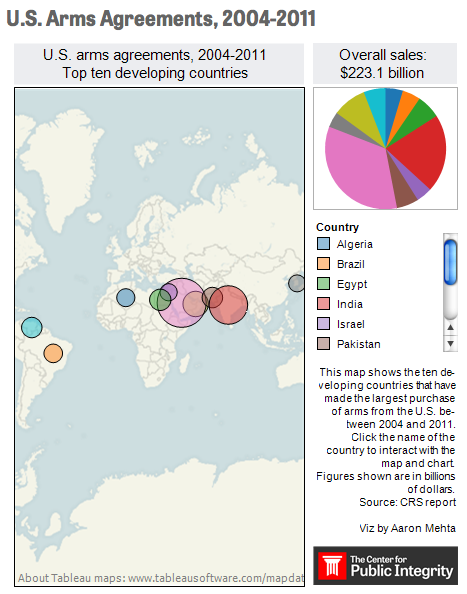
The Saudis were not alone in purchasing weaponry in the region. The United Arab Emirates purchased 16 Chinook helicopters for just under $1 billion total; Oman shelled out $1.6 billion for 18 F-16 fighters. Egypt added land forces, spending $1 billion on M1 Abrams tanks, a sale that the Pentagon has used to argue for freezing domestic production of the Army’s signature land vehicle.
But “the U.S. arms agreements with Saudi Arabia were extraordinary,” concluded the report, as they “represent, by far, the largest share of U.S. agreements with the world or the developing world in 2011.”
The selling of arms to Saudi Arabia is not without controversy. As the Center reported in June, the country has continued to receive steady flows of arms from the United States despite being on a State Department watchlist for human rights violations. Since the start of 2004, Saudi Arabia has purchased $75.7 billion in arms.
Another country which has received weapons despite human rights abuse concerns is the tiny nation of Bahrain. Earlier this year, the Center reported that the U.S. lifted a freeze on arm sales that had been put into effect due to human rights abuses during the “Arab Spring” uprising. Like Saudi Arabia, Bahrain is a major strategic partner for the U.S. The Persian Gulf nation received $80.4 million in military financing from the U.S. between 2005 and 2010 and is home to a 60-acre U.S. naval base which houses the U.S. Fifth Fleet.
No law requires that U.S. arms be exported only to countries that the State Department — in its annual human rights assessments — determines are treating their citizens well. Instead, a more narrow restriction known as the so-called “Leahy Law,” named for author Sen. Patrick Leahy (D-Vt.) and passed in 1997, prohibits U.S. assistance to specific military and police units deemed responsible for human rights abuses.
While the United States was clearly the leader in weapons transactions, a number of other countries took part in the global arms trade, including France, the United Kingdom, Germany, and Italy — traditional Western European arms suppliers. China has also begun to rise to prominence in this area, although they still lag significantly behind the U.S. and Russia.

