This article is re-posted from Vox Union.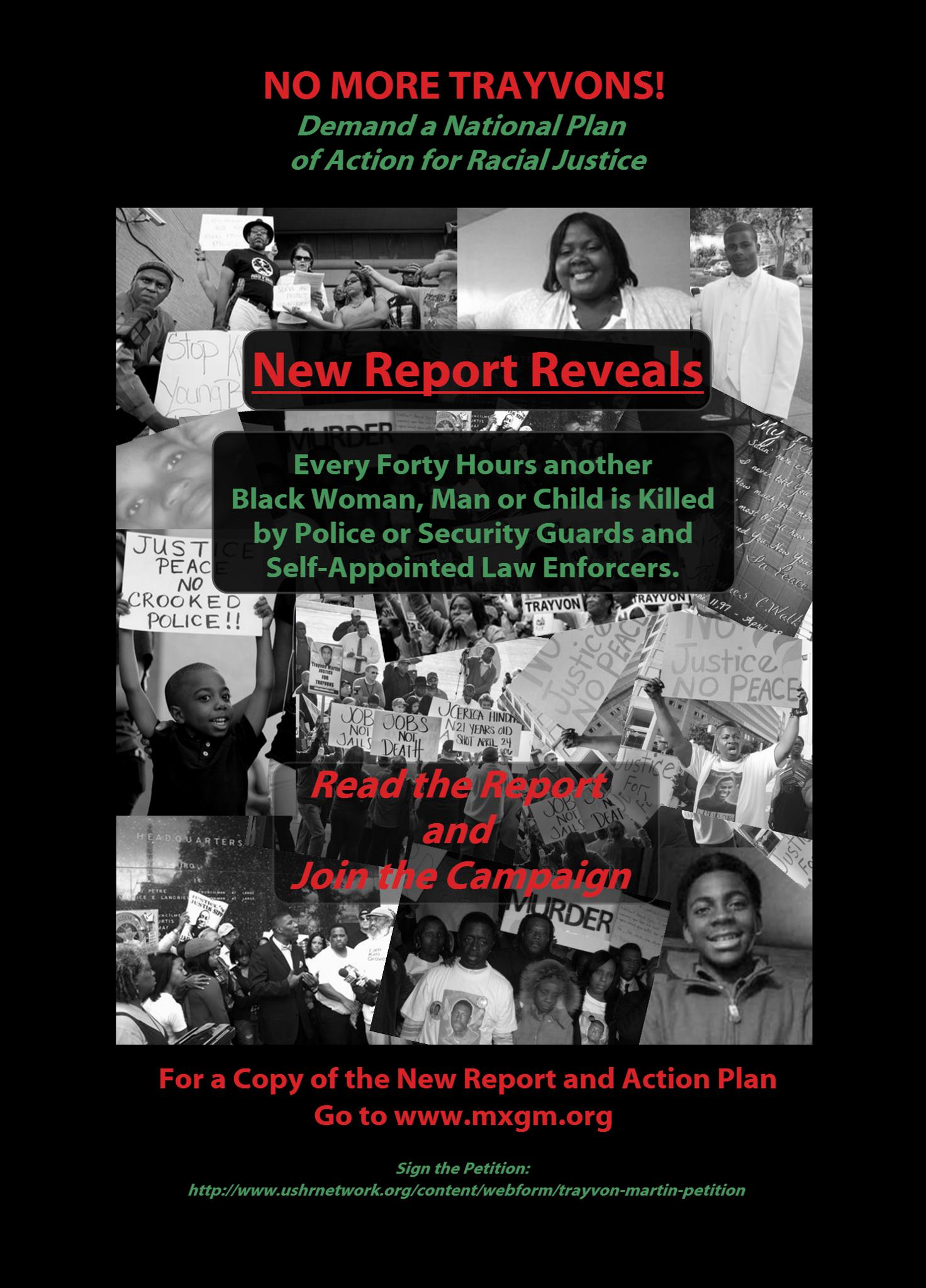
Every 40 hours in the United States one Black woman, man or child is killed by police, and by a smaller number of security guards and self-appointed vigilantes. These are the startling findings of a new Report on Extrajudicial Killings of Black People released July 9, 2012.
What motivated the round-the-clock research for this new Report? More than two years ago, on New Year’s Eve, police killed two innocent men: Oscar Grant in Oakland, Adolph Grimes in New Orleans and shot Robert Tolan in a Houston suburb. Based on research started in 2009 after those murders, we learned there were a lot more killings that had not yet been uncovered. Then, after Trayvon’s murder, there was a huge public outcry and a few headlines about more killings. More grieving families and more calls for investigation. Further research became urgent and it demonstrated that Trayvon’s death was not an isolated tragedy. Between January 1, 2012 and June 30, 2012, at least 110 Black people were killed by police and their “deputies”.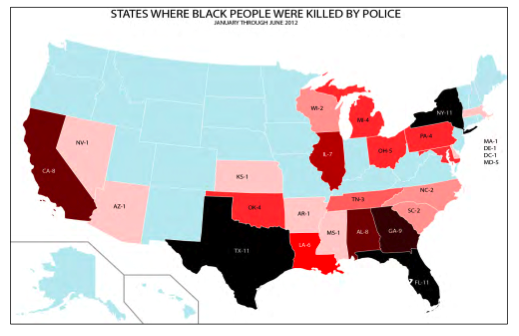
“Any one of these people killed could have been my son or your husband or daughter”, says Arlene Eisen, member of the Malcolm X Solidarity Committee and co-author of the Report.
Rosa Clemente of the Malcolm X Grassroots Movement elaborates, “Nowhere is a Black woman or man safe from racial profiling, invasive policing, constant surveillance, and overriding suspicion. All Black people – regardless of education, class, occupation, behavior or dress – are subject to the whims of the police in this epidemic of state initiated or condoned violence.”
The Report, produced by the Malcolm X Grassroots Movement (MXGM) and the “No More Trayvon Martins” campaign, is part of a larger effort. Kali Akuno, MXGM member and report co-author explained, “The Report shows how people of African descent remain subjected to institutionalized racist policies and procedures that arbitrarily stop, frisk, arrest, brutalize and even execute Black people. The killing will continue despite calls for investigations and lawsuits. We urge people to read this Report and join us in demanding that the Obama administration implement a National Plan of Action for Racial Justice to stop these killings and other human rights violations being committed by the government”.
To read the report visit www.mxgm.org. For information on the petition visit http://www.ushrnetwork.org/content/webform/trayvon-martin-petition.
Homophobia Is Bigger Than Hip-Hop
This article by Alexander Billet is re-posted from Dissident Voice.
First things first: it takes an immense amount of bravery to come out of the closet. That’s true whether you’re a student, a file clerk or a hip-hop artist. Though the circumstances are all very different, the once certain common denominator for coming out is courage. This is, of course, the main motivation for the amount of support rightfully being offered up to Frank Ocean.
Like all other music in today’s world, Ocean is a contradiction. He is an excellent rapper and lyricist who’s made a name for himself in the indie hip-hop and R&B scenes while at the same time writing lyrics for Justin Bieber, Brandy and Beyonce, and collaborating with Jay-Z and Kanye West. He’s part of the collective of young uber-misanthropes Odd Future Wolf Gang Kill Them All (OFGKTA). His relationship with Nas, an MC whose own political and lyrical evolution place him heads above the Odd Future crew, seems to have Ocean straddling a wide spectrum.
Now, he is the first hip-hop artist to come out of the closet while in the midst of his career. On July 4th, Ocean wrote on his Tumblr page that he is bisexual, stating that four years ago he had had a relationship with another man his age. Though he didn’t mention the man’s name, he did thank him for his influence. Ocean also said: “I don’t know what happens now, and that’s alrite [sic]. I don’t have any secrets I need kept anymore… I feel like a free man.”
Some might say that the news of Frank Ocean’s coming out as bisexual might be made “simpler” if he weren’t such a musical contradiction — in particular if he weren’t affiliated with a group who have become infamous for front-loading lyrics that feature gruesome violence against gays and lesbians. But then, the politics of sexual liberation have never been simple. Neither is popular music, or, for that matter, hip-hop.
Timing is everything, and there’s without a doubt some telling timing in Ocean’s decision to come out — namely that it comes barely two months after President Obama himself has announced his support for same-sex marriage. Some have gone so far as to thank Obama for Ocean’s coming out in the first place!
In a certain sense, it’s not so far-fetched. Especially if one accepts the logic that has been promoted for years in the mainstream debate over the rights of LGBTQ people — and the logic of how civil rights are won.
In broad strokes, that logic can be summed up like this: that the leaders know best, that they always have a reason for supporting or opposing something. Those who want just treatment immediately are being reckless, and ironically jeopardizing their rights by standing up for them. If a president changes his position, it is due to his wisdom — a wisdom designed to protect us from ourselves. The state, no matter its laws, can’t be hateful one way or the other because it’s the state, an entity hovering above us all, and it’s our own ideas that are really the problem. The notion of bottom-up movements and cultures providing spaces of enlightenment is right out.
So it’s little wonder that few have asked why despite his own support, Obama continues to drag his feet on signing an executive order around same-sex marriage. The street-level activism that has put years of pressure on the prez has been at best glossed over.
Ocean’s revelations have provoked some thoughtful and interesting debate. AllHipHop.com’s editorial section carried a piece entitled “5 Things That Will Come Out From Frank Ocean’s Coming Out.” The article points out that there have been countless rumor mills about this or that rapper’s sexuality for a long time, then goes on to say that:
Hip-Hop will be forced to cool off on the homophobia. The fact is, Hip-Hop has had gay people in it for a very, very long time. That is a fact and far truer than people care to admit. But, somehow, unlike the rest of the world, the Urban Music world has been slow to accept homosexuality. Sure, there have been folks like Little Richard and Sylvester back in the day, but recently, gays in R&B and Rap stay tucked away in the closet. Frank Ocean is at the beginning of his career, but you better believe with Jay-Z and Kanye West as homies, along with Odd Future, maf*ckas are going to have to recognize.
Russell Simmons, in a very brief article of his own, extended his congratulations to Ocean on Global Grind:
I am profoundly moved by the courage and honesty of Frank Ocean. Your decision to go public about your sexual orientation gives hope and light to so many young people still living in fear. These types of secrets should not matter anymore, but we know they do, and because of that I decided to write this short statement of support for one of the greatest new artists we have.
While both of these tributes are certainly appreciated, they also present a very skewed picture. For one thing, Kanye is already on record declaring that homophobia in hip-hop needs to go. For another, as society’s own ideas have shifted on sexuality, so has the rejection of homophobic ideas within hip-hop — though once again, as in society as a whole, those ideas have not completely disappeared.
Even when it comes to the debate around Odd Future, the tendency has way too often been to place the reactionary ideas squarely on hip-hop’s doorstep with nary a mention of the deep homophobia that prevails in the world at large. Too many commentators, including within hip-hop itself, are willing to present the art-form as a monolithic entity.
A similar dynamic took hold two months ago when Tom Gabel of agit-punkers Against Me! announced her intention to begin hormone therapy and to live as a woman named Laura Jane Grace. There was plenty of thought-provoking and incisive commentary on the matter, including many in the scene asking themselves about the nature of machismo in punk rock. There was little acknowledgement that, along with this machismo, punk also provided a space to question dominant sexual mores (Tom Robinson, Jayne County, Genesis P-Orridge and others).
Looking from the outside, punk must have looked like little else than a bunch of dumb white kids looking to beat up anyone not manly enough. Now, this same one-sidedness has been amplified and sharpened around Ocean and hip-hop.
While Ocean’s announcement is surely significant, it’s not as singular as one might be led to believe. Note the wording in the third paragraph of this article: “[Ocean] is the first hip-hop artist to come out of the closet while in the midst of his career.”
In other words, the hip-hop world is filled with queer and trans MC’s, but most of them have been out before they started recording and touring. The Lost Bois from DC, New Orleans’ Big Freedia, and countless others from various underground scenes, many of whom can rhyme with the best of them. This is befitting a sub-culture that’s grown from a cry against invisibility in the South Bronx to a global language encompassing a diverse array of experiences — racially, economically, and sexually.
The difference, though, is that the major labels have no idea what to do with artists that push sexual taboos — no matter what we’re told about hyper-sexualized teen pop stars. Record companies have spent years molding all popular music into something that is easily consumed and tossed aside; ideas of sexual liberation don’t square with this.
Onus for all this falls squarely on the shoulders of the execs and moguls, who have a fundamentally opposing interest in music to that of the artists. And so while Russell Simmons may have rushed to be one of the first to congratulate Ocean, nobody seems to be asking why Simmons, when he was head of Def Jam, never signed any openly queer MC’s himself.
Nobody appears to be pointing out that homophobia isn’t specific or unique to hip-hop, that it’s woven into society’s fabric and has to be torn out by the root. And, of course, it’s not pointed out that there is a ruling clique of politicians and industry moguls who materially benefit from bigoted ideas running through society, whatever their own race or sexuality.
This skewed picture, at its most extreme, portrays on the one side a mostly tolerant and accepting musical mainstream ready to join hands and sing kumbaya across all lines of sexuality, while on the other side of “urban” music is an endless array of MC’s searching for the word that best rhymes with “faggot”. The underlying message isn’t very thinly veiled; we heard the same script with different actors when African-Americans in California were blamed for passing Prop 8.
It’s a dangerous assumption to make. Not only does the “hip-hop equals homophobia” equation paint with far too broad a brush — forgetting, for example, that historically Blacks have been the most enthusiastic supporters of civil rights legislation. But that same equation lets off the hook a broad structure that remains profoundly unequal and discriminatory toward anyone who deviates from the norm of straightness.
Harvey Milk was murdered by a white former cop. It was a duo of young white men who beat Matthew Shepard and left him to die on a fence in Wyoming. It was a group of older white people who called CeCe McDonald and her friends “niggers” and “faggots” before attacking them and forcing her to defend herself. And it was a white prosecutor who refused to drop the charges of manslaughter against CeCe.
None of these cases are to say that queer-bashing or transphobia, wherever they may rear their ugly heads, should be given a pass from anyone of any race. It will certainly be interesting to see if Ocean’s newfound public sexual identity will have any bearing on OFWGKTA’s future material (I won’t hold my breath, though).
We live in a “post-civil rights” era, however; one in which politicians will gladly use hip-hop culture as a proxy for African-America in their push to divide and conquer. Readers only have to think back to the fallout from Don Imus’ “nappy-headed hos” comment in 2007 for an example of this. The shock-jock’s excuse was that rappers use the same language. Within a few weeks, Imus was out of the spotlight and there were hearings being held on the Hill about hip-hop’s “depravity.” What could have been a national dialogue about structural sexism was now twisted into a conversation about the misogyny of Black men. Obama, right at the start of his presidential campaign, was perhaps more eager than anyone to join that chorus.
A far more effective tactic could be seen last summer, when none other than Odd Future were announced as headliners at Chicago’s Pitchfork Music and Arts Festival. Though the awful misogyny and gay-bashing of the group’s lyrics were rightfully highlighted by activists, they were careful to not let their arguments turn into ones about hip-hop in particular. Rather, the organizers of the Pitchfork Festival themselves were targeted and called out for denying domestic violence and queer community organizations table space in the fest. It was this way that these same groups were able to turn attention toward the sexual violence that is endemic in society as a whole.
And now, as it turns out, such an argument has proven prescient. If a bisexual man like Frank Ocean can find himself affiliated with a group who so casually use anti-gay violence in their lyrics, then it goes to show just how deeply rooted homophobia is in our world. It also speaks toward the urgent need for an alternative that points to the common interests of ordinary LGBTQ people and working people of color.
That’s the reality of the system we live in, and the conversation can’t stop at any one style or culture. Homophobia, bigotry and the struggle against them are, after all, bigger than hip-hop.
Greenwashing the Olympics
This article is re-posted from Corpwatch.
Rio Tinto, the global mining company, has been named as early front-runner for the Greenwash Gold award for the worst Olympic sponsor, with BP, the oil and gas multinational, in second place and Dow Chemical third.
The three corporations are banking on getting a good return on their purchase of the right to stick their names all over Olympic promotional material and activities. But Olympic branding has sparked bad publicity, too. Activists have accused the companies of “greenwashing” – a tactic by which companies “preserve and expand their markets by posing as friends of the environment and enemies of poverty.”
Last week, as London celebrated one month to the Games opening, demonstrators in India and London staged protests against “the toxic reputation” of Dow Chemical for failing to take responsibility for clearing up the site of the 1984 industrial plant disaster in the Indian city of Bhopal to ensure that the toxic waste buried there does not continue to poison people.
“Dow Chemical have been refusing to accept that their wholly-owned subsidiary, the Union Carbide Corporation, is wanted on the criminal charges of culpable homicide for the Bhopal Gas Disaster,” said Colin Toogood of the Bhopal Medical Appeal. “We cannot understand why the Olympic organizers continue to defend Dow Chemical when these are the facts.”
Campaigners are particularly angry that Lord Coe, the four-times Olympic medalist who runs the London Olympics organizing committee, has failed to honor a promise made in response to a previous demonstration that he would be happy to meet demonstrators to discuss the issues they had raised.
Human rights organization Amnesty International joined in the criticism, complaining that Coe’s reaction to a mass of emails from the organization “was apparently to block all emails sent via our website, and disengage from any conversation about Dow’s involvement in the Olympics. This does not reassure us that the Olympic Committee is committed to ethical, responsible investment.”
Coe’s reluctance to engage with the demonstrators is not surprising, given that the Olympic organizers have conferred the title of ‘Sustainability Partner’ on BP. The activists say that the company is “a world-class climate criminal”, in the words of Emily Coats from the UK Tar Sands Network, who points out that “BP has just launched another shiny advertising campaign to continue to obscure from the public its devastating operations in the Gulf of Mexico, Alberta tar sands and pristine Arctic.”
Other actions have already targeted the company in London. Members of the “Reclaim Shakespeare Company” leaped on stage and performed an anti-BP “guerilla Shakespeare” skit in front of a theater audience that included many BP employees.
Rio Tinto must also be bracing for protests. Richard Solly of London Mining Network, one of the backers of the Greenwash Gold campaign, says: “Rio Tinto has provided nearly all the metals for the Olympic Medals from mines in Utah where local residents have accused the company of creating so much pollution that it is contributing to premature deaths and respiratory diseases. You can’t pretend to have ‘the greenest games ever’ when you’re working with such a dirty and disreputable company like Rio Tinto.”
Meredith Alexander, the ex-Olympics ‘ethics tsar’ who resigned over controversies surrounding Olympic sponsorship condemned Coe for ignoring concerns about unethical Olympic sponsors.

“He does not want to hear about BP’s investment in the most polluting form of oil, the environmental problems that come with Rio Tinto’s medals or the fact that Dow Chemical is the company now responsible for the Bhopal tragedy,” said Alexander.
Anti-corporate protests in London take place on fertile ground because of a series of corporate scandals, the latest of which are the $455 million fine imposed on Barclays bank for letting its traders manipulate the interbank lending rates such as Libor and Euribor to suit the bank’s trading positions (even business-friendly Chancellor, George Osborne has said criminal investigations could follow) and revelations about offshore tax avoidance schemes.
So a report that Olympic sponsors will avoid paying up to $942 million in tax as venues will be treated like offshore havens during the Games will add insult to injury.
A report by Ethical Consumer claimed that under new tax rules ushered in as part of “Team Great Britain’s” winning Olympic bid, corporate partners like Coca-Cola, McDonald’s and Visa were given a temporary exemption from corporation tax as “non-resident” companies from March 30 to November 8. The new rules also reportedly mean foreign employees working for the companies do not have to pay income tax in the UK. “
The real winners in the London Olympics are those companies who stand to make millions out of the greatest sporting event in the world,” says Tim Hunt of Ethical Consumer.
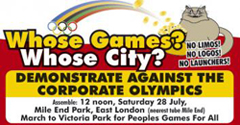
On 28 July, the second day of the Olympics, the Counter Olympics Network is holding a demonstration in an east London park, on the doorstep of the main Olympic site, “to protest the government’s turning of the games into a showcase for corporate, financial and military power at a time people are crushed by sweeping austerity measures.”
Water activists like Maude Barlow and Vandana Shiva have been saying for years that in the minds of capitalists, water is going to be just as precious a commodity as oil has been over the past 60 years.
Understanding that water is the source of major political and economic battles, the corporations that make massive profits from water and water related products have been engaged in PR wars to win the hearts and minds of the public.
Companies such as Coca Cola, Nestle and Veolia have spent billions on ad campaigns and PR projects to try to project themselves as responsible and sustainable companies. However, a simple investigation into how these companies present themselves in ad campaigns is often an indicator of how they really feel about the world.
Take this recent Brita TV commercial. This 15 – second spot begins with a person who looks indigenous (most likely Inuit) and is drinking water from a stream. All of a sudden a woman who is not dressed for the snowy climate appears and gives the indigenous person a Brita bottle and says, “It’s water from the drinking fountain at the mall.”
The indigenous person drinks the water and then smiles big for the camera, just before a cut away to a manufactured scene of a Brita bottle and a narrator telling viewers how magical Brita water filters are.
First, the Brita commercial is racist in that it depicts an indigenous person in a stereotypical fashion, without any context or understanding of how they live. Are we to assume that indigenous people just kneel down and drink from the stream? Maybe they do, but the reference would most likely lead American TV viewers with a sense that “these people” are quite primitive. In other words there is no cultural or historic context.
The racist depiction continues when the woman from the “civilized” world shows up with a Brita bottle that contains water from the Mall. Of course it is from the Mall. The Mall is one of the most dramatic symbols of modern capitalism and consumerism.
After the indigenous person drinks the water he smiles at the camera. He doesn’t talk or engage in conversation, he just smiles. Such a reaction just fuels the racist stereotype about indigenous people as mute and as being grateful for the wonderful benefits of modern capitalism in the form of a Brita water bottle.
Brita would no doubt argue that this commercial is not racist and is in fact a celebration of Native culture, a predictable response that has been the norm from any company or entity that uses Native images or symbols without Native consent. Sports teams and Universities have been using this argument for decades over the challenges from indigenous people because of the racist depictions in team mascots and logos.
False Environmentalism
There was no explanation of this Brita commercial on their website, but what one does find is a huge push from the company to present itself as an environmentally responsible company.
Brita has a whole section on their website entitled, Say No to Bottled Water. In addition, the company has partnered with some trendy entities, even well known musicians, to get the word out that they fighting waste created by the bottled water industry.
It is true that the bottled water industry is deceptive and has taken the world down a dark path by selling us water, as if water wasn’t already available to us. However, the problem with Brita’s position here is that they are essentially no different that bottled water companies in that they sell their products with the argument that tap water isn’t clean enough, so we should also by their filtration systems and we’ll be better off.
This is the beauty of capitalism or disaster capitalism as Naomi Klein calls it. You have a problem, which in this case is dirty water or at least the perception of dirty water. But instead of solving the problem by preventing further contamination of the water that people will use, just sell people a product that will just benefit them. If Brita really cared about the quality of water that people consumed, they would be working to educate and organize people to stop the root causes of water contamination. This will never happen, because the root cause of water contamination is industrial capitalism, which Brita is part of.
There has been a growing interest in recent years with people to want to eat local. So much so that many local stores and restaurants now promote themselves as selling food that is locally grown.
Despite the push for people to buy local food, much is often overlooked with the localism mentality.
Food that is grown locally can still be done in such a way that exploits people and the land. We know from a 2010 report from the Michigan Civil Rights Commission that working and living conditions for many migrant workers is oppressive and exploitative. Thus, just because food is grown locally doesn’t necessarily mean that promotes justice.
This will be the theme of the discussion that the Bloom Collective is hosting on Saturday, July 14, a potluck discussion about Food Justice. According to their facebook event it says:
We will have informational handouts that analyze the current food system and facilitate a discussion on how we can create more food justice.
The event is taking place at Garfield Park near the South East Area Farmers Market, a market that is run by the local food justice organization, Our Kitchen Table. The event is a potluck and people are invited to bring food to share.
Food Justice Potluck
Saturday, July 14
1:00 – 3:00 PM
Garfield Park 334 Burton SE, Grand Rapids
To Aid Afghans, Not Just Afghanistan
This article by Giuliano Battiston is re-posted from Common Dreams. Editors Note: For more detailed analysis on aid money and intervention in Afghanistan over the past 10 years, read this highly informative report Snapshots of an Intervention, produced by the Afghan Analysis Network.
Afghanistan’s international donors gather on Sunday in Tokyo for a conference at which they are expected to pledge economic aid, and ensure their assistance level will be maintained after withdrawal of ISAF-NATO troops, in 2014. But Afghan people and civil society groups working in the country say much of the aid is being directed the wrong way.
Donors are expected to promise 3.9 billion dollars in annual economic and development support at least through 2017, going by what Afghan President Hamid Karzai said some days ago. Head of the Afghan Central Bank, Noorullah Delawari, says Afghanistan needs about six to seven billion dollars annually in economic aid.
The international community has often made firm commitments for financial, development and security assistance for Afghanistan beyond 2014, but civil society activists have several concerns.
“The international community has done its best here, but has failed, because it tried to apply a strategy elaborated elsewhere, by people without any specific knowledge of the country,” Soraya Pakzad, founder of Voice of Women Organisation in Herat, about 640km west of capital Kabul, told IPS.
“Tokyo could give donors and international players the last chance to revise their strategy, which has to be focused on economic development and social inclusion in order to be useful, rather than only on the military sector, as it was for the last 11 years,” she added.
Abdul Khaliq Stanikzai, regional coordinator for Sanayee Development Organisation told IPS that the marginal level of development aid, as compared with the volume of funds for military activities, “clearly shows the priorities accorded to the political-military objectives over those of reconstruction, while the modest amount of money assigned to humanitarian activities was too dependent on the NATO’s aim to ‘win the Afghan hearts and minds’.”
Over the past years, many NGO workers and independent researchers have criticised the securitisation of humanitarian aid, as seen in its geographical distribution, reflecting the political and military objectives of donor countries rather than the needs of the Afghan population.
The growing securitisation of aid and the focus on the military sector “has negatively affected the agenda pursued by the international community in Afghanistan,” Stanikzai told IPS.
A detailed report by the independent group Development Initiatives confirms his ideas: of the 286.4 billion dollars invested in Afghanistan from 2002 to 2009 in aid, security and military sectors, a total of 242.9 billion dollars, 84.6 percent, was allocated to military operations in the country. Just 9.4 percent (26.7 billion dollars) was destined to development aid, and a modest 0.3 percent (0.8 billion dollars) went to multilateral peacekeeping (UNAMA, the United Nations Mission in Afghanistan and Eupol, the European Police Mission).
With the downsizing now of the foreign forces, the international community must open a new chapter in its strategy on Afghanistan, civil society organisation members say.
The European Network of NGOs in Afghanistan (ENNA) is trying to promote a common call to the European governments that starting from the beginning of the withdrawal, for each euro saved from the military budget 30 cents be re-allocated to cooperation projects meant to promote social and economic progress.
“We still need military support at a national level to fight terrorism and anti-government insurgents, but we mostly need to address the main, structural roots of the conflict that are linked to the lack of economic opportunity for the people,” Daoud Saba, Governor of Herat province told IPS.
“And we also need to improve our institutional mechanisms to answer citizens’ claims and needs. This means that for the Afghan government it would be better to directly control much of the funds.”
So far, allocation of funds has mostly been decided by international donors, with a low involvement of local partners and interlocutors. “The Government of the Islamic Republic of Afghanistan estimates that 77 percent of aid channeled to the country up to mid-2009 was directed bilaterally to projects, with little or no involvement from the government itself,” writes Lydia Poole, author of the Development Initiatives report.
Many Afghans continue to blame the international community for acting unilaterally. “It is time to give the Afghan government and society their sovereignty back, we have to prove our capabilities,” Abdul Qader Rahimi who heads the Herat branch of the Afghan Independent Human Rights Commission told IPS.
The call for foreign assistance to be routed through Afghan government entities rather than international organisations is a long-standing one, but donors are still reluctant to accept this demand due to corruption and a lack of transparency and accountability. Last year Transparency International ranked Afghanistan the third most corrupt country in the world.
“We too are really concerned that the Afghan government is too weak, corrupt and ineffective to use aid in a proper way,” Haziza Khairandish, West region Coordinator for the Civil Society and Human Rights Organisation told IPS. “There’s the real, concrete possibility that we will lose a great opportunity once again.”
But corruption is not a one-sided issue, civil society activists say. “Corruption is spread over the Afghan institutions, this is clear, but it is also common among the so-called international community,” Ahmad Kharimi, acting director of the High Office of Oversight and Anticorruption (HOOAC) in the West region of the country told IPS.
“The amount of money spent through Afghan channels is marginal compared to that passed through international organisations or directly disbursed by donors, and the latter is much more difficult to trace, check and monitor. We really are used to finding a lot of problems when we try to call donors to accountability: it is six months, for example, that we have been trying to get an appointment with the Italians to discuss some controversial issues. Until now we have not received any answers.”
This study was conducted by Media Matters.
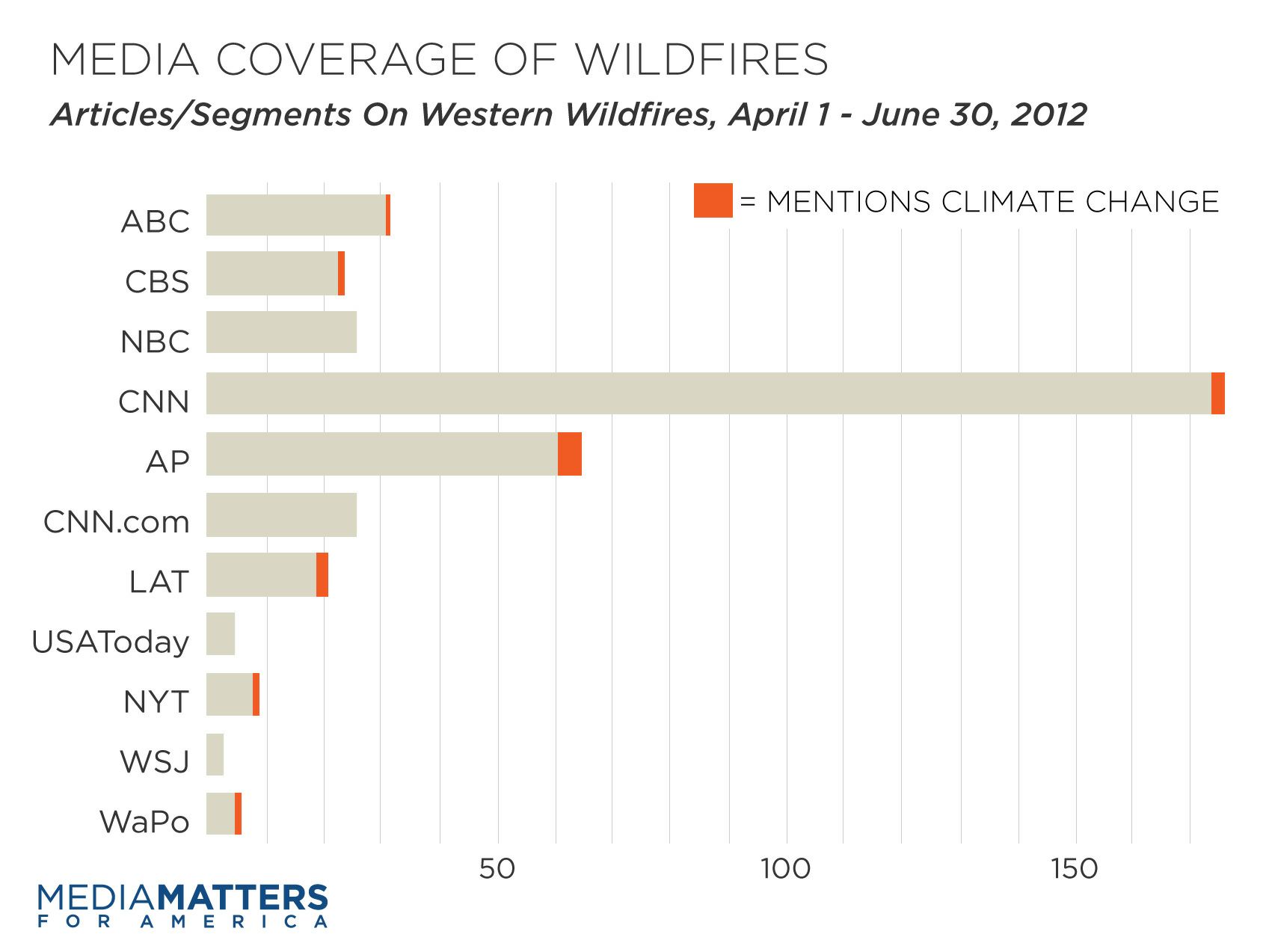
While numerous factors determine the frequency, severity and cost of wildfires, scientific research indicates that human-induced climate change increases fire risks in parts of the Western U.S. by promoting warmer and drier conditions. Seven of nine fire experts contacted by Media Matters agreed journalists should explain the relationship between climate change and wildfires. But an analysis of recent coverage suggests mainstream media outlets are not up to the task — only 3 percent of news reports on wildfires in the West mentioned climate change.
News Outlets Avoid Topic Of Climate Change In Wildfire Stories
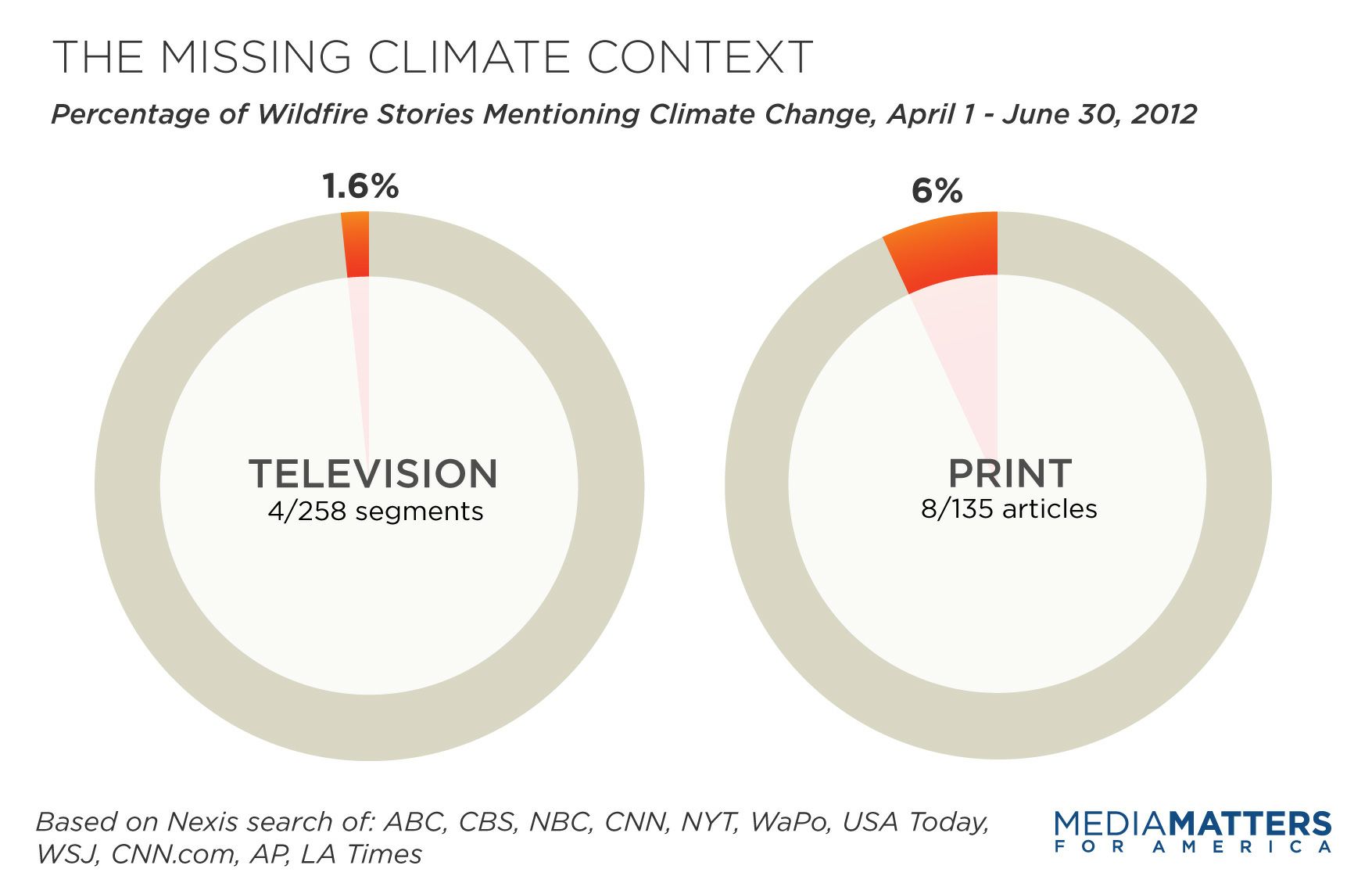
Only 3 Percent Of Wildfire Coverage Mentioned Long-Term Climate Change Or Global Warming. The major television and print outlets largely ignored climate change in their coverage of wildfires in Colorado, New Mexico and other Western states. All together, only 3 percent of the reports mentioned climate change, including 1.6 percent of television segments and 6 percent of text articles.
Climate Central: “Wildfires Require Several Factors To Come Together.” A Climate Central article about the 2011 fire season noted that “major wildfires require several factors to come together,” and that wildfires are strongly influenced by regional climate conditions, which in turn are influenced by global warming driven by greenhouse gas emissions:
As with most extreme weather and climate events, and their related impacts, major wildfires require several factors to come together in order [to] occur — typically some combination of dry and windy weather, abundant and dry vegetation, and a spark, which can range from a carelessly tossed cigarette to a lightning strike.
Wildfires are a naturally occurring phenomenon closely tied to climate conditions, and as the world warms in response to rising amounts of greenhouse gases in the air, many studies show that wildfire frequency and severity will likely shift as well.
Historical variations in climate can explain much of the large year-to-year and decade-to-decade variations in Western US fire activity. Thus, climate change is already increasing wildfire activity in the Western US. This may seem surprising, given the number of other factors (including forest management practices) that are known to affect fire activity. [Climate Central, 6/21/11]
Major Climate Report: “Wildfires in the United States Are Already Increasing Due To Warming.” In a comprehensive report commissioned by the Bush administration and released in June 2009, the U.S. Global Change Research Program said earlier snowmelt and drying of soils and plants have worsened wildfires in Western states:
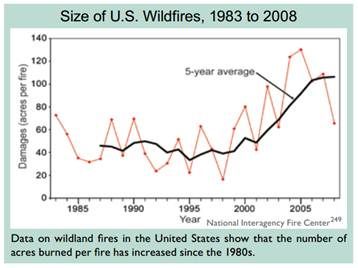
Wildfires in the United States are already increasing due to warming. In the West, there has been a nearly fourfold increase in large wildfires in recent decades, with greater fire frequency, longer fire durations, and longer wildfire seasons. This increase is strongly associated with increased spring and summer temperatures and earlier spring snowmelt, which have caused drying of soils and vegetation. [U.S. Global Change Research Program, 6/16/09]
The report included the following chart showing that the number of acres burned per fire has increased significantly since the 1980s:
For the full report by Media Matters click here.
Millions being spent on ads for the International Bridge in Michigan and against Obama policies
According to data released by the Lansing-based group, Michigan Campaign Finance Network (MCFN), almost $7 million dollars has been spent on TV ads in the state regarding the proposed Detroit River International Crossing bridge.
The data released by MCFN shows that it is pretty even in terms of ad spending by those in favor of the bridge ($3,355,439) and those opposed ($3,416,033). The numbers for ad spending in the Grand Rapids/Kazoo TV market is also roughly even, with $680,579 spent in favor of the bridge and $714,509 being spent against the bridge.
According to MCFN:
DIBC (Detroit International Bridge Company) has already placed deposits for more television advertising that will commence immediately after Michigan’s August 7th primary election and run through September. It spent $6 million for television advertising in 2011 when it succeeded in killing enabling legislation for the bridge project in the Michigan Senate Economic Development Committee.
Presidential Attack Ads
In the Presidential race, neither the Obama nor the Romney camp has been spending money on TV ads since the February Primary, but the data shows that plenty of “non-profit” groups have been paying to attack the President’s policies.
According to MCFN: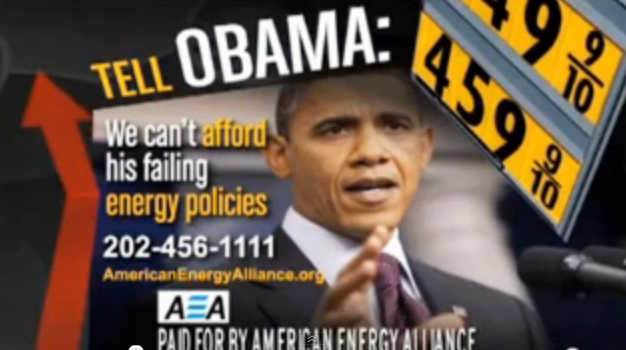
The television ad war has been a one-sided attack against the administration and policies of President Barack Obama, funded by 501-c-4 nonprofit “social welfare” corporations that will not disclose their donors. Americans for Prosperity, American Future Fund, 60 Plus Alliance, American Energy Alliance and Crossroads GPS have spent $5.8 million for candidate-focused “issue” advertisements designed to emphasize one issue: The unsuitability of Barack Obama to be reelected president.
The patchwork of rules regulating disclosure of donors behind political advertisements has been skirted easily by the groups that have dominated the presidential campaign in Michigan so far. Americans for Prosperity began the campaign in January and stopped its advertisements 31 days prior to the Michigan presidential primary election on February 28th, one day before a disclosure window opened that required reporting of donors to committees sponsoring “electioneering communications.”
MCFN acknowledges that SuperPACs are required to disclose their donors, but they can receive funds from “non-profit corporations,’ which do not need to disclose where their money is coming from.
“What we’re seeing is the demise of accountability in federal political campaigns,” said Rich Robinson of the nonpartisan Michigan Campaign Finance Network. “This well-funded, highly coordinated campaign hid the identity of those who provided more than 90 percent of the money behind it.
Since the beginning of the year through June 30 there has been $6,400.486 has been spent on TV ads that are critical of the President. Over a million ($1,062,598) has been spent in the Grand Rapids/Kazoo TV market alone.
This kind of spending on TV ads will no doubt escalate once the August Primary is over and viewers will be inundated with political ads from all sides, once again demonstrating the absurdity of electoral cycles and how money influences outcomes.
New Media We Recommend
Below is a list of new materials that we have read/watched in recent weeks. The comments are not a “review” of the material, instead sort of an endorsement of ideas and investigations that can provide solid analysis and even inspiration in the struggle for change. All these items are available at The Bloom Collective, so check them out and stimulate your mind.
Arab Spring, Libyan Winter, by Vijay Prashad – This is one of the best analytical pieces I have read on the US/NATO intervention in Libya to date. Prashad, a seasoned writer and professor of international studies has provided us with a gem. Arab Spring, Libyan Winter dissects the recent US/NATO intervention in Libya, provides important historical context for US/Libyan relations and then juxtaposes this intervention with what has been happening all throughout the Arab world, in what is now commonly known as the Arab Spring. In addition, the book not only provides readers with clarity on the Arab uprising, but frames this recent history through a critical lens of US foreign policy. Prashad takes on the Obama administration’s efforts to undermine popular movements and real democracy in the Middle East and North Africa. Arab Spring, Libyan Winter is a valuable contribution into understanding the forces and factors that have been determining political uprisings in the Arab world.

Queer Liberation is Class Struggle (Zine), by JOMO – What does queer politics have to do with class struggle? Plenty, according to the person responsible for this 27-page zine. With sharp analysis, the writer makes it clear that queer politics and class struggle not only intersect, but class struggle is essential for queer liberation. The writer uses queer analysis, class analysis and feminist analysis to talk about race, gender, class, homophobia, trans-phobia and capitalism. A great deal is packed into this short zine, but it is well worth reading by anyone who wants to challenge their notion of liberation, particularly with an anti-capitalist analysis. Highly recommended.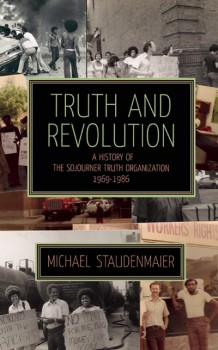
Truth and Revolution: A History of the Sojourner Truth Organization 1969 – 1986, by Michael Staudenmaier – This new book from AK Press is a fascinating investigation into a little known radical group in the Midwest known as the Sojourner Truth Organization (STO). After several years of research and interviews with former members of the STO, the author provides us with a chronological, theoretical and collective analysis of the work, function and evolution of this radical organization. The STO was primarily a class struggle based group that was heavily influenced by Marxist theory and often had Leninist tendencies. The STO did a lot of education and organizing work amongst working class people in the early years, much of it in poor neighborhoods in Chicago. However, the group was a product of the social movements of the 1960s & 70s and was also forced to come to terms with patriarchy and White Supremacy. The book does a fabulous job of navigating how the group dealt with these issues and the internal struggles around identity and action. The STO was also heavily involved in international solidarity work and worked hard to make connections between international liberation struggles and revolutionary politics in the US. However, maybe the best part of the book is its constant reflection on what current radical organizing can learn from the STO, both what to do and what not to do. Truth and Revolution is an interesting and valuable read for today’s revolutionaries.
Slavery by Another Name (DVD) – Based on a book by the same title and written by Douglas Blackmon, this documentary is an illuminating examination on the post-Civil War continuation of varying forms of economic and legal enslavement of African Americans in the US. The film looks at the White Supremacist political and economic system in the US and how it was able to continue to exploit blacks in order to maintain capitalist growth. Slavery by Another Name examines the harsh reality of how blacks were criminalized by laws, which allowed them to be sold into both the agricultural and industrial system as a form of forced labor. The film also looks at peonage laws, share-cropping, chain gangs and other forms of black servitude that lasted at least until WWII. The most powerful point made from this film is that what motivated the exploitation of Blacks was the profit motive, coupled with widespread racism. The only shortcoming of the film, as compared to the book, is that it doesn’t spend enough time looking at Northern-based corporations that also profited tremendously from the exploitation of blacks in the US, which could leave some viewers to conclude that this form of institutional racism was a Southern problem. However, the film does make for a valuable educational tool that should be included in any anti-racism training for those committed to racial justice today.
This article by Glen Ford is re-posted from Black Agenda Report.
The Obama administration recently gave five more states waivers to escape some of the conditions imposed by No Child Left Behind, the corporate blueprint to remake America’s schools. That means almost half the states have already won waivers, and more will probably follow in this election year.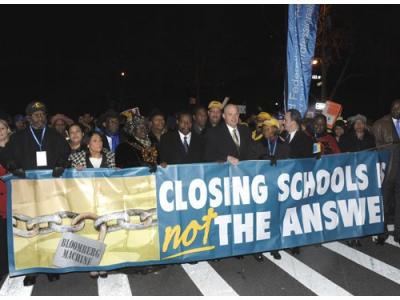
Many critics of No Child Left Behind call the 10-year-old legislation, signed into law by President Bush, a failure. And, if you believe the real purpose was to foster extraordinary improvements in learning, then it was always doomed to failure. You cannot test your way to success, in education or any other endeavor; you can only decide who must fail. Politically speaking, No Child Left Behind was always destined to be selectively dismantled – as Obama is doing – because its arbitrary and impossible to achieve testing benchmarks would inevitably cause too many white schools to fail – as are probably four out of five districts, already. But No Child Left Behind was never intended to meet its stated goals. What the scheme was designed to do, was to use federal spending as a hammer to impose corporate governance over privatized public schools.
It has been largely successful, thanks to the diabolical genius of American racism, which always assumed that the project was aimed at Black and brown communities. The general attitude in 2002 was: break up that blackboard jungle in the inner cities. By all means, experiment on them! African American communities became the wedge through which could be inserted a corporate network of charter schools. Once the charter model reached critical mass in enough localities, President Obama unleashed an unrelenting wave of extortion and bribery that he called Race to the Top, forcing states to vastly expand the new market for charters. Thus reassured that taxpayer-financed education – a potential trillion dollar “market” – would become a Wild West for no-risk investment, Wall Street’s denizens jumped in the game with all four hooved feet.
In the space of a decade, No Child Left Behind has struck a mortal blow to American public education – just as intended. The teachers unions have been demonized, demoralized and rendered largely politically inert – which has always been at the top of the corporate wish-list. This goal was achieved under a Democratic president, whom the teachers unions nevertheless endorsed with unseemly haste, even though Obama has been more effective in their evisceration than his Republican predecessor. The teaching profession, itself, has been degraded, possibly beyond repair.
Black America, which was so callously transformed into the core market for privatized schooling, has been systematically deprived of any avenues for community control of schools, which can never coexist with the corporate structures of charterization. Black teachers have been decimated in city after city, further weakening the social fiber of their communities.
So, it is a mistake to conclude that No Child Left Behind has failed in its actual purposes. Although it may appear that President Obama’s waiver policies are disarming the program, piece by piece, the bomb has already exploded. Disaster capitalism is now deeply entrenched in U.S. public education.
 Grand Rapids Institute for Information Democracy