The Koch Brothers Exposed being shown this Thursday at the Bloom Collective
This Thursday, September 20, the Bloom Collective will be hosting a screening the documentary The Koch Brothers Exposed.
The film takes an in depth look at the political and economic power the Koch brothers have in US policy and the consequences to the democratic process, worker rights, public health, public education and environmental destruction.
However, according to the Bloom Collective Facebook event, they will only being showing part of the film.
This will be more than just a film screening, as the film will be intermixed with other media, resources, and research which will better enable us to capture the true nature of power, thus empowering us to take that power back.
In addition, we’ll screen the trailer for Untouchable Waters, a film being produced locally about Plaster Creek (a Grand River tributary) and how it has become so toxic people cannot touch it without being harmed. More on that project can be found on their facebook page.
Koch Brothers Exposed
Thursday, September 20
7:00 PM
671 Davis NW, Grand Rapids – lower level
$3 suggested donation
The Role of State Secrecy and Deception in Fostering Islamophobia
This article is re-posted from Dissident Voice.
The hatred and vitriol of, the deceptively titled film, Innocence of Muslims was the origin of a subsequent wave of hatred and vitriol. People were angered and people died because of the outraged filliped by the film. When further information came to light about the film and how it was produced, immediately the motto of the Mossad came to mind: “By way of deception …”

I have not seen the film, and I have no intention of seeing it. According to news accounts, Innocence of Muslims mocks Muslims and the prophet Mohammed. Western governments, academia, and state/corporate media bear much responsibility for this further example of the increasingly prevalent scourge of Islamophobia. This is antithetical to progressivism and its principles.
The identity of the man behind the film, and its deception, is clouded. There are conflicting claims made. At first the man was identified as Sam Bacile, an Israeli-born Jew living in California. AP identified the man as an Egyptian Christian, Nakoula Basseley Nakoula. The JTA states unequivocally, “He was not a Jew.” Whatever his background, he was driven by hatred, and hatred can be found within all groups.
Whoever Sam Bacile really is, he appears to be a thoroughly disreputable character. The film was made by deceiving the cast and crew of the film. The actors and crew behind the making of Innocence of Muslims claim they were “grossly misled” about the film, which mentioned neither Islam nor Mohammed in the script.
There is a tendency to be unguarded or loose in criticizing groups that critics need to be wary of: the error of appearing to paint all members of a group with one brush. Are there groups that are 100 percent homogeneous? It is possible that on certain key concepts there may be a unity of belief. Usually there reside countervailing views with most groups; consequently, whenever one group is singled out for blanket criticism and condemnation, it seems prudent to confine criticism to the negative beliefs and actions of the group rather than direct criticism at all the members of the group. Nonetheless, there are certain loathsome groups that believe they have the right to discriminate against non-group members. By virtue of voluntary membership in such groups an entirety of the membership may open itself to blanket condemnation. Examples are the KKK, Nazis, and Zionists.
By way of deception …
Espionage and intelligence gathering is a practice born of, and wed to, deception; it is not peculiar to Mossad. “Bacile” merely practiced what so many governments practice the world over, often with the same fatal results. People need to challenge what their national intelligence agencies are really up to, challenge the raison d’être of the intelligence agencies?
If people desire to live in peace and equality, then it is important to ground oneself in knowledge, principles by which to lead one’s life, and actions that abide by those principles based in epistemology and, its important concomitant, verisimilitude.
Whistleblowing is a sine qua non for a progressivist world — a world of peace enjoyed by all peoples. Wikileaks has been prominent in forging the way for the people’s right to know. Wikileaks (and Julian Assange and Bradley Manning) deserve and need the support of people who cherish open and peaceful societies. If “our” governments clandestinely, through deception, through disinformation and propaganda engage in skullduggery and evil against other groups – it is crucial that the citizenry be informed so that they at least have a chance to formulate opinions and actions based on knowledge of what is happening in their names.
This interview is re-posted from ZNet. Editor’s note: McKibben we be part of a forum on Climate Change in Grand Rapids on Tuesday, Sept. 25 at GVSU’s Eberhard Center in downtown Grand Rapids at 7pm.
Bill McKibben, founder of the international climate change group 350.org, is one of the world’s leading campaigners on the climate change crisis. In 2010, the Boston Globe called him “probably the nation’s leading environmentalist.” The Center for Media and Democracy (CMD) interviewed McKibben to ask about the status of the global climate change movement and the current priorities of 350.org. McKibben will be in Madison, WI to address “Fighting Bob Fest” September 15.

CMD: You have been one of the leading voices in resistance to the construction of the Keystone XL pipeline. While the border-crossing permit for the Keystone XL pipeline has been postponed by the Obama administration, construction has commenced on the southern portion of the pipeline. What do activists need to know about the status of the pipeline?
McKibben: The victory that we won last year was a temporary victory. I guess all environmental victories are temporary, but this one was even more temporary than most. Mitt Romney has made it absolutely clear that if he wins the election his first duty, on his first day in office, will be to approve the Keystone XL pipeline. Barack Obama hasn’t said one way or another what he will do, but the signs aren’t particularly great. The U.S. State Department has given no indication that it will conduct a comprehensive hearing on the climate issues surrounding the pipeline. That’s not a great sign. The thing that we can do most effectively at this point is to try and keep a strong focus on climate change as an issue. We need to make President Obama understand that if he wins again, this is his legacy issue. In many ways it will be the most decision he makes in regards to climate change. We will see what happens. The one thing we can say for sure is that Mitt Romney can’t wait to sign this thing.
CMD: Why is Keystone XL such a important climate change issue?
McKibben: The pipeline runs through sensitive territory and requires people to give up farms and ranches. The good people in Texas right now are fighting hard to block construction of the southern leg that would run through their homes and farms. In the larger sense, it matters enormously because the tar sands in Canada are the second largest pool of carbon on earth. As Jim Hansen at NASA has said, if we manage to burn all the economically recoverable tar sand up there, then its essentially ‘game over’ for the climate. It’s a very big deal. The oil fields in Saudi Arabia are the largest pool of carbon. Burning the oil fields of Saudi Arabia has raised the temperature of the planet about a degree more than any other single thing on earth. That gives us a good reason to not go and do it all over again.
CMD: You have been part of the movement to resist hydraulic fracturing or “fracking.” Why is fracking an issue you are prioritizing?
McKibben: Fracking is really important because it’s this discovery of a new wave of carbon-based energy forms at a time when we already have far more than scientists say we can safely burn. Knowing that, it makes no sense to go out and rip apart the countryside looking for more. Natural gas is a great danger because of the methane leaks in the course of producing it. That methane is 23 times more greenhouse gas intensive, molecule per molecule, than even the carbon dioxide that we worry about so much. Burning this cheap natural gas seems to displace lots of renewable energy, even more than it replaces coal. The net effect seems to be, if anything, it makes climate change worse off than it was before.
I will be in Philadelphia on the 20th for “Shale Gas Outrage.” Pennsylvania is being hit harder than any other place, maybe in the whole world, by fracking. They have had enough. They people there are really ready to get to work.
CMD: You’ve recently written about how the extreme weather we’ve been experiencing — record heat waves, wildfires, flooding and droughts — are now the “new normal” because of the warming planet. Do you think recent weather events have increased awareness about climate change?
McKibben: I do. The polling data shows that the number of Americans that are concerned about climate change has gone up dramatically just in the last year. Its now 72 percent of people. In a sense, how could it be otherwise? All you had to do was poke your nose out the door this summer to have the sense that the world is changing very fast. I’m not surprised at all that people are becoming more engaged. More engagement always increases the odds of actual action taking place.
We are getting ready to launch a very big divestment campaign to get institutions like colleges to get rid of their stock in fossil fuel companies. These companies are dangerous; they are rogue forces. They have contributed way more carbon than the atmosphere can absorb, so we have to stop them. That’s going to be a hard job, but I think we are capable of it.
CMD: Why do you think there has been this increase in civil disobedience and how important is direct action in the progression of the environmental movement?
McKibben: I think its very important. We organized last summer around the Keystone XL pipeline what became the largest civil disobedience action in 30 years in this country with 1,253 people who were arrested. I’m very glad to see that this type of action has spread. There were people who were doing it before that — the mountaintop removal people, heroes like Tim DeChristopher. This idea has spread and it’s a very good thing.
CMD: How would you rate the president’s performance on the environment? How does this administration compare to the Bush administration?
McKibben: He’s better on the environment than the Bush administration. But then, you know, I’ve drunk more beers than my 14 year old niece too. It wasn’t a very high bar to live up to. The Obama administration has been very mixed on environmental and energy issues and its been kind of a shame to watch the power that the fossil fuel industry has exerted over this administration. I guess the relevant question for the moment is how they’ll be vis-à-vis the Romney administration, and it was sad to see Mitt Romney mocking the very idea that someone might try to work on the health of the planet in his convention speech. Even if we re-elect Obama, I think the sort of obvious message is that we can’t just sit around and wait for him to do the right thing. We have to take the action to him and to the corporations in the years to come because they are not going to do the right thing by themselves. I’d say that’s abundantly clear at this point.
I think the administration will only change if we build movements to make it change. Politicians, you have to pressure them to get done what needs doing. Let’s hope we can build that pressure.
CMD: 350.org is a global organization. Can you talk about some promising movements abroad to fight climate change?
McKibben: There’s a lot of good movements going on around the world. We are fighting this huge coal plant in Kosovo; fracking in South Africa. All across Europe people are working on these issues. It’s exciting to see. The willingness of people all over the world to carry on this fight is my motivation. Especially the willingness of people in places that have done nothing to cause the problem. As long as they are willing to fight, I feel like I have no choice but to fight with them.
Howard Zinn play “Marx in Soho,” to be performed September 21st as a fundraiser for Grand Rapids workers on strike
This Friday, September 21st, there will be a performance of the late radical historian Howard Zinn’s play, Marx in Soho.

Marx in Soho gives the audience a rare glimpse of a Marx seldom talked about: Marx “the man” – the pedantic Marx, the vindictive Marx, the loving family man, Marx as humorist, and a Marx that can laugh at his enemies at the same time he expresses outrage at social injustice. The play offers an entertaining and thorough introduction to any person who knows little about Marx’s life, while also offering valuable insight to students of his ideas.
Howard Zinn’s MARX IN SOHO
with Jerry Levy as Karl Marx
Performance at 7pm
Friday, September 21
G.R.E.I.U. Hall
917 Bridge St NW, Grand Rapids MI
Admission: Donations for the Grand Rapids Gravel Striking Workers of Teamsters Local 406
Decades Of Deception: The Coal Industry Has Advertised ‘Clean Coal’ Since At Least 1921
This information on the Greenpeace campaign to expose the lies of the Coal Industry is re-posted from Common Dreams.

Coal is clean! Environmental regulations will cripple the economy! Scientific evidence about coal pollution and the environment is inadequate and uncertain! Sound familiar? Big Coal relies on these arguments today in order to block environmental and public health protections.
Searching through newspaper archives, Greenpeace investigated the history of Big Coal’s advertising to assess how the industry’s arguments have changed over the years. The answer? Not much.
For at least five decades, the coal industry deployed deceptive advertising campaigns to scrub its image and delay important clean air standards. An intriguing pattern surfaces of increased rhetoric and advertising whenever rumors of environmental protections circulate. Once government agencies pass air quality regulations, the coal industry then spins their required cleanup using technologies they once opposed as a big achievement.
It’s time for Big Coal to stop crying wolf. Check out Greenpeace’s slideshow highlighting a handful of Big Coal advertisements.
Michigan Hate Crimes Conference: Vincent Chin – A 30 Year Retrospective on Lessons Learned
The presenter of this session was Tom Hayashi, with the Organization of Chinese Americans. Hayashi began by showing a clip from the film, Who Killed Vincent Chin?
Vincent Chin was beaten to death by two White men in Detroit, with the clear motivation of racial hatred. The backdrop to the story, as it has often been presented, was that one of the killers was an out of work autoworker who beat Chin because he thought he was Japanese and the Japanese were responsible for the US auto industry’s decline.
Initially the two White men charged with the murder did not jail time and only got 3 years of probation. Hayashi stated that this was a wake up to the Asian-American community that it was finally time for their community to stop being nice.
Hayashi then talked about a case against Danny Chen, an Asian American who had joined the US military. Chen was deployed in Afghanistan and upon arrival he was harassed and intimidated by fellow soldiers because of his racial heritage. Chen was also physically abused on numerous occasions and on one day, after being hit with rocks being thrown by other soldiers, was later found dead from a gun shot wound. The military said that Chen had shot himself, but there is no conclusive evidence that Chen took his own life.
Hayashi then provided a much larger historical context around the treatment of Chinese and other Asians in US history in this country. He mentioned that treatment of the Chinese during the construction of the railroads and the racist immigration policies that were adopted in the late nineteenth century that resulted in the deportation of thousands of Chinese.
Hayashi then talked about how Chinese and other Asian Americans are the target of racist stereotypes in political campaigns. Here is a video by Citizens Against Government Waste that demonstrates deeply entrenched racism.
Hayashi then shifted the conversation around the importance of an intersectional analysis, so that deeper relationships can be developed to create more effective strategies for justice. Hayashi said that African Americans must develop relationships with the LGBT community and that the LBGT community needs to development stronger relations with feminist groups and that feminist groups need to collaborate with Asian American organizations.
The presenter stated that we need to figure out ways to find common cause with groups that have a different focus, but where there might be intersecting interests.
Michigan Hate Crimes Conference: Housing and Hate Crimes
This is the first of several articles based on presentations taking place at the Michigan Response to Hate Conference in East Lansing.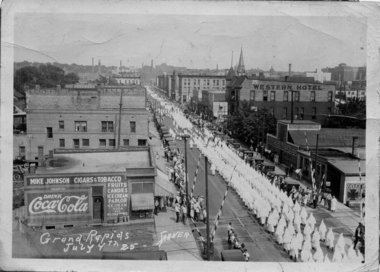
The first presenter at today’s Michigan Hate Crimes Conference was Brian Greene, with the US Department of Housing and Urban Development. Greene provided an overview of hate crimes and racism and its lasting impact on housing in America.
Greene began by talking about the history of the KKK in the US and Michigan. The Klan had numerous large rallies in Michigan prior to WWII, with a major rally taking place in Grand Rapids in 1925, as can be seen in this photo.
Greene then discussed the case of Dr. Henry Sweet, who challenged the norms of White Supremacy in Detroit by buying a house in an all White neighborhood. Sweet and his family were the target of violence, which led to a famous legal case involving Clarence Darrow.
These historical examples were used by Greene to provide a framework for ongoing hate crimes against minorities who dared to move into all White neighborhoods or communities. One recent example that Greene provide was of a hate crime committed in 2010, where an undocumented Mexican immigrant was murdered because he was Mexican, a case that is the subject of a new film, Shenandoah.
Greene provided a few other examples, in particular a case in New York involving John White. White was a Black homeowner in a predominantly White neighborhood in Long Island. Smith’s son was one of a few Black students at the local high school. His son was at a party one night and was asked to leave based on a fake social media posting that claimed White’s son was a rapist.
White’s son left and went home, but was followed by a group of White students who made threats against White. When the boy arrived at home he told his father he was being threatened by this group of White students. The White students arrived, they made racial threats against the father and son. Mr. White was holding a pistol when it was knocked out of his hand, by one of the White students. The gun went off and one of the White boys was shot. During the trial White argued that he was defending his family. White went to jail, but was later released based on a new ruling after the courts acknowledged the role that racial hatred played in this case.
By way of conclusion, Greene made the point again that the current housing disparity and discrimination in the US is rooted in this history of racial hatred that is manifested today.
One issue that Greene did not address was how gentrification fits into the institutional discrimination against racial minorities and the working class poor in urban centers across the country.
Striking Neoliberalism in Chicago
This article by Paul Street is re-posted from ZNet. Go to this link to read all the sources for the article.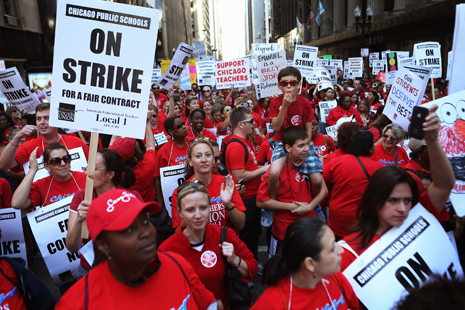
The strike currently being waged by the teachers’ union in Rahm Emmanuel’s Chicago is quite remarkable. A critical underlying issue is how teachers’ performance is appraised. Under a new assessment system that strongly ties teacher evaluations to student test scores, the city is threatening to put “as many as one-third of Chicago’s teachers on track for termination.”[1]
In Chicago as in school districts across the country, the educational authorities have made students’ scores on standardized tests the sacred gauge of whether a teacher deserves to keep her job.
A big problem with this method of measurement is that teachers have no control over what serious researchers have long shown to be the primary determinant of students’ performance on such tests – those students’ home and neighborhood environments and socioeconomic (class) status.[2] As Gary Orfield of the Harvard Civil Rights Project noted eleven years ago, “When students come to class hungry, exhausted, or afraid, when they bounce from school to school as their families face eviction, where they have no one at home to wake them up for the bus, much less look over their homework, not even the best-equipped facilities, the strongest curriculum, and the best-paid teacher can ensure success.” [3]
“Attempting to fix inner city schools without fixing the city,” education professor Jean Anyon noted in her 1997 book Ghetto Schooling, “is like trying to clean the air on one side of a screen door….Educational change in the inner city, to be successful, has to be part and parcel of more fundamental social change. An all-out attack on poverty and racial isolation that by necessity will affect not only the poor but the more affluent as well will be necessary…” [4]
Teachers also do not control the wildly divergent levels of per-student spending that different schools receive under local and state funding formulas that provide more for kids situated in property-rich school districts and less for those stuck in districts with a weak tax base.
Blaming teachers for low test scores in under-funded urban schools with high proportions of poor and deeply disadvantaged students from broken neighborhoods and fragile families is like blaming a farmer for not having a bumper crop after a drought. It’s like blaming a bus-driver for being behind schedule when much of her route is closed by a flood. It is an especially noxious practice in the weak recovery wake of the Great Recession, which pushed U.S. poverty to its highest recorded levels while squeezing school budgets like no time in recent memory – a double whammy for student/teacher “performance” that can hardly be blamed on teachers (Wall Street and “the 1%” are more appropriately to blame, to say the least).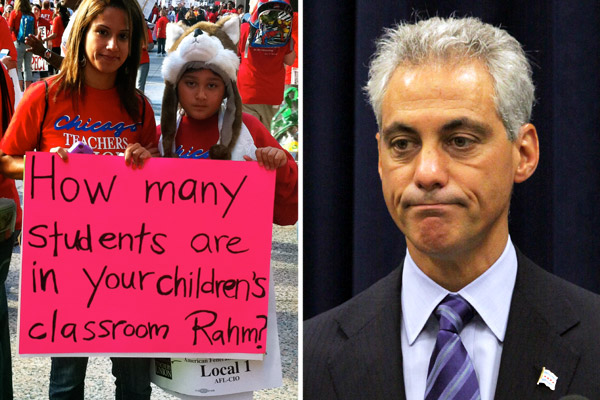
Another problem with the dominant teacher-assessment paradigm is that it incentivizes schools and teachers to gear instruction around the test. This turns the educational experience of many poor and minority children into little more than an authoritarian “drill and grill” exercise focused on repetitive answer-giving mechanics and repetition. That is a surefire way to turn kids off and squelch schools’ capacity to cultivate the many-sided and question-asking critical thinking that democracy requires. As the legendarily eloquent schools author and poor children’s advocate Jonathan Kozol has noted, test-targeted curriculum subordinates “critical consciousness” to “the goal of turning minority children into examination soldiers – unquestioning and docile followers of proto-military regulations.” Under its reign, the prolific left social critic and education expert Henry A. Giroux notes, “Teachers are prevented from taking risks and designing their own lessons as the pressure to achieve passing test scores produces highly scripted and regimented forms of teaching…worksheets become a substitute for critical teaching and rote memorization takes the place of in-depth thinking…Learning facts…becomes more important than genuine understanding.”[5]
This might seem to be a strictly “Republican” paradigm. In fact, however, the neo-Dickensian testing mania is richly bipartisan, like the vicious 2001 No Child Left Behind Act, which mandated funding and other federal penalties for schools that do not miraculously raise poor and minority children’s test scores and thereby contribute to the overcoming of the racial and ethnic “achievement gap.” The mania is enshrined in the Obama Education Department’s “Race to the Top” policy, which uses federal cash grants to encourage school districts to link teacher evaluations to student test performance and to increase their number of non-union charter schools. Obama’s former chief of staff and current leading Obama fundraiser and Chicago Mayor Rahm Emmanuel is a firm proponent of the use of standardized tests without reference to socioeconomic context to assess the merit and performance of students, teachers, and public schools.
Why this preposterous and educationally counter-productive method of teacher and schools assessment in Chicago and indeed across the country? Partly it may reflect policy makers’ fatalistic sense that “social class differences are immutable and that only schools can improve the destinies of lower class children.” This, the liberal educational researcher and author and author Richard Rothstein noted eight years ago, “is a particularly American belief – that schools can be virtually the only instrument of social reform.” [6]
Another factor is racism. Behind the testing frenzy lurks the nasty assumption that predominantly black and Latino poor students do not merit anything more than Giroux’s “highly scripted and regimented” curriculum, which would produce major student and parent rebellions if introduced in affluent white suburban school districts.
At the same time, the test-based policy is a convenient level for the neoliberal rollback and elimination of public teachers’ unions and for the related movement to turn public schools over to private corporations. Along with Republicans and many top Democrats, Mayor Emmanuel and Obama Education Secretary Arne Duncan are determined to advance the privatization/corporatization of American K-12 education. If they share the belief that “only schools can improve the destinies of lower-class children,” they also want to make sure that those schools are as private and authoritarian of possible, free from (among other things) pesky teachers unions, which hinder authorities’ cherished “flexibility” by insisting on irritating things like decent pay, resources and downtime for workers on the rugged instructional front lines. The sadistic game of blaming and shaming teachers for poor kids’ test scores is very useful for the politics and public relations of de-unionization and privatization, masquerading as “school reform.” Teachers unions and indeed public schools themselves become perfect foils for the corporate agenda of misdirecting legitimate popular anger over the failings of the educational system. The misdirection naturally ignores the deeper determinant role of the nation’s steep and savage class and related racial inequalities to advance the false undemocratic solution of corporatization, sold as “choice” and “the free market.”
It is fitting that the right wing Romney-Ryan campaign has gone out of its way to express bourgeois class solidarity with Rahm Emmanuel,[7] who received $12 million from ant-union charter school advocacy groups in his 2011 mayoral election.[8] The Obama campaign has predictably kept its distance from the Chicago conflict even as it advances the neoliberal testing agenda that lay very much of the heart of the strike.
National quadrennial electoral extravaganzas notwithstanding, the progressive Chicago Teachers Union has courageously drawn a line in the sand against the teacher-, student-, neighborhood- and public education-bashing schools agenda of the bipartisan and neoliberal elite. According to the progressive, Chicago-based historian Rick Perlstein on Salon, the fight the teachers have undertaken is a very big deal.“ If Chapter 1 of the American people’s modern grass-roots fight against the plutocracy was the demonstrations at the Wisconsin State Capitol in the spring of 2011, and Chapter 2 was the Occupy encampments of that summer,” Perlstein writes, “the Chicago Teachers Union’s stand against Emanuel should go down as Chapter 3. It’s been inspiration to anyone frustrated that people have forgotten how good it feels to stand up to bullies — and how effective it can be.” That’s no small praise. Whether Perlstein is right or not about that (I hope so), the Chicago teachers richly deserve our support and assistance. [9]
Anti-fracking march in Grand Rapids next Friday, September 21

Next Friday, September 21, the Grand Rapids group Mutual Aid GR invites everyone to participate in an action for the International Day Against Fracking.
The actual international day of protest is September 22, but Mutual Aid GR is doing on the 21st for reasons they will share before the march starts at noon.
There is a growing global resistance to the practice of hydraulic fracturing, also known as fracking. Some states in the US are looking to pass laws banning the practice, but more importantly communities are organizing and engaging in direct action against the oil & gas industry’s desire to extract more oil and gas domestically.
In Michigan, there is a petition campaign being organized by Ban Fracking Michigan and there are at least 11 other communities in Michigan that are hosting an event or action on International Day Against Fracking.
People have also been resisting the sale or leasing of public land by the State of Michigan for the purpose of oil & gas exploration. In May, there was a significant protest in Lansing at a DNR land auction and many people are already preparing for the next DNR land auction, which is scheduled for October 24.
The Facebook event created by Mutual Aid GR states:
In solidarity with communities surviving and resisting the destructive oil and gas extraction method known as “fracking”, we will march through Grand Rapids for Global Anti-Fracking Day, starting at Veteran’s Park on Fulton & Sheldon.
People are encouraged to bring signs and be ready to march in downtown Grand Rapids to make a statement against fracking in Michigan.
Grand Rapids Global Anti-Fracking Day March
Friday, September 21
Noon
Meet at Veterans Park on the corner of Fulton & Sheldon
Dow Chemical wants to expand fracking in Michigan

Yesterday, MLive posted a story about a Press Conference held in Lansing where Michigan chemical companies, such as Dow, were advocating for an increase in exploration of natural gas in this state.
This is not a surprise coming from Dow Chemical, which announced the construction of a new multibillion-dollar natural gas facility in Texas. Dow uses natural gas for production and application of many of the chemical products they manufacture.
What was interesting about the MLive story was that chemical companies were joined by two State Representatives who echoed the desire to increase the amount of natural gas exploration and extraction in Michigan.
The two representatives were State Reps. Charles Brunner, D-Bay City and Aric Nesbitt, R-Lawton. The MLive reporter notes, “Brunner acknowledged environmental concerns about the chemicals injected into the ground during fracking, but said he’s sure it can be done safely in Michigan given the state’s environmental regulations.”
What the MLive article leaves out is that Rep. Aric Nesbitt sits on a House committee that has looked at and made recommendations to increase natural gas exploration in Michigan.
Another issue the MLive story omits is the amount of money spent by corporations and business associations to lobby Michigan legislators and money given to candidates for office in Michigan in order to buy influence on gas exploration and fracking. According to Common Cause nearly $3 million has been spent in Michigan to influence fracking policy over the past decade.

The MLive article does state that there is a mild effort by some state legislators that would require more research on the environmental impact of fracking and that there is a petition campaign to put on the ballot in 2014 a moratorium on natural gas fracking.
What the MLive story does not acknowledge is the growing public resistance to fracking as was demonstrated at the DNR land auction in May or the fact that there are several anti-fracking actions being organized across the state for the international anti-fracking day on Sept. 22.

