Our Kitchen Table to offer class on the History of Food in October

Throughout history and today, food production has been a key component of how members of a society organize themselves and express their different cultural norms and identities. This class explores different types of sustenance economies as well as the history of food from before the rise of civilizations.
Topics will include the history of colonialism, the rise of agri-business and how these have destroyed cultural practices. Finally, we will learn about the relationship of cultures with food and the importance of biodiversity for preserving cultural heritage.

The class is free. Participants are asked to purchase a copy of The Earth Knows My Name: Food, Culture and Sustainability in the Gardens of Ethnic Americans, by Patricia Klindienst (2006, Beacon Press). The class will also include other readings, including selections from Food and Culture: A Reader, edited by Carole Counihan and Penny Esterik (2008, Routledge, second edition).
OKT History of Food Class
- Meeting four consecutive Tuesday evenings, 6 to 8 p.m.
- Oct. 9, 16, 23 and 30
- Taught by anthropologist and GVSU adjunct professor, Christy Mello
- Location TBA
For more information contact OKT at http://oktjustice.org/contact/.
Opposition Mounts As First Tar Sands Mine In US Gets A Green Light
This article by Melanie Jae Martin is re-posted from ZNet.
Last week, a new front opened in the struggle against tar sands mining in the U.S. If you didn’t know that tar sands mining is in the works on this side of the border in the first place, you’re not alone. Most people don’t realize that tar sands extraction, which has caused tremendous pollution and environmental degradation in Canada, has crossed the border to U.S. soil, where it has taken root in Utah.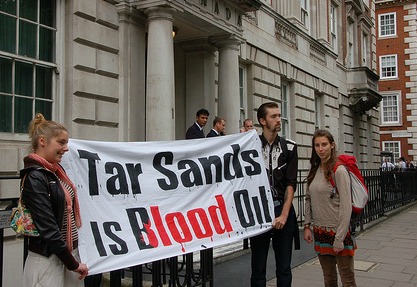
Activists on both sides of the border have been working fervently to halt the spread of tar sands in Canada and the piping of tar sands oil from Alberta to Texas. Beginning with Tar Sands Action’s mass arrests outside the White House in August 2011, followed by the Indigenous Environmental Network’s protests at the climate talks in Durban that December, activists have made Canadian tar sands mining and the Keystone XL pipeline to the Gulf of Mexico a high-profile issue this past year.
Now, direct action campaigns like the Tar Sands Blockade in Texas are continuing the effort to stop construction of the southern leg of the pipeline by disrupting business as usual for the oil industry. The threat of tar sands mining in the U.S., however, complicates the struggle. It forces geographically divergent groups to either divide their efforts or find ways to unite across vast distances. That’s why groups like Utah Tar Sands Resistance and Before It Starts are forming a strategy that can join, as well as compliment, the tornado of opposition that has formed against the tar sands industry.
Before It Starts — co-founded by Ashley Anderson, who began Peaceful Uprising with Tim DeChrisopher in 2009 — is focusing primarily on national outreach, while Utah Tar Sands Resistance is focusing on forging local and regional coalitions. In both groups, activists who have experience in nonviolent direct action are prepared to ramp up efforts when the time is right. Thus far, however, the struggle has mainly been waged in the courtroom.
The environmental group Living Rivers initiated a legal challenge in 2010 to halt the progress of what’s set to become the first commercial tar sands mine in the U.S. — a forested area in Eastern Utah called PR Spring, which the state has leased a portion of to the Canadian mining company U.S. Oil Sands. Living Rivers has contested the company’s permit to dump wastewater at the mine, but last week, the judge — an employee of the Utah Department of Environmental Quality — sided with U.S. Oil Sands, granting it the right to pour toxic wastewater into the remote wilderness of eastern Utah.
The case hinged on whether or not PR Spring contains groundwater. In the hearing back in May, U.S. Oil Sands argued that the land holds no groundwater, which means that polluting the land wouldn’t contaminate water systems. But according to engineering geologist Elliott Lips, who spoke as a witness for Living Rivers, the land holds numerous seeps and springs, which the toxic tailings would pollute before either continuing to flow into rivers or percolating downward into the Mesa Verde aquifer. Ultimately, the judge was satisfied knowing that the company had conducted its own tests and would have reported water if it had found any.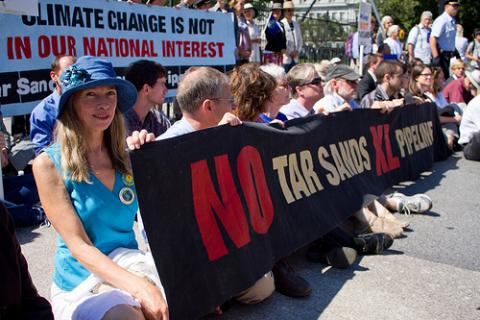
Raphael Cordray, co-founder of the Utah Tar Sands Resistance, explains that tar sands mining would be incredibly destructive in a number of ways, such as polluting water, lowering river levels and destroying diverse ecosystems. “There’s so much wild land in our state, and that’s something I’m proud of,” she said. “That’s our legacy. And it’s a treasure for the whole world. Some of these places they’re trying to mine are so unique that if more people realized they existed, they’d certainly be considered national parks.”
To catalyze mass resistance, the group plans to lead trips to the site. “Helping people experience the majesty of this land firsthand will show people how much is at stake, and move them to take a stronger stand,” said Utah Tar Sands Resistance co-founder Lionel Trepanier.
Together with activists from Peaceful Uprising and Living Rivers, Utah Tar Sands Resistance visited the PR Spring site two weeks ago, and members returned home ready to ramp up efforts to halt the mining. As a member of both groups, I went along on the trip, because I wanted to see firsthand what the land looked like and whether the mining company’s claims about the absence of groundwater were accurate.
As it turns out, they couldn’t be more false. Water has etched its presence into this land, leaving creek beds that may run low at times but never go away. And clearly, the area holds plenty of water to support the large herds of deer and elk, as well as the aspen, Douglas firs and pinyon pines that make up the dense forest covering much of the land.
This vibrant green scenery was juxtaposed by the two-acre strip mine just feet away from the forest’s edge. The difference between life and death could not have been more stark. Looking into the face of such destruction, I realized it’s no longer about saving the ecosystem, or saving our water — it’s about saving life on Earth. But that kind of effort isn’t possible without a broad movement behind it.
According to Lionel Trepanier, the groups working on this issue are looking to Texas’ Tar Sands Blockade as a model for building a broad coalition that includes “diverse groups of people like ranchers, hunters, the Indigenous community and climate justice activists.”
“I think we so often assume that someone won’t agree with us just because they seem different from us, when they could be our biggest ally,” said Cordray. “We’re committed to breaking down those barriers formed by fear of reaching out, and approaching people as human beings who need clean water and a healthy environment just as much as we do.”
While still in the first leg of its campaign to stop tar sands and oil shale mining, the group is reaching out with its teach-in and slideshow presentation to a wide range of outdoors retailers, religious communities and groups concerned about environmental quality in the city. When they handed out flyers and spoke with attendees at a recent Nature Conservancy film screening, they were surprised at how many people in the seemingly politically moderate, middle-class crowd were outraged at the prospect of tar sands mining coming to Utah.
“People are genuinely shocked this is happening,” said Trepanier. “They just want some direction, some guidance.”
After the Utah Tar Sands Resistance secures a vehicle to use for the trips, they’ll invite people at the teach-ins to attend, and will bring as many as possible to the site. They feel that being in nature together will break down barriers, helping them to see each other not as the labels society assigns them, but as human beings who are mutually dependent on the ecosystem, and on each other.
To raise awareness and empower people to join a coalition that ultimately aims to halt the destruction of tar sands and equally-destructive oil shale mining, Utah Tar Sands Resistance and Peaceful Uprising have been working together on creative methods of outreach. In April, they staged a flash mob dubbed Citizens’ Public Hearing in the office of the state agency leasing out public land for tar sands mining. Dozens of people flooded the office, where a woman playing an elementary school student announced that she had called a public hearing to expose the agency’s misguided decision to let state lands be destroyed. They also performed a similar street play, called Bringing Science Lessons to the Governor, outside the governor’s mansion when he held a luncheon to talk energy policy with four other Western governors.
Members are now building a “tar sands monster,” a Frankenstein-inspired creature who never wanted to be pulled from the earth to pollute the waters, which they believe will make an attention-getting mascot for their efforts. The activists also plan to use online videos of their theatrical endeavors as an outreach tool to get activists across the country thinking about joining them in their struggle when the time is right.
Uniting a diverse range of people such as activists, farmers, landowners and outdoor enthusiasts, many of whom may have not previously thought of themselves as activists, will be important, as this is only the beginning of proposed tar sands operations in the U.S. The state agency (School and Institutional Trust Lands Administration, or SITLA) that leased the PR Spring site to U.S. Oil Sands holds pockets of land scattered around the state, which it may lease for tar sands and oil shale mining.
The Bureau of Land Management is also considering leasing nearly 2.5 million acres of public land throughout Utah, Wyoming and Colorado for tar sands and oil shale mining. Much of this would overlap with indigenous land or is in close proximity to national parks and other protected areas.
In the meantime, Living Rivers will likely appeal the decision to let U.S. Oil Sands dump wastewater into the land. Its success, however, will be determined by the extent to which groups like Utah Tar Sands Resistance can educate and empower the general public. Such a base of support, like the one that has formed in Texas, will not only pose a challenge to fossil fuel interests, but also help to usher in a new era of environmental justice.
Update on Thursday’s Public Comment Opportunity to stop DNR auction of public lands for fracking
Last Thursday, we posted a story about this week’s Natural Resources Commission (NRC) meeting in Lansing and the opportunity for people to weigh in on the proposed October 24 auction of more public land for oil & gas extraction.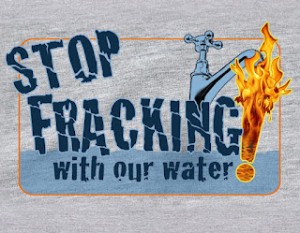
The group Citizens Against Drilling on Public Land Michigan has announced that due to so many peoples signing up for the public comment opportunity the Natural Resources Commission meeting has been moved.
The new location for the September meeting will be held at Lansing Center located at 333 E. Michigan Avenue in downtown Lansing – just a few blocks from the state Capitol.
Citizens Against Drilling on Public Land Michigan states, “The NRC is encouraging those addressing the commission on the same topic to designate a spokesperson to speak on behalf of the group. That spokesperson will be granted ten (10) minutes. All others not included in the group will now be limited to three (3) minutes each to allow maximum public input. Also attached is a copy of the Public Appearance Guidelines. Please bring 10 printed copies of your comments to hand out to the NRC commissioners.”
For more information contact Citizens Against Drilling on Public Land Michigan cadplmich@gmail.com.
For those interested in being part of any organizing against the October 24 DNR land auction you can contact the Grand Rapids group Mutual Aid GR at http://www.facebook.com/MutualAidGR.
Did Democratic delegates just vote down Obama bid to pander to AIPAC on Jerusalem?
This article by Ali Abunimah is re-posted from Electronic Intifada.
An extraordinary thing happened at the Democratic National Convention today. The official party platform for 2012 left out a reference that “Jerusalem is and will remain the capital of Israel” that was in the 2008 version.
Under pressure from the Israel lobby and the Republicans the Democratic leadership hastily moved to shove it back in on a voice vote that required a two-thirds majority. But to the stunned surprise of Los Angeles Mayor Antonio Villaraigosa who was chairing the convention, the “No” votes seemed to be louder, as the video above shows.
Shocked, Villaraigosa held the vote a second time, and then a third time. Each time it seemed the noes had it. Nonetheless, Villaraigosa declared that it had passed anyway. Loud booing could be heard. It’s an astonishing spectacle (see a longer version of the video from C-Span).
Obama intervened directly
Apparently, Obama himself intervened as JTA reports:
late Tuesday afternoon – after Republicans launched a full-force offensive criticizing the omission – the Democrats reversed course. Robert Wexler, a member of the platform draft committee, and a chief Jewish surrogate for the Obama campaign, credited President Obama for the change.
“They are returning the language to the 2008 situation,” Wexler told JTA late Tuesday. “The president directly intervened to make sure this amendment happened.”
But it seems ploy by Obama to pander to the Israel lobby has badly backfired. Gleeful Republicans are already circulating the video and spinning it as Democrats booing Israel.
Shower Israel with love and affection
Just this morning, in a New York Times oped, Israeli-American tycoon Haim Saban ostensibly defended Obama against Republican claims that Obama has “thrown allies like Israel under the bus.” Saban admiringly listed Obama’s unconditional financial, military and diplomatic largesse to Israel. But even after all that Saban – an Obama supporter – suggested that Obama “should have showered Israelis with more love and affection.”
That was in the morning. In the afternoon the Jerusalem debacle occured at the convention. I personally am uninterested in the GOP vs. Democratic aspect. I consider both parties indistinguishable on Israel and so many other issues. They are part of the same ruling establishment.
But ramming through AIPAC’s desires – despite an apparent no vote – was a neat summary of how US elites make decisions when it comes to Israel. Both parties are in a bidding war to appease Israel’s most extreme supporters at home and abroad. If this means riding roughshod over their own members, the American public, world opinion, international law and the basic rights of the Palestinian people, then so be it.
We can expect that in an effort to repair the damage from today, Obama’s big convention speech tomorrow night will shower Israel even more “love” than ever.
Obama’s history of pandering
For Obama, it is also nothing new. Despite elevated and unrealistic expectations that he would be different, I had warned as early as 2007 that Obama had surrendered any autonomy on Palestine to AIPAC.
JTA is revealing on how the platform is actually written in the first place – effectively under direct AIPAC supervision:
A Jewish official speaking on background said that at least three American Israel Public Affairs Committee officials were present during the entire period when the platform was drafted last month in Minneapolis. Other Democratic and Jewish officials confirmed AIPAC’s participation in the process.
There is another way
For those committed to justice in Palestine today’s events are a reminder that the road to justice does not go through the GOP the RNC or the DNC, but for us in the United States it goes through BDS – boycott, divestment and sanctions against an Israeli apartheid regime that has the full backing of US political elites.
Jerusalem, after all, and all of Palestine are not Barack Obama’s or Mitt Romney’s to auction off to the highest bidder.
Michigan Department of Civil Rights to host an LGBT anti-discrimination forum in Grand Rapids on Sept. 19
The Michigan Department of Civil Rights (MDCR) is partnering with the Community Relations Commission of Grand Rapids to host a public hearing on the issue of how anti-discrimination ordinances and the LGBTQ community.
The MDCR has already hosted forums in Jackson and in Holland, where hundreds of people came out to express their concerns and tell their stories about how they or someone they know who identifies as LGBTQ are still being discriminated against in Michigan.
The City of Grand Rapids passed an anti-discrimination ordinance to include some protections for the LGBTQ community in 1994, making it just the 10th city in the country to do so.
However, despite Grand Rapids having such an ordinance, people who identify as Gay, Lesbian, Bisexual, Transgender or Queer continue to be harassed, intimidated and discriminated against in a variety of ways. The public hearing on September 19 will provide an opportunity for those who are being discriminated against and those who are allies of the LGBTQ community to tell their stories.
According to a Media Release from the Grand Rapids CRC:
The event, co-sponsored by the Grand Rapids Community Relations Commission,
will take place at Grand Rapids Community College, DeVos Campus, Sneden Hall, Room 108, 415 Fulton SE, Grand Rapids, 49503 from 4 to 6 pm.
Both written and verbal testimony will be accepted. Follow this link to learn more about telling your story http://www.michigan.gov/documents/mdcr/ELCRAPrompt2012_385444_7.pdf.
To provide written testimony, please email it to calcagnor@michigan.gov before September 17, 2012. Please indicate if you would like to testify during the hearing.
If you want to attend the hearing and need an accommodation to do so, please notify MDCR at calcagnor@michigan.gov.
For more information on the Michigan Department of Civil Rights, visit www.michigan.gov/mdcr.
Opposition to fracking continues in New York with direct action
This article by Yvonne Taylor is re-posted from EcoWatch.
I am chained to a fence outside an Inergy facility near Watkins Glen, New York, and I am not alone.
We are protesting the gasification of New York. We don’t want fracking in this state (or any state), and we don’t like Inergy’s plans to build a gas storage hub in Seneca Lake salt caverns. 
We believe that:
1. Inergy’s plans are reckless and dangerous. Salt Cavern storage facilities are more accident prone than any other type of gas storage facility.
2. Even if nothing goes wrong, there will be plenty wrong. The Inergy project will change the character of our rural area by increasing the levels of traffic, noise and pollution. Just the pollution alone will kill people, and gas development will surely harm our existing winery, agricultural and tourism industries.
3. Inergy can’t be trusted. Inergy has been caught in so many lies and is keeping so many secrets that it has no credibility whatsoever. It cannot be relied on as a guardian of public safety.
4. The Inergy project is clearly meant to facilitate the fracking of New York, Ohio and Pennsylvania. We adamantly oppose fracking and consider it catastrophic folly. We want the Inergy project stopped because of its own lack of merit, and also as part of the larger effort to stop fracking.
5. We resent the fact that, even though we live here, we have been given no say in what happens to our area. We know, for example, that the DEC is keeping secrets for Inergy. And we know that the DEC sent proposed fracking regulations to the gas companies for review, before finalizing them and releasing them for public comment. No such opportunity was afforded to the industry’s opponents. We cannot remain silent while a demonstrably biased agency makes decisions behind closed doors that could forever change our way of life.
Stop the Sale of Mineral Rights for Fracking in Michigan
On Thursday, September 13th there will be a meeting of the Natural Resources Commission where the parcels of land being leased at the October 24th land auction will be discussed.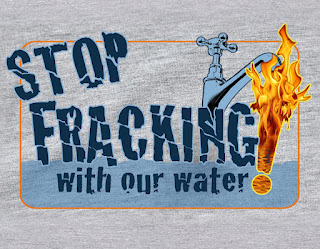
At this meeting, DNR Director Keith Creagh will be announcing his final decision on what state-owned mineral rights will be auctioned off in October. There will be an opportunity for public comment for people who oppose the public auctioning off of Michigan land for fracking or other fossil fuel extraction.
The meeting will be held at Lansing’s Diagnostic Center, located at 4125 Beaumont Road in Lansing, and anyone is allowed to give public comment starting around 3pm.
The group, Citizens Against Drilling on Public Land Michigan, is hoping to gather a sizeable group of people to speak their concerns about the consequences of the upcoming auction. The national organization Food & Water Watch has created an online mechanism for people to sign up to come to this meeting to give public comment.
At the September 13 meeting Citizens Against Drilling on Public Land Michigan also plans to present all the petitions and endorsements they have received over the past few months. For more information contact Citizens Against Drilling on Public Land Michigan cadplmich@gmail.com.
For those interested in being part of any organizing against the October 24 DNR land auction you can contact the Grand Rapids group Mutual Aid GR at http://www.facebook.com/MutualAidGR.
New Media We Recommend
Below is a list of new materials that we have read/watched in recent weeks. The comments are not a “review” of the material, instead sort of an endorsement of ideas and investigations that can provide solid analysis and even inspiration in the struggle for change. All these items are available at The Bloom Collective, so check them out and stimulate your mind.
The Nazis, Capitalism, and the Working Class, by Donny Gluckstein – This new book by Donny Gluckstein will challenge your perceptions about what were the primary ideological factors that drove the Nazi Party in Germany. Gluckstein’s thesis is that in addition to their hatred for Jews, the Nazi Party was motivated by their hatred of socialism, Marxism and organized labor. Hitler and the Nazi Party saw the German defeat in WWI, the Russian Revolution and the weakening of the country the fault of working class revolutionaries. The author tracks this ideological dynamic from WWI through the end of WWII, using numerous source materials, historical records, the German Press, Nazi Propaganda and other investigations to make a convincing argument that the Nazi belief in Capitalism was equal to their belief in anti-Semitism. An important contribution for the ongoing deconstruction of Nazi ideology and the growing collection of new anti-capitalist literature.

The Meaning of Freedom: And Other Difficult Dialogues, by Angela Davis – Few activist/scholars have the ability to bring an intersectional analysis to current freedom struggles the way Angela Davis can. This new collection of speeches from 1994 – 2009 offers a powerful display of intersectional analysis and a passionate plea for people to engage in the most pressing freedom struggles of our day. Davis addresses war, imperialism, neoliberal capitalism, the prison industrial complex, institutional racism, sexism, homophobia and heterosexism through this collection of essays. Whether she is talking about the US prison population, sexual assault, racial discrimination or poverty, Davis never hesitates to challenge our tendencies to look at issues through a single lens. Each speech is a weapon against privilege and together this collection of truth telling can help us dismantle power however it has manifest.
Partisanas: Women in the Armed Resistance to Fascism and German Occupation (1936 – 1945), by Ingrid Strobl – Common stereotypes of women during wartime relegate them to the sidelines of history—to supporting roles like dutiful munitions factory workers or devoted wives waiting for their men to return home. The truth is that much of the armed resistance to fascism, before and during World War II, can be chalked up to women about whom official accounts have little or nothing to say. Through years of intrepid research and numerous interviews with the participants themselves, Ingrid Strobl excavates the history of the women who shouldered guns, planned assassinations, planted bombs, and were among the era’s most active antifascist fighters. Strobl’s commitment to and respect for her subjects has resulted in a work of both scholarly rigor and emotional depth. Weaving moving personal narratives into the broader history of the European resistance, Partisanas is both a detailed historical account and an investigation into what compelled women to reject their traditional roles to take up arms in a fight for a better world.
A Burning Question: Propaganda & the Denial of Climate Change (DVD) – This fascinating and clarifying look at the debate surrounding global warming explores the striking disconnect between the relatively clear-cut concerns of the world’s most prominent scientists and the maze of speculation, rhetorical posturing, and outright misinformation that attaches to this issue whenever it’s taken up by politicians, PR specialists, and political pundits. Mixing a localized focus on Ireland with insights from scientists and leaders from around the world, the film serves as both a primer on climate science and a penetrating analysis of media framing and the science of perception management.
MLive invites you to discuss Obama’s speech with their experts – corporate investors and lobbyists
This morning, MLive posted an announcement about how the public can be part of a discussion after the President’s speech tonight at the Democratic National Convention.
The article states, “we want to hear what you and political experts on both sides of the aisle have to say.”
The panel of experts will include a few MLive reporters, but the three political strategists they have invited are Tom Shields of Marketing Resource Group; Joe Disano of Main Street Strategies; T.J. Bucholz of Lambert Edwards & Associates, and Greg McNeilly of The Windquest Group.
Looking at this line up it is clear what MLive considers as political strategists……..people who represent corporate interests as lobbyists, investors and people who work in the narrow world of money & politics.
The Marketing Resource Group claims to offer PR services, political consulting, marketing, advertising and crisis management. MRG’s history of political consultation was helping to elect John Engler, Candice Miller and according to their site. “Republican majorities in both the Michigan House and Senate.”
The client list for MRG is also instructive, with lots of casino and entertainment companies, along with the bottled water giant Nestle North America, environmental criminal Kennecott Minerals and the anti-gay legal group, the Thomas More Law Center.
Then there is Main Street Strategies, a political lobbying group based in Lansing. Their client list is pretty much just politicians, government entities and labor groups. I guess this would make them the other side of the aisle, since they disproportionately represent Democrats.
Main Street Strategies has a listing of some of their political lobbying campaigns, which includes the kind of ads the public loathes, attack ads. Knowing what they do makes their company tag line all the more ironic, since they claim to be “cutting through the clutter.”The Third expert is with Lambert Edwards & Associates, which promotes itself as a public relations, investor relations company. Their clients are mostly from the corporate world, such as Wolverine Worldwide, Biggby Coffee, Rubbermaid and Zondervan. However, Lambert Edwards & Associates has also represented the Grand Rapids Art Museum and the Michigan Department of Education.
The last expert or political strategist making up the MLive panel for tonight is Greg McNeilly of The Windquest Group. The Windquest Group is the public face that represents many of the DeVos family interests. McNeilly was part of the DeVos led attempt to alter local government through the group known as the One Kent Coalition.
It seems that the line up MLive has put together is made up of power brokers for corporate and government interests and not one of them represents the interests of working class people or issues like environmental protection, economic justice or racial, gender and LGBT equality.
This is what political pundits mean by both sides of the aisle, people who represent the two parties of the capitalist system. It’s as if another side or point of view doesn’t exist.
Profiting from the Global Food Crisis
This article is re-posted from ZNet. Editor’s Note: While this is article is about one company, it is indicative of neoliberal capitalism as a whole, which is based on profit making and not on human needs. See Raj Patel’s book “Stuffed and Starved.”
Barclays has made as much as half a billion pounds in two years from speculating on food staples such as wheat and soya, prompting allegations that banks are profiting handsomely from the global food crisis.
Barclays is the UK bank with the greatest involvement in food commodity trading and is one of the three biggest global players, along with the US banking giants Goldman Sachs and Morgan Stanley, research from the World Development Movement points out.
Last week the trading giant Glencore was attacked for describing the global food crisis and price rises as a “good” business opportunity.
The extent of Barclays’ involvement in food speculation comes to light as new figures from the World Bank show that global food prices hit an all-time high in July, with poor harvests in the US and Russia pushing up the average worldwide cost of staples by an unprecedented 10 per cent in a month.
The extent of just one bank’s involvement in agricultural markets will add to concerns that food speculation could help push basic prices so high that they trigger a wave of riots in the world’s poorest countries, as staples drift out of their populations’ reach.
Nor has the UK escaped rising food costs. Shop food prices have risen, on average, by 37.9 per cent in the past seven years, according to the Office for National Statistics, as the demands of an increasingly affluent and growing world population strain supply. Oils and fats have soared by 63 per cent in the UK during that period, fish prices by 50.9 per cent, bread and cereals by 36.7 per cent, meat 34.5 per cent and vegetables 41.3 per cent. In April, average UK food prices were 4.2 per cent higher than a year earlier.
Oxfam’s private sector adviser, Rob Nash, said: “The food market is becoming a playground for investors rather than a market place for farmers. The trend of big investors betting on food prices is transforming food into a financial asset while exacerbating the risk of price spikes that hit the poor hardest.”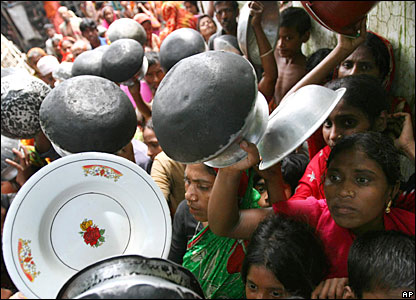
The World Development Movement report estimates that Barclays made as much as £529m from its “food speculative activities” in 2010 and 2011. Barclays made up to £340m from food speculation in 2010, as the prices of agricultural commodities such as corn, wheat and soya were rising. The following year, the bank made a smaller sum – of up to £189m – as prices fell, WDM said.
The revenues that Barclays and other banks make from trading in everything from wheat and corn to coffee and cocoa, are expected to increase this year, with prices once again on the rise. Corn prices have risen by 45 per cent since the start of June, with wheat jumping by 30 per cent.
Barclays makes most of its “food-speculation” revenues by setting up and managing commodity funds that invest money from pension funds, insurance companies and wealthy individuals in a variety of agricultural products in return for fees and commissions. The bank claims not to invest its own money in such commodities.
Since deregulation allowed the creation of such funds in 2000, institutions such as Barclays have collectively channelled an astonishing $200bn (£126bn) of investment cash into agricultural commodities, according to the US Commodity Futures Trading Commission.
Barclays’ dominance in commodities trading is thanks to its former chief executive Bob Diamond, who was Britain’s best-paid banking boss until he was forced to resign last month following a £290m fine for attempting to manipulate the Liborinterest rate. As boss of Barclays Capital he boosted trading in agricultural products.
Dealing with the reputational headache associated with high levels of food speculation will be yet another item in the already-bulging in-tray of Antony Jenkins, who was promoted to become Mr Diamond’s replacement on Thursday.
Christine Haigh, policy and campaigns officer at the World Development Movement and one of the analysts behind the research, said: “No doubt the UK’s biggest player in the commodities markets is hoping it will do better this year by cashing in on rising food prices. “Its behaviour risks fuelling a speculative bubble and contributing to hunger and poverty for millions of the world’s poorest people.”
Banks and hedge funds typically argue that speculation makes little or no difference to food prices and volatility and argue, correctly, that no definitive link has been proved. Barclays declined to comment on the amount of money it makes from trading in agricultural commodities yesterday.
The bank defended its actions, pointing out that trading in so-called futures contracts – an agreement to buy or sell a certain quantity of a product, at a given price on an agreed date – helped parties such as farmers and bakers to hedge against the risk of rising or falling prices. “Our clients include investment companies, food producers and consumers who, among other things, seek our help to manage risks.”
Barclays also declined to comment on whether it thought large amounts of speculation pushed up prices and volatility. A spokesman said: “We recognise there is a perception held by some stakeholders that participation in agricultural futures markets by some participants can unduly influence the prices of commodities. As a result, we continue to carefully monitor market trends and any research produced on this subject,” a spokesman said.”
Barclays Capital analysts admitted in a note to clients in February that speculation did push up prices. Barclays said: “The second key driver is that commodity investors have begun allocating to commodities again after beginning 2012 heavily underexposed to the sector.” The other drivers were the “health of the global economy” and “weather and geopolitics”.
 Grand Rapids Institute for Information Democracy