10 Facts Retailers Don’t Want You to Know About Online Shopping
This article is re-posted from ZNet.
When the news covers Cyber Monday every year, the focus is on sales and consumer spending – not the real cost to the workers who deliver all of those orders. The whole system is built on unsafe, low-paying, temporary jobs. Workers in U.S. shipping centers and warehouses that fulfill online orders for major retailers like Amazon.com and Walmart are subject to dangerous, sweatshop-like working conditions. These workers are consistently asked to work at unreasonable and backbreaking speeds, but they endure the pain because they’re afraid of losing their jobs. Get the real deal on online shipping:
1. Backbreaking pace of work: Workers in shipping centers who fulfill online orders are asked to grab items for boxes at unsustainably high speeds. In many cases, workers are required to collect 1,200 items in a 10-hour shift, or one item every 30 seconds.i If employees can’t keep up, they are disciplined or fired.
2. Marathon walking: Workers have to continuously cross great distances inside the massive warehouses. “Pickers,” who locate and collect items for shipping, reportedly walk on average between 12ii and 15iii miles every shift. Despite some items being football fields apart iv, workers are expected to maintain the same frenzied pace.
3. Extreme temperatures: Temperatures in warehouses are often extreme – either way too hot (120 degrees!v) or too cold. The warehouses can become literal sweatshops. Rather than slow the pace of work or provide air conditioning, last year Amazon executives arranged for paramedics to wait in ambulances outside its warehouse in Allentown, Pennsylvania, to treat all of the workers suffering from dehydration or heat stress.vi
4. Physical injuries: With a frenzied work pace, repetitive heavy lifting, constant walking, and extreme temperatures, many workers report being injured on the job.viiviii ix Many workers last less than six months at the job because of the grueling physical demands.x
5. Contractor curtain: Sweatshop shipping is such a secret now because many online retailers have grown adept at distancing themselves from the problem by hiding behind a “contractor curtain.” Retailers use a dizzying number of contract and temporary firms to hire employees to fulfill their orders – removing themselves from the responsibility of maintaining safe conditions on the job.xi
6. Expendable employment: Temporary employees at online warehouses lack job security because they are employed in an industry that thrives on disposable labor. New workers cost less than long-time employees, and often warehouses fire staff after only a few months. The high firing rate ensures no one knows how long his or her job will last.xii
7. Low wages: Temporary workers in warehouses on average make $3 less an hour than the permanent employees doing the same work.xiii Less than four percent of online warehouse workers in Illinois have health insurance. Sixty-two percent of these workers earn below the federal poverty line. More than one-third of them have to work a second job to pay the bills.xiv
8. Taxpayers forced to foot the bill: Without adequate wages and benefits, one in four workers requires government assistance, such as food stamps or welfare.xv As a result of online retailers not paying warehouse workers enough to make basic ends meet, taxpayers are forced to cover the difference.
9. No voice on the job: Today, workers face sizable obstacles and intimidation from their employer if they try to organize a union to improve working conditions on the job. Due to outdated labor law, temporary warehouse workers face the unrealistic challenge of organizing and overcoming resistance from both the retailer and the temp agency. Given the odds, temporary workers have little to no voice on the job and are extremely vulnerable to retaliation when they speak out.xvi
10. Wage theft: Many warehouse employees are paid on a “piece rate,” or paid per item rather than per hour. While the piece rate results in inconsistent paychecks for workers, it also leads to illegal wage theft as employers exploit workers, taxpayers, and competitors who play by the rules by paying less than minimum wage requirements, failing to pay workers proper overtime, and failing to pay adequate employment taxes. At a warehouse in Riverside, California, one employer racked up nearly half a million dollars in fines for failing to provide itemized wage statements to its employees.xvii
We can stop sweatshop shipping. Online retail is driven by customer demand for discount goods delivered within a day or two. We have to tell these retailers what we do want and will pay for: products from companies that deliver on good jobs by…
- Hiring enough workers to meet production demands and paying them fair wages and benefits.
- Ensuring working conditions are safe and reasonable.
- Taking responsibility as an employer by creating permanent jobs and hiring workers directly, so their employees have more rights, benefits, and security on the job.
This system won’t change until consumers stand up together and let online retailers know that we care more about how they treat their workers than the cheap discounts they’re offering.
This Cyber Monday, Say No to Sweatshop Shipping. Sign the pledge now > >
World AIDS Day 2012 events in Grand Rapids

There are several opportunities to learn about the issue of HIV/AIDS and what work is being done, both locally and nationally, at events in Grand Rapids beginning on December 1st.
World AIDS Day 2012 – The community to Reflect, React and Rejoices
Saturday, December 1
6:30PM
Fountain St. Church – 24 Fountain St., Grand Rapids
An evening of music and dance, along with information tables with resources available in West Michigan for HIV/AIDS. For more information go to http://www.facebook.com/events/546511018696839/.
World AIDS Day – featuring Jake Mossop
Saturday, December 1
8:00pm
Wealthy Theater 1130 Wealthy St. SE
The Grand Rapids Red Project is pleased to be welcoming Jake Mossop, from television’s “1 girl 5 gays,” to join us for an interactive discussion on the state of HIV/AIDS in the world today. For more information go to http://www.facebook.com/events/296663460443655/.
World AIDS Day at GVSU
Monday, December 3
Pew Campus:
noon: Todd Heywood — Criminalization of HIV/AIDS – 136E DeVos
2pm: Pam Lynch — Harm Reduction – 136E DeVos
6:00pm — How to Survive a Plague (film) – Loosemore Auditorium
Allendale campus:
noon: How to Survive a Plague (film) – Grand River Room – Kirkhof Center
All events are free and open to the public. For more information call 331-2530.
United in Anger – film
Wednesday, December 5
7:00PM
UICA – 2 West Fulton, Grand Rapids
Members free, non-members $5
GMOs in Mexico: A Crime Against Peasant And Indigenous Maize; A Crime Against Humanity
This article is based on a Media Release from Via Campesina.
In the next few days, the multinationals Monsanto, DuPont and Dow are expecting a positive response from the Mexican Government to sow 2.4 million hectares of GM maize in Mexico, a surface area equivalent to that of El Salvador. The situation is extremely alarming since Mexico is the world’s centre of maize diversity, with thousands of varieties in the fields of peasant and indigenous communities. Maize is currently one of the world’s three main food staples, so the contamination of Mexican maize by dangerous GMOs is a threat to the entire planet.
There are thousands of local varieties of maize in Mexico’s peasant communities, each one the product of different climates, soils, ecosystems and cultures. From Mexico, maize spread across the world, becoming one of the most important foodstuffs for many other peoples, especially in Southern Africa, Asia and all of Latin America. In recent decades, however, industry and the multinationals have also shown considerable interest in maize. They have developed hybrid varieties, dependent on pesticides and other inputs, which peasants must purchase. They have also developed GM maize varieties which today cover 51 million hectares across the globe.
“The situation is a matter of grave concern, since the Mexican Government is favouring the multinationals at the cost of peasant wellbeing and our health”, said Alberto Gomez, of Via Campesina Mexico. “For the past twenty years, the Mexican Government has been jeopardizing our food sovereignty by opening agriculture to free trade, flooding us with cheap, low quality maize and leaving thousands of peasants in poverty. Now they want to poison us with GM maize. We won’t allow it.”
Studies published recently in France show that GM maize could seriously damage health. These risks have not been properly assessed. In the French studies, rats which ate this maize suffered high incidences of cancer, with damage to their vital organs. In Mexico they want to sow, among others, the same variety of GM maize as that in the French studies, known as “NK 603”.
GM crops are, moreover, a violation of peasant rights. “All GM plants contaminate peasant crops, through genes patented by multinationals, and thus prevent peasants from using their own seeds. That is why in Europe we applied pressure to obtain laws which today ban GM plants from our fields and our food. In Europe and throughout the world we need to support the people of Mexico in their resistance to the multinationals. The wellbeing of everyone on the planet is at stake”, said Guy Kastler of Via Campesina France.
Via Campesina organizations throughout the world are united with Mexican civil society and men and women peasants, who oppose Monsanto’s demands and insist they be rejected. Organizations and citizens are encouraged to take action in their own countries to draw attention to the extremely irresponsible attitude of the Mexican Government. “We need to take action everywhere and denounce the fact that the attack on Mexican maize is an attack on all of humanity”, said Francisca Rodriguez of Via Campesina in Chile. “Native seeds are a treasure held by peasant and indigenous peoples. They are the only seeds which can feed the world in a healthy way, without the need for pesticides. They are the only ones whose diversity enables them to adapt to climate change. We cannot tolerate the loss of these seeds if they are contaminated by GM plants.”
Via Campesina calls upon its organizations to organize a major offensive and to remain alert. in the face of this offensive, we must mobilize in all countries: filing complaints at headquarters of the multinationals Monsanto, DuPont and Dow and with the governments that support them; filing complaints with bodies such as the FAO and the United Nations Convention on Biodiversity (CBD); pressuring Mexican embassies throughout the world; organizing demonstrations and other actions; disseminating the information through all possible media. The people and peasant communities of Mexico resist the multinationals. Reject this attack on life across the planet!
NO TO GM MAIZE! KEEP MONSANTO OUT!
GLOBALIZE STRUGGLE, GLOBALIZE HOPE!
Fracking the Great Lakes
This article by Lois Gibbs is re-posted from the Center for Health, Environment & Justice.
The Great Lakes hold 20 percent of the world’s fresh surface water. The good news is that legacy contaminants are decreasing more quickly than previously reported in three of the Great Lakes, but have stayed virtually the same in two other lakes, according to new research. Polychlorinated biphenyls (PCBs), the pesticide DDT and other banned compounds dropped about 50 percent in fish in Lakes Michigan, Ontario and Huron from 1999 through 2009, although there were no significant changes in Lakes Superior and Erie fish, according to the study to be published this month in Science of the Total Environment.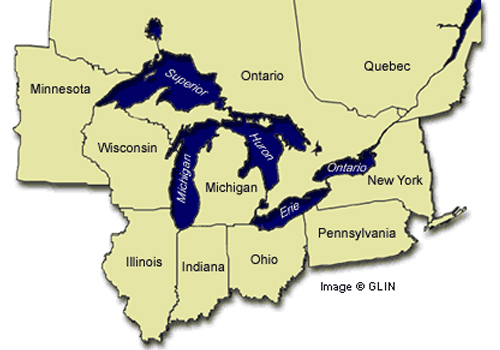
“These are very positive results. The lakes are improving and slowly cleaning themselves up,” said Thomas Holsen, co-director of Clarkston University’s Center for the Environment and co-author of the study. “Even with the decreases, it will be 20 to 30 years until the decades-old contaminants in Great Lakes fish decline to the point that consumption advisories can be eliminated,” Holsen said.
All good news, except as we clean up the old chemicals like Polychlorinated biphenyls (PCBs), the pesticide DDT and other banned compounds they are being replaced by newer ones, such as flame retardants that are building up in fish and wildlife and chemicals we are not yet even looking for from oil and gas development.
Today, the natural gas industry is beginning horizontal hydraulic fracturing all around the Great Lakes to extract gas. It is against the law to frack under the lakes but there are no laws about fracking near streams, creeks, rivers that empty into the lakes. This is insane. Hundreds of toxic chemicals are injected under pressure into the ground to fracture the shale formation. Not all of these chemicals are retrieved after the fracking is done. In fact the common gas well leaves behind about 30 percent of the chemicals, radioactive materials and brine. It’s unbelievable, hundreds of chemicals injected all around our fresh water lakes that both the U.S. and Canada have worked for decades to clean up.
This destructive activity is a prime example of governments’ tunnel vision. Oil and gas development moves forward, cleanup of the lakes moves forward, air deposited of chemicals from many sources continues. It’s like shoveling the sidewalk in a blizzard, it won’t be cleaned until the snow stops falling. There is no sign of the chemical blizzards retreat.
I grew up near the lakes in Buffalo and understand their beauty and value. My sister and brother-in-law were active in advocating the cleanup of the lakes in the 1970’s. Our family vacationed on the lakes. It was exciting back then to hear that a serious effort from both sides of the boarder would advance to make the lakes swimmable, the fish safe enough to eat and so many other promises. Now more than 35 years later reports are praising the cleanup of historical chemical deposits while at the same time new chemicals are allowed to enter the lakes without protest.
Fracking is not yet widespread around the great lakes. Yes there are some wells in Pennsylvania, Ohio and Michigan, but we can stop widespread fracking that would further contribute chemicals to our beautiful lakes by taking a stand and insisting that regulations are put in place and bans where necessary to protect this amazing gift of nature. It is up you and me to make it happen.
New Emergency Manager Bill introduced in the Michigan Senate
Less than a month after the Emergency Management legislation implemented by the Snyder Administration was defeated on Election Day, a new version of a similar policy has been introduced into the Michigan Senate.
According to Michigan Forward, one of the groups that was instrumental in defeating Proposal 1:
Michigan’s lame duck legislators in the Senate are working day and night to resurrect the dictatorship over 2.3 million voters rejected November 6. Senate Bill 865, introduced by Senator Phil Pavlov of St. Clair Township reintroduces policy that gives Governor Rick Snyder and private companies total control over school districts, cities and towns. Here’s more on the new dictator bill, SB 865:
· Reenacts PA 4 almost word for word
· Defines “consideration for local government input” by allowing them to propose an alternative to the recommendation of the Emergency Manager on only 3 issues (CBA abrogations or revisions , asset sales and borrowing) provided they have the same financial impact and provided the local government objects within 7 days and providedthey propose the alternative within 10 days of that only to have them likely ignored by the Local Emergency Financial Assistance Board: a 3 member board consisting of 3 cabinet members including the State Treasurer)
· An appropriation to avoid another referendum
To jump start a campaign to defeat this new legislative proposal, Michigan Forward has organized a lobbying day in Lansing on Wednesday, November 28. Michigan Forward is calling people to Lansing to meet with their state officals and demand that they not support SB 865. The event will kick off at 11:00 A.M. at Central United Methodist Church in Lansing (located 215 North Capitol Avenue — corner of Allegan and Capitol).
Media Alert: No More Media for Murdoch
This media alert is re-posted from Free Press.
Rupert Murdoch — the guy who’s under investigation in England for phone hacking, influence peddling and bribery — wants to get his mitts on the Los Angeles Times and the Chicago Tribune1,2. These are the major papers in the nation’s second- and third-largest cities (where, incidentally, Murdoch already owns TV stations).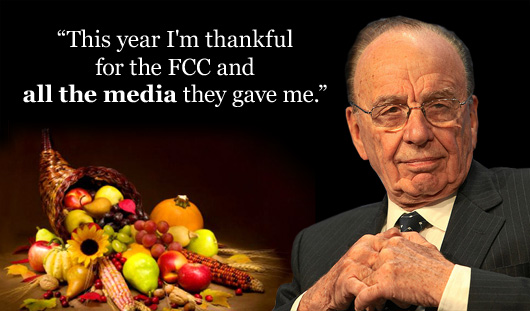
Federal Communications Commission Chairman Julius Genachowski is trying to change the agency’s ownership rules to pave the way for Murdoch to get exactly what he wants. Worse, Genachowski and Murdoch are keeping this all very hush-hush, hoping you won’t notice.3
These changes wouldn’t just benefit Murdoch. If the FCC proposal passes, one company could own the major daily newspaper, two TV stations and up to eight radio stations in your town. And that one company could be your Internet provider, too. What is the FCC thinking?!?
We can still stop the agency from taking this perilous step — but we have less than a month to do it.
By taking action, you’re joining a movement of millions who are working to stop big media from getting even bigger. Please take action today.
1. “Murdoch Eyes L.A. Times, Chicago Tribune,” Chicago Tribune, Oct. 20, 2012: http://articles.chicagotribune.com/2012-10-20/business/sns-rt-us-newscorp-tribune-labre89j0fm-20121020_1_murdoch-controls-news-corp-chairman-ceo-rupert-murdoch
2. “News Corp.’s Rupert Murdoch Is Said to Be in Early Talks to Buy the L.A. Times and the Chicago Tribune from Tribune Co,” Los Angeles Times, Oct. 19, 2012: http://articles.latimes.com/2012/oct/19/business/la-fi-ct-murdoch-newspapers-20121020
3. “FCC Proposes Loosening TV/Newspaper Cross-Ownership Ban … Again,” Nov. 14, 2012: http://www.broadcastingcable.com/article/490405-FCC_Proposes_Loosening_TV_Newspaper_Cross_Ownership_Ban_Again.php
Third Report Warns that Leaders’ Lack of Action Is Locking In Worst Consequences of Climate Change
This article is re-posted from the Union of Concerned Scientists.
A string of recent reports paints a clear picture that the world is not on track to fulfill leaders’ stated goal of limiting global warming to 2 degrees C (3.6 F) above pre-industrial levels, according to the Union of Concerned Scientists (UCS).
“The alarm bells scientists have been ringing for years are turning into a chorus,” said Alden Meyer, Director of Strategy and Policy at UCS. “World leaders set a goal of avoiding 2 degrees of warming, but the commitments they’ve made to meet that goal are inadequate. Without much more aggressive action, we will lose the fight to avert the worst consequences of climate change.”
A United Nations Environment Program (UNEP) report released today says that countries aren’t doing enough to keep the world from warming 2 degrees C above pre-industrial levels. Even if they met the most ambitious versions of current pledges, the report concludes, emissions of carbon dioxide and other greenhouse gases in 2020 will be about 52 gigatons (Gt) — some 8 Gt more than is needed to have a “likely” chance of keeping temperature increases below 2 degrees C. The gap could be as high as 13 Gt if more lenient assumptions about current pledges are used. For comparison, current emissions are about 50 Gt per year. This projected gap for 2020 is 2 Gt higher than in last year’s UNEP report.
“Not only are nations failing to close the gap between their actions and the 2 degrees goal,” Meyer said, “but the gap is actually widening.”
The UNEP report echoes two others: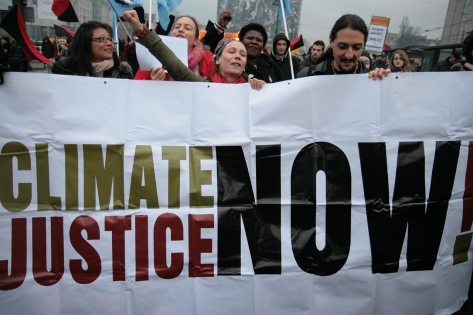
— Last week, the International Energy Agency’s World Energy Outlook 2012 concluded, “if action to reduce CO2 emissions is not taken before 2017, all the allowable CO2 emissions would be locked-in by energy infrastructure existing at that time.” The agency found that two-thirds of known fossil fuel reserves would have to stay in the ground to retain the possibility of limiting warming to no more than 2 degrees.
— Earlier this week, the World Bank issued a climate report that said without further action, “the world is likely to warm by more than 3 degrees C [5.4 F] above the preindustrial climate.” It further found, “Even with the current mitigation commitments and pledges fully implemented, there is roughly a 20 percent likelihood of exceeding 4 degrees C by 2100. If they are not met, a warming of 4 degrees C could occur as early as the 2060s.”
Exceeding a 2 degree C increase in global temperatures would exacerbate already evident effects of climate change, including ocean acidification, rising sea levels and coastal inundation, droughts, and more frequent and severe heat waves. The World Bank report, in particular, warns of the severe consequences for developing countries, including damage to coastal cities, water shortages and crop failure.
World leaders will again convene for a United Nations climate summit in Doha, Qatar later this month.
This article byJosh Eidelson is re-posted from Common Dreams.
HANOVER and SEVERN, MD—For about twenty-four hours, Walmart workers, union members and a slew of other activists pulled off the largest-ever US strike against the largest employer in the world. According to organizers, strikes hit a hundred US cities, with hundreds of retail workers walking off the job (last month‘s strikes drew 160). Organizers say they also hit their goal of a thousand total protests, with all but four states holding at least one. In the process, they notched a further escalation against the corporation that’s done more than any other to frustrate the ambitions and undermine the achievements of organized labor in the United States.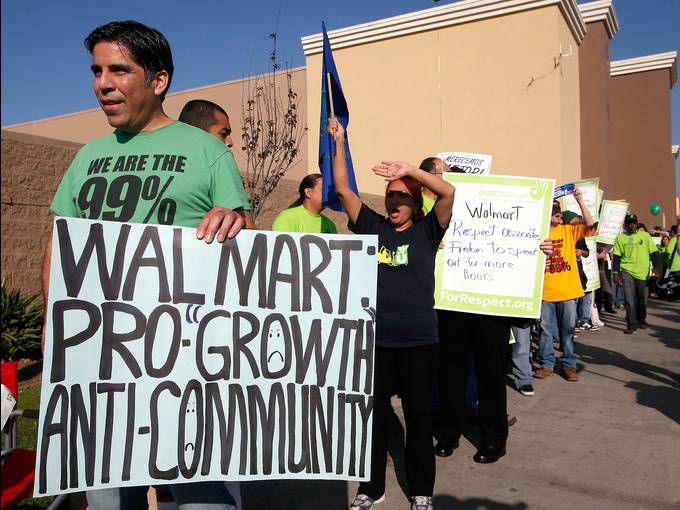
“I’m so happy that this is history, that my grandkids can learn from this to stand up for themselves,” Miami striker Elaine Rozier told The Nation Thursday night. Before, “I always used to sit back and not say anything…. I’m proud of myself tonight.”
Rozier and her co-workers kicked off the Black Friday strike around 7:30 EST Thursday night; it rolled from Miami through big cities like Chicago and smaller ones like Tulsa, where overnight stocker Christopher Bentley Owen, agitated by an intimidating “captive audience” meeting, decided at the last minute to join the organization and became his store’s sole striker. After holding back because he didn’t plan to stay in his job for long, said Owen, he recognized that millions of other low-wage workers offer the same reason not to get involved. “Meanwhile,” he said, “there are millions of people in those jobs…at some point, people have to get together.”
By 9 am Friday, Walmart had already sent out a statement announcing its “best ever Black Friday events,” claiming that only fifty workers were on strike, and dismissing the action as a failure. Organizers accused Walmart of making up numbers, and noted that the company’s aggressive efforts to discourage participation undermined its supposed indifference.
The Black Friday strike came a year and a half after retail workers announced the founding of the new employee group OUR Walmart, five months after guest workers struck a Walmart seafood supplier and seven weeks after the country’s first-ever coordinated Walmart store strikes. Walmart striker Cindy Murray, a veteran of the last decade’s unsuccessful union-backed campaign against Walmart, said that after the 2008 election, “I was like, we have to do something different.” (Strikes at Walmart certainly qualify.) Murray said OUR Walmart has had greater success because workers saw it “as our organization,” as so they “finally said, maybe we can be saved. Maybe we can speak out.”
Murray helped lead a Friday morning march of four-hundred some workers and activists to Hanover, Maryland’s Capital Plaza Walmart. Chants included “Whose Walmart? Our Walmart!,” and “Stand up! Live better!” At the edge of the Walmart-controlled portion of the shopping center’s parking lot, leaders from Jobs with Justice asked a manager to commit not to punish the workers striking today; they say he replied that Walmart won’t retaliate, said it never does, and denied that a corporate vice president’s warning of potential “consequences” constituted a threat.
Asked whether the retaliation would get worse before it gets better, United Food & Commercial Workers union Organizing Director Pat O’Neill called it “a real possibility” and said it “would be a mistake.” “I think the workers are showing,” added O’Neill, “that they’re not going to be silenced.”
Retaliation was an ever-present theme of the day: an outrage that drove some workers to strike, a threat that led many more to stay at work, a focus of workers’ demands, and a question hanging over next week. Allegations of illegal retaliation provided workers greater potential legal protection to strike; puncturing any sense of safety about striking may have been the motivation for Walmart’s Labor Board charge alleging that the strikes were themselves illegal. And Walmart’s tactics over the past week may have taken a toll: organizers said that 100 DC-area Walmart store workers struck this week, but maybe no more than a dozen on Black Friday itself (they chalked this up to workers’ desire to cause more disruption earlier in the week while products were still being unloaded). Paramount, California, striker Maria Elena Jefferson said that some of her co-workers wouldn’t strike because “they think we’ll never win” and “they didn’t want to lose their jobs.” She said she hoped today’s actions–including a rally of well over 1,000 supporters in Paramount–would change their minds.
The Paramount rally included the day’s only planned civil disobedience, with three Walmart retail workers and six other supporters taking arrest for blocking Lakewood Boulevard. Other tactics were more common across the country, including subversive light shows and mic-checking flash mobs.
The Maryland protesters split up after their rally into two groups: a larger one which leafleted and caroled at a store in Laurel (“I saw Walmart fire Santa Claus”, “Deck the aisles with living wages”) and a smaller group of community activists that headed to nearby Severn. There, about fifty people walked quickly through the garden section, to the front of the store, and launched a mic check, the crowd echoing an organizer from Jobs with Justice as she read from a prepared script: “We call on Walmart to change. We call on Walmart to stop bullying.” After being warned by police, the group turned and left, chanting “We’ll be back.”
The Maryland rally, like the overall campaign, had close ties to the UFCW; most of the Hanover marchers arrived on a half dozen buses that departed from UFCW Local 400’s nearby union hall. Felicia Miller, a UFCW member working at Safeway as a deli clerk, told The Nation that Walmart is driving down standards for new workers at her unionized store. “The young people coming in, pay stinks now because of Walmart…” said Miller. “Because our companies are saying, If Walmart can get away with it, why can’t we?” She said the sight of Walmart workers on strike was “awesome. I’m here to support them all the way.”
While some observers are already deriding the strike for failing to bring Walmart to its knees, worker activists and staff organizers have long been talking about it as an escalation, not a climax. While on the picket line Thursday and Friday, workers were already talking about striking again, and hoping that their courage this time would embolden more workers to join in the next. “There’s going to be more days that we’re going to strike,” Rozier said last night, “and it’s not going to stop. I’m not going to stop until they respect us and give us what we want.” That’s in line with what the UFCW’s Dan Schlademan promised earlier this month: “This is a new permanent reality for Walmart…. Two thousand and twelve is the beginning of the season where retail workers are going to start to stand up.”
As he marched towards the Hanover Walmart this morning, former SEIU organizer Stephen Lerner credited the campaign with showing that workers, through strategic use of strikes, “can engage in actions that both make them feel powerful and that impact the company, and they don’t need to just spend their life waiting for some [National Labor Relations Board] process to demonstrate they want a union.” Lerner, the architect of the Justice for Janitors campaign, added, “What they’re really showing is, they’re acting like a union.”
By 9 pm EST Friday, the day’s last major action, a picket in San Leandro, California, with a dragon puppet and a “brass liberation band,” had come to a close. The three workers who’d been arrested in the afternoon had made it safely home. Tomorrow, the Walmart strikers are headed back to work, with at least one exception: a San Leandro worker who wanted to strike but was scheduled for days off on Thursday and Friday. She’ll be striking tomorrow.
Many of us remember that awful we are the world music video from the 80s, along with all the tear-jerking images of suffering African people.
Much of that campaign and most “aid” projects are just another manifestation of the White Savior Complex. It is easy for us to engage in well-intentioned charity, since it allows us to ignore the root causes of injustice and suffering.
This paternalistic view of the world, and particularly of Africa, has not been overlooked by people who are often the objects of American paternalism. A new project designed to challenge Western paternalism, Africa for Norway, is an excellent resource that uses satire and sound analysis.
Here is what they have to say:
Imagine if every person in Africa saw the “Africa for Norway” video and this was the only information they ever got about Norway. What would they think about Norway?
If we say Africa, what do you think about? Hunger, poverty, crime or AIDS? No wonder, because in fundraising campaigns and media that’s mainly what you hear about.
The pictures we usually see in fundraisers are of poor African children. Hunger and poverty is ugly, and it calls for action. But while these images can engage people in the short term, we are concerned that many people simply give up because it seems like nothing is getting better. Africa should not just be something that people either give to, or give up on.
The truth is that there are many positive developments in African countries, and we want these to become known. We need to change the simplistic explanations of problems in Africa. We need to educate ourselves on the complex issues and get more focus on how western countries have a negative impact on Africa’s development. If we want to address the problems the world is facing we need to do it based on knowledge and respect.
WHAT DO WE WANT?
- Fundraising should not be based on exploiting stereotypes. Most of us just get tired if all we see is sad pictures of what is happening in the world, instead of real changes.
- We want better information about what is going on in the world, in schools, in TV and media. We want to see more nuances. We want to know about positive developments in Africa and developing countries, not only about crises, poverty and AIDS. We need more attention on how western countries have a negative impact on developing countries.
- Media: Show respect. Media should become more ethical in their reporting. Would you print a photo of a starving white baby without permission? The same rules must apply when journalists are covering the rest of the world as it does when they are in their home country.
- Aid must be based on real needs, not “good” intentions. Aid is just one part of a bigger picture; we must have cooperation and investments, and change other structures that hold back development in poorer countries. Aid is not the only answer.
New Media We Recommend
Below is a list of new materials that we have read/watched in recent weeks. The comments are not a “review” of the material, instead sort of an endorsement of ideas and investigations that can provide solid analysis and even inspiration in the struggle for change. All these items are available at The Bloom Collective, so check them out and stimulate your mind.
Philosophy for Militants, by Alain Badiou – This short little book is really a collection of three essays by French philosopher Alain Badiou, who was part of the French uprising in 1968. The commentary by Badiou is interesting and engaging, but does require some knowledge of other philosophical icons such as Plato, Hegel, Nietzsche, Heidegger and Satre. Badiou explores the relationship between philosophy and politics and contemporary democratic movements. The author also looks at the iconic image of the soldier/warrior, which is where the idea of militant comes into play in the title of the book. The book ends with sort interview with Badiou talking about the student uprising in Quebec. While some might think the book is too vague on politics, the ideas shared within prompt more questions and greater exploration of the relationship between politics and philosophy.
 White Supremacy, by Joel Olsen – This zine is one in a series of zines called the Lexicon Series and can be downloaded from AK Press. Olsen’s zine rightly reframes what is usually presented as racism to White Supremacy. The author provides important historical background on this theme in order to make the point that the classification of race was a creation of the early colonial power structure in North America, primarily as a means of pitting working people against each other. Olsen also acknowledges that multiculturalism and colorblindness are not adequate solutions racial injustice, since they fail to acknowledge White Supremacy as an integral part of all US institutions. In addition, the author makes the point that the abolitionist movement, which was the first major movement in the US, was really a movement to challenge White Supremacy. This early movement also had tremendous influence on the early labor and women’s movements, which is why the author points out the centrality of having an analysis of White Supremacy in doing radical social justice work. An important contribution for those doing the work on the ground and those wanting to do the work.
Sexual Decoys: Gender, Race and war in Imperial Democracy, by Zillah Eisenstein – Written during the later half of the George W. Bush administration, this book takes on the military industrial complex through a feminist lens. Like in her previous works such as Global Obscenities, Eisenstein takes on large policy issues from an intersection perspective of race, gender and violence. This analysis isn’t about just any form policy, but the policies of the US government, which Eisenstein identifies as imperialist. The author applies her analysis to the US War on Terror, the use of torture, military occupations and the push to privatize the military. Eisenstein also takes on the function of race, gender and sexual orientation in the US military, with an analysis that would apply equally today in the Obama administration. A well written and passionate exploration of the true nature of US militarism. Highly recommended.
ReGeneration: The Politics of Apathy and Activism (DVD) – Ryan Gosling narrates this engrossing film about social activism, the forces that galvanized the Occupy movement, and how a new generation of young people is coming to terms with a rapidly changing world. The film skillfully weaves commentary from some of the country’s leading political and social analysts with personal observations from a collective of young musicians, a tight-knit group of suburban high-school students, and a young conservative family, providing a nuanced look at the myriad challenges facing the next generation of Americans. The result is as personal as it is political, as much a portrait of the contemporary political scene as of a generation of young people finding their way in uncertain times. Features Noam Chomsky, the late Howard Zinn, Adbusters‘ Kalle Lasn, Andrew Bacevich, Amy Goodman, Talib Kweli, Sut Jhally, and music from STS9.
 Grand Rapids Institute for Information Democracy
