Until Housing is a Right, Blacks Will Live Marginalized Lives
This article by Glen Ford is re-posted from Black Agenda Report.
“The very notion that housing should be affordable to all – much less that housing is a right – has all but disappeared from major party political discourse.”
This year’s Martin Luther King Day report from United for a Fair Economy critiques U.S. housing policy, which has always been geared towards individual family home ownership. In recent decades, as Wall Street consolidated its political and economic dominance, government policy has been to treat housing as an asset whose value is to be constantly boosted; that is, housing as a wealth-building mechanism. It is a policy that ultimately serves the financial capitalists – a class that produces nothing, but grows more and more wealthy by manipulating the value of assets ever upward. Artificially inflating the price of housing also creates value against which homeowners can borrow – which is great for the banks but creates artificial bubbles in the economy that finally burst with catastrophic consequences.
In all of this mad, artificial wealth and bubble building, the very notion that housing should be affordable to all – much less that housing is a right – has all but disappeared from major party political discourse. United for a Fair Economy’s report, State of the Dream 2013: A Long Way From Home, puts housing policy at the center of what’s wrong with economic policy. Author Tim Sullivan says the steady “hemorrhaging of wealth in communities of color stems largely from treating housing policy as an asset-building policy.” Home ownership accounts for roughly half the total wealth of Black and Latino families, “but only 28 percent for white families,” who have other sources of wealth. The report urges that the government invest “in affordable housing and policies that reach people for whom homeownership is not the best or most viable option” – that is, renters, or forms of community-owned housing. Housing should be treated as a right, and housing policies must be informed by the realities of race.
If anything, the report is understated. In a pervasively racist society like the United States, race becomes an overwhelming factor. Race has shaped the social geography of the United States – and, therefore, the geography of wealth – as in no other modern society. Just as Black life is devalued in the criminal justice system, so the very presence of Blacks devalues the surrounding land and structures, in terms of market price. Race – and by that, I mean white racism – distorts and deforms this country’s market system, lowering the value of assets based on their proximity to concentrations of Black people, and artificially boosting the value of land and buildings that are located at a distance from Black neighborhoods.
Informal racial redlining remains probably the most powerful pricing mechanism in the American real estate market. One can cross an invisible line from a largely Black and brown city to a mostly white town, and the property values immediately soar upward, regardless of the quality of the actual houses. Urban development schemes pre-suppose the breaking up or clearing out of Black population concentrations before any economic revitalization is even attempted. Public housing has been marked for extinction, based, at root, on the assumption that concentrations of Black people are bad for business and for society. These facts of American life require that Blacks demand that affordable housing be provided as a right, not as something that trickles down. Otherwise, African Americans will remain marginalized people living on marginalized properties.
This article by Marion Nestle is re-posted from EcoWatch.
Who knew that Wednesday’s New York State Supreme Court hearing on the lawsuit filed against New York City’s cap on sodas larger than 16 ounces would turn out to be a debate about race relations?
Let’s be clear. This lawsuit is about only one thing and one thing only: to protect the profits of Big Soda—mainly, Coca-Cola and PepsiCo. The lawsuit is funded by their trade association, the American Beverage Association (ABA), at what must be astronomical expense.
But to shift attention away from profit as a motive, the ABA enlisted two organizations of underrepresented groups—the NAACP and Hispanic Federation—to file an amicus brief on behalf of the soda companies. The brief argues that the soda cap discriminates against citizens and small-business owners in African-American and Hispanic communities. But it neglects to mention that both “friends of the court” received funding from soda companies.
The financial arrangements between Big Soda and such groups demand further examination. Fortunately, we have Michael Grynbaum at the New York Times, who explains that:
The obesity rate for African-Americans in New York City is higher than the city average, and city health department officials say minority neighborhoods would be among the key beneficiaries of a rule that would limit the sale of super-size, calorie-laden beverages.
But the N.A.A.C.P. has close ties to big soft-drink companies, particularly Coca-Cola, whose longtime Atlanta law firm, King & Spalding, wrote the amicus brief filed by the civil rights group in support of a lawsuit aimed at blocking Mr. Bloomberg’s soda rules…Coca-Cola has also donated tens of thousands of dollars to a health education program, Project HELP, developed by the National Association for the Advancement of Colored People. The brief describes that program, but not the financial contributions of the beverage company. The brief was filed jointly with another organization, the Hispanic Federation, whose former president, Lillian Rodríguez López, recently took a job at Coca-Cola.
Soda companies have a long history of targeting their marketing efforts to Blacks and Hispanics, as shown in at least one book (and described in one of its reviews).
Last fall, the East Bay Express exposed how the soda industry exploited race issues and used them to divide and conquer in defeating the Measure N soda tax initiative in Richmond, California.
The No on Measure N workers’ paychecks were signed by political consultant Barnes Mosher Whitehurst Lauter & Partners (BMWL), which had been hired by the American Beverage Association … By the time that Big Soda had arrived, the issue of race was already a factor in the campaign. Some opponents of the tax had alleged that it was racist, arguing that it would unfairly harm low-income residents in the city. And the No on Measure N campaign … nurtured that sentiment. Indeed, there is evidence that the beverage association helped keep race at the forefront of the campaign as part of a strategy that exploited Richmond’s existing tensions.
… the beverage industry discovered a winning formula in Richmond last year that it might be able to replicate elsewhere … And if that were to happen, it could drive a wedge through traditional Democratic constituencies in many communities, with blacks and Latinos opposing their longtime political allies—progressives and environmentalists—just like they did in Richmond.
Is a cap on soda sizes discriminatory? Quite the contrary.
Public health measures like this are about removing health disparities and giving everyone equal access to good nutrition and health. This makes public health—and initiatives like the soda cap—democratic, inclusive, and anything but elitist.
But I can’t think of anything more elitist, less inclusive and more undemocratic than suing New York City over the soda cap.
In funding this suit, the soda industry has made it clear that it will go to any lengths at any cost to protect its profitability—even to the point of dragging along with it the very groups that would most benefit from the initiative.
If the American Beverage Association and its corporate members really cared about Black and Hispanic groups, it would stop target marketing, stop marketing to children and stop pretending that sugar-sweetened beverages are an important part of active, healthy lifestyles. It certainly would stop wasting these groups’ time and credibility on anti-public health lawsuits.
New Film Captures Egypt’s Ongoing Revolution After Mubarak’s Fall
This video is re-posted from Democracy Now!
As Egyptians mark the second anniversary of the Egyptian revolution, we look at a new documentary that captures the ongoing protest movement in Egypt well after the downfall of Hosni Mubarak.
“The Square” follows a group of activists as they risk their lives in the uprising that ousted Mubarak only to face further threats under the transitional military regime. We’re joined by the film’s Egyptian-American director, Jehane Noujaim, at the Sundance Film Festival in Park City, Utah. Noujaim’s previous work includes the famed Al Jazeera documentary, “Control Room.”
Obama’s Unprecedented Number of Deportations
This article by Tanya Golash-Boza is re-posted from CounterPunch.
Between 1892 and 1997, a total of 2.1 million people were deported from the United States. A change in laws in 1996 permitted the number of deportees to increase from 70,000 in 1996 to 114,000 in 1997. In 1998, the number of deportees rose to 173,000. The numbers stayed fairly steady until 2003, when the creation of the Department of Homeland Security (DHS) infused more money into immigration law enforcement and 211,000 people were deported. From there the numbers have continued to rise – peaking at just over 400,000 in 2012.
These numbers are unprecedented: by 2014 President Obama will have deported over 2 million people – more in six years than all people deported before 1997. However, there is more to this trend than these numbers. The content of policies has also changed. There have been relatively low numbers of returns as compared to removals, a reflection of a focus on interior enforcement. There has been a shift towards the deportation of convicted criminals. With these trends, unprecedented numbers of people have been separated from their families in the United States. Obama has not only deported more people than any President; he also has separated more families by focusing on interior enforcement.
More Removals than Returns
Under the Obama administration, immigration enforcement has shifted from the border to the interior. The ratio of returns to removals reflects this shift – as returns are a border enforcement mechanism.1 “Returns” occur when a Border Patrol agent denies entry, whereas a “removal” involves a non-citizen attending an immigration hearing or waiving the right to a hearing—as in an expedited removal. In 1996, there were 22 times as many returns as removals. This ratio has dropped continuously, and in 2011, for the first time since 1941, the United States removed more people than it returned.
How has ICE been able to achieve a marked increase in removals?
Removals are carried out by immigration law enforcement officers who work in two branches of the Department of Homeland Security (DHS): Customs and Border Patrol (CBP) and Immigration and Customs Enforcement (ICE). Since 2008, we have witnessed a shift towards more ICE apprehensions. In 2002, ICE apprehensions accounted for 10% of all DHS apprehensions. By 2011, that figure was nearly 50%.
In Fiscal Year 2011, immigration law enforcement agents apprehended over half a million non-citizens. For the first time, ICE apprehended nearly half of them: just over 300,000. The decrease in Border Patrol apprehensions is due to the fact that fewer people are crossing the border illegally. Deportations have continued to rise because ICE has enhanced its efforts in the interior of the United States. This has happened in two ways: 1) funding for programs targeting criminal aliens has skyrocketed; and 2) increases in Police/ICE cooperation. ICE can’t do this alone. There are only 20,000 ICE agents nationwide, with only 5,000 actively employed in enforcement and removal operations. To achieve 400,000 deportations, ICE has to rely on Border Patrol apprehensions and police arrests. As Border Patrol apprehensions decrease, ICE increasingly relies on local law enforcement.
Focus on Criminal Deportations
President Obama’s focus has been not only on deporting more people, but deporting more immigrants convicted of crimes. There are four programs designed to locate criminal aliens: Criminal Alien Program (CAP), Secure Communities, 287(g), and the National Fugitive Operations Program (NFOP). Congress appropriated $690 million for the four programs in 2011 – up from $23 million in 2004. This funding led to an increase in arrests through these programs from 11,000 to 289,000 during that time.
The Criminal Alien Program is the largest of the four programs. In FY 2011, ICE issued 212,744 charging documents for deportation through the Criminal Alien Program (CAP). In that same year, 78,246 people were removed through Secure Communities, a program where the FBI automatically sends the fingerprints of people arrested to DHS to check against its immigration databases. 287(g) is a program that allows state and local law enforcement agencies to act as immigration law enforcement agents within their jurisdictions. I don’t have 2011 data on 287(g), but in 2010, 26,871 people were removed through 287(g). Only about 1500 were removed through NFOP. Much of the attention on Police/ICE cooperation has been on Secure Communities and 287(g), yet the vast majority of removals are occurring through the Criminal Alien Program.
Mostly minor offenses
Many of these criminal deportees are deported after a minor criminal conviction. In 2011, 188,382 people were deported on criminal grounds. Nearly a quarter were deported after a drug conviction, another 23% for traffic crimes, and one in five for immigration crimes. The DHS does not get very specific about these convictions, but we do know that drug crimes include marijuana possession; traffic crimes include speeding; and immigration crimes include illegal entry and re-entry.
It is likely that large numbers of people apprehended through the Criminal Alien Program are minor drug offenders and immigration offenders. Additionally, it is likely that the Criminal Alien Program is tearing apart families. One study found that, on average, people deported after being convicted of a crime had lived 14 years in the United States.
Family Ties
There has been an increase in the number of deportees who have family ties in the United States. Between July 1, 2010, and Sept. 30, 2012, nearly a quarter of all deportations—or, 204,810 deportations—involved parents with U.S. citizen children. This is remarkable, as a previous report found that DHS deported about 100,000 people who had U.S. citizen children in the ten years spanning 1997 and 2006.
Is there a relationship between interior enforcement and the focus on criminals?
We have seen a concurrent increase in the deportation of people convicted of crimes and of people with US citizen children being deported. Are these two factors related? The answer to this question may be an obvious “yes,” but I’d like to be able to speak more concretely about this in order to assess the consequences of deportations under the Obama administration.
ICE field offices
We can address this question by looking at ICE field offices that deport people. There are 25 ICE field offices responsible for deportations. Of these, five include jurisdictions along the southern border: El Paso, Houston, Phoenix, San Antonio, and San Diego. The remainder operate in the interior of the United States. Immigrant detainees may be transferred from office to office, so this is far from a perfect measurement. However, a look at ICE field office activity can reveal some important trends.

CAP and ICE offices
In FY 2011, there were 396,906 deportations. Of these, 208,940 were from the five southern border jurisdictions. The remaining 187,966 were from other field offices without a southern border. The percentages are similar for 2010 and 2009.
Many of the people deported from the five southern border jurisdictions were living in those areas, but many were also recent border crossers. And, even those recent border crossers may have previously lived in the United States returning to be with their families. In FY 2011, 45,938 of the people deported were recent border crossers who were removed, as opposed to simply returned.
Whereas deportations are concentrated in the southern field offices, this is not the same for the Criminal Alien charging documents. For example, in 2011, 36,195 people were deported via the El Paso office. In that same year, there were only 4429 CAP charging documents issued in El Paso – a ratio of 0.12. Compare that to New York City, where 3,522 people were deported, yet 7267 CAP charging documents were issued – a ratio of 2.09.

The overall ratio of CAP charging documents to removals in FY 2011 was 0.53. The ratio for the five southern border field offices was an average of 0.23. The average for the remaining field offices was 0.87 – nearly a 1 to 1 ratio. This difference between the southern border field offices and the others points to a crucial distinction in deportations: relatively speaking, CAP is much more active in the interior of the United States. Since the vast majority of criminal deportees are found through CAP, it is fair to say that criminal deportations are more likely to affect immigrants living in the United States.
Conclusion
This brief analysis provides some evidence that the focus on criminal deportations has led to enhanced interior enforcement, and that this in turn is the reason so many parents of U.S. citizens are being deported. It would be useful to get a handle on how and why enforcement has changed. One of the most important changes appears to have happened in 2008, when ICE apprehensions shot up from 84,000 to 320,000. What happened within ICE to provoke this change?
Many pro-immigrant Obama supporters would like to know if the unprecedented numbers of deportations that have happened under his watch are due to his actions or to those of Congress or other parties. The most marked changes appear to have happened in 2008, the year before Obama was elected. However, President Obama has chosen to continue on the path set by the Bush administration. For example, President Obama appointed Janet Napolitano as Secretary of DHS, and she has made it her mission to achieve a quota of 400,000 deportees a year, even as fewer immigrants have come to the United States illegally. Obama has made it clear that he wants DHS to focus on criminal deportations. This commitment has led to increased Police/ICE cooperation, which has torn millions of immigrants from their homes.
Protestors Confront Gov. Snyder outside of Amway Grand Plaza Hotel
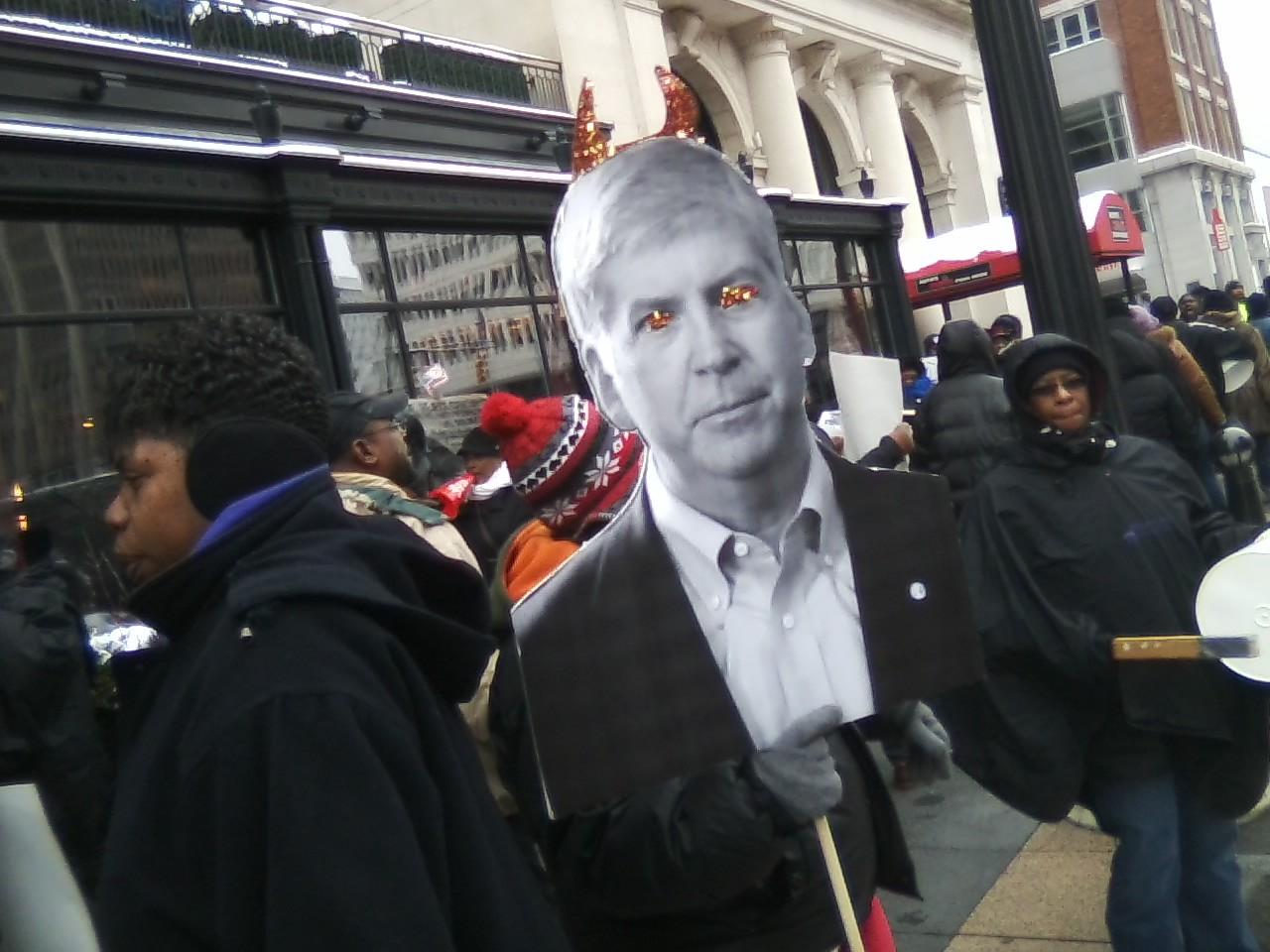
Earlier today, about 100 people from Detroit travel to Grand Rapids to confront Michigan Governor Rick Snyder over his economic policies, particularly the recent Right to Work law.
The group organizing today’s protest was Good Jobs Now, a group that was formed in April of 2011. According to their website, Good Jobs Now is a broad coalition of community groups, faith leaders, concerned citizens and the labor sector that is committed to solving the issues facing our neighborhoods and holding decision makers and elected officials accountable for creating jobs and finding solutions to these problems.
Some of the protestors went inside the Amway Grand Plaza Hotel with sign and noisemakers, which resulted in Grand Rapids Police officers showing up immediately to make sure people did not “disrupt” the patrons in the hotel.
The cops tried to talk to protestors, but people just kept chanting and ignoring the police, while marching in front of the hotel.
Amway security were posted inside the front doors to prevent protestors from coming in and when asked about what they thought of the protestors, they told refused to respond.
We did talk to one representative from Good Jobs Now about what brought them to Grand Rapids today. According to Kimland Terry, Gov. Snyder was in Grand Rapids for a couple of weeks to participate in the Auto Show and was staying at the Amway Grand Plaza Hotel.
The Governor has slashed taxes for 2% of the wealthiest in the state, while working class and middle class families had been forced to share a bigger portion of the financial burden facing this state.
It is out intent to either ride him out of state or to vote him out of office, but either way we are committed to winning justice for our communities, said Mr. Terry.
The Good Jobs Now protestors were an almost exclusively African American group today, with little evidence that West Michigan people were in attendance, despite a Facebook posting about the action.

Workers respond to management abuse by forming new union at Star Tickets in Grand Rapids

On Wednesday, employees at Star Tickets in Grand Rapids, announced they are formally a union with the Industrial Workers of the World (IWW).
According to their Press Release they have “walked on the boss” today demanding a reduction in workload, an employee grievance procedure, and recognition of their union. The employees have formed the IWW Star Tickets Workers Union for mutual support and respect on the job. Their intentions are to begin collective bargaining with owner, Jack Krasula, over a work environment that they say has become untenable.
“We are just exercising our legal right to form a union for our mutual benefit” said Deirdre Cunningham, a Client Services Representative. “We have been meeting, assisting one another, and acting as a union for some time so today we made it official to our boss.”
Star Tickets, which is located at 620 Century Avenue Southwest #300, becomes the second Grand Rapids establishment whose workers have joined the Industrial Workers of the World labor union in just over a year. Workers at Bartertown Diner, 6 Jefferson St., all joined the IWW in 2011.
“During my time here Mr. Krasula has routinely sent us his insights and anecdotes for success. We hope that he will respect our choice and work with us in affecting the context of our daily lives ” said Alisa Stone.

The owner of Star tickets, Jack Krasula, who has operated several large business operations and has substantial personal wealth, also has his own radio show in the Detroit area, which offers a daily dose of his own personal philosophy on life. It seems that Krasula doesn’t believe in applying those same principles to those he employs.
On Wednesday, the workers filed with the National Labor Relation Board, but as of today there has been no overt reaction from the company to their announcement of becoming an IWW workplace.
The newly formed union – IWW Star Tickets Workers Union – has created a Facebook page, where they plan to post updates and welcome comments of solidarity.
Aquinas screening new film on slain Salvadoran Bishop Oscar Romero
On Friday, January 25th, the Student Social Action Committee is hosting a screening of a new documentary on the life of Salvadoran Archbishop Oscar Romero.
In El Salvador in the late Seventies, one man was the voice of the poor, the disenfranchised, and the Disappeared – all struggling under the corrupt Salvadoran government. Appointed Archbishop in early 1977, Monseñor Óscar Romero worked tirelessly and in constant personal peril until the day he was assassinated in March 1980.
Romero broke off ties with the military and aligned himself with the poor, delivering messages of hope in weekly sermons which became national events. Encouraging direct action against oppression, Romero’s speaking impacted political events in El Salvador that still have meaning to this day.
With rare recordings and film footage from Romero’s own collection and a wide range of interviews from those whose lives were changed by Archbishop Romero, including church activists, human rights lawyers, former guerrilla fighters and politicians, Monseñor: The Last Journey of Óscar Romero is a timely portrait of one individual’s quest to speak truth to the rich and powerful forces which dominated his government.
Monsenor: The Last Journey of Oscar Romero
Friday, January 25
7:00 PM
Aquinas College: Loutit Room Upper Wege
This event is free and open to the public.
Are America’s Nutrition Professionals in the Pocket of Big Food?
This article by Dave Murphy is re-posted from EcoWatch.
Ever have that creeping feeling that those in charge of watching over our food supply or making recommendations about what constitutes a healthy diet have lost their way? Sadly, the Academy of Nutrition and Dietetics’ looks like it has fallen sway to big money corporate contributions and sponsorships from Big Food like junk food giants Coke, Pepsi and Nestlé.
Public health attorney and author Michele Simon asks: Are America’s nutrition professionals in the pocket of Big Food? While the Academy of Nutrition and Dietetics’ 74,000-member trade group partners with the likes of Coke and Hershey’s, the nation’s health continues to suffer from poor diet.
The largest trade group of nutrition professionals—the Academy of Nutrition and Dietetics—has a serious credibility problem. In a damning report released yesterday, industry watchdog Eat Drink Politics examines the various forms of corporate sponsorship by Big Food that are undermining the integrity of those professionals most responsible for educating Americans about healthy eating.
The report details, for example, how registered dietitians can earn continuing education units from Coca-Cola, in which they learn that sugar is not a problem for children and how Nestlé, the world’s largest food company can pay $50,000 to host a two-hour “nutrition symposium” at the Academy’s annual meeting. Additional disturbing findings from the report include:
- Beginning in 2001, the Academy listed 10 food industry sponsors; the 2011 annual report lists 38, a more than three-fold increase;
- Companies on the Academy’s list of approved continuing education providers include Coca-Cola, Kraft Foods, Nestlé and PepsiCo;
- At the 2012 annual meeting, 18 organizations—less than five percent of all exhibitors—captured 25 percent of the total exhibitor space. Only two out of the 18 represented whole, non-processed foods;
- The Corn Refiners Association (lobbyists for high fructose corn syrup) sponsored three “expo impact” sessions at the 2012 annual meeting;
- A majority of registered dietitians surveyed found three current Academy sponsors “unacceptable” (Coca-Cola, Mars, and PepsiCo);
- 80 percent of registered dietitians said sponsorship implies Academy endorsement of that company and their products;
- The Academy has not supported controversial nutrition policies that might upset corporate sponsors, such as limits on soft drink sizes, soda taxes, or Genetically Modified Organisms (GMO) labels;
- Sponsors and their activities appear to violate the Academy’s own sponsorship guidelines.
Among the report’s recommendations are for the Academy to:
1) provide greater transparency on corporate funding sources;
2) gather input from all members on corporate sponsorship;
3) reject all corporate-sponsored education; and
4) provide better leadership on controversial nutrition policy issues.
Registered dietitian and academy member Andy Bellatti, who has long criticized his professional group’s conflicted corporate sponsorships said:
Michele Simon’s report on the Academy of Nutrition and Dietetics is thoroughly researched and expertly points out the different ways in which the nation’s leading nutrition organization harms its reputation, efficacy and members by forming partnerships with food companies that care more about selling products than they do about improving the health of Americans. Anyone concerned about public health will realize that the Academy of Nutrition and Dietetics is in dire need of systemic change if it hopes to take a leadership role and be taken seriously as the home base of the nation’s nutrition experts.
MLive reported yesterday that two West Michigan companies have received contracts from a major project being undertaken by the largest oil company in the world, Exxon/Mobil.
Dooge Veneers Inc. and Herman Miller have both landed contracts with Exxon/Mobil, which is building a massive company campus near Houston, Texas.
The MLive story talks about the significance of these contracts, particularly with spokesperons from Dooge Veneers Inc, which is procuring wood from around the world to be used for walls in the new Exxon/Mobil campus.
The spokesperson for Dooge Veneers Inc. talks with enthusiasm about this new contract and Herman Miller’s CEO Brian Walker says this is “one of the largest contracts” the Zeeland company has ever had.
All of this seems pretty straight forward, with the local news media celebrating the financial gains that two West Michigan companies are making from this project. So what’s the problem?
The problem is that the corporation that the West Michigan companies have contracts with is quite possibly the single largest private contributor to climate change.
Exxon/Mobil is the largest global petroleum company that operates in over 100 countries, has a long history of colluding with dictators, destroying ecosystems around the world and spending millions to influence public policy.
Steve Coll’s book Private Empire: ExxonMobil and American Power is an excellent source that exposes the kind of power this global company has. We are all familiar with the environmental devastation from the Exxon Valdez oil disaster off the coast of Alaska, a disaster that the company tried to blame on the ship’s captain.
However, the more egregious crimes committed by Exxon/Mobil is its contribution to global warming. The company is the largest extractor of oil and gas in the world, but in addition to their role in creating climate change, which impacts all life on this planet, the company has vigorously funded think tanks to deny climate change is even an issue.
Expose Exxon has documented the amount of money and institutions that the petroleum giant has contributed to in order to promote the idea that climate change is a hoax.
The level of violence done by Exxon/Mobil to human and non-human life is difficult to quantify, but it is one of the most dangerous corporations on the planet that makes billions while the world is on the brink of ecological catastrophe.
The question we should ask ourselves is, how is it that the major news media continues to treat one of the biggest environmental criminals on the planet as it was a good global citizen?
New Media We Recommend
Below is a list of new materials that we have read/watched in recent weeks. The comments are not a “review” of the material, instead sort of an endorsement of ideas and investigations that can provide solid analysis and even inspiration in the struggle for change. All these items are available at The Bloom Collective, so check them out and stimulate your mind.
A Secret History of Coffee, Coca & Cola, by Ricardo Cortez – This 40 – paged book is a gem. Not only does the author include fabulous illustrations about the recreational narcotics millions consume, but a beautiful literary approach to sharing information about these substances. However, what makes this book so fabulous, is that it provides new information about recently discovered documents. These documents show a long standing relationship with officials from Coca Cola and the US Federal Bureau of Narcotics, which not only resulted in domestic drug policies, but international anti-narcotics treaties adopted by the United Nations. These agreements essentially made coca production illegal by anyone, with one exception…….the Coca Cola Company. It is not surprising information, but should provide further evidence of the sinister nature of the largest global beverage company and why they should be despised by everyone with a conscience. Not your average coffee table book.

Power Systems: Conversations on Global Democratic Uprisings and the New Challenges of US Empire, Interviews with Noam Chomsky – by David Barsamian – This is the latest collection of interviews between Chomsky and Barsamian and they are as fresh and dynamic as the ones between these two that were done 20 years ago. Covering a two-year period from Spring of 2010 through Spring of 2012, these interviews deal with the Arab Uprising, the US Occupy Movement, organizing, the Obama administration, the Middle East, Latin America and Southeast Asia. Chomsky and Barsamian have a long-standing relationship, which makes the interviews flow and easier to follow. Like much of what Chomsky has to say, I found this collection of interview inspiring and intellectually stimulating.
Our Food, Our Right: Recipes for Food Justice, published by the Community Alliance for Global Justice – The book was a community project that involved dozens of people who are passionate about food and food justice. If you are looking for a great resource on how food justice and food sovereignty are practiced, then Our Food, Our Right is worth looking at. This is a collection of fact sheets, poetry and local stories on food justice. The book includes profiles of farmers involved in this project, examples of transnational solutions to hunger and sustainable agriculture, plus pages of delicious recipes. There are even pages devoted to canning, drying a freezing. This is one of the best and most comprehensive collection of writings on food justice as it should be practiced. Highly recommended.
Precious Knowledge: Arizona’s Battle over Ethnic Studies (DVD) – Precious Knowledge interweaves the stories of students in the Mexican American Studies Program at Tucson High School. While 48 percent of Mexican American students currently drop out of high school, Tucson High’s Mexican American Studies Program has become a national model of educational success, with 100 percent of enrolled students graduating from high school and 85 percent going on to attend college. Lawmakers and politicians mount a public relations campaign to discredit the passionate students, claiming that Paulo Freire’s textbook The Pedagogy of the Oppressed teaches victimization and sedition. Officials ask that the classroom’s Che Guevara posters be replaced with portraits of founding father Benjamin Franklin. Meanwhile, the students answer back by fighting for what they believe is the future of public education for the entire nation, especially as the Latino demographic continues to grow.

