Local politics is often the most critical. People are more likely to be engaged at the local level and often feel they can have a direct impact on policy.
However, local politics also has has a tendency to allow people with greater privilege to gain access to decision-making, whether this is through elected office or board appointments. In Grand Rapids, the amount of money spent on running for city commission seats has grown exponentially and board appoints often are determined insiders and those connected within certain political circles.
Take for example the Grand Rapids Planning Commission Board. This board is made up of 9 members, who, like most boards in Grand Rapids, are appointed, not elected. Being appointed often translates into those who have greater access, greater privilege and disproportionately higher class status.
The current make up of the Grand Rapids Planning Commission Board is disproportionately made up of professionals or those who own businesses. Here are the 9 Planning Commission Board members and what status they hold within the community.
- Kyle Van Strien – Co-Owner of Long Road Distillery
- Thomas H Koetsier – Koetsier Realty LLC
- Stephen Ruis – Co-Owner of Art of the Table
- Paul Rozeboom – Professional Engineer and principal shareholder of C2AE, a consulting engineering and architecture firm
- Rick Treur – Director of Annual Giving and Alumni Engagement at Calvin College, Leadership Grand Rapids graduate
- Erica Curry Van Ee – Urban Curry Consulting, LLC
- Reginald Smith – Calvin Theological Seminary
- Mary Angelo – former Director of Roosevelt Park Neighborhood Association
- Walter M Brame – Insurance Sales Representative at Bankers Life and Casualty Company & former Director of the Grand Rapids Urban League.
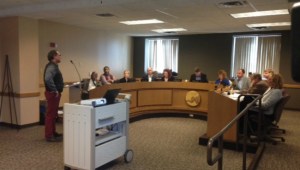
Given the current make up of the Planning Commission Board, it doesn’t come as a major surprise that the majority of them have been approving many of the development projects that have come before them over the past few years. Many of them would benefit in some ways to have new developments approved, because it would bring more upscale consumers and residents to the city and in some cases near the businesses they own and operate. These new development projects and the upwardly mobile class status of those the develop projects have attracted, are one of the major factors in the ongoing gentrification of Grand Rapids.
This is even reflected in a recent exchange between someone with Grand Rapids Homes for All and members of the Planning Commission Board/Staff in a document dated April 28, 2016.
Mr. Bartley related receipt of an email from Chuck Skala, Grand Rapids Home for All, regarding the GVSU Medical Education facility expansion, Coit Square condo project and the Rise project on Benson, and other proposed developments involving the demolition of existing rental homes and the displacement of families residing in those homes. He asked that as these projects come before the Planning Commission for review that they consider the impact on displaced families, especially with the current crisis in lack of availability of replacement housing for these families. He asked that the Planning Commission ask staff to include displacement impact as part of their analysis of proposed projects. He asked that the Planning Commission ask developers how they plan to accommodate families they are displacing. It has been their experience that displaced renters aren’t likely to attend public hearings regarding projects affecting them. In such cases decision makers sometimes rely on the opinion of neighborhood associations that may be disproportionately weighted in favor of home owners that stand to benefit from new development contrasted with renters who will be displaced. They request that the Planning Commission make a concerted effort to determine the impact on displaced families and provisions to accommodate them.
Mr. Bartley explained that he shared the communication because it is public comment, they were asked to share it, and it is certainly something to think about. Mr. Bartley advised that staff doesn’t believe the Planning Commission can include that as a Standard of review however; it isn’t a land use Standard. Staff intends to craft a response to explain their position.
Ms. Curry Van Ee asked if there is anything included in the Great Housing Strategies report regarding displacement that could be referenced in staff’s response.
Mr. Bartley replied that depending how you look at it the entire report affects that. There are no mechanisms to control rent and none of the strategies or recommendations from the report includes rent control.
Ms. Angelo asked if staff has any knowledge about how many people are being displaced with these projects. When visiting proposed project sites that include proposed demolition it seems that the homes are largely vacant. Mr. Van Strien asked the vacancy rate in the city.
Mr. Koetsier advised that the vacancy rate of active rentals is 1%; the lowest in the country. Not only is development removing homes but rental homes that go on the market are being purchased by owner-occupants and tenants are being displaced. He noted that development is part of the solution. When tearing down 11 houses and replacing them with 60+ apartments gradually the situation will improve.
Ms. Turkelson related that staff continues to have meetings on Great Housing Strategies and ways to implement it. She advised that staff is working on an analysis for the City Commission regarding how many units are being lost to development and how many units are replacing them. With the vast majority of the projects more units are being created by the new development.
Mr. Rozeboom asked if the City Commission can deny a rezoning request based on affordability.
Mr. Forshee advised that he would discourage that. The City Commission should be using similar Standards that the Planning Commission considers. His opinion is that because zoning flows from the Zoning Enabling Act that it limits that power. Ms. Turkelson added that they are also bound by the Master Plan.
What is instructive is the perspective. Mr. Koetsier, with Koetsier Realty LLC, states:
“Not only is development removing homes but rental homes that go on the market are being purchased by owner-occupants and tenants are being displaced. He noted that development is part of the solution. When tearing down 11 houses and replacing them with 60+ apartments gradually the situation will improve.”
First, many of the homes that Mr. Koetseir says are being purchased by by owner-occupants isn’t consistent with what has been happening in many of the recent development projects. For example, in the Belknap area, houses have been demolished, and the newly approved RISE Real Estate project on Michigan will demolish roughly a dozen homes and several commercial buildings.
Mr. Koetsier also states, “development is part of the solution.” This has not been the case when it come to affordable housing. Virtually everything that is being proposed is either “market-rate” or very high end. Ms. Turkelson also states, “With the vast majority of the projects more units are being created by the new development.” While it is acknowledged that there are more new units being created, a very small percentage of them are not affordable for working class individuals or families.

One can see from the graphic above when the term for each of the Planning Commission board members will end. What would it take to have new board members come from the ranks of those most impacted by gentrification? Is this even possible? Should those most impacted from ongoing development projects engage in movement building instead? Should both be done? Important questions for those who care about housing justice.
The Unaffordability of Grand Rapids
On Monday, MLive ran yet another story about new housing development projects in Grand Rapids, entitled, High-end, micro apartment projects up for tax breaks.
The brief article looks at four proposed housing development projects seeks approval from the city of Grand Rapids, along with the possibility of tax breaks for each project. The four projects are: a 616 Lofts project on Quimby NE; Maplegrove Development LLC project on Market Avenue; Green Cane Property ( in conjunction with Orion Construction) project on Wealthy in Uptown, and; a Third Coast Development project in the Firestone building on Jefferson SE, near Fulton.
However, the brief MLive article focuses mostly on the Green Cane Property project at the site of the old McDonald’s on Wealthy SE and their micro apartments. The only source cited is a representative with Green Cane Property. In addition, the article does mention that the Grand Rapids City Commission would be deciding on all four of these projects at their May 10 meeting and whether or not to offer tax breaks for each of the projects.
According to the City Commission Agenda Packet for their May 10 meeting, the Green Cane Property project will be getting significant tax breaks. There was no additional information from said City Commission packet on tax breaks for the other three housing development projects.
The MLive article states at one point, “Grand Rapids commissioners have been exploring ways to encourage development of more “affordable” housing, with rents below market rate. Recent ordinance changes include the addition of parking incentives for construction of “micro-units” that are 475 square-feet or smaller.”
The question should be asked, what exactly is it that the City Commissioners are doing to explore and implement ways to make affordable housing a reality in Grand Rapids? The same sentiments were shared during an April 12 City Commission meeting, a meeting where they unanimously approved a $300,000 per condo development project. At that April 12 meeting every commissioner commenting on the need to increase affordable housing, but none of them offered up a plan on how to make affordable housing a reality. 
Everyone of the four housing development projects mentioned in the MLive article will not be offering truly affordable housing options for individuals or families, like almost all of the new housing development announcements in recent months. Almost all of the housing options with these four development projects are listed as market rate, with the 616 Lofts project on Plainfield listing rental rates between $850 to $1,500 per month; the Maplegrove Development project on Market Ave. listing rental rates between $935 to $1,795 per month; the Third Coast Development project on Jefferson SE listing rental rates between $1,250 to $2,000; and the Green Care Property/Orion Construction project on Wealthy SE listing rental rates between $700 to $1,400 per month.
Someone making $10 an hour, which is the reality for thousands of people in the Grand Rapids area, equals $22,400 a year. The rate of the lowest rental cost of the four new projects is $700 per month for a micro apartment. Rent at such a location for one year is $8,400, over one-third of the income of someone making $10 an hour. A single person might be able to survive on that income, but not someone with children or those supporting other family members. Grand Rapids is quickly becoming a city that is unaffordable for thousands of working class individuals and families.
For 31 years, numerous businesses, trade associations, universities and non-profits have come organized what has become known as West Michigan World Trade Week. 
The event is primarily organized through the Van Andel Global Trade Center, which is part of Grand Valley State University. The Van Andel Global Trade Center is located in the Seidman College of Business, which has grown to be the primary source for creating new “talent” for local businesses that have a global reach.
The proponents of West Michigan World Trade Week claim that the benefits of their efforts are as follows:
- Highlight the link between international trade and Michigan’s economic well-being
- Recognize the contributions of international trade to job creation in Michigan
- Celebrate companies succeeding in the global marketplace
- Share knowledge, resources and ideas to facilitate business success internationally
While points 3 and 4 are true, in that they both celebrate local companies that do global business; and they do share resources and ideas that benefit local companies that profit in the world market, the first two points are false claims or capitalist myths.

Capitalist Myth #1 – Highlight the link between international trade and Michigan’s economic well-being
The link between international trade and the economic “well-being” of Michigan’s economy is a rather slick way of saying that businesses in Michigan that engage in global trade are making a hefty profit. There is no such thing as Michigan’s economy and more than there is a Grand Rapids economy. We all are subjected to the economic system of Capitalism, and Capitalism as we know primarily benefits the ownership class.
Even if we accepted the idea that Michigan had its own economy, we could discern its well-being by looking at certain factors. First, what percentage of the children are currently experiencing poverty? According to the most recent data from the Michigan League for Public Policy (2014), 22.6% of children between 0 – 17, are experiencing poverty. If we looked at just Kent County, the percentage of children living in poverty is 20%. If one looks at the poverty rates for African American and Latino/a children living in poverty, it’s almost 1 out of 3.
Does this seem like the economy of Michigan is well off? Of course, those who truly believe in a Michigan economy are those who most benefit from capitalism that is practiced locally. Those who are experts on Michigan’s economy are people who represent firms such as Anderson Economic Group, which are the same experts that represent big business in Michigan. If on the other hand you spoke to working class people, people making poverty level wages, working long hours and constantly struggling to make ends meet, they you could get a very different picture of “Michigan’s economy.” However, we almost never hear from these people, especially not from commercial media sources.
Capitalist Myth #2 – Recognize the contributions of international trade to job creation in Michigan
Another indicator is the so-called link between international trade and job creation in Michigan. While some of the larger companies that engage in global trade have added some jobs, thousands of jobs in Michigan have been lost due to global trade.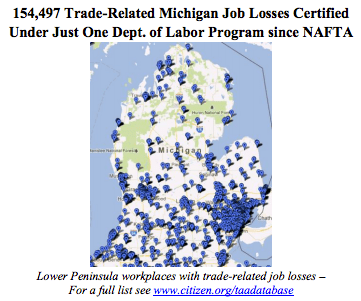
According to a recent study done by Public Citizen,
Over 21 years, a series of trade agreements not only have failed to meet their corporate and political backers’ glowing promises of job creation, but instead have contributed to unprecedented and unsustainable trade deficits, the net loss of nearly 5 million U.S. manufacturing jobs and more than 55,000 factories, the offshoring of higher-wage service sector jobs, flat median wages despite significant productivity gains and the worst U.S. income inequality in the last century.
For most working class people, they recognize that trade deals such as the North American Free Trade Agreement (NAFTA), the Central American Free Trade Agreement (CAFTA), the Korean Free Trade Agreement and the most recent Trans Pacific Partnership (TPP) have resulted in the loss of manufacturing jobs. Under NAFTA alone, according to the US Labor Department, 154,497 jobs were lost in Michigan since the agreement was signed in 1994.
Countering World Trade Week and local capitalism
The West Michigan World Trade Week will not be challenged until there is a substantial multi-issue movement that can make the link between local capitalism and their own experiences. As of right now, such resistance is a long way off. There have been some encouraging and even inspiring actions that are challenge neo-liberal capitalism on the local level, particularly the bus drivers union and Students Against Sweatshops, but there needs to be a much larger movement with a broader vision if the local capitalist class is to be challenged.
First, we need to shift our energies away from the empty promises of electoral politics. The two-party system in the US is essentially just 2 branches of the capitalist class. If more energy and resources we re-directed to mass movement, the capitalist class would feel threatened.
Second, there is no real hope in the non-profit industrial complex. Too many non-profits not only rely on a disproportionate amount of funding from the capitalist class, they have deep relationships with them in the form of projects, who sits on the board of directors and the internalization of the values that is the foundation of neo-liberal capitalism.
Lastly, there are no significant intersectional movements in West Michigan that can challenge local capitalism. Too often organization and movements are operating in silos and do not, or will not, see the connection to other pressing issues of the day. This is often of no fault of their own, since it is difficult to survive in this capitalist economy, especially if you are against war, poverty and racism.
However, this does not mean that we have to accept the status quo. We can chose to put our efforts into movement building. We can chose to organize in grassroots and autonomous ways, and we can develop a more robust intersectional analysis that can actually challenge the local economic and political systems of power. We can also be encouraged by the numerous existing global movements that do make the links and do operate outside of mainstream politics, movements such as the MST in Brazil, the PAH in Spain, the Zapatistas in Mexico and the Idol No More movement in the occupied territories of Canada and the US.
The indigenous movement in southern Mexico known as the Zapatistas has a saying about what real leadership is. Mandar Obedeciendo means to “Lead by Obeying.”
The principle behind this philosophy is that true leaders follow the will of the people, the desires of the larger community. This principle challenges authoritarianism in the communities, and representatives who are not accountable to the widespread desires of the community will be ousted from their positions.
This is not the typical form that leadership takes, especially in dominant cultures like the US. Here, leadership often exists to perpetuate itself, amassing power and making decisions for others. This is the Neo-liberal Capitalist model. Even in the non-profit world, leadership often mimics the corporate world, with a board of directors and a CEO or Executive Director.
This model of leadership development is practiced right here in Grand Rapids through the Center for Community Leadership.
The Center for Community Leadership (CCL) is a project of the Grand Rapids Chamber of Commerce. The creation of such a program was first proposed in the early 1980’s. The mission of the CCL is to, “equip talented professionals with intensive training, active networks, and meaningful resources to shape their careers, innovate within their companies, and engage in community change.”
The CCL offers a 9-month program where “community leaders” interact with participants to give them insights on how to be a leader in this community. The themes that are discussed are:
- Essential Needs

- Talent Development
- Public Safety
- Community Health
- Economic Prosperity
- Quality of Life
- Community Trusteeship
- Philanthropy
This 9-month program invites anyone to apply, as long as you can pay $2950. Now, some employers will foot the bill for staff to apply and there are a few scholarships available, but by charging such a fee, it is clear that the program is designed to create leaders that will not challenge the hierarchical Neo-liberal model.
First, the major sponsors of the CCL program are the same businesses that benefit from Neo-liberal capitalism, such as: Meijer, Amway, Steelcase, Fifth Third Bank, Spectrum Health, Lacks Enterprises, Wolverine Worldwide, Metro Health, Blue Cross-Blue Shield, Foremost Insurance, etc.
Second, the Center for Community Leadership Council is made up of essentially people from the same companies listed above, along with Chamber of Commerce representation and a few of the local universities. Thus, the CCL perpetuates itself by developing leadership that internalizes Neo-liberal values.
Third, addition leadership development projects are offered to continue to mold people within the CCL framework, such as the Emerging Leaders Series, Leadership Advantage and Leadership: An Inside-Out Perspective. Each of these programs are also come with a fee – $750, $2750 and $1,250 respectively.
If one signed up for all four of the Center for Community Leadership programs, they could end up spending $7,700. Such cost automatically eliminate most people in the community and ends up serving those with tremendous privileges. But that is the point of the CCL programs, to foster the kind of leadership which embraces the values of an economic and political system which rewards the privileged few and marginalizes the majority of the community.
If one thinks about the great social movements that have arisen in the US over the past 150 years. Beginning with the abolitionist movement, what kind of leaders did these movements produce – Harriet Tubman, Frederick Douglas, Sojourner Truth, Angela Grimkie, Lucy Parsons, Mother Jones, Eugene Debs, Big Bill Haywood, Dorothy Day, W.E.B. Du Bois, Ida B. Wells, A.J. Muste, Rosa Parks, Dan Berrigan, Martin Luther King Jr., Stokley Carmichael, Cesar Chavez, Dolores Huerta, Fannie Lou Hamer, Ella Baker and Angela Davis……just to name a few. What these leaders (and some of them bristled at the title leader) had in common was a deep commitment to their communities, the willingness to take serious risks and to fight against systems of oppression and for structural transformation. I ask you, is this what the Center for Community Leadership is all about.
By way of ending, I wanted to share another principle of leadership that guides the Zapatista movement. Todo Para Todos, Nada Para Nosotros, which means, Everything for Everyone, and Nothing for Ourselves.
This principle is predicated on the idea that Leaders are not in power to benefit themselves personally, but to fight for benefits for everyone in the community. If there is a type of leadership that we should advocate for, then this is that type of leadership, not the kind that the Center for Community Leadership produces.
Editor’s Note for transparency: When I used to work for the Community Media Center, the Center for Community Leadership used to come to the CMC. I facilitiated a critical thinking/Media Literacy workshop for 2 years, but then told my former boss I would no longer do this workshop, since it did not support the values I embraced of what I thought the CMC embraced.
Senator Peters follows in the footsteps of Carl Levin with unquestioning support for Israel
Last week the it was reported that the US government plans to increase the amount of annual aid to Israel, from $3 billion to $5 billion. 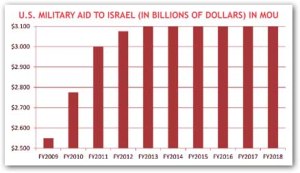
Israel has been the number one recipient of US military aid for the past 40 years, but despite the level of US support, the Israeli government is demanding an increase. This is no surprise when considering the near unanimous US Congressional support that Israel has received over the past 4 decades, along with every administration during that same time period.
Michigan Senator Carl Levin was one of the biggest cheerleaders on behalf of Israel and he was rewarded handsomely by being one of the largest recipient’s of money from the Israeli Lobby – over $1 million during his time in the US Senate.
Senator Levin demonstrated over and over that he was deeply committed to being an apologist for Israel and Israeli war crimes, whether it was on the Israeli treatment of Palestinians, the Israeli occupation of Palestine or the Israeli position on Iran.
Sen. Peters: an apologist for Israel
Elected to replace Carl Levin, Senator Gary Peters is now following in the footsteps of Levin by continuing a legacy of unquestioning allegiance to Israeli policies. According to Senator Peters’ website, “Last year, Peters helped introduce an amendment included in the National Defense Authorization Act authorizing joint U.S.-Israel anti-tunnel defense research, development, and test activities in order to better detect and destroy tunnels which have been utilized by terrorist groups. Funding for this research and development was included in the year-end government spending bill signed into law by the President Obama last December.”
Now Senator Peters, along with 82 other Senators, has sent a clear message to the Obama administration about the so-called need to increase US military aid to Israel. “In light of Israel’s dramatically rising defense challenges, we stand ready to support a substantially enhanced new long-term agreement to help provide Israel the resources it requires to defend itself and preserve its qualitative military edge,” wrote Peters and his colleagues.
Senator Peters was 19th on the list of top Senate candidate recipients of the Israeli lobby in the 2014 election, receiving $113,849 from several pro-Israel groups since his 2014 run as a Michigan Senator. However, the most recent letter that he and his fellow Senators have sent President Obama demonstrates his ideological commitment to maintaining Israeli and US supremacy in the Middle East.

Here is the text of the letter sent to President Obama from Senator Peters and his colleagues last week:
Dear Mr. President:
We commend you for your continued work on negotiating a new Memorandum of Understanding (MOU) for security assistance to Israel. In light of Israel’s dramatically rising defense challenges, we stand ready to support a substantially enhanced new long-term agreement to help provide Israel the resources it requires to defend itself and preserve its qualitative military edge. As you know, a strong and secure Israel remains a central pillar of our national strategy to achieve peace and stability in the Middle East. Israel remains America’s strongest ally in this troubled region.
Unfortunately, Israel faces a variety of threats which require increasing the resources devoted to its defense. Hezbollah has positioned up to 150,000 rockets and missiles to Israel’s north, and promises to attack at a time of its choosing. Disorder in Syria has spawned multiple terrorist groups dedicated to Israel’s destruction, including affiliates of al Qaeda and ISIS. Iran’s intervention in Syria has brought the Islamic Revolution Guard Corps and Shi’ite militias near Israel’s border. In the south, Hamas has grown its rocket and missile inventory and is actively rebuilding tunnels to attack Israel. The Sinai has become a lawless haven for militant Islamist groups. Iran is actively helping most of these groups, in addition to illicitly testing sophisticated ballistic missiles capable of carrying nuclear warheads. Earlier this month, two such weapons were launched bearing the ominous words in Hebrew: “Israel should be wiped out.”
In addition to these immediate threats, Israel must take into account the possibility that regional instability could lead to toppling of one or more of America’s friends. Given the extraordinary levels of weapons pouring into in the Middle East, Israel could quickly find itself on the wrong end of the regional military balance. This problem is compounded by the mounting cost of the new aircraft and other weapons systems that Israel must acquire to keep pace with its neighbors. Moreover, Israel must prepare for the likelihood that Iran will resume its quest for nuclear weapons.
Members of Congress from both parties have been proud to work with you and previous administrations to provide Israel the essential resources it needs to survive in a very tough neighborhood. The nature and breadth of the current threats, however, mean that the United States must enhance its investment in the long-term security requirements of our closest Middle East ally. Already this year, we intend to consider increasing U.S. funding in FY17 for cooperative missile defense programs, much as we have done over the past several years. Most importantly, we urge you to conclude an agreement with Israel for a robust new MOU that increases aid while retaining the current terms of our existing aid program. That MOU should pledge aid at a level that will enable Israel to combine our assistance with its own increased defense budget to meet its essential defense needs over the coming decade. We look forward to working with you on this critical issue.
More displacement = more Market Rate Housing for GR

Two days ago MLive posted a story about yet another development project that has received the green light.
The development in question will take place on the north side of Michigan street, between Grand and Benson, just south of the I-196 highway. RISE Real Estate Development will head up the project. The Georgia-based developer has this to say about themselves on their website:
Rise is a nonprofit organization that connects key groups working to revitalize communities and neighborhoods. Rise partners with communities to develop affordable market-rate housing in partnership with community development corporations, particularly in neighborhoods with the potential to enhance economic diversity.
Seems like they use all the right buzz words, but lets look at the reality of what they are doing with this new development project along the Michigan Street corridor.
First, the $53 million apartment project has been given permission to keep $8.9 million in local and school taxes. This means they will “capture $4.3 million in local property 
taxes and $4.6 million in school taxes over the next 14 years. Eligible expenses include demolition of existing buildings, site grading, new streets and the installation of new utilities.”
How is it that this project gets such a large tax break? $8.9 million is just under one-fifth of the total cost of the project, plus they won’t have to pay taxes for 14 years. How does this benefit the city? Can you imagine if people who wanted to stay in their homes and make improvements would get comparable tax breaks. How about giving comparable tax breaks to people who wanted to purchase and fix up the houses in this neighborhood? Wouldn’t they be revitalizing the neighborhood?
Second, the tax breaks were approved by the Michigan Strategic Fund Board, which is part of the Michigan Economic Development Corporation (MEDC). The MEDC is a public-private partnership that seeks to promote tourism and economic development in Michigan. The reality is that the MEDC is predominantly made up of people from the private sector, with a few representatives from local government. These people are appointed, not elected.
The Michigan Strategic Fund Board, which approved the $8.9 million in tax breaks for the RISE Real Estate Development project, is also an unelected group and is made up mostly by members of the private sector and two state government bureaucrats. Thus, it is evident as to why tax breaks were provided for this development project. However, it makes it difficult for this writer to understand how RISE is going to enhance economic diversity with such a project, especially when 16 homes are being demolished and so many people are being displaced to promote “market-rate” housing.

Third, how do you think the 16 houses currently occupied by individuals and families will feel about RISE and its commitment to “revitalize communities and neighborhoods.” This is a critical point, since it is not likely that those being displaced will feel revitalized. The question with all of these development projects is not whether it will be a community benefit. The question is, which people within the community will benefit. There are clear winners and clear losers, with the winners being RISE, real estate speculators, and other development projects or potential development projects in the area. The clear losers are those who are being displaced, working class families and disproportionately community of color, who are statistically more vulnerable to displacement. This is Grand Rapids.
When We Fight, We Win: Grand Rapids Homes for All
Last Thursday evening, another 70 people showed up to talk about rent increases, gentrification, landlord abuse and alternatives to “market rate” housing in Grand Rapids.
Building on the first gathering in late February, the Grand Rapids Homes for All movement took its next step by continuing to develop some focus around what needs to be done to combat gentrification and the growing disparities between upscale housing and affordable housing.

One important step that the local effort took was to join the national Homes for All campaign and sign the pledge. This decision not only provides Grand Rapids housing activists an opportunity to utilize the resources of the national campaign, but it provides peer to peer training, which has the potential to lead to an effective and deeply intersectional campaign.
The meeting last Thursday already followed the national model of developing working groups; Renters Rights, Development without Displacement and Alternative Models of Housing for People Not Profit. These three working groups provide a cohesive framework for moving forward and addressing very specific needs in the community.
The Renters Rights track entails the fight for renters rights ordinances across a city/county/state or contracts with individual landlords and approaches that organize mass numbers of renters into renters rights formations to fight displacement and advance the political power of the renter nation.
The Alternative Models of Housing for People Not Profit track represents transformative solutions that seek to create the new world we seek now. These campaigns center on acquiring collective community ownership of land and establishing democratic Community Land Trusts as an essential first step in taking land off the speculative market and establishing permanent community control. Collective ownership of the housing, cultural space, green space and worker cooperatives are also essential to the establishment of our holistic vision of community control, not in just one arena but all those that are critical for our communities to thrive and each of us reach our full potential.
The Development Without Displacement track unites campaigns across the country in which communities are fighting big developers and gentrifiers to ensure that all current residents (predominantly people of color) in communities facing gentrification win agreements and guarantees to ensure that they can stay in their community and help shape and benefit from the development.
Each of these three areas of organizing are based on the shared values of the Homes for All campaign. The four shared values are:
- Community and Housing are a human right, not a commodity to be exploited for profit.
- Land and Housing should be collectively owned and controlled by communities.
- Land and Housing should be developed in a way that is sustainable for the planet.
- Land and Housing should be accessible, permanent, quality, and connected to economic, social and cultural networks and institutions.
These values provide an important framework for doing the necessary organizing that promotes housing justice, challenges gentrification and displacement and creates a movement for social justice.
The working groups have already identified several key areas of work, such as doing renters rights training, doing a landlord by landlord campaign to win contracts and rent controls, creating a renters union, holding elected officials and developers accountable and looking at alternative forms of housing that is based on cooperation.
The timing of this organizing work has also coincided with the opportunity for a few of us to spend the weekend in Chicago, attending a Homes for All national retreat, featuring 135 organizers from around the country that have been engaged in amazing work. The weekend was spent sharing stories in the struggle, learning models of organizing, sharing tactics, connecting with communities and developing strategies for the next phase of the national Homes for All campaign.
The weekend was truly inspiring, since not only did it bring together so many organizers, it demonstrated that there is power in direct action. What this often means is that, despite the limitations of the law around issues like rent control, people have been able to win collective bargaining and contracts landlord by landlord or building by building throughout the country. Here is just a sampling of the victories that have been won when direct action efforts are applied. 
We participated in the Renters Rights organizing committee, which also meant we discussed Corporate Landlords. Corporate Landlords are property management companies, which own a substantial amount of property and are able raise housing costs because of the volume they deal with. One of the largest private companies is Blackstone and the Homes for All campaign has even created a major report on what this company does, primarily with rental units under the banner of Invitation Homes.
The Corporate Landlord organizing effort around Blackstone provides a great example of how to challenge rent increases and organize renters building by building and community by community.
What was also inspiring about the weekend was the clarity it gave around ways to do organizing campaigns and how to create horizontal models for social justice. The retreat emphasized that the movement around renters rights, displacement and anti-gentrification work must be led by those most impacted, which are often working class communities of color. In fact, the retreat practiced this core value by making sure that those who led most of the sessions and talked about their work were women of color.
If we are to have an authentic housing justice movement in Grand Rapids, we too need to make sure that it is led by those most impacted as well.
For those interested in being part of this work, the next meeting will be held on Thursday, May 12, 6pm at Hope Church on the corner of Burton and Kalamazoo SE.
Grand Rapids City Commissioners vote unanimously to approve $250,000 – $300,000 Condo Project
We recently found out that the Coit Square Project was set for a vote by the Grand Rapids City Commission. The Coit Square Project, along with other developments in the Belknap Lookout area, have come under increased scrutiny due to the gentrification and displacement taking place.

The Grand Rapids Planning Commission had already unanimously approved the Coit Square Project and now it was up to the City Commission to make a decision. However, there was a planned public hearing for this issue, which was taken off the table and the City Commission was just going to decide on a vote.
The Commission meeting was packed tonight, with standing room only. Shortly after the opening formalities, the City Commission invited people to comment on items on the agenda, one of which was the Coit Square Project.
The Coit Square Project is important, in that it further contributes to gentrification, after the GVSU project had already begun this process.
Several people had already submitted letters to the City Commission on the Coit Square Project. One, in particular, is worth quoting. Chuck Skala, with the Micah Center, wrote these comments to the City Commission.
“The GREAT HOUSING STRATEGIES Plan states, at page 27, that it is a goal of the City of Grand Rapids to “ENCOURAGE MIXED-INCOME NEIGHBORHOODS.”
The Plan document elaborates, moreover, “The importance of mixed-income neighborhoods was identified as a priority throughout the Great Housing Strategies process. While reinvestment and development are positive, a concentration of either market-rate or rent assisted development may have negative effects on a neighborhood.” “An intentional balance is necessary for the health and success of all city neighborhoods.”
We whole heartedly agree!
We very much appreciate the current mixed-income character of the Belknap Lookout neighborhood, and we want to preserve it. That character is threatened by the Coit Square project that proposes to demolish 22 low-income housing units and replace them with 39 up-scale, market-rate, $250,000 – $300,000 condominiums.
Approval of Coit Square, as it is now contemplated, would potentially contribute to a chain-reaction, domino effect of such developments resulting in, not mixed-income housing, but stratifed-income housing in the extreme.”
Other members of the Micah Center and affordable housing advocates also called on the City to not vote and hold a public hearing, as they believe the process has been flawed and that the developer in question (Angel Gonzalez) is on the board of the neighborhood association, which they believe is a conflict of interest.
Angel Gonzalez, with the Artisean Group did speak before the City Commission, most about how he was a self-made man and was committed to the stability of the neighborhood. Gonzalez did send out a memo about his intentions, but the intentions falls way short of the commitment of the city to have more affordable homes and rental properties in neighborhoods like Belknap.
The City Commission then voted unanimously to approve the plan to build the $250,000 – $300,000 condos. What was interesting is that almost every commissioner spoke about how the process did take into consideration neighborhood interests, but that there were no easy answers.
So, how does the decision to support such a project fit with the City’s commitment to provide more affordable housing options? What kind of message does it send to people who are experiencing poverty and come from more marginalized communities about how they are valued? These are important questions that need to be addressed, but it didn’t seem as if those questions were being addressed honestly on this night.
Afterwards, I spoke with two teachers from Coit School, who believe that their days are numbered and that the future of Coit School is being threatened by the changing demographics in that neighborhood. One teacher said, “what has been happening to Detroit is the same thing that is happening in Grand Rapids. The city didn’t care about certain neighborhoods for years and now they want to provide all kinds of financial incentives to people to re-develop neighborhoods that are forcing people out.”
The DeVos Family is once again buying political influence
According to recent reports from the Michigan Campaign Finance Network, the DeVos Family has once again out spent virtually everyone in the state when it comes to buying elections. 
Based on data from the most recent Federal Election Commission findings, the DeVos Family spent $1.32 million on Super PAC funding. This includes money given to Marco Rubio’s Conservative Solutions PAC, A New Day for America PAC (John Kasich), Right to Rise PAC (Jeb Bush) and the CARLY for America PAC (pro-Florina).
The largest chunk of DeVos Family money was donated to Rubio’s Conservative Solutions PAC, despite the fact that Senator Rubio has recently dropped out of the race for the GOP nomination. This has not and will not deter the DeVos Family as they continue to be the largest electoral donor in Michigan. The DeVos Family also gives a substantial amount to the State Republican Committee, which can decide what races it want to give money to. In many ways, the DeVos Family has been much more interested in state politics, as is evidenced by recent influence peddling with the state legislature.
Speaking of buying State Policy
The other major campaign finance issue in Michigan has been the amount of money going to influence state education policy, particularly in Detroit.
The DeVos Family has contributed $1.22 million to individuals and two caucus committees. Betsy DeVos is front and center in the battle to get Charter Schools and private education as “schools of choice.” She recently made her views know in a February opinion piece published in the Detroit News.
“The state should “liberate all students from this woefully under-performing district model and provide in its place a system of schools where performance and competition create high-quality opportunities for kids.” The state “should expand school choice so students could use state education funds at the public or private school of their choice.”
Other potential reforms touted by Betsy DeVos: A-F letter grading for schools; alternative certification for teachers; and a ban on teacher sickouts. Here is where the DeVos Family spent their money on privatizing education in Michigan.
1. House Republican Campaign Committee, $480,000
2. Senate Republican Campaign Committee, $281,000
3. Gov. Rick Snyder, $34,000
4. Lt. Gov. Brian Calley, $20,400
5. Sen. Margaret O’Brien (R-Portage), $19,000
(Tie) 6. Rep. Brandt Iden (R-Oshtemo Twp.), $18,000
(Tie) 6. Rep. Holly Hughes (R-Montague), $18,000
(Tie) 6. Sen. Marty Knollenberg (R-Troy), $18,000
(Tie) 6. Sen. Wayne Schmidt (R-Traverse City), $18,000
(Tie) 10. Rep. John Bizon (R-Battle Creek), $16,000
(Tie) 10. Sen. Mike Kowall (R-White Lake), $16,000
(Tie) 10. Sen. Jim Marleau (R-Lake Orion), $16,00
(Tie) 13. Sen. Peter MacGregor (R-Rockford) $14,000
(Tie) 13. Rep. Klint Kesto (R-Commerce Twp.) $14,000
(Tie) 13. Rep. Tom Barrett (R-Potterville), $14,000
(Tie) 13. Sen. Phil Pavlov (R-St. Clair) $14,000
(Tie) 13. Sen. Goeff Hansen (R-Hart), $14,000
Betsy DeVos is a member of the American Federation for Children, a national right wing lobbying effort on privatizing education.


Yesterday, activists involved with the Grand Rapids BDS (Boycott, Divestment & Sanctions) campaign went to downtown during the lunch hour to pass out flyers for Israeli Apartheid Week.
Israeli Apartheid is the ongoing oppression of Palestinian people, plus the illegal occupation of Palestinian land. For those who are not familiar with Israeli Apartheid (directed at Palestinians), check out the important resources from the End the Occupation campaign.
The target of Israeli Apartheid Week was the Right Place Inc. and for 2 main reasons.
First, the pro-business entity recruits businesses to West Michigan. Therefore, they have recruited the military contractor Plasan North America, http://www.plasan-na.com/ based in Walker, Michigan. Plasan is not just any military contractor, they are an Israeli-owned military contractor with facilities in the US, France and Israel. Plasan not only makes weapons, but provides “security resources and solutions” that focus on Border Protection, Special Forces Operations, Intelligence Missions, Disaster Management, and Convoy & VIP Protection. Here is a sample of “services” they offer with the products, which is taken from their own promotional material.
Second, The Right Place Inc., actively recruits Israeli businesses and promotes Israeli products. They do this through the Michigan Israel Business Bridge (MIBB), a Bloomfield Hills-based entity. The Right Place Inc. CEO ,Birgit Klohs, is part of the Advisory Council for the MIBB.
The action the Grand Rapids BDS Campaign took for Israeli Apartheid Week was to hand out flyers about the pro-Israeli practices of The Right Place Inc. Several hundred flyers were distributed during the lunch hour in downtown Grand Rapids. People were mostly receptive to the information and many people admitted that they knew very little about Israeli Apartheid.
At one point a representative of The Right Place Inc. took pictures of the demonstration, but chose not to engage people as to why they took action.
Here is the flyer that was handed out during the action taken during Israeli Apartheid Week.


