World Social Forum Opens in Tunisia
This article by Jordan Flaherty is re-posted from Counter Punch.
Tens of thousands of people marched through downtown Tunis on Tuesday in a spirited march celebrating the beginning the 13th World Social Forum – the first to be held in an Arab country. The majority of marchers were from Tunisia and neighboring nations, but there was substantial representation from Europe, as well as from across South America, Asia, and Southern Africa. An enormous annual gathering that bills itself as a “process” rather than a conference, the WSF brings together by far the largest assembly of international social movement organizations, aimed towards developing a more just and egalitarian world.
The WSF was first held in Brazil in 2001, and is billed as an alternative to the wealth and power wielded at the World Economic Forum, an elite annual gathering in Davos, Switzerland. Tuesday marked the official opening of the WSF, but official sessions start today and continue through March 30 at the El Manar University Campus. The theme of this year’s Forum is “dignity,” inspired by the movements collectively known as the Arab Spring, launched here just over two years ago.
As of last night, the WSF had reported registration by more than 30,000 participants from nearly 5,000 organizations in 127 countries spanning five continents. Since that estimate, thousands more have registered on-site. The officially announced activities include 70 musical performances, 100 films, and 1000 workshops.
Tuesday’s march traveled three miles from downtown Tunis to Menzah stadium, with chanting in multiple languages and representation from a wide variety of movements from the Tunisian Popular Front to Catholic NGOs to ATTAC, a movement challenging global finance. At Menzah stadium, an opening ceremony began at 7:30pm with female social movement leaders from Palestine, South Africa, Tunisia, and the US taking the stage, including Besma Khalfaoui, widow of Tunisian opposition leader Chokri Belaid, who was assassinated last month. According to Forum organizers, only women were chosen for the opening as a response to the rise of conservative religious governments in the region as well as patriarchal systems around the world. “We decided this because women are the struggle in the region,” said Hamouda Soubhi from Morocco, one of the organizing committee members. “They are struggling for parity, they are struggling for their rights. The new regimes want the constitutions to be more religious, and we want to take our stand against this.”
In short speeches – each about 5 minutes in length – the women projected a vision of a global movement that was inexorably rising, as the audience roared in approval. “We are trying to hold our government accountable for what it has done and continues to do around the world,” said one of the speakers, Cindy Weisner of Grassroots Global Justice, a US-based coalition of social movement organizations. “Some of the most inspiring movements and people are gathered here in Tunis. Together, we can change the course of history.” Among the loudest cheers came when speakers mentioned left political leaders and movements, including the jailed Palestinian leaders Marwan Barghouti and Ahmad Sa’adat, as well as sustained applause for Hugo Chavez and the Occupy movement.
After the opening speeches, legendary musician Gilberto Gil took the stage. Known for his politics and musical innovation, Gil was a leader of Brazil’s tropicália musical movement of the 1960s and more recently served as Minister of Culture in the administration of President Luiz Inácio Lula da Silva. As a sea of people from around the world danced ecstatically, Gil played a set that ranged from his own songs to pieces by Bob Marley and by John Lennon.
Among the opening sessions this morning was a press conference led by members of La Via Campesina, an organization representing more than 200 million poor farmers from 150 local and national organizations in 70 countries in Africa, Asia, Europe and the Americas. “The false solutions of the government have been affecting us worse and worse,” Nandini Jayara, a leader of women farmers in India told Al Jazeera. “I feel the WSF is a stage for us to share our problems and work together for solutions.”
Over the past decade, the WSF has been credited with a number of important international collaborations. For example, the global antiwar demonstrations in February 15, 2003, which have been called the largest protests in history, came out of a call from European Social Forum participants. In the US, labor activists who received international attention for a successful factory take-over in 2008 at Chicago’s Republic Windows and Doors factory said inspiration came from workers in Brazil and Venezuela that they met at the World Social Forum.
Among the many movements seeking to launch new campaigns and coalitions are indigenous activists who are seeking to educate activists from around the world about the problems in the climate change solutions, such as the “cap and trade” strategy put forward by the United Nations and mainstream environmental organizations. “We have to look at the economic construct that has been created in this world by rich industrialized countries and the profiteers that have created this scenario,” said Tom Goldtooth, director of Indigenous Environmental Network, an international alliance of native peoples organizing against environmental destruction. “We have ecological disaster, and that is capitalism’s doing.” Goldtooth’s organization is also seeking to raise awareness about REDD (Reducing Emissions from Deforestation and Forest Degradation), a United Nations program promoted as an environmental protection strategy that Goldtooth calls “genocidal” because it promotes solutions like carbon trading that he says will lead to mass deaths of poor people due to environmental catastrophe brought about by climate change. “We’ve come to a time where there has to be a transition to something different, Goldtooth added. “Our communities are saying we need some action now.”
Every year, some Forum attendees must overcome travel restrictions from various countries, and the WSF is also plagued by infighting from a sometimes fractured left. Among the incidents reported this year, Human Rights Watch reported that Algerian border authorities illegally barred 96 Algerian civil society activists from traveling to Tunisia. Meanwhile, in Tunis, a group identifying themselves as Tunisian anarchists said that they were boycotting the Forum, and appeared at the opening march, parading in the opposite direction of the rest of the crowd.
“For us the forum is already done. We have succeeded,” declared Hamouda Soubhi in an interview with Al Jazeera at the close of the opening ceremony. “Tomorrow will be problems, as there always are.”
More than 100 people arrested in Chicago while taking part in mass civil disobedience against Rahm Emmanuel’s cuts and closures
This article by Gary Younge is re-posted from The Guardian.
More than 100 demonstrators taking part in mass civil disobedience were arrested in Chicago on Wednesday as several thousand people marched against the largest proposed round of school closings in recent memory.
Many carried placards proclaiming “Strong Schools, Strong Neighbourhoods” and “Protect Our Children” while chanting “Whose Schools, Our Schools” and calling for mayor Rahm Emmanuel’s resignation.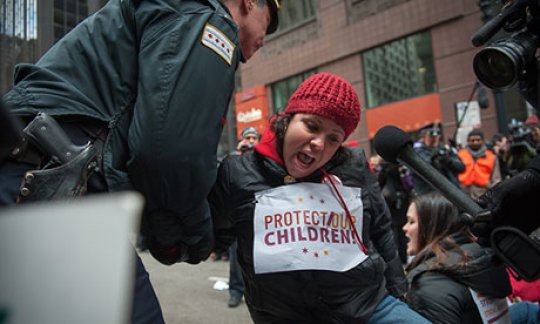
“We’re signalling that there is going to be a large and determined movement that will use the tactics of civil disobedience and direct action in order to keep these schools open,” said Chicago Teachers Union vice-president Jesse Sharkey, who was arrested outside City Hall, one of 131 detained by police. “We see this event as kicking off an extended campaign this spring and we think it was a great success.”
The city last week announced plans to close 54 schools affecting more than 30,000 students, primarily in low-income black and Latino areas. The proposals – which had already sparked huge, rowdy protests at hearings throughout the city prior to the announcement – mark Emmanuel’s second major confrontation over education in less than six months following the teachers’ strike in late August.
“People have a right to the neighbourhoods in which they live,” said CTU leader Karen Lewis at the rally. “Children have the right to a safe, nurturing, loving environment.”
Chicago Public Schools claims the closings are necessary to plug a $1bn deficit in the third-largest school district in the city and that consolidating under-utilised and under-performing schools will save $560m over 10 years by reducing investment in shuttered buildings. The district insists the savings will go to improving classroom resources including air conditioning, libraries and iPads for all students in grades 3-8.
Roughly 100 schools in Chicago – the third-largest school district in the country and with 87% of students from low-income families – have already been closed since 2001. Eighty eight per cent of the students affected in those closings were black, even though black students comprise just over 40% of the city’s student body as a whole.
Community groups, unions and many parents argue that the closings will devastate already struggling areas, raise student-teacher ratios, put children in danger by forcing them to cross gang lines to go to new schools and are based on flawed calculations and savings.

“For too long children in certain parts of Chicago have been cheated out of the resources they need to succeed because they are in underutilised, under-resourced schools,” said Barbara Byrd-Bennett, the CPS chief executive, explaining the announcement. “The district must consolidate … to get students into higher-performing schools.”
Opponents point out that there is little evidence that school closings achieve that aim and claim the closings mark an acceleration of the city’s bid to “privatise” education by forcing students into charter schools.
“In the same time these school closings have been taking place over the past decade, the city has opened about 100 charter schools in the very neighbourhoods where they’re now closing schools through under-utilisation,” said Sharkey. “Meanwhile supports of charter schools have been very open ideologically about making school competition part of the larger picture.
“We have not yet won the argument with the people of Chicago that this is a critical moment to be active. But this was a good start. Four or five thousand people and lots of different schools represented today. The argument can and will be won.”
A study by the University of Chicago’s Consortium on Chicago School Research revealed that from the 38 schools closed between 2001 and 2006 only 6% of students who were moved went to high-performing schools.
“Our research found that school districts tended to save under $1m per school [closed],” Emily Dowdall, a senior associate at the Pew Charitable Trusts told the New York Times. “So in some ways that’s not a game-changing amount.”
Sharkey further argues that the city rarely follows through on its promises on savings. “In the past there’s been investment for the first one or two years. But the money dries up once the attention is gone.”
Emmanuel, who was absent on a skiing vacation on the day the closings were announced, which many here interpret as a bid to disassociate himself from the move, has since joined the fray. “If we don’t make these changes we haven’t lived up to our responsibility as adults to the children of the city of Chicago,” he said. “And I did not run for office to shirk my responsibility.”
The CTU emerged with considerable public support after it blunted Emmanuel’s attempts to tie teachers’ pay to test scores last year. It has pledged to continue the campaign of non-violent disobedience. “People who work in the schools and rely on public schools will oppose the mass closings by any and all peaceful means,” Sharkey has told union members. “[School closings] are not something we are prepared to accept without a fight … We’re going to take this fight as far as we have to, to defend our community schools.”
This article by Steve Horn is re-posted from Counter Punch.
The more things change, the more they stay the same.
Almost 11 years ago in June 2002, Environmental Resources Management (ERM) Group declared the controversial 1,300 mile-long Baku–Tbilisi–Ceyhan (BTC) Pipeline environmentally and socio-economically sound, a tube which brings oil and gas produced in the Caspian Sea to the export market.
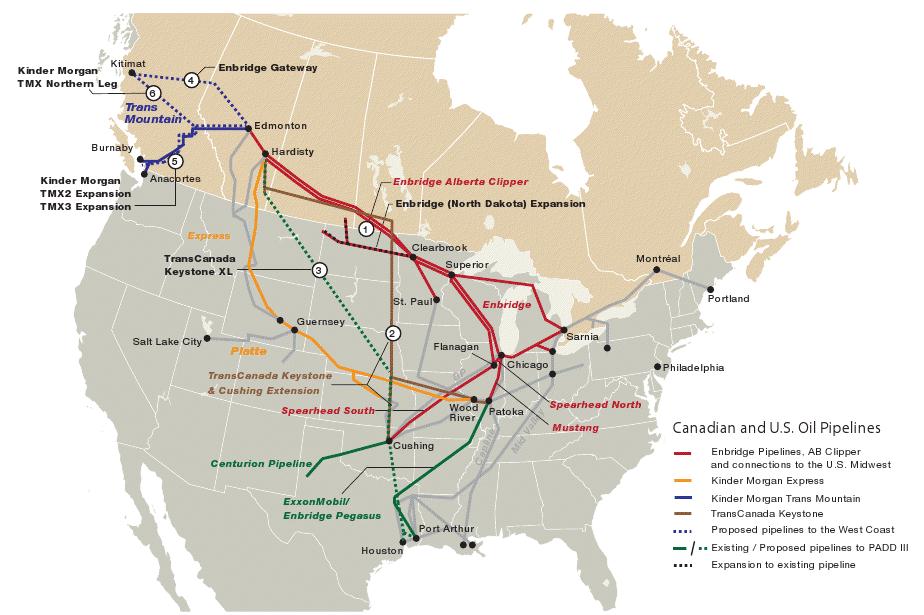
On March 1, it said the same of the proposed 1,179 mile-long TransCanada Keystone XL (KXL) Pipeline on behalf of an Obama State Department that has the final say on whether the northern segment of the KXL pipeline becomes a reality. KXL would carry diluted bitumen or “dilbit” from the Alberta tar sands down to Port Arthur, Texas, after which it will be exported to the global market.
ERM Group, a recent DeSmogBlog investigation revealed, has historical ties to Big Tobacco and its clients include ExxonMobil, ConocoPhillips and Koch Industries. Mother Jones also revealed that ERM – the firm the State Dept. allowed TransCanada to choose on its behalf – has a key personnel tie to TransCanada.
Unexamined thus far in the KXL scandal is ERM’s past green-light report on the BTC Pipeline – hailed as the “Contract of the Century” – which has yet to be put into proper perspective.
ERM is a key player in what PLATFORM London describes as the “Carbon Web,” shorthand for “the network of relationships between oil and gas companies and the government departments, regulators, cultural institutions, banks and other institutions that surround them.”
In the short time it has been on-line, the geostrategically important BTC pipeline – coined the “New Silk Road” by The Financial Times – has proven environmentally volatile. A full review of the costs and consequences of ERM’s penchant for rubber-stamping troubling oil and gas infrastructure is in order.
Massive Pipeline, Massive Hype: Sound Familiar?
Like the Keystone XL, the BTC Pipeline – owned by a consortium of 11 oil and gas corporations, including BP, State Oil Company of Azerbaijan (SOCAR), Chevron, ConocoPhillips, Eni and Total – was controversial and inspired a bout of activism in the attempt to defeat its construction.
Referred to as “BP’s Time Bomb” by CorpWatch, the BTC Pipeline was first proposed in 1992, began construction in May 2003 and opened for business two years later in May 2005. BTC carries oil and gas from the Azeri-Chirag-Gunashli (ACG) Caspian Sea oil field, co-owned by Chevron, SOCAR, ExxonMobil, Devon Energy and others, which contains 5.4 billion recoverable barrels of oil.
Paralleling the prospective 36-inch diameter Keystone XL that would carry 830,000 barrels per day of tar sands bitumen through the U.S. heartland, the BTC serves as a 42-inch diameter export pipeline and moves 1 million barrels of oil per day to market.
Like today’s KXL proposal – which would only create 35 full-time jobs – the false promise of thousands of jobs also served as the dominant discourse for BTC Pipeline proponents. The reality, like KXL, was more dim. The Christian Science Monitor pointed out in 2005 that only 100 people were hired full-time in Georgia, the second destination for BTC.
“People were told that there would be 70,000 Georgians that were going to be employed because of this pipeline,” Ed Johnson, BP’s former project manager in Georgia told the St. Petersburg Times in 2005. “The (Georgian) government needed to sell the project to its own people so some of the benefits were overblown.”
Massive Ecological Costs and Consequences
Part of the BTC Pipeline’s circuit runs through the Borjomi Mountain Gorge, an area known for its landslide hazards, and the source of Georgia’s massive bounty of mineral water. The pipeline also makes over 1,500 river crossings, according to the St. Petersburg Times.
Spills and explosions, both in the Caspian Sea that feeds the pipeline with oil and gas and in the pipeline itself, have also occurred.
The most prominent blowout, subject to a mainstream media blackout, was the 2008 BP Caspian Sea oil platform explosion that preceded the infamous 2010 BP oil disaster in the Gulf of Mexico. BP, to this day has never admitted it was an explosion – describing it simply as “a gas leak“ – but its plausible deniability cover was blown in the form of a Wikileaks cable discussing the matter, and via whistleblowers who contacted investigative reporter Greg Palast.
Palast obtained information from whistleblowers in Baku who said that, rather than a minor “gas leak,” there was a serious well blowout akin to the Gulf disaster two years later. As in the Gulf, the well-capping cement had failed. A methane explosion from the well ”engulfed the platform.”
“In fact, the workers themselves said that, like the workers on the Deepwater Horizon, they were one spark away from death, with frightened minutes to escape,” Palast wrote for EcoWatch. “More seriously, [its] official filing to the U.S. Securities Exchange Commission…again talked about a ‘subsurface release,’ concealing that the methane blew out through its drilling stack.”
BTC itself also had a major explosion in its first decade of existence.
An Aug. 2008 Wikileaks cable discusses a BTC explosion in a mountainous area of eastern Turkey – where ERM said the pipeline was environmentally sound – which spewed 70,000 barrels of oil into the surrounding area.
Massive Landowner and Human Rights Costs and Consequences
Eminent domain – or the right of corporations to expropriate private land to build projects claimed to serve the public good – is a major concern for landowners living along the path of the Keystone XL. A parallel situation occurred for citizens living along BTC’s route, with private property rights essentially eliminated to make way for the pipeline.
“Host Government Agreement – the legal document on which the pipeline is based…[is a] document [that] is not simply a contract, but has the status of an international treaty, and over-rides all other national laws (except the constitution),” explained PLATFORM London. “It denies all future governments the right to introduce any new taxes or laws – including environmental, human rights or labour laws – which reduce the pipeline’s profitability.”
Environmental critics described it as the oil and gas industry becoming akin to a sovereign nation along BTC’s route.
“Turkey is now divided into three countries: the area where Turkish law applies, the Kurdish areas under official or de facto military rule; and a strip running across the entire length of the country where BP is the effective government,” Nick Hildyard of Cornerstone told The Guardian in 2002, speaking to Turkey specifically but which can be applied to all countries which cross paths with the BTC due to the dictates of the Host Government Agreement.
Getting rich quick has also turned out to be more rhetoric than reality for citizens whose property sits along BTC’s path.
“One landowner in northeast Turkey reports that he was paid the price of 7 pieces of chewing gum per square metre of his land. In some cases, no compensation has been paid at all,” PLATFORM wrote.
Activists working on behalf of human rights for Kurds explained BTC’s impacts in stark terms, with the Kurdish Human Rights Project (KHPR) filing cases in the European Court of Human Rights on behalf of 38 affected villagers along the route.
KHPR “alleg[ed] multiple violations of the European Convention on Human Rights including the illegal use of land without payment of compensation or expropriation, underpayment for land, intimidation, lack of public consultation, involuntary resettlement and damage to land and property,” CorpWatch wrote.
The most shocking example of the BTC’s human rights impact is explained in investigative journalist Jeremy Scahill’s book “Blackwater: The Rise of the World’s Most Powerful Mercenary Army.” He explains that the U.S. military contracted out the infamous Blackwater USA to guard Azerbaijan’s portion of the BTC Pipeline and the area surrounding it.
“Beginning in July 2004, Blackwater forces were contracted to work in the heart of the oil- and gas-rich Caspian Sea region, where they would quietly train a force modeled after the Navy SEALs…[to] protect…the West’s new profitable oil and gas exploitation in [the] region,” Scahill wrote.
Grassroots Response to ERM Group in 2003
As noted here on DeSmogBlog, grassroots activists responded to ERM’s claim that the BTC Pipeline’s Turkey portion was safe by occupying ERM’s office headquarters located in the City of London, a 1-square-mile subsection of London that serves as a tax shelter for multinational corporations.
It still remains to be seen what activists will do about ERM’s bogus KXL study in the U.S., with the Obama State Department expected to confer with the study’s “findings” in issuing a decision on the KXL pipeline by October.
BTC’s sordid history – which ERM helped ensure – should also enter into any honest KXL assessment.
“ERM played a crucial role in gaining approval for the BTC by presenting it as a sustainable success. But this doesn’t represent the reality of violence and pollution we have witnessed,” PLATFORM‘s Mika Minio-Paluello, co-author of The Oil Road – a new book documenting the slew of destructive impacts of BTC – told DeSmogBlog in an interview. “Supposedly an environmental consultancy, in practice ERM operated more like a PR firm representing BP and now they’re fulfilling a similar role for TransCanada.”
Starting last week, former Guatemalan dictator Efrain Rios Montt has been on trial in his country for charges of genocide against the people of Guatemala, particularly the Mayan people.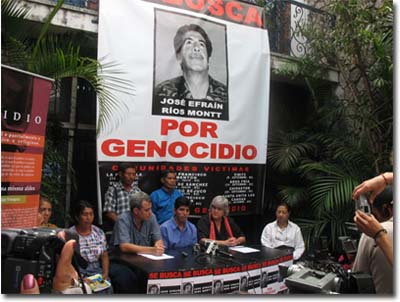
This trial is significant on lots of levels. First, it is significant for the Guatemalans who have been organizing and demanding for years that Montt be held accountable for his crimes against the Guatemalan people while he was ruler of the country for roughly 18 months in the early 1980s.
Montt, after taking power in a military coup, disbanded the Guatemalan constitution and continued a campaign of terror against Guatemalan civil society that had been going on in varying degrees since the CIA coup of 1954. However, under Montt, the brutality was taken to another level and the Mayan population was targeted by genocidal policies that resulted in tens of thousands being killed during Montt’s short time in the National Palace.
The charges against Montt are well documented by numerous Guatemalan Human Rights groups like Grupo Apoyo de Mutuo and the National Security Archives, which has been collecting declassified documents from the US and Guatemala that relate to political violence since 1954. The National Security Archive has a great deal of these documents along with analysis that can be found here.
The trial of Efrain Rios Montt is also significant for the US, since Montt was considered an ally by the US government, particularly the Reagan administration. The Reagan administration provided financial & military support for Montt’s regime, thus making the US complicit in the genocidal policies committed at that time.
Sectors of the religious community in the US are also to blame for these crimes, as Montt had converted to evangelical Christianity in the mid – 70s and worked closely with US evangelicals, particularly a group from California called the Church of the Word. This relationship is detailed in the book, Terror in the Land of the Holy Spirit: Guatemala Under General Efrain Rios Montt 1982-1983, written by Virginia Garrard-Burnett. Montt’s own theological views contributed to his military policies. Montt believed that the Mayan were possessed by demons and said that when the military was slaughtering them they were not killing people, but demons.
Lastly, the trial of Efrain Rios Montt is significant for people in West Michigan, because West Michigan is home to thousands of Guatemalans who have migrated to this part of the country in large numbers as a result of the political violence and economic exploitation perpetrates by Montt and other government leaders in Guatemala.
I know this personally, having been part of the US Sanctuary Movement in the 1980s, where we hosted several families from the Huehuetenago region of Guatemala. These political refugees fled the scorched-earth policies of the Montt regime, which had resulted in the murder, disappearance and torture of thousands of Guatemalans.
Following this trial is important, because it not only forces us to come to terms with why so many Guatemalans have come to West Michigan, it also provides the possibility of some political and psychological relief to Guatemalans who still live in fear of speaking out about what happened in the genocidal years. If Montt is found guilty and justice is served in some way, imagine how important this will be to the Guatemalan people and the possibilities for systemic change in the future.
For those wanting to follow the trial of Efrain Rios Montt, check out http://www.riosmontt-trial.org/. Also, there will a screening of a recent documentary on the genocide charges against Montt, Granito, that will be shown on April 6th in Grand Rapids.
This article by Andrea Germanos is re-posted from Common Dreams.
In what some see as an attempt to muzzle critics, Walmart is suing a union and other groups over protests that sought to highlight the retail behemoth’s low pay and poor working conditions.
The lawsuit targets the 1.3 million-strong United Food and Commercial Workers International Union (UFCW), OUR Walmart, which is made up of “associates” of Walmart, and another group over repeated protest actions in over a dozen states, Bloomberg reports.
Walmart’s suit seeks to stop the groups from being able to picket or protest on its property, Bloomberg reports. Reuters adds:
Wal-Mart alleged that the defendants violated Florida law through coordinated, statewide acts of trespass in several Walmart stores over the last eight months.
What the suit is really about, say some of the defendants, is silencing criticism of Walmart’s corporate, and union-preventing, model.
“Rather than creating good jobs with steady hours and affordable healthcare, Walmart’s pattern is to focus its energies on infringing on our freedom of speech,” Reuters reports OUR Walmart as saying in a statement.
Denise Diaz, executive director of Central Florida Jobs With Justice, said, “This is another attempt on Wal-Mart’s behalf of … silencing their employees and also the communities that support them.”
And Walmart may indeed see OUR Walmart as a thorn in its side, as Andy Kroll writes in Mother Jones:
On Black Friday last year, it helped organize protests at nearly 100 Walmart stores in 46 states. An estimated 500 associates walked off the job on the biggest shopping day of the year. Walmart, already facing allegations of bribery in Mexico and unsafe working conditions at its Asian suppliers, asked the National Labor Relations Board (NLRB) to block the protests, saying OUR Walmart was a union front. Store managers received a confidential memo (PDF) on dealing with restive employees (talking point: “I don’t think a walkout is a good way to resolve problems or issues, especially because it interferes with customer service and other associates who want to work”). A company spokesman said on national TV that if workers didn’t show up on Black Friday, “there could be consequences.”
The case, Wal-Mart Stores Inc v. United Food and Commercial Workers International Union et al, merits wide attention, as Josh Eidelson has previously written in The Nation:
Even though Walmart employs just under 1 percent of the American workforce, most of us live in the Walmart economy. Its model has been forced on contractors and suppliers, adopted by competitors and mimicked across industries.
Earlier this month we reported that the Star Tickets Workers Union won their election.
One of the organizers of that campaign was Deirdre Cunningham, a dedicated organizer with the Grand Rapids branch of the IWW. Just minutes ago we found out that the owner of Star Tickets, Jack Karsula, fired Deirdre Cunningham.
The Grand Rapids branch of the IWW just released this statement of solidarity and action:
IWW Organizer Deirdre Cunningham has been fired from Star Tickets after a successful union election. The IWW workers of Star Tickets were officially recognized as the bargaining agent for Star Tickets today. Also today Mrs. Cunningham was fired in retaliation.
Call owner Jack Krasula and demand justice for Deirdre!!
Phone – 248-945-1127
Sample Script:
I’ve been made aware that Deirdre Cunningham has been fired from Star Tickets. On the same day that the IWW Star Tickets Workers Union was certified. I will be letting all my friends and family know what is going on at Star Tickets until you:
Re-instate Deirdre Cunningham
Stop Trying to Bust the Union
Immediately begin bargaining with the Star Tickets Workers Union.
I’m sure you are aware its a violation of federal labor law to retaliate against a worker exercising their right to organize. I hope you’ll make the right decision in this matter.
IWW organizer Cole Dorsey said the local chapter is in the process of organizing a demonstration on behalf of Deirdre. Once we hear of any plans we will post them and you can check the Star Tickets Workers Union Facebook page for updates.
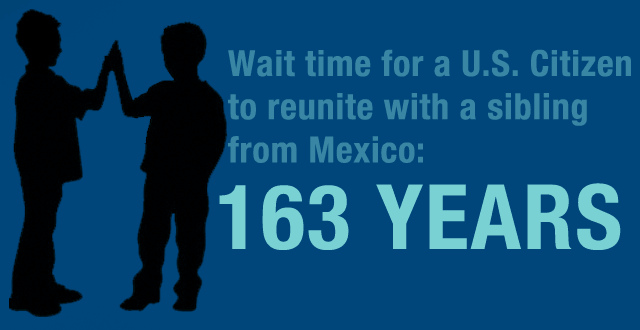
Could You Wait 163 Years to be Reunited With Your Family?
This article from Jorge Rivas is re-posted from Colorlines.
Have you ever heard someone argue that all immigrants should just “get in line” and apply to come to the United States legally?
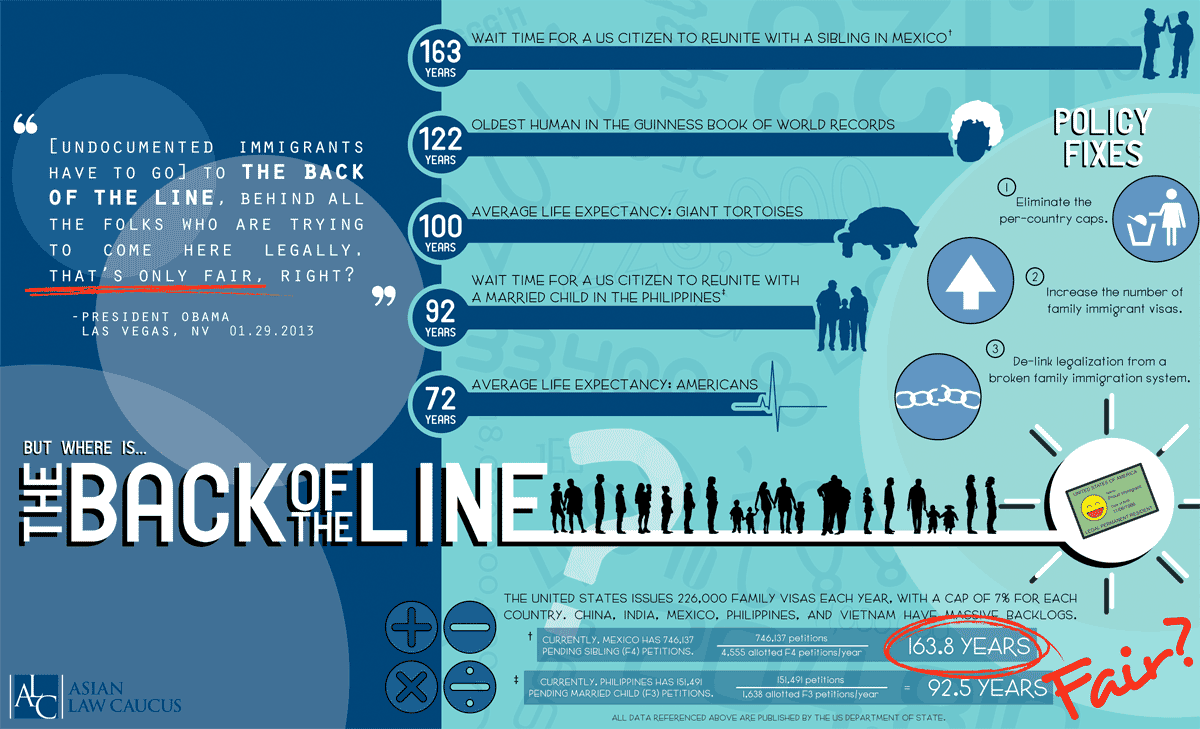
During his immigration reform speech in Las Vegas earlier this year, President Obama said “[undocumented immigrants have to go] to the back of the line, behind all the folks who are trying to come here legally. That’s only fair, right?”
But is it fair? Check out the infographic below from the Asian Law Caucus.
Updated Branded Alphabet Media Literacy Exercise
There have been numerous changes to the Obama administration and its cabinet members in recent months, which has prompted us to update the Brand Alphabet Exercise.

This media literacy exercise has been useful over the years as a mechanism to begin a conversation around what we know and what we don’t know, based on what the commercial news media gives us.
Since we live in a hyper-marketing media world, it is much easier for people to recognize branded products than to identify people at high-level positions in the federal government.
This is not some conspiracy to keep the public ignorant, rather it is the outcome of a media system that is profit driven, where the standards of journalism have declined and are in constant competition with corporate media’s desire to get good ratings/more readers.

Test your knowledge and do the two part exercise. In part I, identify the products, based on the letters. In Part II, identify the current list of people in the Obama administration, both their names and what position they hold.
The answers can be found here.
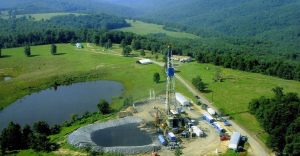
Last night, people from all over West Michigan attended a public forum on the growing practice of hydraulic fracturing. This forum, unlike the ones organized by State Legislators in the area did not include representatives from the MDEQ and Michigan DNR, which have been taking a pro-fracking position.
The event was co-sponsored by three groups, Kent County Water Conservation, Citizens for Responsible Resource Management and Mutual Aid Grand Rapids. All three groups oppose hydraulic fracturing on the grounds that it contaminates the water & land, perpetuates our dependency on fossil fuels and contributes significantly to climate change.

The forum consisted of a presentation by GRCC professor, Maryann Lesert, who has been doing research on this issue and presenting at many forums across the state. Lesert, asked that people who were not with the co-sponsoring organizations refrain from recording the forum. One man, with the oil & gas industry, refused to comply and numerous people surrounded him and prevented him from recording the event. We found out later that person was Eric Bauss, with the company Energy In Depth.
Maryann presented a great deal of information on the ecological and human health impact of fracking, as well as first hand images of fracking sites in the state. The number of sites is only likely to increase in the near future, based on the amount of land that has been publicly and privately leased in the state over the past year. The map below shows the sites in Kent County that were leased in October at the DNR auction in Lansing.
We have also discovered that over 400 plots of private land has been leased by a number of private oil & gas companies or front companies that have purchased the leases, based on county records.
After the talk, time was allotted for questions and comments. Many people expressed concern over the long term environmental effects of fracking and were angered at what has been taking place in Michigan without much public input in the process. Several people said they were afraid of what will happen if oil & gas companies were allowed to move forward and set up more fracking sites all across the state.
There were some antagonistic questions posed by representatives from the oil & gas industry. One oil & gas representative kept asking questions, even though everyone else had been given an opportunity to ask just one question. This person arrogantly kept asking questions and making statements to try to undermine the credibility of what Lesert had presented, but it seemed clear to this writer that people were just agitated by the disrespectful behavior of the oil & gas man.
The three sponsoring groups all had information tables and people took virtually everything that was offered, reflecting a strong interest from people that they wanted to know about this issue. One group even had a large map of Kent County that listed privately owned land that has been leased to the oil & gas industry, which lots of people looked at and expressed concern over, since many of those in attendance live near these sites.
The oil & gas industry set up a table outside the meeting space with their propaganda, despite not being a co-sponsoring group and never getting permission from the groups who organized the event. Their behavior reflected a sense of desperation that more and more of the public was now aware of the consequences of hydraulic fracturing, along with the growing opposition.

The following pictures were provided by Jeff Wilkinson, with Kent County Water Conservation.


Ford Goes Further By Stuffing Bound Gagged Women Into the Back of Their Cars to Sell Them

This article by Abby Zimet is re-posted from Common Dreams. Editor’s Note: These ads by Ford are appalling, but not surprising, considering the normalizing of the objectification of women in media. Our recent study of gender representation in 2012 films, underlines how the objectification of women and normalizing male dominance are constantly represented in popular media. The more important question we all need to ask is what is the correlation between media representation of women and violence against women?
An Indian ad agency had the brilliant idea for this real-live Ford ad, part of a series of grotesque ads mostly featuring semi-naked women bound and gagged under the tagline, “Leave Your Worries Behind with the Figo’s extra-large boot.” Of three ads, one had famously-womanizing Italian Prime Minister Silvio Berlusconi in the driver’s seat.
Another had, somewhat inexplicably, Paris Hilton and the Kardashians, and one showed all men. After the ads were posted online, but before they were officially approved, they caused a wee bit of a stir, though Italian coverage seemed to worry more about giving offense to Berlusconi than to women.
The ads were subsequently pulled and Ford apologized for images “contrary to the standards of professionalism and decency.” Given pretty much everything about the ads – not least of which the fact they appeared in India, where a woman is said to be raped every 20 minutes – you think?

 Grand Rapids Institute for Information Democracy