When We Fight, We Win: Grand Rapids Homes for All
Last Thursday evening, another 70 people showed up to talk about rent increases, gentrification, landlord abuse and alternatives to “market rate” housing in Grand Rapids.
Building on the first gathering in late February, the Grand Rapids Homes for All movement took its next step by continuing to develop some focus around what needs to be done to combat gentrification and the growing disparities between upscale housing and affordable housing.

One important step that the local effort took was to join the national Homes for All campaign and sign the pledge. This decision not only provides Grand Rapids housing activists an opportunity to utilize the resources of the national campaign, but it provides peer to peer training, which has the potential to lead to an effective and deeply intersectional campaign.
The meeting last Thursday already followed the national model of developing working groups; Renters Rights, Development without Displacement and Alternative Models of Housing for People Not Profit. These three working groups provide a cohesive framework for moving forward and addressing very specific needs in the community.
The Renters Rights track entails the fight for renters rights ordinances across a city/county/state or contracts with individual landlords and approaches that organize mass numbers of renters into renters rights formations to fight displacement and advance the political power of the renter nation.
The Alternative Models of Housing for People Not Profit track represents transformative solutions that seek to create the new world we seek now. These campaigns center on acquiring collective community ownership of land and establishing democratic Community Land Trusts as an essential first step in taking land off the speculative market and establishing permanent community control. Collective ownership of the housing, cultural space, green space and worker cooperatives are also essential to the establishment of our holistic vision of community control, not in just one arena but all those that are critical for our communities to thrive and each of us reach our full potential.
The Development Without Displacement track unites campaigns across the country in which communities are fighting big developers and gentrifiers to ensure that all current residents (predominantly people of color) in communities facing gentrification win agreements and guarantees to ensure that they can stay in their community and help shape and benefit from the development.
Each of these three areas of organizing are based on the shared values of the Homes for All campaign. The four shared values are:
- Community and Housing are a human right, not a commodity to be exploited for profit.
- Land and Housing should be collectively owned and controlled by communities.
- Land and Housing should be developed in a way that is sustainable for the planet.
- Land and Housing should be accessible, permanent, quality, and connected to economic, social and cultural networks and institutions.
These values provide an important framework for doing the necessary organizing that promotes housing justice, challenges gentrification and displacement and creates a movement for social justice.
The working groups have already identified several key areas of work, such as doing renters rights training, doing a landlord by landlord campaign to win contracts and rent controls, creating a renters union, holding elected officials and developers accountable and looking at alternative forms of housing that is based on cooperation.
The timing of this organizing work has also coincided with the opportunity for a few of us to spend the weekend in Chicago, attending a Homes for All national retreat, featuring 135 organizers from around the country that have been engaged in amazing work. The weekend was spent sharing stories in the struggle, learning models of organizing, sharing tactics, connecting with communities and developing strategies for the next phase of the national Homes for All campaign.
The weekend was truly inspiring, since not only did it bring together so many organizers, it demonstrated that there is power in direct action. What this often means is that, despite the limitations of the law around issues like rent control, people have been able to win collective bargaining and contracts landlord by landlord or building by building throughout the country. Here is just a sampling of the victories that have been won when direct action efforts are applied. 
We participated in the Renters Rights organizing committee, which also meant we discussed Corporate Landlords. Corporate Landlords are property management companies, which own a substantial amount of property and are able raise housing costs because of the volume they deal with. One of the largest private companies is Blackstone and the Homes for All campaign has even created a major report on what this company does, primarily with rental units under the banner of Invitation Homes.
The Corporate Landlord organizing effort around Blackstone provides a great example of how to challenge rent increases and organize renters building by building and community by community.
What was also inspiring about the weekend was the clarity it gave around ways to do organizing campaigns and how to create horizontal models for social justice. The retreat emphasized that the movement around renters rights, displacement and anti-gentrification work must be led by those most impacted, which are often working class communities of color. In fact, the retreat practiced this core value by making sure that those who led most of the sessions and talked about their work were women of color.
If we are to have an authentic housing justice movement in Grand Rapids, we too need to make sure that it is led by those most impacted as well.
For those interested in being part of this work, the next meeting will be held on Thursday, May 12, 6pm at Hope Church on the corner of Burton and Kalamazoo SE.
Grand Rapids City Commissioners vote unanimously to approve $250,000 – $300,000 Condo Project
We recently found out that the Coit Square Project was set for a vote by the Grand Rapids City Commission. The Coit Square Project, along with other developments in the Belknap Lookout area, have come under increased scrutiny due to the gentrification and displacement taking place.

The Grand Rapids Planning Commission had already unanimously approved the Coit Square Project and now it was up to the City Commission to make a decision. However, there was a planned public hearing for this issue, which was taken off the table and the City Commission was just going to decide on a vote.
The Commission meeting was packed tonight, with standing room only. Shortly after the opening formalities, the City Commission invited people to comment on items on the agenda, one of which was the Coit Square Project.
The Coit Square Project is important, in that it further contributes to gentrification, after the GVSU project had already begun this process.
Several people had already submitted letters to the City Commission on the Coit Square Project. One, in particular, is worth quoting. Chuck Skala, with the Micah Center, wrote these comments to the City Commission.
“The GREAT HOUSING STRATEGIES Plan states, at page 27, that it is a goal of the City of Grand Rapids to “ENCOURAGE MIXED-INCOME NEIGHBORHOODS.”
The Plan document elaborates, moreover, “The importance of mixed-income neighborhoods was identified as a priority throughout the Great Housing Strategies process. While reinvestment and development are positive, a concentration of either market-rate or rent assisted development may have negative effects on a neighborhood.” “An intentional balance is necessary for the health and success of all city neighborhoods.”
We whole heartedly agree!
We very much appreciate the current mixed-income character of the Belknap Lookout neighborhood, and we want to preserve it. That character is threatened by the Coit Square project that proposes to demolish 22 low-income housing units and replace them with 39 up-scale, market-rate, $250,000 – $300,000 condominiums.
Approval of Coit Square, as it is now contemplated, would potentially contribute to a chain-reaction, domino effect of such developments resulting in, not mixed-income housing, but stratifed-income housing in the extreme.”
Other members of the Micah Center and affordable housing advocates also called on the City to not vote and hold a public hearing, as they believe the process has been flawed and that the developer in question (Angel Gonzalez) is on the board of the neighborhood association, which they believe is a conflict of interest.
Angel Gonzalez, with the Artisean Group did speak before the City Commission, most about how he was a self-made man and was committed to the stability of the neighborhood. Gonzalez did send out a memo about his intentions, but the intentions falls way short of the commitment of the city to have more affordable homes and rental properties in neighborhoods like Belknap.
The City Commission then voted unanimously to approve the plan to build the $250,000 – $300,000 condos. What was interesting is that almost every commissioner spoke about how the process did take into consideration neighborhood interests, but that there were no easy answers.
So, how does the decision to support such a project fit with the City’s commitment to provide more affordable housing options? What kind of message does it send to people who are experiencing poverty and come from more marginalized communities about how they are valued? These are important questions that need to be addressed, but it didn’t seem as if those questions were being addressed honestly on this night.
Afterwards, I spoke with two teachers from Coit School, who believe that their days are numbered and that the future of Coit School is being threatened by the changing demographics in that neighborhood. One teacher said, “what has been happening to Detroit is the same thing that is happening in Grand Rapids. The city didn’t care about certain neighborhoods for years and now they want to provide all kinds of financial incentives to people to re-develop neighborhoods that are forcing people out.”
The DeVos Family is once again buying political influence
According to recent reports from the Michigan Campaign Finance Network, the DeVos Family has once again out spent virtually everyone in the state when it comes to buying elections. 
Based on data from the most recent Federal Election Commission findings, the DeVos Family spent $1.32 million on Super PAC funding. This includes money given to Marco Rubio’s Conservative Solutions PAC, A New Day for America PAC (John Kasich), Right to Rise PAC (Jeb Bush) and the CARLY for America PAC (pro-Florina).
The largest chunk of DeVos Family money was donated to Rubio’s Conservative Solutions PAC, despite the fact that Senator Rubio has recently dropped out of the race for the GOP nomination. This has not and will not deter the DeVos Family as they continue to be the largest electoral donor in Michigan. The DeVos Family also gives a substantial amount to the State Republican Committee, which can decide what races it want to give money to. In many ways, the DeVos Family has been much more interested in state politics, as is evidenced by recent influence peddling with the state legislature.
Speaking of buying State Policy
The other major campaign finance issue in Michigan has been the amount of money going to influence state education policy, particularly in Detroit.
The DeVos Family has contributed $1.22 million to individuals and two caucus committees. Betsy DeVos is front and center in the battle to get Charter Schools and private education as “schools of choice.” She recently made her views know in a February opinion piece published in the Detroit News.
“The state should “liberate all students from this woefully under-performing district model and provide in its place a system of schools where performance and competition create high-quality opportunities for kids.” The state “should expand school choice so students could use state education funds at the public or private school of their choice.”
Other potential reforms touted by Betsy DeVos: A-F letter grading for schools; alternative certification for teachers; and a ban on teacher sickouts. Here is where the DeVos Family spent their money on privatizing education in Michigan.
1. House Republican Campaign Committee, $480,000
2. Senate Republican Campaign Committee, $281,000
3. Gov. Rick Snyder, $34,000
4. Lt. Gov. Brian Calley, $20,400
5. Sen. Margaret O’Brien (R-Portage), $19,000
(Tie) 6. Rep. Brandt Iden (R-Oshtemo Twp.), $18,000
(Tie) 6. Rep. Holly Hughes (R-Montague), $18,000
(Tie) 6. Sen. Marty Knollenberg (R-Troy), $18,000
(Tie) 6. Sen. Wayne Schmidt (R-Traverse City), $18,000
(Tie) 10. Rep. John Bizon (R-Battle Creek), $16,000
(Tie) 10. Sen. Mike Kowall (R-White Lake), $16,000
(Tie) 10. Sen. Jim Marleau (R-Lake Orion), $16,00
(Tie) 13. Sen. Peter MacGregor (R-Rockford) $14,000
(Tie) 13. Rep. Klint Kesto (R-Commerce Twp.) $14,000
(Tie) 13. Rep. Tom Barrett (R-Potterville), $14,000
(Tie) 13. Sen. Phil Pavlov (R-St. Clair) $14,000
(Tie) 13. Sen. Goeff Hansen (R-Hart), $14,000
Betsy DeVos is a member of the American Federation for Children, a national right wing lobbying effort on privatizing education.


Yesterday, activists involved with the Grand Rapids BDS (Boycott, Divestment & Sanctions) campaign went to downtown during the lunch hour to pass out flyers for Israeli Apartheid Week.
Israeli Apartheid is the ongoing oppression of Palestinian people, plus the illegal occupation of Palestinian land. For those who are not familiar with Israeli Apartheid (directed at Palestinians), check out the important resources from the End the Occupation campaign.
The target of Israeli Apartheid Week was the Right Place Inc. and for 2 main reasons.
First, the pro-business entity recruits businesses to West Michigan. Therefore, they have recruited the military contractor Plasan North America, http://www.plasan-na.com/ based in Walker, Michigan. Plasan is not just any military contractor, they are an Israeli-owned military contractor with facilities in the US, France and Israel. Plasan not only makes weapons, but provides “security resources and solutions” that focus on Border Protection, Special Forces Operations, Intelligence Missions, Disaster Management, and Convoy & VIP Protection. Here is a sample of “services” they offer with the products, which is taken from their own promotional material.
Second, The Right Place Inc., actively recruits Israeli businesses and promotes Israeli products. They do this through the Michigan Israel Business Bridge (MIBB), a Bloomfield Hills-based entity. The Right Place Inc. CEO ,Birgit Klohs, is part of the Advisory Council for the MIBB.
The action the Grand Rapids BDS Campaign took for Israeli Apartheid Week was to hand out flyers about the pro-Israeli practices of The Right Place Inc. Several hundred flyers were distributed during the lunch hour in downtown Grand Rapids. People were mostly receptive to the information and many people admitted that they knew very little about Israeli Apartheid.
At one point a representative of The Right Place Inc. took pictures of the demonstration, but chose not to engage people as to why they took action.
Here is the flyer that was handed out during the action taken during Israeli Apartheid Week.

Anti-Gentrification Movement comes to Grand Rapids

For years now Grand Rapids has been plagued by gentrification in numerous areas, like Wealthy street, the Belknap neighborhood, the Division/Wealthy area and the near west side. There has even been plans to gentrify part of the southeast by Rockford Construction, until their plans were exposed.
Grand Rapids needs to challenge these developers and push back against the city of Grand Rapids, which seems to be complicit or at least unwilling to slow down this process.
Many people are subjected to significant rent increases, unable to afford property taxes that have sky-rocketed and landlords who are willing to sell to larger businesses that are buying up property all over the city.
Grand Rapids Homes For All
Fortunately, there is an effort underway that seeks to challenge the gentrifying forces and create a movement for those most impacted and most vulnerable to displacement.
Grand Rapids has been working with the national organization, the Right to the City, with their Homes for All Campaign. Homes for All is a national campaign uniting renters and residents facing displacement in cities across the country to fight for and win renters’ rights and community control of land and housing. Homes For All is playing a central role in building the tenants’ and housing and land justice movement from city to city through translocal campaigns. The campaign recognizes racism has always shaped housing and land policies and practices in the US. Thus, while the campaign brings together a wide range of allies, Homes For All is led by communities of color and working class communities that are hardest hit. These campaigns strive to link common local campaigns together to share best practices, build momentum across cities and provide support with trainings and mentorship.
The Homes for All Campaign is based on three strategies: renters rights, Alternative Models of Housing for People Not Profit and Development Without Displacement. These three strategies will be laid out at our next meeting, on Thursday, April 14. People will be asked to participate in these working groups and further develop these strategies to promote housing justice.
The meeting is scheduled for Thursday, April 14 at 6pm and will be located at the Kent County Health Department 700 Fuller NE.
This is an autonomous and grassroots movement that will be driven by those most vulnerable to displacement. Click on the facebook event page.
Two weeks we wrote an article that was critical of the Cesar Chavez march held on Thursday, March 17 in Grand Rapids. Last week we wrote a piece on intimidation tactics being used against GVSU students standing in solidarity with Grand Rapids transit workers. This week, Grand Rapids is getting the attention from two national civil rights and civil liberties organizations. 
The national office of the United Farm Workers has sent a scathing letter to the Mayor of Grand Rapids, Rosalynn Bliss.
Bliss, who was at the front of the Cesar Chavez march last Thursday, received a letter from the President of the United Farm Workers, Arturo Rodriguez.
“On behalf of the more than 10,000 members of the United Farm Workers, I am writing to express our deep disappointment in the breathtaking hypocrisy demonstrated by your administration this past week. On Thursday, March 17, you marched under our banner to commemorate the work of an American icon and our founder, Cesar Chavez. The very next day, on Friday, March 18, you dispatched Grand Rapids Police to the homes of student activists to intimidate them for organizing a January sit in to support transit workers represented by Amalgamated Transit Union (ATU) Local 836.
You cannot march in the name of Cesar Chavez one day and use police officers to suppress all that he fought for the next. The United Farm Workers stands in solidarity with our ATU brothers and sisters struggling to preserve their retirement security and the United Students Against Sweatshops (USAS) who, in an inspiring acts of selflessness, have embraced their elders fight as their own.
I also write to call you to a higher purpose than implementing an austerity agenda that may win accolades from the comfortable, but will destroy the lives of the constituents who are counting on you the most. We ask that you adopt the spirit of our heroes – Cesar Chavez, Rosa Parks, Martin Luther King Jr. – whose names adorn your city streets and parks by rejecting the tactics who opposed and oppressed them in their lifetimes.
The letter from the United Farm Workers is dated March 25.
On the same day, Mayor Bliss received another letter from the Bill of Rights Defense Committee/Defending Dissent Foundation. That letter states in part:
The Bill of Rights Defense Committee/Defending Dissent Foundation strongly condemns the ongoing campaign of intimidation against transit workers and students in Grand Rapids, Michigan. The struggle for workers rights has always been closely aligned with the struggle for free speech. We honor the commitment of these students and workers to speak truth to power, and deplore the tactics employed by the City and the transit agency to silence them.
In January, Grand Valley State United Students Against Sweatshops staged a day of actions in support of the ATU workers. These actions included both a fare strike and a sit-in. The sit-in took place at a public meeting of the transit authority and was made up of mostly students and community supporters. Students report that the plan was to stage the sit-in when the transit authority moved from public session to executive session and leave when asked to do so by the police. Although police were present, at no point did they ask the protesters to leave and the protesters ultimately left of their own accord.
On Friday March 18–nearly two months later–police showed up at the doors of the students and a worker who participated in the sit-in, asking them questions about fellow activists, and telling them they might at some point in the future be arrested over the sit- in. The baffling and quite frankly absurd nature of this train of events indicates that the police have very little interest in actual law enforcement and are merely attempting to intimidate students and workers from participating in protest actions. In a free society, law enforcement is not used to silence dissent. Such actions are intolerable.
To view both letters in their entirety, click here.
Students in Grand Rapids and across the state participate in action to draw attention to Gov. Snyder’s Austerity Politics

Earlier today in Grand Rapids, Detroit and Ann Arbor, students with the Michigan Student Power Network took part in an action to challenge the brutal effects of economic austerity measures throughout the state.
The Michigan Student Power Network media release states, “Beginning at 8 am on Tuesday the 29th we will be driving side by side in teams at multiple locations around the state, slowing traffic, in protest against the Emergency Financial Manager law and Governor Snyder’s failure to resign in the wake of the Flint Water Crisis.”
This action takes its inspiration from the 1936/37 Sit Down Strike in Flint, which literally shut down production at the GM plant in Flint and had a ripple effect on the auto industry and sent a strong message to the capitalist class that workers will not be exploited. 
The media release went on to say:
“As the scope of the Flint water crisis has become public, it has become a touchstone for popular resentment against a government; however this is just the latest, though most heinous, in a long series of corporate backed austerity policies that have stripped Michiganders of support, services, and rights, in order to protect private profit margins. These policies have served simply to further enrich Michigan’s wealthiest people and corporations; groups that coincidentally invested heavily in supporting the ruling conservative politicians.
We believe that fighting austerity begins with repealing its greatest weapon: The Emergency Financial Manager. We are demanding that the legislature pass, and the governor sign, HB 5260, a proposed repeal of the current EFM law. Direct action will be taken all across the state to show the people’s discontent with the EFM law and with the way our state is placing profit above people.”
GRIID also interviewed Lindsey Disler, with the GVSU United Students Against Sweatshops and the Michigan Student Power Network.
Earlier today, Todd Robinson, author of the important book, A City Within A City: The Black Freedom Struggle in Grand Rapids, Michigan, spoke to an audience attending the Kutsche Office of Local History forum at GVSU. 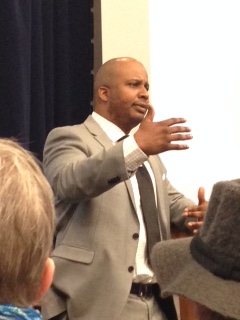
Robinson, who is working on a follow up book that will cover the mid-1970s to the present, provided an overview of his book and touched on some major themes.
By way of creating a framework for talking about Jim Crow era policies in Grand Rapids, Robinson showed a couple of ads used by Grand Rapids businesses in the early part of the 20th century.
The first ad was from the Vinkemulder Company and was an ad for watermelons that used a racist depiction of Black people to sell the fruit. Robinson said this ad was directed at local people, which is why the ad was crass. The second ad was from the
St. Johns Table Company ad featuring an image of a Black servant. Here, Robinson was saying that the ad was meant for the outside world, so the imagery is less crass, but equally racist.
Robison used these images to make the point that the harm done by racist images and racist practices are no less damaging, even if the images and practices are less in your face. In many ways, this sums up much of Grand Rapids and its historical treatment of African Americans, where they weren’t using water hoses of Blacks, instead used tactics that still made it difficult for Blacks to achieve justice.
Next Robison referred to the 1950s as the “Golden Era”, with new housing construction and the growth of the middle class. This is a romanticized and sanitized period, a period of American history that white people remember fondly.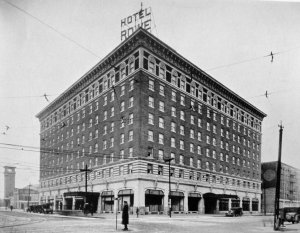
However, for Black people, the 1950s was still a period of Jim Crow policies, even in Grand Rapids, where racism dictated where they could and could not eat, shop and go to school.
This is why the action that Milo Brown and his wife engaged in at the Rowe Hotel (pictured here) was so important, because it was one of the first known instances where a Black couple came into a segregated restaurant and ordered food.
Robinson believes there is a heighten level of etiquette in Grand Rapids around race relations, where white people want to believe that things are pretty good. The author said, “Grand Rapids loves to put on a performance, but what is missing are the hidden transcripts,” the unacceptable, even subversive narrative that pulls back the veil and reveals something else.
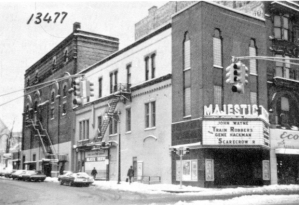
This performance narrative around racism was also practiced in places like the old Majestic Theater in Grand Rapids. This was a place where White and Black patrons could walk up and buy tickets, but once they went inside, Black patrons were directed to the balcony, but White patrons could sit where ever they damn well pleased.
Robinson also showed images of map that reflected the practice of Red Lining in Grand Rapids. However, Robinson made it clear to those in attendance that this federal government sanctioned practice not only impacted where people could live, but schools their children would attend. Again, much of this happened during the so-called “Golden Era” in the US and Grand Rapids.
One last example of the kind of veiled racism or what he calls in his book, Managerial Racism, was when Black Power activist Stokley Carmichael came to Grand Rapids and spoke at Fountain Street Church in 1967. Robinson said that at one point during the evening a White woman got up and said, “I don’t understand why Carmichael was brought here, because Grand Rapids has always been so good to you people.”
In many ways, this comment reflects the general attitude of most White people who still believe that Black people have been treated “pretty well” in Grand Rapids.
Robison certainly provided some great analysis and information that can inform where we go from here, which will not be easy. Much of Grand Rapids is still in denial about how deeply racist this city is, particularly on a structural level.
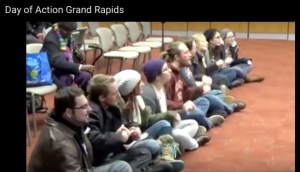
In late January we posted a story about the Day of Action organized by members of the local bus drivers union (ATUGR) and students from the GVSU chapter of United Students Against Sweatshops (USAS).
Those who participated in the Day of Action hung banners, passed out flyers on buses and engaged in a sit in during the monthly Rapid Board meeting. The Rapid decided to call the police and police told the sit in participants that if they didn’t leave they would be arrested. Everyone complied and left the Rapid Board meeting. End of story, or so it would seem.
The ATUGR and students with the GVSU chapter of USAS are now reporting that, “Grand Rapids police detectives went to the homes of students and workers, threatening them with charges of disturbing the peace for their participation in the January sit-in to protest the proposed fare increases, the termination of workers’ pensions, and stalled contract negotiations between ATU Local 836 and The Rapid.”
Late last year a federal court ruled that The Rapid could not prohibit or interfere with the free speech rights of ATU Local 836 members working for the agency. However, The Rapid has suspended one of the ATU Local 836 members for speaking out during The Rapid board meetings.
In a recent press release ATU International President Larry Hanley, stated, “This is a witch-hunt by Rapid CEO Peter Varga and the City of Grand Rapids that knows no bounds. We will continue this fight for as long as it takes to protect the students, our riders, and the livelihoods of our Rapid workers.”
The press release also included comments from one GVSU USAS member who said, “I was surprised and scared that there was a Grand Rapids police detective at my door to question me,” says Grand Valley State University junior Jen Knickerbocker “It’s very frightening to be told you are going to be charged with a crime for participating in a peaceful protest at a public meeting.
“It’s clear to me that the city and The Rapid will stop at nothing to silence anyone who stands in their way. The very fact that the mayor and The Rapid are using police officers as political operatives to intimidate members of the community should alarm everyone.” Knickerbocker says the detective also asked her about fellow students who also attended the sit-in.
We contacted another organizer and participant in the Day of Action sit in, Lindsey Disler. She stated, “It seems ridiculous that they would start coming after us 2 months after the event took place, and after a federal judge ruled that there could be protests at board meetings. It honestly seems like they are just trying to scare us into silence and it wont work. “
Grand Rapids has a long history of union busting and intimidation of workers demanding justice. Despite the continuous accolades this city receives about being progressive, this most recent round of intimidation tactics only demonstrates that this City doesn’t tolerate disobedient workers, especially those that challenge power.
Cops, Power and the Protest against Snyder’s Econ Club visit

Yesterday, roughly 30 people gathered at the main entrance of the JW Marriott Hotel to to protest the guest speaker, Michigan Gov. Rick Snyder.
Within minutes, the management of the hotel had come out to tell those protesting that they needed to leave or the Grand Rapids Police Department would be called. Hotel management even had a form letter, with a penciled in date, that they thought would intimidate people and make them leave. The letter did not have the desired effect they thought it would, so the GRPD was called.
In the meantime, as members of the Econ Club were entering the building people began to engage them on the issue of how the state government and Governor Snyder had created the crisis in Flint. People were making the assertion that that what happened in Flint was criminal and that it was the result of policies ( Emergency Management and other Neoliberal Capitalist austerity measures). Such sentiments were reflected in many of the signs people held up during the protest.
On several occasions those going into the building engaged in rather arrogant and privileged behavior, telling people present to “get a job” and asking participants why “they had nothing else better to do.” Such response were expected from members of the Econ Club, who generally represent members of the capitalist class, as we pointed out in a recent article.
About 30 minutes after protestors were notified that the cops had been called, the GRPD showed up. At one point this writer had counted 5 police cruisers and at least 8 officers. The police told those there to confront Snyder and his supporters that if they didn’t leave they would be arrested. Several people attempted to engage the policy with questions like, “so if I deliberated poisoned children, would you arrest me” and “are you here to arrest the governor?”

The cops said they were not there to “debate” these issues, but to enforce private property rights. Such evasions are typical of cops at these kinds of demonstrations as they know they don’t have a leg to stand on in terms of what many people would see as selective enforcement of the law. In other words, government policy and private businesses can cause all kinds of harm to people and these are either seen as “mistakes” or externalities…..meaning it is just part of doing business.
This of course speaks to the real function of law enforcement agencies, which is to protect power, both economic and political power. If anyone who is part of the general public steals a wallet or assaults a child there would be clear consequences, most likely fines and jail time. However, when governments poison a whole community or when businesses fire people or subject them to unhealthy, even dangers work conditions, that is not viewed as criminal or pathological behavior.
Cops function to protect the system and maintain order, which is code for maintaining business as usual. Those of us who truly want substantive change, revolutionary change, must come to terms with this role that the police play in an authoritarian capitalist society.
The other thing that those who want revolutionary change must come to terms with is that if we want serious, systemic change to take place, we have to think of using other tactics and strategies that will actually threaten and dismantle political and economic power.
Thanks to Mike Saunders and Pete Walsh for contributing photos for this article.
 Grand Rapids Institute for Information Democracy