Philanthropy is just reputation laundering for the oligarchy.
It is that time of the year again, when GRIID posts about the various West Michigan Foundations from families that make up the Grand Rapids Power Structure. I start with the DeVos family, which has 5 different foundations.
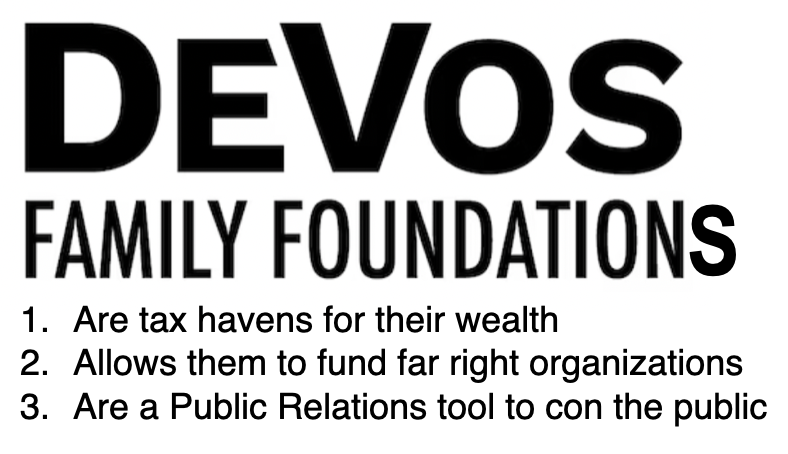
The DeVos Family Foundation
GRIID has always begun our Foundation Watch work by looking at the foundations associated with the most powerful family in West Michigan, the DeVos family. Four weeks ago I looked at the Dick and Betsy DeVos Foundation, then three weeks ago I investigated the Doug and Maria DeVos Foundation. Two weeks ago it was the Dan and Pamela DeVos Foundation, and last week it was the CDV5 Foundation, which is the Cheri DeVos Foundation. Today, I want to look at the DeVos Family Foundation.
According to GuideStar, in 2023, the DeVos Family Foundation contributed $4,372,976 leaving them with $4,825 of funds left in their foundation account.
The DeVos Family Foundation made contributions to dozens of entities in 2023, but there are some clear categories of groups they contributed to, such as the Religious Right, Think Tanks, Education-centered groups, and social service entities, to name a few.
However, what is different about the DeVos Family Foundation in relation to the other DeVos Foundations is that this foundation is what remains of the Richard and Helen DeVos Foundation, which is why as of 2023 there was only $4,825 of funds left in that foundation account. You can also see from the 990 document for 2023, there are several Florida-based recipients, which makes sense, since this was where Rich and Helen DeVos spent more of their time in their final years.
Here is a list of some of the Florida-based recipients, followed by a list of the contributions to DeVos created entities.
Florida-based recipients:
- AdventHealth Foundation Central Florida – $150,000
- Covenant House Florida – $60,000
- Education Foundation Osceola County – $15,000
- Every Kid Outreach – $15,000
- First Tee of Central Florida – $10,000
- Foundation for Orange County Public Schools – $15,000
- Foundation for Seminole County Public Schools – $15,000
- Habitat for Humanity Greater Orlando and Osceola County – $150,000
- Harbor House of Central Florida – $95,000
- Lift Orlando – $150,000
- New Image Center – $60,000
- United Against Poverty – $45,000
- Urban Think Foundation Inc. – $30,000
- Zebra Coalition – $30,000
DeVos-owned, created or connected groups
- Alliance for Children Everywhere – $500,000 – Amway provides material support and several DeVos Foundations are partnersChicago Cubs Charities – $10,000
- Corewell Health Foundation – $1,000,000
- Degage Ministries – $300,000 – someone from RDV Corp sits on the Board of Directors
- Orlando Magic Youth Foundation – $385,000
- Start Garden LLC – $360,000
Foundations are tax shelters for the rich
Since the DeVos Family Foundation appears to be phasing out, it is an excellent time to talk about how much money the DeVos family has collectively put into their foundations to avoid that wealth from being taxed.
If you add up the assets from the five DeVos foundations that we have looked at the total comes to $206,104,533.00, which is just shy of a quarter of a billion dollars that the DeVos family has is not taxed.
According to inequality.org, “Private foundations are only required to payout 5 percent of assets annually to charities and donor-advised funds (DAFs) have no payout requirement. To make matters worse, some wealthy donors are playing shell-games to fulfill these minimal obligations.”
In a 2023 report published by inequality.org, entitled, The True cost of Billionaire Philanthropy, the report provides some interesting findings:
- $73.34 billion in tax revenue was lost to the public in 2022 due to personal and corporate charitable deductions.
- If we include just the little data we have about charitable bequests and the investments of charities themselves, the revenue loss is pushed up to roughly $111 billion.
- And if we also include the capital gains revenue lost from the donation of appreciated assets, the true revenue costs of charity likely add up to several hundreds of billions of dollars each year.
Thus, while billionaires like the DeVos family love to brag about their philanthropic giving, the foundations are not only tax havens, they are another mechanism to fund far right and religious right organizations, which is ultimately subsidized by regular taxpayers.
This is why I continue to say during public presentations and on the GRIID blog that while I have nothing but contempt for the DeVos family, it is a mistake if we ignore how strategic they are with their wealth. I am convinced that they are brutal and cruel in how they use their money, but they are not stupid, and it would be a mistake to think so.
Kent County Airport Board Authority statement essentially normalizes human rights violations
Last week I reported on the action that GR Rapid Response to ICE did at the Kent County Airport to inform and dramatize the impact of the Avelo Airlines contract with ICE.
As a follow up to that June 21st action, GR Rapid Response to ICE invited people to attend the Kent County Airport Authority’s monthly board meeting and to pressure the board members to demand that Avelo Airlines end its contact with ICE. Both WOODTV8 and WZZM 13 reported on that meeting, which included comments from several people who want to see Avelo Airlines either be removed from operating at the Kent County Airport or end their contract with ICE.
The Kent County Airport Authority Board did not respond directly to the issues about Avelo Airlines that people raised during their monthly board meeting, but has since released the following statement:
“The airport is required by federal law to allow all airlines to use our gates as long as they comply with FAA rules and regulations and remain in good financial standing. To do otherwise would unfairly discriminate against an airline, which could jeopardize our FAA funding.”
The Kent County Airport Authority statement reveals several things. First, the Kent County Airport Authority is making it clear that even if private airlines have contracts with ICE, contracts that allows them to transport undocumented immigrants to El Salvador with little hope of justice, that this is NOT a violation of the Federal Aviation Authority (FAA). Indeed, having a contract to do harm to immigrants does not violate FAA rules and regulations, which means the FAA rules and regulations normalizes human rights abuses.
Second, the Kent County Airport Authority statement makes it clear that apart from not violating FAA rules and regulations, as long as Avelo Airlines remains “in good financial standing”, they can continue to profit off of human rights abuses. This is exactly why GR Rapid Response to ICE, along with a national movement, is calling for a Boycott of Avelo Airlines, which could impact the financial standing of the airline company. In the toolkit that groups across the country are using to confront Avelo Airlines it states:
If we put pressure on Avelo – “Abduction Air” – management through targeted escalating actions that threaten the company’s reputation and already shaky financial situation, they will be forced to discontinue their DHS contract to avoid insolvency and become an example for other bad actors who provide deportation logistics.
We will do this by strategically influencing different financial levers of Avelo airlines and uplifting competitors who haven’t decided to make the decision to profit off of deportations. Making a clear example of Avelo on what can happen to airlines who participate in deportation logistics will help us ensure that no commercial airline decides to gamble with people’s lives.
This is why a boycott of Avelo Airlines is the most effective strategy at this point, especially since the Federal Aviation Authority condones airlines that have contracts with ICE or any other US government entity that violates human rights.
A few additional talking points are:
- Avelo Airlines says the contract with ICE is necessary for its bottomline, which makes them vulnerable to a Boycott.
- Avelo has cancelled and shifted flight plans before of financial issues – it is clearly struggling with solvency.
- To manage the intake of ICE flights, the company announced it would draw down some scheduled flights in order to operate deportation flights – which it plans to fly on unmarked planes.
- Avelo is trying to raise $100M to expand their operations and is actively trying to hire staff to staff these flights.
Clearly, Avelo Airlines is vulnerable to a Boycott. Use the toolkit, inform people how we won’t tolerate profits over people, and that we can win the battle by targeting Avelo Airlines with a Boycott! Lastly, you can follow https://www.stopavelo.org/ for additional information on the national campaign against Avelo Airlines and follow GR Rapid Response to ICE about other actions regarding Avelo Airlines.
It has been more than 20 months since the Israeli government began their most recent assault on Gaza and the West Bank. The retaliation for the October 7, 2023 Hamas attack in Israel, has escalated to what the international community has called genocide, therefore, GRIID will be providing weekly links to information and analysis that we think can better inform us of what is happening, along with the role that the US government is playing. All of this information is to provide people with the capacity of what Noam Chomsky refers to as, intellectual self-defense.

Information
Israel ‘Disappeared’ Almost 400,000 People in Gaza, Half of Them Children: Report
Gaza First Amendment Alert (6/24/25)
‘An Avoidable Disaster’: Israeli Blockade of Gaza Could Starve Hundreds of Premature Babies
Against Israel’s New Middle East Vision
ISRAELI SOLDIERS KILLED AT LEAST 410 PEOPLE AT FOOD AID SITES IN GAZA THIS MONTH
Gaza’s Grassroots Effort to Ensure Humanitarian Aid Reaches Starving Palestinians
Analysis & History
‘Their Goal Is to Equate Protests for Palestine With Support for Terrorism’
The Crime of Opposing Genocide w/ Kathleen Brown & Michael Mueller
Image used in this post is from Integrated Food Security Phase Classification (IPC).
It is exactly seven years since Movimiento Cosecha and GR Rapid Response to ICE began a campaign to get Kent County to end their contract with ICE.
The Kent County Sheriff’s Department had a contractual agreement to hold immigrants in the Kent County Jail for ICE and ICE would compensate them per person, per bed for as long as they were in the County Jail.

In late June of 2018, there was a call to show up to the Kent County Commission meeting to pressure the commissioners to end the contract with ICE. Roughly 200 people showed up to that meeting, which I wrote about 7 years ago.
ICE eventually ended their contract with Kent County in September of 2019, some 15 months after the End the Contract campaign had begun. To be clear, ICE ended the contract, not Kent County. In fact, there was essentially no support from Republican and Democratic Commissioners to the demand to end their contract with ICE. However, because of the collective efforts of Movimiento Cosecha and GR Rapid Response to use a variety of tactics and strategies, ICE decided to end the contract because of all the publicity the campaign received, both locally and nationally. Here is a list of the tactics the End the Contract campaign used, which is included in my, A People’s History of the End the Contract Campaign in Kent County article.
- We held dozens of strategy meetings, which always resulted in planning future actions.
- We attended every Kent County Commission Meeting to continue to make our demands, to offer testimony on family separation that was happening by ICE in Kent County and to monitor any comments made by commissioners about the contract.
- Some of the people involved in the campaign met with individual commissioners
- We ran a petition campaign to End the Contract, which we delivered at one of the Commission meetings.
- We held a protest outside of Chairman Saalfeld’s home the night before one of the commission meetings.
- We organized several protests at the Kent County Jail.
- We organized several protest outside of the various ICE offices in downtown Grand Rapids.
- We organized a disruption protest during ArtPrize, on their main stage, drawing attention to family separation in Kent County.
- We created educational materials, which we distributed.
- We created artwork and had sign making parties.
- We spoke to community-based groups about the campaign.
- We utilized social media to educate and get the word out about the End the Contract Campaign.
- We held a People’s Commission action during one of the Kent County Commission meetings.
- We worked with the Western Michigan branch of the ACLU and MIRC, who not only obtained their own FOIA documents, but offered their legal expertise on why Kent County was not legally obligated to cooperate with ICE.
Seven years later Movimiento Cosecha and GR Rapid Response to ICE are still resisting ICE in Grand Rapids and Kent County
 Since the first Cosecha march in January, which coincided with the Presidential inauguration, there has been lots of organizing and efforts to get more and more people involved in resisting ICE and Grand Rapids and Kent County.
Movimiento Cosecha and GR Rapid Response to ICE began campaigns to get the City of Grand Rapids and Kent County to adopt Sanctuary policies. Hundreds of people have attended a GR Rapid Response to ICE training and after ICE agents abducted immigrants attending their scheduled appointments at the ISAP office, GR Rapid Response to ICE has been providing accompaniment to people who have appointments at the ICE and ISAP offices.
 Movimiento Cosecha and GR Rapid Response to ICE also organized an ICE out of Grand Rapids 10 days ago, in solidarity with how people are mobilizing in Los Angeles against ICE raids. Then last Saturday, GR Rapid Response to ICE did an action at the Kent County Airport to bring attention to the fact that Avelo Airlines now has a contract with ICE to transport immigrants to a prison in El Salvador.
Upcoming Actions to resist ICE
In July, there are several opportunities for people to get involved with Movimiento Cosecha and GR Rapid Response to ICE and resist Immigration and Customs Enforcement in this community.
On Monday, July 7th, there is a meeting at Linc Up at 6pm to update people about what Movimiento Cosecha and GR Rapid Response to ICE are doing. The brief meeting will be followed by a local action to resist ICE in Grand Rapids. You need to attend the meeting for details on the action.
On Thursday, July 24th, people are invited to come to the Kent County Commission meeting to pressure that elected body to adopt Sanctuary policies that Movimiento Cosecha and GR Rapid Response to ICE initiated back in February. The Kent County Commission meeting will take place at 8:30am on July 24th, on the 3rd floor of the County Building. You can still sign the Action Alert to get Kent County to adopt Sanctuary Policies.
Lastly, On Tuesday, July 29th, people are invited to the Grand Rapids City Commission at 7pm to continue to demand that the City adopt Sanctuary policies that were introduced in January. People can still sign the Action Alert to demand that the City of Grand Rapids adopt Sanctuary policies, policies which are listed in the Action Alert.
Just like in 2019, when Movimiento Cosecha and GR Rapid Response to ICE organized to End the Contract with ICE and Kent County, these two groups believe that we can pressure Grand Rapids and Kent County to adopt Sanctuary policies that make it harder for ICE to harm our immigrant neighbors in our community. #ResistICE
Philanthropy is just reputation laundering for the oligarchy.
It is that time of the year again, when GRIID posts about the various West Michigan Foundations from families that make up the Grand Rapids Power Structure. I start with the DeVos family, which has 5 different foundations.
The CDV5 Foundation
GRIID has always begun our Foundation Watch work by looking at the foundations associated with the most powerful family in West Michigan, the DeVos family. Three weeks ago I looked at the Dick and Betsy DeVos Foundation, then two weeks ago I investigated the Doug and Maria DeVos Foundation. Last week it was the Dan and Pamela DeVos Foundation, so today will be the CDV5 Foundation, which is the Cheri DeVos Foundation. Cheri DeVos owns CDV5 Property Management, which does property management for retail, office and residential buildings, like the one I wrote about in 2022.In addition, it is important to point out that the CDV5 Foundation has provided funds to other DeVos family economic assets, specifically Ottawa Avenue Private Capital $212,047.00 and the RDV Corporation $151,581.00.
According to the most recent 990 document on GuideStar, in 2023, the CDV5 Foundation contributed $3,872,500.00 leaving them with $73,236,396.00 of funds left in their foundation account.
The CDV5 Foundation made contributions to dozens of entities in 2023, but there are some clear categories of groups they contributed to, such as the Religious Right, Think Tanks, Education-centered groups, and social service entities, to name a few. Below is a listing of each from these categories, with a dollar amount and a brief analysis.
I also include groups that are DeVos owned or created, along with liberal non-profits. With the liberal non-profits, we believe that funding from foundations like the DeVos family foundations ARE a form of hush money. When I say hush money, I mean that these entities will not publicly challenge the system of Capitalism, the wealth gap, structural racism and other systems of oppression, which the DeVos family benefits from and perpetuates through their own political funding.
Religious Right
- Basecamp Urban Outreach – $20,000
- Keystone Community Church – $100,000
- Partners Worldwide – $30,000
- Young Life-Central Grand Rapids – $25,000
These religious groups practice varying degrees of conservative politics, which fit into the ideological framework that the DeVos family is committed to.
Education-centered groups
- Ada Christian School Society – $250,000
- Grand Rapids Public Schools Foundation – $135,000
- Potter’s House – $75,000
- Rehoboth Christian School Association – $100,000
Most of the education groups that the CDV5 Foundation contribute to are conservative Christian Schools. The Ada Christian School society is where several of the DeVos family members have sent their children. Betsy DeVos has had a special relationship with Potter’s House school, and the Rehoboth Christian School Association is one of those old school missions for Indigenous children. It is important to note that the DeVos family foundations have contributed millions to the Grand Rapids Public Schools Foundation over the last decade or so, with the goal to always influence GRPS practices and policies.
DeVos-owned, created or connected groups
- Chicago Cubs Charities – $10,000
- Corewell Health Foundation – $25,000
- Downtown Grand Rapids Inc./DBA ArtPrize – $25,000
- Helen DeVos Children’s Hospital – $10,000
Of course all these entities that were created by DeVos family members, also promote their ideological religious and capitalist values. On top of that, it also means that DeVos family members are funding their own entities and using their foundation to fund their own pet projects, and arts and culture institutions that cater primarily to members of the Capitalist Class.
Groups receiving Hush $
- Baxter Community Center – $30,000
- Bethany Christian Services Inc. – $40,000
- Community Food Clubs – $30,000
- Exalta Health – $50,000
- Home Repair Services of Kent County Inc – 115,000
- Hope Network – $50,000
- Kids Food Basket – $100,000
- Safe Haven Ministries – $50,000
- YMCA of Greater Grand Rapids – $250,000
These groups all provide some sort of social service – people fleeing domestic violence, those who are housing insecure, people with disabilities, adoption and immigration. There are root causes to all of these issues, but these groups are not likely to address root causes and larger systems of oppression. When the DeVos family foundations make contributions, this will increase the likelihood that systems of oppression will not be addressed by these groups.
Foundations rarely make contributions without strings attached. The CDV5 Foundation has a long history of funding far right and religious right groups, which GRIID began documenting over a decade ago when I started this project. Lastly, it is worth noting that Cheri DeVos, like all of the DeVos family members, make significant candidate campaign contributions to further impact public policies, policies that often create the need for charity and social services, since those policies create poverty, privatize public services and oppose labor unions or minimum wage increases.
“History can untie our minds, our bodies, our disposition to move — to engage life rather than contemplating it as an outsider. It can do this by widening our view to include the silent voices of the past, so that we look behind the silence of the present.”
The quote above is from radical historian Howard Zinn. Zinn gave us the gift of looking at history through the lens of regular everyday people especially those most marginalized in the dominant society. In contrast, the GR Chamber of Commerce, which has not only represented Captain of Industry, they have been part of the local power structure since they were founded in the late 19th Century.
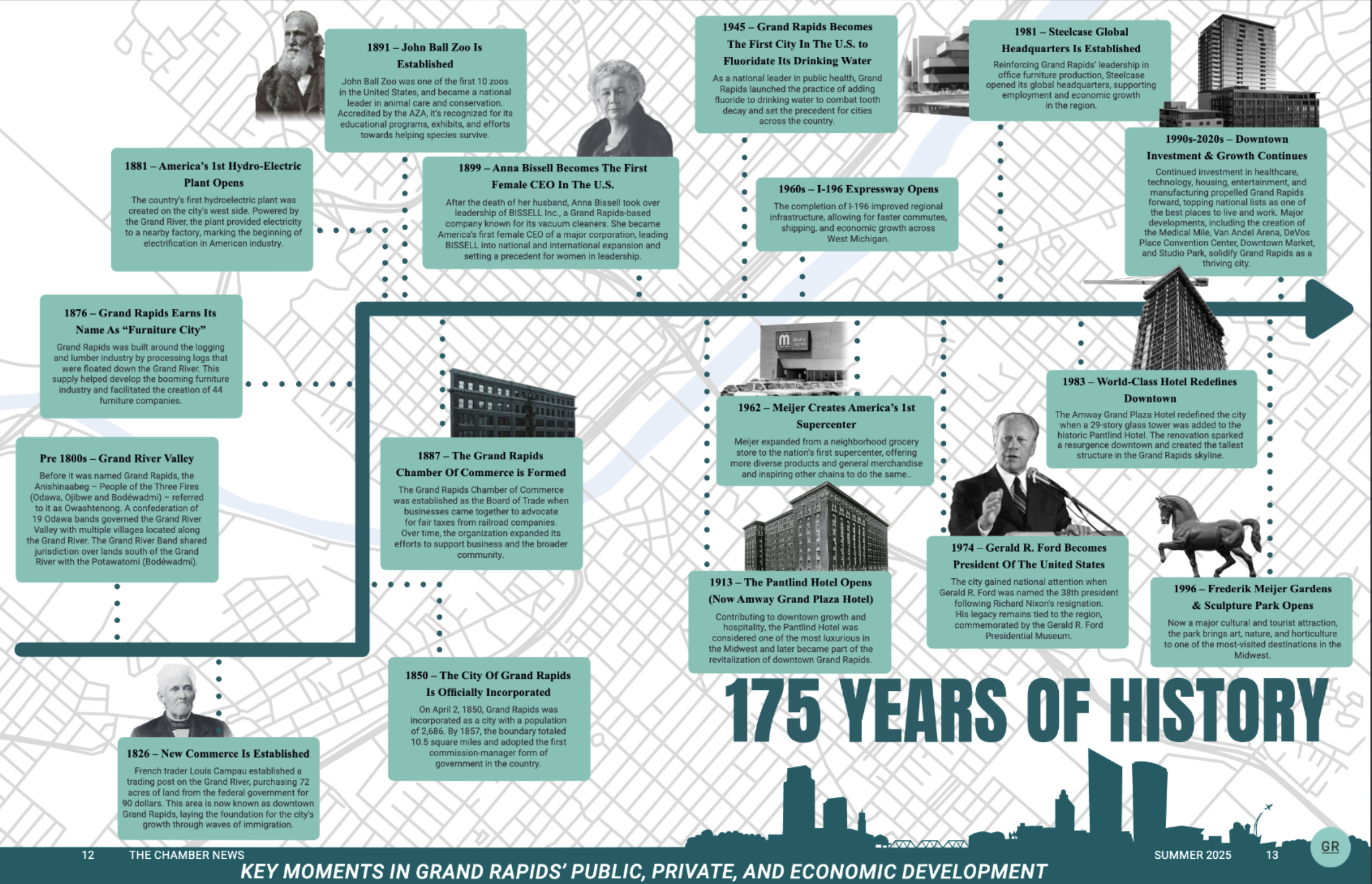
The GR Chamber of Commerce reveal what they think about local history, by posting the infographic above in their most recent newsletter. This infographic reveals the ideological framework that the GR Chamber of Commerce works from, thus providing us with an understanding of what they value and what priorities they have.
What follows is a frame by frame deconstruction of this infographic, with a GR People’s History response.
Pre 1880s – Grand River Valley – The GR Chamber of Commerce acknowledges that Indigenous people lived in this area before it became Grand Rapids, but they never mention how the Indigenous population was displaced, nor do they talk about the Settler Colonial history of the founding of Grand Rapids.
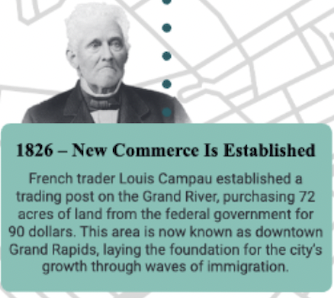 1826 – New Commerce is established – Here the GR Chamber celebrates Louis Campau as starting commerce, but they omit the role he played in Settler Colonialism. It was Campau’s role as a fur trader that positioned him to be one of the first Euro-Americans to introduce alcohol to Indigenous people in this part of Michigan. Like many fur traders, Campau worked closely with the Catholic missions along the Grand River, aligned in the goal of settler colonialism.
1850 – The City of Grand Rapids is Officially Incorporated – The GR Chamber celebrates the founding of the City of Grand Rapids, but fails to offer any honest assessment of what that meant. See my recent article, What are we really celebrating on the 175th Anniversary of Grand Rapids? The 1850 narrative also says that Grand Rapids had a Commission-Manager form of government, which is not true. Grand Rapids changed their charter in 1916 to go from a Strong Mayor form of government to a City Manager style of government, because the furniture barons were concerned about the previous government structure after the 1911 furniture workers
  strike.
1876 – Grand Rapids Earns Its Name as “Furniture City” – Here the Chamber ignores the history of labor exploitation that happened in the Furniture industry. People should read Jeffrey Kleiman’s book, Strike: How the Furniture Workers Strike of 1911 Changed Grand Rapids, along with what the Grand Rapids People’s History Project has written about the topic.
 1881 – America’s 1st Hydro-Electric Plant Opens – The GR Chamber is quick to celebrate energy production for industry, but fails to discuss what sort of environmental impact this had on the Grand River and surrounding water sheds. Check out the GR People’s History article entitled, The Grand River: Flooding, Forests and Factories.
 1887 – The Grand Rapids Chamber of Commerce is Formed – No surprise that with this date the GR Chamber celebrates their founding and then throws in the line, “expanded its effort to supporter business and the broader community.” Of course they offer no verification that they supported the broader community. Since 2010, GRIID has posted dozens of articles that have provided critical analysis of the GR Chamber of Commerce, which challenges the notion that they supported the broader community.
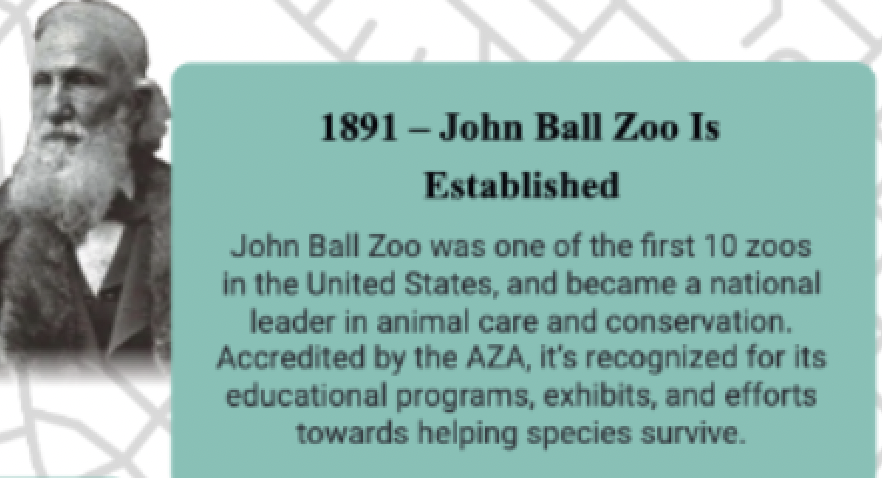 1891 – John Ball Zoo is Established – Here the GR Chamber celebrates the founding of the zoo, but fails to mention the ongoing legacy of the expansion of the John Ball Zoo and how that has impacted the John Ball Neighborhood and green space in that area.
1899 – Anna Bissell Becomes The First Female CEO In The US – Again, the GR Chamber celebrates a female CEO, but offers no context. Anna, who was married to Melville Bissell, started as a sales  person for the company, but took over in 1889 when her husband died. Anna Bissell ran the company until 1919 and remained chairman of the board until 1934. There is no evidence that a labor union was allowed to organize or attempted to organize at the company. The notion that paid sick leave and pensions plans were implemented “long before these practices were widespread, does not mean that the company engaged in such practices out of some benevolence. These policies were adopted at a time in the early years of the 20th Century, when organized labor was more radical and militant than at any other point in US history. The fact that the Bissell Corporation adopted such labor practices could also very well suggest that they did so by adopting such policies was a way to prevent workers from organizing.
 1913 – The Pantlind Hotel Opens (Now Amway Grand Plaza Hotel) – The GR Chamber doesn’t acknowledge how this luxurious hotel was unaffordable for most Grand Rapidians in the early 20th Century. It is also interesting that the GR Chamber history mentions this same hotel twice in their timeline, while no other signal entity is mentioned more than once.
 1945 – Grand Rapids Becomes The First City in the US to Fluoridate Its Drinking Water – While this piece of history is true, it ignores the vast health disparities that exist in Grand Rapids around class and race dynamics.
1960s – I-i96 Expressway Opens – For the GR Chamber the highway construction was all about faster commutes and economic  growth. The GR Chamber never says who really benefited from the highway construction, nor do they acknowledge the displacement of 4000 people in the process and the destruction of hundreds of homes in both white and Black communities. See Roughly 4,000 people were displaced from highway construction through Grand Rapids: An interview with Fr. Dennis Morrow.
 1962 – Meijer Creates America’s 1st Supercenter – It is is true that Meijer became the first store of its kind, but there is no discussion of how these supercenters put out of business all kinds of Mom & Pop neighborhood stores over the years. In addition, this piece of history ignores the history of the Meijer family and their wealth expansion over the decades, especially during the pandemic.
 1974 – Gerald R. Ford Becomes President of the United States – Here the GR Chamber ignores what Ford did as President. Ford became Nixon’s Vice President in October of 1973 and was sworn in as President in August of 1974. He served as President until Carter took the oval office in January of 1977. Ford supported the repressive government in the Philippines in its counterinsurgency war against rebels. During the coup in Argentina in 1976, Ford supported the generals who took power and slaughtered thousands of dissidents. Under Ford the US provided millions of dollars in military aid to the right-wing movement in Angola known as UNITA. He negotiated military bases in Spain with the fascist dictator Franco. Ford maintained the illegal terror war and embargo against Cuba and was president during the final days of the US occupation of South Vietnam. But probably the foreign policy that best defines Ford was his support of the Indonesian invasion of East Timor. For more details see For additional information on this topic, see the video, The untold history of Gerald Ford.
 1981 – Steelcase Global Headquarters Is Established – Here the GR Chamber acknowledges the Steelcase headquarters, which “supported employment and economic growth.” What the GR Chamber does not say about Steelcase is that they have resisted efforts amongst workers to unionize and they fail to mention that since Steelcase went global in 1981, they have been negatively impacted by trade policies like NAFTA.
 1983 – World-Class Hotel Redefines Downtown – While it is true that the purchase of the Pantlind Hotel by the DeVos family has been good for downtown business, the GR Chamber also fails to mention how the DeVos family and the GR Chamber of Commerce have convinced City and County leaders to re-direct public funds to improve and compliment the private sector acquisitions and new develop projects in downtown Grand Rapids.
 1996 – Frederik Meijer Gardens & Sculpture Park Opens – The GR Chamber frames the Meijer Gardens as a tourist attraction and destination, but fails to acknowledge how these sorts of venues/destinations also plays a role in quieting public rage directed at Billionaire families like the Meijer family, as they have quietly amassed tremendous wealth.
 1990s – 2020s – Downtown Investment & Growth Continue – The GR Chamber of Commerce has spent the last several decades working in conjunction with members of the Capitalist Class and groups like Grand Action 2.0 to get City and County officials to use public money for private benefit and to influence public policy that caters to the interests and goals of the ownership class that runs downtown Grand Rapids. This was demonstrated clearly when the GR Chamber got the City of Grand Rapids to adopt ordinances that criminalized the unhoused.
In looking at the history and narrative that the Grand Rapids Chamber of Commerce is promoting through their infographic on local history, it is vitally important that we collectively provide counter-narratives to the Capitalist narratives that the GR Chamber is notorious for. GRIID is happy to provide some of the counter-narratives.
Grand Rapids School Board narrowly passes 2025-2026 Budget, with unanimous opposition during public comment
“For the first time in recent memory, executive contracts were not rubber stamped by the GRPS Board of Education! Instead we saw the board ask good questions, name gaps, and look for ways to better prioritize students.”
The above comments are from community efforts to pressure the GRPS to adopt a more just budget, one that centers teachers and students. The Grand Rapids Educators Association (GREA), supported by the Urban Core Collective, hosted a picnic prior to the GRPS Budget hearing. The event was design to building community and solidarity with teachers in the district and to push for several demands that the teacher’s union presented during the Budget Hearing.

Some of the information and demands from the GREA included:
- GRPS spends only 48.35% of its budget on instruction, which is nearly 10% less than the average of similar sized districts.
- Among the 32 largest districts in Michigan, only Lansing spends less on instruction than GRPS.
- 91% of all Michigan districts spend more of their resources on instruction than GRPS
- Teachers dropped from 47.7% to 38.4% of total staff between 2016 – 2025
- GRPS is reducing teacher positions faster than the state average
- The district is hiring more non-instructional staff while reducing teacher positions, the positions that directly impact student learning.
- GRPS teachers earn $3,623 less annually than the Kent County average
- Master’s degree teachers lose $5,096 per year compared to county pears
- There is $17 million sitting in capital projects fund while claiming budget constraints.
During the Public Comment portion Budget Hearing, the GRPS Board President decided to limit people to two minutes instead of three, since there were several dozen people who had filled out cards to speak. It always amazes me how elected officials can arbitrarily reduce the length of time for public comment, just because there are lots of people who want to speak. It seems like they should be welcoming as much public input as possible.
Throughout the public comment, there were students, teachers, parents, alumni and community members who spoke out against the proposed budget. There were lots of GRPS teachers who spoke, with some of them using the talking points listed above. One recent Physical Education (PE) hire spoke about how difficult it was to get hired and how long they had to wait until a GRPS representative got back with them regarding their application. The PE teacher also talked about how understaffed they were, even though many of their friends had also applied for similar positions.
A Special Education teacher also spoke forcefully about how the GRPS was violating state law, with too many Special Education students in a class room per teacher. This GRPS teacher talked about how they were also understaffed and how moral in their department was low, because people felt overworked and under appreciated.
Another public comment came from a GRPS alumni, who had organized an online petition campaign to prioritize the GRPS budget for students and teachers. This community member stated that over 600 people had signed the petition.
However, the overriding theme of the public comment during the Budget Hearing was that no one support the existing budget proposal, since it did not prioritize teachers and students. There was unanimous opposition to the budget proposal.
When it came time for the School Board to vote on the budget, Dr. Roby read a statement suggesting that the budget outcome is the result of outside forces that were out of the control of her office. Dr. Roby also made it clear that board members who are pushing back on the budget have been “negligent” in their demands and that if the budget isn’t adopted it will impact families and scholars.
The Board President followed Dr. Roby’s comments stating that it would be a vote of no confidence of Dr. Roby to not adopt the budget. The Board President then pushed to immediately go to a vote. Several Board members stated the need to have a discussion on the proposed budget before it went to a vote. GRPS Board members all spoke up and several of them talked about how they would not be voting out of fear or that they would not be intimidated to vote a certain way.
Dr. Roby spoke again in response to the push back from some board members. I took Dr. Roby’s comments as a form of gaslighting that was directed at Board members who were challenging the proposed budget. At one point Dr. Roby also said that the community needed to do their own homework to understand the budget. There were several people in the audience were were taken back by this statement, especially since the proposed budget had only been available to the public for one week. I personally felt insulted by this comment and based on the reactions of those who spoke during the Budget Hearing, they too were somewhat disgusted.
The School Board finally voted on the General Operating Budget, a vote that was 5 in favor and 4 against. Those voting against were Melton, Moreno, Rodriguez and Kilpatrick.
We can never rely on cops to prevent ICE from taking people or holding them accountable in Grand Rapids or anywhere else
Over the past week I have seen the information in the graphic below shared on social media. Some people in the Grand Rapids area have even asked what GR Rapid Response to ICE thinks about this information. I am not speaking on behalf of GR Rapid Response to ICE, but I am a volunteer organizer with them and understand where we stand on the relationship between cops and ICE agents.

ICE and Cops go hand in hand
 The only thing in the graphic here on the right that I agree with is for people to record/document when ICE agents – masked or unmasked – take people.
Calling the GRPD or any local police department is not only a bad idea, it could make it worse for the person or persons that have been taken.
The rest of the information in this graphic is also deeply problematic, since it is operating with the assumption that there is accountability with cops involved. “Verified Law Enforcement” is a meaningless term, primarily because it suggests that those who are identifiable are somehow legitimate. Police officers work for governments, thus they are state workers, or as David Correia and Tyler Wall state in their book, Violent Order: Essays on the Nature of Police, police are violence workers. The co-authors write, “The purpose of the police is to inflict pain or to threaten pain when order is is being threatened, just as the purpose of the taser is to inflict pain in order to control another human being.”
I get that ICE agents showing up with no badge and no visible evidence that they are ICE agents is deeply troubling, but it is troubling when people apprehend immigrants, regardless if they have their faces covered or not. We have to remain rooted in our opposition to anyone working for the state that wants to do harm to people in our community.
The rest of the information within the graphic continues the same worldview that the system works and that accountability can be achieve, especially if the police become involved. The cops take a statement, which pressures the cops to identify themselves, leading to a paper trail, with the possibility of a civil lawsuit. This line of thinking ends with accountability, the graphic claims. Again, this line of thinking demonstrates that the policing and legal system work and are a legitimate avenue for obtaining justice. Such thinking is both naive and historically inaccurate.
People really need to unlearn what we have all been taught about the cops, the courts and the Prison Industrial Complex. We really need to come to terms with what the actual function of policing is, which Alex Vitale describes beautifully, stating:
“The reality is that the police exist primarily as a system for managing and even producing inequality by suppressing social movements and tightly managing the behavior of poor and nonwhite people; those on the losing end of economic and political arrangements.”
I would highly recommend that people read some of the following books to being our process of unlearning what the real function of policy is:
- Our Enemies in Blue: Police and Power in America, by Kristian Williams
- The End of Policing, by Alex Vitale
- No More Police: A Case for Abolition, by Miriam Kaba and Andrea Ritchie
- Becoming Abolitionists: Police, Protests, and the Pursuit of Freedom, by Derecka Purnell
- “Prisons Make Us Safer”: And 20 Other Myths about Mass Incarceration, by Victoria Law
- Copaganda: How Police and the Media Manipulate Our News, by Alec Karakatsanis
- Beyond Courts, by Community Justice Exchange
What is ultimately missing from this graphic I have been deconstructing is that it omits the most powerful way(s) we can create community safety. In terms of preventing ICE from taking people, I believe that what Movimiento Cosecha and GR Rapid Response to ICE are doing is already working to prevent ICE from taking people. The other major shift would be to stop funding ICE and Police departments and invest that money in meeting the basic community needs. This is why we say, Community Care, Not Cops!
GR Rapid Response to ICE action dramatizes the horror of ICE violence by exposing the Avelo Airlines contract with ICE
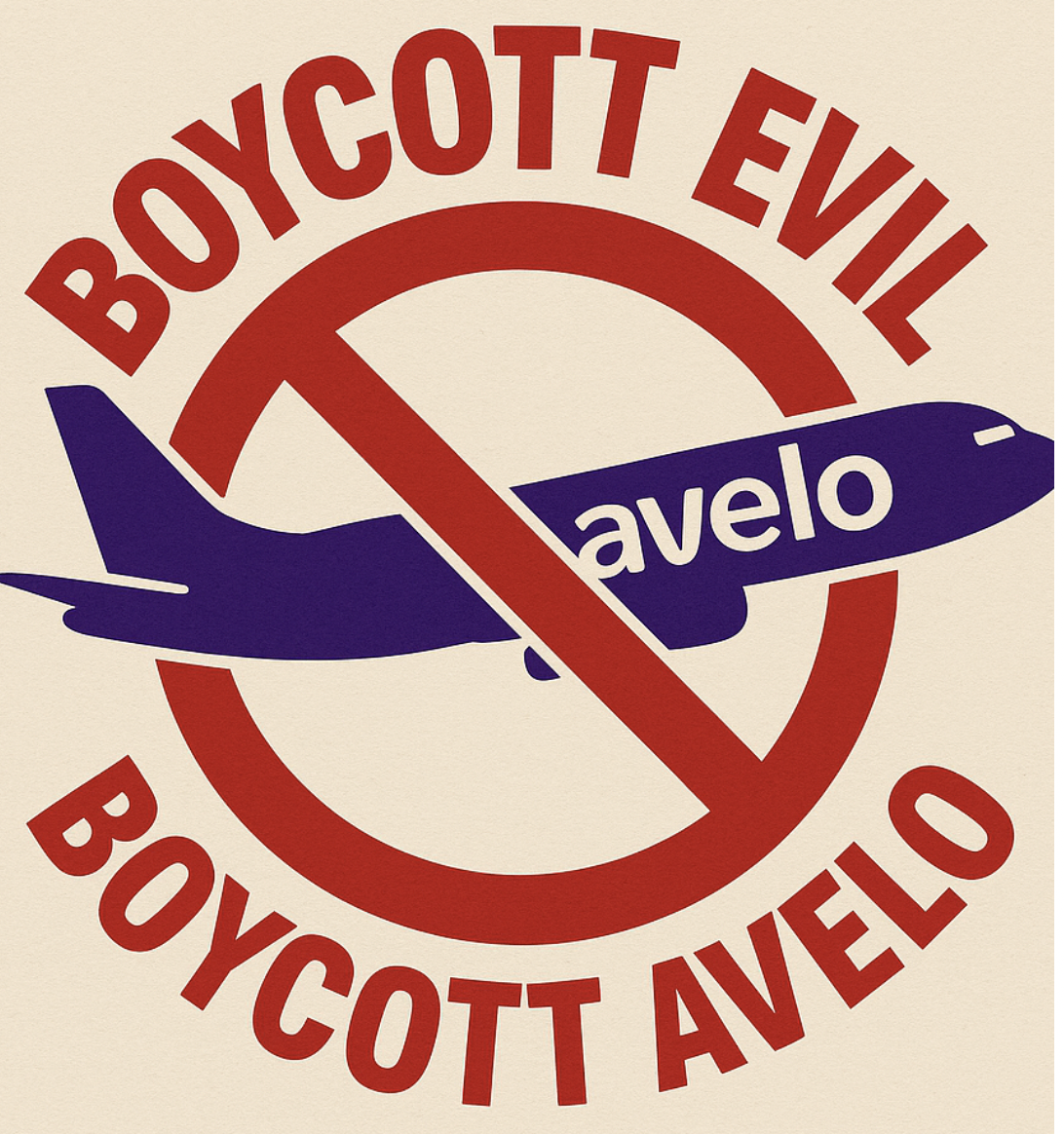 On Saturday, a dozen activists took part in an action organized by GR Rapid Response to ICE.
The action centered around the contract that Avelo Airlines signed with Immigration and Customs Enforcement (ICE) to transport immigrants directly to El Salvador. Avelo Airlines is a small airline that launched in 2021 with a fleet of 20 aircraft. On May 12, Avelo Airlines became the first commercial airline to begin deportation flights, and running flights and hiring flight attendants in Mesa, AZ to fly people in ICE custody out of the country.
In March, it was announced that Avelo Airlines would be offering flights out of the Kent County Airport, with a few direct flights to North Carolina and Florida. GR Rapid Response to ICE began talking about organizing an action, but only if it would fit within the larger work to pressure Kent County to adopt a Sanctuary policy.
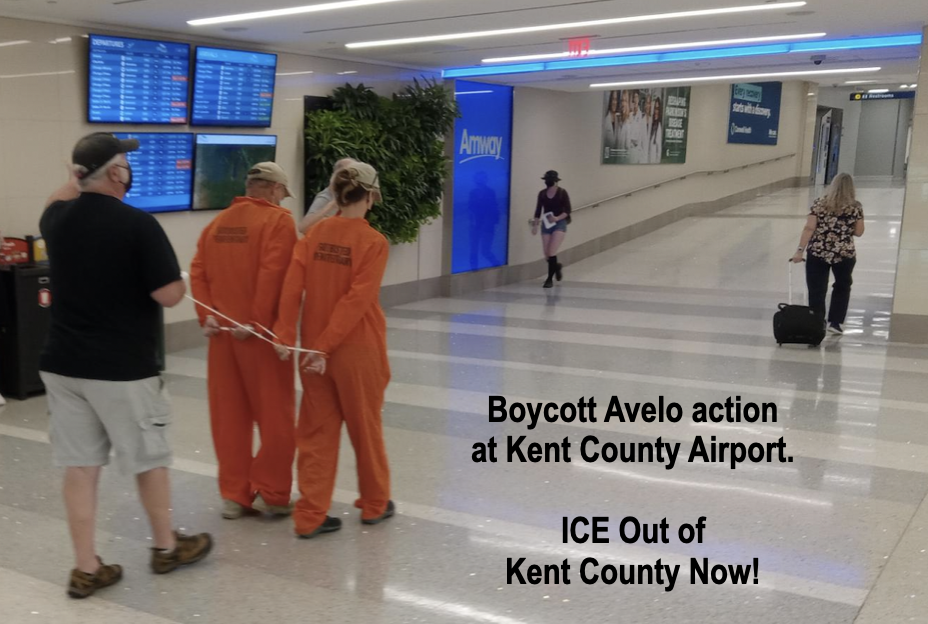
The action on Saturday was a low risk action, that involved handing out informational flyers and using street theater to dramatize the relationship between Avelo Airlines and ICE. You can watch the short video here below.
Street Theater is a creative tactic for social movement work, a tactic that was popularized by the Brazilian theater practitioner and political activist Augusto Boal. Using street theater also provides a more visual and emotive mechanism to communicate political realities, especially realities that are rooted in oppression.
The informational handout complimented the street theater, since it provided concrete information on Avelo Airlines, along with additional actions that people could take after knowing about the contract between ICE and Avelo Airlines. The handout lists numerous actions that people can participate in, making the action at tactic that leads to other actions. What follows is a list of actions that people can take:
1. Boycott Avelo Airlines – don’t purchase tickets from them and tell others to do the same.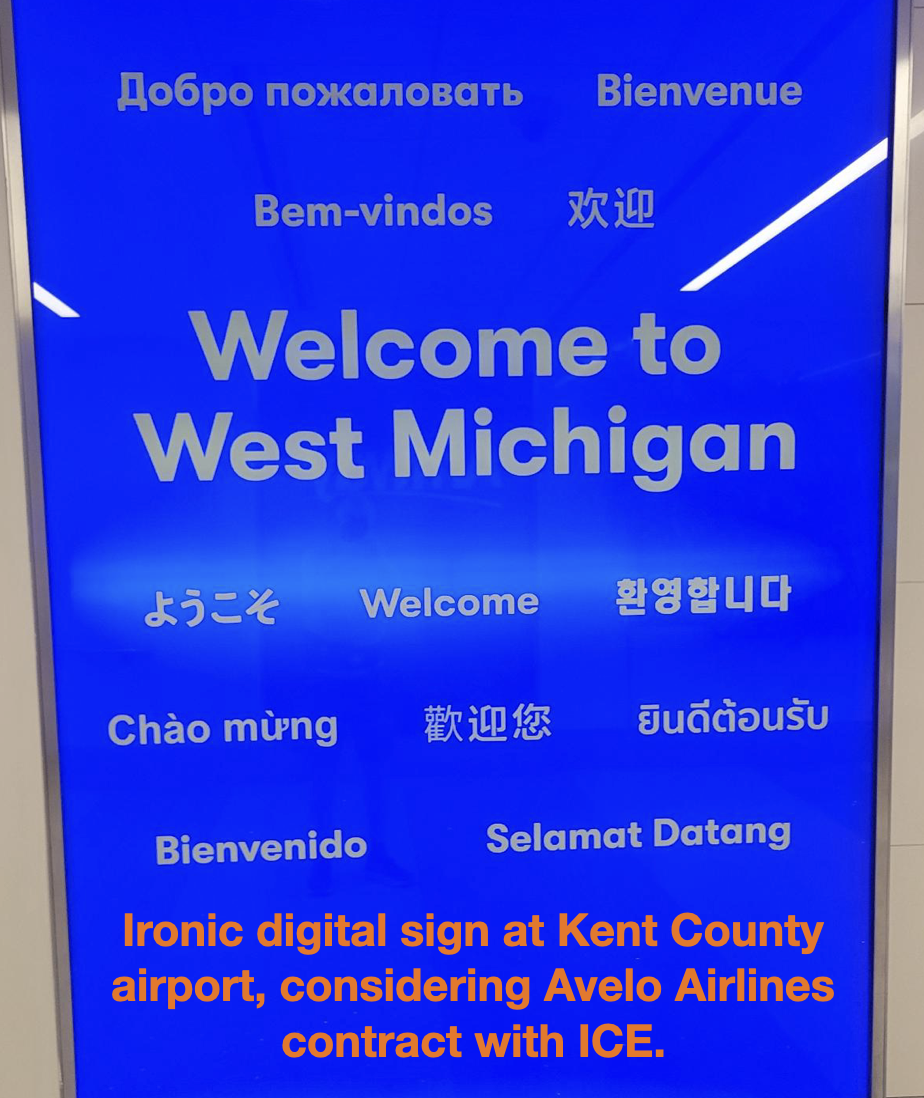
2. Send a message to the Gerald R. Ford International Airport Authority Board to end their contract with Avelo Airlines grrboard@grr.org
3. Sign the Action Alert to get the Kent County Commission to adopt a Sanctuary policy tinyurl.com/KentCountySanctuary
4. Attend the July 24th Kent County Commission meeting to demand they adopt a Sanctuary policy – 8:30am in the County Building.
5. Join the work of Movimiento Cosecha and GR Rapid Response to ICE to get ICE out of Kent County by sending an Email to info@grrapidresponsetoice.org
The US bombed Iran last night in a cruel act of aggression. Yes, the Trump Administration bombed Iran without Congressional approval, but most members of Congress have refused to condemn the bombing, like Rep. Scholten and Senator Slotkin.

Around midnight of last night, Rep. Hillary Scholten posted these comments on her Facebook page:
Iran must never be allowed to obtain nuclear weapons.
As the president takes action without congressional approval, my thoughts are with our troops. The American people deserve a voice—through Congress—before our troops are sent to serve in another endless war.
Rep. Scholten leads with an ideological comments that Iran can never obtain nuclear weapons. What arrogance! Scholten is reflecting a standard US imperialistic narrative that certain countries cannot have nuclear weapons, but the US and a few other imperialist nation can possess nuclear weapons. What is glaringly omitted from Scholten’s comments is that she fails to mention that the US is the only country that has used nuclear weapons, weapons that were dropped on civilian populations in Hiroshima and Nagasaki, Japan in 1945.
In addition, Scholten’s demand that Iran never be allowed to obtain nuclear weapons is taken from the AIPAC playbook, which you can read in the AIPAC statement in support of the Trump Administration’s bombing of Iran. This makes complete sense, since Rep. Scholten has been loyal to Israel and AIPAC, ever since she first took an AIPAC paid-for trip in the summer of 2023.
Michigan Senator Elissa Slotkin also released a statement after the Trump Administration bombed Iran, stating:
I expect a full, classified brief on the strikes in Iran, and the strategy and force protection plans, as soon as possible.
In the meantime, tonight I’m focused on the safety of the over 40,000 U.S. forces in the Middle East, and their loved ones back home, concerned about retaliation and what comes next.
While it’s too early to know the results, a successful strike by our capable military wasn’t the primary question.
The real question is: what happens the day after? A strike can have major repercussions for safety and stability across the region. As someone who served in Iraq and saw up close the loss of blood and treasure over 20 years, I don’t want to be embroiled in another drawn out conflict, and neither do the American people.
This is exactly why our founders built a role for Congress on issues of war and peace — to ensure questions of real consequence are answered before American men and women are engaged in war.
There is not one single word of condemnation in Senator Slotkin’s statement. Like Rep. Scholten, she focuses on the safety of US military personnel, to the exclusion of the Iranians who were killed in the US military bombing of Iran.
Senator Slotkin also wants us to think that just because she was in the US military in Iraq that she some how doesn’t want the US to be “embroiled in another drawn out conflict.” The US was not embroiled in a conflict in Iraq, the US bombed the shit out of Iraq and engaged in a military occupation of that country for years, resulting in over a million dead Iraqis.
Rep. Scholten and Senator Slotkin are not only cowards, they are complicit in the US bombing of Iran, just as they have both been complicity in Israel’s ongoing genocide of the Palestinians.
 Grand Rapids Institute for Information Democracy