 There has been a tremendous amount of push back from communities all across the country try and in West Michigan regarding proposed Data Centers.
In December GRIID interviewed people in Lowell who have been organizing to oppose a proposed Data Center in their community and they have been doing an amazing job pushing back against the proposal at local government meetings.
I recently came across an event, shown here in the flyer on the right. This event will feature panelists, but when I inquired about who will be speaking I have not received a response.
The promotional language for this event on January 22nd states:
“Exploring & unpacking the rapid rise of data centers and their growing role in Michigan’s AI-driven economy. This community conversation, led by some the industry’s brightest minds, will explore the economic opportunities data centers create, the infrastructure and energy challenges they introduce, and the long-term implications for communities, workforce development, and regional competitiveness.”
This narrative seems to be very pro-Data Center, plus the event is being held at Start Garden, which is a DeVos-created entity that has been part of Rick DeVos’ Wakestream Ventures and now operates as the Start Garden Foundation, according to GuideStar.org.
People who are informed and mobilized around opposing Data Centers might want to attend this forum, since the panelists are unlikely to provide substantive critiques or reveal the full community impacts that Data Centers can have.
ICE was created out of fear and retribution: ICE can be abolished by resistance and solidarity with immigrants
Immigration and Customs Enforcement (ICE) was created in 2003. In 2003, the Homeland Security Act separated ICE from the Immigration and Naturalization Service (INS).
The Homeland Security Act was overwhelmingly adopted by Congress in 2002, with the House passing it 295-132 and the Senate 90-9. Therefore, the creation of the Department of Homeland Security had bi-partisan support.
Thus the creation of ICE comes out of the US Government’s response to 9/11 and their so-called war on terrorism. ICE was created as a more militarized version of INS, allowing federal agents to use force to apprehend immigrants they deemed to be a threat to the county. The reality has been all along that ICE has primarily targeted undocumented immigrants and engaged in racial profiling in the process.
ICE funding has always been substantial, receiving $3.3 billion 2003 and expanding to $9 billion in 2024. This means that in every administration since it was created – Bush, Obama, Trump and Biden – each administration has endorsed ICE operations and every Congress since 2003 has voted to fund ICE.
In March of 2025, Congress voted to increase the ICE budget to $10 billion. Then there was the Beautiful Big Bill, which provided the largest increase to ICE making ICE the highest funding federal law enforcement agency in US history.
The so-called One Big Beautiful Act allocates more than $170 billion over four years for border and interior enforcement, with a stated goal of deporting 1 million immigrants each year. Of that $170 billion ICE will receive $75 billion over a four year period or an additional $18.7 billion per year.
The other entity that increased its budget from the Big Beautiful Bill was Customs and Border Protection (CBP). CBP operates along the US/Mexican and the US/Canadian borders. Remember, Michigan shares some of its borders with Canada, which is why there is CBP presence in this state.
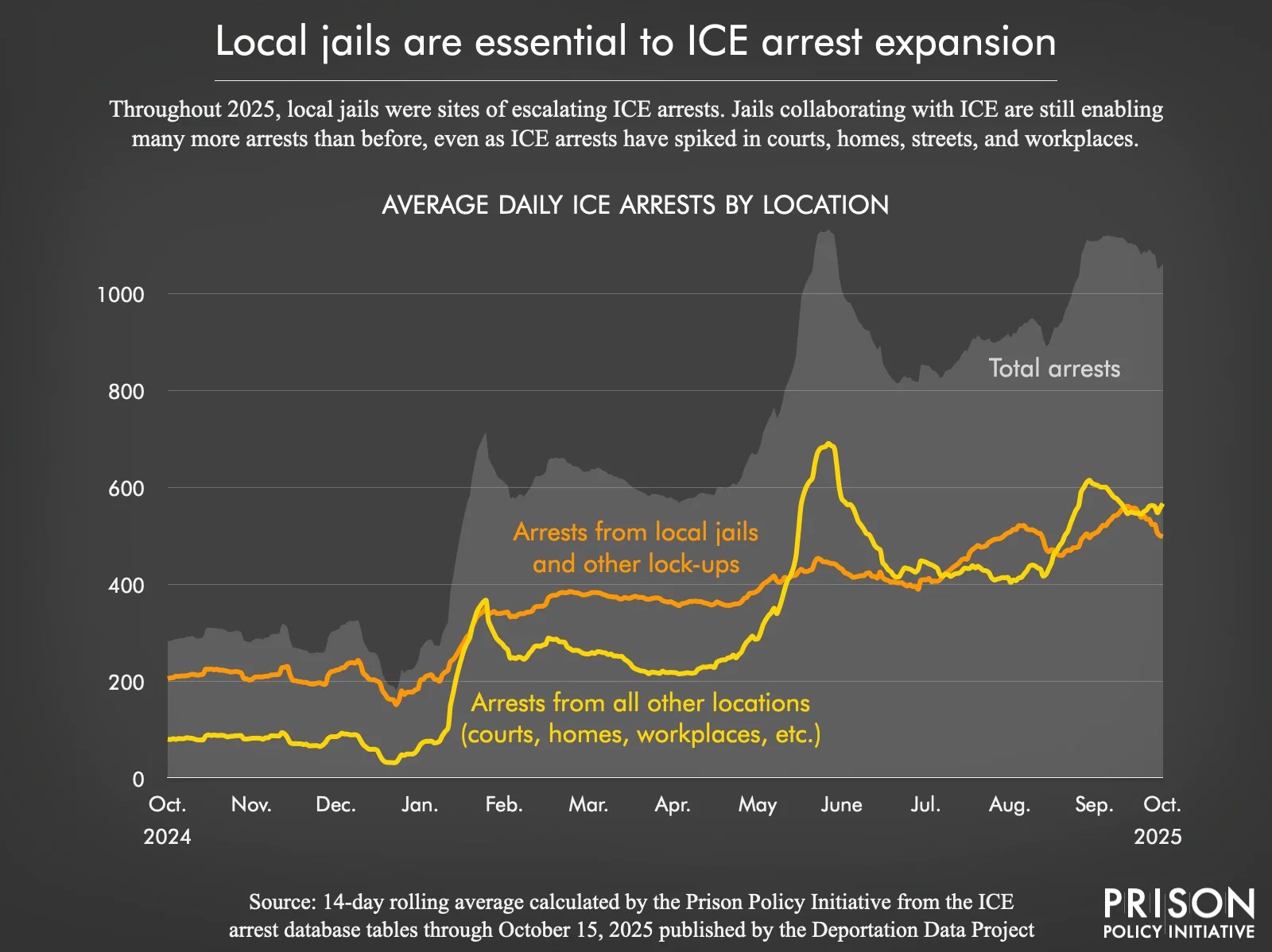
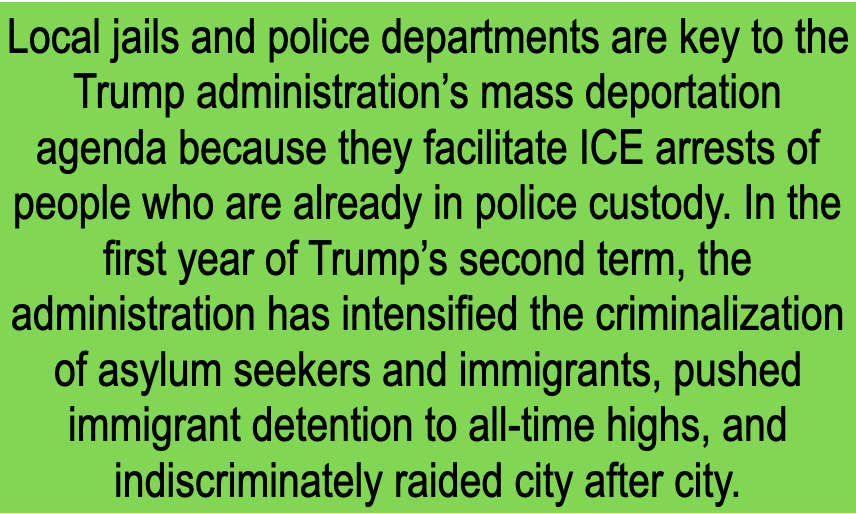
According to the Prison Policy Initiative local jails play a major role in the apprehension of immigrants for ICE, especially in states, counties and cities that have not adopted policies that would prevent local cooperation with ICE. See graphic above.
From a recent report by the Prison Policy Initiative they write:
Despite overwhelming displays of power and intimidating rhetoric, the federal government nonetheless relies heavily on state and local collaboration to enact its mass deportation agenda. The Trump administration is therefore vulnerable to state and local policy action that goes beyond merely limiting sheriffs and police from deputizing officers to work as immigration agents. This weakness is evident in the data, which show significantly smaller jumps in arrest rates in states where advocates have most aggressively worked to reject collaboration, and much higher rates in states that have embraced it.
This is exactly why it is vitally important for people who live in Kent County to get behind the campaign that Movimiento Cosecha and GR Rapid Response to ICE have been demanding for the past year to adopt 6 sanctuary policies for the City of Grand Rapids and for Kent County.
The six sanctuary policies are:
- Policies restricting the ability of state and local police to make arrests for federal immigration violations, or to detain individuals on civil immigration warrants.
- Policies restricting the police or other county workers from asking about immigration status.
- Policies prohibiting “287(g)” agreements through which ICE deputizes local law enforcement officers to enforce federal immigration law.
- Policies that prevent local governments from entering into a contract with the federal government to hold immigrants in detention.
- Policies preventing immigration detention centers from being established in Kent County, which would include the use of the Kent County Jail as a detention facility for ICE.
- A policy that will not allow the Kent County Sheriff’s Department to share Flock camera images or any other information gathered by county staff with ICE or any other law enforcement agency seeking to arrest, detain and deport immigrants.
Historically there has been bipartisan support for ICE and there has never been an elected member of Congress who has called for the defunding and abolition of ICE. We cannot vote our way out of this mess, but we can resist ICE at the local level.
This is why it is critical that if people are really pissed off at ICE, then they should get involved in the daily resistance work that Cosecha and GR Rapid Response to ICE do, plus join the campaigns to pressure Kent County and the City of Grand Rapids to adopt the six sanctuary policies listed above. This is exactly how social change has happened throughout the centuries…..from the ground up.
Moving from protesting ICE to resisting ICE
Since last Wednesday, when ICE agents killed Renee Good in Minneapolis, we have seen tens of thousands of people take to the streets demanding justice and in many cases calling for ICE to be abolished.
It is always encouraging to see people push back against state repression, which right now for many people is Immigration and Customs Enforcement (ICE). There are many mainstream groups like 50501 and Indivisible that are also protesting ICE. And while I support people focusing on ICE and making demands against that government agency I believe we need to be more strategic with our actions.
ICE doesn’t really care if hold a sign outside their office, at the airport or at major intersections in any given town. What ICE doesn’t want to see happen is for the public to directly interfere with their desire to apprehend, arrest and detain undocumented immigrants. As a longtime participant with GR Rapid Response to ICE I have seen first hand how ICE agents are frustrated when people make it difficult for them to do what the federal government wants them to do.
Now, imagine if the tens of thousands of people who protested ICE, held signs, hosted rallies/vigils and made statements condemning the ICE murder of Renee Good had redirected their energy in a strategic way, in a way that would directly benefit the very people that ICE is targeting – undocumented immigrants.
- Imagine if people protesting ICE would build relationships with undocumented immigrants, then listen to what they want, so that they could keep themselves and their families safe.
- Imagine if people responded to calls for direct intervention when ICE attempts to kidnap undocumented immigrants in Kent County.
- Imagine if every immigrant who has an appointment at the ISAP office or immigration court was accompanied by allies that would reduce the chance of being taken b y ICE.
- Imagine if there were teams of people doing patrols in neighborhoods where immigrants live/work and where immigrants have told us that they have seen ICE operating.
- Imagine if there were faith communities, community centers, non-profits and other entities that would declare themselves as sanctuaries for undocumented immigrants.
- Imagine if families that were directly impacted by ICE violence were supported by the community with transportation, material aid, financial aid and legal support for those being detained.
- Imagine if there was an organized campaign to get local government bodies to adopt sanctuary policies that would make it harder for ICE to arrest and detain immigrants.
 Guess what??? You don’t have to imagine the things listed here above, since this is what Movimiento Cosecha and GR Rapid Response to ICE are already doing on a daily basis. Both of these groups are strategically resisting ICE and expanding the number of people and organizations that want to move beyond protesting ICE to concretely resisting ICE, primarily by making it harder for ICE to kidnap and detain undocumented immigrants in Kent County.
This type of work is strategic, but it is also not operating in a reactionary manner. Yes, the ICE murder of Renee Good was brutal, but ICE has killed primarily undocumented immigrants since they were created in 2003 and they have been terrorizing millions of immigrants over the past 23 years by arresting them, detaining them and deporting them. These acts of violence have created tremendous financial and social hardship for millions of immigrants, all of which have also been traumatized by these experiences, especially immigrant children.
If you want to be part of this work, part of resisting ICE in Kent County, then support the work of Movimiento Cosecha and GR Rapid Response to ICE. Take one of the monthly trainings that GR Rapid Response to ICE offers. If you are unsure about how best to be involved in this work, just ask GR Rapid Response to ICE by sending an Email info@grrapidresponsetoice.org or come and talk with them at the Melt ICE concert on February 15th.
Last week I posted an article that was critical of the GR A250 group, which was created to celebrate the 250th anniversary of the founding of the US and the 175th anniversary of the founding of Grand Rapids.
I have also noted in a previous post that the steering committee for the GR A250 group is dominated by members of the GR Power Structure.
The types of posts that the GR A250 group is making continues to represent GR history through the lens of those in power or what insurgent historian Howard Zinn refers to as the “historical winners.”
I want to share recent GR A250 posts and then provide some counter stories and/or analysis.
Cops and Freedom
The first post from GR A250 I want to look at is from 5 days ago, which features a 29 second video where two GRPD cops are asked what freedom means to them. WTF! This video is not only insulting it completely ignores the long standing history and recent history of how the GRPD has brutalized BIPOC people in Grand Rapids, including the murder of Patrick Lyoya in 2022 and the trial for the cop that killed him him just last May. See the GRIID coverage and analysis of how the commercial news media reported on that trial in the GRIID news study report, specifically pages 6 – 10.
Events and growth in GR
The second post from GR A250 was four days ago, with the following narrative – “Grand Rapids has always known how to gather, grow and build from generation to generation. It’s what makes our city special.” The post includes three examples – 1) a balloon race in the early 1900s that took place in East GR; 2) the Christkindl Markt that started in 2023; and 3) Construction on the Amway Stadium for the new professional soccer team that is owned by both the DeVos and Van Andel families.
Not surprising all of these events have primarily benefited the wealthiest families in Grand Rapids. What the GR A250 excluded when talking about events that speak to how people gather could have been the 6000 plus furniture workers that went on strike for months in Grand Rapids in 1911, which was followed by 10,000 Grand Rapidians showing up to support those workers during the Labor Day march that same year. A more recent example of people coming together could be the largest march in GR history in 2006 where 10,000 march for immigrant justice.
Centering the DeVos patriarch
 The third post from GR A250 was also four days ago, which celebrates the “Believe! 50th Anniversary Edition is being released with new reflections from Doug DeVos.” The narrative says in part: “The timeless principles that have been a guide for previous generations – free enterprise, human dignity and family – help keep the American Dream alive when everyday people put them into practice. Believe! Helps restore and reinforce those principles for a new generation.”
Of course the GR A250 group would celebrate this bullshit, not only because Doug DeVos is on the steering committee, but because the DeVos family has had the most influence on GR politics in recent decades than any other family, and to the exclusion of thousands of families that are struggling to survive in Grand Rapids. As an alternative check out the GRIID DeVos Family Reader for a very different narrative.
Celebrating Business leaders, not workers
The fourth post from GR A250 was three days ago and celebrates Anna Bissell who was the first female CEO in Grand Rapids. Bissell has a statue honoring her in front of the DeVos Convention Center, which was part of the Peter Secchia-led monuments campaign. To read an alternative narrative about Anna Bissel check out a post from the GR People’s History Project entitled, Anna Bissell Statue in Grand Rapids: Honoring another Capitalist.
With the direction that the GR A250 Facebook page is going I plan to write articles that counter these narratives where history is made by people with power with narratives from a people’s history of Grand Rapids.
The ICE shooting of a white woman in Minneapolis last week was a clear reminder that state repression has always been a reality in this country whenever there is public opposition to government policies.
This reality of state repression might be foreign to those of us who carry a great deal more privilege, especially for white people. However, for BIPOC communities, queer and trans communities, dissidents and undocumented immigrant communities state violence and state repression have always been front and center.
ICE was created in 2003 and was the outgrowth of the US War on Terror after 9/11. Every US administration since ICE was created has been committed to funding ICE and allowing ICE to terrorize undocumented immigrants, by arresting them, detaining them and deporting them. The current administration has escalated the ICE terrorism on undocumented immigrants because they have $150 billion more in funding and because their base completely supports an anti-immigrant America First platform.
The ICE shooting of Renee Nicole Good in Minneapolis on Wednesday morning has forced the public to come to terms with ICE and state terrorism. However, a great deal of the responses to the ICE killing have in many ways hurt the movement to abolish ICE. I say this because many of the responses in the last few days have not centered undocumented immigrants. In fact, many of recent responses have centered whiteness, white anger and white privilege.
 The national group 50501 (which I have critique previously) has now created a ICE Out for Good campaign that is happening now, January 10 and 11. You can see if the graphic here that “ICE is a danger to every American,” which takes the attention away from the fact that undocumented immigrants are the primary targets of ICE violence. Claiming that ICE is a danger to every American minimizes brutal history of ICE and how millions of immigrants have been arrested, detained, deported and brutalized by ICE since 2003.
The 50501 group even created a toolkit for this 2-day campaign, which you can find here. This toolkit does not center undocumented immigrants. This toolkit gives ideas for US citizens on what they can do, but it primarily excludes the most important part of this decades-long movement, which is based on the lived experiences of undocumented immigrants. How this toolkit is being used has already impacted Grand Rapids.
On Friday, I saw on the Individual Great Grand Rapids Facebook page some commentary about connecting with faith communities to urge them to push the ICE out for Good message that the 50501 group is pushing. I responded by saying this:
Cosecha GR has a Sanctuary team, so it would be great if you coordinated with them, as we have been talking to faith communities for years about offering sanctuary and taking a public stand against ICE. It is my contention that any group that wants to abolish ICE or at least oppose ICE is that they need to first go to Cosecha GR since they have been doing this work the longest in West MI and because they are the very people who are impacted by ICE terrorism in this community. Please talk with them before you doing anything. This is what immigrant solidarity looks like and white people acting like they know what they are doing is just another form of white supremacy.
I have yet to receive a response from the IGGR group from that post.
Later on Friday, I saw that someone else had live posted about 10 white people standing in front of the 517 Ottawa ICE office holding signs in protest of ICE. I wrote the following comment on that post:
Immigrants often have appointments at the 517 ICE office. GR Rapid Response to ICE will accompany them if requested, but immigrants will generally not feel comfortable with protests happening outside while the enter for their appointments. In fact, ICE will question immigrants coming to their appointments about the protest, which puts immigrants at greater risk of being detained. Please consider not protesting at the ICE office during business hours or joining GR Rapid Response work to monitor ICE activity from that office. This is what the immigrant community wants from us.
With this post I got a response which was something to the effect that if they stood across the street or just around the corner, would that be ok? I responded by saying that if immigrants can see you, which they would be able to because of where the ICE office is located, then it would still put immigrants in danger. This same person responded by saying that the ICE website says that immigrant appointments are only Tuesday – Thursday. I responded by saying that GR Rapid Response to ICE has done accompaniment for immigrants at this office every weekday. I also asked the question, Why would you trust anything that ICE says?
What was so frustrating about this interaction was that those holding signs in front of the ICE office wanted so bad to do this protest that they kept looking for any justification to allow them to still do it, even if it put immigrant lives at risk. The other aspect about those holding signs outside of the ICE office was that it was clear that it was all about making them feel better, but not about abolishing ICE. ICE doesn’t give a shit if you stand outside their office holding signs or chanting. They have the federal government, $150 billion in new funding and half the voting population behind them. On top of that ICE does not feel threatened by these kinds of protests.
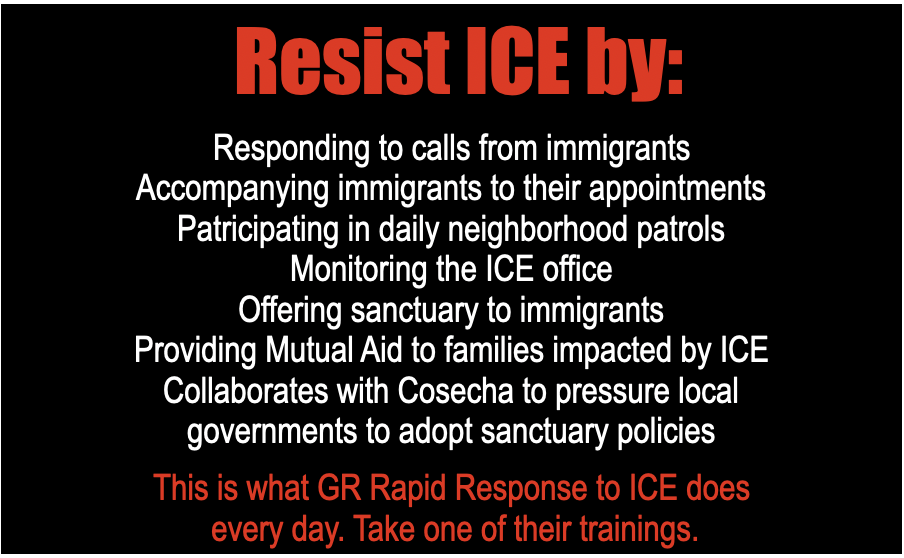
So what does ICE feel threatened by? ICE is threatened when there are organized efforts in communities to resist ICE. Notice I did not say protest ICE, I said resist ICE. What Movimiento Cosecha and GR Rapid Response to ICE does is to resist ICE in the following ways after you go through a training:
- Responding to calls from immigrants when they see ICE.
- Provide accompaniment for immigrants to their appointments and court dates.
- Patrol multiple neighborhoods throughout the city to monitor ICE activity and mobilize people who have been trained to respond.
- Provide legal support for people who have been detained.
- Offer transportation, material support, financial support and other forms of Mutual Aid to immigrant families who have already been impacted by ICE violence.
- Offering Sanctuary for individuals and immigrant families that no longer feel safe where they live.
- Working on the sanctuary policy campaigns that Cosecha has been pushing for the past 12 months to get the City of Grand Rapids and Kent County to adopt.
This is what resistance to ICE looks like, where we are putting our bodies between ICE and those they are targeting and directly supporting immigrant families who have had someone arrested, detained or deported.
There are lots of groups who are protesting ICE now because of the ICE killing last Wednesday, which I totally get. However, the problem is that they are ignoring the work that Movimiento Cosecha and GR Rapid Response to ICE have been doing since 2017. When groups ignore this work and this history they are disrespecting the work that has been done, along with the people who have invested a great deal and made sacrifices in support of affected communities, mostly because it has been about building relationships and developing trust with undocumented immigrants.
What is worse is when groups who want to center themselves while opposing ICE speak up. I they are not centering affected people AND not reaching out to them before they plan anything to ask – What can we do to support? – they are perpetuating white supremacy. This is happening in Grand Rapids right now and it needs to stop!
If you want to be in solidarity with the very people who are being terrorized by ICE – undocumented immigrants – then you should be following the lead of Movimiento Cosecha in the greater Grand Rapids area. If you are not an undocumented immigrant then you should join the work of GR Rapid Response to ICE, since they do exactly what Movimiento Cosecha asks them to do.
If you are working for immigrant justice in other communities, then you need to reach out to and build relationships with affected communities to find out what they want you to do. Stop practicing White Saviorism and center the lived experiences and voices of affected communities. This is what practicing solidarity looks like and this is how we build a movement to abolish ICE! Chinga La Migra!!!!
The community showed up to pressure Kent County officials about sanctuary policies, but they were greeted with gaslighting and no support
Movimiento Cosecha, GR Rapid Response to ICE and other community members showed up Thursday morning to the Kent County Commission meeting to continue their efforts to push for the 6 sanctuary policies (see below) that they have been demanding over the past 12 months.
Because there was a good turnout, the Kent County Commission Chair Ben Greene conferred with legal council to limit public comment from 3 minutes to 2 minutes. This was an interesting response, especially since the whole meeting lasted less than an hour, since Movimiento Cosecha Live-streamed the meeting.
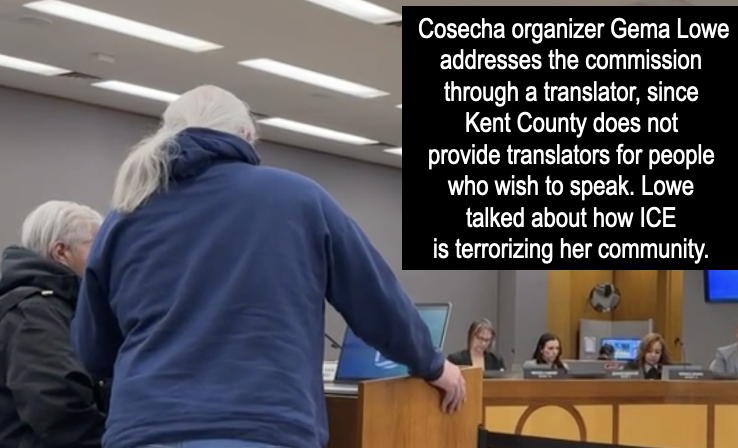
There were 21 individuals who spoke during public comment, all of which addressed the demands for Kent County to adopt the 6 sanctuary policies, with people talking about how ICE has been impacted immigrants in Kent County, along with several of the people arrested at the Sheriff’s office talking about why they risked arrest.
It was no surprise what followed after public comment. First, the County Administrator Al Vanderberg spoke for several minutes – actually he talked down to those who spoke during public comment – about why Kent County cannot address immigration policies, so while they “hear” our concerns, there is nothing they can do. Not only do people hate it when politicians gaslight them, they hate it when politicians try to avoid being held accountable.
Let’s be clear, Movimiento Cosecha and GR Rapid Response to ICE are not asking the county to adopt immigration policies, they are asking them to adopt policies that will not allow Kent County agencies, specifically the Sheriff’s office to collaborate with ICE, all for the purpose of keeping people safe. Thus, the 6 sanctuary policy demands are really public safety policies, not immigration policies.
Most of the Kent County Commissioners chose not to speak towards the end of the meeting, but there were four County Commissioners that spoke, all of which were Democrats. One said that he was going to have a conversation with the Sheriff and the other three commissioners said they “heard people” and that they think about these things, but none of them made a commitment to actually push these demands with their fellow commissioners.
The lack of interest and the action of action was palpable. However, it got me thinking. What if politicians actually listened to their constituents and showed up in community to hear directly from undocumented immigrants? How might that change their minds? What if politicians centered affected communities and ask them what they want? What if politicians actually spoke up when hearing from the community and pushed their fellow commissioners to hold hearings and craft policies that were based on what the community wants? Don’t you think that if politicians were to behave in these ways that they would actually be serving the people?
The fact of the matter is that right now those that are listening to undocumented immigrants are Cosecha and GR Rapid Response to ICE. Gema Lowe from Cosecha said during her public comment that it was the community, not the government that was keeping the immigrant community safe. We take care of each other.
The six sanctuary policies are:
- Policies restricting the ability of state and local police to make arrests for federal immigration violations, or to detain individuals on civil immigration warrants.
- Policies restricting the police or other county workers from asking about immigration status.
- Policies prohibiting “287(g)” agreements through which ICE deputizes local law enforcement officers to enforce federal immigration law.
- Policies that prevent local governments from entering into a contract with the federal government to hold immigrants in detention.
- Policies preventing immigration detention centers from being established in Kent County, which would include the use of the Kent County Jail as a detention facility for ICE.
- A policy that will not allow the Kent County Sheriff’s Department to share Flock camera images or any other information gathered by county staff with ICE or any other law enforcement agency seeking to arrest, detain and deport immigrants.
Get angry, grieve, then organize locally: How we can best resist ICE in Grand Rapids
The ICE murder of Renee Nicole Good in Minneapolis on Wednesday morning should enrage us all. Good was acting as a legal observer and work with the local Rapid Response group that attempts to intervene when ICE seeks to adduct people and provide Mutual Aid to immigrants families that have already been traumatized by ICE.
There was a vigil last night in Grand Rapids for Renee Nicole Good. For those who attended I hope they were able to grieve in community.

Renee Nicole Good is not the first person killed by ICE, as several others have died attempting to flee ICE, along with the dozens of immigrants that have died in ICE detention centers across the country in 2025.
Right now I am feeling disgusted, but I am also feeling conflicted over the fact that the community outcry over the death of Renee Nicole Good might dissipate in the coming days and weeks. I have seen this pattern over the past 45 years of doing organizing work. And yet, it never has to come to this.
ICE is and has always been a repressive apparatus of the state, ever since it was created in 2003. ICE has always abducted immigrants, caused fear and trauma, has sent millions to detention centers and eventually deportation. The difference right now is that ICE has a vastly larger budget, an administration that doesn’t care about optics and a base of supporters that are overtly xenophobic and simply want blood.
So what are we going to do about ICE? Ultimately, ICE needs to be abolished……period. There is no argument that can be made for a kinder, gentler form of state repression. However, both the Republicans and Democrats will never agree to abolish ICE. So what do we do……we organize and resist ICE.
I urge you to challenge the rage that you have right now over the murder of Renee Nicole Good into the most effective way to resist ICE in Grand Rapids, which is to be part of the work that Movimiento Cosecha and GR Rapid Response to ICE. Both of these groups, which have worked in tandem since 2017, are doing the important work of resisting ICE in this community. Here is how you can be part of that work:
- Attend a GR Rapid Response to ICE training, which are monthly. Just go to their Facebook page to find the next training dates.
- Once you take a training you can directly respond to calls from the immigrant community to directly intervene and stop ICE from apprehending people. The hotline number is 616-238-0081.
- Be part of the daily patrols that GR Rapid Response to ICE does throughout the city.
- You can respond to the requests for accompaniment, where immigrants have appointments to check in with ICE or for immigration court dates.
- Be part of our efforts to monitor and document the activity of ICE in Grand Rapids, with teams that monitor the 517 Ottawa office.
- Join the GR Rapid Response to ICE Mutual Aid teams that offer transportation, material resources and can connect immigrants to legal assistance. Since September the Mutual Aid team has raised roughly $40,000 to support immigrant families who have had a family member taken, are in detention or have already been deported.
- Join the Sanctuary team that is working hard to get various institutions, non-profits, businesses and faith communities to become sanctuary spaces. In addition, we are working to create more safe houses for immigrants who no longer feel safe where they live.
- Be part of the Cosecha efforts to get the City of Grand Rapids and Kent County to adopt the 6 sanctuary policies that will prevent the city or the country from cooperating and collaborating with ICE to inflict harm on immigrants.
- Join the Cosecha and GR Rapid Response to ICE boycott of Mayor LaGrand’s businesses, since he has been unwilling to adopt the 6 sanctuary policies for Grand Rapids. The Mayor of Minneapolis said on Wednesday that he wants “ICE to get the fuck out of his city.” This is the kind of Mayor we want to see in Grand Rapids.
- GR Rapid Response to ICE members have been working with No Detention Centers in Michigan to assist individuals who are being released from the detention facility in Baldwin, Michigan.
- Get trained in Civil Disobedience so when Cosecha asks allies to use that tactic for escalated actions and risk arrests, they will have an unlimited number of people that will disrupt business as usual and amplify the resistance to ICE in this city.
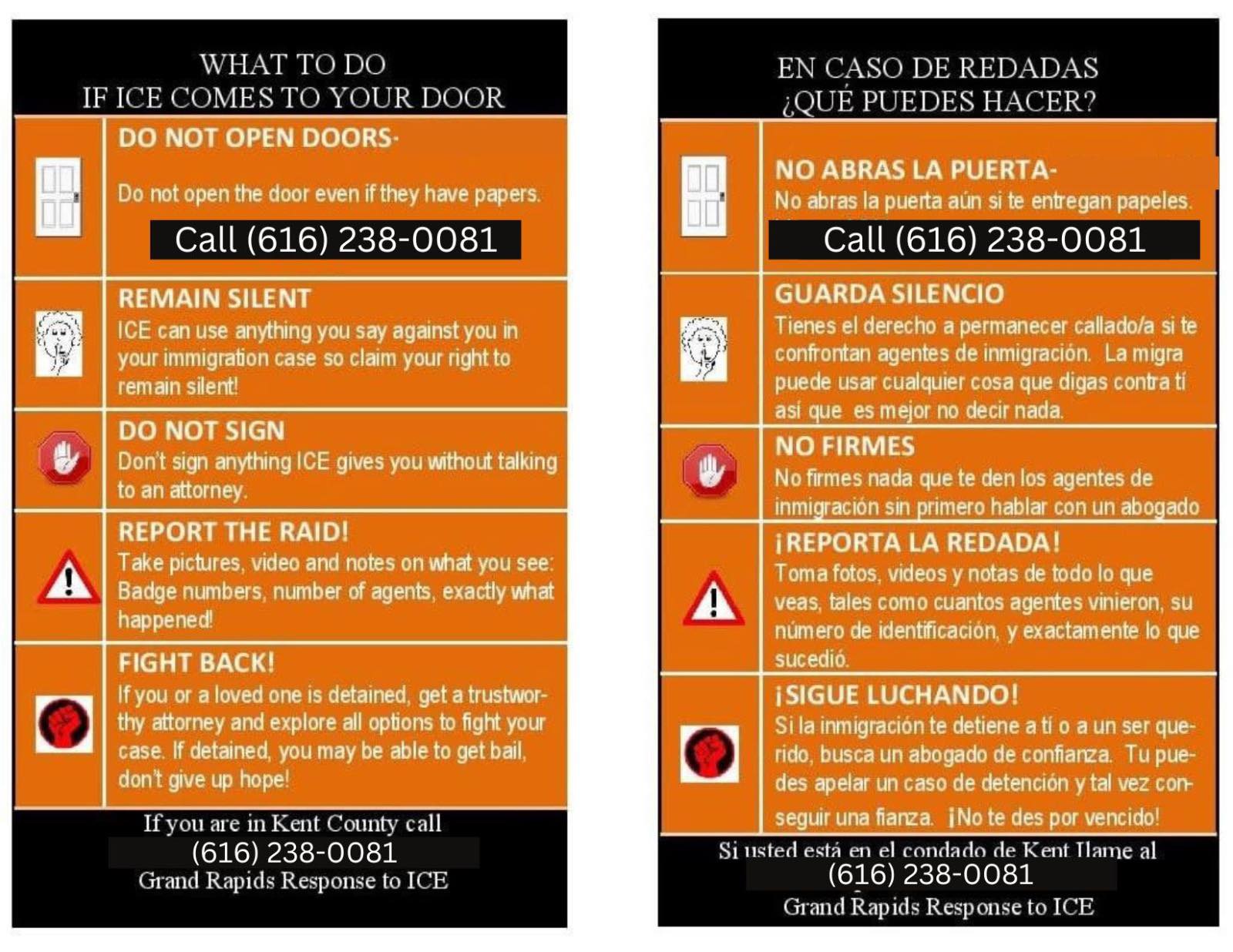
- Lastly, you can help spread the word by distributing the cards below, in Spanish and English, with tips on what to do if ICE shows up, which also has their hotline number.
Let’s channel the rage and energy we all have because of the ICE murder of Renee Nicole Good by joining the work of Cosecha and GR Rapid Response to ICE. That is the most effective way to resist ICE in Grand Rapids and Kent County, and it will be what is needed to get us closer to abolishing ICE once and for all.
Echo chambers for state propaganda: WOODTV8 only talked to Venezuelans that hate Maduro
It is deeply problematic when news agencies only present one side in a story, especially when the one side they present affirms state propaganda. Channel 8 did run a story about the protests, but in that story they did include multiple perspectives and ended the story with Michigan political statements that were anti-Maduro. However, the three politicians cited were Michigan Democratic Senators Peters and Slokin, followed by Rep. Moolenaar, but the story suggested that only Moolenaar was anti-Maduro, when in fact as I reported on Monday, Michigan Democrats are also taking an anti-Maduro position.
On Monday, WOOD TV8 ran a story where the news reader began the story by saying, “A group of Venezuelans in West Michigan has a message for people in the U.S.: Listen to Venezuelans.” However, unlike Saturday’s coverage, channel 8 only provides an anti-Maduro perspective in this most recent story and they posted a link to the letter that was written by a group called Venezuelans of West Michigan.
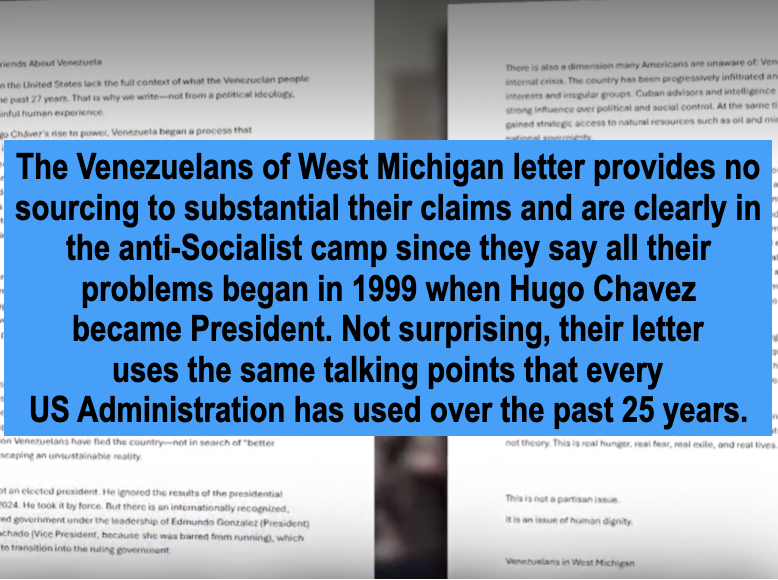
Channel 8 posted this letter without any verification or differing perspectives, something that never happens when groups that challenge state narratives. However, before I deconstruct the letter I wanted to say something about the two people cited in this channel 8 story.
The first person cited in the story was Belkis Lizarazo, a Venezuelan who runs a food business. Lizarazo has had a Facebook page since 2018, but has never said anything about Venezuelan politics. On her Linkedin page it says she is Community Leader with the Treetops Collective, yet she has never publicly said anything about the immigration status of Venezuelans in the US nor the possibility that the Trump Administration may deport up to 600,000 Venezuelan immigrants currently living in the US.
The other person cited in the channel 8 story was Jose Duran, who is referred to as “president of Movimiento de Ciudad.” Duran is the Executive Director of Movimiento America Latina, but is also Director of City Leaders Collective, which is a partner group of Movimiento America Latina. One of the partner groups of City Leaders Collective is Movement West Michigan. Looking at the websites of each of these groups they come off as charity-based/faith-based that doesn’t questions systems of power, and in the case of Movimiento de Ciudad they are clearly an entrepreneurial organization.
Deconstructing the letter from Venezuelans of West Michigan
The first thing to point out about the letter is that Venezuelans of West Michigan do not provide any support for their claims, meaning no souring.
The letter begins by saying that Venezuelans have endured problems over the past 27 years, specifically since 1999 when Hugo Chavez came to power. Interestingly enough, this was the exact same time that the US became anti-Venezuela, since Chavez identified himself as a Socialist who wanted to further the Bolivarian vision of the great Simon Bolivar. See Geo Maher’s book, We Created Chávez: A People’s History of the Venezuelan Revolution.
As I mentioned in a previous post, the effort to undermine Venezuelan sovereignty began 1999. Beside the US support of the attempted coup in 2002, the US has been supporting pro-US/pro-Capitalist candidates and organizations in Venezuela. The primary mechanism that the US government has used to subvert Venezuelan sovereignty has been the National Endowment for Democracy, also referred to as the NED. The NED has been at the forefront of the US campaign to get a pro-US/pro-Capitalist government in Venezuela over the past 25 years. None of this is mentioned in the letter from Venezuelans of West Michigan.
Like the group did with Chavez, they only demonize Nicolás Maduro, making claims of being a dictator, opposing free speech and saying he is not the elected President of Venezuela. It is instructive that these are the same claims being made by the Trump Administration. Regarding the election in Venezuela in 2024, that election is hotly contested, but the context of that election is much more complex than what the Venezuelans of West Michigan suggest. Here is an excellent article, which provides important context and analysis of the 2024 election.
The Venezuelans of West Michigan also reference economic hardships that those living in Venezuela, but completely ignore the fact that the US has imposed economic sanctions on Venezuela since 2005, with more severe sanctions being added over the past 20 years.
Lastly, the Venezuelans of West Michigan claim that Cuba, Russia and China have worked with the Maduro government, plus that government is also connected to “the ELN, FARC, Hezbollah, and networks linked to Hamas.” These are pretty serious claims, yet this group provides no concrete evidence to substantiate these claims.
In the end, Venezuelans of West Michigan is an entity, which has no online presence and essentially has created a narrative that mimics what the US government has been saying since 1999 about Venezuela, that the country is corrupt and repressive. For ongoing analysis from a grassroots Venezuelan perspective check out https://venezuelanalysis.com/.
Why we used the tactic of civil disobedience: Statements from those arrested for exposing ICE holds in Kent County
In the most recent post I described the action that took place on Monday at the Kent County Sheriff’s office, where five people were arrested for exposing the fact that Kent County has been collaborating with ICE by holding undocumented immigrants at the jail for the federal agency.
Today I was to share testimony from each of the five that were arrested, so the community can hear from them directly on why they chose to use the tactic of civil disobedience in service of immigrant justice.
John – I chose to protest because I believe what’s happening in our community is wrong. ICE is detaining people without real due process, using racial profiling that spreads fear, and placing people in dangerous detention conditions. Our local sheriff is cooperating by holding people for ICE even after bail is paid and without a judge’s warrant, despite being funded by us to serve local needs— not federal immigration enforcement. When the sheriff cooperates like this it makes Kent County complicit in this harm. I’m only able to protest like this because of my privilege and our sheriff should protect our neighbors, not help ICE disappear people into fear, detention and abuse!
Sharon – I am in complete agreement with the statements read by Cosecha and my fellow protestors. Why was someone like me willing to risk arrest? The simple answer is because I can and should! I have been a rule follower my entire life. It is important that more individuals feel compelled to stand up and put their bodies at risk for the many who cannot at this time. I was raised in a household that strongly believed that authority figures and institutions were designed to protect ALL of the people’s rights and liberties.
Unfortunately, I have witnessed events to the contrary. What happened to due process? What happened to Judicial warrants? I can no longer stand on the sidelines and watch the cruel and unjust policies being used by the local police and Sheriff’s office to create fear and destruction of our affected community members. This in turn has created an environment of fear and mistrust. This is not what we want our community to look like!
Be transparent with all of the people that work and live in this community!
What is the Kent County Sheriff’s office policy on holding immigrants for ICE? What are their policies on other issues pertaining to the sharing of information and cooperation with ICE agents? What are they doing with our taxpayer dollars in regards to these questions? Stop hiding behind closed doors and simply answer these questions in the open!
Mel – Standing in the face of a violent and abusive system, shouting into the void that COPS AND ICE GO HAND IN HAND was an honor.
Cindy – The reason I protest at the risk of being arrested is because I am a Christian and this is what the Kingdom of God looks like standing up against oppression, injustice and unfairness. And standing up with and for people who are being bullied and persecuted. They are not immigrants, aliens or bad guys – they are our brothers and sisters in Christ.
Jeff – I chose to do civil disobedience today for the following reasons:
First, I want to follow the lead of affected communities, those who are undocumented and Movimiento Cosecha. We cannot claim to be in solidarity with the immigrant community if we are not doing what they ask of us.
Second, I risked being arrested today to amplify the fact that the Kent County Sheriff’s Department is collaborating with ICE to separate families and cause lifelong trauma to immigrant families by holding undocumented immigrants at the Kent County Jail. This is exactly why Movimiento Cosecha has been pushing Kent County Commissioners to adopt sanctuary policies for the past 12 months, since ICE cannot engage in the harm they engage in without the collaboration of entities like the Kent County Sheriff’s Department. This means that the Kent County Sheriff’s Department and the Kent County Commissioners are complicit in the brutal violence being directed at undocumented immigrants in this community.
Lastly, I used the tactic of civil disobedience today because as an accomplice in the fight for immigrant justice, I have a great deal of privilege. Therefore, I am using this opportunity to invite other people of good will to be part of Movimento Cosecha’s campaign to get Kent County and the City of Grand Rapids to adopt the 6 sanctuary policies they have been demanding over the past 12 months. I am inviting people to leverage their privilege and use the tactic of civil disobedience to further disrupt the Kent County Sheriff’s Department until they stop collaborating with ICE and to stop inflicting harm on undocumented immigrants and their families. If pervious movements have taught us anything it is that those of us with privilege need to engage in direct action to resist systems of power and privilege if we want things to change!
La Lucha Sigue!!!
Five arrested at the Sheriff’s office because Kent County is conducting ICE holds on immigrants at the jail
Yesterday there were five individuals who were arrested at the Kent County Sheriff’s office to protest the fact that the Kent County Jail is collaborating with ICE by conducting holds on immigrants.
GRIID reported previously that Movimiento Cosecha and GR Rapid Response to ICE held protests at the Kent County Sheriff’s office to confront the Sheriff about why they were holding immigrants for ICE at the jail. The group of five have been involved in the two previous protests and were working with Movimiento Cosecha to do an escalated action of civil disobedience at the Kent County Sheriff’s office.
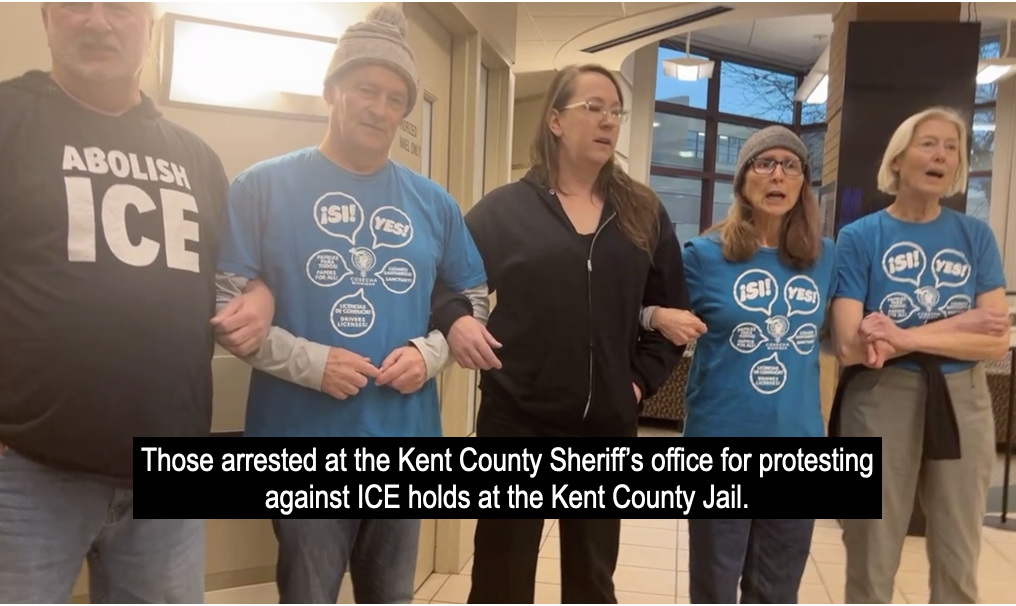
One of the five protesting the ICE holds at the Kent County Jail read the following statement:
Today, as accomplices in the struggle for immigrant justice in Kent County, we deliberately refused to leave the Kent County Sheriff’s Office, resulting in our arrest.
Over the past months, members of Movimiento Cosecha and GR Rapid Response to ICE have repeatedly attempted to engage with the Kent County Sheriff’s Office to demand clear answers about whether Kent County is holding immigrants at the Kent County Jail on behalf of ICE. We are aware of multiple cases in recent months in which immigrants who were detained at the jail, had paid their bond, and were eligible for release were instead kept in custody on civil immigration allegations. As a result, these individuals were later transferred to ICE detention centers, separating them from their families and communities.
Since 2019, the Kent County Sheriff’s Office has publicly stated that it would only hold immigrants for ICE when presented with a judicial warrant for each individual. However, based on what we are witnessing in our community, we do not believe this policy is being followed. This is why we have protested at the Sheriff’s Office over the past months, and why we risked arrest today. When we asked for a direct answer, the Kent County Sheriff’s Office first instructed us to submit a FOIA request. Later, Sheriff LaJoye-Young refused to answer our question directly, despite being present and having the opportunity to clarify the policy. Instead, we were told that we would need to make an appointment.
The lack of transparency from the Kent County Sheriff’s Office is deeply disappointing, but the greater injustice is its continued cooperation with ICE in the persecution, racial profiling, and detention of immigrant workers in our community.
Since January 2025, Movimiento Cosecha GR and GR Rapid Response to ICE have demanded that the Kent County Commission adopt six concrete sanctuary policies. These policies would build trust with the immigrant community and clearly signal that Kent County will not cooperate with ICE’s rogue and violent detention practices, including detentions carried out without proper judicial civil warrants.
The six sanctuary policies are:
- Policies restricting the ability of state and local police to make arrests for federal immigration violations, or to detain individuals on civil immigration warrants.
- Policies restricting the police or other county workers from asking about immigration status.
- Policies prohibiting “287(g)” agreements through which ICE deputizes local law enforcement officers to enforce federal immigration law.
- Policies that prevent local governments from entering into a contract with the federal government to hold immigrants in detention.
- Policies preventing immigration detention centers from being established in Kent County, which would include the use of the Kent County Jail as a detention facility for ICE.
- A policy that will not allow the Kent County Sheriff’s Department to share Flock camera images or any other information gathered by county staff with ICE or any other law enforcement agency seeking to arrest, detain and deport immigrants.
Those of us risking arrest today are using our position of privilege to be in solidarity with undocumented immigrants who are living in constant fear of detention and deportation. We are not subject to being sent to detention or of being deported, so our action today was to amplify the oppressive realities that our immigrant neighbors are facing in Kent County and at the hands of the Kent County Sheriff’s Office.

After reading the statement those present began chanting, which eventually brought out members of the Kent County Sheriff’s Department who demanded that those protesting needed to leave. Some of the protesters told them they would not leave. The Sheriff’s Department then made those who weren’t risking arrest leave the building. The officers hoped this would end the occupation of the building, but the five that remained still refused to leave.
The Sheriff’s Department officers eventually realized that they would have to arrest the five, but they didn’t want to arrest them in the lobbying, especially since everyone else was still standing just outside of the entryway doors and filming. So the Sheriff’s Department officers took the five down a hallway, cuffed them and got their IDs. After cuffing them the cops took people in a separate room one by one to read them their rights and attempted to squeeze information from all five.
Eventually the cops told the five that they would be processing each of the, giving them a citation, charging them with trespass and a court date to appear before a judge. This all took another 20 minutes, with everyone being released through a side door at the Sheriff’s office. Those who came to support the action had already gone to the jail with the intent of bonding out those who were arrested. The five walked over to the Kent County Jail and surprised everyone, since those doing jail support thought that it would have been hours before they were released.
Movimiento Cosecha videotaped the entire action, at least up until the point where the cops made the 5 that were arrested walk down a hallway that was out of site of those who were recording. You can watch that video here.

