Billionaire Meijer Family opens store on Bridge St. now that the neighborhood is catering to the professional class
On Monday, Meijer executives and other members of the Grand Rapids elite showed up for a photo opportunity and to promote their own business interests.
Meijer held a “ground breaking” ceremony, where a bunch of White-connected men did the whole, “we are only mimicking that we are doing actual physical labor,” photo op.

Channel 8 began its news story with the news reader saying, “It’s an exciting day for Grand Rapids’ westside,” which normalizes the ongoing celebration of more development that will cater to the more professional/business class and further marginalize the working class and communities of color.
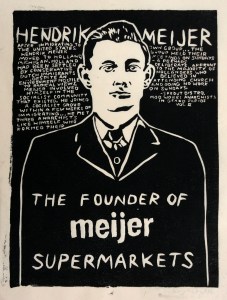 The WOOD TV 8 story, like most media coverage of the new Meijer store on Bridge St, leaves out any historical context, which the billionaire Meijer family is happy about. MLive has Hank Meijer talking about how proud his father would have been about this new urban store. However, neither Hank, not his brothers, would be talking about what his Grandfather Hendrik Meijer may have thought about this, especially since Hendrik was part of a Socialist community and even made it a point to get married on the anniversary (November 11, 1912) of the execution of the Haymarket Anarchists.
The other major contextual piece that is ignored in the commercial media narrative about has to do with white flight. Meijer stores, like most retail stores, has focused heavily on suburban store development since the 1960s, in part because of the ways that cities were being designed around the use of cars, but primarily because there was tremendous economic divestment from the urban core of major cities, along with lots of white people fleeing cities out of fear, since black people were more aggressively demanding justice.
Now, the opposite is happening, where white people are re-investing in the urban core and re-taking property that has been lived on by communities of color. This is definitely the case on the near westside, which has see a significant increase in the number of Latino and African Americans over the past 20 years. However, now that white folks are seeing the benefits of “walkable” communities, they are moving back in droves to areas like Bridge St, which has been radically altered in recent years to cater to the professional and business class, with high-end stores, breweries, cafes and market rate housing.
Rockford Construction, the company that is behind this major re-development of the near westside, confirms the financial benefits that market rate housing options have on retail in their Complete Neighborhoods report, where they state:
Locally, Downtown Grand Rapids, Inc. demonstrated in a January 2014 presentation the effects of housing on retail. Market rate housing was estimated to generate $15,559 annually in retail spending, with affordable housing generating $7901 annually.
Market rate housing is already dominating the majority of the new housing options in the Bridge St. corridor and it is likely that the push for more market rate housing in the area will increase. Development projects like the new Meijer Bridge St. Market have a domino effect on neighborhoods that will ultimately mean that working class people and communities of color will be displace because existing housing options will be torn down and because landlords and property management companies will increase the rental rates.
There is nothing surprising in the commercial media’s response to the ground-breaking photo op for the new Meijer Bridge St. Market. However, it is important that we can counter the narratives about what this new grocery store will mean for the westside, who benefits and who will be marginalized. We don’t have to buy into billionaire Meijer family project, which will further the gentrification of the westside.
8 of Michigan’s top 26 Families making political contributions in the last election cycle are from West MI
A new report from the Michigan Campaign Finance Network, reports that the top 40 families in Michigan contributed a total of $44 million dollars in the last election cycle.
Not surprising, the DeVos Family contributed to the most on that last at $15 million in the 2015 – 2016 election cycle.
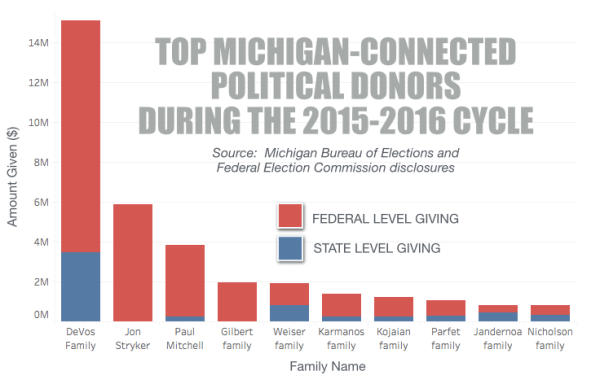
However, it is important for those who live in West Michigan to recognize that there were other families in this area that also contributed a significant amount of money to influence the 2015-2016 election cycle. These are all families that make up the local power structure, some have large foundation, many sit on boards of non-profits, others contribute to local colleges and many are involved with groups like the West Michigan Policy Forum, the Grand Rapids Chamber of Commerce, Grand Action and the Econ Club.
The amount of money from this list, provided by the Michigan Campaign Finance Network, includes federal and state money. At the federal level the families from West Michigan primarily gave to the Republican Party, but in some cases they provided funds to candidates like Rep. Justin Amash and Rep. Bill Huizenga.
Contributions at the state level have receive less attention, which is unfortunate, since state policy often impacts people more directly than federal policy. For example, here is just a sampling of state laws that have been passed, which was introduced and promoted by lawmakers that the DeVos Family made contributions to:
- In June of 2015 Governor Snyder signed into law HB 4052, a law that takes away control of local municipalities.
- In July of 2015, Michigan adopted HB 4188. This legislation, often framed as a religious freedom bill, allows adoption agencies in Michigan the ability to deny LGBT couples/partners/families from adopting.
- Public Act 269 was signed into law in December of 2015, by Gov. Snyder. This act doubles the amount of money that can be contributed to Political Action Committees and it Prohibits corporations from collecting contributions from its employees to a union’s PAC.
- They spent $1.2 million in 2016 to influence policymakers (a total of 15) on the issue of Detroit School privatization.
 Now, let’s look at the other 7 families from West MI that were in the top 26 in the state on political contributions in the 2015 – 2016 election cycle.
Jandernoa Family (42 North Partners, Perrigo) – Contributed $827,500
Kennedy Family (Autocam) – Contributed $723,100
Van Andel Family (Amway) – Contributed $667,300
J.C. Huizenga (National Heritage Academies, Huizenga Group) – Contributed $445,489
Meijer Family (Meijer) – Contributed $386,400
Haworth Family (Haworth Inc.) – Contributed $367,536
Secchia Family (Sibsco) – Contributed $317,380
What we are listing below are some of the committees and State Legislators that these families from West Michigan gave money to in the 2015 – 2016 election cycle. The Michigan Campaign Finance Network provides a document that lists the top 40 Families in Michigan, the breakdown for Federal and state contributions and the top recipients.
Top donors to the House Republican Campaign Committee for 2015-2016: DeVos family, $720,000, Kennedy family, $160,000, Haworth family, $80,000, Meijer Inc. PAC, $60,000, J.C. Huizenga, $55,000, Michael Jandernoa, $50,000
Top donors to the Senate Republican Campaign Committee for 2015-2016: DeVos family, $121,000, J.C. Huizenga, $55,000, Meijer Inc. PAC, $40,000, David Van Andel, $40,000
20th House District, Rep. Jeff Noble – DeVos family, $9,000
30th House District, Rep. Diana Farrington – DeVos family, $8,000
32nd House District, Rep. Pamela Hornberger – DeVos family, $9,000
38th House District, Rep. Kathy Crawford – DeVos family, $9,000, Haworth family, $2,000
39th House District, Rep. Klint Kesto – DeVos family, $9,000
41st House District, Rep. Martin Howrylak – Meijer PAC, $2,000
43rd House District, Rep. Jim Tedder – Kennedy family, Autocam, $2,000
45th House District, Rep. Mike Webber – Kennedy family, $2,000
51st House District, Rep. Joseph Graves – DeVos family, $8,200, Haworth family, Haworth Inc., $2,000
56th House District, Rep. Jason Sheppard – Meijer PAC, $3,000
57th House District, Rep. Bronna Kahle – DeVos family, $9,000
61st House District, Rep. Brandt Iden – DeVos family, $9,000, Meijer PAC, $4,000
62nd House District, Rep. John Bizon – DeVos family, $9,000
66th House District, Rep. Beth Griffin – DeVos family, $9,000
70th House District, Rep. James Lower – DeVos family, $9,000, Haworth family, Haworth Inc., $2,000
71st House District, Rep. Tom Barrett – DeVos family, $9,000
72nd House District, Rep. Steve Johnson – Peter Secchia, retired, $1,000, Matthew Haworth, Haworth Inc., $1,000
73rd House District, Rep. Chris Afendoulis – John Kennedy, Autocam, $5,000, Meijer PAC, $3,500
74th House District, Rep. Rob VerHeulen – DeVos family, $9,000, Meijer PAC of Michigan, $2,500, Kennedy family, $2,000, Haworth family, $2,000
77th House District, Rep. Tommy Brann – DeVos family, $9,000, Haworth family, Haworth Inc., $2,000, Michael Jandernoa, 42 North Partners, $1,000, Peter Secchia, Sibsco, $1,000
80th House District, Rep. Mary Whiteford – Haworth family, Haworth Inc., $2,000, Peter Secchia, Sibisco LLC, $1,000, Michael Jandernoa, 42 North, $1,000
82nd Houst District, Rep. Gary Howell – DeVos family, $9,000
85th House District, Rep. Ben Frederick – DeVos family, $9,000, Jandernoa family, 42 North Partners, $2,000
89th House District, Rep. Jim Lilly – DeVos family, $9,000, Haworth family, Haworth Inc., $2,000
90th House District, Rep. Daniela Garcia – DeVos family, $9,000, Haworth family, $3,000, Kennedy family, Autocam, $2,000, Meijer PAC, $2,000
91st House District, Rep. Holly Hughes – DeVos family, $9,000
93rd House District, Rep. Tom Leonard – DeVos family, $9,000
97th House District, Rep. Jason Wentworth – DeVos family, $9,000, Haworth family, Haworth Inc., $2,000
99th House District, Rep. Roger Hauck – DeVos family, $7,000
101st House District, Rep. Curt VanderWall – DeVos family, $9,000
102nd House District, Rep. Michele Hoitenga – J.C. Huizenga, Huizenga Group, $1,000
103rd House District, Rep. Daire Rendon – DeVos family $9,000, Haworth family, Haworth, $2,000
104th House District, Rep. Larry Inman – DeVos family, $9,000
106th House DIstrict, Rep. Sue Allor – DeVos family, $9,000
107th House District, Rep. Lee Chatfield – DeVos family, $9,000, Haworth family, Haworth International, $2,000
108th House District, Rep. Beau LaFave – DeVos family, $9,000, Haworth family, Haworth, $2,000
13th Senate District, Sen. Marty Knollenberg – DeVos family, $3,000
19th Senate District, Sen. Mike Nofs – Meijer PAC, $1,000
28th Senate District, Sen. Peter MacGregor – Michael Jandernoa, $2,000, Meijer PAC, $2,000
29th Senate District, Sen. Dave Hildenbrand – David Van Andel, Van Andel Institute, $2,000
30th Senate District, Sen. Arlan Meekhof – John Kennedy, $50,000, DeVos family, $40,000, Van Andel family, $15,000, Peter Secchia, retired, $10,000, J.C. Huizenga, $10,000, Dick Haworth, $5,000, Meijer PAC, $3,500
32nd Senate District, Sen. Ken Horn – DeVos family, $3,000
Rockford Construction has been working on the Southtown Development Project since at least 2014
In our ongoing coverage of DeVos-led AmplifyGR group and their partner, Rockford Construction, we want to continue to ask relevant questions and raise the level of awareness about those who are part of the local power structure are planning to do in neighborhoods across the city.
In our original story, we looked at what the AmplifyGR/Rockford Construction efforts were proposing in the Southtown area of Grand Rapids. We reported that over the past 6 months AmplifyGR and Rockford Construction have been meeting with city planners and people who make up part of the Southtown Corridor Improvement District committee.
In Part II of this series, we looked at the number of plots that Rockford Construction has already purchased in both the Boston Square Area and the Cottage Grove area. We made the point in this post that AmplifyGR is really a project that amplifies the voices of developers and investors who have already created an unequal power dynamic by virtue of how much land they control in the target areas.
In our third article on AmplifyGR, we wanted to alert people to a meeting that AmplifyGR was hosting on June 29, shed some light on the process and provide some information on the entity that is financing AmplifyGR – the Doug & Maria DeVos Foundation.
In today’s post we continue to want to raise relevant questions about the AmplifyGR project.
Last year, we ran a story about a Rockford Construction development plan that had created some controversy at the time, because they already had a proposed plan before even discussing the development idea with people who actually live in the target neighborhood. The development project became public when someone from Linc posted information on Facebook and in their online news section. The online news piece is entitled, Rockford Construction’s “Hushed” Plan for Southeast Redevelopment Brought to Light . 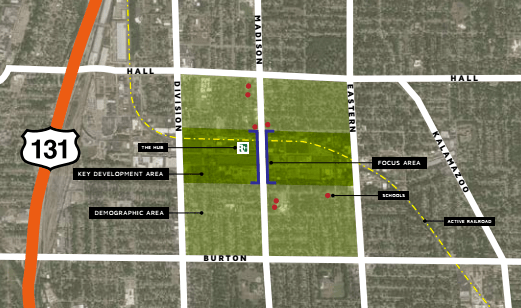
The “Hushed Plan” that Linc is talking about is a 43-page document, ironically titled, Complete Neighborhood. We revisited that document, in light of the recent revelations that Rockford Construction was working with AmplifyGR. AmplifyGR has stated that their proposal for the Boston Square area is based on the Purpose Built Communities model. In re-reading the Rockford Construction document, they mention that they had attended a Purpose Built conference and were working with consultants from that organization. On pages 6 – 7 of the Rockford Construction document it states:
Purpose Built Communities, led by Greg Giornelli, has provided support to the Grand Rapids team in a number of ways:
Strategic Planning Session – Greg Giornelli visited Grand Rapids to review the fundamentals of the Purpose Built Model and to assist in goal-setting. While the pillars of Purpose Built are foundational for every member community, each neighborhood bring its own unique challenges, and each community must craft its own approach to solving problems.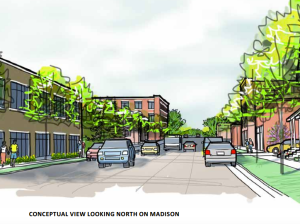
Members of the Grand Rapids team attended the Purpose Built Conference in September, 2014. Other Purpose Built Members were in attendance and topics ranged from neighborhood resident engagement to early childhood brain development. Of note was the wide variety in both the physical characteristics of each neighborhood and the organizational approach to implementing strategies.
So, it seems clear that Rockford Construction has been working on a plan to re-develop part of Southtown since 2014, based on their own report comments about meeting with folks from Purpose Built Communities. Three years later, they appear to be ready to implement such a plan, even before those who live in the target area even know what the hell is going on.
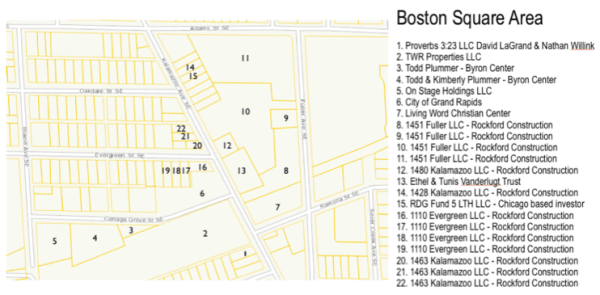
We also looked closer at the land purchases that Rockford Construction has been making in the Southtown area, particularly the Boston Square neighborhood and the Cottage Grove area. Below you can see which parcels they have purchased, for how much and in what year.
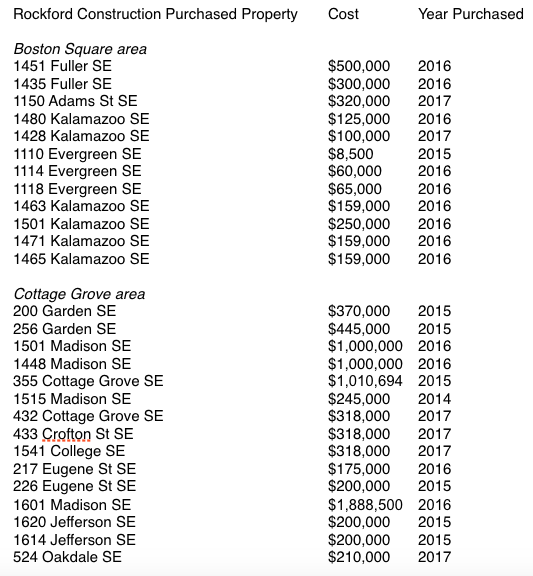
All of the property purchases combined is an estimated $10 million that Rockford Construction has spent on the land in the two areas of Southtown. This is an incredible amount of money and one wonders if the company has that kind of money to spend or if they have other financial backers?
One thing that isn’t clear from the 2015 Rockford Construction document is who will ultimately maintain control over all this property in the Southtown area, not how much the company stands to profit off of such a plan. The company clearly is motivated by profits, so it will be interesting to hear what their CEO has to say about this at the public meeting on June 29.
The report does provide a Mission Statement, which is worth reprinting here:
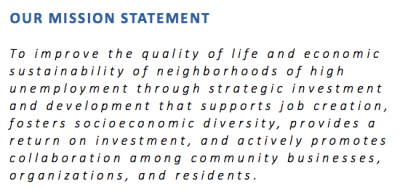
What the mission statement says to this writer is that this is all just another neoliberal capitalist scheme that will make money off of poverty, while attempting to present the proposed development and Rockford Construction as Saviors of the neighborhood.
What if instead, people were to make a counter proposal back to Rockford Construction and AmplifyGR. The community proposal could go something like this: How about all the land you have purchased, and the additional money that investors are willing to throw at this project, were given to those who live in the community to be put into a Community Land Trust (CLT). This CLT would be completely under the control of those who lived in the neighborhood, could provide tremendous financial opportunities for home owners and tenants in the area and could lead to community based ideas for how best to move forward. If Rockford Construction and the DeVos-created AmplifyGR really wanted these neighborhoods to truly prosper, then they wouldn’t have a problem transferring all those assets over the the people who live there.
 Last week, Secretary of Education Betsy DeVos spoke to a gathering of people at the National Alliance for Public Charter Schools.
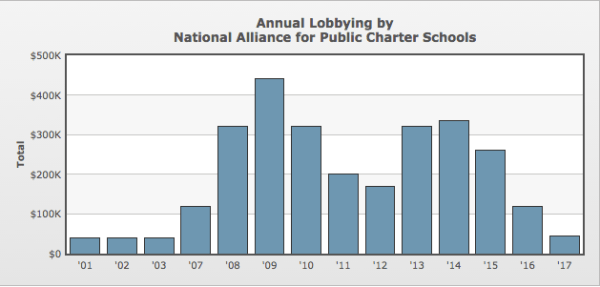
The National Alliance for Public Charter Schools is an organization committed to the growth of Charter Schools and lobbies at both the state and national level on education policy. You can see from the graphic below, the National Alliance for Public Charter Schools has spent several million dollars over the years to influence federal education policy, according to the Center for Responsive Politics.
The National Alliance for Public Charter Schools relies on some of the richest family foundations, like the Walton and Gates Foundations and they boast being in partnership with some of the most anti-Public School groups in the country. A few of the groups they partner with have strong ties to Dick & Betsy DeVos, such as the Alliance for School Choice and the American Federal for Children.
What Betsy DeVos had to say to those gathered at the National Alliance for Public Charter Schools event was not terribly revealing, but there were some comments that are worth pointing out.
First, she likes to talk about her and her husband, Dick DeVos.
Defenders of the status quo like to paint me as a “voucher-only proponent”, but the truth is I’ve long-supported public charter schools as a quality option for students. I worked with many others to get Michigan’s first charter legislation passed in 1993—the third state to do so. And my husband founded a charter high school in Michigan that focuses on aviation, educates kids in the STEM fields and prepares them to contribute in significant ways to our 21st century economy.
Midway through her comments at the National Alliance for Public Charter Schools, DeVos mentions several school programs that she has high regard for, one of which is the Christian Academy for Reaching Excellence (CARE). Jeff Bryant, a national writer, who advocates for public education has the following comments about Betsy DeVos and CARE. 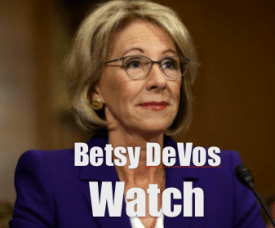
DeVos’s belief in using education as a way to “advance God’s Kingdom” is well documented.
As Kristina Rizga reports for Mother Jones, the lengthy philanthropic record DeVos and her husband have amassed over many years shows “the couple’s clearest preference is for Christian private schools.”
CARE elementary certainly fits that profile. Students at CARE, according to the school’s handbook, “Attend weekly chapel, they are taught Christian principles with love and respect, and they are exposed to the love and grace of Jesus Christ. Prayer is part of the CARE experience.”
On its website, CARE says the school admits students of “any race, color, national, and ethnic origin” and “does not discriminate on the basis of race, color, national, and ethnic origin.” Discriminating based on religion is notably absent.
Since the school’s opening in the fall of 2015, it has gotten significant praise from school choice advocates in South Florida, including the Foundation for Excellence in Education, which endorsed DeVos’s nomination.
The Foundation for Excellence in Education was founded by former Florida Governor Jeb Bush and has received generous support from DeVos and her foundation. DeVos has also served on its board of directors.
The Secretary of Education wraps up her comments to the National Alliance for Public Charter Schools by making the following comments near the end of her speech. This comment is simply an affirmation on her commitment to fund education systems that are anything but public education.
Today we have a great opportunity. While some of you have criticized the President’s budget—which you have every right to do—it’s important to remember that our budget proposal supports the greatest expansion of public school choice in the history of the United States. It significantly increases support for the Charter School Program, and adds an additional $1 billion for public school choice for states that choose to adopt it.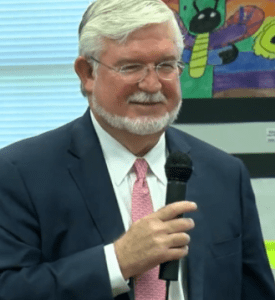
Possible Student Loan Officer should scare the shit out of students
The other news about Betsy DeVos that is worth mentioning is her announcement about who she intends to appoint as the Chief Operating Officer of Federal Student Aid.
The Education Secretary wants to bring in , whom the Education Department press release says has, “more than 30 years of experience in the financial services industry.”
Johnson has been the CEO of numerous financial institutions and has spent more than 30 years working to make money for those same institutions. Having him as the Chief Operating Officer of Federal Student Aid should make any student with federal loans scared and angry.
A recent article on Buzzfeed does point out the predatory nature of Dr. Johnson being Betsy DeVos’s choice to head up this position.
The Education Department’s statement described A. Wayne Johnson as the “Founder, Chairman and former CEO” of a payments technology company called First Performance Corporation. It noted his PhD in education leadership, and Education Secretary Betsy DeVos, citing his dissertation, said he “actually wrote the book on student loan debt.”
But what wasn’t noted was Johnson is currently the CEO of Reunion Student Loan Services, a detail confirmed by a company representative reached by phone on Tuesday afternoon. Reunion originates and services private student loans, and offers refinancing and consolidation for existing loans.
GVSU Magazine, the Westside, and Gentrification
 Developers, whether they are private or public, always have an impact on neighborhoods no matter how much they try to hide it.
This is the case with a recent Grand Valley State University Magazine article, which depicted the impact that campus was having on the westside of Grand Rapids.
The article, entitled, West Side Story: Grand Valley Strengthens Connection to Neighbors Through Collaboration, paints a very one-sided picture of what the school’s impact has had on the lower westside since they first moved to that part of town beginning in 1988, when the Eberhard Center opened.
The first person interviewed in the article is a student who was involved in a project called Civic Studio. Civic Studio has not been shy about exploring the history and contemporary dynamics that impact the westside of Grand Rapids, with a significant emphasis on gentrification. This writer has attended many forums on this theme at Civic Studio hosted forums and there has been plenty of community and student discussion, some of which has been critical of GVSU’s role in perpetuating gentrification.
However, the article ends that section by stating that the student who was interviewed, “is just one of the estimated hundreds of students who live on the West Side, home to Grand Valley’s Pew Grand Rapids Campus, where university collaborations with residents, organizations and schools are common.”
The rest of the article includes several GVSU faculty and staff voices and just one perspective from a local non-profit, all of which support the notion that GVSU has been nothing but good for the westside.
The article even includes an image of westside map that is very cute and fun and has landmarks such as the John Ball Zoo, several schools, a park and of course the GVSU campus.
Now, there might be some people, even westsiders, that feel that the GVSU presence is a good thing, but to present this issue so one sided is not only dishonest, it ignores the complexities of how any major institution impacts neighborhoods.
This writer has attended many forums on gentrification in the past two years and there have been many people from the westside who have spoken about the negative impact that GVSU has on that part of town. The most frequent response that people give, in terms of the GVSU impact on the westside, is on student housing.
There are hundreds of students who rent on the westside of Grand Rapids, often sharing a house or an apartment with other students. What landlords and property management companies have realized is that charging 4 students (at $500 – 600 a piece) is much more profitable than it is to rent to a family of four. This dynamic has caused rental costs to increase across the board on the westside, making it difficult for working class individuals and families to afford rent.
In addition, many of these rental properties have been purchased by investors, many of which are from out of town and out of state. The Michigan Radio documentary, Pushed Out, provides important details about this dynamic. Beginning with the 2008 economic crisis, hundreds of homes in Grand Rapids were foreclosed, bought up by investors and then turned into rental properties right at the time that the most recent gentrification push took off. The map here shows (in red) where homes were foreclosed on the westside and purchased by investors.
Besides the increase in rental properties and higher cost of rent, there are more and more development projects that are located near the GVSU westside campus, development projects that primarily cater to those who can afford $1500 a month rental costs, $4 cups of coffee micro-breweries, boutique shops and all the other upscale services being offered. An article from If the River Swells, provides important analysis of how these development projects impact the westside, projects which is connected to the ongoing expansion of the GVSU campus.

It will be interesting to see how the Grand Valley Magazine would spin the campus expansion in the Belknap neighborhood. Would they say they are practicing good community engagement or that it is another “model partnership?” Not everyone in the community is fooled by these kinds of glowing PR pieces.
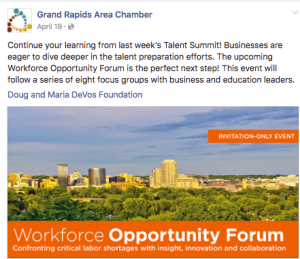 Last month we posted a story about a new report from the local group Believe 2 Become about Workforce Development. The report was arguing the need to create more “opportunities” for students, but tended to focus on building stronger relationships between the business community and the schools.
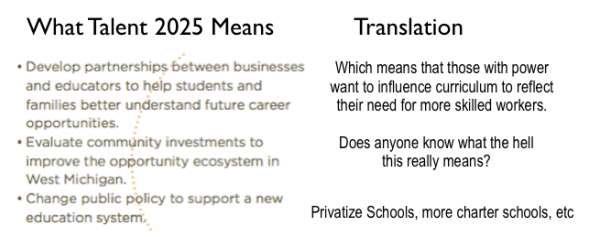
The Believe 2 Become report also references the talent management group Talent 2025, which has identified these three goals for West Michigan, if the economy is to grow. Below is what Talent 2025 is suggesting and our own translation of what they are proposing.
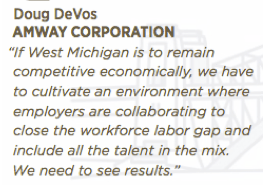 In the report there are also quotes from representative of the local power structure. You can see what Doug DeVos says here, which is really a way of saying, “we need more skilled workers in order to increase our profits.”
Recently, the Believe 2 Become report was the focus of gathering of local power brokers, who came together to discuss ways in which to facilitate a deeper relationship between schools and the business community.
Here is the video that provides a summary of the invitation only gathering that took place at Meijer Gardens. Pay close attention to which voices are heard.
It’s interesting that there are three women who set up the video, who are then followed by several people who make up the West Michigan Power structure, particularly Doug DeVos, Rockford Construction CEO Mike VanGessel, Peter Haines from the Ottawa Intermediate School District, Shana Welch from Mercy 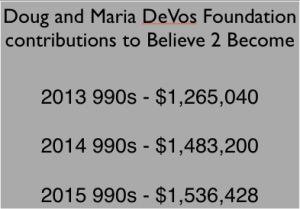 Health, Kenyatta Brame with Cascade Engineering, President of the Grand Rapids Chamber of Commerce Rick Baker, Kevin Stotts with Talent 2025 and Teresa Weatherall Neal – Superintendent of the Grand Rapids Public Schools.
The most instructive thing shared in the video is when Doug DeVos says that the people to fix the workforce shortage problem are in this room. Again, people with power making decisions for the rest of us, because they know best what we need and what we want.
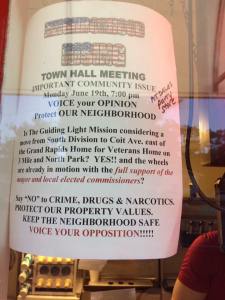 About 60 people showed up to a meeting last night that was held outside across from a building that some people believe might be the future site of the Guiding Light Mission.
A Facebook posting and a flyer (seen here) is what brought out people to the gathering.
Mike Farage, someone who is running for 2nd Ward City Commission, was facilitating the meeting and another person was passing out a document that said it was presenting facts about what was happening.
One “fact” that the document listed said, “A developer purchases the property from the City of Grand Rapids to do a 15 year build to lease to the General Services Administration (GSA) for Federal VA use.” This fact seemed to be called into question, since according to the City Parcel map, the current owner of the property is listed as VA Ventures Grand Rapids, which is based in Crown Point Indiana. Several commercial sites, including Bloomberg, list VA Ventures Grand Rapids as being founded in 2004 and identifies them as a real estate entity.
The document shared at the meeting was also claiming that an anonymous person was going to Too Talls Ice Cream and Dale’s Party Store and asking that flyers be taken down. Again, no one could substantiate said claim.
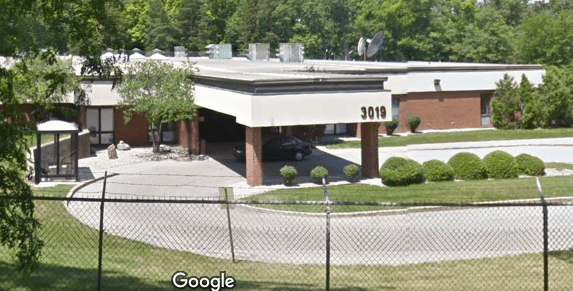
The meeting was run in such a way that didn’t make it easy for most people to speak, partly because the facilitator kept injecting his own commentary during the meeting and because it was not a safe space for people with differing opinions. There was one person who challenged the authenticity of the claim about Guiding Light moving into the building at 3019 Coit NE and another person who stated that they felt like the meeting was using fear tactics.
Another neighbor spoke up at one point about how she and other residents got a halfway house kicked out of the neighborhood some years back, because of the dangers it was posing to the area. At one point this same neighbor acknowledged that Guiding Light Mission deals with people with addictions, but that “those people needed to be in the right facility, in the right neighborhood.” This begs the question, what is the right neighborhood?
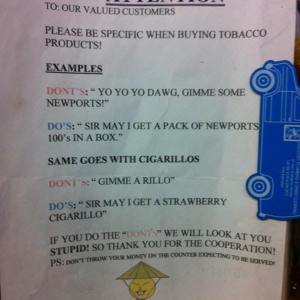 In many ways this was a classic example of NIMBY (Not in My Back Yard) politics. In addition, it should be stated that most if not all of those in attendance were white. The Not In My Back Yard also seemed to have a racial component to what was taking place. Dale’s Party Store has a sign on the outside of the building that clearly targets black youth, saying No Shirt, No Shoes, No Service – Pull up your damn pants (shown above). Inside the party store they have posted a Do’s and Don’ts (on the left) that clearly reflects a bias against non-white cultures and how others speak.
To other observers, this gathering may have seemed like an example of people engaging in the process of democracy, with a simple desire to not have a facility that deals with the homeless, relocate to their neighborhood. However, a great deal more was happening at this gathering, including racist attitudes and a political candidate that had his own agenda. The meeting last night also seemed to reflect much about the current political culture in the US, where people can say stuff that is not based in fact and get a whole bunch of other people to node their heads in agreement.
The function of Managerial Racism in Grand Rapids today
People often say that Grand Rapids is not Chicago, Detroit or New York City. This sentiment is applied both to an analysis of how oppression functions here and how we respond to it.
I will agree that at some level the oppression directed at communities of color may not be totally like it is in larger cities, but this in no way lessens the harm being done. Sure, we can argue that the number of murders committed by cops in Grand Rapids is not like that of other cities, but this does not diminish the role that law enforcement plays in repressing communities of color.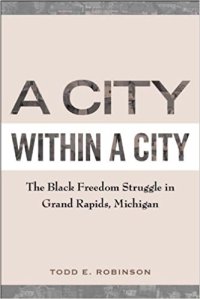
One might even say that there isn’t the same kind of overtly White Supremacy in Grand Rapids as there is in other cities, but that could have to do with how the power structure in Grand Rapids has historically dealt with communities of color.
Grand Rapids loves to white wash this history. Those in power put up statues to honor native leaders, without wanting to tell the history of settler colonialism.
In Todd Robinson’s important book, A City Within a City: The Black Freedom Struggle in Grand Rapids, Michigan, he names the type of structural racism and white supremacy in Grand Rapids as Managerial Racism.
Robinson notes that in the mid-1950s, there was a shift in the local power structure with the ascendency of the Citizens’ Action movement, a group of businessmen who made reformist changes to how politics was practiced here. The author states early on in the book, “members of the Citizens’ Action movement replaced a citywide policy of overt discrimination with a complex system of managerial racism.”
Throughout his book, Robinson offers numerous examples of how managerial racism was practiced, but maybe the best example was from chapter 4 of the book. Chapter 4 focuses on education and the black struggle, but his statement about managerial racism is much broader and should be seen as how the power structure in Grand Rapids dealt with African Americans on all issues. He states on page 96:
The managerial form of racism practiced by Chamber of Commerce members and business politicians placed whites in the role of patrons and blacks as clients. Designed to filter each racial issue, managerial racism ultimately sought to locate a “middle ground,” as long as it was situated squarely on the interest-side of the “race managers.” Thus the application of managerial racism relied on strict procedures designed to bog down racial change while effectively presuming a position of compliance. Phillips’s appeals satisfied the paternalistic prerequisite for advancement in Grand Rapids, because he operated within the traditional framework. Orderly black progress could occur at a piecemeal rate so long as the “managers” of race in the city approved and set the terms of agreement.
This analysis by Robinson is not only important to how we understand the function of white supremacy in the history of Grand Rapids, but it provides an analytical lens for how we could understand the ways in which managerial racism in practiced today.
Practicing Managerial Racism Today
There are no shortages of how managerial racism is practiced today in Grand Rapids. We just have to look for it. We offer a few examples of contemporary managerial racism in Grand Rapids, but we also invite people to give their own examples.
Policing – One of the most evident examples of managerial racism in Grand Rapids today has been playing out in the past few months with the recent police treatment of the 5 African American boys in March of this year. The GRPD falsely assumed that these 5 black youth had been involved in violence and then pulled guns on them while on patrol, making them get on the ground. The trauma of this incident has mobilized the mothers of these 5 boys, it has mobilized the community as a whole and it brought forth a groundswell of responses from communities of color on their collective experience of police abuse and intimidation in this city.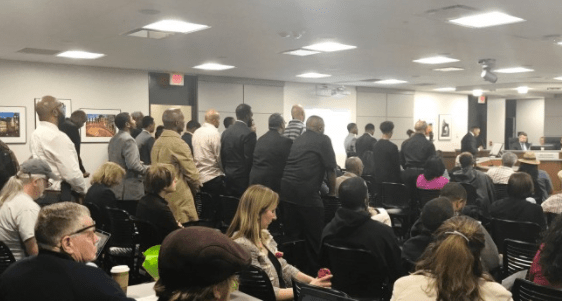
Rallies have been organized in response to the police treatment of these 5 boys, along with prayer vigils and frequent visits to Grand Rapids City Commission meetings. On May 9th, dozens of African American men showed up at the City Commission meeting to collectively call for a “state of emergency” in regards to how they police are treating the black community.
The Grand Rapids City Commission has offered some verbal responses to these demands, but to date, the best they can offer is to host a series of community/police relations meetings.
This is managerial racism at its best. The African American community calls for a state of emergency and the response is, “we’ll hold some meetings about how to rebuild trust between the cops and the community,” when the community has been saying all along that they do not trust the police and haven’t for years.
The City of Grand Rapids spent thousands of dollars of taxpayers money to have a report to tell them that communities of color are stop by cops more frequently that white people are. However, African Americans in Grand Rapids have been telling city leaders this has been their experience for years. Not only was the report a waste of public money, it was a slap in the face to the black community, essentially telling them that the city doesn’t take them seriously.
The Housing Crisis – Another area in which it is fairly easy to see how communities of color are being exploited and oppressed is in the current housing crisis in Grand Rapids.
Grand Rapids has seen the reversal of white flight that took place in the 1960s and 70s, where in the last decade white people, particularly through white-owned development companies, are now “re-discovering” the urban core.
Look at what has happened along the Wealthy Street corridor over the past 10 years and what is currently happening along Michigan Street, in the Belknap neighborhood and on Bridge St. and West Fulton. These areas are being heavily gentrified through development of businesses and market rate housing that will primarily benefit the professional and creative class. These are neighborhoods that have traditionally been working class neighborhoods, where families and communities of color can no longer afford the cost of rent. People have been displaced directly through the destruction of existing homes or because of the increased costs to live in areas that many people can no longer afford.
The response we often hear from people is that these neighborhoods have been under-developed for years and people should welcome all the re-investment, or they say people should be thankful that these areas have been cleaned up. What this really means is that; 1) white people do not want to own the history of white flight/white disinvestment in neighborhoods and; 2) white people do not want to acknowledge that these development projects benefit white people at the expense of communities of color. Again, Robinson’s notion of managerial racism applies here – managerial racism relies on strict procedures designed to bog down racial change while effectively presuming a position of compliance.
Such an example of the housing crisis and how it impacts communities of color is also being played out in the proposed re-development (read – gentrification) in the Boston Square area being facilitated by the DeVos created group AmplifyGR and Rockford Construction.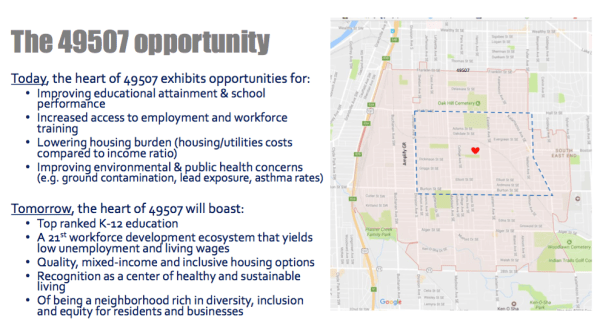
The Boston Square neighborhood and the Cottage Grove area, also known as Southtown has experienced de-industrialization, poverty and white flight in recent decades. Now, the Doug and Maria DeVos Foundation and Rockford Construction want to play White Saviors in this situation, promising to transform this neighborhood with plans they already have. Look at the imagine above they have been using in planning meetings with people other than neighbors.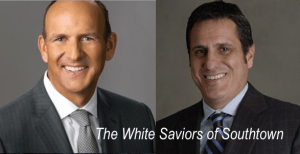
The message in these pronouncements of “opportunity” suggests that the people in that neighborhood are:
- Incapable of envisioning a better future for themselves
- That the residents are somehow to blame for their current condition, and
- Only with the help of White Saviors can they possibly achieve a better life
The response that AmplifyGR wants from the community, particularly the black community, is a display of gratitude for the benevolence of the likes of Doug DeVos and Mike VanGessel.
Michigan Teacher Pensions Undermined: Latest goal of the West Michigan Policy Forum achieved
 Every two years, the West Michigan Policy Forum, which is made up of the political and economic elite in this area, proposes a state policy change.
At their 2016 conference, they made it their goal to undermine public sector employee and teacher pensions.
Yesterday, the Michigan House and Senate voted to do just that.
The Michigan House of Representatives voted 55 to 52 in favor of undermining public school teacher pensions. Michigan House Bill 4647 will eliminate the state-run school pension system and make new teachers hired after 2017 to shift to a defined contribution lifetime annuity or 401(k) accounts. This is a recent trend we are seeing across the country, a neoliberal capitalist model that attacks public sector workers and privatizes benefits and pensions.
At the September 2016 West Michigan Policy Forum, David Walker, with PricewaterhouseCoopers, did a major presentation for the local economic and political elite on why state teacher pensions are a liability. Interestingly enough, this is the same language that state policy makers used to undermine teacher pensions. Rep. Chris Afendoulis, R-Grand Rapids Township, said the state teacher pension system is an unfunded liability.
Other members of State Legislators from West Michigan that voted to undermine teacher pensions, in addition to Afendoulis (73rd District), were Tommy Brann (77th District), Rob VerHeulen (74th District), Thomas Albert (86th District), Steve Johnson (72nd District), Roger Victory (88th District) and Daniela García (90th District).
Here is a list of major campaign contributors who are involved in the West Michigan Policy Forum:
- Rep. Steve Johnson – Peter Secchia and Matthew Haworth
- Rep. Chris Afendoulis – John Kennedy and the Meijer Family
- Rep. Rob VerHeulen – John Kennedy
- Rep. Tommy Brann – DeVos Family and Haworth Family
- Rep. Thomas Albert – none
- Rep. Roger Victory – Matthew Haworth
- Rep. Daniela Garcia – DeVos Family, John Kennedy and Haworth Family

The Michigan Senate also passed a similar bill, SB 401. The West Michigan State Senators that voted in favor of the bill were 28th Senate District, Sen. Peter MacGregor, 29th Senate District, Sen. Dave Hildenbrand and 30th Senate District, Sen. Arlan Meekhof.
Here is a list of major campaign contributors who are involved in the West Michigan Policy Forum:
- Sen. Peter MacGregor – DeVos Family and Meijer Family
- Sen. Dave Hildenbrand – DeVos Family and Meijer Family
- Sen. Arlan Meekhof – DeVos Family, John Kennedy and Van Andel Family
As they say in politics, Follow the Damn Money!
[Data comes from the Michigan Campaign Finance Network http://mcfn.org/donor-tracking]
 Over the past 25 years that I have been monitoring the news media in West Michigan, rarely have I come across a reporter who has been willing to challenge local power. This has most definitely been the case with the most powerful family in West Michigan, the DeVos family.
On Tuesday, MLive ran a story about the DeVos-created group AmplifyGR and its partnership with Rockford Construction to develop part of what is referred to as Southtown.
The MLive article is instructive on many levels and I want to provide a bit of deconstruction.
First, the article is framed as presenting a balance of perspectives, which is even the focus of the headline. However, there is no real balance in this story. The reporter provides all kinds of commentary about Doug, Maria and Cheri Devos, saying they have “been involved in several school and community redevelopment programs around the U.S. and in West Michigan.” There is no follow up on these other efforts or any investigation, rather it is just stated as fact.
There is also some elaboration on what AmplifyGR is, but the source that MLive uses is taken from the RDV Corporation’s (DeVos owned) posting about the job description for the AmplifyGR job. In other words, there is no independent source.
Secondly, those cited in the article, also reflect a significant imbalance. The AmplifyGR Executive Director, Jon Ippel is cited, as is a representative from Rockford Construction. In addition, Third Ward GR City Commissioner Dave Allen speaks positively about the project. Only one neighborhood resident who opposes the plan is cited. There is reference to others opposing the plan, but no one is sourced and you can tell how many other people expressed opposition.
Third, about halfway through the article it states, “Though Amplify GR was scheduled to send a delegate to the Homes for All group, they canceled, saying DeVos and VanGessel preferred to share their vision with neighbors at the meeting on June 29.” This is simply not true. AmplifyGR cancelled coming to the GR Homes for All forum because they said that the facebook event and my article on the project had created a, “hostile environment.”
What is also interesting about the above quote from the MLive article is that Doug DeVos and Rockford CEO Mike VanGessel will be sharing “their vision with neighbors” on June 29. The facebook event page for the AmplifyGR event says there will also be a presentation. This seems to contradict a later comment in the MLive story, which says, “Rockford Construction’s community development director, said details of their plans with Amplify GR have yet to be developed.”
Ok, so if there are no plans as of yet, then what is the presentation all about? Also, AmplifyGR and Rockford Construction have somewhat developed plans, since they have been presenting information at the Southtown Corridor Improvement District meetings over the past 6 months. You can see all kinds of plans in our original article about the DeVos-created AmplifyGR. Do the following two slides suggest anything other than the fact that they have some concrete ideas of what they plan to do in the Southtown area?


Fourth, in the very first paragraph of the article it states that the AmplifyGR project will embark, “on an ambitious campaign to redevelop a tired and underdeveloped neighborhood on the southeast side of Grand Rapids.” Using terms like tired and underdeveloped to describe the neighborhood AmplifyGR seeks to develop provides no historical context for the area. The area was once a thriving neighborhood, but the MLive story provides no investigation as to what changed and why there are abandoned factories.
Fifth, the article states that, “Rockford Construction has acquired more than a dozen properties in the target area.” Actually, according to Grand Rapids City records, the total number of properties that Rockford Construction has purchase in the area is 28, as we noted in our Part II story about the DeVos/Rockford plan.
Lastly, the MLive article concludes with the following:
Ippel said their approach is based on other successful initiatives, such as, Purpose Built Communities, an 8-year-old group that successfully redeveloped the East Lake community near Atlanta, and is working with 15 other communities.
It is worth noting that the Purpose Built Communities seems to be driven by people other than those who live in the neighborhood that is being targeted. The staff and boards members of the organization are made up of former politicians, corporate executives and people who have worked at foundations.
It seems that up to this point, the same can be said for the AmplifyGR project, which is relying on politicians, foundations and corporate developers. The June 29 meeting will be the first time that most residents will know about the project and have a say in the future of their neighborhood. However, as we have noted in pervious postings on this issue, those who have are funding the project and those who have purchased a great deal of land are operating from a position of power. Residents should indeed be suspicious of what those with power and money and those who don’t live in the neighborhood, are really intending to do.

