Resilience and Resistance at Standing Rock: Part 2

Urgent Appeal – The weather has turned much colder in the past 24 hours and people here are in urgent need of funds to purchase materials for permanent structures and other resources to stay warm and stay safe. You can donate to the Michigan Host Tent directly by going to this link https://www.gofundme.com/www-facebook-com-michigan-host-tent-at-standing-rock-9971858.
We also will be making other posts with specific needs for other camps from Michigan that are involved in direct action. Last night, they told us that the pipeline is scheduled to be complete by January 1st, so there is added urgency for solidarity and support.
The picture below shows “security lights” that the Dakota Access Oil Pipeline company uses during the night.
These lights are placed along the trajectory of where the pipeline will be constructed. However, these lights play an additional role in that they are pointed at the camp at night for the purpose of deterring Indigenous Water Protectors from engaging in further action against the oil pipeline. The lights in this photo are just above the river, where police and private security have been using pepper spray and other forms of brutality against the water protectors on an almost daily basis.
We also found out last night that the Dakota Access Pipeline company is using drones to both monitor the route of the pipeline, but also to monitor to the resistance from Water Protectors.

Resilience and Resistance at Standing Rock

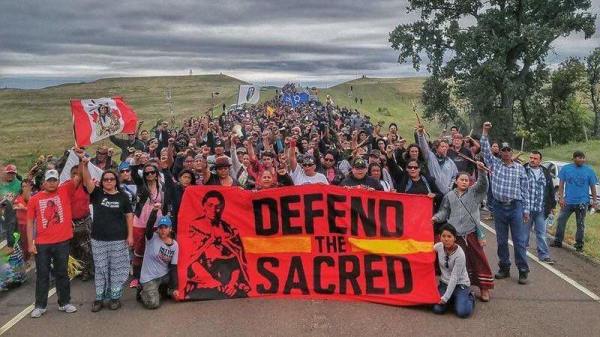
The energy here is amazing. People are coming from all over North America and from around the world to stand with the Lakota against Dakota Access Oil Pipeline.
We were greeted at the camp entrance by a man who welcomed our presence and was glad to know that we were on the right side of history.

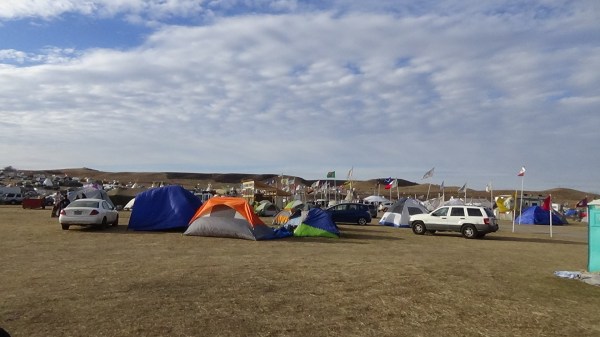
You can see from the picture here how vast the camp has become and it is growing by the day. There is the daily resistance, which consists of direct action, where people are putting their bodies between the pipeline construction workers and land……this sacred land, which the Lakota people have respected and lived on for centuries.
In addition, there is the resistance that takes the form of defying the oil company and the federal government, which have colluded in the construction of the oil pipeline. There are the warriors, women and men, who are praying, resisting and protecting the water.
In many ways, what the people at Standing Rock are teaching the rest of us how live on this earth, how to respect our elders, how to respect all living things and how to respect each other.
Every day there is work that gets done, from splitting wood, to making food, to providing healing for people and to make sure all the donations are being used in a respectful manner. Every day, people bring supplies and engage in mutual aid. This afternoon, two huge trucks came and unloaded logs that will be cut and split to provide warmth for those who are dug in for the long haul. This is the resistance, the defiance that people are demonstrating on a daily basis, by saying they will not give up or give in to the death culture embodied in the oil pipeline.

Then there are the stories. Stories of Indigenous people traveling long distance to be here. One guy, who is from Michigan and now lives in northern California, told us that friends loaded up his car with donations to make the trek to Standing Rock. Along the way, he was stopped by police and forced to sit in a squad car for 2 hours while they searched the contents of the car, because “he looked suspicious.”
We were able to find the Michigan Host tent here at Standing Rock, with people from all over the state, some from Grand Rapids who came to be part of this historic action. We talked with Nancy from Grand Rapids, who has been here for a week and at times feels like she never wants to leave. She was coordinating activities at the Michigan Host tent and making sure that people were getting what they needed. There are also people from Muskegon, Kalamazoo, Port Huron and the UP.
Nancy then talked about the direct action to protect the water. She stated that it was indigenous women who were being targeted by the police and security forces hired by the oil company. People are being arrested and detained for over 24 hours before they even are allowed to contact a lawyer or a family member. But this resistance is only gaining in strength, despite the violence being done against them. This resistance is strong and you can see it in the faces of people here and can feel it in your bones.
The elders are constantly invoking their elders and it often seems as if the past and the present are one and the same. They will tell you that their ancestors are present, telling them what to do and giving them strength.
As the sun begins to go down, we are all warmed by the fire and genuine humanity that surrounds us.
White House No Place for White Supremacy?

It was announced within the last day or so that President-Elect Donal Trump has named Stephen Bannon as his chief strategist and senior counselor.
The news media and blogosphere were all over the this story, often making the statement that the White House is no place for White Supremacists or White Supremacy.
Even the liberal group, the Southern Poverty Law Center released a statement against the announcement, with the following quote:
“Stephen Bannon, a man who led a media empire into becoming what a former Breitbart editor called a ‘a cesspool for white supremacist mememakers,’ simply has no business in the White House.”
Such a statement not only flies in the face of US history, it reflects a complete lack of understanding about the very nature of White Supremacy.
If one reads the important book by Clarence Lusane, Black History of the White House, it becomes clear that White Supremacy has always been an integral part of the US power structure, including the federal government.
The obvious examples were that several of the first US Presidents actually owned staves. More importantly, if we come to terms with the very definition of White Supremacy, then we can see how every US administration has perpetuated this system of oppression.
The Chicana activist/scholar, Elizabeth Martinez, defines White Supremacy as such:

Thus, every US administration has embraced White Supremacy based on the fact that they have been about the exploitation and oppression of other nations, particularly nations with a majority of people of color (think Latin America, Africa, Asia and the Middle East).
One the domestic front, the same thing has been true, whether it has and continues to be the US treatment of Indigenous people/nations, the exploitation and oppression of African Americans right up until this moment and all other communities of color that continue to disproportionately live at higher levels of poverty and make up a disproportionately higher number of those within the Prison Industrial Complex.
Think about the reality of communities of color even under the Obama Administration. The economic status of communities of color has not improved, in fact, it has even become worse under the current administration. Think about the number of black people that have been murdered by cops in the last few years, in which the federal government has refused to do anything substantially to oppose it. Even the number of deportations has gone up under the current administration. This is all because the power structure benefits from such oppression. Remember, White Supremacy is System of Oppression that maintains and defends a system of wealth, power and privilege.
Now, this is not to say that having Stephen Bannon as a member of Trump’s administration is a good thing, but make no mistake about it, the White House has always embraced and perpetuated White Supremacy, a system of oppression that we must resist.

On Tuesday, November 15, a few of us from West Michigan will be traveling to Standing Rock to show our support for those resisting the pipeline that is threatening the lives of Indigenous community in North Dakota.
In addition, we plan to conduct interviews with indigenous people who are resisting the pipeline. This is our primary purpose, to center the voices of indigenous people who have chosen to fight, who have chosen not to be oppressed, who have chosen not to allow the water to be contaminated and those who have chosen to remain sovereign from white, settler-colonialism.
We will only be there for a few days.If you want to know ways to support the indigenous resistance at Standing Rock, here is a link for those wanting to offer monetary or material support.
If you want to offer any support to those of us going, just send an e-mail to jsmith@griid.org.
“Those who own the country ought to govern it.” John Jay 1777
Electoral politics are often brutal, deceptive and often result in strange bedfellows. This has always been the case in the United States, since the founding fathers constructed a nation that would institutionalize inequality.
The spectacle of electoral politics makes for great headlines, with a cast of characters that seem right out of a Marvel comic book. Yet, those who run the country are happy to keep us entertained and distracted with the electoral spectacle.
Take for example the most recent visit to Grand Rapids by the Donald Trump campaign. The MLive coverage of the Trump rally on Monday, was just the most recent example of how electoral politics is nothing more than spectacle, with pictures politicians and loyal GOP voters.
However, there are always hidden gems in such coverage. Former Ambassador to Italy, local businessman and member of the Grand Rapids power structure, Peter Secchia, had some very instructive things to say about contemporary electoral politics. During the Trump rally at the Delta Plex, Secchia is quoted as saying, “I have a message for the Bushes and Mitt Romney, If you don’t want to support Donald Trump: Shut up! If you don’t know where you are today, you’re a loser.”
Such smash mouth rhetoric seems like what you might hear at a WWE event, but this is the norm for contemporary electoral politics in the US. It shouldn’t surprise us, especially when we consider the source.
Peter Secchia has made millions off of other people’s labor and as a member of the Grand Rapids power structure he has waged war on the masses, what Henry Giroux has referred to as, “the expendable class.” Giroux is referring to working class people, the poor, communities of color, immigrants, people with disabilities, those on the margins. The very same people that Donald Trump derides and the very same people that Peter Secchia has contempt for.
Secchia may not use the same language that Trump uses to belittle people, but the policy goals of Peter Secchia have the same results. Secchia has engaged in this policy work most recently through the West Michigan Policy Forum, which is made up of the West Michigan power structure. What this group has been calling for since its inception in 2008 has been for the elimination of the state business tax, passing a Right to Work law in Michigan, pushing for greater austerity measures by local & state government, the privatization of public services and most recently, the elimination of public sector employee pensions.
Once we come to terms with what Secchia and the rest of the capitalist class is really about in West Michigan, we realize that what he had to say at the Trump rally was not all that surprising.
However, the world of electoral politics becomes even more insidious when we look at how it creates strange bedfellows.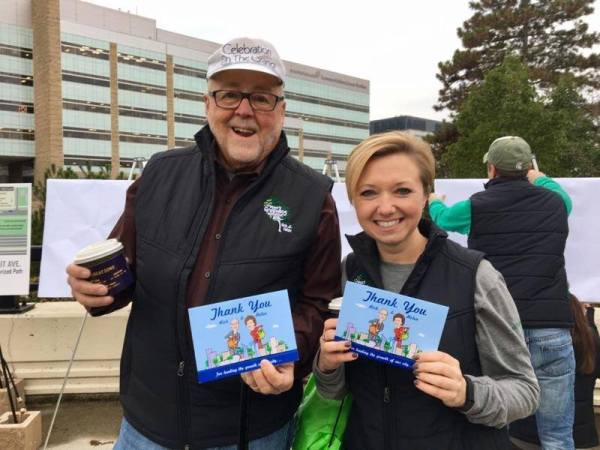
Just last week, during the Mayor’s Tree Planting event, one saw Peter Secchia being photographed with Grand Rapids Mayor, Rosalyn Bliss. In the photo here, you can see Secchia with the mayor, but what is more interesting is that they are holding Thank You cards expressing gratitude for Rich and Helen DeVos. Why did the city find it necessary to say thank you to the local oligarch’s? According to the City of Grand Rapids:
“The DeVos Tribute Grove features a plaque honoring Richard and Helen DeVos for all they have done to beautify and grow our city into what it is today. The plaque also expresses the community’s deep gratitude and love for the couple.”
Secchia did participate in the tree planting event, but more importantly he was engaging if the politics of access. During the last campaign for mayor in Grand Rapids, Secchia, along with several other members of the local power structure (JC Huizenga, Kate Wolters, Scott Brew, Bill Bowling, Robert Woodhouse, Sam Cummings, Doug DeVos, Steve Van Andel, Scott Bowen, Dan Bowen, Sharon Bowen, Mark Breon, Friends of West Michigan Business, Ray Kisor, Mark Murray, Scott Wierda, Thomas Cronkright, Josh May, Lawrence Duthler, Arnold Mikon, Mark Sellers, Realtors Political Action Committee, GR Firefighters Union, GR Police Officers Labor Council all contributed between $500 and $5000 to Bliss’s campaign, according to Campaign Finance records through Kent County.
Campaign money buys access, but it also buys silence and compromise. In this case, it means that the policies that Peter Secchia (through the West Michigan Policy Forum) promotes and the things he said at the Trump rally will not be challenged by local elected officials, particularly the Mayor. The war on working class people will not be challenged, nor will the misogynist, white supremacist language and policies of the local power structure be challenged. In a sense, Secchia telling GOP people who don’t support Trump to Shut Up, is exactly what he is saying to local politicians who believe they have to “be strategic” and not alienate those who not only own the city, but govern it.
It’s Not Philanthropy, It’s Ideological and Class Warfare: How the DeVos Family Foundation contributions complement their political donations – Part II
Last week we looked at how the DeVos Family uses their vast financial resources to influence elections and purchase policy, particularly at the local and state level. We also began the process of investigating how their political funding is complemented by their philanthropic contributions.
We presented recent examples of the DeVos Family’s efforts to influence the 2016 elections and compared that specifically with the Richard & Helen DeVos Foundation contributions. It seems rather clear that in addition to the DeVos Family’s commitment to a patriarchal/heterosexist brand of christianity, their philanthropic giving also supports projects which furthers their deep commitment to Neoliberal Capitalism.
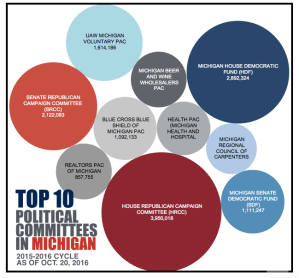
Since last week, it has been reported by the Michigan Campaign Finance Network that nine members of the DeVos Family have been the largest contributors to the House Republican Campaign Committee (HRCC) in the most recent election cycle. Each of the nine members of the DeVos Family have contributed $40,000 to the HRCC, for a combined $360,000. The $360,000 that the DeVos Family has contributed to the HRCC was just for the period of July 21 through October 20.
What we will look at in Part II is the remaining DeVos Family foundations and where they have directed their funding to demonstrate how it fits within their ideological and class warfare framework.
Dick & Betsy DeVos Foundation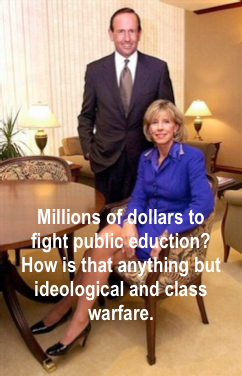
The Dick & Betsy DeVos Foundation also contributes larger sums of money to the organizations that fit within their ideological and class warfare framework. One such entity is the Acton Institute. The Grand Rapids-based think tank, which believes that Capitalism and Christianity make good bed fellows, has received $505,000 from the Dick & Betsy DeVos Foundation according to the 990 reports for 2012 and 2013.
Another Capitalist entity that they have contributed to is Endeavor, which likes to refer to itself as a non-profit for entrepreneurs. The Dick & Betsy DeVos Foundation contributed $162,000 in 2013, according to their 990s, but they also play a significant role in having a staff person from their foundation sit on the regional board of Endeavor in Detroit, Nate Lowery.
However, the major area of philanthropy for Dick and Betsy DeVos is in the area of an attack on public education. They do this through several organizations with their funding. First, there is the DC-based entity called the Alliance for School Choice. In 2013, they contributed $250,000 to this group, which promotes the privatization of public education.
Another anti-public education source for DeVos philanthropy is the Foundation for Excellence in Education ($100,000 in 2013). Betsy DeVos sits on the board of directors, along with Condoleezza Rice and the board president, Jeb Bush.
Lastly, there is the Great Lakes Education Foundation, which has also received substantial funding from the Dick & Betsy DeVos Foundation. ($200,000 alone in 2013) The Great Lakes Education Foundation is a source of funding that supports the Great Lakes Education Project, of which Betsy DeVos is also a board member, along with the DeVos political operative, Greg McNeilly.
Dan & Pamela DeVos Foundation
The Dan & Pamela DeVos Foundation is not nearly as big as the other DeVos foundations, but they contribute in similar ways, thus supporting the link between philanthropy and the family’s more overt political contributions.
Dan & Pamela also give to the usual suspects of pro-capitalism, such as the Mackinac Center for Public Policy ($90,000) and the Acton Institute ($50,000). They also contribute significantly to pro-business universities, such as Northwood ($1.3 million). Lastly, the Dan & Pamela DeVos Foundation also throws its money behind education efforts that promotes privatization, through the Michigan Education Excellence Foundation. ($150,000) This entity has as its partners major corporations and private donors that reads like a who’s who of those who are benefiting most from neoliberal capitalism.
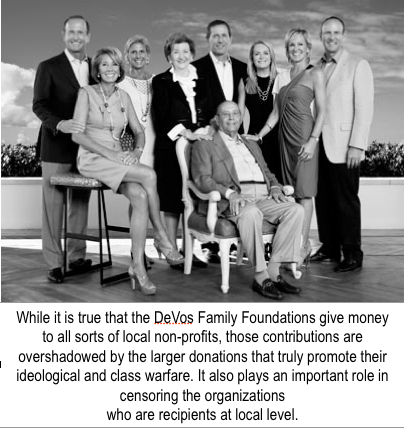
Doug & Maria DeVos Foundation
Like the Dan & Pamela DeVos Foundation, the Doug & Maria DeVos Foundation is smaller than other family members, but they too use philanthropic dollars to fund ideological and class warfare endeavors.
Doug & Maria has contributed large sums to the Acton Institute ($435,000), the American Enterprise Institute ($2 million) and the Mackinac Center for Public Policy ($100,000). This DeVos foundation has also supported anti-LGBT projects, like the National Organization for Marriage (NOM), with a contribution of $250,000.
It should also be noted that the Doug and Maria DeVos Foundation gave $100,000 to the Clinton Global Initiative in recent years. The Clinton Global Initiative has come under increasing scrutiny because of it role in profiting off of misery and its role in shaping US foreign policy.
It’s not Philanthropy, It’s Ideological and Class Warfare: How the DeVos Family Foundation contributions complement their political donations
In the early part of 2013, we set out to look at the role of foundations in West Michigan, particularly those that are connected to the wealthiest families in the area.
During that investigation we relied on the 2009 – 2011 990 reports that all foundations and non-profits must submit, which provides information for the public. These public disclosures are meant to provide a certain amount of transparency, although there is still plenty that is hidden from plain sight.

We know a fair amount about the funding patterns of the wealthiest people in West Michigan as it relates to campaign financing, particularly that of the DeVos Family, which continues to be the largest contributor to political campaigns in Michigan and out of state. Last year we wrote a piece about how much money the DeVos Family had contributed in the 2013-2014 election cycle. Based on a report from the non-partisan group, the Michigan Campaign Finance Network, the DeVos Family outspent every other individual, family or entity on elections during that two year period in Michigan. In fact, Rich Robinson, then the director of the Michigan Campaign Finance Network said, “The DeVos family doesn’t have a peer among individual donors, or as far as interest groups go.”
More recently, we wrote two articles about the DeVos Family contributions in the current election cycle. On August 1, we wrote about their influencing of State races during a 56-day period this past summer. The DeVos Family was contributing $26,785 a day to influence the electoral outcome in November. The second article looked at the DeVos Family contributions to the 2nd and 3rd Congressional races.
However, it is rare that the news media ever talks about the relationship between the DeVos Family’s buying of elections and their private funding through their foundations. More importantly, there is never really any investigation into how this one/two punch of monied influence serves essentially the same purpose.
In looking at the more recent 990 filing for the DeVos Family Foundations, we found that some of the largest recipients of their contributions complemented their political giving. For instance, in 2012, the Richard and Helen DeVos Foundation gave $100,000 to the Tampa Bay Host Committee, which was the organization behind the 2012 Republican Convention in Florida.
Other significant donations from the Richard and Helen DeVos Foundation were to pro-capitalist groups like the American Enterprise Institute ($500,000 for 2012/13) the Acton Institute and the Heritage Foundation ($1 million).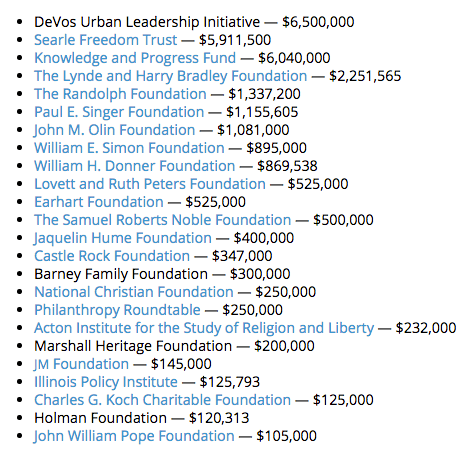
Another significant political donation made through the Richard and Helen DeVos Foundation was $2,000,000 to Donors Trust Inc. “DonorsTrust is a not-for-profit company that distributes millions of dollars in grants each year to groups, organizations and projects that are “dedicated to the ideals of limited government, personal responsibility, and free enterprise,” according to an excellent article on Desmogblog.
In fact, the largest contributor between 2013 and 2014 was the DeVos Family, through their DeVos Leadership Initiative. (pictured here on the right)
The Richard and Helen DeVos Foundation has also been contributing significant amounts of money to most of the colleges and universities in West Michigan, like Calvin, Hope, GRCC, GVSU and MSU. These contributions, ranging from $1 million to $3 million a year clear are meant to influence school policy and curriculum.
However, the Richard and Helen DeVos Foundation has also provided large sums of money to universities outside of Michigan, particularly to private, faith-based schools like Kings College. In a two year period (2012-2013), the foundation gave King’s College $10.5 million dollars. The mission of, “King’s College seeks to transform society by preparing students for careers in which they help to shape and eventually to lead strategic public and private institutions.” Richard and Helen DeVos are also on the Board of Trustees for the College.
One last way in which the Richard and Helen DeVos Foundation compliments their direct political giving is the money they donate to the Young America’s Foundation. Their mission reads:
Young America’s Foundation is committed to ensuring that increasing numbers of young Americans understand and are inspired by the ideas of individual freedom, a strong national defense, free enterprise, and traditional values.
As the principal outreach organization of the Conservative Movement, the Foundation introduces thousands of American youth to these principles. We accomplish our mission by providing essential conferences, seminars, educational materials, internships, and speakers to young people across the country.
YAF has a long history of countering progressive and radical organizing on campuses across the country and often brings anti-Islam and other proponents of White Supremacy speakers to campus.The Richard and Helen DeVos Foundation gave Young America’s Foundation $2 million in 2012.
These are just some of the organizations and entities that are recipients of the DeVos Family money, organizations and entities that have a long history of opposing LGBTQ liberation, unions, racial justice and an economic system based on cooperation and equity.
In the coming weeks, we will look at other DeVos Family Foundations and how their political contributions coincide with their ideological spending as well.
Rockford Construction and the Politics of Displacement
The current housing crisis is happening all across the globe, throughout the United States and particularly in Grand Rapids.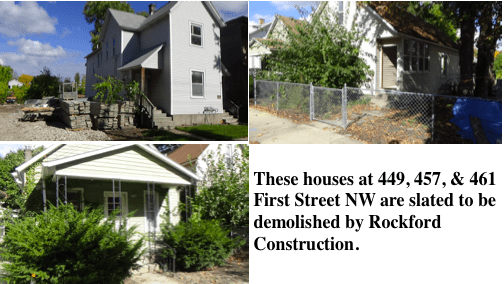
People are faced with rising rental costs, a sky rocketing of the price tag for homes to buy, an increase in evictions and foreclosures are still a major issue in many cities.
People are feeling the effects if gentrification, which includes increase costs to live in a specific area, along with various forms of displacement. People are being displaced from their place of residence in two major ways. First, people are being displaced because of the cost of property taxes or the cost of rent has increased significantly in recent years and they can no longer afford it. People should not be paying more than 30% of their income on housing, yet the reality is that more and more people are paying 40, even 50% of their income on housing. This is particularly the case within communities of color, since those communities are experiencing higher rates of gentrification and because on average they make less than White people do in this society.
The second major factor in housing displacement is the physical destruction, the demolition of housing. In many cases, as gentrification spreads throughout neighborhoods, demolition of housing either precedes new development projects or follows development projects.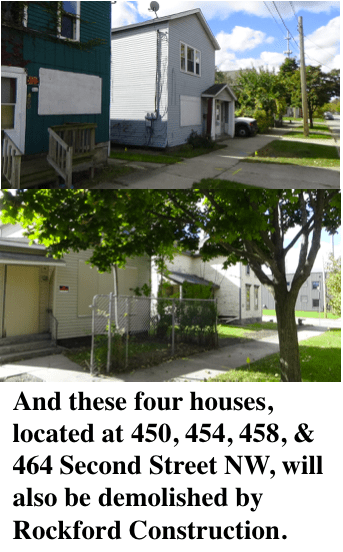
A recent example of displacement through demolition occurred just off Michigan St. along Grand Avenue. Roughly 20 homes were demolished to make room for a new development project that will house 287 market rate housing units. People might think that this still results in a housing increase, but what we often fail to recognize is that the new housing will be for more upscale people, while those being displaced are primarily working class individuals and families.
A current example of homes that are slated for being demolished because of a new development project, is on the westside, near all the new construction that is mostly being implemented by Rockford Construction.
Rockford Construction was behind the new brewery on Bridge St, recently finished the new market rate housing project on Alabama Ave. (along with 616 Development) and is in the beginning stages of gentrifying the area along Bridge and Stocking NW.
The new market rate housing project on Alabama Ave. is most directly connected to the 10 houses currently slated for demolition, but all of their projects in that area certainly have a an impact on the 10 houses that will be torn down.
These houses on First St, Second St and Alabama Ave are all older housing stocking that has been home to working class families for decades. According to the Grand Rapids Planning Commission documents from October 13, there are no immediate plans for redevelopment of the 11 lots (10 house and one vacant lot), but there was lots of discussion about it and upscale housing appears to be imminent. One good guess is that those 11 lots may eventually be used for parking, since the new market rate housing that is on Alabama has limited parking available, although the documents showed that they were considering it to be green space. However, there was no clarity as to whether or not the existing trees would remain or not.
Rockford Construction began buying these houses in 2013 and the last year that any of those houses were certified as rental was in 2014.
The Grand Rapids Planning Commission documents also reveal that the John Ball Area Neighbors sent a letter stating they would not oppose the demolition of these 10 houses.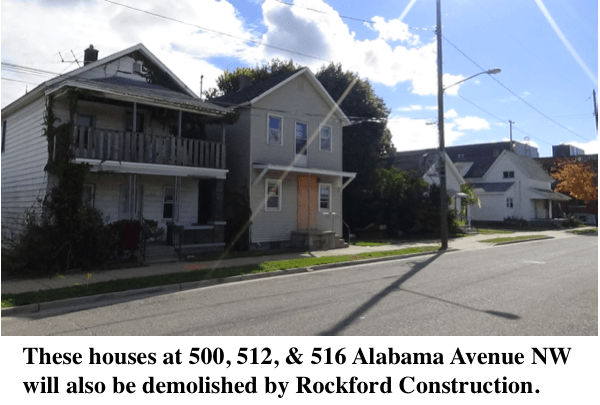
Planning Commission staff Suzanne Schulz, “mentioned the properties were optioned long before Rockford became involved and they have fallen into disrepair over the years,” according to the Planning Commission document from October 13. Such a statement dismisses the reality that landlords often will purposefully allow property to fall into disrepair because they can then pocket more of the money they collect from rent.
Kurt Hassberger, Rockford Construction and Development, “noted that the properties were somewhat orphaned by the two expressways and separated from the neighborhood that it used to be a part of.” While this may be the case, it completely ignores how the highways built in Grand Rapids were a major cause of gentrification and displacement.
In the Planning Commission documents there was also some discussion about the larger impact on the neighborhood, but in the end the Planning Commission voted unanimously to approve the demolition of 10 more houses on the westside by Rockford Construction.
Downtown Development Authority to expand its boundaries, capture more tax dollars and make more of Grand Rapids a play space for those with privilege

Last week, the Downtown Development Authority (DDA) voted to expand the boundaries of downtown Grand Rapids (as can be seen in this map on the right). This means that the DDA, a non-elected body will have more control over the use of taxes and development projects that primarily serve the interests of people who are highly privileged.
This decision was made at the last DDA meeting. The DDA meets on the second Wednesday of every month at 8:00am at City Hall.
The Downtown Development Authority was established in 1980, which is when the financial elites decided to re-invest in the downtown area, determining development projects and and how tax funds would be used. The original area of control in 1980 was a total of 46 acres. Since 1980 the DDA has expanded 15 times and if the City Commission approves the current expansion the will bring the total amount of acres the non-elected body will have control over to 873 acres.
A more detailed look at the proposed expansion areas can be seen in the following 5 maps.


More details can be read in the DDA documents presented at their meeting last week. This document is entitled Development and Tax Increment Financing Plan for City of Grand Rapids Downtown Development Area No. 1 as Amended.
The document is worth reading in that it lays out numerous proposed budgetary plans for ongoing and new projects. For instance, the proposed budget for ongoing and future costs for parks, open space and cultural improvements is estimated to be $25 million. Streetscape improvements are estimate to be $120 million. The Downtown Market, which has already cost taxpayers millions and primarily benefits those with class and race privilege, gets $75,000 every year.

No doubt there are lots of people who will salute the DDA’s expansion plan and have no problem with their use of tax dollars that primarily benefit the capitalist class. However, think for a moment how the millions of dollars they are using and are proposing to increase, think about how that funding could be a re-investment in neighborhoods like the Black Hills area or the Baxter neighborhood. When I say re-investment I don’t mean more micro-breweries or boutique stores, I mean the re-investment in the people who have lived in those neighborhoods who are threaten by gentrification. With the kind of tax dollars the DDA is planning to capture and use for making downtown Grand Rapids a larger play area of the rich, imagine how that could be used to end homelessness, provide safe and affordable housing for the thousands of families that vulnerable to displacement. Imagine if those funds were used to fight food insecurity and to transform neighborhoods into centers of food production that are not market-based.

We continue to wonder why there is such inequity in Grand Rapids, inequity that disproportionately impacts communities of color. This is why the Movement for Black Lives is demanding an investment-divestment plan that would benefit the Black community. The Investment part would transform health care, education and other vital areas for the Black community. The Divestment part would mean that we no longer spend billions on prisons, police, government surveillance and militarism.
The likelihood that that the City of Grand Rapids will pass this proposal is very high, unless of course there is organized opposition. The City officials will make a decision on December 6.
When the Market Dictates Housing Policy: Grand Rapids Chamber of Commerce event advocates false solutions to current housing crisis
On Friday, I attended a gathering hosted by the Grand Rapids Chamber of Commerce focused on the issue of housing. The event was part of the Chamber’s ongoing Issue Summits.
The actual title for the event was, “Housing for a Growing City.” The title alone makes clear the purpose of the gathering, which was to talk about meeting the “growing demands” for housing in Grand Rapids. However, for the Chamber and many of those in attendance, “housing demands” translated into market rate housing.
The event began with Kevin Elsenheimer, who is the head of Michigan State Housing Development Authority (MSHDA). Elsenheimer didn’t speak for very long and began by showing a clip of a video about the old Klingman building that has been turned into subsidized housing. It was interesting that the head of MSHDA began with this project, since much of what he discussed did not address the growing need for affordable housing. In fact, throughout the day, the presenters had a hard time naming it as affordable housing and kept using the phrase the missing middle.
It is worth noting that included on the board of MSHDA, is part of the West Michigan elite and a major property owner with CWD, Scott Wierda. Wierda married into the DeVos family.
After Elsenheimer spoke, they brought up 5 panel members to further discuss housing issues in Grand Rapids. The panelists included Kurt Hassberger (Rockford Construction), Ryan VerWys (ICCF), Lamont Cole (Grand Rapids Urban League), Monica Steimle-App (616 Development and Gustavo Rotondaro (Métrica).
The Rockford Construction representative began the panel session by saying that they see both sides of the housing issue, even though he never clarified what he meant by this. He mostly talked about the the supply and demand aspect of housing and that “market rate housing is important.” Hassberger ended his comments by saying that they (Rockford) could not address the missing middle, since it is “not affordable to build.”
Another panelist was Ryan VerWys with ICCF. He talked about how ICCF helps people who fall through the cracks and he plugged the more recent project they are behind, which is the Tapestry Square Project in the Division/Wealthy St. area. VerWys did note that Rockford Construction does provide the majority of the construction work for their projects and that ICCF was waiting to hear about state subsidies that might result in ICCF run housing on the westside.
Another housing developer, Monica Steimle-App, with 616 Development, stated that what her company does is to create community and how her organization was looking forward to working with Downtown Grand Rapids Inc to attract more people to the area and to make sure that “housing is available to everyone.” This last statement seems to be in conflict with the practice of 616 Development, which has a growing track record of gentrifying neighborhoods.
The last panelist, Gustavo Rotondaro, provided some data showing that 52% of renters in Grand Rapids are spending more than 50% of their income on housing. He also gave data to show that the average White family makes just over double the amount of money that African Americans make.
The data seemed to shake things up a bit and prompted some from the audience to ask more poignant questions.
One African American woman stated that she grew up in the area, had moved away and is now back living in Grand Rapids. She said that since she returned, many other black friends have said to her, “Why did you come back? There isn’t much here and we are faced with the same issues that the black community has always faced. She then said that people being forced out of neighborhoods through gentrification is wrong and asked the panelists what they were going to do about it.
The guy with Rockford Construction said, “they haven’t caused this (gentrification) and don’t support it. He then defends landlords, who have “real costs” and that “they need to make a living.” Hassberger also stated that what Rockford Construction does borders on being philanthropic.
What was so problematic about this forum was that the so-called experts were mostly made up of people who made their profits or their salaries off of housing. In fact, the primary sponsors of the event were corporations notorious for making huge profits, including some local housing developers and real estate firms.
Another major problem with the forum is that those who spoke and made up most of the audience were people with tremendous professional, racial and economic privilege. These were not the people most impacted by the current housing crisis. In fact, many of them were responsible for perpetuating the current housing crisis.
Until people who are most impacted by the housing crisis are actually leading a movement to create housing justice, we will continue to rely on developers, politicians and non-profit agencies to make decisions and set policy that will not fundamentally change to socio-economic reality in West Michigan.
 Grand Rapids Institute for Information Democracy