Rockford Construction receives more state and local welfare to expand their control of land on Grand Rapids westside
On Tuesday, it was announced that the Michigan Strategic Fund board approved the Brownfield project receiving a $13.2 million tax break and a $6.3 million low-interest loan, according to an article that appeared on MLive. 
CEO of Rockford Construction, Mike VanGessel said of this news:
“A project of this scale requires a high level of collaboration at the local and state level. We are thankful to the City of Grand Rapids and the State of Michigan for their support in making this vision a reality for our neighborhood. This is a key approval for this transformational project, and it couldn’t move forward without it.”
What VanGessel is really saying is that unless public money is redirected to Rockford Construction for this project, they would not be able to make the kind of profits they want from such an endeavor.
Rockford Construction and other developers would have us all believe that these project, which rely heavily on public money, will benefit the whole community. This just isn’t the case and the trend is that all the development projects in Grand Rapids in recent years benefits the professional class, investors and other business sectors. There is little to no evidence that working class families or communities of color are benefitting to the ongoing gentrification of Grand Rapids.
In looking at the Michigan Strategic Fund packet for April 25th, one gets some interesting insights into the mindset of those making these decisions. Information on the Rockford Construction project begins on page 128.
The Michigan Strategic Fund document states that the project involves the development of the first full service urban grocery store in downtown Grand Rapids. This statement is interesting, considering that within 100 yards of the proposed site of the Meijer store is a Duthlers grocery store on Bridge St. Granted, the Meijer store will be a major upgrade to the Duthler, but this should be viewed as a reflection of the new class of people that the project, along with the growing number of Rockford Construction projects that have emerged on Bridge and Fulton St. in recent years.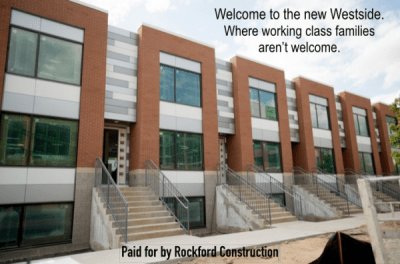
On page 134 of the Michigan Strategic Fund packet is states that the new grocery store will be “offering fresh food within easy access to transit and nearby walkable neighborhoods. The grocery component is expected to service all of the downtown as well as the neighborhoods within a 1 – 2 mile radius.” Let’s be clear that what most contemporary grocery stores offer is not primarily “fresh food,” instead they offer mostly highly process food items that can hardly be identified as fresh.
On the same page, the document further states that the project will, “add at least 130 full-time equivalent jobs for varying skill levels to a neighborhood with a high unemployment rate relative to the rest of the city.” Will these jobs pay a living wage and will they be made available to those who are unemployed or underemployed that live on the near westside? The document does not address these issues, because we are all supposed to be content with the fact that jobs will be created.
However, what the document reveals next provides insight into the larger reason why this development project, along with many others in recent years, are embraced by the planners, decision-makers and investors who are rarely held accountable:
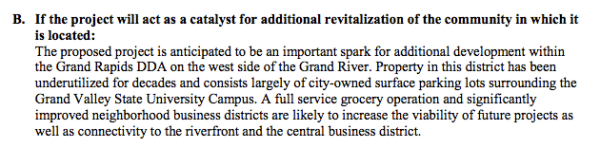
These development projects are all designed to play a major role into the gentrification of areas of Grand Rapids that those in power have been interested in for the past few decades. It’s all about improving business districts and providing greater investment opportunities to companies that, as a recent report from Michigan Radio made clear, are not even based in Grand Rapids. The flip side of all this new development that will benefit the business class and lead to more investment opportunities, is that it will result in the further marginalization of communities of color and working class families, causing more displacement and pricing people out of neighborhoods that have been traditionally working class for decades.
Doesn’t the Affordable Housing component of this project make it all work out?
While it is true that there will be affordable housing units in this new project, this does not reduce the gentrifying effect that Rockford Construction has had on the westside and in other parts of the city. The blog, If the River Swells, aptly entitled an article from last year, The Affordable Housing Smoke Screen. All of the housing units that Rockford Construction has been involved in on West Fulton St, Bridge St and Alabama have all been market rate housing. This means that there is a whole class of people who cannot afford to live in these places.
In addition, Rockford Construction is involved in development projects in the Belknap area, as the lead construction company in the GVSU project, the ICCF project on Wealthy and Division, both of which have displaced working class families of people of color.
Lastly, it is important that we also not leave out the role that Rockford Construction’s CEO, Mike VanGessel plays as part of the West Michigan power structure.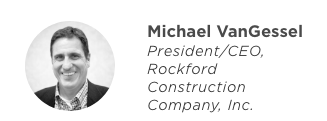
VanGessel sits on the board of directors of the Right Place Inc, along with many of the other members of the West MI power structure. The Rockford Construction CEO also sits on the board of the West Michigan Policy Forum, which has endorsed state policies such as the Right to Work, reducing taxes for businesses and wanting to eliminate public sector employee pensions. VanGessel is also part of the GVSU Foundation board and Rockford Construction is listed as a patron on the Artprize page.
In an MLive article that praised VanGessel and said he wanted to bring “excitement” back to the westside, it states in reference to the earlier Bridge St. development projects:
VanGessel has succeeded in bringing well-heeled investors to the table, such as family members of Amway co-founder Rich DeVos; 42 North, owned by businessman Mike Jandernoa and his family; and SIBSCO, owned by the family of former U.S. Ambassador to Italy Peter Secchia.
Being part of the West Michigan power structure surely has its benefits.
Two weeks ago we wrote about the outcome of the Grand Rapids City Commission meeting that took place shortly after the GRPD, at gun point, falsely accused 5 young African Americans of instigating a fight.
The community once again showed up in numbers at the Grand Rapids City Commission meeting to once again challenge city officials around the recent traffic study, the racism within the GRPD and the lack of affordable housing in the city.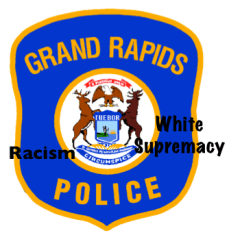
Dozens of people spoke during the public comment period. Some read statements, while others shed tears because of the anger and sadness they feel based on the lack of action from the city. There were several representatives from community-based organizations that spoke, but what was most powerful were the comments from those who have been most impacted by the racist practices of the GRPD and the lack of affordable housing in Grand Rapids.
Despite the input from people throughout the community, the local news media didn’t think that these voices were worthy of being sources to cite in their coverage on Tuesday, April 25. What follows is an analysis of the stories related to the recent practices of the GRPD, its connection to racism and the coverage of the Grand Rapids City Commission meeting on April 25th.
The MLive story was headlined, Commission rejects ‘knee-jerk’ response to Grand Rapids traffic stop study. In the MLive story, the only sources cited were five of the six City Commissioners, City Manager Greg Sundstrom and Police Chief David Rahinsky. To be clear, the MLive article was written at noon on the 25th, after the meeting of the Committee of the Whole, not after the evening meeting where the public comments dominated the meeting.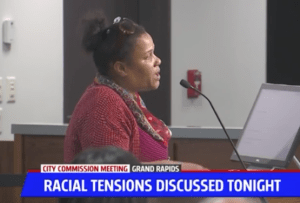
A story on WZZM 13 tended to mimic the MLive article, in that the only voices heard in the story were that of Mayor Bliss and Police Chief Rahinsky.
The WXMI 17 story was an improvement over the WZZM 13 piece, in that the provided brief comments from two African American women, comments that were challenging the city officials. Grand Rapids Mayor Rosalyn Bliss was also cited in the story, a story that was framed as Racial Tensions Discussed at Grand Rapids City Commission meeting.
However, what was problematic about the story was when the two news anchors then brought up children and guns and got the news reporter to talk about recent examples of kids with guns in the Grand Rapids area. This switch to talking about kids and guns diminished the commentary about racism that the story began with. In many ways what the news anchor did was to minimize the issue of racism and to re-frame the story around youth access to guns, even stating that the GRPD follows certain protocol that they will not change with regards to youth and guns.
WOOD TV8 decided to run an interview with Grand Rapids Mayor Bliss, instead of focusing on the community’s reaction at the City Commission meeting. While Mayor Bliss admitted that part of the problem was structural racism, she would not say that the GRPD practices racism when asked by the reporter. In fact, her responses were quite calculated in such a way as to deflect any attention to the recent traffic study and to other GRPD practices, since she felt that every department in the city could “do a better job.” 
It is worth noting that the MLive article and the WZZM 13 story did mention a 2015 report from the City of Grand Rapids called the Safe Alliance for Everyone Anti-Violence Strategy Report & Recommendations. That report offers little in terms of Police and Community relations, as well as any real acknowledgement that the GRPD is an institution that practices systemic racism and White Supremacy.
This is true of the local news coverage within the last 24 hours, where all of the stories are framed in such a way as to make one think that all parties involved are equally responsible for the “racial tensions.” These stories completely avoid what many people from the communities most impacted by these policies and practices of the GRPD, communities of color, have experienced as racism and White Supremacy.
This type of coverage will not likely change, since the commercial media sees police departments as public servants and not as part of a system of oppression.
 As part of a plan leading up to the May 1st march, A Day Without Immigrants, there was a smaller action today to draw attention to the repressive practices of ICE agents (Immigration Customs and Enforcement).
About 50 people gathered at the Calder Plaza around noon today and then marched over the the ICE office, located on Ottawa, just north of the 196 freeway.
Once the march arrived at the ICE office, the three people who were carrying a banner blocked Ottawa street to further demonstrate their opposition to the targeting of people who are undocumented by ICE agents.
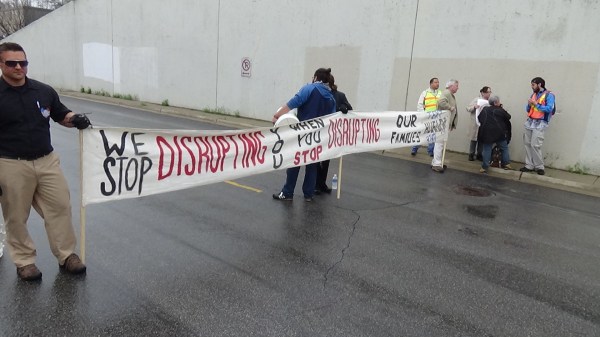
Those from the immigrant community, who organized the action, spoke in Spanish and in English, explaining what the purpose of the action was.
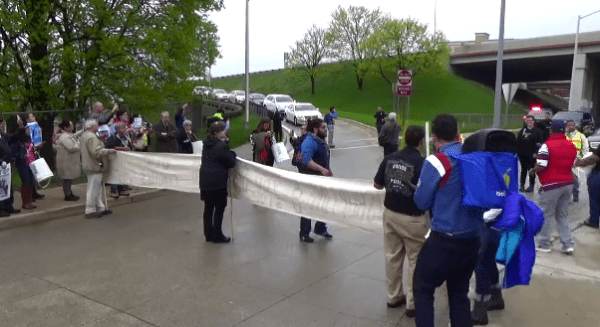
The GRPD arrived shortly after people were blocking the road, but after a brief conversation with the organizers, it was made clear that the police were not going to arrest anyone. Those who organized the action then spent some time discussing amongst themselves what plan of action they would take next. It was then decided that people would walk back towards Michigan St on Ottawa, just beyond where both the eastbound and westbound exits off of 196 are.
you can see from the two pictures below, how traffic was backed up onto the highway from both exits.
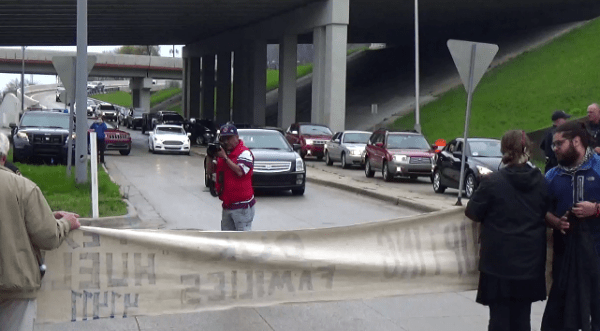
 At this point six GRPD cars converged on the protest march and the arrested the three people who were holding the banner. These three individuals were allies/accomplices who made it clear that this action was not about the, rather it was about the government repression that the undocumented community faces every day. The message was clear from their banner which read, “WE WILL STOP DISRUPTING YOU, WHEN YOU STOP DISRUPTING OUR FAMILIES.
Too often for those of use who carry lots of privilege – race, class, ability or citizenship status privilege – we fail to act or to stand in solidarity with those who are being targeted by systems of oppression. Or, if we do act, the tendency is to engage in savior politics or make it about us.
Let us be clear, this is not about doing missionary work or even being an ally. Those of us who hold lots of privilege need to begin to think about what role we play in movements for social justice and liberation.
A recent article written by an indigenous activist, entitled, Accomplices Not Allies: Abolishing the Ally Industrial Complex, provides us with an important critique of what too often happens from well intentioned white folks who “want to do some good” or who “want to help.”
The article states near the beginning:
The risks of an ally who provides support or solidarity (usually on a temporary basis) in a fight are much different than that of an accomplice. When we fight back or forward, together, becoming complicit in a struggle towards liberation, we are accomplices.
Later on in the article, the author writes:
Don’t wait around for anyone to proclaim you to be an accomplice, you certainly cannot proclaim it yourself. You just are or you are not. The lines of oppression are already drawn. Direct action is really the best and may be the only way to learn what it is to be an accomplice. We’re in a fight, so be ready for confrontation and consequence.
Part of being an accomplice is having mutually respectful relationships with oppressed communities. However, as the above comment makes clear, we must engage in direct action to demonstrate that we are an accomplice in the struggle for liberation.
Grand Rapids opportunities for being an accomplice
The undocumented immigrant community has been experiencing a great deal of harm and suffering for a long time. During the Obama administration 8 year tenure, an estimated 2.7 million people were deported.
Under the current administration, they have taken the gloves off and made it painfully clear that they will be targeting the undocumented community. The Executive Orders that have been passed in the first months of the Trump administration have targeted refugees, muslims and undocumented immigrants. The Trump administration has expressed their desire to build a wall along the US/Mexican border, hire more ICE agents and arrest, detain and deport those who are undocumented.
These recent actions by the federal government have sent fear into the immigrant communities, but it has also galvanized those same communities to fight back. In virtually every city across the US, it is the undocumented and immigrant communities who have begun to increased the level of organizing and taken the lead on this critical issue by organizing marches, boycotts, strikes, actions around A Day Without Immigrants, etc.
The question for those of us who hold lots of privilege and will not be impacted by the wave of anti-immigrant and xenophobic response from the government and white supremacists groups is – what will we do to step up and join the fight along side the undocumented community?
Undocumented Resistance in Grand Rapids
There are several actions coming up in Grand Rapids and opportunities to be ready to mobilize against government repression.
First, this Thursday, April 20th, there is an action at noon organized by the Grand Rapids chapter of the Cosecha Movement. This action is designed to draw attention to the practices and policies of the Immigration, Customs and Enforcement agency known as ICE. The action begins with a gathering at the Calder Plaza and will proceed from there. For more information contact the organizers through the Facebook event. 
The action on April 20th is a lead up to a much larger action on Monday, May 1st. This action, also organized by the Grand Rapids chapter of the Cosecha Movement, is calling for a boycott, strike and march. Organizers are asking people to not go to work or school, to not shop or spend money, rather to march with them for immigrant justice. The Facebook event for May 1st states:
On May 1st join us and thousands of immigrants and immigrant allies and lets win together permanent protection, dignity and respect for all people regardless of where you were born, country of origin,what religion you practice or who you are. Our country was founded by immigrants and is fuel by immigrants!
The march begins at noon on May 1st at Garfield Park. For those of us who hold lots of privilege, showing up send an important message that those in the immigrant and and undocumented community are not alone.
A third opportunity for people to be accomplices in the struggle for justice is for participate in the Grand Rapids Immigrant Solidarity Network’s Rapid Response to ICE campaign. The Rapid Response to ICE campaign is where accomplices, after receiving some training, are willing to mobilize quickly to actually prevent ICE agents from arresting undocumented immigrants and/or to provide mutual aid to family members impacted by the trauma of having someone taken from them.
There have already been several trainings for being part of the Rapid Response to ICE campaign and the next one will be held on Thursday, May 11 from 6:30 – 8:30pm at the Kent Ionia Labor Council. For details go to the Facebook event page for this training.
 Last Thursday, Education Secretary Betsy DeVos made the following statement:
“Every student deserves to learn in an environment where they are safe, and this Administration is committed to promoting a culture of safety on our nation’s campuses.”
DeVos made this statement while meeting with Michigan’s First Lady Sue Snyder, who is attempting to work on the issue of sexual assault on US campuses. There were several news agencies seeking to get more information on the meeting between DeVos and Snyder, but so far no one knows what the two women spoke about.
Sexual Assault on campuses across the US is a major issue. Twenty-three percent of female undergraduate students have experienced some form of unwanted sexual contact, according to reports. Not only can this leave the student struggling with physical and emotional damage caused by the assault, survivors continue to be stigmatized. Some colleges also choose to sweep reports of these assaults under the rug.

So how seriously will Education Secretary Betsy DeVos take the issue of sexual assault on US campuses? It remains to be seen how serious she will take the issue, but we have some indication of where she stands on this matter, based on statements she made during her confirmation hearing.
The Obama administration cranked up the issue in 2011 when it sent a “Dear Colleague” letter out to universities telling them they had to respond promptly to claims of sexual assault and sexual harassment on their campuses. It also said they had to use the standard of “preponderance of the evidence” when determining whether an assault occurred. That standard — common in civil law — is lower than the “beyond a reasonable doubt” standard required for conviction in criminal cases.
During her confirmation hearing, DeVos would not commit to continue what the last administration had begun in 2011. The US Department of Education has confirmed that Candice E. Jackson will become the deputy assistant secretary in the Office of Civil Rights (OCR). Jackson, a lawyer, received national recognition during the presidential campaign in 2016, since she wrote a book about how the Clintons have a history of disrespecting women. The appointment of Jackson seems to be a highly partisan move that will not translate into actual justice for victims of sexual assault on US campuses. DeVos has also stated that she plans on restoring due process for those accused of sexual assault on US campuses, which seems to suggest that she will not be taking an aggressive stance against sexual assault at the university level.
Promoting a Culture of Safety on US Campuses?
It is worth noting that Betsy DeVos, her husband Dick DeVos, the DeVos family and the Prince family have a long history of funding organizations that promote patriarchal values and hetero-normativity. From Focus on the Family to the Family Research Council, the DeVos and Prince families have given millions to dozens of organizations that do not make it a priority, even downplaying the urgency of, sexual assault in the US.
Expanding on the notion of what Betsy DeVos said last Thursday about promoting a culture of safety on US campuses, we must also apply that to students who identify as being from communities of color, immigrant communities, the LGBTQ community and those who practice Islam.
These students, in the current political climate, also would not feel safe on campuses across the nation. Just after the election in November of 2016, campuses were reporting an increase in hostile acts against minorities. However, it should be noted that this is not a new thing for minorities to feel unsafe on US campuses. The efforts to try to integrate schools, beginning in the 1960s, was met with tremendous resistance and a report from the Southern Poverty Law Center in the summer of 2000 documented that “hate on campuses has become commonplace.”
The new Secretary of Education has publicly stated that every student deserves to learn in an environment where they are safe, but we are not hopeful that this is what will actually happen. Safety in education will only happen when communities make it a priority and put it into practice across the country. Safety in education will only happen when white supremacy, classism and heterosexism are eliminated in every school.
CWD and the West MI Power Structure: Part II
 Last month we posted an article about the West Michigan Power Structure that did not specifically involve the DeVos Family. We looked at people like Peter Seechia, John Kennedy, Michael Jandernoa and Mark Murray.
In Part II of our look at the West Michigan Power Structure we look at three men who make up CWD Real Estate Investment – Sam Cummings, Scott Wierda and Dan DeVos.
CWD was in the news last Thursday, after the Grand Rapids City Commission voted unanimously to approve $2.3 million in reimbursements through brownfield funding for a new hotel project. In addition, the Downtown Development Authority awarded CWD an additional $895,000 in tax abatements this past February.
According to the MLive story, the new hotel will be run by the Amway Hotel Corp. This should come as no surprise, considering that Dan DeVos is one of the three men running CWD, but also because of the relationship the company has with other DeVos family members and their role in the West Michigan Power Structure in general.
Sam Cummings, Scott Wierda and Dan DeVos all were involved in business and investment before CWD was created. Cummings has previously been involved in Second Story Properties, Wierda was a co-owner of Jade Pig Ventures and Dan DeVos is the CEO of DP Fox Ventures. CWD was founded in 2008 and since then has amassed a significant amount of real estate property throughout West Michigan. According to the CWD website, they own more than 3 million square feet or retail and urban office real estate in the area.
Funding Republican Priorities
Another aspect of the CWD trio is their funding of GOP candidates and priorities. Wierda and Cummings have spent less money than DeVos on political contributions, but it is significant funding non the less.
Dan DeVos has contributed several hundred thousand dollars in recent years to GOP candidates and to the party itself. Such contributions from the three men are not just ideological, they are strategic in terms of how it benefits their growth as a real estate investment company.
Interlocking systems of power and influence
Cummings, Wierda and DeVos are also deeply connected to organizations, sitting on boards or committees in order to use their financial clout to influence local politics and culture.
Sam Cummings has been involved in the Economic Club of Grand Rapids, the Michigan Association of Realtors, currently sits on the Aquinas College Foundation Board, is a GVSU Foundation Trustee, was a Trustee at the Grand Rapids Community Foundation, a former board member of The Right Place Inc and former Grand Rapids Art Museum Foundation Trustee. Cummings was also instrumental in the failed Grand Prix races in downtown GR back in 1996.
Scott Wierda is also involved in the Econ Club of Grand Rapids, the Michigan Association of Realtors, is a vice-chair of the Michigan State Housing Authority, sits on the GVSU Foundation board of Trustees and used to be a Trustee of the Grand Rapids Art Museum Foundation.
Dan DeVos sits on the boards of organizations that differ from both Cummings and Wierda. DeVos is on the board of the Econ Club of Grand Rapids, Family Outreach Center, Hope Network, Norwood University, the West Michigan Sports Commission, the Orlando Magic Youth Foundation and the Grand Rapids Youth Foundation.

ArtPrize and CWD
Lastly, it is worth looking at the relationship that CWD has with the Rick DeVos-led project ArtPrize.
CWD is a major sponsor of ArtPrize and has been for years. The motivation for supporting ArtPrize should be evident, since their downtown properties stand to make a ton of money from patrons and venue fees. CWD has properties in prime locations throughout downtown Grand Rapids, which provides the company with a constant revenue stream during ArtPrize and lots of exposure and all the free PR that comes with the annual art spectacle.
In the second year of ArtPrize, Sam Cummings was quoted as saying:
“Our long-term goal is really to import capital – intellectual capital, and ultimately real capital. And this (ArtPrize) is certainly an extraordinary tool.”
One last connection between CWD and ArtPrize, is the fact that Scott Wierda’s wife, Rebecca Wierda, sits on the ArtPrize board.
All of these connections, the political, financial and cultural connections, are what makes CWD and their founders an integral part of the West Michigan Power Structure.
The GRPD, White Supremacy and Community Accountability
The recent actions of the Grand Rapids Police Department, where they profiled black youth after an incident at the KROC Center is not only infuriating, it is the most recent example of how deeply entrenched White Supremacy is the norm when it comes to the police.
What happened to those young African Americans is unacceptable and should never be tolerated. The response from the community to demand some form of accountability has been admirable, but we see how the GRPD is simply unwilling to be questioned on their behavior. Both the Chief of Police and the police union have made it painfully clear that they do not care what the community has to say about recent events or what many others addressed during last Tuesday’s City Commission meeting, which was to talk about the collective experience from people of color as it relates to the GRPD.
The recent incident and the response by the police department and police union should cause us all to take a step back and examine the real function the police serve in Grand Rapids, some some history of police unions, White Supremacy in Grand Rapids and the false solutions that the City of Grand Rapids has been presenting on policing.
What are cops for?
For many people in the US it is known that what gave birth of modern policing was the organizing of white men to hunt and police slaves who dared to flee the plantation. Modern policing was founded on slave patrols. This cannot be said enough, because besides this being the origin of modern policing it should tell us something about the ongoing white supremacists nature of how policing has functioned for nearly 200 years in the US. I can’t stress enough how important it is for people to read the book, Our Enemies in Blue: Police and Power in America, by Kristian Williams.
Police departments serve the power structure of any community. This doesn’t mean that cops don’t do “good things,” but we really need to move beyond the good/bad binary and come to terms with the primary function of police departments. Police departments serve the power structure, the state and engage in various forms of population management to make sure that people don’t try to overthrow the systems of power and oppression that most of us live under. The police essentially protect the system of economic exploitation that most of us experience, since they do not go after the capitalist class for unjust treatment of workers, and they make sure that whatever grievances we have with those in power, we will not be allowed to stop the abuses of power by means other than petitions and voting.
Police Unions
The response from the Grand Rapids Officers Association to the recent outcry from the public is frustrating, but it should be understood that it is consistent with the function of police departments and that police unions are fundamentally different than other trade/labor unions.
As Kristian Williams observes:
“Police associations thus developed in relative isolation from the rest of the labor movement, while building close ties with the command hierarchy within departments. This fact points to two related reasons why police unions are not legitimate unions. First, as is discussed above, the police are clearly part of the managerial machinery of capitalism. Their status as “workers” is therefore problematic. Second, the agendas of police unions mostly reflect the interests of the institution (the police department) rather than those in the working class.
Williams goes on to say in Our Enemies in Blue:
Unionization (of police) has thus served to preserve the patterns of abuse and discrimination, while at the same time advancing the agenda of law enforcement on the social and political fronts.
Another way to think about this point is that since police unions work for the system of power, they are not really interested in challenging the status quo or challenging any system of oppression that exist in any community. Again, their function is to serve power and defend the interests of those within the police department. The Grand Rapids Officers Association said in their response to the recent public outcry that they – are charged with taking care of the people who take care of all of our citizens. It is true that their task is to look out for cops, but the notion that cops “take care of all our citizens” is a ridiculous piece of propaganda.
White Supremacy and Cops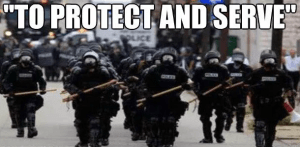
The GRPD is set to host several community meetings across the city on Wednesday, April 19 to share the findings of the recent racial profiling study. While some might see this as a mechanism of accountability, what such studies do is further legitimize the white supremacist nature of police departments.
White Supremacy doesn’t exist in a vacuum, it is the result of structural violence that benefits white people over communities of color. Communities of color disproportionately experience exploitation and poverty, and are therefore more likely to be policed over white communities and white neighborhoods.
The arrest rates and incarceration rates of communities of color is disproportionately higher that that of white communities and this is by design. Therefore, hiring more officers of color will not do much to dismantle the White Supremacy within police departments, it will only further legitimize the nature and function of those police departments.
False Solutions or re-imagining what it means to look out for each other
Within months after the police murder of Michael Brown in Ferguson, Missouri, the GRPD realized that is was important to take the initiative around so-called police reform. The level of police violence was astronomical, particularly in communities of color, so the GRPD and the city leaders knew is was important to appear as if they city was taking proper action.
The city has been working on 12 ways to attempt to improve community relations and restore public trust. These 12 recommendations are really just minor adjustments to the current system of policing and will not result in building trust within the community. All one had to do was listen to those from the community who spoke at the City Commission on Tuesday and it is clear that there are large sectors of the community that do not trust the GRPD.
So what is to be done? Well, there are no easy solutions and any discussion of what is to be done must come from those who are most directly impacted by police abuse and police behavior. What many organizations and many communities who directly impacted from police violence have been saying in recent years is that they want to have control over their own communities. Some organizations and movements, like Black Lives Matter, have been calling for the abolition on policing. Again, we have to listen to the wisdom of those most negatively impacted by police violence.
At a minimum, let us hope that the resistance from the GRPD leadership and the police union to practice accountability, will lead us have more critical discourse on the nature and function of policing and allow us to re-imagine new ways of looking out for each other that do not rely on cops.
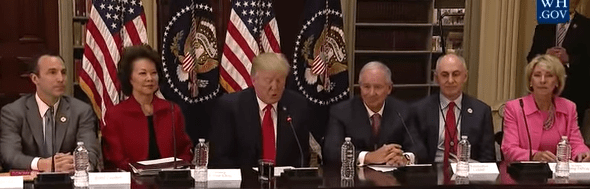
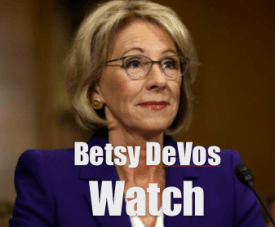 On Tuesday, Education Secretary Betsy DeVos joined President Trump and several other cabinet members for a Strategy and Policy Forum listening session with 17 CEOs from major corporations.
Corporations like Walmart, IBM, General Motors, PepsiCo and Boeing were present to offer their suggestions on how to further privatize the country. Each of the cabinet members met with specific CEOs and Betsy DeVos spent her time with Ginni Rometty of IBM; Jack Welch, formerly of GE and Toby Cosgrove of the Cleveland Clinic.
According to a statement released by DeVos, she stated:
“Today’s event was a great opportunity to listen and learn from some of America’s best innovators and job-creators. I look forward to collaborating with them on how we can maintain our nation’s global competitiveness.”
Speaking as a member of the Capitalist Class, DeVos was in her element during the “listening session,” feeling right at home with public-private partnership dynamics. In her statement from April 11, DeVos also said:
“By encouraging public-private partnerships, we can help connect students with prospective employers and provide those students with the necessary skills to find a good-paying job in their communities.”
For members of the Capitalist Class, education is primarily about talent creation and making sure that schools are producing new workers and managers for the business community. Education is not seen as a form of liberation, development of critical thinking skills or as a mechanism to further explore our humanity. The Strategy and Policy Forum listening session with the 17 CEOs is just one illustration of the importance of education as a form of workforce development.
Further Punishment for those with Student Loans
On Tuesday, Betsy DeVos reversed some Obama administration policies on student debt and student loans, policies that were not all that beneficial those those with student loans.
DeVos stated, “We must create a student loan servicing environment that provides the highest quality customer service and increases accountability and transparency for all borrowers, while also limiting the cost to taxpayers.” 
Such a statement further demonstrates Education Secretary DeVos’ belief that the market should be the driving factor when it comes to education.
Resistance Report noted that, “The new rule will affect approximately 4 million students and graduates whose loans are in default, collectively owing more than $67 billion. The affected students make up about 11 percent of the estimated 44 million Americans who have student debt, according to data from the Federal Reserve. And unlike credit card debt, student debt can’t be discharged through bankruptcy, thanks to laws passed in the 1970s.”
These changes to the student loan policy will most likely result in more students defaulting on their loans, but it will certainly result in more and more people being deeply limited in what they can be involved in, since having 10 – 30 year student loan payments provides little incentive for people to be involved in challenging systems of power that have imposed these loans on them in the first place.
Media Literacy and the Trump Administration
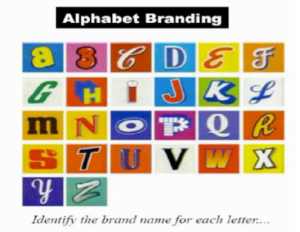 For nearly 20 years, GRIID has been promoting Media Literacy as an important component for an informed public. Over the past two decades we have conducted media literacy trainings throughout Michigan and have worked with public health educators, sexual assault prevention campaigns, labor organizers, environmental activists and anti-war organizers.
Media Literacy is fundamentally about developing critical thinking skills, skills that are often not part of the current educational system. Education is often framed as a mechanism for talent creation or merely preparing students for the job market. We view education as a life-long endeavor that is primarily about developing critical thinking skills that are essential to all of us in order to promote and practice justice and liberation from oppression.
Over the past 20 years we have used numerous media literacy exercises, but none more than the Branded Alphabet. The Branded Alphabet media literacy exercise is a great way for people to:
- Understand the pervasive nature of advertising in our society and how we are all being targeted by advertising campaigns.
- Understand how the news media functions and how they decide what information to give us, when to give it to us and how to give it to us.
- Juxtapose the Branded Alphabet with the current administration cabinet as a way to demonstrate the gap between our knowledge of products vs our knowledge of politics.
- Understand how the media system is constructed in such a way as to make consumerism a priority over an informed public
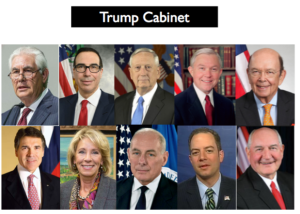 We have just updated the Brand Alphabet media literacy exercise, since we now have a new administration, with most of the key cabinet members being approved by Congress.
We invite you to test your knowledge of both the Branded Alphabet and members of the Trump administration. Ask yourself why you might now products more readily just from one letter than who hold major cabinet positions in the Trump administration? The answers are on page three of the media literacy exercise.
Last Thursday, the US military engaged in a bombing mission against Syria, launching 59 Tomahawk missiles directed at several targets on the Middle Eastern country.
However, this was not the first time that the US has bombed Syria in recent years. Since 2014, the US has been bombing Syria regularly (roughly 8,000 airstrikes), but unlike this past weekend, there was not an outbreak of protests across the nation, like the ones targeting the Trump administration.

Endorsing the US Missile Strike against Syria
Since the Thursday evening US military attack against Syria, politicians have been responding to the Trump administration’s actions. Michigan Senator Gary Peters made the following statement on Friday in support of the missile strike:
“Bashar Al-Assad’s ruthless use of chemical weapons to kill innocent men, women, and children is abhorrent and cannot be tolerated. Our ultimate goals in resolving the crisis in Syria should be restoring stability to the region and providing safety and security for the Syrian people, who have endured unspeakable terror at the hands of their own government. I applaud the skill and bravery of the American service members who executed last night’s air strike.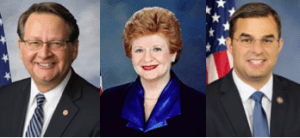
While it’s crucial that we send a strong message to Assad, I firmly believe this strike and any future U.S. military action must be accompanied by a comprehensive strategy to achieve our goals of stability and safety. Now more than ever, we need clear and consistent leadership from the Trump Administration that includes diplomatic, economic and military coordination with our Arab partners in the Middle East and allies in the international community. President Trump should work with Congress to ensure the United States presents a united front to address what is an extremely complicated conflict in Syria.”
Senator Debbie Stabenow has of yet to post a statement on her website, but she was interviewed on WKAR (MSU radio station) and had this to say:
“The Syrian people have endured horrendous atrocities at the hands of their government, and the latest chemical weapons attack against innocent children and their families demands a response. The Trump Administration must ensure that further US action is part of a clear strategy and policy that includes diplomatic coordination with our allies, as well as input from Congress. I stand behind our service members involved in last night’s military action and commend their bravery.”
Interestingly enough, Rep. Justin Amash, unlike Democrats Peters and Stabenow, did not support the Trump administration’s missile attack on Syria. On a brief statement of Facebook, Amash said:
Airstrikes are an act of war. Atrocities in Syria cannot justify a departure from our Constitution, which vests in Congress the power to commence war.
The Framers of the Constitution divided war powers to prevent abuse. Congress to declare war, so the American people might be represented in such a decision; the president to conduct war and repel sudden attacks.
Such a statement from Amash is not out of character, since her has opposed US military actions during the Obama administration as well. To be clear Amash does not take an anti-war or an anti-imperialist position. Amash claims to be more of a Libertarian and a Constitutionalist, but it should also be stated that his seat has been held by Republicans for decades and has been considered a safe seat.
Amash has not been seriously challenged in several races, nor was Rep. Vern Ehlers before him or Rep. Paul Henry before Ehlers. Given that the seat has been a safe seat for republicans, it has allowed those who have held the seat some flexibility to vote against their own party, especially when that vote doesn’t threaten the outcome of any particular legislation.
Major US Media acts as cheerleader for the US missile strike against Syria
Since Friday morning, most of the major US media has been endorsing the US missile strike and acting like a cheerleader for the US Military.
The independent news site, The Intercept, ran an article on Friday with this sentiment, running the headline, The Spoils of War: Trump Lavished With Media and Bipartisan Praise For Bombing Syria.
In addition, the media watchdog group Fairness & Accuracy in Reporting noted that in five major US newspapers, there were 18 opinion pieces on the US missile strike on Syria and all of them praised the US missile strike. Indeed, it has been difficult to find many dissenting opinions within the US commercial media, once again demonstrating US media loyalty to empire.
 Grand Rapids Institute for Information Democracy