100 Ideas, White Supremacy, Entrepreneurs and Income Inequality
 Try to imagine if you can, what Grand Rapids might look like if no one lived in poverty. Imagine if just those who were African American, disproportionately did not live in poverty. Can you even imagine that?
Some will say that African Americans have had every opportunity to get out of poverty and that there is no reason why a high number of blacks in this city should live in poverty.
Those who are quick to say this fail to acknowledge the history of White Supremacy in the US. They fail to acknowledge that slavery meant that black people earned no money and were not allowed to acquire assets, while white people profited significantly off of slavery.
Those who fail to acknowledge the history of White Supremacy fail to take into account the theft of black owned land, the constant terrorism of armed white people, whether it is the KKK or the local police department. Failure to acknowledge the history of White Supremacy means failure to talk about the history  of lynching, segregation, financial red lining, that black people have disproportionately made lower wages than white people, mass incarceration, white flight, gentrification, urban renewal and the defunding of the public sector, which has disproportionate impacted the black community more than any other.
People could read about how the economic system of capitalism doesn’t serve most people, but has particularly impacted the black community, as the great historian Manning Marable documents in his book, How Capitalism Underdeveloped Black America.
Along comes Start Garden, which says it wants to give away $1,000 to 100 people for new business ideas in the coming weeks. In July, Start Garden judges (whoever they might be) will have complete say in determining what lucky 10 people will then each get $20,000 to start a new business initiative.
The funds for this new project are coming from the banks and other financial institutions listed below, with the intent of creating,”10 new sustainable ideas in our Grand Rapids business district,” says, Jorge Gonzalez of Start Garden. Gonzalez went on to say, based on an MLive article, “That means wealth creation.”

Gonzalez’s co-worker in this project, Darrel Ross explained the thinking behind the initiative, when he said, “The solution to poverty is income, and the best way to generate income is through entrepreneurship.” Such a statement not only fails to acknowledge the history of White Supremacy, it fails to take into account how the system of capitalism works.
Capitalism, particularly Neo-Liberal Capitalism, functions best when there are a small percentage of the population keeping most of the wealth, while the masses are living in poverty or just a pay check away from falling into poverty. In fact, the founder of Start Garden, Rick DeVos, and the entire DeVos Family, has been deeply committed to the accumulation of wealth for themselves and influencing public policy to do things like – defund the public sector, eliminate unions, provide tax breaks and major subsidies to corporations, undermine public education and give the super rich unlimited ability to buy elections at the federal and state level.
Yet, somehow those who currently run Start Garden want people to believe that creating more entrepreneurs is the best way to generate income. Now, this might help a few people get out of poverty, but it is not sustainable and it again fails to acknowledge history and the complex nature of systems of oppression that make it extremely difficult for black and brown communities to experience economic justice.

Real economic justice looks more like what the Movement for Black Lives (MBL) is proposing.
First, the MBL is calling for massive Reparations for the wealth extracted from our communities through environmental racism, slavery, food apartheid, housing discrimination and racialized capitalism in the form of corporate and government reparations focused on healing ongoing physical and mental trauma, and ensuring our access and control of food sources, housing and land. 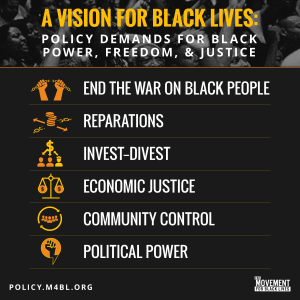
Second, MBL is calling for an Invest-Divest strategy, which says, We demand investments in the education, health and safety of Black people, instead of investments in the criminalizing, caging, and harming of Black people. We want investments in Black communities, determined by Black communities, and divestment from exploitative forces including prisons, fossil fuels, police, surveillance and exploitative corporations.
Third, they are calling for Economic Justice, where they say, We demand economic justice for all and a reconstruction of the economy to ensure Black communities have collective ownership, not merely access.
Each of these strategies and demands comes with lots of details on how the black community can get out of poverty, all of which can be found at this link https://policy.m4bl.org/.
The local news reported that there was a large audience for the kick-off of the 100 Ideas Start Garden Project. This is no surprise, given that 100 people will likely get $1,000 for just pitching a one-minute idea. However, such entrepreneurial ventures will only end up benefitting a small number of people, which will ignore thousands in poverty and perpetuate individualism, rather than promote how we can collectively fight poverty, income inequality and imagine other community-based forms of collective liberation.
From Organizing a Poor People’s Campaign to hosting a Corporate Breakfast: The Uses and Abuses of Dr. King’s Legacy
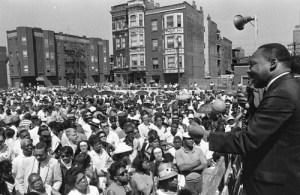 This year will mark the 50th anniversary of the assassination of Dr. Martin Luther King Jr. And this year, like most years since the federal government began to celebrate the Black Freedom Fighter’s birthday, Dr. King’s legacy will be miss used, appropriated and whitewashed by all sorts of entities and systems of oppression.
Federal, State and Local governments will misrepresent King’s legacy with calls for diversity and unity, when in fact Dr. King was so much more than that. If one looks at his evolution, from civil rights leaders to the black liberation struggle, it is clear that King had changed from the days of calling for integration to embracing a more prophetic role in calling out the violence and structural racism that was (and is) so woven into US society.
In his 1967 speech, Which Way Its Soul Shall Go, Dr. King didn’t mince words about racism in America, when he said:
“I am sorry to have to say that the vast majority of white Americans are racists, either consciously or unconsciously.”
Dr. King began to see in the years just before he was assassinated that racism wasn’t just a problem in the deep south. After 1965, when he moved his operations to the north and opened an office in Chicago, he began to deepen his critique of racism and white supremacy. Dr. King also began to expand on his use of tactics and strategies to challenge what he would refer to as the Evil Triplets of American society – Racism, Militarism and Capitalism.
During the 1966 Chicago urban campaign, Dr. King stated:
“We’ll use something that avoids violence, but becomes becomes militant and extreme enough to disrupt the flow of the city. I know it will be rough on them when they have to get 200 people off the Dan Ryan expressway, but the only thing I can tell them, which do you prefer, this or a riot.”
In 1967, in his Beyond Vietnam speech, Dr. King referred to the US as the, “greatest purveyor of violence in the world today.” King’s stance against the Vietnam war was even criticized in civil rights circles as being a divisive issue.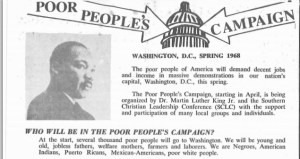
Besides racism and militarism, King began to also critically examine the economic system of capitalism. This was especially the case after 1965, where King became more strident in his denunciation of economic exploitation and began to demand massive reparations for black America, in what he called a “Bill of Rights for the Disadvantaged, our veterans of the long siege of denial.” This call for reparations is what motivated his involvement in the last campaign he organized, the Poor People’s Campaign.
The Poor People’s Campaign was not only based on the idea of massive reparations, but on King’s sharp critique of economic exploitation, which he named as capitalism. Here is what Dr. King had to say:

Considering all of what Dr. King had to say about racism, militarism and capitalism, it was rather disappointing to see that the Grand Rapids Urban League would be hosting their 18th Annual Dr. Martin Luther King Jr. Corporate Breakfast. 
How is it, that anyone could use the name of Dr. King and then add, Corporate Breakfast. How does one engage in this kind of cognitive dissonance? Do people really believe that Dr. King would want to be associated with corporations?
The main sponsors of the Corporate Breakfast that is meant to honor the man who challenged capitalism are, Steelcase, Spectrum Health/Priority Health, Chemical Bank, Mercantile Bank, Fifth Third Bank and Comerica Bank. Then there is the cost of the tables to purchase. A Platinum Sponsorship can get you a table of 30 for a mere $10,000, Gold Sponsorship will pay for 20 people with a price tag of $5,000, Silver Sponsorship $2,500, Bronze Sponsorship $1,250 and Angel Sponsorship $1,000.
I’m not sure how one gets from denouncing capitalism, calling for massive reparations and organizing a poor people’s campaign, to hosting a corporate breakfast.
 It is easy to present Democrats and Republicans as polar opposites, always waring with each other. However, the Blue State/Red State dichotomy is often an illusion framed around certain social issues.
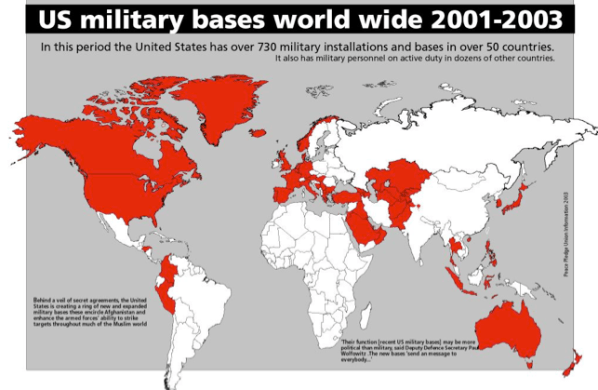
When it comes to US foreign policy and the defense of capitalism, then we can easily see bipartisan consensus. For most of US history, especially once wars are started, it is rare to find members of Congress who take a stand against US militarism. This bipartisan consensus is often framed as “support for the troops,” but a closer look will demonstrate that both the Republicans and Democrats are deeply committed to US wars abroad, which leads to a consensus on the Defense budget, which leads to bringing money to states that have a stake in weapons contracts or domestic military bases.
This bipartisan consensus was on display just before the holidays, when Michigan Senators Gary Peters and Debbie Stabenow, along with the entire Michigan Congressional Delegation, was lobbying for Fort Custer Training Center to become a missile-defense site.
Fort Custer is located between Kalamazoo and Battle Creek, which would mean that as a missile defense site, it would be near two major metropolitan areas.
The Michigan Senators and the entire Congressional Delegation from Michigan submitted a letter to Lieutenant General Samuel A. Greaves, who is the director of the Missile Defense Agency, stating:
“North Korea poses an increasingly substantial threat to our homeland, culminating in the recent launch of a new intercontinental ballistic missile that flew higher and longer than previous launches,” wrote the Senators and Representatives. “Fort Custer benefits from excellent existing infrastructure, including efficient access to two major interstate highways and a nearby 10,000-foot runway. The fields at Fort Custer are shovel ready and it is our understanding the CIS can be constructed at the lowest cost with the least environmental impact.”

This bipartisan consensus demonstrates the commitment that Republicans and Democrats have to US militarism – because the US will not tolerate most countries having nuclear capability; and it demonstrates a bipartisan commitment to capitalism – in that more taxpayer funds will come to Michigan for this missile defense program, which translates into more money for private weapons contractors, along with capital that will be injected into the communities in and around Kalamazoo and Battle Creek.
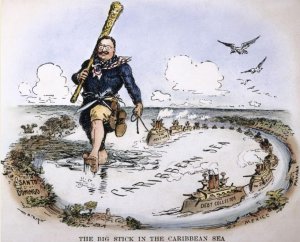 This 8-week class will investigate and analyze US foreign policy from what is normally referred to as the Spanish American War through the current policy under the Trump administration.
It is impossible to investigate more than a century of US foreign policy in 8 weeks. However, we will look at US Foreign Policy through various themes, such as chronological, geographical, the use of US soldiers, economic warfare, the use of proxy forces, weapons sales and diplomatic coercion. In addition, we will look at the human and ecological impact of US foreign policy.
There are no books assigned for this class, but we will use chapters from a variety of books, online sources that provide historical analysis, online sources that track certain aspects of US foreign policy, online sources that focus on specific regions or countries, declassified US government documents and current news & analysis of US foreign policy. In addition, we will use clips from various documentaries on US foreign policy and provide a bibliography for further investigation.
The GRIID class will be held on Monday nights beginning on Monday, January 29th and ending on Monday, March 19. The class runs two hours, from 6:30pm til 8:30pm. The GRIID class will be held at Plymouth United Church of Christ, located at 4010 Kalamazoo Ave SE, Grand Rapids, MI 49508.
The cost of the class is a suggested donation of $25 for the whole 8 weeks, but no one will be turned away because of the cost. For those interested in attending this class, send an e-mail to jsmith@griid.org.
With the Zapatistas on New Years Eve
 In honor of the 24th anniversary of the Ejercito Zapatista Liberacion Nacional (EZLN) uprising in Chiapas, Mexico.
The video below is from New Years Eve of 2000, when I was doing some accompaniment work in Chiapas, with the Zapatistas community in Oventic.
This footage demonstrates the power of direct action, showing indigenous communities converging on a Mexican military base with the intent of occupying that base until the soldiers agreed to leave……and they did!
The second part of the video is a short speech (more like a poem), that was given by Commandate David at midnight, during the EZLN annual celebration of their uprising, which began in 1994, the year that NAFTA was implemented.
This video is a clip from a longer documentary produced in 2006, entitled, Reversing the Missionary Position: Learning Solidarity on Mayan Time, which can be viewed at this link. I also wrote a book, which accompanies the documentary, entitled, Sembramos, Comemos, Sembramos: Learning Solidarity on Mayan Time, which is based on the solidarity work I have done in Central America and Mexico, along with my experiences working with refugees from Meso-America during the 1980s through 2006.
The Best of GRIID 2017: Exposing systems of power and reporting on movements of resistance
It is always difficult to try to limit the amount of stories you want to highlight in an end of the year summary of local news.
There have certainly been numerous stories that have developed in the past year, but in many ways these stories are symptomatic of larger, more systemic problems that certain sectors of the West Michigan community has to deal with all the time.
 While we can acknowledge that there is maybe a new awareness around deeply entrenched issues like White Supremacy with the Trump administration, these issues are not new.
One thing we try to do here at GRIID, is to expose the systems of power and oppression in West Michigan, while at the same time shed light on the grassroots resistance and social movements that are opposing these systems. So here are some of the main stories/issues we have written about in 2017.
AmplifyGR
While attending a housing meeting in late May, I was made aware of the group AmplifyGR. Within 10 minutes of hearing about this new non-profit, I was able to discover that it was a front group for the DeVos Family. Since the initial Part I and Part II stories, we were able to investigate some larger aspects of the AmplifyGR group, including the amount of money spent in purchasing the land in the southeast part of GR, along with how much money the DeVos Family Foundations have spent in the targeted neighborhood. We also have documented the push back from the community to AmplifyGR in both the June and July meetings.

Movimiento Cosecha GR
One of the amazing developments in the past year has been the creation of the local chapter of the national group known as Movimiento Cosecha. Cosecha GR came on the scene in February, with its first major action in February, drawing attention to US immigration policy, with over a thousand people marching in the streets.
Cosecha GR continued its organizing work with other marches and an action at the local ICE office where three people were arrested to expose the bankrupt immigration policies of this country.
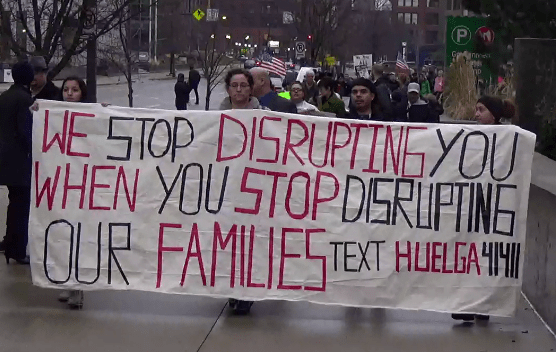
One focus of Cosecha GR has been to use boycotts to address systemic problems around immigration, by making it clear that without immigrants the US economy would come to a stop. The boycott campaign saw several thousand people marching and refusing to buy anything on May 1st, an action at Walmart that exposed the wages of migrant workers and the current Turkey Boycott Campaign.
White Supremacy in GR
White Supremacy in Grand Rapids may not seem so evident to people with racial privilege, but for communities of color – Native, Black, Latinix and other communities, White Supremacy is the norm.
Part of the problem is how we talk about White Supremacy, often limiting our understanding to just looking at hate groups like the KKK, without looking deeper at how White Supremacy functions in this community.
One can see White Supremacy as part of the current housing crisis and how Grand Rapids has become so gentrified in many neighborhoods.
 The other area where White Supremacy has been getting more and more attention is with the function and practice of the GRPD. There was the incident where the GRPD had stopped several young African American kids at gunpoint in April of 2017. In May, members of the Black community were calling for a State of Emergency, even though city officials were not taking them seriously. Just a few weeks ago, the GRPD once again demonstrated how they deal with communities of color, when they handcuffed at gunpoint an 11 year old black girl.
In addition, while we have been writing about ArtPrize since its beginning, we wrote a story this year making the point that what ArtPrize ultimately promotes is Whiteness.

Airport protests
Earlier in the year, we saw millions of people participate in protests against the so-called Muslim ban, where the Trump administration was attempting to implement a travel ban for people from several Muslim dominated countries. People in Grand Rapids quickly organized similar protests at the Kent County Airport, with an initial action in late January, followed by another one in early February.

Betsy DeVos Watch and Resistance
This year saw the appointment of Betsy DeVos as the Secretary of Education and because of that we created a new section on our blog, the Betsy DeVos Watch section. We regularly critique what policies the Secretary of Education has been promoting, along with documenting the number of actions against Betsy DeVos no matter what state she travels in.
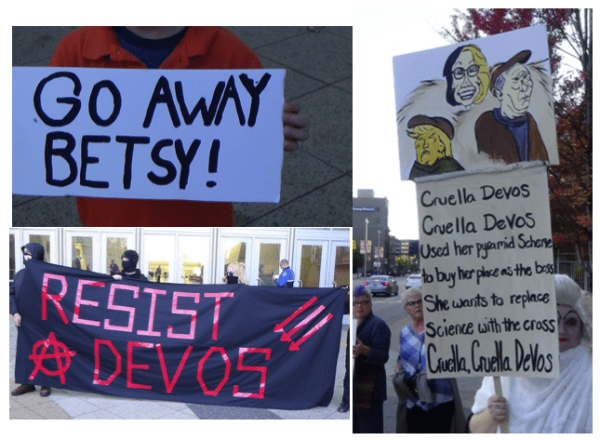
The protests that have greeted Betsy DeVos have also happened in Grand Rapids, with at least three separate actions taking place when she has visited GRCC in August, the MSU ribbon cutting ceremony in September and her keynote address at the Acton Institute’s annual gathering in October.
ATU/Cosecha GR Solidarity
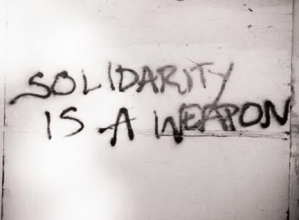 Another inspiring story from 2017, has been the ongoing relationship between members of the Grand Rapids Bus Driver’s Union (ATU) and Cosecha GR. This ongoing relationship has led to numerous solidarity actions, like the effort to collaborate on the campaign to support ATU workers during contract negotiations and an effort to change Grand Rapids city policy, which would prevent city workers from asking the immigration status of people.
While both campaigns were unsuccessful, it has been clear that the victory is in the mutual solidarity that has developed in the past year, which made clear the point that immigration issues are labor issues and labor issues are immigration issues.
The Most Powerful Family in West Michigan
Lastly, since we have been monitoring the activity of the various members of the DeVos Family, we finally decided it was important to put together a collection of articles and archives covering several decades that investigates the power and influence of the DeVos Family. This collection looks at some of the history of the family, their role in West Michigan politics, the various family foundations, how the DeVos Family uses their wealth to influence elections and legislation, local news coverage of the family, ArtPrize and articles on Betsy DeVos since she became the Secretary of Education. You can download the 350-page DeVos Family Reader by going to this link.
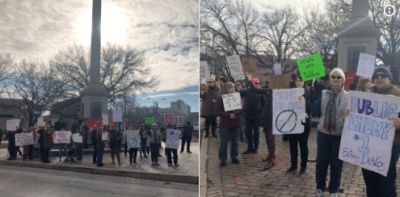 What has come to be commonplace when Betsy DeVos visits a campus or speaks publicly across the country, she is greeted by people who protest her policies and her presence.
Earlier in the week, DeVos gave the commencement address at the University of Baltimore. As has happened at other campuses where DeVos was scheduled to speak, students and faculty attempted to get the administration to cancel the Secretary of Education’s talk.
Before the graduation ceremony people gathered outside of the auditorium to protest the decision of the university to have DeVos as the commencement speaker, as you can see in some of these photos above.
During the commencement speech by DeVos, about 50 students that were graduating turned their back on DeVos, while others booed during her comments as can be seen in the photo below.
In addition, to the protests that confronted DeVos during her speech, it is worth looking a bot at what she had to say. In many ways, what the Secretary of Education had to say was what she has said in previous talks. However, there were a few things Betsy DeVos had to say that is worth discussing.
DeVos was talking about three character building points that will help students succeed in the world. These three are the challenge to be thoughtful, the challenge to be selfless and the challenge to persevere. She then set out to explain what she meant by each of these character building points.
On the matter of being thoughtful, she said:
Spend just a few minutes watching cable news and you’ll encounter folks who haven’t followed that advice. On social media and on many college campuses, groups and individuals pit themselves against each other — not to discuss and debate deeply held beliefs or ideas — but to raise decibels, score “got’cha” points or shout down an opponent’s voice.
But we will not solve the significant and real problems our country faces if we cannot embrace this paradox of silence.
There is an element of truth to what DeVos is saying here, but when you look at the context of the current political culture, it makes complete sense that people do not want to have a dialogue or a debate with white supremacists, misogynists or homophobes and transphobic people. In fact, there has been a push for people to be “civil,” when in fact this push for civility has led to compromise and complicity in hate speech and hate-based violence.
In addition, the DeVos Family is notorious for spending millions of dollars to buy candidates and lobby policies. This political spending is considered a form of speech that seeks to silence those who do not have deep pockets, like the DeVos Family. Betsy DeVos herself has said, “I have decided to stop taking offense at the suggestion that we are buying influence. Now I simply concede that point…..we do expect something in return.” This admission should be understood from a class point of view that rich people, by virtue of their wealth, have the loudest voices in society today.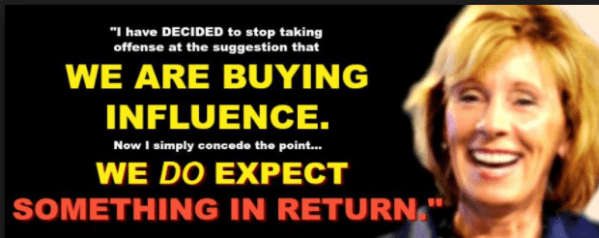
In regards to the second character building point, DeVos stated:
That brings me to a related challenge: to be selfless. This might also come off as counterintuitive in today’s “me-first” culture. But we would do well to recognize that we are — and always will be — greater than the sum of our parts.
I’m inspired by these lines from Scripture: “the parts of the body that seem to be weaker are all the more necessary, and those parts of the body that we consider less honorable we surround with greater honor.”
Too many try to invert the Golden Rule. “Don’t do to others what you would not want done to you.” The inversion suggests that if we just look out for ourselves, we’d all be better off.
 Talking about being selfless, when one comes from a millionaire family and marries into a billionaire family seem rather hypocritical. The DeVos Family, which owns numerous homes across the country, has their own yacht, airplanes and helicopters seems a bit like the “me-first” culture the Secretary of Education is referring to. Betsy DeVos has lived her entire life in a me-first culture, where she has never known what it means to go without, to have to make the difficult decision as a parent to provide food to her children or a warm home to live in.
In fact, it is insulting for DeVos to refer to the “Golden Rule,” unless of course she means, that those with the Gold, should rule.
The third, and last character building principle the Secretary of Education elaborated on was:
The last challenge I’m going to lay out today – to persevere – may well be the most difficult to actually do. That’s because our culture seems to promote the ideal of a sheltered life, free of hardship. This siren song tempts us to always take the easy road, the path of least resistance.
Again, the idea of perseverance from someone who has known material comfort and excess her entire life, seems rather shallow. I’m not saying that billionaires never have to persevere, but it’s hard to take someone like Betsy DeVos seriously, when talking about avoiding the least path of resistance.
DeVos supported Michigan Freedom Fund says anti-gerrymandering group is hyper-partisan
A few days ago, the group Voters Not Politicians delivered 425,000 signatures to Lansing, hoping to get a 2018 ballot initiative that would put an end to gerrymandering of political districts. One organization that is opposing this effort is the Michigan Freedom Fund.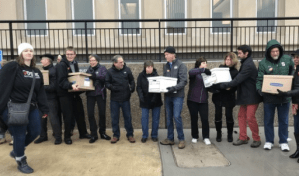
The Michigan Freedom Fund was the creation of Greg McNeilly, a DeVos political operative who also serves as the spokesperson for Dick & Betsy DeVos entity know as the Windquest Group. The Michigan Freedom Fund was created by the DeVos operative McNeilly right around the time that Michigan Governor Rick Snyder was deciding to make Michigan a Right to Work state. It is no coincidence that the Michigan Freedom Fund and Right to Work were happening at the same time. The Michigan Freedom Fund is essentially designed to promote and lobby to neoliberal economic reforms and attack working class efforts and labor unions, which becomes clear when you look at their Facebook page.
On the matter of the anti-gerrymandering ballot initiative, here is what the Michigan Freedom Fund had to say:
Voters Not Politicians, the organization submitting signatures today to put Michigan redistricting in the hands of partisan bureaucrats, potentially running afoul of the Voting Rights Act, is led exclusively by partisan Democratic donors, activists, and a Democratic trial attorney, according to public records, the Federal Election Commission and the Michigan Campaign Finance database.
According to campaign finance records, 7 of the 10 members of the ballot committee’s leadership have donated a combined $5,648 to Democratic candidates and causes, including Mark Schauer, Virg Bernero, Jennifer Granholm, Hillary Clinton, ACT BLUE, and many more. A list of the donations can be found here.
The Committee’s President, Katie Fahey, is a former Hillary Clinton activist who made national news last November when she traveled to New York to participate in Clinton’s later-scuttled victory party.
Jim Lancaster, the Committee’s attorney, is a longtime, prominent Michigan Democratic trial lawyer.
Vice President and Policy Coordinator Nancy Wang, Canvassing and Field Team Director Jamie Lyons-Eddy, Marketing and Communications Director Amelia Quilon, Advisory Council Director Walt Sorg, Outreach and Data Integrity Director Davia Downey, Education Director Lija Hogan, and Finance Director John Hanieski have all written personal checks to Democratic candidates or causes. Not one has contributed a penny to a Republican cause or candidate.
“Voters Not Politicians has been dishonest with voters from the start,” said Terri Reid, President of the Michigan Freedom Fund. “This organization was created by Democrats, run by Democrats, and, undoubtedly, bankrolled by Democrats. Voters deserve better than this kind of partisan masquerade. They deserve transparency. They deserve the truth.”
For an organization that is deeply partisan and is run by a DeVos political operative, the Michigan Freedom Fund has no credibility when it comes to calling out groups for being hyper-partisan.
Having said that, the fact that many Democratic Party operates are behind the anti-gerrymandering campaign is disconcerting. If the ballot initiative passes in 2018, it only means that Voters Not Politician’s wants to establish an Independent Citizen Redistricting Commission through a state constitutional amendment. However, what is to prevent that Commission from not being made up of partisan representatives and who will oversee their efforts.
CEO of group that promotes the business class, says that NAFTA did not eliminate jobs in Michigan
 Last Thursday, the Right Place Inc hosted its annual economic forecast event in downtown Grand Rapids.
The function of the Right Place Inc. is to promote the business class in West Michigan and recruit new companies to operate in the area. Their board of directors is made up of people who are part of the West MI power structure, like John Kennedy (AutoCam Corp), David Van Andel (Van Andel Institute), Mike VanGessel (Rockford Construction), Hank Meijer (Meijer Inc.) and Blake Krueger (Wolverine Worldwide).
During the Right Place Inc event last week, their CEO Birgit Klohs made the following comment about the North American Free Trade Agreement (NAFTA):
“It was not a job killer for Michigan. In fact, in West Michigan alone, almost 50,000 jobs depend on exports and many of those are going to Canada.”
According to an article posted on MLive last Friday, Klohs also had this to say about NAFTA and the potential negotiations of that trade agreement that was adopted by the governments of Canada, Mexico and the US in 1994.
“The changes we’re looking at are very detrimental to our automobile, furniture and agricultural industries,” said Klohs. Any efforts to place tariffs on foreign made goods will either raise prices in the United States or result in a trade war that will harm the flow of trade, she said.
Acting as a stenographer, the MLive writer never bothered to question the claims made by The Right Place Inc CEO, nor did the writer verify the claims made about NAFTA not being a job killer for Michigan. The reporter didn’t even bother to seek out a contrasting source, which are not hard to find.

According to the Bureau of Labor Statistics, Michigan lost 182,288 manufacturing jobs (or 22.8 percent) during the NAFTA-WTO period (1994-2016). This figure is for total manufacturing employment, so it takes into account both jobs created by exports and jobs displaced by imports, among other causes of net job change. The percentage of all private sector jobs that are manufacturing jobs in Michigan declined from 24 percent to 16.4 percent during the NAFTA-WTO period.
The non-partisan group Public Citizen has the number of Michigan jobs lost to NAFTA even higher. According to a recent document published by Public Citizen, Michigan has lost more than 231,000 manufacturing jobs – about one out of three – since the 1994 NAFTA and the World Trade Organization agreements took effect. Nearly five million manufacturing jobs have been lost nationwide. U.S. manufacturing workers who lose jobs to trade and find reemployment are typically forced to take pay cuts. Three of every five who were rehired in 2014 took home smaller paychecks, and one in three lost greater than 20 percent, according to Department of Labor data. More than 154,000 specific Michigan jobs have been certified under the Trade Adjustment Assistance (TAA) program as lost to offshoring or imports since NAFTA. These numbers significantly undercount trade-related job loss as TAA only covers a subset of jobs lost to trade.
This information clearly is in contrast to the claims made by Birgit Klohs. Public Citizen, even provides a detailed look at what they refer to as the Trade Adjustment Assistance Database, where you can look at all the jobs lost due to NAFTA, based on company, the year and how many workers were laid off. There are pages and pages of job layoffs, when looking at the database. Here is a brief sampling from that database.

Community Responses to the GRPD violence against Honestie Hodges and the limits of reform politics
 It has more than a week since the news that several Grand Rapids police officers handcuffed at gun point and 11 year old black girl while looking for a suspect.
Initially, Police Chief Rahinsky and other members of the Grand Rapids City Commission responded with concerns about how this 11 year old black girl was treated, with Rahnisky even saying he felt “nauseated” after watching the body cam footage. Our post last week made the point that the city and the police department would not make any fundamental changes because this is how policing is designed, especially when interacting with communities of color and poor working class white people.
Since then, the Grand Rapids Police Union has made it clear that they felt the officers responsible for handcuffing Honestie Hodges at gunpoint followed standard protocol.
According to MLive, on Friday, At the press conference, Rahinsky said he thought there was “good police work” at a quickly evolving scene where officers were responding to a stabbing with unknown factors in play. He also said they followed proper training. But at the same time, he hoped for a better outcome that would not traumatize an 11-year-old.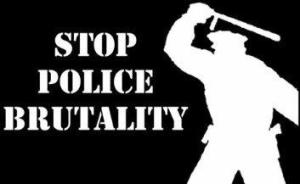
While the police union says it doesn’t think that Rahnisky has their trust, the responses from Rahinsky make it clear that he believes the officers involved with handcuffing the 11 year old black girl at gunpoint was how cops should handle this situation. We should not by lulled into believing that Chief Rahnisky has the community’s best interest in mind, just because he felt “nauseated” when viewing the video footage. Again, this is how the police function.
Community Responses
There have been several community responses since the GRPD handcuffed at gunpoint Honestie Hodges on December 6. On Tuesday, December 12 and last night, people spoke out against the way that this 11 year old girl was treated. In both cases, these comments came during the open public comment period, as there has not been a forum public hearing on this police abuse by the GRPD.
Last Wednesday, some 30 local clergy gathered at Brown-Hutcherson Ministries in Grand Rapids to discuss what the faith community ought to do in this case. According to a WOOD TV 8 story, the clergy stated:
“We are not asking for change now, we are cohesively demanding to have the Department of Justice to review the police practices and training mechanisms,” said Jerry Bishop, pastor of Lifequest Ministries.
One additional response is a campaign, initiated by Dana Knight, to have people donate gifts to Honestie Hodges, by dropping them off at the LINC office.
Linc also is calling for the suspension of all the GRPD officers involved in handcuffing at gunpoint Honestie Hodges, based on a Press Release from yesterday.
Lastly, at a press conference held yesterday at City Hall, the NAACP stated:
“The officers involved violated Honestie Hodges’ Fourth Amendment Constitutional right, in addition to using excessive force,” the Grand Rapids branch of the NAACP said in a statement.”
“The NAACP Grand Rapids Branch is greatly concerned with the disturbing trend in which officers have aggressively traumatized youth of color. Recently, five African American males between the ages of 12-14 were ordered to the ground, held at gunpoint and handcuffed for over 10 minutes on their way home from a community center.”
“The regional, state and national affiliates are also closely watching, expecting appropriate disciplinary actions be taken.”
The Limits of Reformist Politics
All of these responses are understandable given the current political culture we live in. We want the police department to be held accountable and to adopt policies and procedures that will not allow for this kind of behavior in the future. However, when we take a step back and look at what happened, do we honestly believe that there will be any real change because we ask the police to do better?
If we read Michelle Alexander’s book, The New Jim Crow, or familiarize ourselves with the Black Lives Matter movement, it becomes clear that the analysis that these people bring to the table, in addition to their own lived experience, should suggest to us that reformist politics are inadequate as a response to the function of policing in the US. Now, I’m not suggesting that we not make demands from local officials and the GRPD. We should, but we have to be more strategic about it.
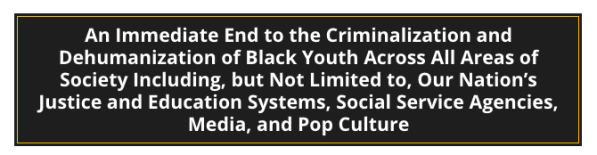
What if, instead of just going to a City Commission and expressing our collective anger at what the police are doing to black people in this city, we went with the intention of not leaving until certain demands were met? What if we had 100 people willing to do civil disobedience and stay in city hall until we got what we wanted? This of course would mean we would need to devise a list of demands, which should really be part of a robust community conversation that questions the actual function of police departments.
 Would it be wiser to ask for some kind of reprimand against the officers who handcuffed at gunpoint the 11 year old black girl or should we demand some radical shifts in how policing functions in this community and whether or not there are community-based solutions to safety that do not require heavily armed individuals that are trained to protect private property, power and privilege?
Of all the community responses so far, the best one is giving gifts to Honestie Hodges. I say this because, it is always good to practice mutual aid, where those who are victimized by systems of oppression (yes, the GRPD is part of a system of oppression) get some relief and care from the larger community.
What has happened in the past couple of years, both nationally and locally, with greater attention given to police violence against the black community, is that it has forced us to question the role of police departments. This violence by cops against the black community is nothing new and in fact, it is consistent with the history of policing from the beginning. What we need to do is to collectively come up with a strategy to challenge the way we think about cops and the way we think about public safety. Until then, we are not likely to change much of anything, since our responses are too often reactionary and reformist in nature.

