Yesterday, the Grand Rapids Cosecha Movement engaged in their latest action in their campaign to demand respect, dignity and permanent protection for all immigrants.
At the 54th street Walmart, Cosecha GR members participated in what they were calling a “penny action.” The action involved adults and children buying milk and paying with pennies.

People went to the checkout lanes, each with 2 gallons of milk, and paid with pennies counting them one at a time.
Clogging up the checkout lanes caused them to backup, creating long lines of shoppers, as you can see in the pictures below.


This process played out for about 30 minutes, including people the returning the same milk they had just purchased. Eventually, Cosecha members took out a banner that said we will stop disrupting you, when you stop disrupting our families. Then, another member of Cosecha GR, with the use of a megaphone read a statement, which you can see in this video:
One of the things that the Cosecha GR action was attempting to draw attention to was the fact that there are literally thousands of immigrants working in the agricultural sector. Migrant workers pick the food we eat and milk the cows we drink. These migrant workers don’t make a livable income, which is why the Cosecha Movement is calling for a strike. A strike, even if it only involved immigrant workers, would cause tremendous financial harm to businesses all across the country.
The Cosecha GR members were also appealing to Walmart workers who don’t make a livable wage, often relying on food assistance.
Cosecha members also handed out information to customers with some explanation of the action, along with an invitation to be part of the local movement. In fact, they are inviting anyone with a commitment to immigrant justice to text the word Huelga or Strike and the number 41411.
Walmart management attempted to silence the action and to prevent Cosecha GR members from filming, but were unable to do so. Walmart called the local cops, who showed up just as the Cosecha GR members were leaving the store.

 Yesterday, the DeVos-created group AmplifyGR sent an e-mail to the group Grand Rapids Homes for All cancelling the meeting that was scheduled for June 8 at the Baxter Community Center.
Here is the message that AmplifyGR sent:
I wanted to let you and the Grand Rapids Homes for All team know that we will need to reschedule our June 8 meeting scheduled until July/August.
We have been working with City Commissioners to host a neighborhood meeting in late June to share information with residents on Amplify GR’s goals, planning process, partnerships and real estate transactions. Once that meeting happens, we would like to reschedule with Grand Rapids Homes for All and work with you to maximize attendance and discuss how our goals align for creating and maintaining quality housing for all.
I apologize for the disruption, but hopefully we can identify an opportunity to continue the conversation in July/August.
Sincerely, Jon Ippel
The GR Homes for All Facebook event made it clear that the AmplifyGR group was funded and created by the RDV Corporation, which is part of the DeVos family holdings.
The fact that AmplifyGR canceled this community meeting raises questions about what it is that they don’t want the public to know, particularly those who will be most impacted by the development plans they are working on as it relates to the Boston Square and Cottage Grove neighborhood areas, as we reported on Tuesday.
If indeed a public meeting will be taking place in the Southtown neighborhood area, how will that meeting be run and who will be facilitating it? Once a meeting date is known, we will post information about it so that people can attend, ask the necessary questions and raise concerns about the process so far, which appears to favor the Rockford Construction/DeVos-led development project at the expense of residents.
It is not yet known if the Grand Rapids Homes for All meeting will still be held on June 8. Once we know for sure, we will update this post.
 Over the past several years, we have seen the impact that developers and investors are having on the gentrification of neighborhoods throughout Grand Rapids.
The Wealthy Street corridor, Michigan Street, the Belknap neighborhood, Bridge Street and West Fulton are just a few examples of neighborhoods that have seen the cost of rent rise dramatically, houses being torn down, families being displaced and the new development projects primarily benefiting the business/professional class.
There are now plans under way in the Southtown area of Grand Rapids, specifically the area that is bordered by Hall St. to the North, Burton St. to the South, Division St. to the West and Fuller/Kalamazoo to the East. Some people also refer to this area as the Boston Square neighborhood and the Cottage Grove business district.
One of the entities that is pushing for the re-development of this area is the Rockford Construction Company. Last year it was revealed that the major Grand Rapids development company had already drafted a blueprint for the area without the knowledge of those who actually live in that neighborhood.
The other major player to surface with an interest in the Boston Square neighborhood/Cottage Grove business district is a lesser-known organization called AmplifyGR. AmplifyGR is a non-profit organization recently created by the DeVos entity known as RDV Corporation.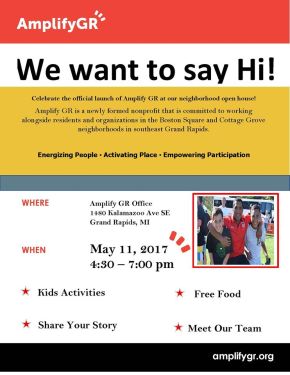
AmplifyGR has a website, but there is very little content found at the site. However, there is more information about what AmplifyGR has been up to, based on city documents, mostly from the Southtown Corridor Improvement District minutes. Those minutes (1/18/2017) include the following information about AmplifyGR:
Jon Ippel and Brad Mathis shared that over the last nine months, Rockford Construction, in partnership with the Doug and Maria DeVos Foundation, has been developing Amplify GR. Their focus area, which overlaps the Southtown CID, is from Burton St SE to 28th St SE and S Division Ave to Kalamazoo/Fuller Ave SE. Amplify GR will be opening an office in the community and partnering with existing organizations to address issues faced by the community. They developed this model based on the Purposeful Communities model in Atlanta. They plan to begin community engagement in February, 2017. This is anticipated to long term work (15+ years). (Full presentation added to the agenda packet.)
Commissioner Senita Lenear talked about the long-term, community benefit of ownership, both of homes and businesses. Commissioner Lenear asked Mr. Mathis to speak to the property acquisitions that they have made in the focus area. Mr. Mathis shared that Rockford Construction has purchased roughly 12 buildings, the most visible being the former Dexter Lock factory at 1601 Madison Ave SE.
It should be noted that the Doug Maria DeVos Foundation have also been the primary funders of LINC.
This new partnership between Rockford Construction and the DeVos family should raise lots of red flags to anyone who has seen what Rockford has done on Bridge St and the near westside of Grand Rapids in recent years. Such a partnership should also raise red flags for those who are aware of the pro-capitalist, anti-worker, anti-LGBTQ, anti-public schools history of the DeVos family.
What follows is the AmplifyGR presentation that was mentioned in the minutes of the 1/18/2017 meeting:
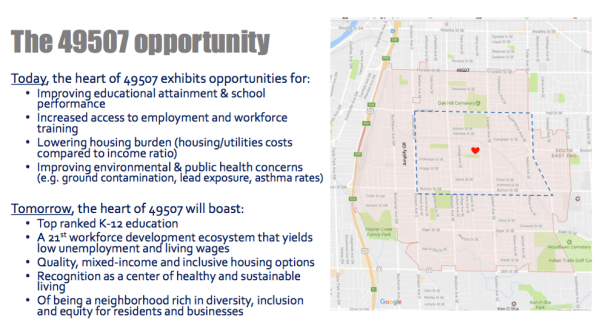
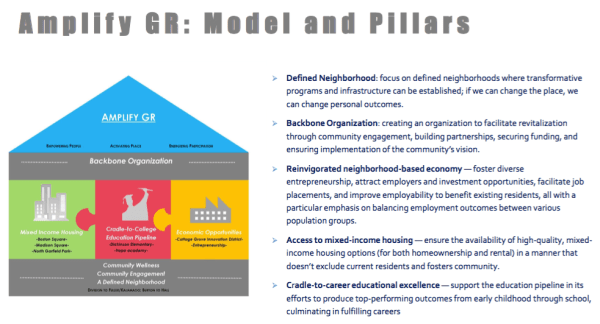
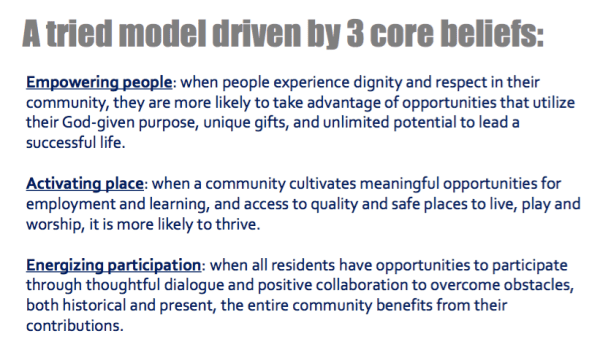

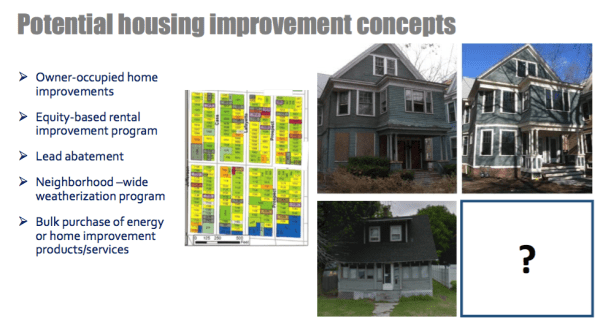
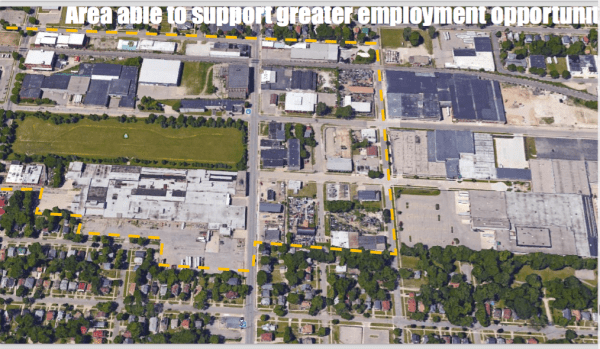
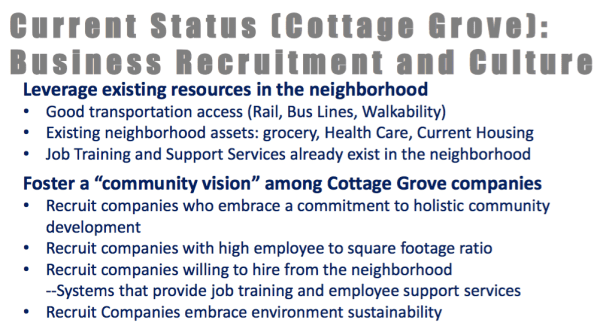
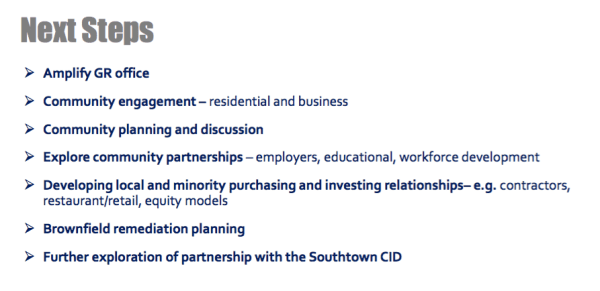
What is most alarming about the AmplifyGR presentation information is the neo-liberal capitalist language such as entrepreneurship, “defined neighborhood” and “cradle to career educational excellence.” The cradle to career educational excellent is code for charter schools, schools of choice and privatized education and the rest of the language reflects a certain form of paternalism, which suggests that those who currently live in the neighborhood just can’t improve their situation on their own.
In the March 15, 2017, Southtown Corridor Improvement District meeting minutes it states:
Jon Ippel gave the update of Amplify GR hiring of Willie Patterson, formerly of LINC, to continue the work of identifying key areas of partnership. Amplify is focused primarily in the Boston Square and Cottage Grove areas. They are working on partnering with communities on developing and repositioning underutilized properties, working with the local schools, and increasing affordable housing. J. Ippel emphasized that they want to respect the work that has been and being done by others. They are looking to partner with orgs and people such as LINC, Seeds of Promise and Oakdale Neighbors already doing this work.
First phase of community engagement led by W. Patterson is a survey in partnership with Seeds of Promise and Oakdale Neighbors. In spring larger meetings looking to identify the opportunities and assets available to see out the vision.
Longer term they are asking how do they reposition the properties in Boston Square and Cottage grove in a way that provides employment to people living in Southeast Grand Rapids.
Helen Harp asked about a timeline of when things start. J. Ippel stated that the survey begins in April. They will move into office space in Boston Square in 2 weeks. They hope to have a better sense of when community meeting can be set within the coming few weeks.
H. Harp asked about joining the Area Specific Plan (ASP) surveys with Amplify GR’s survey. Com. Senita Lenear noted that it may to be done at the district level.
Pat Pulliam voiced the concern of the ongoing planning process with the ASPs while at the same time developers are going forward with their projects and their own visions. Without the ASP vision being laid out and developers already moving ahead, particularly on parcels that are being built by right, there is potential for conflict.
It was suggested that it would be good to have Amplify work closely with Planning Dept. to get the concerns and vision of the communities as well as sync up the different timelines.
P. Pulliam noted that given that they are beginning the process again this was an opportunity to get the communication, planning and engagement right. Concern of development getting ahead of the actual planning and solidifying the vision, particularly given that the CID is large and each Business district is unique. Com. S. Lenear recommended that Amplify be sure to work closely with the CID and get the timeline together in order to give Amplify more credibility when engaging the community as a new organization.
J. Ippel spoke on the urgency given the needs of housing and employment but was willing to work in partnership. Com. S. Lenear noted that it may be necessary to do the project well and correctly since there will always be urgency and the ramifications of getting it wrong will be felt for a long time.
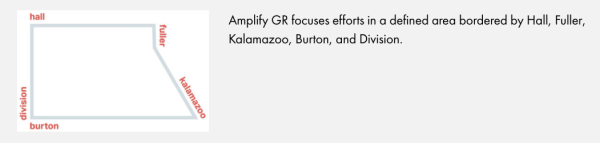
It seems clear from these minutes that AmplifyGR wants to move forward quickly and not have to be bothered by the tedious process of public and resident input, because there is an “urgency.”
All of these developments are taking place somewhat under the radar and should concern all of us who care about justice and equity. The group Grand Rapids Homes for All is hosting a meeting with AmplifyGR on Thursday, June 8, from 6 – 8pm at the Baxter Community Center. Come with questions, come with concerns and lets not allow the DeVos family to dictate the future of yet another part of the city of Grand Rapids.
The funding scheme of ArtPrize

Yesterday, MLive reported that the City of Grand Rapids has a new event policy, which changes the payment structure for events held in Grand Rapids.
The MLive article states:
The change will impact ArtPrize the most, which will now be paying at least $9,000 in new fees to the city this year, said Tom Almonte, managing director of public services.
The change was a part of a large new fee structure the commission passed in order to make it easier for smaller community events to afford permit applications. However, the change doesn’t fully account for the lowered cost as $75,000 from the city’s general fund will be used to cover the difference.
The MLive article frames the issue as if entities like ArtPrize are being penalized for having an event with large crowds, when the reality is just the opposite. Like most coverage of ArtPrize, there is no critical inquiry and no context for actual costs.
First, the City of Grand Rapids is saying that they are contributing $75,000 of taxpayers money. Does this use of money from the general fund also include the cost of having members of the GRPD police the event?
Second, the additional $9,000 it will cost ArtPrize might seem like a lot of money to the public, but to the DeVos family, this is simply a drop in the bucket.
According to the most recent (2015) 990s for the Dick & Betsy DeVos Foundation, it states:

In addition to this loan, the Dick & Betsy DeVos Foundation contributes money to their son Rick’s annual event. Again, according to the 2015 990 document for the foundation, his parents gifted $750,000 and an additional $400,000 in two separate line items.
The Dick & Betsy DeVos Foundation has assets listed at $55 million and change. Foundation money is a way for rich people to hide their wealth from being taxed. However, if the Dick & Betsy Foundation want to pay the $9,000 fee the City of Grand Rapids is now asking, that is essentially like asking the rest of us to pay 90 cents.
In addition to the large sums of money that the Dick & Betsy DeVos Foundation provides, several other family foundations make sizable donations to ArtPrize, along with dozens of other sponsors.
Then there is the fact that each individual artist must pay $50 to register the art they have created for ArtPrize. In 2015, there were 1,742 artists who entered ArtPrize, which at $50 a pop comes to $87,100.
To top it off, while a few artists win cash prizes, all of them give their labor for free. Imagine having several thousand artists create all kinds of art pieces, in various mediums, and not get compensated one penny.
It seems that the DeVos family has figured out another way to redirect public funds to cover some of the cost of ArtPrize, use non-taxed foundation money to underwrite the event, have sponsors pony up thousands more and get 2,000 artists to give free labor and pay money to enter this damn contest. Isn’t capitalism wonderful!
A closer examination of what Betsy DeVos said about the Education Budget cuts yesterday
 On Monday, we posted a critique of the proposed budget cuts that Education Secretary Betsy DeVos has proposed. These budget cuts amount to roughly $10.6 billion and would negatively impact students of color, working class children, public schools and children with disabilities.
Yesterday, DeVos spoke before Congress about these proposed budget cuts. Here is a link to her opening statements made before the House Appropriations Committee.
One thing about DeVos’s comments is that she uses rhetoric that most politicians use, claiming that, the “budget lays out a series of proposals and priorities that work toward ensuring every student has an equal opportunity to receive a great education.”
Such platitudes are repeated over and over again, yet there is no evidence that this is currently the case or has ever been the case when it comes to guaranteeing that every student receives a great education.
In her comments, DeVos then lists 5 principles that are guiding the education budget proposal.
First, our request would devote significant resources toward giving every student an equal opportunity for a great education. It emphasizes giving parents more power and students more opportunities. Again, platitudes, with no evidence to substantiate the claims.
Second, the Administration’s request recognizes the importance of maintaining strong support for public schools through longstanding State formula grant programs focused on meeting the educational needs of the nation’s most vulnerable students, including poor and minority students and students with disabilities. Just the opposite is the case, since vulnerable students will suffer under the proposed cuts and there is plenty of evidence that States are redirecting funds to charter and other privatized education systems and away from public education.
Third, our request maintains funding for key competitive grant programs that support innovation and build evidence of what works in education. This also means strong support for the research and data collection activities of the Department. Education funding should not be based on competition, but providing equitable funding for all students, particularly those most vulnerable.
Fourth, our request reduces the complexity of funding for college while prioritizing efforts to help make a college education accessible for low-income students. As Congress prepares to reauthorize the Higher Education Act, I look forward to working with you to address student debt and higher education costs while accelerating and improving student completion rates through such efforts as Year-Round Pell, and reducing the complexity of student financial aid. DeVos contends that the budget “makes a historic investment in America’s students,” while at the same time eliminating or significantly changing many of the programs meant to assist future or current students in realizing their dreams of a higher education. 
And fifth, consistent with our commitment to improve the efficiency of the Federal government, our request would eliminate or phase-out 22 programs that are duplicative, ineffective, or are better supported through State, local or philanthropic efforts. Six additional programs were already eliminated in the reauthorization of the Elementary and Secondary Education Act. All told, taxpayers will save $5.8 billion. This last point is particularly offensive, since it claims that the states will fulfill some of the programs that are being cut, like Native students in Alaska and Hawaii, plus eliminating Special Olympics Educational programing. The other aspect of the fifth principle is the fact that DeVos included philanthropic efforts, along with State and local. Philanthropic efforts should scare the shit out of all of us, considering the ideological agenda that her family’s philanthropy has support as it relates to education.
The fifth principle also seems like a particularly cruel joke, considering how her family’s foundations, along with the various anti-public education groups she has funded or co-founded, have been about the business of transferring public money into private education systems. This point is made less diplomatically in a recent article by Jeff Bryant entitled, What Betsy DeVos Calls Education Transformation Is Actually Public Theft.
Bryant points out in his article:
A recent op-ed in the New York Times cites a study which found Indiana students using the state’s voucher program to transfer from public schools to private schools voucher students “experienced significant losses in achievement” in mathematics and “saw no improvement in reading.”
But one thing Indiana’s voucher program certainly accomplished is to provide a huge cash infusion to religious schools. As Mother Jones recently reported, of the more than 300 schools receiving voucher money in the Hoosier state, only four aren’t “overtly religious.” The remaining four are for special needs students.
Diane Ravitch, a highly respected education historian and author of numerous books on education, including Reign of Error: The Hoax of the Privatization Movement and the Danger to America’s Public Schools, points out in a recent blog post that Betsy DeVos recently posed for an advertisement (see below) for a Christian school that does not accept students with disabilities.
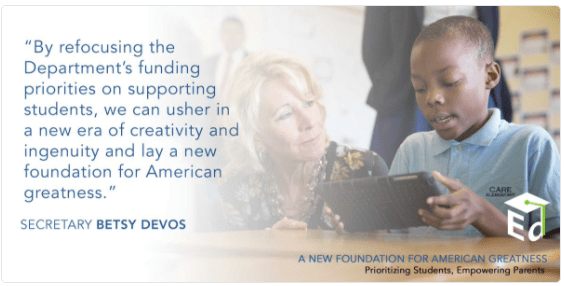
This point about private schools that discriminate against certain students came up during the her education budget discussion in front of the House Appropriations Committee yesterday. DeVos was asked if she would withhold federal funding for private schools that engaged in discrimination against students, and the Education Secretary refused to say she would withhold funding from private schools that discriminate.
Speaking of Diane Ravitch, her most recent article in the New Republic, an article that appeared on Tuesday, provided important analysis that some people are unwilling to hear.
The article is entitled, Don’t Like Betsy DeVos? Blame the Democrats. Ravitch’s main argument is that the Democratic Party paved the way for the education secretary’s efforts to privatize our public schools.
Here are a few important excerpts from that article:
Thirty years ago, there was a sharp difference between Republicans and Democrats on education. Republicans wanted choice, testing, and accountability. Democrats wanted equitable funding for needy districts, and highly trained teachers. But in 1989, with Democrats reeling from three straight presidential losses, the lines began to blur. That year, when President George H.W. Bush convened an education summit of the nation’s governors, it was a little-known Arkansas Democrat named Bill Clinton who drafted a bipartisan set of national goals for the year 2000 (“first in the world” in mathematics, for starters). The ambitious benchmarks would be realized by creating, for the first time, national achievement standards and tests. Clinton ran on the issue, defeated Bush, and passed Goals 2000, which provided grants to states that implemented their own achievement metrics.
Later on Ravitch states:
When Barack Obama took office in 2009, educators hoped he would return the party to its public school roots. By then, even Bill Clinton was calling No Child Left Behind a “train wreck.” Instead, Obama and Education Secretary Arne Duncan doubled down on testing, accountability, and choice. Their Race to the Top program was, in essence, No Child Left Behind II: It invited states to compete for $5 billion in funds by holding teachers accountable for test scores, adopting national standards, opening more charter schools, and closing low-scoring public schools.
The Obama years saw an epidemic of new charters, testing, school closings, and teacher firings. In Chicago, Mayor Rahm Emanuel closed 50 public schools in one day. Democratic charter advocates—whose ranks include the outraged Booker and Bennet—have increasingly imported “school choice” into the party’s rhetoric. Booker likes to equate “choice” with “freedom”—even though the entire idea of “choice” was created by white Southerners who were scrambling to defend segregated schools after Brown v. Board of Education.
These are important points that Ravitch makes and ones we must come to terms with if we are truly fight for quality education for all students. Partisan politics have systematically destroyed public education and if we are to salvage what is left then we can not rely on either political party to do the right thing, based on their track record. It is too easy to blame Trump and DeVos, when the record shows that the attacks on public education have been a bipartisan affair.
 Yesterday, activists and organizers discovered that the Grand Rapids City Commission was going to vote on a proposal to further limit the ability of people to dissent.
The language of the proposal (read pages 231 – 241) referred to the growing dissent as, “Expressive Activity.” The proposal put forth at the City Commission yesterday states in part:
As has been the case in cities across the country, Grand Rapids has seen a steady increase in the numbers of parades, rallies, marches and other activities. Since November of 2016, Grand Rapids has hosted at least 40 such events, averaging more than six per month.
The proposal goes on to say:
A “Notice of Intent to Engage in Expressive Activity” is required for groups of fifty (50) or more persons. The notice includes the date, location and a contact person, who shall be the “Receipt Holder” for the activity. The City will, in turn, provide a “Receipt of Notice”. This receipt is not a permit; it is merely an acknowledgement by the City to the Receipt Holder that City staff has received the information. Such notice allows the City to coordinate efforts and proper staffing across departments. City staff will also use the receipt as an opportunity to provide information to the receipt holder, including any logistical concerns the group may wish to take into consideration, such as overbooking of the location or capacity concerns about the crowd expected. Groups of fewer than fifty persons are not required to provide notice, but may do so, if they wish. No fees will be charged for filing a notice.
The Grand Rapids City Commission proposal wanted to have organizers give notice of when they would be having a march (for instance), where it would be and the person or persons in charge.
Towards the end of said proposal, the city lists what they refer to as Standards of Conduct, which, apparently we are all supposed to abide by. These Standards of Conduct are:
- The participants shall not block access to buildings, nor impede ingress or egress to any parking lot, park, facility, or event. Under no circumstance shall any participant impede vehicular or pedestrian ingress or egress to any hospital, fire station, or other emergency response facility.
- The participants shall not obstruct vehicular or pedestrian traffic. Under no circumstance shall any participant impede access to any interstate highway, including ramps, access roads and bridges serving such highways.
- The Expressive Activity shall not constitute unlawful activity. Participants must follow all Federal, State, and Local, laws, statutes, ordinances, regulations, and rules.
- The Expressive Activity shall not include the use any amplification devices.
- The Expressive Activity shall not include littering, or posting materials on City property, utilities, or sidewalks. Participants shall be responsible for picking up any printed materials dropped on the ground around the areas of distribution.
- Parking lots,ramps,and garages are not designated or suitable for Expressive Activities, and placing flyers on windshields is not permitted.
- The Expressive Activity must occur during the normal operating hours of the facility in which it is held.
The City Commission, during the Tuesday morning session voted down said proposal, which was a small victory, but we should not confuse this vote against the proposal as a signal that the City of Grand Rapids is in favor of dissent and resistance to local, state or federal government policies, white supremacy, US imperialism, transphobia, patriarchy, environmental destruction or any other form of oppression.

The City of Grand Rapids, primarily through their use of the police department, has always been about the business of managing dissent. Whether we are talking about the 1911 Furniture Workers Strike, the opposition to the Vietnam War, the 1967 race riot or any organized resistance in the past few months, the City of Grand Rapids wants to manage public dissent.
This most recent proposal, although not approved, is just another confirmation that the city does not approve of dissent, unless it does not disrupt business as usual. If people organize a picket, a demonstration, a vigil, a march or any other form of protest, the city could care less, as long as it doesn’t disrupt business as usual.
If however, an action disrupts traffic, shuts down a business or prevents the normal functioning of commerce, then the City of Grand Rapids will respond with force, as people saw during the May 1 action in support of A Day Without Immigrants.
We Don’t Need No Stinking Permits
The whole history of dissent in the US, or any other country, that has been effective, is predicated on the ability of those who dissent to disrupt business as usual. Tactics such as a strike, a sit in, shutting down a military recruitment station, preventing the normalized violence against women, taking over a highway, chaining yourself to trees slated to be cut down, riots against police violence or any other action that costs businesses money are things that are effective and therefore, are the very things that system of power try to prevent or persuade us from participating in.
- We have to stop asking permission to engage in resistance and dissent.
- We have to start thinking about effective tactics of dissent and resistance that will cost systems of power, both monetarily and morally.
No government ever gave us rights, we have to fight for them and for our collective liberation.
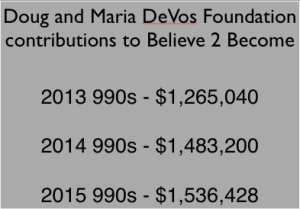 Last December, we wrote an article responding to the praise that GRPS Superintendent, Teresa Weatherall Neal, was giving to Betsy DeVos for her “support” for Grand Rapids Public Schools.
A major part of the reason that Neal was singing Betsy DeVos’s praises was because we noted how much money the DeVos Family had donated to the various programs West Michigan’s most powerful family had help to start. These programs, are in many ways, connected to the main goals that the DeVos Family espouses, which are inserting religion in the public sphere and promoting neo-liberal capitalist principles.
 One of the projects the DeVos Family has had their hands in and provided a substantial amount of funding to, is the GRPS-supported project, Believe 2 Become. The Believe 2 Become initiative is funded by the Doug and Maria DeVos Foundation. According to the most recent 990s, the Doug and Maria DeVos Foundation has increased each year the amount of money they have donated to Believe 2 Become.
A new report from Believe 2 Become reflects to worldview of the DeVos Family and many other members and organizations that make up the Power Structure in West Michigan.
The report, Workforce Opportunity in West Michigan:Connecting a Qualified Workforce to High-Growth Opportunities, demonstrates that the local power structure sees students primarily as workers they can make money off of.
The contemporary business community uses terms like talent management and workforce development, but these are essentially modern terms for what 19th century writers would refer to as wage slaves.
Look at these comments from Business Leaders and you can see how they view students:
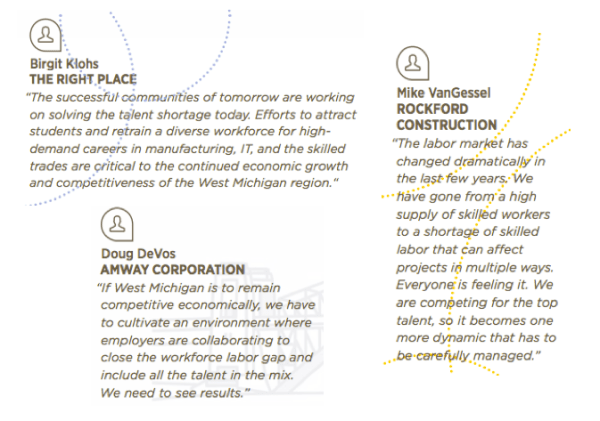
Each of these members of the capitalist class make it clear that the function of education is to prepare people to be good and obedient workers.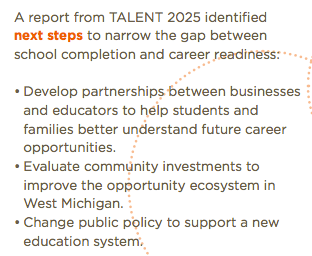
The talent management group Talent 2025 has identified these three goals (on the right) for West Michigan, if the economy is to grow.
These goals are instructive, since they make it clear that education should serve business interests, corporate funding should drive greater economic opportunities and the education system should change, meaning it should become more privatized to serve business needs.
It is crucial that we all not buy into the Orwellian use of language and promote talent creation, talent management or workforce development. This language is simply meant to deceive us into believing the lies of an economic system that only benefits a small percentage of people.
We could make our own three goals or recommendations about how to discern and resist the power of the business community in West Michigan.
- We should not see students/youth as a talent pool that primarily serves business interests. Instead, we should see students/youth as people who deserve to live in a world that is not driven by the profit motive.
- We should recognize that when the business community talks about growing the economy of West Michigan, what they really mean is to grow it for themselves. All their talk about low-unemployment rates is contradicted by the fact that 25% of the population of West Michigan lives in poverty. The percentage of those living in poverty increases to nearly 30% if we are talking about communities of color.
- We need to develop autonomous, grassroots and community-based efforts that are built on cooperation and redefine an economy that serves all people and preserves ecosystems.
In other words, we need to both resist the current economic system, while at the same time begin to develop new economies that are based on justice, equity and ecological integrity.
The Trump administration is supposed to release their proposed Education Department Budget cuts this Tuesday, followed by Education Secretary Betsy DeVos going before the House Appropriations Committee on Wednesday.
However, there have been several news outlets that have gained access to the proposed education cuts through leaked documents. The proposed education budget cuts would total of $10.6 billion will be cut from existing programs, with a share of those “savings” invested in school choice.
Here is a breakdown of the proposed education budget cuts:
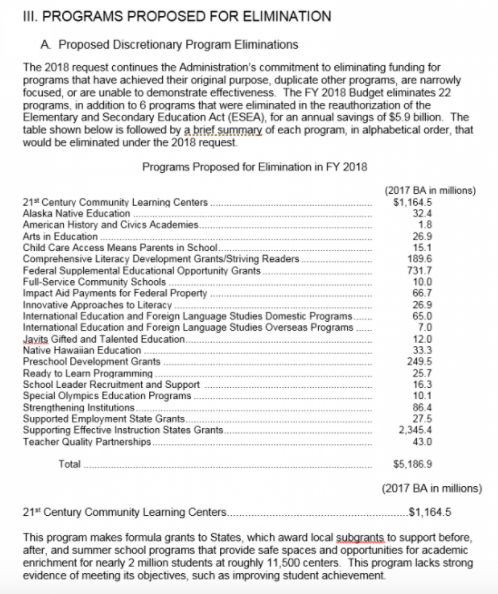
As was predicted with the nomination of Betsy DeVos, this focus of the new administration would be to accelerate the further privatization of public education, a process that has been happening over the past several decades.
According to a recent article by Jeff Bryant, A glaring example of this pivot to the private sector is the plan’s cuts to programs that make public schools attractive options for parents, especially in low-income communities, while boosting federal support for “school choice” that incentivizes parents to turn to charter schools and private schools instead.
The proposed education budget cuts would most negatively impact communities of color. Two examples of how these budget cuts will impact communities of color, are the cuts to Alaska Native Education ($32.4 million) and Native Hawaiian Education ($33.3 million) programs.
The Washington Post, which also obtained the leaked documents, provides a useful breakdown of the administration’s rationale for each of the proposed education budget cuts. For the Alaskan Native Education program it states:
This program supports supplemental education services for a very high-need student population facing unique challenges in obtaining a high-quality education. The Alaska Native Education program largely duplicates services that may be funded through the $260 million in other Federal elementary and secondary programs that support Alaska as well as State, local, and private funds.
A similar rationale is provided for the cuts to the Native Hawaiian Education program.
 What is equally devastating are the cuts to support arts education, international studies and foreign languages. A $400 million fund to pay for an array of school-enriching services and academics — such as mental-health support, anti-bullying programs and advanced courses — gets zero. Even money for Special Olympics education programs would be gone.
In addition, these proposed budget cuts provide greater opportunities for the super rich and corporations to channel money into private education programs, programs that the super rich and corporations can write off as major tax deductions.
A new report from the School Superintendents Association and the Institute on Taxation and Economic Policy, confirms this analysis on how school privatization and voucher programs will benefit the capitalist class.
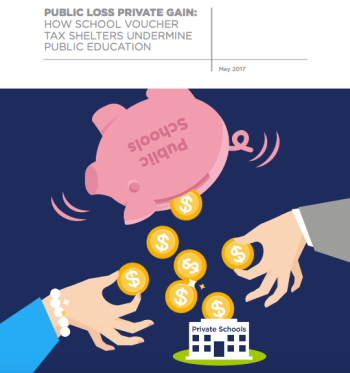
Public Loss, Private Gain: How School Voucher Tax Shelters Undermine Public Education exposes how state and federal tax policy promotes the privatization of education funding while simultaneously draining public coffers to enable savvy taxpayers to turn a profit. 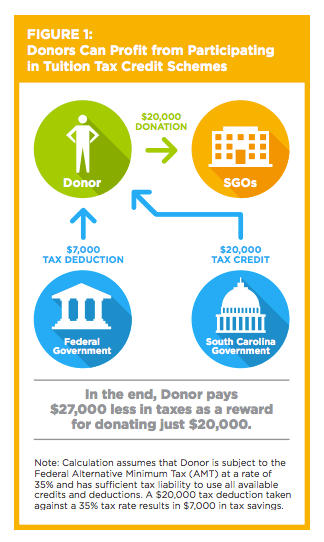
The report notes that, “Seventeen states divert a total of over $1 billion per year toward private schools via school voucher tax credits. When combined with a federal tax loophole, nine of these states’ credits are so lucrative that they allow some upper income taxpayers to turn a profit (at federal taxpayer expense) on contributions they make to fund private school vouchers, all while leaving less resources available for federal investments in education. Simply put, wealthy taxpayers are benefiting from a federally sanctioned voucher tax shelter.”
The graphic on the right provides an example of how the school privatization/voucher system will benefit the capitalist class.
The report also notes the following:
The Educational Opportunities Act (HR 895 /S 148) would put two new types of voucher tax shelters within reach for many more Americans, and for profitable corporations. It would allow individual taxpayers and businesses in any state to receive federal tax credits for donations to school voucher nonprofits, up to $4,500 per year for individuals or $100,000 per year for corporations. Donors in states with state voucher tax credit programs would also be eligible for a state credit. By stacking federal credits and state credits together on a single donation, some individuals and corporations would be able to double their money by claiming a dollar in state credit and a dollar in federal credit for each dollar donated. The result would be a risk-free, 100% profit of up to $4,500 per year for individuals or up to $100,000 for corporations. Wealth managers and tax accountants would be foolish to not advise their clients to take advantage of this handout from their federal and state governments.
Just one more example of how policy benefits the capitalist class and harms working class and communities of color.
We have been made aware of the fact that our posting from this morning, which said ICE agents, when it was US Marshal’s who had the assistance of the Grand Rapids Police Department in apprehending someone they claim was a “suspect on a Felony Warrant.” We did correct which law enforcement agency was involved.
However, we stand by the content of the article posted earlier today, in that the fact that the GRPD’s collaboration with federal law enforcement agents does in NO Way makes those in the immigrant and undocumented community feel safe. Chief Rahinksy makes it clear in his statement at the end of the Media Release they sent out this afternoon, when he says:
“While the GRPD does not enforce Federal immigration law (Title 8, Code of Federal Regulaitons), we cannot refuse a request for assistance from a Federal or State law enforcement agency” – Chief David Rahinsky
Here is the entire media release that was sent to me by the Communications Director of the City of Grand Rapids that was from the GRPD and posted on Facebook, where they respond directly to the GRIID article.
Public Information Release – GRPD Clarifies Role in Recent Arrest
Grand Rapids, MI (May 18, 2017, 2:05 pm)
Amidst growing concerns of the Hispanic, immigrant, and undocumented members of the community, the Grand Rapids Police Department shares the account of a recent incident which resulted in a community member’s arrest. The department also explains its position when responding to requests from Federal Law Enforcement agencies.
On March 17, 2017, at approximately 9:04 am, a Grand Rapids Police Officer was in the area of Grandville Av and Ritzema Ct SW, near the Cesar E. Chavez Elementary School, when a United States Marshal saw the officer and asked for assistance in locating a suspect wanted on a Felony Warrant.
The Officer and U.S. Marshal spoke with a female who resided at a residence on the 1200 block of Grandville Av who was subsequently arrested on the warrant. The 38 year old woman was taken to the Kent County Correctional Facility.
It has been reported by the Grand Rapids Institute for Information Democracy (GRIID) that the Grand Rapids Police Department was assisting Immigrations & Customs Enforcement (ICE) on this incident. The information contained in their report is not accurate. The officer was assisting a U.S Marshal, whose responsibilities are to locate federal fugitives, provide witness protection and prisoner transport, to name a few.
“The GRPD strives to be transparent and accessible in responding to our community’s concern regarding immigration enforcement. While the GRPD does not enforce Federal immigration law (Title 8, Code of Federal Regulaitons), we cannot refuse a request for assistance from a Federal or State law enforcement agency” – Chief David Rahinsky
 Yesterday, the Hispanic Center of Western Michigan was informed by residents along the Grandville Avenue corridor that Federal agents and the GRPD made their presence known in the heart of the Latino community.
Shortly after the Hispanic Center received word from residents about the presence of law enforcement, they released a brief statement on their Facebook page stating:
Comunidad Latina de Grand Rapids,
Le pedimos que tenga cuidado hoy, Miercoles, el 17 de Mayo. Tenemos razon de creer que hay U.S Marshals en nuestros vecindarios.
Si usted no tiene sus documentos necesarios no salga de su casa. Si alguien toca su puerta y usted no sabe quien es, no habra la puerta. Informese de sus derechos. El Centro Hispano del Oeste se esta cominicando con la cuidad y el Departamento de Policia de Grand Rapids.
Latin community of Grand Rapids
We ask that you be careful today Wednesday, May 17. We have reason to believe US Marshals are out in our neighborhoods.
If you don’t have the necessary documents with you, do not go out on the street. If there is a knock on the door of your house and you don’t know who it is, don’t open the door. Inform yourself of your rights. The Hispanic Center of Western Michigan is communicating with the city as well as GRPD.
The statement was accompanied by the handout that the ‘Grand Rapids Immigrant Solidarity Network has been distributing, that lets people know what to do if ICE shows up, in both Spanish and English.

Spanish language radio stations, La Mejor GR and La Poderosa both interviewed Hispanic Center director Roberto Torres about the presence of both ICE agents and the GRPD in the southwest part of the city.
Torres was clearly not happy that federal officers were present in the Grandville Avenue area, since the level of fear that people in the immigrant and undocumented community face on a daily basis. However, what seemed to bother the Hispanic Center director more, was the fact that the GRPD was with the federal officers.
This is in part because of what Grand Rapids Police Chief Rahinsky said at a forum held at the Hispanic Center in early March in regards to cooperating with ICE officials. In an interview that Rahinsky did after that community forum, he stated, “If an agency arrests someone who is here illegally and books them into either their municipal facility or their county facility, I believe we have an obligation to notify our federal counterparts in ICE of that arrest.”
This statement by the Grand Rapids Chief of Police is opposite of what he said to a group of community organizers and immigration lawyers back in December to talk about Grand Rapids becoming a Sanctuary City. At that meeting Rahinsky went so far as to say, “while we are not a Sanctuary City, we operate in such a way that we act as one.” He went on to say, “we don’t work to enforce national immigration policy.”
The question we must put in front of the Grand Rapids Police Chief is, “what were your officers doing with federal agents on May 17 in the Grandville Avenue corridor?” The GRPD claims to serve the community and Chief Rahinsky has gone out of his way to present himself as a supporter of immigrants, yet the practice of the GRPD is a completely different reality, a reality that is causing thousands of people in the immigrant and undocumented community to live in constant fear.
 Grand Rapids Institute for Information Democracy