The function of Managerial Racism in Grand Rapids today
People often say that Grand Rapids is not Chicago, Detroit or New York City. This sentiment is applied both to an analysis of how oppression functions here and how we respond to it.
I will agree that at some level the oppression directed at communities of color may not be totally like it is in larger cities, but this in no way lessens the harm being done. Sure, we can argue that the number of murders committed by cops in Grand Rapids is not like that of other cities, but this does not diminish the role that law enforcement plays in repressing communities of color.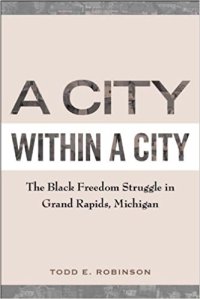
One might even say that there isn’t the same kind of overtly White Supremacy in Grand Rapids as there is in other cities, but that could have to do with how the power structure in Grand Rapids has historically dealt with communities of color.
Grand Rapids loves to white wash this history. Those in power put up statues to honor native leaders, without wanting to tell the history of settler colonialism.
In Todd Robinson’s important book, A City Within a City: The Black Freedom Struggle in Grand Rapids, Michigan, he names the type of structural racism and white supremacy in Grand Rapids as Managerial Racism.
Robinson notes that in the mid-1950s, there was a shift in the local power structure with the ascendency of the Citizens’ Action movement, a group of businessmen who made reformist changes to how politics was practiced here. The author states early on in the book, “members of the Citizens’ Action movement replaced a citywide policy of overt discrimination with a complex system of managerial racism.”
Throughout his book, Robinson offers numerous examples of how managerial racism was practiced, but maybe the best example was from chapter 4 of the book. Chapter 4 focuses on education and the black struggle, but his statement about managerial racism is much broader and should be seen as how the power structure in Grand Rapids dealt with African Americans on all issues. He states on page 96:
The managerial form of racism practiced by Chamber of Commerce members and business politicians placed whites in the role of patrons and blacks as clients. Designed to filter each racial issue, managerial racism ultimately sought to locate a “middle ground,” as long as it was situated squarely on the interest-side of the “race managers.” Thus the application of managerial racism relied on strict procedures designed to bog down racial change while effectively presuming a position of compliance. Phillips’s appeals satisfied the paternalistic prerequisite for advancement in Grand Rapids, because he operated within the traditional framework. Orderly black progress could occur at a piecemeal rate so long as the “managers” of race in the city approved and set the terms of agreement.
This analysis by Robinson is not only important to how we understand the function of white supremacy in the history of Grand Rapids, but it provides an analytical lens for how we could understand the ways in which managerial racism in practiced today.
Practicing Managerial Racism Today
There are no shortages of how managerial racism is practiced today in Grand Rapids. We just have to look for it. We offer a few examples of contemporary managerial racism in Grand Rapids, but we also invite people to give their own examples.
Policing – One of the most evident examples of managerial racism in Grand Rapids today has been playing out in the past few months with the recent police treatment of the 5 African American boys in March of this year. The GRPD falsely assumed that these 5 black youth had been involved in violence and then pulled guns on them while on patrol, making them get on the ground. The trauma of this incident has mobilized the mothers of these 5 boys, it has mobilized the community as a whole and it brought forth a groundswell of responses from communities of color on their collective experience of police abuse and intimidation in this city.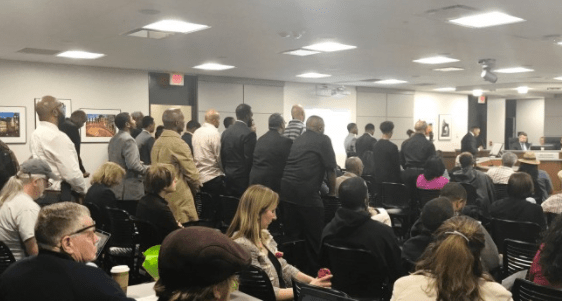
Rallies have been organized in response to the police treatment of these 5 boys, along with prayer vigils and frequent visits to Grand Rapids City Commission meetings. On May 9th, dozens of African American men showed up at the City Commission meeting to collectively call for a “state of emergency” in regards to how they police are treating the black community.
The Grand Rapids City Commission has offered some verbal responses to these demands, but to date, the best they can offer is to host a series of community/police relations meetings.
This is managerial racism at its best. The African American community calls for a state of emergency and the response is, “we’ll hold some meetings about how to rebuild trust between the cops and the community,” when the community has been saying all along that they do not trust the police and haven’t for years.
The City of Grand Rapids spent thousands of dollars of taxpayers money to have a report to tell them that communities of color are stop by cops more frequently that white people are. However, African Americans in Grand Rapids have been telling city leaders this has been their experience for years. Not only was the report a waste of public money, it was a slap in the face to the black community, essentially telling them that the city doesn’t take them seriously.
The Housing Crisis – Another area in which it is fairly easy to see how communities of color are being exploited and oppressed is in the current housing crisis in Grand Rapids.
Grand Rapids has seen the reversal of white flight that took place in the 1960s and 70s, where in the last decade white people, particularly through white-owned development companies, are now “re-discovering” the urban core.
Look at what has happened along the Wealthy Street corridor over the past 10 years and what is currently happening along Michigan Street, in the Belknap neighborhood and on Bridge St. and West Fulton. These areas are being heavily gentrified through development of businesses and market rate housing that will primarily benefit the professional and creative class. These are neighborhoods that have traditionally been working class neighborhoods, where families and communities of color can no longer afford the cost of rent. People have been displaced directly through the destruction of existing homes or because of the increased costs to live in areas that many people can no longer afford.
The response we often hear from people is that these neighborhoods have been under-developed for years and people should welcome all the re-investment, or they say people should be thankful that these areas have been cleaned up. What this really means is that; 1) white people do not want to own the history of white flight/white disinvestment in neighborhoods and; 2) white people do not want to acknowledge that these development projects benefit white people at the expense of communities of color. Again, Robinson’s notion of managerial racism applies here – managerial racism relies on strict procedures designed to bog down racial change while effectively presuming a position of compliance.
Such an example of the housing crisis and how it impacts communities of color is also being played out in the proposed re-development (read – gentrification) in the Boston Square area being facilitated by the DeVos created group AmplifyGR and Rockford Construction.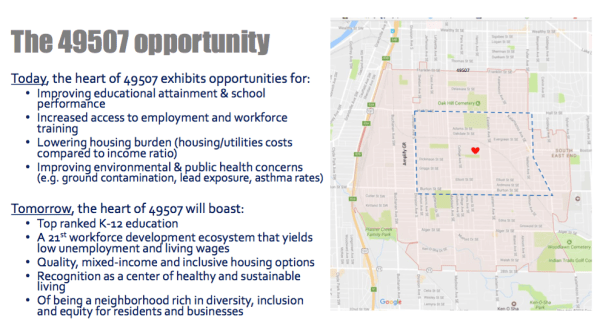
The Boston Square neighborhood and the Cottage Grove area, also known as Southtown has experienced de-industrialization, poverty and white flight in recent decades. Now, the Doug and Maria DeVos Foundation and Rockford Construction want to play White Saviors in this situation, promising to transform this neighborhood with plans they already have. Look at the imagine above they have been using in planning meetings with people other than neighbors.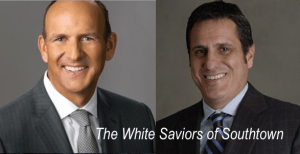
The message in these pronouncements of “opportunity” suggests that the people in that neighborhood are:
- Incapable of envisioning a better future for themselves
- That the residents are somehow to blame for their current condition, and
- Only with the help of White Saviors can they possibly achieve a better life
The response that AmplifyGR wants from the community, particularly the black community, is a display of gratitude for the benevolence of the likes of Doug DeVos and Mike VanGessel.
Michigan Teacher Pensions Undermined: Latest goal of the West Michigan Policy Forum achieved
 Every two years, the West Michigan Policy Forum, which is made up of the political and economic elite in this area, proposes a state policy change.
At their 2016 conference, they made it their goal to undermine public sector employee and teacher pensions.
Yesterday, the Michigan House and Senate voted to do just that.
The Michigan House of Representatives voted 55 to 52 in favor of undermining public school teacher pensions. Michigan House Bill 4647 will eliminate the state-run school pension system and make new teachers hired after 2017 to shift to a defined contribution lifetime annuity or 401(k) accounts. This is a recent trend we are seeing across the country, a neoliberal capitalist model that attacks public sector workers and privatizes benefits and pensions.
At the September 2016 West Michigan Policy Forum, David Walker, with PricewaterhouseCoopers, did a major presentation for the local economic and political elite on why state teacher pensions are a liability. Interestingly enough, this is the same language that state policy makers used to undermine teacher pensions. Rep. Chris Afendoulis, R-Grand Rapids Township, said the state teacher pension system is an unfunded liability.
Other members of State Legislators from West Michigan that voted to undermine teacher pensions, in addition to Afendoulis (73rd District), were Tommy Brann (77th District), Rob VerHeulen (74th District), Thomas Albert (86th District), Steve Johnson (72nd District), Roger Victory (88th District) and Daniela García (90th District).
Here is a list of major campaign contributors who are involved in the West Michigan Policy Forum:
- Rep. Steve Johnson – Peter Secchia and Matthew Haworth
- Rep. Chris Afendoulis – John Kennedy and the Meijer Family
- Rep. Rob VerHeulen – John Kennedy
- Rep. Tommy Brann – DeVos Family and Haworth Family
- Rep. Thomas Albert – none
- Rep. Roger Victory – Matthew Haworth
- Rep. Daniela Garcia – DeVos Family, John Kennedy and Haworth Family

The Michigan Senate also passed a similar bill, SB 401. The West Michigan State Senators that voted in favor of the bill were 28th Senate District, Sen. Peter MacGregor, 29th Senate District, Sen. Dave Hildenbrand and 30th Senate District, Sen. Arlan Meekhof.
Here is a list of major campaign contributors who are involved in the West Michigan Policy Forum:
- Sen. Peter MacGregor – DeVos Family and Meijer Family
- Sen. Dave Hildenbrand – DeVos Family and Meijer Family
- Sen. Arlan Meekhof – DeVos Family, John Kennedy and Van Andel Family
As they say in politics, Follow the Damn Money!
[Data comes from the Michigan Campaign Finance Network http://mcfn.org/donor-tracking]
 Over the past 25 years that I have been monitoring the news media in West Michigan, rarely have I come across a reporter who has been willing to challenge local power. This has most definitely been the case with the most powerful family in West Michigan, the DeVos family.
On Tuesday, MLive ran a story about the DeVos-created group AmplifyGR and its partnership with Rockford Construction to develop part of what is referred to as Southtown.
The MLive article is instructive on many levels and I want to provide a bit of deconstruction.
First, the article is framed as presenting a balance of perspectives, which is even the focus of the headline. However, there is no real balance in this story. The reporter provides all kinds of commentary about Doug, Maria and Cheri Devos, saying they have “been involved in several school and community redevelopment programs around the U.S. and in West Michigan.” There is no follow up on these other efforts or any investigation, rather it is just stated as fact.
There is also some elaboration on what AmplifyGR is, but the source that MLive uses is taken from the RDV Corporation’s (DeVos owned) posting about the job description for the AmplifyGR job. In other words, there is no independent source.
Secondly, those cited in the article, also reflect a significant imbalance. The AmplifyGR Executive Director, Jon Ippel is cited, as is a representative from Rockford Construction. In addition, Third Ward GR City Commissioner Dave Allen speaks positively about the project. Only one neighborhood resident who opposes the plan is cited. There is reference to others opposing the plan, but no one is sourced and you can tell how many other people expressed opposition.
Third, about halfway through the article it states, “Though Amplify GR was scheduled to send a delegate to the Homes for All group, they canceled, saying DeVos and VanGessel preferred to share their vision with neighbors at the meeting on June 29.” This is simply not true. AmplifyGR cancelled coming to the GR Homes for All forum because they said that the facebook event and my article on the project had created a, “hostile environment.”
What is also interesting about the above quote from the MLive article is that Doug DeVos and Rockford CEO Mike VanGessel will be sharing “their vision with neighbors” on June 29. The facebook event page for the AmplifyGR event says there will also be a presentation. This seems to contradict a later comment in the MLive story, which says, “Rockford Construction’s community development director, said details of their plans with Amplify GR have yet to be developed.”
Ok, so if there are no plans as of yet, then what is the presentation all about? Also, AmplifyGR and Rockford Construction have somewhat developed plans, since they have been presenting information at the Southtown Corridor Improvement District meetings over the past 6 months. You can see all kinds of plans in our original article about the DeVos-created AmplifyGR. Do the following two slides suggest anything other than the fact that they have some concrete ideas of what they plan to do in the Southtown area?


Fourth, in the very first paragraph of the article it states that the AmplifyGR project will embark, “on an ambitious campaign to redevelop a tired and underdeveloped neighborhood on the southeast side of Grand Rapids.” Using terms like tired and underdeveloped to describe the neighborhood AmplifyGR seeks to develop provides no historical context for the area. The area was once a thriving neighborhood, but the MLive story provides no investigation as to what changed and why there are abandoned factories.
Fifth, the article states that, “Rockford Construction has acquired more than a dozen properties in the target area.” Actually, according to Grand Rapids City records, the total number of properties that Rockford Construction has purchase in the area is 28, as we noted in our Part II story about the DeVos/Rockford plan.
Lastly, the MLive article concludes with the following:
Ippel said their approach is based on other successful initiatives, such as, Purpose Built Communities, an 8-year-old group that successfully redeveloped the East Lake community near Atlanta, and is working with 15 other communities.
It is worth noting that the Purpose Built Communities seems to be driven by people other than those who live in the neighborhood that is being targeted. The staff and boards members of the organization are made up of former politicians, corporate executives and people who have worked at foundations.
It seems that up to this point, the same can be said for the AmplifyGR project, which is relying on politicians, foundations and corporate developers. The June 29 meeting will be the first time that most residents will know about the project and have a say in the future of their neighborhood. However, as we have noted in pervious postings on this issue, those who have are funding the project and those who have purchased a great deal of land are operating from a position of power. Residents should indeed be suspicious of what those with power and money and those who don’t live in the neighborhood, are really intending to do.
 Joe Carter, the Senior Editor of the Acton Institute for the Study of Religion & Liberty, recently wrote a story on the organization’s PowerBlog that defends Islamophobia.
The article written by Carter is entitled, Bernie Sanders imposes a religious test for public office, focuses on a confirmation hearing last week for Russell Vought, nominated for deputy director of the Office of Management and Budget.
What Senator Sanders too issue with during the confirmation hearing was the following comment written by Russell Vought in an online publication called The Resurgent.
“Muslims do not simply have a deficient theology,” wrote Vought, pushing back against a claim made by theologian John Stackhouse. “They do not know God because they have rejected Jesus Christ his Son, and they stand condemned.”
Senator Sanders challenged this statement and pushed Russell Vought to own it, which you can hear in this video.
Vought never really answers Sen. Sanders’ question, he only argues that he is a Christian and we are all supposed to deduce from that, that as a Christian he rejects all other faiths.
The Senior Acton Editor then ends his post with these comments:
The fact that Sanders and Van Hollen are profoundly ignorant about both Christianity and Islam is neither surprising nor all that disconcerting. But for them to imply that anyone who holds a traditional Christian view on salvation is unfit for public office is repugnant and unconstitutional.
Although most of America has been distracted by the Comey hearing, we shouldn’t ignore this threat to our religious freedom. We must send a clear message to Washington: Such displays of anti-Christian bias by politicians like Senator Sanders and Van Hollen has the potential to set a dangerous precedent and will not be tolerated.
Such contempt should come as no surprise to anyone who has followed the Acton Institute over the years. Their founder, Rev. Robert Sirico, is a close friend of Erik Prince (the founder of Blackwater). In fact, Sirico performed the ceremony at Prince’s wedding and acts as somewhat of a “spiritual Advisor,” according to Jeremy Scahill’s book, Blackwater: The Rise of the World’s Most Powerful Mercenary Army.
Erik Prince even sees himself as a modern day crusader who seeks to eliminate infidels around the world, including those who practice Islam. It would seem that Joe Carter is simply continuing the position of Islamophobia that the Acton Institute’s founder has endorsed for some time now.
Billed as Community-Police relations “listening tour,” the meeting was a highly managed forum
Last night, I attended one of the 5 community-police relations meetings that are being held throughout the city. The one this writer attended was held on the westside of Grand Rapids, at Stocking School.
Billed as a “listening tour,” the format of the forum was to hear a report back from a city staffer on the progress of 6 of the 12-point plan the city has been working on for the past 2 years, then break into smaller groups and have participants provide feedback on the so-called progress. 
There was a handout provided on the progress made on 6 of the 12-point plan. However, a city staffer read through that handout, with some elaboration, which seemed unnecessary and those from the community could not ask questions or make comments during the large group meeting.
We were divided into three groups, each with a moderator, to cover just to 6 themes that the City wanted participants to discuss. In many ways this felt like the parameters of what people could talk about were highly managed. In addition, there was a limited amount of time allotted for each theme that was discussed, which felt more like a kind of speed dating rather than allowing for lots of feedback from the community and some robust dialogue to talk place.
At one point, the facilitator in our group said that they wanted to provide a safe space for people. However, there were several police officers in the room sitting just on the periphery of the breakout sessions, which didn’t really make the space safe. Did having police presence causing anyone in the community to self-censor? Police Chief Rahinsky was also present and moved around to the 3 groups as they were discussing issues.
There was also two retired police officers in the small group I was part of who were very dismissive of the current criticism of the GRPD. These two men had a very “back in my day” attitude, which seemed disrespectful to the criticisms and comments coming from participants. At one point, one of these retired cops interrupted an African American community member who was talking about the traffic study and who gets stopped more often and made a comment about the 1967 riot in Grand Rapids, saying, “Who do you think was rioting?” The African American community member responded by saying, “and why do you think they were rioting?”
Those who facilitated were asking questions like, “Are we headed in the right direction?” and “what was missing” in the six themes that we were encouraged to discuss. Several people in my breakout session wanted more accountability, a citizen review board with subpoena power and more transparency with police date and practices.
The amount of time that people were provided to give input was limited, although sticky notes were provided so that people could give additional written input. This meeting did not feel at all like the numerous city commission meetings, where dozens of Grand Rapids residents spoke passionately with their criticisms of the GRPD. At a recent city commission meeting members of the African American community even called for a State of Emergency.
One of the reasons why the meeting felt so managed was that it was limited to discussion of just 6 predetermined points. There was not much of an opening for people to discuss issues outside of the predetermined framework and even then it felt like you would be stepping outside of acceptable boundaries.
What I was hoping to hear and to discuss was a recent comment that City Commissioner Joe Jones had made. He stated the following:
If I had it my way, the urban core of Grand Rapids would be devoid of police presence because of an unwavering commitment by the people to police our own communities. Not only should we aspire to do this, but we must also commit ourselves to creating real opportunities for our children and for others in our community to thrive. We have to engage in the work of community change by first of all being present in the community. We must avail ourselves and lend all of our gifts, talents, and resources collectively to provide uplift for any and all who desire to do and experience better. I believe if there were greater prosperity and access to opportunity in the urban core of Grand Rapids, there would be a reduction in crime. http://www.rapidgrowthmedia.com/features/rapidblogjoejones.aspx
Not only does this statement operate outside of the dominant narrative on policing, it makes it clear that there are other possibilities. In addition, the commissioner’s statement makes it clear that economic inequality in the city is a main obstacle to realizing a vision where neighborhoods could police themselves, since it is likely that crime would be significantly reduced with great income equality.
These are the kinds of topics and discussions we need to have in this community. We can not limit ourselves to a narrative and a framework that is determined by those with power.
 The DeVos-created organization, AmplifyGR, will be hosting a meeting on June 29, from 6 – 7:30pm at the Living Word Church, located at 1534 Kalamazoo Ave. SE.
In the past two weeks, we have posted two stories about the DeVos/Rockford Construction plans to re-develop parts of Southtown.
In our May 29 article, we primarily provided information on the meetings and planning that AmplifyGR has been participating in, meetings that have largely been limited to planners and policy makers. The May 29 article also provides details of the vision that the DeVos/Rockford Construction tandem has for parts of the southeast area of Grand Rapids.
On June 1st, we reported that AmplifyGR had canceled a scheduled meeting they were invited to that was being hosted by GR Homes for All. That meeting was cancelled in part because of the fact that AmplifyGR was clearly presented as a DeVos-created entity, something that they were not transparent about on either their website or their Facebook page.
Last week, we then posted part two of our initial article on the DeVos/Rockford Construction collaboration to redesign parts of Southtown, with details on how many properties they had purchased in preparation for their development plans.

Now the June 29 meeting has been scheduled. The AmplifyGR facebook page says that the meeting is being hosted by the two Third Ward City Commissioners (Lenear and Allen) and AmplifyGR. The description also says that Doug DeVos, from the Doug & Maria DeVos Foundation will speak, followed by the CEO of Rockford Construction, Mike VanGessel.
The Doug & Maria DeVos Foundation are financing this re-development project, although we do not know how much money they are investing in the project, since their foundation will not have to legally post their 990 financial disclosure documents for another two years. However, we do have information on what the Doug & Maria DeVos Foundation has been funding in recent years that are relevant to the AmplifyGR discussion. 
First, the person who is working for AmplifyGR, Willie Patterson, used to work for LINC, which has received more funding from the Doug & Maria DeVos Foundation since their founding than any other source.
Second, the Doug & Maria DeVos Foundation has invested significantly in “educational” projects in Grand Rapids, often in conjunction with the Grand Rapids Public Schools. Their foundation has been the primary funding source for the Believe 2 Become project, which has been a way for the DeVos family to inject religion into the local public schools, along with the Grand Rapids Initiative for Leadership, which is an even more overtly faith-based program that works with the GRPS. This “educational” funding is relevant, since one of the components of the Southtown development vision is education. Education, with the DeVos context means private, charter or faith-based programing with a public school system.
Lastly, the Doug & Maria DeVos Foundation has provided hundreds of thousands of dollars to ideologically driven organizations, such as the National Organization for Marriage (NOM), which has been a leader in opposing marriage equality in the US. More importantly, the Doug & Maria DeVos Foundation regularly funds groups like the Acton Institute, the Mackinac Center for Public Policy, the Heritage Foundation and the American Enterprise Institute, all of which support neoliberal economic policies that harm working class families and communities, like the neighborhoods being targeted in the AmplifyGR plans.
After Doug DeVos and Mike VanGessel speak at the June 29 AmplifyGR meeting, there will be a presentation of the development plans, “followed by the opportunity for neighborhood residents and business owners to ask questions and learn how to stay involved in the ongoing planning in the community by the City of Grand Rapids and AmplifyGR.”
This last sentence suggests that what is being developed is more or less a done deal and that the June 29 meeting is designed merely to inform people what they will be doing. Let’s face it, a meeting that only lasts 90 minutes, includes comments from politicians, Doug DeVos and the CEO of Rockford Construction, followed by a presentation of the AmplifyGR project, won’t allow for much time for people to speak up. In reality, the June 29 meeting is a managed meeting, like so many other meetings led by developers, and is not really designed for public input, rather it is just to create a perception that they want to hear from the community.
With more assets than Koch or DeVos, the Bradley Foundation also impacts policy in Michigan and the Midwest
 We all know what influence that the Acton Institute and the Mackinac Center for Public Policy had in making Michigan a Right to Work state a few years ago. Funding from the DeVos Family certainly played a role in pushing for Michigan to become a Right to Work state.
However, new research coming out of the Wisconsin-based group, the Center for Media & Democracy (CMD), has uncovered the influence of a little known entity known as the Bradley Foundation. According to the CMD:
 Documents examined by the Center for Media and Democracy (CMD) expose a national effort funded by the Milwaukee-based Lynde and Harry Bradley Foundation to assess and expand right-wing “infrastructure” to influence policies and politicians in statehouses nationwide.
The documents open a window to the behind-the-scenes workings of one of America’s largest right-wing foundations. With $835 million in assets as of June 2016, the Bradley Foundation is as large as the three Koch family foundations combined, yet receives much less attention as a significant funder of the right.
CMD has examined thousands of these documents, including Bradley board documents between 2013-2016. The documents indicate that Bradley has a new stream of funding to build this “conservative infrastructure” and is using a metric to assess the strength and depth of that infrastructure in individual states — including “receptive” politicians, right-wing “think tanks,” symbiotic “grassroots” groups, friendly media, litigation centers, and opposition research — to guide Bradley’s strategic funding initiatives.
Watch this Bradley Foundation video, which seeks to recruit others in their efforts to maintain Blue Lakes and create Red States.
One area in particular that the Bradley Foundation has focused their energy is on attacking and undermining labor unions. One of their partner organizations in this work is Berman and Co,, founded by Richard Berman.
Berman came to Grand Rapids in 2010, to present an anti-union strategy at the West Michigan Policy Forum Conference.
This is consistent with the CMD documentation on Michigan and Right to Work, where the Bradley Foundation has essentially bankrolled the Mackinac Center for Public Policy.
Since 1993, Bradley has provided $1,357,000 in support of Mackinac Center for Public Policy’s (MCPP) activities, almost all for its anti-union “Labor Education Project.” Mackinac, a member of SPN, has also worked aggressively to roll out and defend ALEC-style “right to work” legislation in Michigan and other states (Mackinac, Grant Proposal Record, 2/24/15).
In 2015, Bradley gave the group $175,000 to support general operations. “Mackinac is among the most aggressive and, as the right-to-work victory shows, successful state think tanks in America. With many Bradley-supported allies, Mackinac and its labor, legal, and educational efforts provide good programmatic and organizational models for the rest of the country.” Bradley has funded the group’s app, called VoteSpotter, which”provides a concise, neutral, ‘plain-English’ descriptions [sic] of specific legislative actions, in real time” (Mackinac, Grant Proposal Record, 2/24/15).
In 2014, Bradley gave Mackinac $50,000 to support general operations. The grant describes some of Mackinac’s activities: “Bradley’s recent support of Mackinac has been styled as for its Labor and Education Project. Mackinac would also like to use some of any continued Bradley support for its Mackinac Center Legal Foundation (MCLF), the attorneys of which do most of their work on labor- and education-related matters. Mackinac’s director of labor policy is Vincent Vernuccio, who chairs a committee of the labor task force of the Bradley-supported American Legislative Exchange Council and previously has worked at the Bradley-supported Capital Research Center and Bradley-supported Competitive Enterprise Institute… MCLF spent much of last year helping to defend the new right-to-work law, in policy and legal arguments, as well as in the larger public discourse in the state and nationally… MCLF is working with the Bradley-supported National Right to Work Legal Defense Foundation on this and several other legal matters surrounding implementation of right to work in Michigan… On education, among other things, Mackinac is analyzing mroe [sic] than 200 collective-bargaining agreements (CBAs) in the state, covering some 75% of the state’s public-school students, to see if and if so, how, they are adhering to the teacher-tenure and -evaluation policy changes. The results will be an important, in-depth, one-state version of the larger, national study of CBAs being done by the Thomas B. Fordham Institute…” (Mackinac, Grant Proposal Record, 2/25/14).
“Its labor and education work in particular has been funded by the Dow, Earhart, Herrick Foundations and Chrysler,” say the Bradley files (Mackinac, Grant Proposal Record, 2/25/14).
Like Bradley, Mackinac is a tax-exempt “charitable” organization. It is prohibited from engaging in partisan political activities and can only engage in very limited “grassroots” lobbying. It reported zero direct or grassroots lobbying to the IRS in 2012.
Yet audio released by Progress Michigan reveals Mackinac Director of Labor Policy F. Vincent Vernuccio telling supporters at an Americans for Prosperity gathering in 2012 that he had met with Michigan lawmakers to make a plan for ramming a “right to work” bill through the state legislature during a lame-duck session. Right-wing pundit and Trump campaign advisor, Stephen Moore, also wrote that Mackinac “persuaded Lansing lawmakers to pass a right-to-work law in the Wolverine State.”
The Bradley Foundation also has a long history of funding charter schools, school privatization and opposing marriage equality. With this new information, it is an important reminder for any social movement to always do a power analysis and understand what forces are organized to push back against the current freedom struggles.
Meijer Golf Tournament Fights Hunger? Another example of the Charity Industrial Complex in West Michigan
 The Charity Industrial Complex is not something new. It has been around for decades, but it has evolved over the years in an attempt to supplant the hard work of social movements.
The Charity Industrial Complex is essentially the business and philanthropic community’s attempt to convince the public that what they are doing is “making a difference.” Virtually every week, events are hosted by businesses and sometimes by non-profits, with the purpose of getting the public to donate towards whatever cause is popular and trendy.
One of the most popular causes these days is “fighting hunger.” People can go to their favorite bar or restaurant and a portion of what they spend will go to a local charity that claims to be fighting hunger. Lots of people participate, because they don’t have to do anything other than be a good consumer. People get to drink beer or eat fish tacos and still feel like they are contributing to efforts to end hunger. What’s even better, is that they don’t even need to interact with people who are experiencing poverty.
However, the activities of the Charity Industrial Complex is fundamentally based on a lie. All of businesses and non-profits that claim to be fighting hunger are really just offering another bandaid to the deeply systemic problem of hunger and poverty. In fact, many of the same businesses that participate in the anti-hunger campaigns are the same ones that are profiting from the current food system that is designed to keep people malnourished and hungry.
Last month, we posted an article about the fallacies of food drives. Food drives are really designed to distract us into think that we are making a difference, when in fact we end up perpetuating the problem by not addressing the root causes of hunger and poverty.
Golfing Fights Hunger???
Next week, West Michigan will play host to the Meijer LPGA Classic at the Blythefield Country Club. The annual golf tournament is one way for the Meijer Corporation to con the public into thinking that they care about the community, through their Simply Give program.
In the upbeat video, we are told over and over again that this whole effort is to “help feed the hungry” and to make sure that “no one goes to bed hungry.” Amazing! Those with power have been able to manipulate the public into believing that a huge corporate golf tournament will actually fight hunger. So, how do they do this?
First, the Meijer Corporation spends a ton of money on their Simply Give campaign, in much the same way that they market their business image. Meijer is seen as an important resource in West Michigan and banks on the idea that people can’t imagine a West Michigan without the food retail giant.
Second, the Golf Tournament enlists celebrities and thousands of volunteers through the local news media, which has been promoting this event for years and begins promoting months ahead of the actual golf tournament. In addition, the news media participates as sponsors of events like the Meijer LPGA Classic and presents it as a fun, family opportunity that will also do some good, by fighting hunger.
Third, this event (and the Charity Industrial Complex as a whole) is normalizing the way in which society solves problems, which is through charitable efforts for the “less fortunate.” We are not allowed to ask the question, “why are so many people going hungry in our community.” We just have to accept that those who are in need, are struggling because of some misfortune. We cannot allowed to have any discussion that seeks to understand the root causes of hunger and the systemic forces that are the beneficiaries of hunger and poverty.
I mean, look at the list of co-sponsors of the Meijer LPGA Classic in the graphic below. These are all corporations that are part of the food industry. These corporations have made billions off of an unjust food system and primarily sell and market products that make us unhealthy. They are also corporations that have spent millions to support political candidates and to lobby members of Congress to maintain an unjust food system and to line their pockets with billions of dollars in subsidies.

It is important that we not buy into these lies and that we expose the Charity Industrial Complex as just another way to maintain systems of oppression and exploitation.
 The Michigan legislature will be hearing testimony tomorrow about House Bill 4015, also known as the Sanctuary Policy Prohibition Act.
This legislation will make it law that will prohibit and city, county or township government in the state of Michigan from enacting a sanctuary policy, particularly a policy that would make it illegal for local law enforcement to NOT cooperate with federal officials as it relates to undocumented people.
Section 5 of the proposed legislation reads:
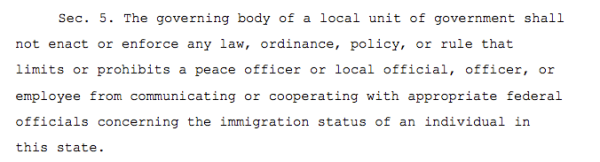
Section 9 of the proposed legislation is equally problematic. It reads:

House Bill 4051 also means that local governments must provide in writing to the state of Michigan that they have complied with this legislation, should it pass, and if it does not do so, the “state treasurer shall withhold the total annual payment amount that the 5 local unit of government receives under the Glenn Steil state 6 revenue sharing act of 1971, 1971 PA 140, MCL 141.901 to 141.921, 7 for each year or portion of a year that the local unit of 8 government fails to comply with the requirements of this act.”
The sponsors of this legislation are Representatives Pamela Hornberger, Tim Kelly, Jim Runestad, Gary Glenn, Peter Lucido and Tom Barrett. Rep. Hornberger was only elected to the Michigan House in 2016 and she was the primary sponsor that introduced this legislation.
According to the Michigan Campaign Finance Network’s data base, Rep. Pamela Hornberger’s number one campaign contributor is the DeVos Family.
There is also subsequent legislation that is being proposed and will be discussed in Lansing, House Bill 4334. The language of this legislation is very similar to HB 4051, but is more broadly advocating for local law enforcement to fully cooperate with federal officials.
There is a rally being held in front of the Capital on Wednesday, June 7 at 10am, followed by a Press Conference. In addition, individuals and organizations will be submitting comments and letters in opposition to this legislation during the hearing, which is scheduled for noon.
If you are unable to attend and want to send a letter in opposition to this legislation, you need to do it TODAY. Email your testimony to the Committee Clerk: Angie Lake alake@house.mi.gov.
In addition, it is important to get as many people trained in Rapid Response to ICE. The next training is Thursday, June 15, from 6:30 – 8:30pm, with more details at this link.

The DeVos Family now wants to remake part of a southeast Grand Rapids neighborhood: Part II
Last week we reported on the organization known as AmplifyGR, an organization that is a non-profit, 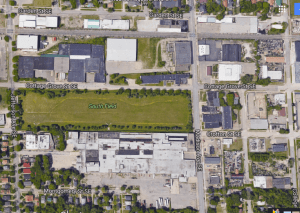 created by the DeVos family’s RDV Corporation.
We reported that AmplifyGR was working with Rockford Construction Company and the Doug & Maria DeVos Foundation to develop parts of the Southtown neighborhood area, particularly, the Boston Square area and part of industrial area surrounding Cottage Grove SE.
In the March 15, 2017, Southtown Corridor Improvement District meeting minutes it states in part, “Longer term they are asking how do they reposition the properties in Boston Square and Cottage grove in a way that provides employment to people living in Southeast Grand Rapids.”
While these minutes reflect the notion that AmplifyGR and Rockford Construction want to provide employment opportunities to people in the area, Rockford Construction had purchased more than two dozen properties in these neighborhoods more than a year before these pronouncements were made at the Southtown Corridor Improvement District meeting.
We Call it a Land Grab
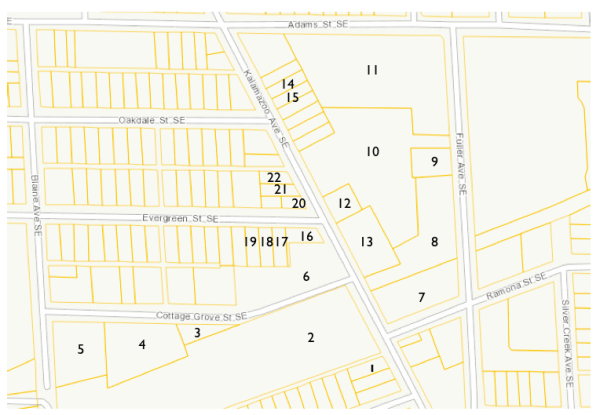
In the first map (below), you can see that Rockford Construction (according to the most recent data available on the Grand Rapids Parcel Viewer map) owns thirteen properties in the Boston Square area. The land that Rockford Construction owns in this area is fairly substantial and makes them the largest land owner along the Kalamazoo corridor in the Boston Square neighborhood.
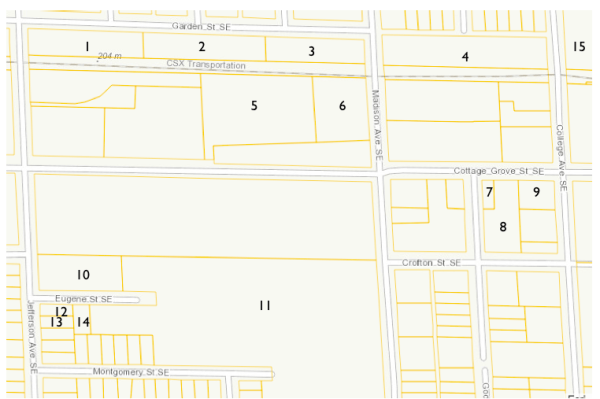
 In this second map below (according to the most recent data available on the Grand Rapids Parcel Viewer map), one can see that the Rockford Construction Company now owns fifteen lots in the Cottage Grove area between Jefferson and College SE. In this instance, Rockford Construction, along with the Notions Marketing Corporation.
This means that as of right now Rockford Construction owns 28 properties in the target area for development, as proposed through the information presented by AmplifyGR. In addition, what this information suggests is that for at least a full year before AmplifyGR began to “engage” the community, Rockford Construction was quietly buying up property with the intention of developing the Boston Square and Cottage Grove areas.
 Here is where resident are at a disadvantage. Developers, like Rockford Construction, do not come to residents in neighborhoods to present an idea before they develop plans or buy property. It seems that the only just thing to do would be for residents to have an equal say in what happens to their neighborhoods before plans are being developed or property is being purchased by an outside entity.
Now, this may seem unrealistic in a world where property ownership is held sacrosanct, but such a process would limit the power that developers, land speculators and investors have in the process.
 What AmplifyGR is really doing, and what it was designed to do (in my opinion), is to amplify the voices of developers and investors who have purchased land in the Southtown area, without telling residents, thus creating a power dynamic that favors those with wealth.
In this instance, with an imbalance of power, what recourse do residents have if they do not want what AmplifyGR, Rockford Construction or the Doug & Maria DeVos Foundation is selling? Residents could organize and ban together to create and community land trust, which takes time and is no easy task or they could organize to publicly resist these forces through an informational campaign that would seek to get the larger community behind them to stop the proposed plans laid out by AmplifyGR, as we reported on last week.
AmplifyGR already pulled out of a scheduled meeting with Grand Rapids Homes for All that is scheduled to be held at the Baxter Community Center on June 8. However, this seems like an important opportunity for people who are concerned about the economic and political forces like Rockford Construction and members of the DeVos family who want to redesign an entire neighborhood. One of the best ways to defeat power is by shinning the light on what they are doing, along with resistance to whatever plans they want to impose on residents of that area.
 Grand Rapids Institute for Information Democracy