Cosecha GR continues the legacy of Dr. King with campaign of non-violent Direct Action
Yesterday, members of Movimiento Cosecha GR, held a press conference in downtown Grand Rapids, right in front of the statue of civil rights organizer Rosa Parks.
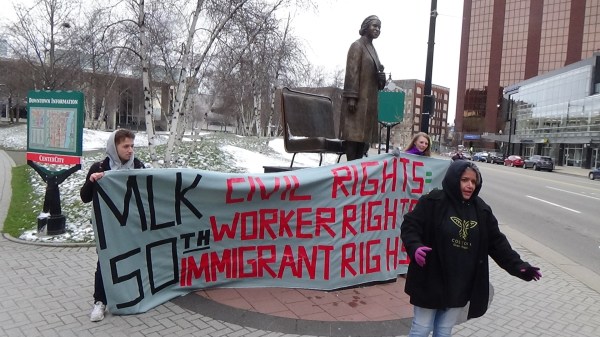
Cosecha GR members Lorena Aguayo-Marquez and Karla Barberi, read a statement (in English and Spanish) about why they were holding a press conference on the 50th anniversary of Dr. Martin Luther King’s assassination.
“On April 3rd, 1968, Dr. Martin Luther King Jr. said his last speech in Memphis, Tennessee as he and other members of the Civil Rights community were there to support sanitation workers who were on strike, demanding better wages and working conditions.
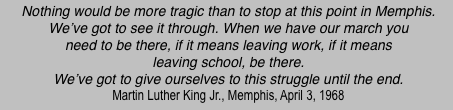
The sanitation workers were paid substandard wages and were not permitted to organize a union. On top of that, the work conditions were horrid, with white supervisors constantly harassing black employees. On that day he said, “Nothing would be more tragic than to stop at this point in Memphis. We’ve got to see it through. When we have our march you need to be there. If it means leaving work, if it means leaving school, be there. We’ve got to give ourselves to this struggle until the end.”
This year today, on April 4, marks the 50th Anniversary of the assassination of Dr. Martin Luther King Jr. Movimiento Cosecha GR wants to honor the legacy of Dr. King, by continuing to promote social justice and non-violent direct action.”
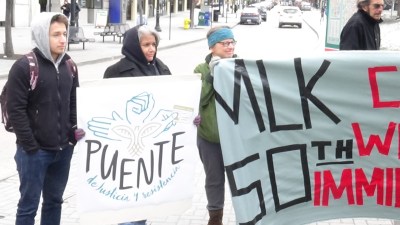 Cosecha GR members also used the press conference to talk about their upcoming campaign to get driver’s licenses for undocumented immigrants, what they are calling Driver’s Licenses for All. Here is what the Cosecha GR members had to say about the Driver’s License campaign:
Driver license increases state revenue through vehicle registration, car insurance, and sales tax. Movimiento Cosecha GR is fighting for driver’s licenses for all in the State of Michigan. Immigrant families are being excluded from access to medical care, work, continued education, places of worship, consumption, and financial security. Not having a driver’s license limits the ability to be an active member of the community, donate organs, and donate blood. Driver’s license for all would provide people with the ability to support themselves and their families. It would promote public safety by ensuring that all drivers are trained and screened. It would increase state revenue through vehicle registration, car insurance and sales tax. Movimiento Cosecha GR is calling for an end to the fear and the oppression that families are being forced to live under that a simple traffic stop by the police could lead to detention, deportation and family separation.
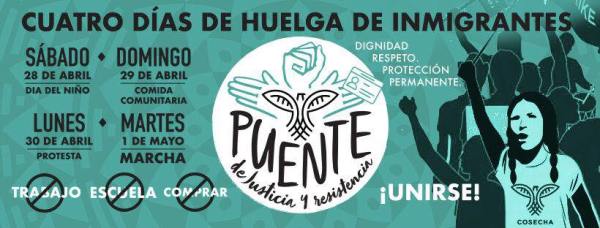
We invite you to participate in the following activities as part of the resistance to the attacks that our immigrant community has been receiving by eliminating DACA, TPS and for many years here in Michigan the Secretary of State has denied DRIVER’S LICENSES to under-documented immigrants.
The activities that Cosecha GR has invited the community to participate in is a four day strike, with activities on each day. For details go to this link.
There were also other people from the community who spoke briefly at the Cosecha GR press conference, including RayLiberator, an immigrant student who talked about the importance of people getting involved in making change, and Rev. Justo Gonzalez, pastor of Ministerios Rios de Agua Viva/Joy Like a River UCC, which announced a few weeks ago that they would be a sanctuary church for undocumented immigrants being targeted by ICE agents. Here is what Rev. Gonzalez had to say at the Press Conference.
The Cosecha GR Press Conference concluded after Lorena Aguayo-Marquez read one more quote from Rev. Martin Luther King Jr.
“You are demonstrating that we can stick together. You are demonstrating that we are all tied in a single garment of destiny, and that if one black person suffers, if one black person is down, we are all down.”

For people who were part of the Civil Rights and Black Freedom Movement between the 1950s and the 1970s, the murder of organizers was all too frequent.
 White Supremacists, which were often part of the law enforcement community, were the ones responsible for the assassination of many of the leaders and organizers within the Civil Rights Movement. They took the lives of people like Medgar Evers, Bobby Hutton, Malcolm X, Fred Hampton and Dr. Martin Luther King Jr.
Today is the 50th Anniversary since they took the life of Dr. King in Memphis Tennessee, while he stood on the balcony of the Lorraine Motel.
Dr. King had been receiving death threats for years and he knew it was just a matter of time before they took his life. People are somewhat familiar with the death threats against Dr. King and other organizers in the South during the Montgomery Bus Boycott and later with the Freedom Rides. However, what is less known, were the threats that Dr. King received in the North, especially after he moved his operation to Chicago. Dr. King often noted that there were larger crowds and more hate-filled verbal assaults on his life in cities in the North than there were in the South.
 When Dr. King was a passenger on a bus or a plan, the departure times were always delayed, because of bomb threats against him, his family and other members of the Southern Christian Leadership Conference. It is hard to quantify the amount of stress that Dr. King had to endure. However, we do know that after Dr. King was assassinated, the medical examiner who preformed the autopsy, reported that he was surprised to see the 39-year old’s heart had the wear and tear of a 60-year old man.
In addition to the white public backlash against Dr. King, the FBI had been monitoring and threatening Dr. Martin Luther King Jr. for several decades. This history of FBI surveillance is well documented in Michael Friedly and David Gallen’s book, Martin Luther King Jr.: The FBI File.
FBI director J. Edgar Hoover, often referred to the Civil Rights leaders as, “that burrhead King” or “the most dangerous Negro in America.” At one point the FBI even sent Dr. King a letter, suggesting that he kill himself, as you can see in this partly redacted letter.
It is no surprise that the FBI saw Dr. King as the “most dangerous man in American,” considering his own evolution. Dr. King was referring less in his speeches about having a Dream, instead he came to the conclusion in his 1967 speech, Which Way It’s Soul Shall Go, to say: I’m sorry to have to say that the vast majority of white Americans are racists, either consciously or unconsciously.
Dr. King realized that demanding an end to racial segregation was not enough. The fiery minister came to see that racial justice was demanded, that the US should pay reparations to black Americans, that economic exploitation was a crime and that the US war in Vietnam was immoral. In fact, Dr. King had come to believe that, “the greatest purveyor of violence in the world today was my own government.”
What Brought Dr. King to Memphis?
One of the strongest criticisms that King had developed in the last few years of his life, was a criticism of poverty, economic exploitation and capitalism. In King’s famous speech, Beyond Vietnam, he provides his own commentary on the story of the Good Samaritan, see here on the right. Restructuring the edifice that produces beggars means we need to change the economic system.
In addition to King’s increasing critique of capitalism, King was in the midst of working on the last campaign he was organizing, the Poor People’s Campaign. Dr. King and the other organizers of this campaign were planning on using direct action in the nation’s capital, by having a tent city, where poor people from all over the country would be occupying land in Washington, DC to not only draw attention to the issue of poverty, but also to demand the promissory note that King spoke often about, which is just another way of saying reparations.
Considering Dr. King’s increased focus on economic justice and the Poor People’s Campaign, it’s no surprise that he would support the black sanitation workers in Memphis.
Michael Honey’s well research book, Going Down Jericho Road: The Memphis Strike, Martin Luther King’s Last Campaign, provides critical insight into King’s support for the striking sanitation workers. Honey provides detailed background material on the black population in Memphis and how that community was plagued by poverty and white supremacy.
The sanitation workers were paid substandard wages and were not permitted to organize a union. On top of that, the work conditions were horrid, with white supervisors constantly harassing black employees.
On top of the general climate of exploitation, the black sanitation workers were often forced to seek refuge inside the garbage trucks, just to get out of the rain. On February 1st, 1968, while some of the workers were inside the garbage truck, the compactor malfunctioned and killed Echol Cole and Robert Walker, crushing them. On February 11, 700 sanitation workers attended a meeting and decided to go on strike. A week later the NAACP passed a resolution supporting the strike, as did King’s organization, the Southern Christian Leadership Conference (SCLC).
Dr. King arrived on March 18 and that same day gave a speech, where he told the crowd, “You are demonstrating that we can stick together. You are demonstrating that we are all tied in a single garment of destiny, and that if one black person suffers, if one black person is down, we are all down.” At that same speech, King not only endorsed the striking workers, he joined others in supporting a city-wide work stoppage on March 28th.
The March 28th city-wide work stoppage also included 22,000 students who boycotted going to school. These students, along with the sanitation workers and people from all over the city marched to demand justice for the dead workers, for the right to organize a union and for better wages and working conditions.
However, the march was disrupted by violence and a 16 year old was shot and killed by Memphis police. Police also followed marchers to a local church, entered the church, released tear gas inside the sanctuary, and clubbed people as they lay on the floor to get fresh air.
The next day, the Mayor of Memphis, Henry Loeb, a Democrat, called for Marshal Law and had 4,000 National Guard Troops brought in to the city.
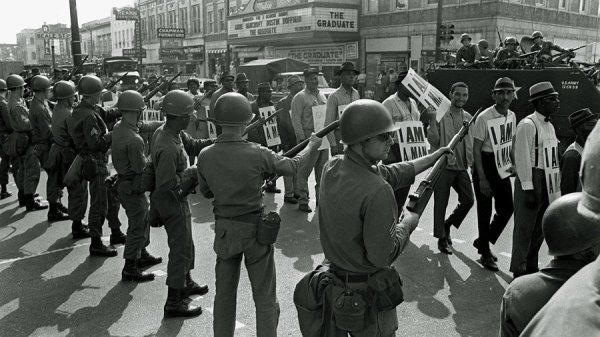
In response, striking workers and Dr. King decided to organize another march. Dr. King came back to Memphis on April 3 and delivered what would be his last speech that evening at Bishop Charles Mason Temple.
The next day, while Dr. King, and those with him, were getting ready to go to dinner, he was shot while standing on the balcony of the Lorraine Motel.
Who Killed Dr. King?
For years the US government presented conclusive information that lone gunman James Earl Ray had shot and killed Dr. Martin Luther King Jr. We were always led to believe that this individual racist had taken the life of Dr. King in a fit of rage over what the man had stood for.
 Considering how much Dr. King, and those closest to him, were being monitored by the FBI and local law enforcement, how is it possible for a lone gunman to have shot and killed Dr. King in such a public setting as outside hi motel room? The police were constantly nearby and the motel had been checked by local police for bombs the day before his assassination. Something didn’t seem right.
Along comes William Peppers, a lawyer, who decided to look at this case in greater detail. Peppers interviewed dozens of people who were there in Memphis that day and was able to gain access to lots of documentation and reports on what local law enforcement and the National Guard were doing at the time of Dr. King’s assassination.
After years of research and investigation, William Peppers published a book in 2003 entitled, An Act of State: The Execution of Martin Luther King. In this book, the author provides a detailed analysis, along with evidence that 1) either the government was directly involved in the assassination of Dr. King, or 2) the government turned a blind eye to what had happened on April 4, 1968.
What Pepper’s argues is that at a minimum, the US government had turned a blind eye to the assassination of Dr. King. However, what seems more plausible, is that law enforcement agencies and the National Guard had collaborated to participate in and allow the assassination of Dr. King.
How People Reacted to King’s Death?
There were demonstrations and riots all across the US in the aftermath of Dr. King’s assassination, with dozens of cities reporting that people were taking out their rage on white-owned businesses.

In Washington, DC, Stokely Carmichael and SNCC were going around the city demanding that businesses close for the day out of respect to the black community. However, the crowd of protestors grew larger by the minute and eventually people were smashing windows and taking items from stores. The National Guard was called in to suppress the uprising.
The scenario repeated itself in cities all across the country, in places like New York, Chicago, Baltimore and Detroit. Michigan Governor George Romney had called in the National Guard to stop people from protesting, much like he had done the previous July during the uprising in July of 1967 in both Detroit and Grand Rapids.
How did Grand Rapids Respond to the Death of Dr. King?
On April 5, the Grand Rapids Press put the assassination of Dr. King on the front page.

However, most of the Press coverage framed the reaction to the death of Dr. King in a negative way. The GR Press did interview people from the community to get reactions.
It states, in an article from the Grand Rapids People’s History Project:
Reggie Gatling, referred to as a black power militant, said, “Members of the black community had a meeting last night and decided we would not give out a public statement that would be reflective of feelings. We’re in mourning for Dr. King, but to say anything further would only give comfort, or possibly discomfort, to white racists.”
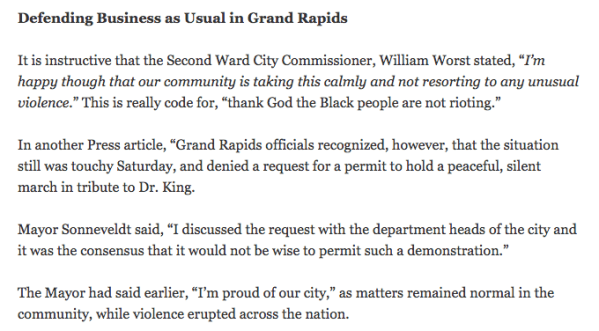
What is instructive about Grand Rapids, is how the White Power Structure responded. Again, we refer to the Grand Rapids People’s History Project:
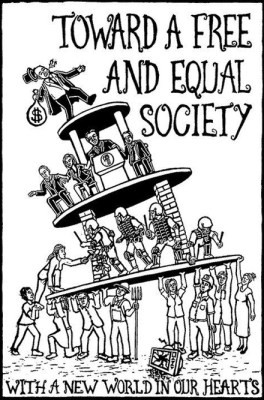
It is vitally important that we continue to morn the assassination of Dr. Martin Luther King Jr. In addition, we must not forget this history. We must not forget that Dr. King was in Memphis to be in solidarity with sanitation workers who were striking. We must not forget that Dr. King was working on the Poor People’s Campaign, which was a direct action campaign designed to gain reparations for the black community and poor people in general. And we must not forget that the US government was spying on Dr. King, making threats against him and most likely involved with his assassination.
To honor Dr. King’s Legacy, we should practice the same kind of justice and love in our actions and campaigns today. Anything less would be dishonorable.
 On Saturday, the Business Leaders for Michigan (BLM) bought ad space on MLive to promote their “new” plan for Michigan’s economy.
The reality is, that this is not a new plan and it is not really about boosting the economy of Michigan. In fact, there is no such thing as a state economy. States don’t have an economy, just like countries and cities don’t have an economy. What we have is Capitalism, which is an economic system that doesn’t recognize borders, is based on constant growth, exploitation of natural resources & human labor, along with increased profits for those who already have tremendous wealth.
All one has to do is look at who makes up the Business Leaders for Michigan, which can be found near the end of the 32-page economic plan they have devised.
The Chairman of this group is none other than Blake Krueger, the CEO of Wolverine Worldwide. Wolverine Worldwide has clearly demonstrated that profits are more important than ecological sustainability and human health, now that the world knows how they have deliberately polluted large areas of northeast Kent County, putting thousands of people’s lives at risk.
 In addition to the Wolverine Worldwide CEO, there are representatives from GM, Chase Bank, DTE Energy, Dow Chemical, Whirlpool, Ford, Consumers Energy, Google and the CEO of Quicken Loans, Dan Gilbert. Gilbert, who also owns the Cleveland Cavaliers, has become Detroit’s equivalent to the DeVos Family. In a recent issue of the Jacobin Magazine, there is a solid article entitled, Opportunity Detroit:
In the national folklore, it is Gilbert — Detroit’s “superhero,” according to the Atlantic — who helped Detroit escape its downward spiral by investing billions in the real estate market when other capitalists scorned it. He now owns at least ninety-five buildings in Detroit and wields immense influence over the city’s future. Even many of his critics admit that he’s had a positive impact. Sure, they say, he owns a huge chunk of downtown and enjoys incredible power over the local economy. But what would Detroit look like without him?
This is a false premise. The choice isn’t between billionaire-led investment and the destitution of the city. On the contrary: the revival spearheaded by people like Gilbert is made possible by, and depends upon, the poverty and dispossession of working-class Detroiters.
There is also substantial representation on the BLM, from names that we are very familiar with here in West Michigan. People like Doug DeVos, Steve Van Andel, Mark Bissell, Michael Jandernoa, John Kennedy, Matthew Hayworth and Hank Meijer. If you are familiar with our writing here at GRIID, you know we refer to these people are members of the West Michigan Power Structure. These white men (not surprising that they are men and white) are the wealthiest in the area, the are involved in groups like the West Michigan Policy Forum and they all contribute a ton of money to political candidates, in order to influence public policy that expands their wealth.
This plan to “improve Michigan’s economy,” uses phrases that are meant to sound creative, but in reality, it is meant to just continue the same old capitalist model that benefits a few at the expense of the majority.
The Plan – Decoded
The plan laid out by the Business Leaders for Michigan uses language that is somewhat vague and often deceptive. Here is a look at several of the major themes the group of rich, white men are promoting.
- Stronger Job Growth – at first appearance this might seem like more jobs for people, but in reality it means creating a better business climate. A better business climate means lower taxes for businesses and the business class, greater public subsidies and less government regulation.
- Improving Fiscal Management – is simply code for getting government to privatize more. One example the BLM cites is the recent legislation in Michigan which ended public sector employee pensions and shifting people’s retirement to the whim of the speculative market.
- Competitive Tax Environment – is code for reducing taxes for businesses, especially larger businesses. It also means re-directing more public money into private hands.
- Talent Pipeline at Risk – is code for we need to improve education to that these business leaders have a larger pool of future workers to chose from and who have the skills they need to insure greater profits for the businesses they own.
- Automotive Past Can Build a Stronger Future – is code for GM and Ford wanting to continue to push the same old tired car culture on the rest of the world, instead of developing an efficient mass transit system that would decrease the use of fossil fuels.
- Strategic Assets for Growth – is code for how to push certain industries and exploit more of the natural world, which they refer to as Natural Resources. In a Capitalist world, trees, water, soil, etc. are commodities for making profits.
- Innovation Boosts Entrepreneurism – is code for pushing venture capitalism and competition. In other words, capitalists don’t believe in sharing knowledge and collective liberation, they believe in survival of the richest.
The rest of the report continues with more details on how to compete, invest and growth Michigan’s economy. Here is a chart that lays out their strategy:

Towards the end of “The Plan,” there is this statement in larger letters:
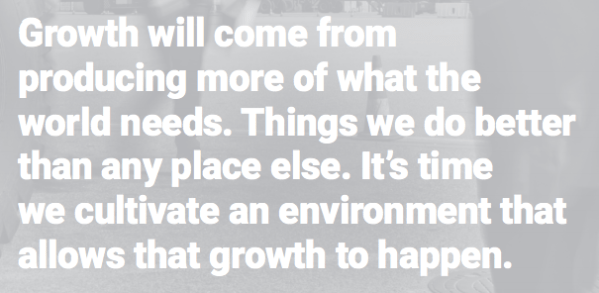
Based on the people and the companies that make up the Business Leaders for Michigan group, producing more of what the world needs would mean:
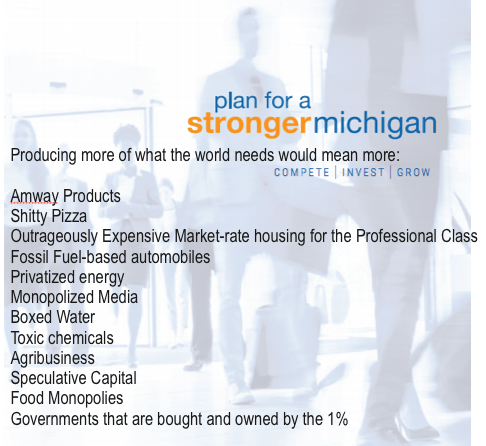
Let’s be honest. This IS the kind of world that the Business Leaders for Michigan want. It will not benefit most of us. It will not give land back to Indigenous communities. It certainly won’t benefit black and latino  communities. It will not benefit most immigrants. It will not promote environmental justice. It will not end poverty. It will not end mass incarceration. It will not end police violence.
This economic plan that the wealthiest has for us must be resisted. We can resist it with radical imagination, with cooperation, with mutual aid, with reparations, with love and with justice. We can imagine a better world, a different world and a world based on collective liberation. Another World is Possible.
GRPD’s Youth Interaction Policy provides no real evidence that they will not continue to hold youth at gunpoint in the future
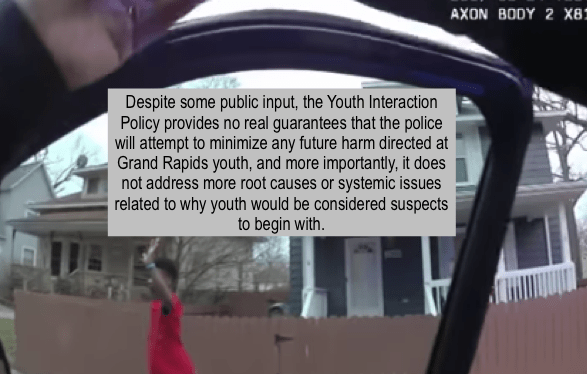
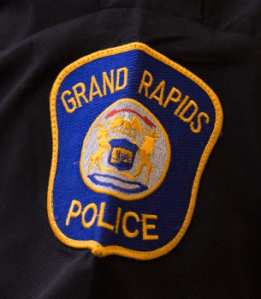 Just over a week ago, we posted an article in response an MLive story, about the 1 year anniversary of when Grand Rapids police officers held 5 black youth at gunpoint.
The article cites Police Chief Rahinsky as saying that the police responded appropriately in this instance, that he would love to have more officers hired and that the GRPD needs to spend more time with youth, doing things like playing basketball.
In that same MLive story, written on March 22nd, the police department announced that they would be releasing a “youth police” document, in response to several high profile cases involving the GRPD holding black youth at gunpoint. You can read the 2 page document at this link.
The Youth Interactions Policy is rather vague. It also frames the issue primarily around youth who are suspects. This notion that youth are suspects is exactly what people were so upset by in the community, both in the case of the 5 black youth held at gunpoint a year ago and the 11 year old Black girl held at gunpoint and handcuffed last December. In both of these cases, the youth were not suspects, they just happened to either fit the profile of other suspects or they were in the wrong place at the wrong time.
However, most of the 2-page document deals with youth suspects. Under the section General Procedures, there are 5 points made. Only the 5th point talks about what to do if the youth in question is not a suspect and what to do with them. At this point the document includes 3 ways in which Grand Rapids Police Officers are supposed to deal with youth that are no longer determined to be suspects.

Even these operational procedures, which are to be applied if the youth in question is no longer a suspect, uses language that still views the youth and or the parents as problematic. How many families from communities of color have had difficult and unpleasant experiences with Child Protective Services? If the youth are not suspects, why should an officer be assigned to them?
According to a story on WXMI 17, the cost of the updated training curriculum that is specific to youth interaction, is costing the City of Grand Rapids $9,995.
The Youth Interaction Document doesn’t seem like it will prevent the GRPD from holding youth in Grand Rapids at gunpoint. In fact, the document provides little evidence that the GRPD will be making much of an effort to NOT further traumatize youth, particularly youth of color.
This document was crafted with input from a Task Force, made up of members of the GRPD and community members, listed here at this link from the City. However, despite some public input, the Youth Interaction Policy provides no real guarantees that the police will attempt to minimize any future harm directed at Grand Rapids youth, and more importantly, it does not address more root causes or systemic issues related to why youth would be considered suspects to begin with.
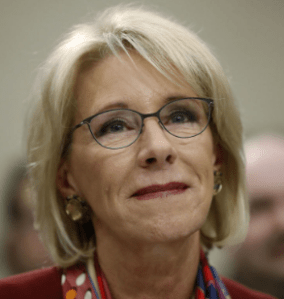 Last week, Secretary of Education, Betsy DeVos, announced that a new School Safety Commission has been formed.
The announcement from DeVos also stated, “The Commission has been charged with quickly providing meaningful and actionable recommendations to keep students safe at school.”
This new commission has been created, in light of the recent school shootings, but is not limited to just gun violence. If the goal is to keep students safe while attending school, then we can make some assessments based on who has been name to sit on this 4 member commission.
Betsy DeVos
Since Betsy DeVos was put in charge of creating this new Commission on School Safety, she has designated that she would be one of the four members of the commission. Her qualifications in this area are rather vague, plus she has inherited a system that in many ways is not committed to student safety.
For instance, since the 1990s, the Department of Justice funded the “Cops in Schools” program, costing taxpayers $750 million. One of the results of the Cops in Schools program, “has led to the a massive increase in the arrests of students that fundamentally undermines the educational mission of schools, turning them into an extension of the larger carceral state and feeding what has come to be called the school to prison pipeline,” according to Alex Vitale. (The End of Policing)
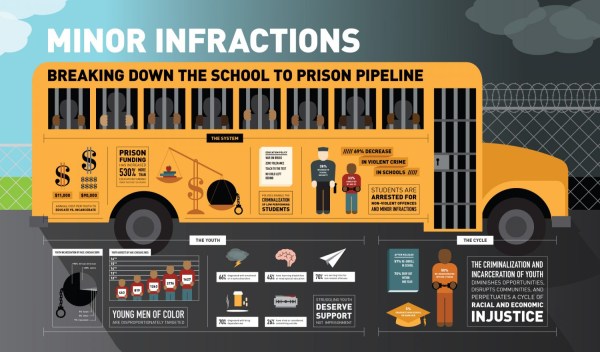
The presence of police in schools has also resulted in more suspensions and detention for students, especially students of color and student from families living in poverty.
This is a system that Betsy DeVos has inherited and she has given no indication that she we de-militarize schools, by removing police officers.
Secondly, Betsy DeVos worked to diminish Title IX policies, thus making it harder for students who have been sexually assaulted on campuses across the country, to get justice.
Third, Betsy DeVos has made no public statements against Immigration & Customs Enforcement (ICE) officials from coming into schools or waiting at school to arrest parents of students who are undocumented.
Attorney General Jeff Sessions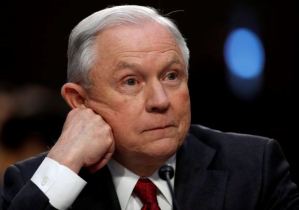
First, according to a recent article on Buzzfeed:
Sessions had earned top grades from the advocacy group over his two decades as a senator, and the director of the NRA’s lobbying arm, Chris Cox, boasted about Sessions’s record in an op-ed last January in USA Today. The firearm advocacy group announced in a press release at the time that it would spend at least $100,000 on commercials to boost him to the top post of the Justice Department.
Second, just after the school shooting in Florida in February, Sessions, while attending a Sheriff’s Convention in Washington, DC, made the following statement:
“I think effective enforcement of our gun laws, focusing on criminals and dangerous people, mentally ill people that have been — where we have the legal ability to do so — can reduce violence in our communities and improve public safety,” Sessions said. “It is not good if we got gun laws that say criminals can’t carry guns and they never get enforced. So we intend to enforce our laws.”
A Think Progress article responded to this statement by saying:
But there are a couple obvious problems with Sessions’ idea. Nikolas Cruz, the 19-year-old allegedly responsible for using an AR-15 semi-automatic rifle to murder 17 people at Marjory Stoneman Douglas High School in Parkland, Florida, bought his military-caliber weapon legally. Cruz also had no criminal record. So it’s hard to see how stronger enforcement of existing gun laws could have prevented the carnage.
Third, Attorney General Jeff Sessions has made it clear that he will begin deporting more undocumented immigrants. This will create more stress, anxiety and fear for students who have parents that are undocumented, since schools will be places that ICE agents will target while immigrant parents pick up their children.
Lastly, Jeff Sessions announced last year in a memo, that he is giving cops permission to continue and expand targeting blacks. This too creates more anxiety, stress and fear for black students if they or their families members will be targeted by law enforcement.
Secretary of Homeland Security Kirstjen Nielsen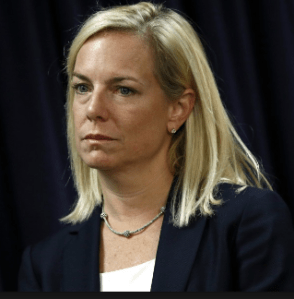
Nielsen is a longtime Homeland Security Department official who served as Kelly’s chief of staff when he was DHS secretary and accompanied him to the White House as his deputy. She also worked at the DHS during the George W. Bush administration and founded a consulting firm focused on risk and security management, according to a Washington Post story last year.
After the Florida school shooting, the Department of Homeland Security announced they were drafting a guide to help schools and law enforcement create Targeted Violence Prevention Plans.
“These plans outline procedures for schools on how to create multidisciplinary threat assessment teams, establish central reporting mechanisms, identify student behaviors of concern, define the threshold for law enforcement intervention, and identify intervention and management strategies for decreasing the risk of a targeted attack,” a Homeland Security news release said.
This announcement doesn’t really sound like this effort will keep students safer, instead it will likely result in profiling students over “behavioral concerns.”
Lastly, upon taking office in December of 2017, Nielsen made it clear where she stands on immigration issues, when she stated:
“The president has made it clear that my number one priority as secretary of Homeland Security is to protect America from all threats,” Nielsen told the Washington Examiner on Friday. “As I discussed this week, making America safe starts with securing our borders, increasing interior immigration enforcement, protecting our communities, and dismantling transnational criminal organizations.”
Like her colleagues on the School Safety Commission, Nielsen is equally committed to rounding up undocumented immigrants, which will created a larger climate of fear for students of immigrant parents.
Secretary of Health and Human Services Alex Azar
Azar comes to the Trump administration as the former president of the U.S. arm of Eli Lilly & Co. Eli Lilly has a history of spending millions of dollars to get candidates elected and to lobby for policies that would be financially beneficial to the pharmaceutical industry.
Azar has no real world experience around public safety issues, let along school safety. However, the head of Health & Human Services has said that he would support the CDC in conducting more extensive research into gun violence.
As you can see, it would be unreasonable for the public to have expectations that this new commission will actually make a difference in school safety. On the contrary, this commission will likely result in firming up the already systemically violent relationship to students, particularly black students and students from immigrant families.
 It is common knowledge that at the state and federal level, candidates need a substantial amount of money of they are going to get elected within the current political system.
In fact, both candidates and incumbents never really stop raising money, for either their own campaign or for other politicians within their party. This definitely the case for Democrats and Republicans.
On top of that, most candidates and incumbents are primarily interested in big donors. You can usually tell by how much their fundraising events cost and where they are located.
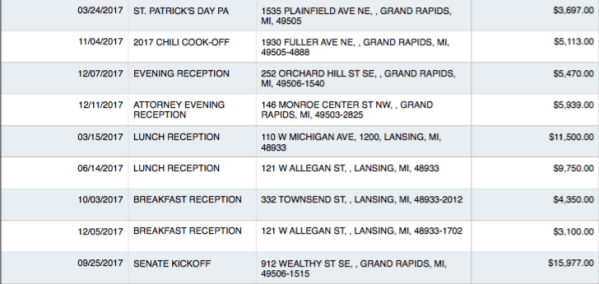
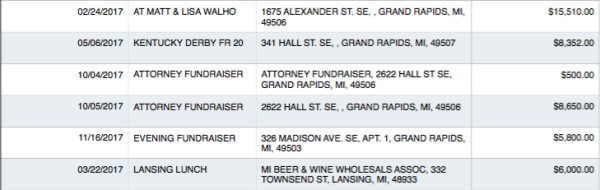
The Michigan Campaign Finance Network recently released a new report showing that in 2017, there were 601 fundraisers for state office holders in Michigan. In 2016, there were 439 fundraisers and in 2015, there were 315. Clearly, there has been an increase in the amount of fundraisers being hosted by incumbents or those who are term-limited and seeking higher office.
As you can see from the graphic above, Grand Rapids was the number two destination where these fundraisers were held. The fact that Lansing was the number one location makes complete sense, since incumbents hold fundraisers near their downtown Lansing offices.
We wanted to share with you some of the data on fundraisers that have been hosted by incumbents or those term-limited and seeking higher office from West Michigan.
Democrats
Winnie Brinks for State Senate
Rep. David LaGrand
Republicans
Rep. Chris Afendoulis 73rd House District

Rep. Tommy Brann 77th House District

Rep. Julie Calley 87th House District

Daniela Garcia for State Senate

Rep. Steve Johnson 72nd House District

Rep. Jim Lilly 89th House District

Rep. Rob VerHeulen 74th House District

Donor’s Trust, Dark Money and their ties to West Michigan
Donor’s Trust is a non-profit that was created in 1999 and committed to the, “ideals of limited government, personal responsibility, and free enterprise.” It’s sister organization , is called Donors Capital Fund and both of them are made up of members of the Capitalist class to provides big donors an opportunity to hide their money that can influence public policy.
According to SourceWatch, “As a rule, Donors Trust refers clients to Donors Capital Fund if they expect to open donor-advised funds of more than $1,000,000. The twin Donors organizations are advertised as a way for very wealthy people and corporations to remain hidden when “funding sensitive or controversial issues,” creating a lack of accountability.”
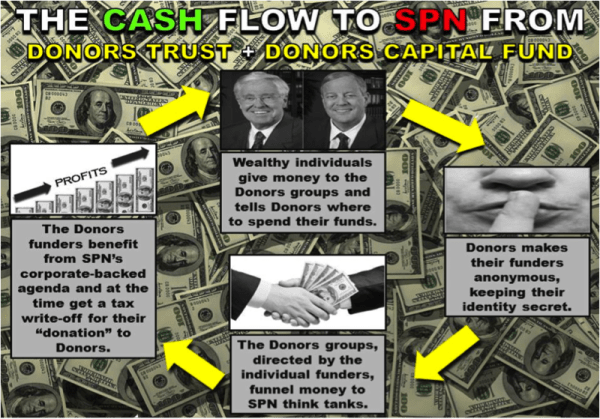
In 2013, we ran a story about how the Richard & Helen DeVos Foundation was a major contributor to the Donor Trust and the Donor Capital Fund. Along with the Koch Brothers and other Wealthy families in the country, the DeVos family channels funds to Donors Trust to help hide some of their funding that might otherwise be scrutinized.
The Center for Media and Democracy just posted a new article about how much money Donors Trust gave out to support right wing groups that are engaged in promoting hate against Islamic groups, undermining unions, denying climate change and a whole litany of organizations that are deeply committed to imposing harsh neoliberal austerity measures on the public.
One such organization that is deeply committed to these neoliberal economic principles, is the Acton Institute for the Study of Religion and Liberty.
 In 2015, based on the 990s from Donors Trust and Donors Capital Fund, the Acton Institute received $1,083,200 to support their work to promote neoliberal capitalist economic policies. When looking at the 990s, the funding from Donors Trust and Donors Capital Fund to groups like the Acton Institute, it always says the money is for “general operations.” Such designation’s are purposely vague, as a means to make it harder to find out what they do with these funds.
Dark Money entities like Donors Trust and Donors Capital Fund help to channel money to other non-profits that can influence public policy, as well as elections – see the info graphic from the Center for Public Responsibility here on the right. The Center for Public Responsibility also has great resources and analysis on the function of Dark Money.
The very fact that the Acton Institute is a major recipient of Donors Trust and Donors Capital Fund monies, is just one more reason that this Grand Rapids institution in should be exposed and resisted.
What one GRPS Principal said to students during the National Walkout in support of Parkland Students
 On March 14, hundreds of thousands of students participated in the National Walkout in support of the Students from Parkland and Against gun violence in schools
Like the rest of the country, the Grand Rapids Public Schools students participated in the walkout.
GRPS Superintendent Teresa Weatherall Neal said they are using the event as a teachable moment focused on school safety and the district’s’ “See It, Say It, Do Something About It-Stop School Violence” theme.
Shortly after the GRPD Superintendent release a statement on what they intended to do, several GRPS students wrote how what the GRPS administration was doing was a hinderance to students. The student response reads in part:
The problems with the district’s endorsement of the walkout are most evident in the letter sent home about the event. The letter contained a short statement of support for the walkout, a rigid plan for each grade level laying out what the students would and would not be allowed to do as part of the demonstration, and a permission slip to be signed by each student’s parent or guardian before they could participate in the action.
Some of those in leadership positions within the GRPS went a step further on the day of the student walkout, which we were alerted to recently by a parent who wishes to remain anonymous. Here is video of what the Principal at North Park Montessori, Robin Sorge, said to the students at that school:
What the Principal at North Park Montessori read to the students on March, was from a posting on a right wing blog site, called Common Sense Evaluation.

The parent who found the statement read by the principal, sent her the following message:
I’m really disappointed in the way you handled the walkout assembly today. My children and husband were also very disappointed. The boys wanted to write a letter to you themselves, but they are too scared to send it because they think they’ll be in trouble if they tell you.
You did not honor children’s voices at all when you dictated the agenda today.
You did not share the microphone so the children could be heard. You held it the entire time.
The letter you read originated from a tea-party website filled with anti-lgbtq messages, conspiracy-theories, anti-immigration sentiments, nationalist rhetoric and pro-NRA messages.
The site even included multiple theories that the Parkland School students were crisis actors, and were hired to promote anti-second amendment messaging.
My husband and I are teaching our children that their voices matter and that they have a right to protest and be heard. We chose Montessori because of the principles of listening to the child, following them and supporting them in their work of becoming engaged members of society.
This assembly did none of those things.
We also wanted to know what you will do with the answers you wrote. Will you share them with any decision-makers at the school? Will anything change to make the children feel safer?
We all appreciated that you wanted us to be nice to each other, but that letter you read, promoting this, also implied that the children in Sandy Hook or Parkland perhaps weren’t nice enough, and that’s why the shooter came in. That being nice will stop bullets. And also that their protests, their raised voices begging to heard, were useless.
I understand why you did what you did from the perspective of someone who wants to control the narrative and maybe protect small children’s ears, but it was very poorly handled.
My kids wanted to walk out of school today with the rest of the nation’s participating children after hearing about honoring the children who were hurt in their school. But they also wanted to hear what you said first in the gym, they respect you. Perhaps consider respecting them next time by letting them have a say in setting the agenda and allowing them to exercise their rights.
You should strongly consider issuing an apology to your students. They were not truly honored today.
I’d also very much appreciate a response as to why you thought it was acceptable to read that dismissive, patronizing and pro-NRA letter in front of the entire school.
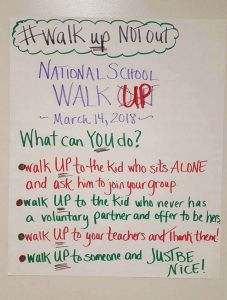 In many ways, the letter that was read from the conservative blog, is very much in line with the viral campaign WalkUpNotOut. This counter-campaign is not only ridiculous, it completely puts the focus on student behavior instead of those coming into schools with guns and shooting people.
What we all learned from the past few weeks, especially from the speeches that students gave on Saturday, it that they know what their lived experience is and that we need to listen to them. Hell, we need to get out of their way and let them determine what they want for themselves.
Incidents, like what happened at North Park Montessori is a clear example of what adults should NOT being doing. If you want to communicate with the Principal from North Park Montessori, Robin Sorge, her e-mail is SorgeR@grps.org. In addition, it might be a good idea to communicate with School Superintendent Neal about this incident. She can be reached at nealt@grps.org.
 Yesterday, MLive ran a story 1 year after Grand Rapids Police officers held 5 black youth at gunpoint, because they “fit the description” of someone who had a gun in their backpack.
The comments from the youth was moving to read. It was also instructive, because they basically said that they Do Not Trust the Cops. This response is completely understandable, because of the trauma these kids experienced being held at gunpoint, but it is also reflective of a larger experience of mistrust between black communities and the police. In fact, this experience that black people has towards law enforcement dates back to the days of slavery, where policing was born in the US.
However, what was more revealing than the mistrust of police by black youth, was the comments from Grand Rapids Police Chief Rahinsky.
Rahinsky said:
- The cops responded appropriately when they held these 5 black youth at gunpoint.
- What cops need to do is play basketball with these kids to try to avoid these situations in the future.
- And, that in a perfect world, he would have more officers.
 In other words, that practice of holding black youth at gunpoint will continue and that they need more cops. Rahinsky also conveniently puts the focus back on “bad” youth when he said, “Unfortunately, we live in a culture where it’s not uncommon to take a handgun off of a child.”
In addition, the head of the GRPD fails to truly address the lack of trust that black people have with cops, almost dismissing this by suggesting that if he had more officers who could play basketball with these kids, things would be all good.
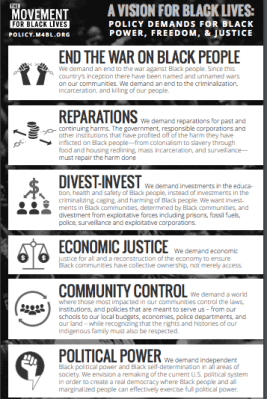
This flies in the face of what black people have been saying for decades about cops, which is in intricate part of the platform of the Movement for Black Lives, reflected here on the right. In Grand Rapids more cops playing basketball with black youth is just another “West Michigan Nice” response.
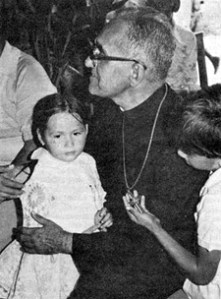 On Saturday, it will be 38 years since Salvadoran Archbishop Oscar Romero was gunned down while saying mass in a small chapel in San Salvador. A Salvadoran soldier who was the graduate of the US Army School of the Americas, it was revealed later, killed Romero.
There has been much written about Romero since his assassination and the factors that led to his eventual death. However, it is important to note that Romero wasn’t always a radical priest or a proponent of Liberation Theology.
Before Romero was chosen as the new Archbishop of El Salvador, he was a quiet and conservative bishop. Romero was even a member of the Opus Dei, a movement within the Catholic Church that began in Spain in the early part of the 20th century and supported the dictatorship of Franco.
However, Romero was a close friend of Fr. Rutillio Grande, a priest in one of El Salvador’s rural communities. Grande was a proponent of Liberation Theology and when he was assassinated for serving the poor and challenging the wealthy oligarchy in El Salvador, Romero began to see the light. This moment of transformation is what Jesuit scholar Jon Sobrino called “Rutillio’s Miracle,” because it was the catalyst that transformed Romero into the Voice of the Voiceless.
Quickly Romero began to not only speak out on behalf of the poor, he began acting in such a way that soon thousands of Salvadorans would come to call him simply “Monsignor.” Romero turned the facilities at the cathedral into a space for people to come for relief, food and medical assistance. Romero also began hearing the stories of countless Salvadorans who told him how their family members were disappeared, tortured and killed.
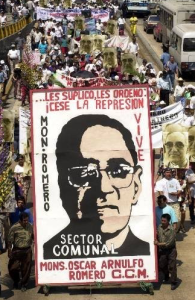 Romero then began to challenge the power structure in El Salvador, mostly through his Sunday sermons and his weekly radio broadcast. Romero understood all to well that the poverty and violence that people endured was because of the unjust economic power that the country’s wealthy possessed.
Romero also understood that the political violence that was terrorizing the country’s poor and working class people was a direct result of US military aid to El Salvador. Five weeks before Romero was assassinated he wrote a letter to then US President Jimmy Carter. He asked Carter that if the US really wanted to support justice in El Salvador that the US should stop sending weapons to his country and that the US should not directly intervene in any way into the political, economic, military or diplomatic affairs of El Salvador.
Noam Chomsky writes in the book Manufacturing Consent, that after Romero sent the letter to Carter, the Carter administration put pressure on the Vatican to try and curb the activities of the archbishop.
Romero also understood that many of the foot soldiers in the Salvadoran military were poor people who had been forced into the army. The day before Romero was assassinated he made a special appeal to the soldiers in El Salvador to not kill their fellow Salvadorans. Romero ended his sermon with these words:
We want the government to seriously consider that reforms mean nothing when they come bathed in so much blood. Therefore, in the name of God, and in the name of this long-suffering people, whose laments rise to heaven every day more tumultuous, I beseech you, I beg you, I command you in the name of God: Cease the repression!
Here is a video with audio of Romero during his last sermon.
Accompanying those in the struggle for justice
According to Staughton Lynd’s book, Accompanying: Pathways to Social Change, Salvadoran Archbishop was the first person to use the term accompaniment. Romero practiced accompaniment in two important ways.
First, the Salvadoran Archbishop practiced accompaniment by speaking out against injustice. Romero did spoke out against the injustice in El Salvador, because that is what the people told him to do.
Shortly after Fr. Rutillio Grande was assassinate in 1977, Romero defied church authorities by hosting a singular mass for Fr. Grande and the two others murdered with him.
In his Third Pastoral Letter as Archbishop, Romero stated, “The most acute form in which violence appears in Latin America, is structural, or institutionalized violence, in which the socioeconomic and political structures operate to the benefit of a minority with the result that the majority of people are deprived of the necessities of life.” This is why in the same pastoral letter, Romero denounces Capitalism.
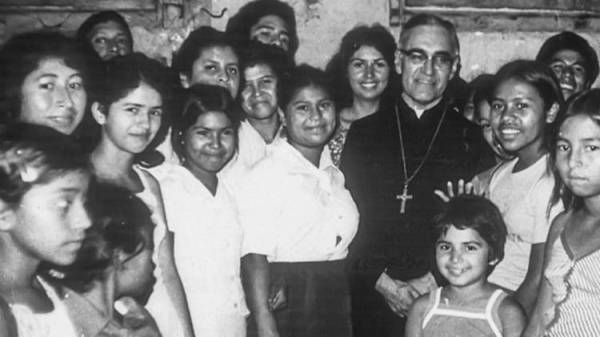
However, the second and most important form of accompaniment that Romero practiced, was walking with the people. Romero made it a point to visit communities all over El Salvador, to listen to them and to learn from them in their struggle.
Eventually, people began coming to the Archdiocese office in wave after wave to talk with Monsenor Romero. In late 1977, Romero turned the church office and courtyard into a place where people could come share their stories, get food and medical attention Romero also used this opportunity to document the disappearances, torture and murder of those who sought out his company. In addition, Romero arraigned for housing for those who had been displaced by the military repression and violence. In many ways, what the Salvadoran Archbishop had done was to offer Sanctuary for the people of El Salvador.
Dr. Paul Farmer, a physician and organizer engaged in accompaniment work in Haiti once wrote a description of what accompaniment work looked like:
“There’s an element of mystery, of openness, in accompaniment. I’ll go with you and support you on your journey wherever it leads. I’ll keep you company and share your fate for a while. And by a while, I don’t mean a little while. Accompaniment is much more about sticking with a task until its deemed completed by the person or people being accompanied, not those doing the accompaniment.”
Monsenor Romero understood this notion of staying with those he was accompanying, sharing their fate, even if that meant death.
Accompaniment in Grand Rapids
 As we wrote on Tuesday, the UCC Church in Wyoming, Michigan, Joy Like a River, is now a sanctuary for undocumented immigrants.
This is a clear form of accompaniment. In fact, Rev. Justo Gonzalez, used that terminology during his address to those present during the Press Conference on Tuesday. Doing sanctuary work is not about helping people, it is about being in solidarity with people who are being targeted by state repression.
 There are other forms of accompaniment being offer in Grand Rapids, such as the work of the GR Rapid Response to ICE project, where people who have been trained attempt to prevent ICE from arresting and detaining immigrants, as well as providing financial, legal, material and emotional support for immigrants impacted by ICE. For those wanting to get involved, like their Facebook page and find out when the next training is.
In fact, the GR Rapid Response to ICE group is hosting a screening of a documentary about Monsenor Romero, tonight at Taqueria Rincon. You can get details at this link.

