$700 Billion US War Budget for 2018 gets Bipartisan support: Senators Stabenow and Peters get guarantees for Michigan weapons contractors
 Language used by those in power is always instructive. The US Department of Defense used to be called the US Department of War, which is a more honest description, since there is little in the war budget for defense.
The US has military bases in over 150 countries, totally some 900 bases, with nuclear weapons in several of these countries. The US has been engaged in warfare, in some form or another – overt war, covert war, proxy war, drone war, the drug war, etc – ever since the country was founded. The US also spends more on war and militarism than the next top ten country military budgets, combined.
 The budget for the US Department of War is no different this coming year, as Congress just passed the National Defense Authorization Act for Fiscal Year 2018. The House of Representatives passed the near $700 Billion budget request by a margin of 344 to 81, while the Senate was near unanimous, passing the war budget by a margin of 89 – 8.
US militarism has always been a bi-partisan affair, but it is more than just an allocation for US militarism abroad, it is also a collective statement that says, Congress is will to spend money on war and militarism abroad, but not on housing, education and other social services at home. The US military budget always surpasses domestic spending and as Dr. Martin Luther King Jr once said:
A nation that continues year after year to spend more money on military defense than on programs of social uplift is approaching spiritual death.
Looking at some of the reasons why members of Congress would agree to spend $700 billion on war and militarism is also very instructive. Lets look at what both Michigan Senators had to say about why they voted for a $700 billion war budget.
Michigan Senator Gary Peters posted a statement on his website saying:
Our country faces constantly evolving threats, and it is vital that our brave men and women in uniform have the resources and support they need to safely conduct military operations and protect the homeland. I’m pleased the Senate passed the National Defense Authorization Act with bipartisan support, and I was proud to work to include several critical provisions that will bolster Michigan’s role in our nation’s defense, promote better mental health care for service members and support small businesses that contract with the federal government.
So, does anyone really believe Peters when he says its about protecting the homeland? The other reason, making sure that Michigan businesses that make stuff for the US military are included, that seems like a credible reason. Nearly all of the “provisions” that Senator Peters included in the National Defense Authorization Act were to guarantee that Michigan-based businesses would profit from the taxpayer subsidy knows as the US military budget.
Senator Stabenow follows the same line of justification as Senator Peters, in her posted statement about why she voted for the $700 billion war budget.
“Today, we are making a strong investment in our men and women in uniform as well as Michigan’s defense industry, which supports over 100,000 jobs and plays an important role in our nation’s security. The defense bill includes one of my amendments to toughen up our Buy American law. It also protects over 1,500 jobs for Michigan workers and suppliers who help build the Littoral Combat Ships at Marinette Marine Shipyard, authorizes additional funding for critical ground vehicle research at TARDEC, and provides a well-earned pay raise for our troops. I strongly support these priorities and will continue leading the effort to protect Michigan’s defense assets and identify new opportunities that will create jobs.”
Both Michigan Senators would like us to believe that they are just looking out for Michigan workers by voting for the 2018 US war budget. However, the truth is that they voted for the $700 billion war budget because they believe in US exceptionalism and US imperialism – that the US has the right, indeed, the duty to control the resources of other countries and to make sure that other countries don’t interfere with US military and geo-political supremacy abroad.
Most State Legislators who voted for the new Super PAC bill, have received lots of money from the DeVos Family
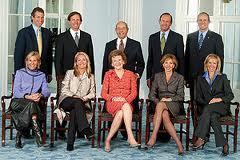 Last week Governor Rick Snyder signed into law what is being referred to as the Super PAC Bill.
In some ways, this new bill mirrors the federal election funding trend of Citizen’s United. However, as the Michigan Campaign Finance Network (MCFN) has noted:
The bill goes further, specifically allowing candidates to solicit unlimited contributions to supposedly “independent” Super PACs. It also allows candidates and Super PACs to share certain vendors, like attorneys or other campaign consultants.
So while an individual donor can give up to $1,000 to a state House candidate’s campaign. The candidate could ask the same donor or a corporate entity to give a much larger check to a Super PAC that is going to support the candidate. Because Super PACs can accept corporate contributions, the original sources of their money are notoriously hard to trace.
What this all ends up meaning is that the wealthy capitalist class will have an even greater influence in both electing candidates and legislation that is put forth by the candidates that those with economic power have put in place.
In Michigan, according to the MCFN, the number one non-corporate entity to contribute to candidates for state government has been the DeVos Family. Therefore, we thought it would be useful to look at which members of the Michigan Senate and the House of Representations have received money from the DeVos Family and which of them voted for the Super PAC bill.
The Senate Bill 335 passed by a margin of 23 – 12. Of the 23 that voted for the bill, 18 of them have received substantial amounts of money from the DeVos Family during their time in office. Here is the list of those who voted for the Super PAC bill and have received money from the DeVos Family:
- Darwin Booher (R) has received $9,000 from the DeVos Family
- Jack Brandenburg (R) has received $14,000 from the DeVos Family
- Tom Casperson (R) has received $9,000 from the DeVos Family
- Pat Colbeck (R) has received $18,000 from the DeVos Family
- Mike Green (R) has received $18,000 from the DeVos Family
- Goeff Hansen (R) has received $16,000 from the DeVos Family
- David Hildenbrand (R) has received $21,000 from the DeVos Family
- Ken Horn (R) has received $3,000 from the DeVos Family
- Joe Hune (R) has received $9,000 from the DeVos Family
- Marty Knollenberg (R) has received $21,000 from the DeVos Family
- Mike Kowall (R) has received $18,000 from the DeVos Family
- Peter MacGregor (R) has received $18,000 from the DeVos Family
- Jim Marleau (R) has received $18,000 from the DeVos Family
- Arlan Meekhof (R) has received $54,000 from the DeVos Family
- John Proos (R) has received $9,000 from the DeVos Family
- David Robertson (R) has received $7,000 from the DeVos Family
- Wayne Schmidt (R) has received $18,000 from the DeVos Family
- Tonya Schuitmaker (R) has received $9,000 from the DeVos Family
 In the Michigan House the Super PAC bill passed by a margin of 62-45. Of the 62 that voted for the measure, 31 have also been recipients of DeVos Family money over the years. Here is that list:
- Chris Afendoulis (R) has received $4,500 from the DeVos Family
- Sue Allor (R) has received $9,000 from the DeVos Family
- Tom Barrett (R) has received $18,000 from the DeVos Family
- John Bizon (R) has received $18,000 from the DeVos Family
- Tommy Brann (R) has received $9,000 from the DeVos Family
- Edward Canfield (R) has received $9,000 from the DeVos Family
- Lee Chatfield (R) has received $9,000 from the DeVos Family
- Kathy Crawford (R) has received $18,000 from the DeVos Family
- Diana Farrington (R) has received $8,000 from the DeVos Family
- Ben Frederick (R) has received $9,000 from the DeVos Family
- Daniela Garcia (R) has received $18,000 from the DeVos Family
- Joe Graves (R) has received $17,200 from the DeVos Family
- Beth Griffin (R) has received $9,000 from the DeVos Family
- Roger Hauck (R) has received $7,000 from the DeVos Family
- Pamela Hornberger (R) has received $9,000 from the DeVos Family
- Gary Howell (R) has received $9,000 from the DeVos Family
- Holly Hughes (R) has received $18,000 from the DeVos Family
- Brandt Iden (R) has received $18,000 from the DeVos Family
- Larry Inman (R) has received $9,000 from the DeVos Family
- Bronna Kahle (R) has received $9,000 from the DeVos Family
- Klint Kesto (R) has received $18,000 from the DeVos Family
- Beau LaFave (R) has received $9,000 from the DeVos Family
- Jim Lilly (R) has received $9,000 from the DeVos Family
- James Lower (R) has received $9,000 from the DeVos Family
- Steve Marino (R) has received $9,000 from the DeVos Family
- Jeff Noble (R) has received $9,000 from the DeVos Family
- Daire Rendon (R) has received $9,000 from the DeVos Family
- Jason Sheppard (R) has received $9,000 from the DeVos Family
- Curt VanderWall (R) has received $9,000 from the DeVos Family
- Rob Verheulen (R) has received $9,000 from the DeVos Family
- Jason Wentworth (R) has received $9,000 from the DeVos Family
In most of the cases where members of the Michigan Legislature didn’t receive money from the DeVos Family and did vote for the Super PAC bill, they did receive substantial amounts of money from Michigan Chamber of Commerce and the Michigan Farm Bureau, both of which lobbied for the legislation.
In addition, there were also numerous cases where legislators who did not receive funding from the DeVos Family, but did receive funds from other families who are part of the West Michigan Power Structure; such as the Meijer Family, Peter Secchia, Michael Jandernoa and John Kennedy.
However, it seems clear that the DeVos Family, a family who stands to benefit from the new legislation, which will allow for more individual campaign contributions and PAC money to be raised for candidates, will be one of the real winners of the new bill signed last week by Gov. Rick Snyder.
Lastly, so as not to forget Governor Snyder’s relationship to the DeVos Family, he has received $142,830 from them since he first ran as Governor for Michigan.

Boycott Artprize
(The following article was written by Russell Gorton and is reposted with his permission.)
Artprize is dumb and harmful to art and artists.
1. The premise of artprize binds art to money. This rewards spectacle, which is not the same as art.
Like capitalism, artprize does not reward bad luck. Artists become casino gamblers, feeding their dollars and their work into a machine with worse-than-random odds. Viewing art, learning about art, discussing the merits of art, building a public audience engaged with art — none of these things are made better with a hokey lottery attached.
Judging the best cuisine by public vote, results in McDonalds and Applebees. Similarly, artprize does not allow consideration of smaller pieces conceived without the intent to provoke a broad public response. Repeatedly, the artprize public has chosen meticulous production, imposing scale, systemic and repetitive techniques. 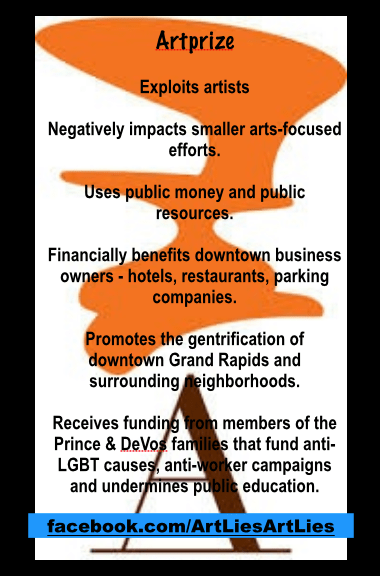
Art is often not regarded as valuable and profound in its own time. Tchaikovsky died thinking his most famous ballet was a failure. But artprize presupposes that good art must immediately impress a broad audience. The Mona Lisa is not a very big painting. It would look fairly small sitting in the fountains at a convention center or presidential museum, next to towering elephants.
Not every human effort must have a monetary value assigned to it. Good, interesting art need not be huge, complicated, or time-consuming. Artists know this, but perhaps this is a tough sell in “my kid could do that!” country.
2. The winning art sucks. I mean, It’s really, really terrible. The public winners reinforce our image as red state rubes.
25% of winners are gigantic quilts by the same lady. The treacly military boosterism has ranged from open white supremacy nostalgia (cavalry drawing) to mawkish sentimentality (warrior dogs – which recalled CIA torture of muslim prisoners – a literal dog-whistle lolol). The bizarre crucifixion piece overwhelmed, all garish color and size, like a shiny Cadillac limo with gold trim and fur seats once owned by Elvis.
West Michigan sure likes to trumpet its “work-proud” mentality. That art took a lot of time to make. That artist must have worked really hard. Really makes you think about sacrifice and honor, and the northwoods, and Jesus. Must be worthwhile. My kid couldn’t do that.
3. The family’s politics are nightmarish and simply cannot be supported in a modern humanist cultural conversation.
“I don’t get into that stuff.” – Rick DeVos, when asked about his family’s politics. and “I just want to see crazy crap all over downtown.” – Rick DeVos, when asked about the validity of the art, in relation to its cultural merits or ultimate purpose. Implicit in this statement is the acknowledgement that spectacle is the goal.
These are facile, unserious, and childlike avoidances of some serious issues, which someone in his position of wealth, and the influence it buys, would do well to address.
The family who founded ArtPrize® despises gays and spends profligately to harm them politically and socially. A long-time board member and financial backer of artprize has been in the news recently, you may have heard of her! She was appointed to lead a federal agency she apparently thinks shouldn’t exist. This family is intimately and thoroughly involved in a Calvinist/pre-destinationist Christian sect that (like most) claims to have the keenest grasp on The Correct Moral Principles Of Mankind. Yet the family stays silent regarding the monster in their midst. They apparently love Christ but ignore the most notorious mercenary commander of our time, a man unwelcome in his homeland, a man who directs a private army of murderers at the behest of the top dollar.
So they want us to enjoy their “radically” “disruptive” little boardwalk picture show without so much of a word about this? There will be no reckoning, no shame for these people?
If you are going to throw your family’s money around to be the loudest voice in our cultural conversation each year, Rick, then you should probably admit that your family isn’t about the open sharing of culture at all. They aren’t about living by the received wisdom of Christ either. They’re about controlling the conversation and making money.
Artists, why are you paying $ to enter this silly contest that associates your work with Dominionists who are so clearly on the wrong side of history? Why not ask a restauranteur if she will display your art, without the bogus contest stuff? Hey maybe y’all could start a fringe festival and piggyback on the crowds coming to town for artprize? Or maybe organize some protest actions? Inject some more defiance into this stuff, please? Shoot for zero votes. Tell your friends to avoid the vote. Let’s see a juried prize winner get fewer than 100 public votes. That would be a statement — a sort of jury nullification. Hey, if we hate Betsy DeVos’s dumb policies enough to whine about it on Facebook, why not, you know, consider avoiding this fiasco she helped fund and sat on the board of until… last year.
Venues, why are you associating yourselves with this useless contest? Powerful people who seek to cripple public education; to restrict choice in love, for families, for health; to dictate their sad twisted patriarchal morality into legislation — Are these the “family values” that should dominate the art scene around here? Second-, third-, and fourth-generation nouveau riches, who have never scrounged to make rent and eat and get to work on time? Unlike, you know, artists who need exposure? It is unsound to be a politically progressive employer yet allow your dining room to be co-branded like this.
Serious Local Art Institutions, why are you allowing your season calendars to be cramped by this mess? Why are you allowing these people to continue dominating the cultural conversation in our city? Agree to display controversial art. Challenge audiences to spend time with smaller, more intimate pieces. Ideally, turn down artprize as a venue and allow yourselves the space to dictate your own early Fall exhibitions. Who knows? You guys are screwed one way or the other every year.
Anyway, it’s all pretty foolish and worthless. Whole thing is panning out as a failure, going into the ninth year.
I wish good luck
to the building-sized quilt
depicting police dogs
surrounding Jesus
as he aims his AR-15
at a gay Syrian couple
being turned away at the US border,
supertitled “PSALM 108:13”
and “9/11 NEVER FORGET”
in golden thread
hand-embroidered letters
20 feet tall.
That took a really long time.
Those ladies sure worked hard on that quilt.
Top 10 easily.
Too bad I can’t vote for it
more than once!
— Russell Gorton
Grand Rapids, Michigan
September 18, 2017
Update 9/20/17 — some responses and answers:
I received some comments defending the artists, pointing out that because of artprize, artists are able to have their work seen by throngs of people, build relationships with venues, maybe contribute to a sense of civic pride. I agree artprize has drawn an unusually large audience to see art, and that has intrinsic value. But the lure of the prize incentivizes a certain kind of public art, which usually tends to suck, while the rest of the sleeping-in-their-cars type artists are still paying $50+ to show their work in a restaurant booth or church lobby somewhere. Multiply that by the # of entries, and AP is earning a significant chunk of the prize money from the artists themselves.
I do not hate on any artists for showing in artprize. Artists should do what they do, when and where they want to do it. I felt that a critical analysis from a leftist perspective would contribute to the discussion around artprize. Now that it has had eight years to demonstrate what it is about, some conclusions may be drawn.
Can artists and venues attract crowds without big prize money attached? There are numerous other art fairs and shows throughout Michigan and the Midwest. My problem is with the prize money, where it comes from, and the assumptions it brings about human or social value being inextricably connected to financial wealth.
I was taken to task specifically over my derision regarding the quilts. I’m not belittling quilts, it’s a perfectly lovely form of art. I just point out the absurdity of the public voters picking not one, but two giant painstaking quilts as some notional “best” art. Nothing inherently wrong with the quilts; it’s the neopuritan ethos of them and their scale and subject matter, that appealed to the broad audience around here – is the idea I’m putting forward – that this desire to reward laborious craft and settler values for their own sake is a reflection of the reactionary white grievance tendencies of our region.
Like many white men learning to be allies, I have work to do but I in no way intended to belittle quilting as an art form or as “women’s work”. Feminism has benefitted me greatly and I am grateful daily for the women in my life who shape me.
Those attending the MSU ribbon-cutting ceremony were greeted by anti-Betsy DeVos protestors in Grand Rapids
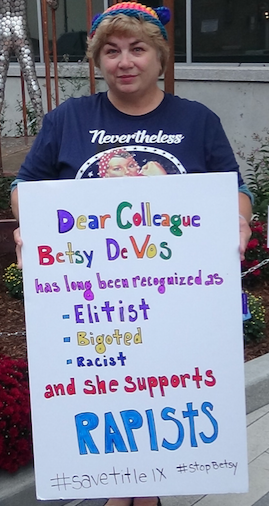 Earlier today, MSU students organized a demonstration at the new MSU medical building on the corner of Monroe and Michigan in downtown Grand Rapids.
The reason for the protest, was due to the fact that MSU administrators had invited Betsy DeVos to speak at the grand opening of the new university facility.
An estimated 60 people showed up to protest DeVos, a protest that was organized by MSU students and faculty.
The MSU student-led protest included a petition to stop DeVos from speaking, which included these bullet points:
As Education Secretary, Secretary DeVos:
- Recommends a $9 billion cut in federal education funding, including cuts to higher education, training and after-school programs.
- Supports cutting financial aid to low-income college students making it easier for private loan servicer’s to prey on Michigan families. The MSU College of Human Medicine already has some of the highest per student debt in the nation.
- Rolled back regulations on for-profit colleges and has made it easier for low performing for-profit colleges to defraud students.
- Refuses to limit federal education funding for schools who actively discriminate against LGBTQ students.
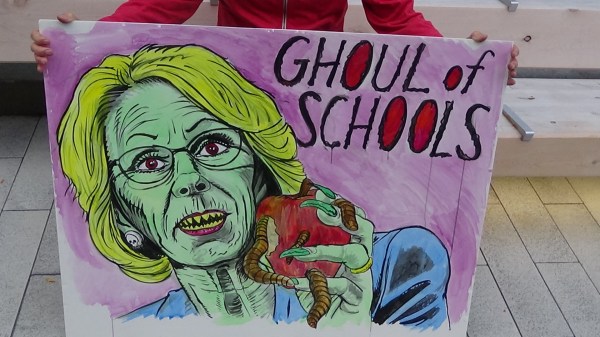
As expected there were police everywhere, in cars, on bike and on foot, to make sure that the MSU ribbon cutting affair would go smoothly. The police put up tape and barricades to deter people opposed to Betsy DeVos from entering the north side of the property (see below), where the university had set up a large tent where DeVos spoke and attendees could schmooze and have refreshments.

Those who were protesting Betsy DeVos, brought signs and engaged in various chants with bullhorns. The signs covered a variety of messages that spoke to who Betsy DeVos is and what some of her positions as Secretary of Education have been so far.

One of the most consistent messages had to do with what the Secretary of Education is proposing to change about Title IX. I did a short interview with one of the protestors who talked about the Title IX issue and why it is so problematic.
 In the early part of the demonstration there were numerous people who clearly were headed to the event with Betsy DeVos. They had to walk through the gauntlet of protestors as they made their way to the north side of the building, where the outdoor tent was. Some notable people who went to hear Betsy DeVos, were President of the Right Place Inc., Birgit Klohs and Grand Rapids City Commission Dave Shaffer. Grand Rapids Mayor Rosalynn Bliss also showed up and since there were members of the Grand Rapids Amalgamated Transit Union (ATU), they let Bliss know that she was not welcome. In addition, the CEO of The Rapid, Peter Varga, also came to the event. He was also confronted by protestors, particularly ATU members, who unleashed a barrage of comments at Varga, who just received yet another raise, while bus drivers don’t have a contract. Varga had an exchange with one ATU member, then walked back to the corner of Monroe and Michigan and asked a cop to escort him (pictured on the right) down to the north side of the building.
The anti-DeVos demonstration lasted about two hours and certainly made it clear to those who attended the event and those driving by, that Betsy DeVos was not welcomed.
Lastly, there were about 15 pro-Trump/pro-DeVos people who also showed up, but they didn’t seem to be there for any other reason than to harass those in the anti-DeVos camp. They were not successful.

What will we do in Grand Rapids to fight against government repression that targets immigrants?
 (Editor’s note: In the interest of being transparent, I am part of the Rapid Response to ICE effort.)
In the past two weeks we have been aware of the fact that at least a dozen families have been directly impacted because of ICE raids in the greater Grand Rapids area.
Last Friday, we received calls that ICE had been seen in the area of Alpine and Leonard and on Sunday, there were 5 or 6 people who had been picked up by Immigration, Customs and Enforcement officials.
In the past few days we have been contacted by several other members in the immigrant community who have either had a family member picked up by ICE or are facing deportation themselves.
This is the reality that thousands of people face every day in the West Michigan community. People live in fear and people are having their families torn apart. Children in these families don’t know if their parents will be home after school because of ICE and parents are afraid to go to the grocery store for fear of encountering ICE.
So what do people who are not facing these oppressive realities do? There are no easy answers and no simple blue prints to follow. However, there are concrete things that we can and should be doing.
The Rapid Response to ICE group has been hosting monthly trainings to involve people to; 1) prevent ICE from taking people who are undocumented, and 2) provide mutual aid/support to families impacted by having ice arrest, detain and possibly deport people. The next training is this Thursday, September 21 from 6 – 8pm, with details you can find at this link.
The mutual aid that people can provide often involves raising money for people to cover legal costs, but it also means donating money so that people can pay their rent, provide food for their children or cover medial expenses. Mutual aid is also about providing transportation to detention facilities or to court dates and then sitting with family members in the courtroom. 
Another important group to become involved in is the Cosecha Movement in Grand Rapids, which is a movement led by immigrants and the undocumented community. This movement believes in respect, dignity and permanent protection for immigrants, especially for those that are being targeted by ICE and anti-immigration policies. They meet on a weekly basis have been doing important organizing work.
But this still begs the question of what do people who are not faced with this kind of repression do? What do those of us with white privilege do knowing that the immigrant community is facing this kind of oppression on a daily basis?
Back in January, I participated in an all day gathering at Eastern Avenue church to talk about these dynamics and to see what those of us who carry a great deal of privilege could do. One of the main areas of focus on that day in January was to talk about faith communities offering sanctuary for those who are confronted with anti-immigration policies. The breakout session talked a bit about the history of sanctuary work in Grand Rapids and the more recent Sanctuary Movement that is growing across the country.
There were several faith-based communities that day that were considering offering sanctuary, whether that was in a very public manner by declaring themselves a sanctuary or a more underground manner, where sanctuary was being offered, but in a less-public way. The unfortunate reality is, that not one church or faith-based group has stepped up to offer sanctuary (at least not that we are aware of).
This fact is unacceptable. Grand Rapids and West Michigan as a whole, prides itself on being a very religious community, yet not one religious community has chosen to take a stand with the immigrant community that is being targeted with government repression. Sure, there are churches and faith-based non-profits that offer important resources – financial, legal and translation services – but offering individuals and families sanctuary would send a whole different message to the immigrant community. It would send the message that those of us who carry a great deal of privilege are willing to stand with the immigrant community and potentially suffer the same kind of government repression.
It is in these moments of history where people are confronted with what to do and have to face the question – what did we do while whole communities were experiencing repression? What did we do to make a difference? What did we do to make it clear to impacted communities that we stand in solidarity with them? What will we do?

Betsy DeVos selectively eulogizes Rev. Dwight Montgomery
 Last Thursday, the Secretary of Education, Betsy DeVos, released this brief statement:
“Rev. Montgomery was a steadfast advocate for equality and opportunity for all, especially for students and parents. He knew neither income nor address should determine the quality of education a child receives. Through his work in Memphis and with the Southern Christian Leadership Conference, many students and families benefitted from opportunities, both educational and spiritual, they would otherwise have been denied.
We in the education community mourn the loss of his leadership, but most who knew him mourn the loss of their pastor. My prayers are with the faithful of Annesdale Cherokee Baptist Church as they will be the legacy of their shepherd.”
Such a statement begs the question, “why does the Secretary of Education eulogize a Black minister who is part of the Southern Christian Leadership Conference (SCLC)?
According to a statement released by the President of the SCLC, Dr. Charles Steele Jr.:
Montgomery always believed in having a wide variety of educational alternatives available, Dr. Steele said, “because no single, educational approach works for every child.” “He was a charter school advocate, and was passionate about both public schools and alternative education,” he said. “Traditional schools shouldn’t just be a one-way street.”
The statement by the current SCLC president provides a window into why Betsy DeVos might eulogize the recently deceased Rev. Montgomery, but it still only provides a small window.
However, an article by Laura Faith Kebede on Chalkbeat, provides us with more details on why Secretary DeVos felt compelled to release a statement about Rev. Montgomery.
Kebede writes, Montgomery backed efforts that would support local Christian schools — including tuition vouchers, which set aside public money for children to attend private schools. Voucher legislation has failed to pass in Tennessee for at least a dozen years.
The writer of the Chalkbeat article goes on to say:
In Tennessee and Florida, chapters of the Southern Christian Leadership Conference have frequently partnered with the American Federation for Children, an organization that DeVos once chaired, to push vouchers as a civil rights issue. In 2015, Montgomery led a group of pastors affiliated with SCLC to the state Capitol to present a petition of 25,000 signatures supporting vouchers.
This statement underscores why Betsy DeVos would eulogize Rev. Montgomery last week. In demonstrates that the Secretary of Education will sing the praises of people who support school voucher programs and those that enter into an alliance with the American Federation for Children.
Not surprising, Betsy DeVos did not praise Rev. Montgomery for his recent efforts to remove a statue of Confederate Gen. Nathan Bedford Forrest from a Memphis park, shortly after the White Supremacist violence in Charlottesville.
More importantly, DeVos failed to acknowledge Rev. Montgomery’s work with Dr. Martin Luther King Jr. on the national Poor People’s Campaign. The Poor People’s Campaign was really about radical redistribution of America’s wealth to the poor, particularly communities of color. Dr. King stated in an SCLC retreat in 1967, his vision for what the Poor People’s Campaign meant for the movement:
I think it is necessary for us to realize that we have moved from the era of civil rights to the era of human rights…[W]hen we see that there must be a radical redistribution of economic and political power, then we see that for the last twelve years we have been in a reform movement…That after Selma and the Voting Rights Bill, we moved into a new era, which must be an era of revolution…In short, we have moved into an era where we are called upon to raise certain basic questions about the whole society.
Somehow, Betsy DeVos chose not to acknowledge Rev. Montgomery’s work against White Supremacy and Capitalism.
In Praise of Grand Action and its founders: The Pandering of MLive
 On Friday, an entity created by some of the members of the West MI Power Structure, Grand Action, announced that the three founding members – David Frey, John Canepa and Dick DeVos – were leaving the group.
On Saturday, MLive reported on this announcement and then spent the rest of the article praising the three men and their work with Grand Action.
Here is an excerpt from the MLive article:
Grand Action was the catalyst for Grand Rapids major civic projects, beginning with the Van Andel Arena, followed by DeVos Place, Grand Rapids Civic Theatre, MSU College of Human Medicine Secchia Center and the Downtown Market.
More than a quarter of the $420 million price tag for the large scale projects was donated from the private sector. Deep-pocketed philanthropists such as Rich DeVos, Jay Van Andel, Fred Meijer and Peter Secchia picked up the bulk of those private contributions, helping to raise a total of $130 million.
The rest of the article is basically pictures and a few sentences on each of the “civic projects” that Grand Action has had a hand in, along with pictures of the three men, their involvement with Grand Action and a few quotes from each.
It is as if, the MLive writer was simply using a Media Release from Grand Action. There is not one single critical perspective provided and the praise of Frey, DeVos and Canepa is nothing short of pandering.
This pandering is also reflected in the excerpted comment above, when one considers that the emphasis is on how much private money was raised and not how much public money was used. Based on the numbers provided in the article, the public contributed $290 million and the private sector contributed $130 million.

Apart from the obvious difference in the amount given from private vs public, the other significant difference is that the public had NO say in these projects. These civic projects were not part of a millage or something that taxpayers could have a say in. These were decisions made by members of the West MI Power Structure at Grand Action, then vetted through meetings at the Downtown Development Authority, where promises were made on how much public money would be provided, without public input.
The MLive article is also pandering to those with power in this town, because there are no critical perspectives provided about any of the projects, about the use of public money with no public input and the fact that many of those who make up the committee on Grand Action, most clearly Dick DeVos, would financially benefit from these downtown projects. The DeVos family empire, with all the hotels they own downtown, would certainly profit from these Grand Action initiated projects, including the Grand Rapids Destination Asset Study, which Grand Action commissioned last December.
Betsy DeVos is the featured guest at the annual Acton Institute Dinner on October 18
 Current Secretary of Education and former board member of the Acton Institute, Betsy DeVos will be the featured speaker at the 27th Annual Acton Institute Dinner on Wednesday, October 18 in Grand Rapids.
DeVos, who served on the Acton Institute Board from 1995 – 2005, will be speaking at the event, which will be held at the DeVos Hall in downtown Grand Rapids. The event is a mere $175 a plate per person or for the more ambitious members of the capitalist class, you can spend $7,500 for a table of 10 people, recognition in the program and an invitation to receptions before and after dinner.
The text that accompanies the invitation states:
A Grand Rapids native, Betsy DeVos is a proven leader, an innovator, a disruptor and an advocate. In education, in business and in politics, Betsy has been a pioneer in fighting to remove barriers, to enact change and to create environments where people have the opportunity to thrive.
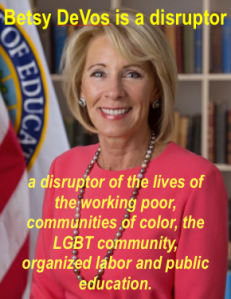 No surprise that the Acton Institute describes a fellow member of the capitalist class and the religious right this way. Betsy DeVos has indeed been a pioneer in the fight to remove barriers, barriers to amassing more wealth for her family and other members of the West Michigan elite. Betsy DeVos is also a disruptor, a disruptor of the lives of the working poor, communities of color, the LGBT community, organized labor and public education.
She will share the stage at the Acton Institute Annual Dinner, by Acton founder Rev. Robert Sirico. Sirico is one of the most committed apologists of capitalism and believes that Christianity is completely compatible with the so-called free market. Rev. Sirico also acts as a sort of spiritual counselor to the brother of Betsy DeVos, Erik Prince.
The visit to Grand Rapids by DeVos for the Acton Institute’s Annual Dinner provides a perfect opportunity for people to engage in active resistance. For those interested in organizing some kind of action, send me a message jsmith@griid.org.
From Fighting Childhood Hunger to Economic and Racial Justice: A Response to Kids Food Basket Expansion plans
Last week it was announced that the non-profit food charity group, Kids Food Basket, was expanding its operation and kicking off a new funding raising component called, Feeding Our Future Campaign.
The announcement received news coverage in all the mainstream commercial news sources as well as community news sources and lots of social media. The narrative put forth was basically the same:
Kids Food Basket already serves 7,500 children each weekday in three counties with a sack lunch. Through the new fundraising campaign they will be able to provide the same services to up to 15,000 more children in West Michigan.
On the surface, this narrative sounds pretty wonderful. I mean, who could be against feeding children who are hungry? Well, that depends on how you ask the question or if you raise another question – why are so many families in West Michigan experiencing poverty?
I get that people want to do something to respond to child hunger in this community and putting together sack lunches is good form of triage when responding to larger systemic issues. However, if we continue to do the same thing and even do more of it, without having a strategy for dealing with poverty and economic inequality, then we will continue to make more and more sack lunches for children in this community.
In Andrew Fisher’s book, Big Hunger: The Unholy Alliance Between Corporate America and Anti-Hunger Groups, he makes the argument that the anti-hunger industrial complex ends up only perpetuating more hunger. The book offers some fresh insight into the anti-hunger industrial complex and makes it clear that food charity is a false solution. One major theme of the book is this:
In both allying themselves with corporate America and not pursuing labor-related issues, anti-hunger advocates tacitly exonerated businesses from their role in foster income inequality and, in various cases, of engaging in practices that perpetuated hunger among their own workers or subcontractors.
Kids Food Basket is a popular response to child hunger, precisely because it does not question poverty and economic inequality. One way you can determine this is based upon why sits on the board of directors and which companies are major supporters of the food charity project. 
The corporations that are major donors to Kids Food Basket; like Amway, Bank of America, Tyson and Walmart, all are involved in lobbying for economic policies that serve their own interests and/or provide funding to organizations that promote anti-union, privatization or other economic austerity measures that contribute to more and more families experiencing poverty.
Even the current Feeding Our Future fundraising campaign involves people who are part of the Grand Rapids Power Structure, people like Hank Meijer, Peter & Joan Secchia, Mike & Sue Jandernoa and David & Carol Van Andel. These people are millionaires or billionaires that have contributed to the wealth gap in Grand Rapids, which is the worst in the state.
So What is the Alternative?
What most Food Justice organizations recognize is that the issue of hunger is systemic and therefore need solutions that strategically combat this kind of systemic injustice. There are never any easy or simple answers when dealing with hunger and poverty, but here are a few suggestions of what we know have worked historically.
- It would be important for any and all groups who do food triage work to acknowledge that just providing food assistance on a regular basis does not solve the problem. I’m not saying that people shouldn’t practice mutual aid and assist people in a time of crisis. We absolutely should practice mutual aid when we can. However, it is not enough to just provide charity, we must work towards justice.
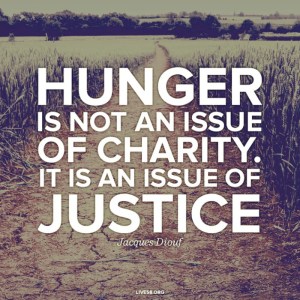
- Once Kids Food Basket can acknowledge that hunger is a much larger and systemic economic and racial problem, then they can with other like-minded groups begin to develop multi-pronged strategies to fight for economic and racial justice.
- Ending partnerships with corporations and families which are part of the power structure
- Promoting and participating in a Living Wage campaign at the city/county level. Currently, many groups around the country are calling for a $15 minimum wage. However, a Living Wage would go further, because it would force us to have a much more substantial conversation about economic policy.
- Wealth re-distribution in the form of reparations. Those families, communities and corporations which have exploited workers and communities for decades, should be required to pay back the communities, families and individuals they have exploited.
- Organizations like Kids Food Basket need to adopt clear racial justice policies that recognize historical racism and how it currently in manifested in West Michigan. How is it that the people who pick most of our food in West Michigan, migrant farmworkers, have a high rate of poverty?
- Part of the plan for the Kids Food Basket expansion is to grow food for their sack lunch program. What about allowing people to come to this newly acquired land and grow food together, specifically the families that are benefiting from the sack lunch program. Provide people with the skills, transportation and child care so they could chose to be involved in producing their own food. This could also be done by supporting more programs in neighborhoods that are experiencing poverty, by assisting those neighborhoods with urban food production, if that is something they want to do.
These are only just a few suggestions, but I believe that many more creative and powerful ideas could surface if we changed the narrative around how to respond to hunger from food charity to food justice.
Sifting through the bullshit: Acton Institute pontificates about Antifa
There have been all kinds of commentary, from both conservative and liberal sources, about what it means to be part of the group/movement known as antifa.
Part of the problem with how conservative and liberal responses to antifa, is due in part to the fetishization on non-violence. Too many people think that somehow non-violence is a superior moral strategy to embrace, yet more often than not those who advocate this position (in response to antifa) are usually people who do NOT want to practice a basic principle of non-violence.
One of the most basic points of non-violence, besides the call to not participate in harm, is the idea that one will not avoid having harm done to themselves. Most people who scream we need to be non-violent are people to will not do anything that will risk putting their ass on the line. Can you imagine during the Black Freedom Movement, if those who rode buses in the south, sat at segregated lunch counters or put their bodies on the line against police brutality had said, “sorry, we believe in non-violence, but we don’t want to take any risks.” Dr. King famously said, “we will wear you down with our capacity to suffer.”
Now, I think non-violence can be a useful strategy to engage in, but I also think we should never be limited to such strategies or tactics. In fact, we should never foreclose on the use of any tactic. We all need to stop fetishizing non-violence are start understanding the world in terms of power and oppression. I would highly recommend that people read the following books: How Non-violence Protects the State; Pacifism as Pathology and This Nonviolent Stuff’ll Get You Killed: How Guns Made the Civil Rights Movement Possible.
Acton Institute on antifa
Last Wednesday, the Grand Rapids think tank that defends the Capitalist Class, the Acton Institute, decided they need to share some facts about antifa.
The Acton blog post provides 5 facts about antifa, which are worth looking at, as they reflect many of the uninformed assumptions about antifa.
The first sentence of “fact 1” states: Antifa is a radical and often violent protest movement organized around “anti-fascism.” Again, there is that word violent. When the dominant culture gives us images and messages about cops, they don’t usually associate them with being violent. However, not only are cops always heavily armed, they more consistently engage in acts of violence and repression than any other domestic group in the country. Yet, we rarely see the description of cops as being “mostly violent.”
Antifa, does not hesitate to use force to defend people who are being targeted by fascists or to use force against those who come into communities to do actual harm. Those involved in antifa see this as providing real community-based security or creating safe spaces against groups that are white supremacists and fascists.
“Fact 2” from the Acton Institute is not necessarily an inaccurate point, but it is fairly simplistic.
“Fact 3” states: Almost all of those who align with Antifa are from the extreme political left, usually identifying as communists, socialists, or anarchists. Again, this statement is meant to marginalize those involved with antifa, since association with communism, socialism or anarchism is often seen as extremists. However, there are millions of people who identify with communism, socialism or anarchism. What the Acton Institute means by the extreme political left, is really meant to say that anyone who does not celebrate or act as an apologist of capitalism.
“Fact 4” is the most accurate of the facts presented about antifa, mostly because it relies on historian Mark Bray, author of the recent book, Antifa: The Anti-Fascist Handbook.
“Fact 5” begins with an accurate statement about antifa being decentralized, but then ends with this sentence:
The Department of Homeland Security formally classified Antifa’s activities as “domestic terrorist violence,” according to interviews and confidential law enforcement documents obtained by Politico.
The fact that the Acton Institute considers the Dept. of Homeland Security as a credible source, should tell us something. Also, if you participate in non-violent civil disobedience, the Dept. of Homeland Security also considers you to be violence. You are violent either way, not necessarily because of the tactics you use, but because you challenge and confront the dominant narrative about the state.
For anyone wanting to honestly try to understand what antifa is all about, then I would suggest a few sources:
Read the response from It’s Going Down to Politico’s awful post on antifa. https://itsgoingdown.org/taking-trash-fact-checking-politicos-antifa-attacks/
Check out a recent interview with Mark Bray, author of Antifa: The Anti-Fascist Handbook, on Democracy Now https://www.democracynow.org/2017/8/16/antifa_a_look_at_the_antifascist.
Better yet, you should just read Mark Bray’s book, Antifa: The Anti-Fascist Handbook, to have a more complete analysis of what antifa or anti-fascism really means.
 Grand Rapids Institute for Information Democracy