WXMI 17 station parent company about to merge with Trump Administration friendly Sinclair Broadcasting Group
 In May of this year it was announced that the Fox affiliate, WXMI 17 and their parent company the Tribune Media Co., would be bought up by the Sinclair Broadcasting group.
MiBiz recently ran an article about this buyout and does a pretty good job of pointing out that this merger would be in violation of current Federal Communications Commission (FCC) rules.
This is because the Sinclair Broadcasting Group already owns a TV station in the area, WMMT, channel 3, based in Kalamazoo, and according to FCC rules, you can’t own more than one TV station in the same market.
Radio/TV ownership deregulation
The deregulation of radio and TV stations is nothing new. Beginning in the 1980s, there was the first major push to deregulate the broadcast market and allow for greater media ownership consolidation.
The largest shift came in 1996, under the Clinton administration, where radio corporation were allowed to expand the number of stations they owned in one market from 3 to 8. This FCC shift during the Clinton years gave birth to mega-media corporations like Clear Channel, which owns 8 radio stations in the Grand Rapids market.
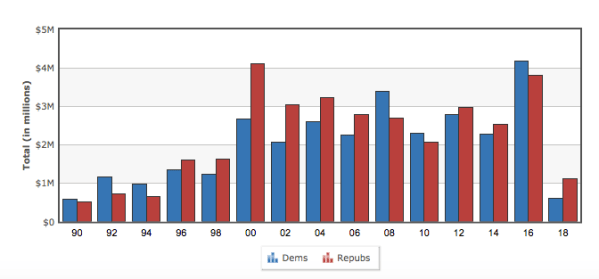
However, the push to further consolidate media ownership didn’t end with the 1996 FCC ruling, especially since the media companies themselves have become monopolies looking out for their own interests. Media companies spend millions annually lobby the federal government to further deregulate the broadcast market. According to data from the Center for Responsive Politics, you can see how much the commercial TV & radio companies have been spending on lobbying and how they give pretty much equally to both parties.
WXMI 17 and media bias
As someone who has been monitoring the local news over the past 30 years, it is clear that WXMI presents news through the lens of the dominant culture. When I say dominant culture, I mean they represent the views of those with economic and political power, along with a bias towards white supremacy.
This bias has nothing to do with them being a FOX affiliate, since they have never been owned by FOX, they just rely on FOX News as a source for national news. We have tracked WXMI 17 around election coverage since 1998, along with war coverage, racial representation and a number of other issues and WXMI 17 is no more biased that WOOD TV8 or WZZM 13.
Sinclair Broadcasting Group and the Trump Administration
While WXMI 17 has not demonstrated any partisan bias, this may change if the station gets bought up by the Sinclair Broadcasting Group.
The partisan bias of the Sinclair Broadcasting Group has been well documented for more than a decade. According to the Center for Media & Democracy (CMD), The company and its executives have consistently funded right-wing political candidates, according to the Center for Responsive Politics.
In April 2004, Sinclair refused to let its stations broadcast a special “Nightline” episode, produced by the ABC television network, that was devoted to reading the names of soldiers who had died in “Operation Iraqi Freedom.” It also directed its stations to air an anti-Kerry program ahead of the 2004 presidential election.
Sinclair stations are forced to make room for “must run” segments produced by the company, such as brashly right-wing video op-eds from Sinclair executive Mark Hyman and the station’s chief political analyst (and senior advisor to Trump’s campaign) Boris Epshteyn, who memorably claimed that President Obama won North Carolina because of voter fraud.
Sinclair stations are also fed scripts to introduce must-runs, leaving local news stations across the country echoing language such as, “Did the FBI have a personal vendetta in pursuing the Russia investigation of President Trump’s former national security adviser Michael Flynn?” as evidence was mounting that Flynn was in serious legal jeopardy for failure to report foreign ties and for withholding information from the Pentagon and the FBI.
According to the national media reform group, the Free Press, the Sinclair media merger would be detrimental to a free flow of information. In a recent post, the Free Press writes:
In addition to violating the agency’s longstanding ownership rules, the merger would give an even bigger megaphone to a company that forces its stations to run right-wing political commentaries every single day. Sinclair routinely overrides the objections of local journalists and fails to provide coverage that serves community needs. At its worst, Sinclair uses its massive network of broadcast stations to fan the flames of racial and religious prejudice and put local communities at risk. “When a broadcaster’s political perspective is so strident that it inhibits local editorial control and subverts localism, the Commission must consider whether that broadcaster is acting in the public interest,” reads the Free Press response.
“Sinclair has long evaded the FCC rules it’s now trying to completely erase with the help of the Trump FCC under Chairman Pai,” said Free Press President and CEO Craig Aaron. “Sinclair forces its local stations to air pro-Trump propaganda and then seeks favors from the Trump administration worth billions. This should be a national scandal. And if it’s allowed to happen, it will unleash a new and unprecedented wave of consolidation in local TV that may boost short-term stock prices but will spell long-term disaster for local communities.”
“For all their bluster, Sinclair and Tribune have once again failed to show how this unprecedented merger could possibly serve the public interest,” said Free Press Policy Analyst Dana Floberg. “Instead they seek to distract the FCC with boasting and technical quibbles in the hopes that Chairman Pai will overlook the transaction’s blatant violations of FCC ownership rules. The reality is that this deal would seriously harm people of color, low-income families and other communities that rely on local television for local news. It would silence independent community voices while giving mega-broadcaster Sinclair even more control over what we see and hear on the news.”
This proposed media merger will benefit the small number of media monopolies that exist, but you won’t hear about it from other broadcasters. The local TV stations certainly are not making this an issues, especially since they are also owned by major media corporations. WOOD TV 8 is owned by Texas-based Nexstar Media Group Inc. and WZZM 13 is owned by Gannett.
It is difficult to fight these corporate conglomerate, but there are groups like the Free Press who do take up that fight. We also recommend that you seek out independent sources of news and information, particularly sources that were created by and led by marginalized communities, like communities of color, immigrants, queer & transgender communities and working class communities. Change the narrative!
A Eulogy for Public Education: Demonstrators march in Grand Rapids and denounce the policies of Betsy DeVos
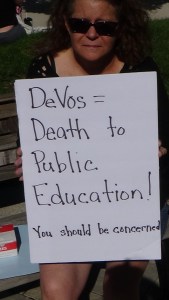 About 60 people gathered in downtown Grand Rapids yesterday, to hold a mock funeral for public education.
Organized by the Michigan Student Power Network, people met at Monument Park, most dressed in black, to eulogize Public Education in the US. Those who organized the action handed out a small document, something you might find at a funeral, which read in part:
It is with great sadness that we announce the impending death of the great institution of Public Education. After years of living on life support, Public Education is now in the terminal stages of its long battle with underfunding, privatization, segregation, and rich political donors, it would seem that the end is drawing near for this vital institution.
Shortly after 2pm, one of the organizers read the entire statement, a statement that was offered up as a eulogy in this video.
After the eulogy, the march/procession began with people carrying signs, banners, flags and coffins, each speaking to the death of public education. The group of 60 marched west on Fulton Street, then around the arena district, to end up back on Fulton Street. Here is a short video of the march/procession.
Along the route, the march/procession made stops at the downtown GVSU campus, the GRCC campus and back to Monument Park. At each stop there were speakers addressing a variety of issues such as the assault on Title IX policies, which will decrease the efforts to support those who have been sexually assaulted on school campuses across the country.
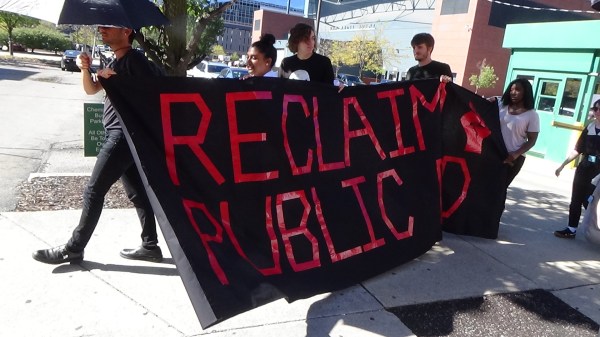
Another speaker addressed the issue of budget cuts for education, especially to programs that are offered to students with disabilities and other marginalized groups.
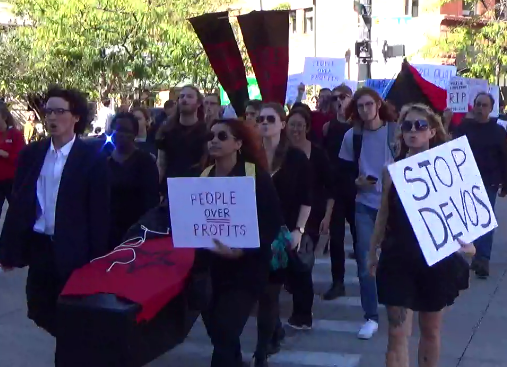
Another speaker addressed how the Secretary of Education and her policies have and will impact the Grand Rapids Public Schools. This speaker also addressed the relationship between Betsy DeVos and the Superintendent of the GRPS.

Along the march/procession route, there were a few detractors, but most people responded positively to what the action was drawing attention to. As expected, the police got involved early on in the march/procession (see photo above) and even threatened people at one point with arrest if they didn’t get out of the street.
You can follow the Michigan Student Power Network on Facebook at https://www.facebook.com/michiganstudentpower/?ref=br_rs.
Updated – Working without a contract, Kendall Faculty Association takes action to challenge Ferris Board of Trustees

(Thanks to Sarah Doherty for the updated information and for sharing the video posted here at the end.)
Earlier today, several dozen members of the Kendall College Faculty Association and 20 additional community supporters held an informational picket today. The action was called by the Kendall Faculty Association, which has been operating without a contract.
In addition, Kendall College faculty are amongst the lowest paid for a four-year public college in Michigan. This of course is all happening while the annual compensation for the four-person administration has a total cost in excess of $600,000.
We interviewed several of the faculty members about their action and what they are asking for. The first interview wis with the president of the faculty union, Adam.
There are more specific issues that the faculty at Kendall are dealing with such as the fact that they do not have a pension plan and they already pay for a portion of their health plan. These kinds of policies have historically been used to try to break unions.
We also interviewed Stefanie, another member of the Kendall faculty.
The third person we spoke with is also with the Kendall faculty and has been teaching at the college for 16 years.
Just before 11:00am, faculty members and community supporters entered the building, since the board of the college was meeting. People went in with signs and stood in the back of the room while the board members began their meeting. Some of the members of the Kendall Faculty Association were planning on addressing the board, but unfortunately, this writer had to leave and was unable to stay for that portion of group’s action.

The video below is Kendall Professor Deb Rockman addressing the administration board. Rockman was speaking on behalf of the Kendall Faculty Association. After her comments the demonstrators left the meeting and reconvened on the sidewalks outside of the KCAD federal building. They chanted under the window of the second floor room where the board was meeting, and continued to hand out fliers to people walking by.
 The objectification of women is the norm within the media world, whether we are talking about films, TV shows, advertising or video games. Read or watch any of the videos produced by educator and feminist Jean Kilbourne and it is hard to argue this assertion.
The use of women’s bodies and their identities is also prevalent as a market gimmick. This is certainly the case with a recent effort by the Grand Rapids radio station WGRD.
On September 15, WGRD posted on their website this piece, which began by saying:
There are plenty of places to go to enjoy the nightlife of Grand Rapids on a daily basis, and those of us who have lived here for a while know that we often have to explain the different bars to new people. So, we’ve come up with a comprehensive way to explain the bars in GR to your new-to-town friends by comparing them to girls we all know. You know… THOSE girls…
The posting then provides readers with 7 bars that are now referred to as “girls.” Here is an example:
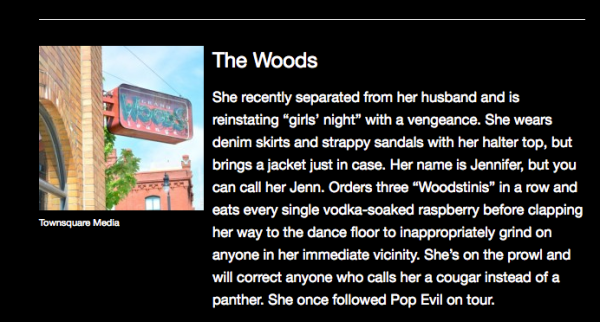
Now, a common reaction might be, so what’s the big deal? At the bottom there is a link to bars in Grand Rapids that are named after guys. So, it seems that WGRD equally objectifies men and women. While, I believe that thinking of bars as people is a stupid idea, the notion that men and women in this culture are equally objectified is just plain nonsense. 
The hyper-objectification and sexualization of women in our media saturated world happens a great deal more than the hyper-objectification of men’s bodies. More importantly, the objectification of women’s bodies must also be seen in the context of the statistical reality of how frequently women and girls are sexually assaulted by men. In other words, the consequences to the objectification of women’s bodies is much more serious than the objectification of men’s bodies.
In addition, it is worth pointing out that WGRD has a history of objectifying women’s bodies, specifically for male pleasure.
In 2004, an intern with GRIID conducted a research project looking at the objectification of women on local radio stations and their websites. WGRD had numerous links to porn sites and used to promote the Babe of the Day. Here is one of the images (above) from the 2004 study, with a WGRD DJ posing with women in bikinis.
A year later Media Mouse conducted a study of WGRD and wrote this:
local Grand Rapids alternative rock station 97.9 WGRD makes extensive use of sexism and misogyny to generate an appeal to its core demographic of 25 to 34 year old adults. The study, focusing on a month long period of monitoring this winter, found that DJ David Fox repeatedly made reference to prostitutes, strippers, sex, and “hot chicks” in addition to making racist and homophobic statements.
 DJ David Fox was eventually fired, but in 2007, Media Mouse did a follow up study and found that the hyper-sexualized content was still a problem. Media Mouse wrote:
Like the websites of other radio stations in the West Michigan area, the “Babe of the Day” feature syndicates content from “Stare Magazine” that uses the slogan “we don’t even HAVE articles” to promote its “bikini and lingerie” photographs. The image featured on WGRD’s site when this review was conducted was an example the “dismemberment” of women when they are reduced to nothing more than a single body part (or set of). Essentially, there is no humanity in the photo and instead the body is presented as the only defining aspect of the woman. Based on Stare’s website, this is quite common as the majority of the photos on the website–including the header image–feature such dismemberment.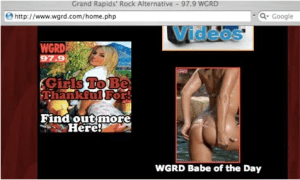
The “WGRD Girls To Be Thankful For!” feature is a contest that solicits photos from women. Women who submit photos are displayed on the website and then are eligible to win WGRD “prize packs.” Not surprisingly given the portrayals of women elsewhere on the site, photos tend to be shot in a way that represent stereotypical “male” “fantasies.”
WGRD uses the public airwaves that are technically supposed to be use to serve the public interest, not to promote the objectification of women. We encourage people to not listen to their station and to contact their Brand Manager John Walker at this e-mail John.Walker@townsquaremedia.com.
Over the past 10 days, people are deeply saddened by the devastation occurring in Puerto Rico and are pissed off at the administration’s lack of empathy for those on the island that are suffering.
Groups on all parts of the political spectrum have been weighing in on Puerto Rico, including the Grand Rapids-based Acton Institute for the Study of Religion and Liberty. In fact, there have been two postings on the Acton website in the past 2 weeks, postings that are worth unpacking.

The first post from September 22nd is entitled, Hurricanes Prove Human Solidarity: The law written on the human heart. The headline sounds encouraging, but the content is not what you think.
The Acton article, written by Steve Stapleton (a financial investment advisor), uses this opportunity to dismiss climate change before he even talks about solidarity. This is consistent with the position that Acton has taken over the years, a position that is essentially one of climate denial.
Last year, a group of US Senators identified 32 organizations in the US that effectively promote climate denial, and among those groups was the Acton Institute.
In 2007, the Acton Institute brought in a speaker from the Competitive Enterprise Institute to talk about corporate responsibility, but he also talked about how climate change was a hoax. That same year, the Acton Institute screened a climate denial documentary at the Wealthy Street Theater and it has been know for years that the Acton Institute has been the recipient of funds from ExxonMobil (beginning in 1998) for the specific purpose of publicly denying that climate change is a reality.
 After injecting anti-climate change rhetoric, the author of the Acton article finally gets to the issue of human solidarity. He only spends a few paragraphs talking about human solidarity, but in a very simplistic and vague fashion, without really providing clear examples. Essentially, the author ends up talking about charity, instead of human solidarity. Real solidarity is what is being practiced by those involved in the Mutual Aid Disaster Relief network.
Steve Stapleton then quickly shifts gears to talk about how it is not the state’s function to intervene when disasters happen. The author goes as far as to refer to states that do act in the face of disaster as, “the nanny state.” In the end, this article on human solidarity ends up being just another opportunity for the Acton Institute to push its ideological propaganda.
The second article on the Acton Blog, which addresses Puerto Rico and hurricane relief, appeared on September 28 and is entitled, How protectionism is hindering Puerto Rico relief efforts. This article was written by Joe Carter, who is the senior editor at the Acton Institute.
The author’s focus in this article is essentially to point out that government protectionist policies are the problem, specifically the Merchant Marine Act of 1920, also known as the Jones Act.
 While in principle, I would support the repeal of the Jones Act, this alone is not the problem. First, the Acton writer fails to even acknowledge the colonialist history between the US and Puerto Rico. Second, the recent history of neoliberal capitalist changes in Puerto Rico must be acknowledged, which has impacted public education, workers and health care on the island. Lastly, it is absolutely necessary to also expose those who have profited from the austerity measures being imposed on the people of Puerto Rico. The group Hedge Clippers has identified many of the individuals and corporations profiting from the economic policies imposed on the people of Puerto Rico , including the Baupost Group, a Boston-based hedge fund group that hold about a billion dollars of Puerto Rico’s debt.
Lastly, the Acton Institute and many other groups, both conservative and liberal, are also practicing a form of white savior politics, by failing to really listen to the voices in Puerto Rico who have been fighting colonialism, economic austerity and are the people on the ground who are involved in the real solidarity work with their people. These people published an important statement on Monday that speaks to what must be done, including a list of demands.
Once again, the Acton Institute demonstrates their own brand of arrogant paternalism and their endless quest to promote a free market fanaticism.
The significance of Betsy DeVos appointing John Engler to the National Assessment Board
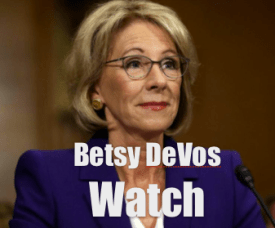 Last week it was reported by MLive, that Secretary of Education Betsy DeVos had appointed several new people to the National Assessment Board, including former Michigan Governor John Engler.
The National Assessment Board’s mission is to:
The National Assessment Governing Board was created by Congress in 1988 as an independent, nonpartisan board to set policy for the National Assessment of Educational Progress (NAEP), also known as The Nation’s Report Card.
MLive includes a brief comment from DeVos about the appointment of Engler, where the Secretary of Education says, “He is a tireless advocate for all our nation’s students, and his strong leadership will be a substantial asset to the board.”
The MLive article also mentioned that Engler has been a supporter of Charter schools and, “as governor helped launch the sector in 1993 with an effort to overhaul school funding and the eventual passage of the Michigan Charter School Act of 1994.”
The MLive article didn’t say much more than what is cited above and the same was the case for the announcement in the Detroit Free Press and the Detroit News.
Shortly after John Engler became Governor of Michigan, the issue of public education funding became an issue. Engler had proposed in the summer of 1993 to cuts property taxes by 20%. At the time, as a State Senator, Debbie Stabenow proposed a 100% cut to property taxes.
According to a story on Michigan Radio,
At the time, Stabenow’s move was widely interpreted as an attempt on her part to show how silly it was to cut taxes without specifying new revenues for the schools. If that was its purpose, it backfired. The Senate passed the amended bill the same day, the House followed a day later, and the governor immediately announced that he would sign the bill. With little debate the state had eliminated $6.5 billion in school taxes for the 1994-1995 school year. Absent further action, there would be no way to finance the public schools.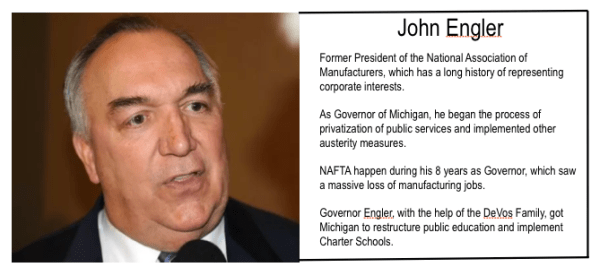
This decision to gut financing for public schools, eventually paved the way for charter schools to be introduced into Michigan.
I remember when this was all happening. Governor Engler came to Grand Rapids in the fall of 1993 to visit what was then called Henry School (now MLK School). There were parents and other activists waiting for the Governor’s motorcade. One parent held a sign that said, “Hey Engler, Remember what happened to Custer.” Engler’s motorcade did not stopped and parents were prevented from speaking with him while he visited the school.
The Michigan Radio piece then goes on to say, “Both Republicans and Democrats worked together to create school choice in Michigan – that issue was not put to voters. The question to voters was how to pay for it. Proposal A increased the state sales tax and tobacco tax to help pay for schools. It also put a cap on how much money local governments could raise to spend on schools.”
Since then the record on the performance of Charter Schools is not good, according to a recent story by The Bridge. And John Engler is certainly a part of that same legacy, a fact that seems to be missed by MLive and the other major dailies in Michigan.
For a listing of those who will join John Engler on the National Assessment Board, see the information that the Secretary of Education posted on each of the new appointees.
35 years later, American Made movie tells part of the story of US Drug Policy, the CIA and Barry Seal
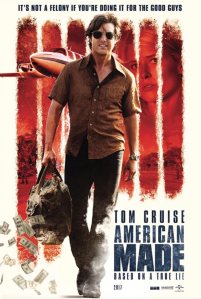 This past weekend, the Hollywood version of what pilot and drug runner Barry Seal did for the CIA in the 1980s, opened in movie theaters across the country.
If you go see the film, there are some things you should keep in mind, as Hollywood is prone to sensationalize real-life events, especially when Tom Cruise is involved. Before we talk about the role of Barry Seal and his relationship to US government agencies, it is important to point out what the black community has been telling us for years, which was something like, we don’t have the planes and the boats to bring these drugs into the US, this was always done by white people, yet it has had devastating effects in the black community.
Barry Seal was an airplane pilot who started transporting drugs into the US in the mid-1970s. He first began by bringing in marijuana, but that eventually evolved to cocaine. Seal was eventually murdered in 1986, by what were believed to be hitmen hired by Colombian drug lord Pablo Escobar.
It is important that we put the role that Barry Seal played as a drug smuggler for the CIA in solid historical context. Seal was engaged in the bulk of his drug smuggling work during the Reagan administration, which was eventually confronted by the Iran-Contra affair. This guns, for drugs, for hostages scandal underscores many of the same dynamics that Barry Seal was involved in. You can read details about the Iran-Contra scandal through the declassified documents that were put together by the National Security Archives.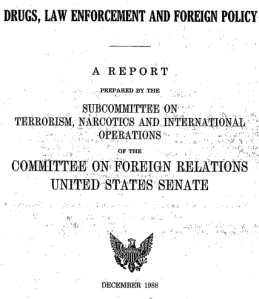
Another important historical context to acknowledge is the fact that there was a major investigation by the US Senate, which produced a report released in 1989. This investigation and report admitted that various US agencies were either fully aware of or deeply involved in facilitating the drug trade during the 1980 in Latin America.
However, there are two independent books I wanted to talk about that also shed a great deal of light on this topic and the role that Barry Seal played in drug smuggling for the US government in the late 1970s and early 1980s.
 The first book is the scholarly work done by Peter Dale Scott and Johnathan Marshall, which produced the book, Cocaine Politics: Drugs, Armies, and the CIA in Central America. Barry Seal’s involvement with illegal drug smuggling and his relationship to the DEA and CIA is cited throughout the book, but we will reference one section that has the most details on pages 98 – 102.
“In March 1983, after a DEA investigation, Barry Seal was indicted in Fort Lauderdale for a shipment of 200,000 Quaaludes. Through 1983 and 1984 Seal attempted to beat the indictment by offering to become an informant for the DEA’s Miami Field Division. His offers were refused. Then, after his conviction in February 1984, Seal found a more sympathetic audience for his problem, who arranged for Seal to stay out of jail and in the cocaine business: in March 1984, while out of jail on an appeal bond, Seal flew his Lear jet to Washington and telephoned Vice President Bush’s office; and he spoke on the street to staff members of the vice president’s South Florida Task Force.
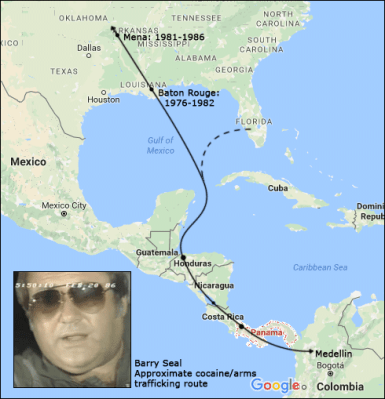 The Task Force’s DEA liaison sent Seal to DEA’s Washington headquarters, which then found a supervisor, newly posted to the Miami Field Division, who reversed previous DEA policy and agreed to handle Seal as an informant. Less than a month later, on April 6, 1984, Seal flew to Colombia for a drug shipment that soon led to one of the White House’s bigger propaganda efforts against the Sandinistas: photographs allegedly linking them to the Medellin cocaine trafficker Pablo Escobar.
The CIA was certainly involved in the preparations for Seal’s trip to Nicaragua: it was the CIA that provided the cameras for Seal’s C-123K cargo plane in 1984. It was the CIA that provided the disputed description of Seal’s Nicaraguan contact, Frederico Vaughan, as an aide to Nicaraguan Interior Minister Borge. It was certainly Duane Clarridge, the CIA’s Latin American Division Chief in charge of the Contras, who was responsible for Oliver North’s learning, the very day of Seal’s return with the film, that the photos show Vaughan and Nicaraguan interior troops. General Gorman claimed three days later that the US now had firm proof of Sandinista drug trafficking; and DEA officials soon learned to their dismay that Clarridge and North had somehow obtained the Seal photos. Within weeks both the story and the photos had been made public, and the DEA had to break off the Seal flights to Nicaragua.
The second book worth referencing on Barry Seal’s role in the US/CIA/DEA drug operations in the 1980s was journalist Gary Webb’s Dark Alliance: The CIA, The Contras, and the Crack Cocaine Explosion.
While working for the San Jose Mercury News, Gary Webb had discovered the CIA/Contra connection in California in the mid-1990s, while investigating the crack cocaine epidemic within the Black community. He wrote a four-part series for the San Jose Mercury News, which eventually became the book, Dark Alliance. 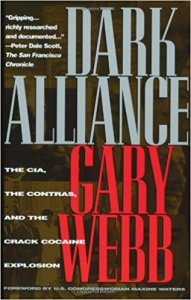
The wrecked C-123K in which those flight logs were found had a history of involvement with cocaine, the Medellin cartel, and the CIA. It was the same plane Louisiana drug dealer Barry Seal used in a joint CIA-DEA sting operation in 1984 against the Sandinistas. In that case the CIA had taken Seal’s plane – which he’d recently obtained through a complicated plane swap with the cartel – to Rickenbacker Air Force Base in Ohio and outfitted it with hidden cameras. Then Seal, who was working as a DEA informant, flew the aircraft to an airfield in Nicaragua and snapped pictures of men loading bags of cocaine into his plane.
One of Seal’s grainy, almost indistinguishable photos was later shown on national TV by President Ronald Reagan the night before a crucial vote in Congress on Contra Aid. “This picture, secretly taken at a military airfield outside Managua, shows Frederico Vaughan, a top aide to one of the nine commandantes who rule Nicaragua, loading an aircraft with illegal narcotics, bound for the United States,” Reagan announced. “No, there seems to be no crime to which the Sandinistas will not stoop – this is an outlaw regime.”
After the president’s remarks were uncritically spread across the country by the national media, both the DEA and the Justice Department admitted there was no evidence, other than Barry Seal’s claims, to support Reagan’s accusations.
A 1988 congressional investigation raised troubling questions about whether or not the Seal sting was even a real sting. It produced evidence suggesting that the whole episode had been stage-managed by Oliver North and the CIA as a domestic disinformation operation. Among other things, the House Judiciary Committee investigation revealed that the alleged Sandinista official named by Reagan, Frederico Vaughan, may have actually been working for the US government. Committee chairman William Hughes of New Jersey told reporters that “subcommittee staff recently called Vaughan’s number in Managua, Nicaragua and spoke to a domestic employee who said the house belonged to a US Embassy employee,” and that his investigators were told the house had been “continuously rented” by the United States since 1981.
Four DEA officials testified before Hughes’s committee that they’d received pressure from North and the CIA to leak the news of Vaughan’s involvement with drugs to the press. They also said North wanted to take $1.5 million in drug profits Seal had collected from the Medellin cartel and give it to the Contras. When the DEA refused to to either, the DEA officials testified, the story was leaked by the White House to the rightwing Washington Times, which was supporting the Contras both financially and editorially.
Therefore, don’t be misled by the sensationalized version of this story as depicted by Tom Cruise. In fact, if you wanted to watch a Hollywood film that more accurately tells the story of US drug policy in the 1980s and 90s, watch the 2014 film Kill the Messenger, which is about journalist Gary Webb and what he uncovered. One of the things that this film does, which is so important, is to link the crack-cocaine epidemic within the black community with the US government role in facilitating drugs coming into the US.
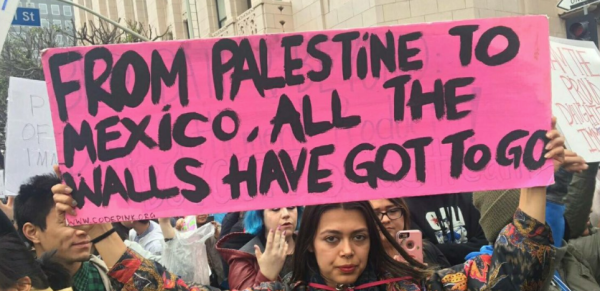
The U.S. Department of Homeland Security (DHS) announced that it would award millions of dollars in contracts to fulfill President Donald Trump’s ominous promise to expand the wall at the Mexico/U.S. border. These contracts are going to Israeli companies, as was reported by the international Boycott, Divestment and Sanctions (BDS) campaign.
The BDS campaign reported:
Israel Aerospace Industries subsidiary, Elta North America, has been awarded a contract worth up to $500,000 to build prototypes for the wall on the Mexico/U.S. border, while the U.S. subsidiary of the Israeli security and surveillance company Elbit Systems has received its third contract to build the U.S. border wall and to militarize the border area.
In 2014, the U.S. Department of Homeland Security awarded Elbit Systems a $145 million contract to erect and maintain surveillance towers along the Arizona/Sonora (Mexico) border. Already in 2006, Elbit had been subcontracted by Boeing to provide cameras and radar systems for the DHS’s Strategic Border Initiative. Earlier this month, Elbit announced a contract to deliver even more radar and surveillance towers to militarize the Mexico-US border area, boasting it offers “field proven architecture” tested on Palestinians.
Elbit Systems has a connection to West Michigan. First, the former Chairman of Elbit Systems, Joseph Parini, is on the advisory board for the Michigan Israel Business Bridge. Another advisory board member for the Michigan Israel Business Bridge is Birgit Klohs, who is the President and CEO of the Right Place Inc. here in Grand Rapids. Klohs has aggressively sought to bring Israeli companies to West Michigan and has already brought Plasan North American to Walker, Michigan.
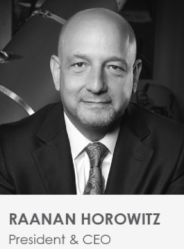 The other interesting connection between Elbit Systems (which has new contracts for the US/Mexican border wall) and West Michigan, is the current CEO of Elbit Systems, Raanan Horowitz. According to the Elbit Systems website, Horowitz, “received a Master of Business Administration from the Seidman School of Business at Grand Valley State University in Allendale, Michigan.”
 Some communities are organizing actions on November 9, for a World Without Walls. This day of action is to make the connection between the illegal Israel wall on Palestinian land and the US wall that will be expanded along the US/Mexican border. It would seem that Grand Rapids might want to join is this global day of action, considering the connections between the Israeli companies contracted to be involved in the US/Mexican border wall and the ties that one of those companies has to West Michigan.
Grand Rapids, ArtPrize and Whiteness
Recently, I was driving back into Michigan on highway 94 and saw a billboard just after re-entering the state that read, Cool City – Hot Art. The billboard was created by Experience GR and also included the words food, beer and music.
This billboard, in many ways, is reflective of the economic, political and cultural climate that exists in Grand Rapids. If we were to more honestly depict in words what the reality is for Grand Rapids, this is what the billboard would actually look like.

Grand Rapids is such an overtly White City. The whiteness permeates everything about the city, from the hyper-religious reality to the heavy handed entrepreneur/free market/philanthropy crap that is constantly shoved down our throats. This is also the case with the litany of non-profits that exist, with their emphasis on practicing white savior politics. Then there is the cultural climate in Grand Rapids, where every organization claims to celebrate diversity, but more often than not engages in cultural appropriation or is patronizing to the populations they “serve.” Most organizations, whether it is city government, the Chamber of Commerce or culture-focused say they love black and brown people, but only if they remain loyal to whiteness. If people of color dare to challenge the whiteness that permeates Grand Rapids, they will be further marginalized and punished.
When I say whiteness, I am not just talking about white people, I am talking about a way of being in the world that centers and privileges white reality and white values. Now ask yourself who has economic and political power in this city? Who has power to impose their will on other people or whole communities? What entities spend a great deal of time celebrating Grand Rapids and all of the lists that the city has been included in over the past 5 years? Who in this city makes it a point to say that Grand Rapids is a great place to raise a family? The answer is always white people. Whether we are talking about the DeVos family, the Meijer family, Secchia, Jandernoa, Rockford Construction, the Right Place Inc., the Art Museum, the Christian Reformed Church, the commercial news media, Experience GR, Mel Trotter Ministries or ArtPrize.
Notice in the altered billboard above that the words, beer, art and music are crossed off and replaced by poverty, racism and gentrification. While the dominant culture in Grand Rapids likes to think of beer, art and music, a disproportionate amount of those in communities of color experience, racism, poverty and gentrification. Whiteness says we need to celebrate the good things in our city, and that is because they “good” things disproportionately happen to white people.
For communities of color, the reality is quite different. Think about this. Why are there a disproportionate amount of black and brown folks living in poverty in Grand Rapids? Why are there a disproportionate amount of Black and brown folks in the Kent County Jail or facing probation in this city? Why are the public schools predominantly made up of black and brown students? Why are the neighborhoods that are experiencing gentrification disproportionately made up of black and brown folk? Why are black and brown neighborhoods disproportionate targeted by the GRPD? If Grand Rapids is so welcoming, why the hell are so many people in the immigrant and undocumented community living in constant fear? I mean, if Grand Rapids is such a cool city and the best place to raise a family, then why the hell are so many people from communities of color struggling to survive or wanting to get the hell out?
ArtPrize and Whiteness
We are in year nine of ArtPrize and that means that for a few weeks thousands of people will descend upon Grand Rapids, look at art, stay in hotels, eat in downtown restaurants and park their cars in every possible space imaginable. In addition, the city always tries to keep all these visitors from having to deal with those on the street asking for money or sleeping in storefront entryways.
Then there is the experience of many artists of color who are either outright being censored for their work or are marginalized by the lack of exposure or the intentional omission of art venues that feature works by artists of color (Cultura Collective). This is in part because ArtPrize is primarily about downtown Grand Rapids and that it has to offer whiteness. There are hotels, restaurants, bars and music venues because those with power in this community has made sure that the downtown has been heavily invested in. When you think of the Grand Rapids Brewing Company, the BOB, the Amway Grand Plaza, the DeVos Convention Center, the Art Museum or the UICA, what kind of spaces do you think they represent? These are white spaces, plain and simple.
Then there is the very nature of ArtPrize, which is often billed as a free wheeling art exhibit where anything goes. However, apart from the fact that is is an event that is bankrolled and run by members of the DeVos family, the event is really just another way to promote and celebrate the the free market. Artprize awards a select few with cash prizes, some of which are chosen by handpicked jurors and the rest are voted on by the public. Those artists that with through the public vote shows just how democratic the event truly is, according to the ArtPrize founder Rick DeVos. So rich people funding an event that financially benefits them and their friends, while the public gets to vote is called democracy? Sound familiar. This is exactly what the DeVos Fanily does in the political arena, where they contribute millions of dollars to candidates to make sure that the legislation that gets passed protects and expands their wealth and the other values they want to impose on the rest of us.
There was a recent article in the New York Times about Artprize entitled, How a Quirky Art Prize tied to the DeVos Family Went Political. Like most stories about ArtPrize, the NYTs piece completely misses the point. ArtPrize doesn’t have to be heavy handed about the content of the art submitted. In fact, they could care less about the content. What Rick DeVos and his family care about are: the PR benefits of the event that gets people to say, “they’ve done so much for this city”; the amount of money they make from the annual event; and the hope that people will be less inclined to examine the power and influence their family has in West Michigan.
But there is also another aspect to the spectacle that is ArtPrize, which brings us back to the notion that Grand Rapids is a White City. The racism/white supremacy, poverty and gentrification that plagues thousands of people in this city will still plague people in this city after ArtPrize is over. Those who have political, economic and cultural power in this city, will still have that power after ArtPrize. ArtPrize does not and will not change the realities of racism/white supremacy, poverty and gentrification. ArtPrize does maintain the status quo and business as usual, despite its appearance. In a word, ArtPrize maintains whiteness in Grand Rapids.
So, to those of us who are descendants of Europeans and Euro-Americans, we have to come to terms with the reality that Grand Rapids is a White City. What some people call West Michigan Nice, is essentially whiteness. West Michigan nice is not wanting to upset anyone, it’s avoiding conflict and it is not wanting to confront the ugly reality of our history or the present.
At this point, maybe readers will expect some sort of plan or suggestion on how Grand Rapids can stop being a White City. However, as I have learned over the years from those in communities of color, we all need to figure this shit out and stop wanting people to provide us with a fucking blueprint on how to stop participating in white supremacy. We (us white folk) need to do the hard work, get over our fragility and start working on dismantling white supremacy in all its manifestations.
MLive, census data and the politics of class
Back on September 14, MLive ran a story entitled, “Michigan’s median income is up and poverty is down, new census data shows.” 
The headline is based on a comparison between the 2014-2015 data and the 2015-2016 data, which you can search by county, with the help of the cloud database embedded in the article.
However, the MLive headline is problematic on many levels. First, while poverty is only slightly down from the previous, it is still affecting 15% of the total Michigan population and in communities of color, those numbers are between 20 – 30% for Black, Latino and Native communities.
Second, the media household income is not a great way to make determinations about economics. For instance, there are a growing number of very wealthy people living in Kent County. The number of millionaires in Kent County increased from 407 in 2010, to 600 in 2014. We also know that there are numerous individuals and families in the area that are billionaires. Therefore, even though the wealth gap is rather significant, the median income will be higher based on the fact that there is a class of people that are disgustingly wealthy.
Third, according to a study done by the Economic Policy Institute last year, the wealthy gap in Michigan was most pronounced in Grand Rapids/Wyoming. Unfortunately, there is no attempt in the MLive article to assess the wealth gap. There was a follow up MLive article, based on the census data, which looked at the wealthiest communities in Michigan. This was also based on median income, which still doesn’t provide a truly accurate sense of the gap between those with tremendous wealth and the rest of the population.
Fifth, the federal government determination for those living below the poverty line is also highly problematic. There are too many factors, especially the rising cost of housing and medical expenses, which can make it difficult for a family of four that earns $50,000 a year to make ends meet.
In comparison, if you look at the data from DATA USA for Kent County, you have a somewhat better sense of the disparities in income. This chart below is a better indication of the amount of people who earn less than $50,000 a year, compared to those who make more than $50,000 a year. Clearly, over 50% of the population in Kent County makes less than $50,000 a year. What is interesting, is the spike in people making over $200,000. Unfortunately, it is hard to know how many of them are millionaires and billionaires.

Lastly, it is worth noting that the only person cited in the MLive articles on income and the most recent census data, is an economist for the Upjohn Institute for Employment Research. The economist had this to say, “It’s been a hard slog, but the good news is that things are continuing to look better,” This statement doesn’t really tell us anything and we should also just ask ourselves the question, “things are continuing to look better for whom?”
It’s too bad we don’t have regular reporting on economic realities. What if working class people and those experiencing poverty were featured in the reporting on MLive? Oh, I forgot, then we wouldn’t have enough space left for print and electronic stories about ArtPrize.
 Grand Rapids Institute for Information Democracy