 For years I have been hearing from people in the community, some who even identify as progressives, that Rick DeVos is different from his parents and grandparents.
The first time that someone suggested that Rick DeVos was different than his family’s right-wing history, was just before the first year of ArtPrize. I was told that I just needed to sit down and talk with him and I would see that he was different.
I responded to this claim that unless he has distanced himself from his family’s money and was willing to publicly come out against their stance on issues like gay marriage, labor unions, public education, religion, politics and capitalism, then he is not really operating any differently than the rest of his family.
Rick solidified his continuation of the DeVos Family ethos, when he founded (with Dick & Betsy’s money) 5 x 5 Night and Start Garden. Venture capitalism and entrepreneurism are easy when you come from billionaire parents and grandparents, but Rick wanted to make his own mark in that arena. His most recent project is WakeStream Ventures.
However, if one needed more evidence that Rick DeVos, the son of Dick and Betsy and the grandson of Rich and Helen, was embracing the family’s ideological history, then one need to look no further than the fact that Rick DeVos is now a board member of the Acton Institute for the Study of Religion and Liberty.
Rick DeVos follows in his mom’s footsteps, as a board member of the Acton Institute. Betsy DeVos’ mother, Elsa Prince Broekhuizen, is also a current board member. In addition to serving on the board of directors, DeVos Family members have given millions of dollars to the Acton Institute over the years.

By now serving on the Acton Institute board, Rick DeVos further solidifies his commitment to the same right wing, pro-capitalist and religiosity that his family has embraced for decades. After all, the Acton Institute values the wedding of religion and capitalism, which works beautifully for the DeVos Family to justify their wealth and their politics.
The Acton Institute despises organized labor, public education, has taken hundreds of thousands of dollars from Exxon/Mobil to promote climate denial, supports US imperialism and regularly posts anti-Islamic articles on their blog.
Therefore, one cannot sit on the board of an organization that zealously embraces a far right ideology and not support those same principles. The guy who once said he just wants to see “crazy shit happening all over Grand Rapids,” is nothing more than a neo-liberal capitalist, who defends an anti-union, anti-muslim, anti-public education and US imperialism ethos. Rick DeVos is clearly following in the footsteps of Rich, Helen, Dick and Betsy DeVos.
Grand Rapids City Budget: Omissions, lack of vision and the possibility of Participatory Budgeting
On Sunday, May 27, MLive ran an article headlined, 10 things to know about Grand Rapids’ $587M budget.

The 10 things that MLive wants us to know about the 2018 City Budget are:
- Property taxes will stay the same
- Income tax revenue will increase
- $1M for police-community relations
- $20 million in LED streetlights
- River restoration
- Two fire stations will be replaced
- Trees
- Staffing up communications office
- Seed money for affordable housing fund
- 32 percent of budget in savings
As with all media, these 10 things we should not are crafted and are not necessarily the most relevant things about the 2018 City Budget. There are definitely some things that are omitted from the MLive story and it is also worth noting that there are things about the article that are problematic, in that the article provides no strong context, nor is there any analysis of these 10 points or the city budget as a whole.
One point about these 10 things that MLive thinks we should know, is not they they are completely irrelevant, but that these items are presented primarily based on numbers, on costs. For example, point number three, tells us that the city is going to spend $1 million on police/community relations, yet they fail to mention that a full third of the entire budget is dedicated to the GRPD. One third of the entire budget is roughly $195 million.
A second observation is that in point 8, MLive tells us that the city is planning on adding more communication’s staff, based on recommendations from an audit done by Truscott Rossman. Truscott Rossman is a PR firm that was founded by John Truscott, the former spokesperson for Michigan Governor John Engler. Truscott Rossman has primarily worked with corporate clients, but also has a history with the City of Grand Rapids.
A third point worth making is about point number 9, the affordable housing fund. While setting aside money for such efforts, there is no real discussion about how the amount of funds the city will set aside is grossly inadequate, but there is also no information about how it will be administered and who gets to decide about affordable housing. Will construction companies and non-profit housing agencies get to decide or will those struggling to find affordable housing have a say it how these funds will be used? All indications so far, suggests that those who have made up the Mayor’s Affordable Housing Task Force will get to decide, which doesn’t include a single person who is struggling to find affordable housing.
A fourth point has to do with point number 10, which says the City will be operating in the black, with funds in a savings account. Here it is important to point out that revenue sharing is left out of the MLive article all together. Like all municipalities, Grand Rapids has lost a ton of money that they used to get through revenue sharing from the state. One of the main projects that the Snyder administration took on soon after it began in 2011, was to impose neo-liberal economic policies on municipalities, specifically austerity measures. These austerity measures were to push the privatization of former public services and to eliminate public sector employee benefits and pensions.
The fact that the city is experiencing a savings is not so much about good fiscal management, but about embracing neo-liberal capitalist principles of attacking public sector unions and adopting privatization.
 The last point about the MLive article is that it mentions near the beginning that people will have a chance to comment on the budget during the June 5th City Commission meeting. While this may seem like the city is really seeking public input, this is really a weak and lazy approach to public participation into determining the budget.
What the City of Grand Rapids needs to do, is to provide a mechanism for the public to democratically decide on how budget funds should be spent. In fact, there is an international movement called Participatory Budgeting, which provides an important model on how people who live in communities get to decide on budget priorities. IN many cases, those who participate in this process will be involved in making decisions in a process that takes a year and then continues for 12 months every year to ensure that there is real transparency and real democracy for anyone who wants to take part in the process.
Grand Rapids Power Structure: Part III
This is our third article in our series on the Grand Rapids Power Structure. In the first piece, we provided an overview of the Grand Rapids Power Structure, along with a framework for how those with power function in this city.
In our second piece, we looked at the most powerful family in Grand Rapids, the DeVos Family. In today’s post we are going to identify the other members of the Grand Rapids Power Structure and what role they play in influencing the economy, politics and social dynamics in this community.
There are numerous individuals and families that also wield tremendous power in Grand Rapids. In fact, there are too many to name, but we want to provide some insight into those who have a higher profile within the local power structure.

Meijer Family
Next to the DeVos Family, the Meijer Family has the largest economic and political impact in Grand Rapids. According to the 2018 Forbes listing of the wealthiest people, Doug and Hank Meijer are together work $6.1 billion. Doug and Hank are co-chairs of the Meijer Corporation, which is one of the largest retail chains in the mid-west.
Like the DeVos family, the Meijer Family name can be seen on numerous buildings in the Greater Grand Rapids area. There is the Meijer Gardens and the Meijer Broadcast Center. However, the largest area in which the Meijer Family wields power in with the Meijer Corporation. For years, Meijer has taken advantage of local communities by strong-arming municipalities for tax breaks when they chose to build a new store. Taxpayers all across the mid-west have provided the Meijer Corporation with millions in tax subsidies, even though those communities have no real say in providing these subsidies.
Politically, the Meijer Family uses its wealth to fund candidates. At the federal level, Meijer Inc. has contributed over $1.2 million to candidates, primarily to Republican candidates.
At the state level, Meijer has also used its wealth to influence electoral politics. According to the Michigan Campaign Finance Network, the Meijer Family contributed $333,300 during the 2015-2016 election cycle in Michigan, with that money going to Republican candidates and groups like Business Leaders for Michigan. Business Leaders for Michigan is made up of the CEOs of Michigan’s largest corporations.
Van Andel Family
Along with the DeVos Family, the Van Andel Family was responsible for the founding of the Amway Corporation. Jay Van Andel, now deceased, has been succeeded by his sons, who have continued to influence Grand Rapids, both economically and politically.
The Van Andel Family is worth $4.8 billion. Steve Van Andel was until last year, co-President of the Amway Corporation, along with Doug DeVos. Steve’s brother David, is the CEO of the Van Andel Institute, which was founded in 1996, here in Grand Rapids. The Van Andel name is also visible on many buildings in the area, like the Van Andel Arena and the Van Andel Public Museum.
The Van Andel Family foundations contribute to numerous far right entities nationally, like the Heritage Foundation and locally to Spectrum Health and the Grand Rapids Public Museum.
Politically, the Van Andel Family has contributed a sizable amount of money to influence electoral politics. The Van Andel Institute does its own share of lobbying at the federal level, but the members of the Van Andel Family have contributed a substantial amount of money in Michigan electoral politics. According to the Michigan Campaign Finance Network, the Van Andel Family contributed $254,000 in the 2015-2016 election cycle. In the current election cycle, the Van Andel Family has contributed to numerous candidates in West Michigan, most notably State Senator Peter MacGregor.
The Van Andel Family also has a long history of supporting hyper-conservative Christian organizations and has had representation on the national, state and Grand Rapids chapters of the Chamber of Commerce.
John Kennedy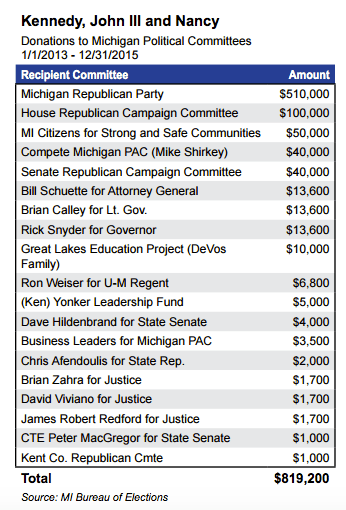
John Kennedy is the CEO of Autocam Corporation. Kennedy has a long history as a conservative businessman. The Autocam CEO has been a vocal opponent of women’s reproductive rights and was outspoken against the Affordable Care Act.
Kennedy, a Catholic businessman, is also a major contributor to the Republican Party. The graphic on the right here shows where he spent his money to support politicians and influence public policy in Michigan between 2013 – 2015. In 2016, John Kennedy contributed $589,700 to state races and is continuing this trend in the current election cycle by contributing several hundred thousand between January of 2017 and April of 2018.
John Kennedy also sits on the boards of numerous organizations in West Michigan, a topic we will explore in our next post on the Grand Rapids Power Structure.
Peter Secchia
Peter Secchia is the former CEO of Universal Forest Products and was the US Ambassador to Italy during the Reagan Administration.
Secchia is a name that can be found on numerous buildings on the GVSU downtown and Medical Mile campuses, because of his large contributions to these construction projects.
Peter Secchia was named to chair the Secchia Commission in 1994, by then Michigan Governor John Engler. Engler has served on numerous boards and is also a major contributor to Michigan State University.
In the 1980s, Secchia started a real estate property management company called Sibsco.
Like the other members of the Grand Rapids Power Structure, Secchia has contributed hundreds of thousands of dollars to political campaigns. During the 2015 – 2016 election cycle, Secchia contributed over $200,000 and in the current election cycle, Secchia has already contributed tens of thousands of dollars, all of which to Republican candidates and Political Action Committees.
In 2006, Peter Secchia hosted an event at his home in East Grand Rapids, which featured then Vice President Dick Cheney. The event was protested by members of ACTIVATE, because of Cheney’s ongoing support of US war crimes in Iraq. The police prevented protestors from getting close to Secchia’s home and said that protesting in residential areas of the city was prohibited. The West Michigan chapter of the ACLU became involved and got that ordinance overturned in 2007.
Michael Jandernoa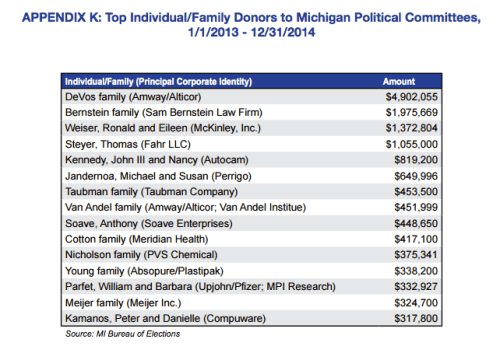
Jandernoa is the former president of Perrigo. In recent years, Jandernoa has been involved with 42 North Partners, which he created with his wife Sue. In addition, Jandernoa serves as General Partner at Bridge Street Capital Fund I, L.P, where he sits on the Executive Committee with John Kennedy. He is the Co- Founder of Grand Angels, LLC., which is another investment capital entity in Grand Rapids.
You can see from the chart here on the right that Jandernoa has used his wealth to influence state politics. In addition, according to the Michigan Campaign Finance Network, Jandernoa gave $437,500 in the 2015 – 2016 election cycle (the 9th most in the state) to the Republican Party and has already contributed tens of thousands in the 2017 – 2018 election cycle, most notably to candidates from the Greater Grand Rapids area, like State Senator Peter MacGregor ($10,000).
Jandernoa also sits on the boards of numerous groups that are part of the Grand Rapids Power Structure, which we will explore in our next article.
Mike VanGessel
While VanGessel’s personal wealth does not match that of the other people listed above, his role in influencing community outcomes is significant.
As CEO of Rockford Construction, VanGessel has positioned his company to win millions in tax breaks from the City of Grand Rapids. Since Rockford Construction moved to the westside of Grand Rapids, the company has made it a mission to gentrify the near westside, tearing down old housing and commercial property to primarily build housing and new commercial space that benefits the professional class.
In addition to its westside expansion, Rockford Construction has partnered with the DeVos Family and their Amplify GR project, which seeks to redesign whole neighborhoods in the southeast part of the city. Rockford Construction has been looking to gentrify part of southeast Grand Rapids, at least since 2014, when they first began designing plans to transform that part of the city, even before people who lived there knew what they were up to.
VanGessel also does not use his money to influence electoral politics to the degree that the other members of the Grand Rapids Power Structure do, but he is involved in numerous boards and organizations that play a major role in determining policy in the area.
J.C. Huizenga
J.C. Huizenga is the Chairman and Founder of the National Heritage Academies, a Charter Schools entity which has benefited tremendously from the privatization of public education trend over the past two decades.
According to the Michigan Campaign Finance Network, J.C. Huizenga contributed $260,600 to influence state policy in the 2015 – 2016 election cycle (all to the Republican Party). So far in the 2017 – 2018 election cycle, Huizenga has contributed to several candidates, along with making a $25,000 contribution to Bill Schuette.
J.C. Huizenga sits on the board of the right wing think tank, the Mackinac Center for Public Policy and is involved in several area organizations that make up part of the Grand Rapids Power Structure, which we will explore further in our next posting.
Blake Krueger
Blake Krueger is the CEO of Wolverine Worldwide, manufacturer of footwear, and now the target of one of the worst environmental contamination cases in West Michigan in decades.
According to 2016 records, Krueger’s wealth was estimated at over 7 billion dollars. The Wolverine CEO has profited handsomely while the company has downsized its workforce, eliminating hundreds of jobs in recent years.
The CEO of Wolverine World Wide, Blake Krueger, is also a significant contributor to political candidates, as a means of buying influence at the state level, particularly with the GOP. In the 2011-2012 election cycle, the Wolverine CEO contributed $49,500 to the GOP. Krueger has continued to contribute big money to the GOP since 2012 and specifically has contributed directly to Michigan Governor Rick Snyder’s campaigns.
The Grand Rapids Power Structure consists of many other individuals, like Grand Rapids Chamber CEO Rick Baker, CWD partner Sam Cummings, Huntington Bank President Jim Dunlap, Jeff Connolly (Blue Cross/Blue Shield), Matthew Hayworth (Hayworth Inc), Doug Small (Experience GR) and many more.
In our next posting, we will look at the organizations that have have a tremendous political and economic influence in Grand Rapids, as well as the interlocking relationships between the members of the Grand Rapids Power structure and these organizations.
On May 16th, Secretary of Education, Betsy DeVos, was once again speaking at an event hosted by an organization that funds private, religious education.
DeVos was the featured speaker at a fundraiser for the Alfred E. Smith Foundation, a foundation that supports Catholic Education. Named after a former New York Governor, the Alfred E. Smith Foundation not only supports Catholic education, they provide grants to other Catholic social service agencies.

In her comments at the annual fundraiser by the Alfred E. Smith Foundation, DeVos cites Pope Leo the 13th:
“The contention that the civil government should — at its option — intrude into and exercise intimate control over the family and the household is a great and pernicious error.” Pope Leo was right! Government can’t know the needs of individuals better than a parent, a pastor or a friend.
Not surprising that DeVos would use such a quote from Pope Leo the 13th, since it justifies her position of limiting government influence in private education and her undermining of public education.
DeVos goes on to talk about changes to state constitutions that would prohibit tax dollars to support private, religious schools – something that DeVos ironically calls bigotry.
DeVos continues with an ideological framework around education, when she says:
That’s why I’m committed to expanding education freedom for families across America. You’ve heard me described as “pro-school choice.” Well, I am, but choice in education is not limited to a student picking this building or that school – using this voucher or that scholarship. And it’s not public versus private. Parochial versus charter. Homeschool versus virtual. Choice in education is bigger than that.
Choice is about freedom! Freedom to learn, and to learn differently. Freedom to explore. Freedom to fail, to learn from falling and to get back up and try again. It’s freedom to find the best way to learn and grow…to find the exciting and engaging combination that unlocks the God-given potential in every individual.
DeVos then refers to a student in Grand Rapids, Michigan, who received a scholarship from Sacred Heart Academy. Sacred Heart Academy, used to be Sacred Heart of Jesus School, but in 2013-2014, the school changed it’s focus under the leadership of Fr. Robert Sirico, the founder of the rightwing group, the Acton Institute.
Fr. Sirico utilizes the resources of the Acton Institute, to provide programing at Sacred Heart Academy, which is reflected in the curriculum and programing offered at the school. It is no surprise that Betsy DeVos speaks highly of Sacred Heart Academy and Fr. Sirico, especially since the DeVos Family has contributed millions to the Acton Institute and Betsy herself, used to be a board member of the free market think tank.
DeVos continues in her speech at the foundation to talk about a program in Pennsylvania, where millions of dollars were redirected from public education to private education and the importance of 529 plans.
529 plans are a market-driven plan for families to save money for their children’s college tuition. However, last year, some of the provisions of 529 plans were changed, which allow families to cover tuition not only at colleges and universities, but also at private elementary and high schools. You read that correctly, it provides parents a way to use government money to help pay for private education. Below is a useful graphic which shows how 529 plans work and the December 2017 changes.
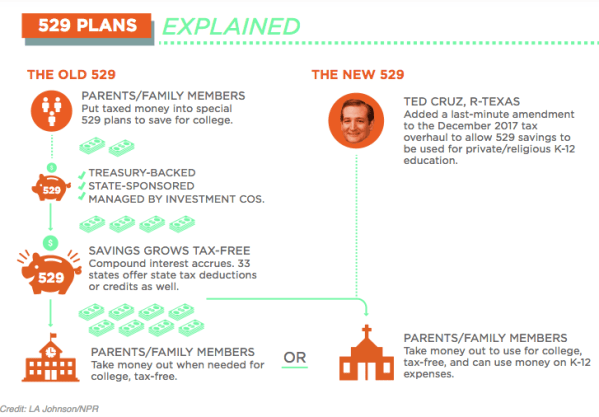
Secretary of Education Betsy DeVos, once again demonstrates her commitment to privatizing education and using religion as a means to achieve her goals.
Proposed Trump Immigration Policy would further punish immigrant families, especially children
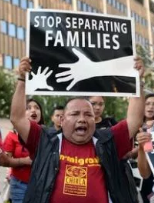 The US government’s war on immigrants just added a new component. The Trump administration will soon be issuing a new regulation that would:
“jeopardize the status of millions of immigrants who use—or whose children use—health, housing, nutrition, and other key services and supports. It would do this by radically altering the way in which federal officials evaluate whether certain immigrants are—or are likely to become—a “public charge.”
The concept of “public charge” first appeared in U.S. immigration law in the Immigration Act of 1882, which prohibited any immigrant “unable to take care of himself or herself without becoming a public charge” from being admitted to the United States. Since 1903, the Immigration and Nationality Act has included public-charge considerations in two contexts: (1) whether immigrants seeking entry to the United States or seeking legal permanent residency are at risk of becoming a public charge and thus deemed inadmissible and (2) whether immigrants who have been admitted to the United States have become a public charge within five years of entry. The Act does not define “public charge,” but in each context a public-charge analysis has developed through case law and agency guidance.
The Trump administration has been threatening to enact changes to the current “public charge” policy, since 2017. The goal behind this change is twofold: (1) to make it harder for immigrants who might use public services—such as health and nutrition programs—to come to the United States and settle here permanently and (2) to force families to choose between the food, housing, and health care they need and being with the people they love.
The draft of these policy changes can be viewed at this link. According to analysis from the Kaiser Family Foundation, the proposed policy changes would impact the immigrant community in the following ways:
- Individuals who are determined to be a “public charge” can be denied lawful permanent residence or entry into the U.S., and, in very limited cases, deported. Under current policy, individuals may be determined a public charge if they rely on or are likely to rely on public cash assistance or government funded long-term institutional care. Current policy does not allow the federal government to consider the use of non-cash benefits, such as health and nutrition programs, in public charge determinations.
- Under the draft proposed policy, the federal government could consider previously excluded health, nutrition, and other non-cash programs in public charge determinations. In addition, the changes would newly allow the federal government to take into account use of programs by citizen children and other family members in making a public charge determination.
- The changes would likely lead to decreased participation in Medicaid, the Children’s Health Insurance Program (CHIP), and other programs among legal immigrant families, including their citizen children. The primary group affected by the changes would be individuals seeking a green card through a family-based petition. However, the changes would likely increase fear and confusion among all legal immigrant families, leading to decreased participation in health coverage and other programs for themselves and their children. Decreased participation in these programs would contribute to more uninsured and negatively affect the health and financial stability of families as well as growth and healthy development of their predominantly U.S.-born citizen children.
The Kaiser analysis finds that between 657,000 to 1.5 million citizen children could become uninsured if the proposed changes are implemented.
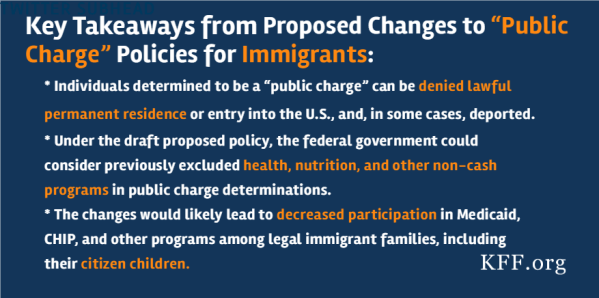
The National Immigrant Law Center calls these proposed changes another “attack” on immigrants by the Trump administration. Calling it an attack is not hyperbole, since it will increase the already high level of fear in the immigrant community, plus it will cause real harm for immigrant families who will not be able to access these public resources.
The Michigan Immigrant Rights Center (MIRC) believes that the Trump administration will make these proposed changes in July of 2018. The MIRC and the Michigan League for Public Policy have teamed up to combat this proposed policy.
In addition, there is this video that provides solid information and analysis on the “public charge” policy. The video is just over 30 minutes, but the details are important.
West Michigan’s Wealthiest Families funded the Trump Transition after the 2016 Election
 I recently came across an article on from the well-researched site of the Center for Public Integrity (CPI).
The article is about the corporations and billionaires in the country that provided funding to Donald Trump after the 2016 Election in November.
According to CPI, “The nonprofit formed to handle President Donald Trump’s transition raised about $6.5 million in private contributions, fueled in part by corporate interests, billionaires and lobbyists, according to a Center for Public Integrity analysis of a new federal filing.”
According to Federal law, the transition of administrations only allows donations up to $5,000 at one time. This money is separate from the money raised during the election and could only be used after the election results were in. As you can see from the list below, most of these contributions took place in December of 2016.
Amongst the billionaires who contributed to Donald Trump’s transition to the White House, were the DeVos Family and the DeWitt Family (from Holland).

Other notable contributors to the Trump Transition were Mark Meijer ($5,000 on 12/14/2016) and Peter Secchia ($5,000 on 12’15/2016)
Again, this money is separate from the millions of dollars contributed by these same billionaires to the Republican Party before the 2016 Election. You can research this data from the Center for Responsible Politics, especially through their local search engine. Here is a link to the data from the 49503 zip code, which is where the DeVos Family claims to reside. The reality is that the 49503 zip is where their Grand Rapids headquarters are for the Windquest Group, RDV Corp and all the various family foundations.
This information is important as a reminder that these families helped to elect an administration that has been waging war on immigrants, the black community, organized labor, the LGBTQ community, women, working class families, the environment and public health. It is also important to mention that the Trump administration has been involved in war crimes abroad, selling weapons to dictatorships and creating greater political instability around the world.
 On Friday, MLive reported that the Kent County Sheriff’s office had recently order a, “rapid deployment vehicle” to combat violators of Michigan’s medical marijuana law and illegal grow operations.” Costing taxpayers $175,000, the Sheriff’s office had converted a Ford F-59 step van into a vehicle that would be used to, “deploy tactical teams for drug search warrant raids.”
According to MLive, about two thirds of the cost of this new anti-drug vehicle had come from the state of Michigan and the other $54,812 would come from the County’s Drug Forfeiture Fund. Like all law enforcement agencies, whenever they make drug-related arrests, they often seize assets belonging to those arrested – homes, boats, cars, tech equipment, money, etc.
Again, according to the MLive article:
In 2017, the multi-jurisdictional Kent Area Narcotics Enforcement Team conducted 613 marijuana-related arrests, confiscated 1,238 marijuana plants, seized about 138 pounds of marijuana, dismantled 26 marijuana-growing operations and inspected four medical marijuana facilities, according to the state grant request.
Only 138 pounds of marijuana was seized last year. That’s it? This is not a serious quantity of marijuana seized for the entire Kent County area. According to 2015 data, there are 636,369 people living in Kent County and only 138 pounds of marijuana was seized. This is an insignificant amount of marijuana, yet the county commissioners unanimously approved the use of taxpayer funds for a new anti-drug vehicle that will be used to deploy tactical teams for drug raids. How is this possible?
What makes this news even more astounding is that the entire 19 member Kent County Commission voted to approve this travesty.
On March 8th, the Kent County Commissioners adopted the following resolution:
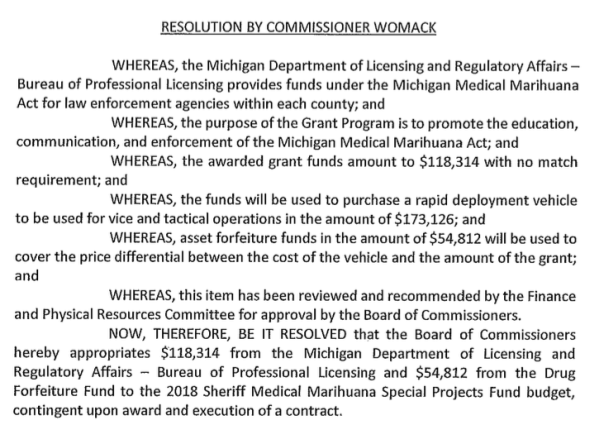
Some may argue that there is no surprise with the majority Republican Commissioners voting for this resolution, but why did the five Democratic Commissioners support such a measure? In addition, why did a Democratic Commissioner introduce the legislation?
I asked former Kent County Commissioner Candace Chivis to comment on the decision by the current commissioners. Here’s what she had to say:
I think that it’s reprehensible that every democrat voted for this but my time on the board proved that democrats often give lip service to diversity and then vote in ways that hurt the black and Latino populations. I am not sure why Robert Womack would have introduced this and voted for it. It’s apparent that he didn’t think about his constituents at all when he voted for this. It makes me wonder how exactly he thinks he’s serving the community.
Kent County is in the grips of a serious opiate crisis and they waste money on something as useless as this? Never mind that it’s a proven fact that state’s with medical marijuana have lower rates of opiate use. In the past year, I have seen people overdose in gas stations, fast food restaurants, on the street, in the library and in the park. Why isn’t Sheriff Stelma concentrating his energies on finding the heroin dealers instead of trying to put licensed marijuana growers out of business.
The enactment of this policy is absurd, particularly since Marijuana use and possession has been decriminalized in the city of Grand Rapids. The board of commissioners, particularly their democratic members, obviously didn’t do their due diligence.
What will this decision to deploy tactical teams for marijuana raids mean for medical marijuana growers and dispensers? What will this decision have for communities of color, who are disproportionately targets of drug raids and drug violations? It seems clear that the War on Drugs is alive and well in Kent County.
 In the past year there has been an effort to pass legislation in Michigan that make it a more severe crime for people to target law enforcement officers. The Michigan legislation was HB 4590, and was introduced by Rep. Kesto from the 39th House District.
Now there is legislation at the Federal level, which would do the same thing that many state legislatures have attempted to do. On Wednesday, May 16, the House passed HR 5698, also known as the Protect and Serve Act of 2018. This federal legislation reads:
Whoever, in any circumstance described in subsection (b), knowingly assaults a law enforcement officer causing serious bodily injury, or attempts to do so—
(1)shall be imprisoned not more than 10 years, fined in accordance with this title, or both; and
(2)shall be imprisoned for any term of years or for life, fined in accordance with this title, or both, if—
(A)death results from the offense; or
(B)the offense includes kidnapping or an attempt to kidnap, or an attempt to kill.
HR 5698 pass by a vote of 382 – 35. Of the Michigan members of Congress, every one of them vote for the Protect and Serve Act of 2018, except for Rep. Justin Amash from the 3rd Congressional District. All of the other 13 Representatives from Michigan, both Republican and Democrat, voted in favor of this legislation.
The Bi-partisan Support for Cops
Supporting police departments has always been a bipartisan affair in the US, ever since the days when cops were hired to hunt down runaway slaves. Most members of Congress have always stood behind local state and federal law enforcement agencies. This was the case during the civil rights years when police brutalized members of the African American community, as was the case in during the Black Power movement. The bi-partisan support for police continued during the so-called War on Drugs years, especially during the Reagan/Bush years.
The Clinton Administration passed the Crime Bill in 1994, also with bi-partisan support. The Crime Bill included $9 billion for prison construction and $8 billion for 100,000 police officers. Among its sentencing provisions were an expansion of the federal death penalty, mandatory minimum sentencing, and “truth in sentencing” incentives to encourage states to adopt harsh punishments and limit parole. In January 1994 the President even touted the federal “three strikes and you’re out” provision of the bill in his State of the Union address.
During the Obama Administration, the Black Lives Matter movement came into being, after numerous high profile cases involving police murdering African Americans. On average, there have been just under 1,000 people killed by the police in the US, with a disproportionately high number from the black community in 2015, 2016 and 2017, based on national data.
A recent article from The Intercept, makes the case that support for these Blue Lives Matter bills, are nothing short of an attack on the Black Lives Matter movement.
Since the Trump administration took power in 2017, there has been a continued high level of police killings of black people, along with an increase in the targeting of the immigrant community, particularly the Latino immigrant community. However, despite there being large numbers of black and latino votes supporting Democratic candidates, the Democratic Party continues to ignore these communities and supports legislation that supports the cops.
 In recent weeks there have been numerous posts on social media about white people calling the police on people of color. There was the Starbucks incident, the student of color relaxing in the campus lounge, the black golfer and the black family that was grilling at a public park.
In each of these incidents, it was white people calling police, most often it was reported that these white people were “feeling unsafe,” because the people of color didn’t “belong there” or because people of color were not speaking English.
Each of these incidents are deplorable, they are a form of violence and it really underscores the very notion of how White Supremacy functions in the US.
However, it is important that we not single out certain white people for their decision to call cops on people of color. As I stated, these recent examples are deplorable and should be condemned by anyone who believes in racial justice. But it is highly problematic for white people who think they would never call cops on people of color, when in fact all white people pay taxes for local, state and federal law enforcement that is designed to primarily police communities of color.
Alex Vitale, in his important book, The End of Policing, states:
Well-trained police following proper procedure are still going to be arresting people for mostly low-level offenses, and the burden will continue to fall primarily on communities of color because that is how the system is designed to operate – not because of the biases or misunderstandings of officers.
This is the history of policing in the US, which grew out of organized white people policing runaway slaves. The function of policing that grew out of policing runaway slaves, then enforced Jim Crow laws, the policing of black people during the civil rights and anti-segregation movements, to the so-called War on Drugs campaign to the current backlash against the Black Lives Matter movement. White people have always dictated the practice of policing people of color, white people have always benefited from it and white people continue to perpetuate the reality of police departments policing communities of color.
Look at any police department in major cities and you will see that police patrols, in cruisers, on bikes or on foot, disproportionately spend their time and energy in neighborhoods of color. Again, this is by design.
Another example of how police departments are always wanting to present themselves as public servants as opposed to a tool of white supremacy, is the recent comments from the GRPD in regards to the Latino/Latinx community.
Members of the GRPD were recently on a local Spanish language radio station, right after the May 1st immigrant justice march. This was clearly a public relations ploy to try to convince the Latino/Latinx community that the GRPD exists to help the immigrant community. The GRPD keeps saying that they are not interested in the immigration status of people, yet here is what one member of the GRPD said in the recent MLive article:
Local officers do not seek out immigrants who are in the country illegally, and they’re not actively passing names along to federal agencies. However, there are incidents when officers are obligated to assist ICE when asked.
In addition, last fall, the Grand Rapids City Commission adopted a resolution, referred to as the Equal Service Policy. This policy was originally designed to make it so that all city employees, including those within the GRPD, would not be allowed to ask people what their immigration status is. However, at the 11th hour, the city changed the language of the ordinance, which ended up excluding the GRPD from this city policy.
If the GRPD was so committed to the idea of not asking people what their immigration status was, why would they lobby the city to exclude them from the Equal Service Policy and why would they collaborate with ICE agents when called upon? We must not be fooled by the GRPD’s attempt to convince us that they care about immigrants, African Americans or any other community of color, which they by design disproportionately target with their community policing practices. We have to see past this lie and recognize that community policing is just a form of domestic counter-insurgency.
White people have got to stop calling the police when they feel threatened by people of color. This only causes harm to communities of color, it promotes violence and it results in ore and more people of color ending up in the Prison Industrial Complex.
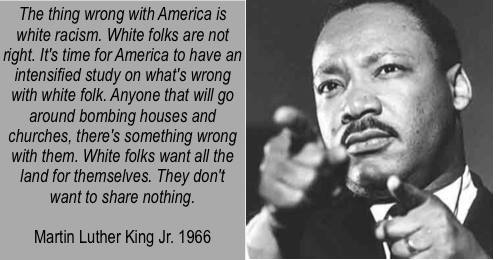
What white people need to do, is engage in some serious collective self-examination and how we are all beneficiaries of a system of White Supremacy. We need to come to terms with the assessment that Dr. Martin Luther King Jr. made about white people in 1966.
Grand Rapids Power Structure: The DeVos Family
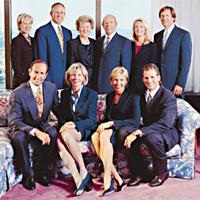 On Monday, we began our revision of the current Grand Rapids Power Structure, with an overview of where Grand Rapids is right now in terms of who has power in this community.
When we say who has power, it is important to note that we mean power over. A local power analysis is designed to investigate who has power over – who oppresses, exploits and engages in policy that benefits them to the exclusion of everyone else – the majority of people living in Grand Rapids.
As we noted in the previous post, we believe that private power – individuals and organizations – have the most power over people in this community, based on the hierarchy of power chart. Private power primarily relies on economic and political power and the family that has the most of that kind of power is the DeVos Family.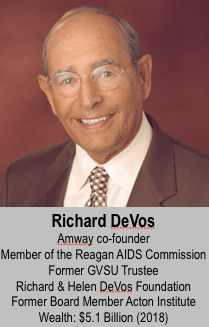
In terms of the DeVos Family, we have to start with the patriarch, Richard (Rich) DeVos. Rich is one of the co-founders of the pyramid scheme known as Amway. For the past 45 years, Rich DeVos has been using his wealth to influence economic, social and political realities in this community.
Rich DeVos and his now deceased wife Helen, have contributed more to the Republican Party than any other person in Michigan in the last several decades. The millions of dollars that Rich DeVos has contributed to the national and state GOP has had a tremendous influence in shifting politics to the right on numerous issues. According to the Michigan Campaign Finance Network, the DeVos Family as a whole have contributed $82 million since 1999.
This amount of money injected into State politics buys a tremendous amount of influence and there are clear examples of how the DeVos Family has influenced policy. (see our examples from 2016) 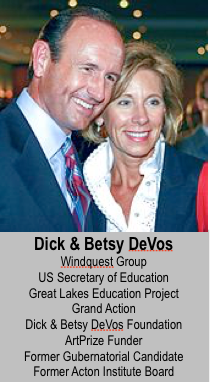
The most powerful family in Grand Rapids also has financed Kent County Commissioners and candidates running for office in Grand Rapids. You can find out which candidates by going to the County Clerk’s Campaign Finance link.
The mechanisms that the DeVos Family uses the most to influence public policy, besides money, is their role in the Grand Rapids Chamber of Commerce and the West Michigan Policy Forum. Both of these entities have been promoting economic policies that benefit the wealthy, attacks unions, promotes privatization and supports patriarchal, homophobic and white supremacist values.
In Grand Rapids, the DeVos Family has used their wealth and influence to promote the development in downtown Grand Rapids. This process began when they purchased the old Pantlind Hotel and changed its name to the Amway Grand Plaza. Since that time the family has purchased and developed land in downtown Grand Rapids, now owning numerous hotels and office space for their various projects, including the Windquest Group, RDV Corp and ArtPrize.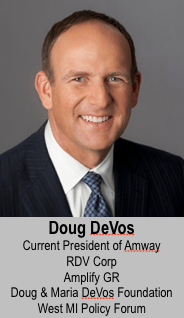
The DeVos Family also used the group Grand Action to dictate downtown development and re-direct millions of public dollars to finance the Van Andel Arena, the downtown convention center, the downtown market and the restoration of the Civic Theater.
Another major area of influence is the various family foundations. These foundations support far right groups around the country and in Michigan, like the Acton Institute and the Mackinac Center for Public Policy, but they also use their foundation money to finance non-profits. DeVos Family funding of non-profits in Grand Rapids, has numerous benefits for the most powerful family in the city.
First, the foundations fund most of the major educational institutions in the area – GVSU, Calvin College, GRCC, Davenport University, Christian Schools and the Grand Rapids Public Schools. This funding of the major education centers in Grand 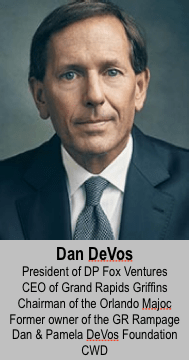 Rapids allows the DeVos Family to have influence in the direction of each of these entities, such as GVSU’s failure to provide domestic partner benefits in the 1990s to the pro-charter, privatization policies that even the GRPS has adopted.
Second, the DeVos Family Foundations have contributed to numerous liberal entities that provide social services in the community. The financing of these entities serves to have a say in managing social policy, which puts the focus on individual behavior, rather then on a systems analysis of social problems. In addition, funding local non-profits guarantees that these non-profits will NOT ever take a public position against the economic and political actions of the DeVos Family, which contributes to poverty, gentrification and white supremacy in the community. Lastly, funding local non-profits has a PR benefit, since many people in this community will take the position that, “where would Grand Rapids be without the DeVos Family.
One additional way that the DeVos Family influences economic, social and political realities in Grand Rapids, is by sitting on Boards or having their people occupy those 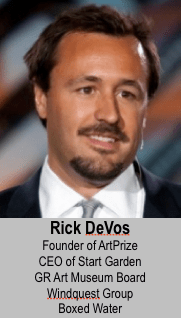 positions, thus providing an additional mechanism of influence and control of area policy. Some of the more notable entitles that the DeVos Family has people placed on local boards or act as partners are: Grand Rapids Chamber of Commerce, West MI Policy Forum, The Right Place Inc., Talent 2025, First Steps Kent, GVSU Foundation, Grand Rapids Art Museum, Experience GR, etc.
For a more full account of the history of the DeVos Family and their influence of the political, economic, social and cultural realities of Grand Rapids, check out our DeVos Family Reader.

