(The following three part series, was written by Jack Prince. Jack is a retired educator with 30 years experience on the High School and college level. He spent 10 years as a teacher with the Grand Rapids Public Schools.)
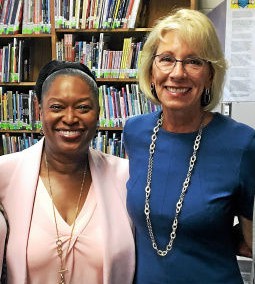 On May 7th a group of protestors, special education parents from the Disability A Team, challenged GRPS board members to explain their position on how their public superintendent could support Betsy DeVos, the most anti public school secretary of education in history. This challenge came after reading Neal’s quote, “Neal thinks DeVos can hold up GRPS as a model of what can be done at other struggling districts.” “She knows education.” “She knows what it’s going to take in order for our kids to be helped.” Neal sees the politically conservative family’s focus on education as their commitment to the, “greater social good”. Neal was the sole superintendent from Michigan willing to go to Washington D.C. to support DeVos in her confirmation hearing for the secretary of education position. Of course this trip was to be paid for by DeVos.
One board member indignantly responded to the question. She mentioned that she personally didn’t like DeVos but added it’s laughable to think DeVos has anything to do with this district! She failed to answer of what she thought Neal’s support to Devos meant and what ramifications that could have on school policy at GRPS!
The same question was posed by local journalist Jeff Smith over a year ago in succinct fashion: As a GRPS board member, I would like to know what your reactions are to 1. The announcement that Betsy DeVos has been named as secretary of Education and 2. What impact that might have on GRPS? No response was ever given to that most pertinent and relevant question. Considering the $67,000 dollar personal gift to Neal from Betsy Devos (a woman who affirmed we expect a return on our investment when asked about her donations). The question seems more then pertinent to the parents and taxpayers of this district. Has not the GRPS Board of Education noticed the national outcry from public school leaders who see DeVos’s efforts as categorically designed to undermine the public school system throughout the country. The board members lack of response and accusation that the entire DeVos connection to GRPS was a laughable issue seems more than irresponsible and professionally inept.
 If privatization is Betsy’s obsession, GRPS should make her very happy beginning with the privatization of the school bus fleet in 2005. The GRPS Board of Education voted in the spring of 2005 to privatize its school bus service in a move to supposedly save the district 18 million over 5 years. In reality the private company cost more monetarily and especially in service. More alarming was the drivers employed by GRPS had agreed to lose their family’s health insurance that would have completely covered the supposed district deficit at that time. Regardless of the concession, the Board of Education pushed through the privatization. Later it was discovered that the owner of Dean Transportation was the son in law of our influential senator who was tight with the DeVos Family and prominent in West Michigan politics.
P.E.S.G. is a privatized substitute teacher company, which claims to be the leader in educational staffing. Before its creation in 2007 the state of Michigan substitutes were part of the State teacher retirement system and were controlled by individual school districts. That district relationship with the subs engendered personal knowledge of the teachers so valuable for effective knowledge of the teachers so valuable for effective placement. The local school secretaries knew who would fit in specific classrooms with particular needs. That personal relationship stopped when in 2007, Henry Bledsoe was approached by a human resource director from a West Michigan school district as well as an attorney according to MLive. It is assumed that the HR director was from Grand Rapids Public Schools since they were the original and only school that contracted with PESG for some time. The initiation of privatized subs at Grand Rapids Public School began the entire states privatization of substitute teachers. The HR director that visited PESG to start this privatization worked for the company upon leaving GRPS. Additionally, worrisome is the fact that Mr. Bledsoe, as owner of Benefit Management Administration, was ordered to cease and desist from continuing to sell fraudulent health insurance policies by the State of Michigan. The employee benefits company at 6307 84th Street is the same address as PESG and sold policies that had no underlying insurance, according to the state office of Financial and Insurance Regulations. Substitute teachers were privatized by a businessman with no background in education caught in an insurance scam! How fortunate for the owner of the Benefit Advisory Group to initiate an entire regions substitute teachers transfer of state retirement benefits to his own benefit 401 plans. The substitute teachers lost their future chance for vested retirement while the districts lost the personal relationships with the subs and sacrificed their responsibility of oversight. As with the bus drivers on immediate decline in sub performance was seen after the privatization. One West Michigan School accurately assessed the damage to the teacher’s retirement fund by eliminating the thousands of contributions according to the Muskegon Chronicle. The Grand Haven School Board is wary that a surge in third party contracting might undermine the state retirement system by reducing contributions. The teacher’s retirement fund has been a target for anti-public school legislatures for years. In fact, a major proponent of eliminating teacher pensions, is the West Michigan Policy Forum, which was created, in part, by members of the DeVos Family.
 In the future when the state insists the retirement pension being paid to teachers be reduces 30 to 40% as they did in Illinois because of a shrinking fund remember the withdrawn substitutes. The most damaging aspect is the complete substitute teacher shortage as mentioned in the MLive article of April 3, 2017: Substitute teacher shortage expected to continue to be an ongoing problem. This problem has been caused by companies that strive for profits for their investors by keeping subs pay low. The dismal condition of privatized subs today can be tied to the advent of PESG and its first involvement with GRPS. Grand Rapids has recently dropped PESG and gone with another private company.
Oakdale Elementary is one of the many examples of public GRPS buildings that have been privatized. There are a number of techniques used to camouflage the transition from public to private components of the GRPS district. Some of the most blatant are to be found at Oakdale Elementary and the former Vandenberg School on Lafayette Street where the direct sale to charter schools is easy to trace. A more insidious technique is to form charter schools under the partnership with big business and call them centers or innovation schools. University Prep is a prime example of this technique. Both the Grand Rapids Child Discovery Center, a full-fledged charter school and University Prep, insists on being called public schools. This tendency to have charter schools or elements of charter schools at GRPS is certainly indicative of Betsy DeVos’ ideology as she has mentioned recently that traditional public schools and charter schools should be thought of as part of the same public system. This comment is particularly irksome to public school educators because the two types of schools are managed differently and subject to different rules and regulations. This clandestine blending or partnership technique produces such subtle differences that no one notices that the Discovery Center is a full-fledged charter school with its own private principal and superintendent and is still called a GRPS public school. When recently asked, the president of the GREA wasn’t even aware that the teachers at the Discovery Center are privately hired and paid by the charter school. One of the manifest differences indigenous to GRPS is that while being called public many of their buildings require a “test in” qualification to enter. This is not an aspect of public schools traditional policy. Public schools allow open enrollment and do not entangle entrance with any test in qualifications; such as that found at the Blandford Elementary, and other buildings within GRPS. Students are not put on a waiting list subject for entrance based on a computer lottery pick in a traditional neighborhood school.
Oakdale was a fine neighborhood public school with open enrollment for decades. It is now the home of 500 privatized students in the Timberline Charter Academy (NHA) K-5. Suspicious circumstances surrounded in the NHA obtaining the GRPS properties. Developer, Bruce Michael, owner of Ojibway Development flat out deceived the city according to then Major Heartwell as he had promised to transform the GRPS building into apartments but instead, immediately after purchasing Oakdale, Lexington and Eastern Schools, sold them to the charter school NHA for the same exact price. Obviously he was not the only one deceiving Grand Rapids citizens. Consider why a developer would sell the properties hours after the purchase from GRPS for the same price for No Profit! It seems someone had worries over the awareness by the public of a public school selling buildings directly to a charter school company. Another question was pointed out in a MLive article: “For many the question is how many students will the (new charter) siphon from Grand Rapids Public Schools? When the NHA deal was revealed Grand Rapids school leadership said it wasn’t competition. Five hundred privatized students would seem to almost anyone as competition but it doesn’t appear that Grand Rapids Public really cares as the district has lost 8,000 students in a little over a decade. There is an epidemic of transformation (code for privatization) occurring in the city of Grand Rapids and its symptoms are clear: they close public and they open private!
Another example of charter establishment was the sale of Campau Elementary (a beloved neighborhood school) to Covenant House Michigan, another for-profit private charter school from Detroit Michigan. Again from MLIve; The Charter School draws students desperate for a last chance from throughout the region but significant numbers of students at S.E. Career Pathways which was a Grand Rapids Public School were also labeled as last chance students and were provided with a curriculum and staff to implement their last chance at graduation. The writer knows this because he taught there. GRPS students at S.E. were sent letters from GRPS informing them it was mandatory to attend the newly opened charter school based on their G.P.A. Today Covenant House has 320 students. Many of them would have been GRPS students.
*The Griid 2016, griid.org
*Mackinaw Center Grand Rapids found Privatizes Busing Michigan Education Report
*MLIve September 25, 2009 State Orders Benefit Management Administrators INC. To stop selling….
*MLIve December 26, 2017: Privatizing Substitute Teachers is a Growing Trend
 Earlier today, a group of students organized under the name of Youth Activism Coalition, took action at the Grandville office of Representative Bill Huizenga.
About 20 students participated in the action, all carrying signs and a piece of tap across their mouths.
The students entered Rep. Huizenga’s office in silence, standing with their signs, while one member of the group made an opening statement about school shootings and what they wanted from the Congressman.
As you will see and hear in the video below, the student who spoke, read a list of the names of those killed in school shootings (223) since Columbine. The students also ended with a clear message for Rep. Huizenga.
(The following three part series, was written by Jack Prince. Jack is a retired educator with 30 years experience on the High School and college level. He spent 10 years as a teacher with the Grand Rapids Public Schools.)
 Michigan is number one in the country with for profit charter schools. The following is an excerpt of the Montgomery Securities Group explaining to corporate America the lure of privatizing education. Author Jonathan Kozol quotes “The education industry, according to these analysts, represents in our opinion the final frontier of a number of sectors once under public control” that have either voluntarily opened or, they note in pointed terms, have “been forced” to open up to private enterprise. Indeed they write, “The education industry represents the largest market opportunity” since health-care services were privatized during the 70’s.
From the point of view of private profit, one of these analysts enthusiastically observes, “The K-12 market is the big enchilada. With the yearly public spending in the hundreds of millions alone in Michigan, neoliberals like Betsy DeVos have long appreciated the profit motive associated with the golden equation “Public money for private profit.” Betsy DeVos, along with President Donald Trump have made promoting charter schools and taxpayer funded vouchers a centerpiece in their educational philosophy and platform. That charter school proclivity is reflected in their proposed education budget, which clearly hurts public schools and college students. A summary of the rejected proposed 2018 education budget indicated DeVos’ priorities:
- cut public education funding by 13.6%
- cut 1.2 billion from after school programs
- cut 27 million from art education
- cut IDEA (special education by 13.3 million
- cut 2.1 billion from funding to reduce to reduce class size and support professional development
- cut 700 million in college loans for low income students *
The savings that would have been realized by these cuts were intended by the DeVos educational department to be channeled back to private and/or religious schools that are unaccountable to public review.
In 2013 K-12 Inc. the largest private charter school in the country with an enrollment of over 100,000 students took in 730 billion from taxpayers for online virtual computer instruction. These virtual charter schools exist here in Grand Rapids, such as the for profit Nex Tech charter school at 801 Broadway, where students are forced to go when the public schools are closed. DeVos’ proposed 2018 budget would have given more than 1 billion more to such virtual online schools along with private school vouchers.
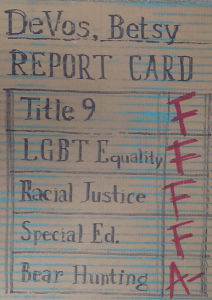
Betsy DeVos’ penchant to undermine public education through the entrenchment of privatization can be seen empirically beyond her education budget machinations .Not knowing what IDEA is or believing that schools should have guns in case of grizzly bears, are mere indications of DeVos’ pervasive ignorance and lack of basic preparedness and yet they are insignificant to the main tenet of her ideology. An ideology that was present in her family decades ago lying in wait like a time bomb here in West Michigan.
Betsy DeVos’ economic prowess was derived from her father, a fundamentalist conservative businessman, who made it rich developing the ubiquitous lighted sun visor in Holland Michigan. In the 1980’s the Prince family merged with one of the most venerable conservative families in the U.S. when Betsy married Dick DeVos , whose father Rich, is the co-founder of the multilevel marketing firm Amway, distributor of home products, regularly plagued with accusations that the company is run like a cult and is nothing more than a sophisticated pyramid scheme.*
Betsy DeVos would go on to chair Michigan Republican Party from 1996-2000. Her husband Dick DeVos was the GOP candidate for governor in 2006. Previously the DeVos family spent upwards of 3 million in 2000 pushing to implement school vouchers in Michigan. Betsy’s brother Erik Prince, in parallel with Betsy’s penchant to privatized education, had his own privatization endeavor with the U.S. army. Erik was the creator of the largest private military industrial company, Blackwater Worldwide, with the $500,000,000 inheritance from his father Edgar. Recently Erik proposed to Donald Trump that the United States have a private mercenary army to fix Afghanistan, a country we’ve been at war with since 2001.* Imagine the conversation around the Thanksgiving table at the DeVos’ 22,000 square foot home in Holland Michigan with Betsy asking Erik how his privatizing of the American army is going with Erik countering with the question of how her privatizing of the public education system is coming, followed by “pass the stuffing please.” Prince and DeVos, like Trump, use their wealth to exert political influence and advance ideological visions that are harmful to U.S. democracy and public institutions. The Prince-DeVos family is yet another example of Trump bringing in wealthy friends to corrupt the foundations of American public life.*
Investment intertwined with political cause is a trademark of Betsy and Erik Prince. Consider the comment from Elizabeth Warren at DeVos’ confirmation hearing “It is difficult to imagine a worse choice to head the department of education-Betsy DeVos doesn’t believe in public schools, her only knowledge of student loans seems to come from her own financial investments connected to debt collectors who hound people struggling with student loans and despite being a billionaire she wants the chance to keep making money off shady investments while she runs the department of education.”
Clearly privatization is an icon for the Prince family. Patriarchal father Edgar and mother Elsa donated millions to support the conservative fundamentalist political goals, including the Family Research Council, which has become one of the leading religious right groups active in organizing against gay rights and promoting state sponsored prayer along with vouchers for religious schools.*
The legacy of vouchers in Betsy’s family history translates into an array of initiatives to induce privatization. It is worthy to consider that privatization of all public institutions is a mainstay in conservative ideology which has cached the Prince family legacy for decades here in West Michigan. The next logical inspection is to see how DeVos’ influence has promulgated in West Michigan and specifically in the Grand Rapids Public Schools, and consider the extrapolation of her ideology nationally now that she presides as the Secretary of Education.
Grand Rapids Power Structure Part V: Local Government
In the past few weeks, we have been looking at the Grand Rapids Power Structure. In Part I, we provided a framework for the local power structure in Part I, the most powerful family in Grand Rapids, the DeVos Family in Part II and in Part III we looked at other members of the most powerful members of the private sector. In Part IV, we looked at the private sector organizations that have power and which individuals sit on the boards of those organizations.
As we mentioned in Part I, there is a hierarchy of power, which starts with Economic Power, followed by Political Power and then State Power. In this article, we look at local government in the role it plays within the Grand Rapids Power Structure.
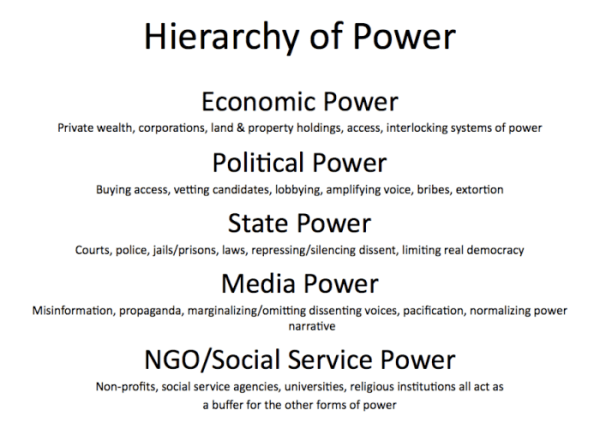
There are numerous functions that local government plays in supporting the Grand Rapids Power Structure. One primary function of local government (city and county), in supporting the area power structure, is to make sure that there is no significant threat to the existing power structure by members of civil society. Local governments practice defending the existing power structure by 1) making decisions, passing ordinances and creating budgets that will not threaten the existing systems of power; 2) limiting the level of direct democracy by civil society, and; 3) using force and fear to make sure that civil society does not challenge the existing power structure.
Promoting Business as Usual
 While the Grand Rapids City Commission likes to present themselves as being progressive, they primarily function as conduit to maintain and defend the existing power structure. The Kent County Commission doesn’t present themselves as progressive, in the same way as Grand Rapids does, but they function pretty much the same, in that they also are a conduit to maintain and defend the existing power structure.
Both the City and the County governments support the economic policy of “growth,” which ultimately means they defend the system of capitalism, which primarily rewards those who already have tremendous wealth and punishes those who do not. Growth, for the local governments, means providing massive taxpayer subsidies to the business community, especially to development projects, which primarily support those with tremendous wealth.
Look at all the development projects in and around Grand Rapids and you can easily see who benefits. These economic decisions will also disproportionately benefit those who are white, thus perpetuating institutionalized racism. Those who get the massive taxpayer subsidies are white and those who are displaced by development projects are disproportionately people of color.
 Economic Growth has also meant a focus on using public funds to develop downtown Grand Rapids, through organizations like the now disbanded group Grand Action, projects like ArtPrize and the expansion of what members of the GR Power Structure identifies as “tourism.” One additional example of how local government defends the power structure, is the recently released financial documents on the failed proposal to bring Amazon to the area. The total “incentives” being offered to Amazon from Grand Rapids and Kent County we over $1.5 billion dollars.
Limiting Direct Democracy
If people have ever attended City or County Commission meetings, they know that most of the decisions made at these meetings have already happened. Most agenda items are simply a formality, but the public is granted an opportunity to voice their concerns, which are heard by commissioners without any real feedback. Occasionally, there are public hearings, but ultimately the power to determine issues that merit a public hearing are still decided by commissioners at the city and county level. In other words, the public does not get to vote directly on major issues that impact the city/county.
Some will say that this is what representative democracy is and that it is the best we can hope for. Regardless of where one stands on the form of government that currently exists, the fact remains that the rest of us are limited in what we can do, if we play by the rules.
Take for example the issue of policing. A full one third of the City of Grand Rapids budget is devoted to policing. At the county level, a significant amount of the budget is set aside for the Sheriff’s Department, which includes the operation of the Kent County Jail. We know that the function of local law enforcement is primarily designed to police communities of color, to protect private property and to defend the interests of those with economic and political power. The amount of money, taxpayers money, that goes into local law enforcement is not something the public gets to vote on. The City and County Commissioners make those decisions and we are told to accept such outcomes.
Another “opportunity” the public has in local government is to sit on committees that have some say in what gets decided economically and politically in Grand Rapids and Kent County. However, the majority of those who sit on these boards are either individuals from the local power structure, representatives of the groups that make up part of the power structure, or people from the non-profit sector, which too often rely on funding from those with power.
For example, look at the list of people who make up the current Downtown Development Authority. Some are elected officials, but most of those listed are people either work for organizations directly tied to the Grand Rapids Power Structure, those who run businesses or those in the non-profit sector that often act as a buffer between those in power and the rest of us.
One last example of how electoral democracy at the city and county level is how candidates are funded. In many ways, it is no different than candidates running for state and federal office, where people with deep pockets often determine electoral outcomes.
Take Grand Rapids Mayor Rosalynn Bliss. People who are part of the local power structure, people like Peter Secchia, JC Huizenga, Kate Wolters, Scott Brew, Bill Bowling, Robert Woodhouse, Sam Cummings, Doug DeVos, Steve Van Andel, Scott Bowen, Dan Bowen, Sharon Bowen, Mark Breon, Friends of West Michigan Business, Ray Kisor, Mark Murray, Scott Wierda, Thomas Cronkright, Josh May, Lawrence Duthler, Arnold Mikon, Mark Sellers, Realtors Political Action Committee, GR Firefighters Union, GR Police Officers Labor Council all contributed between $500 and $5000 to Bliss’s campaign in 2016, according to Campaign Finance records through Kent County. Even since then, some of the very same names have contributed to the Mayor’s re-election, which is documented in the July 2017 campaign finance document.
While it is true that people who are not part of the local power structure also contributed to the Mayor’s campaign in 2016, they gave a significantly less amount. The deep pockets in this community use their campaign contributions to buy access and influence in the decisions that local politicians make. Campaign Financing by the rich is just a basic dynamic in how power functions.
Policing decent, Protecting Power
The third way that local government uses its power to defend the interests of those who have the real power in Grand Rapids and Kent County is by attacking those who dissent. There are a few ways in which this happens. First, those who dissent are often socially marginalized as radicals, haters or those who just like to complain all the time. Sometimes those marginalized are individuals and sometimes they are organizations of social movements that seek to make structural or system changes in the area. Marginalizing these people/groups is an effective tactic, specifically because it sends a message to the general public about what is “appropriate behavior” in the eyes of those with power in this community.
A second tactic used to police dissent is to intimidate, harass and punish those who would dare challenge power. Sometimes this happens as clearly as when student activists were intimidated by the GRPD, who came to their homes to threaten them because of their public support for The Rapid Bus Driver union, which was seeking to negotiate a more just contract.
This kind of harassment and intimidation is mostly targeted at communities of color, particularly the black and Latinx communities. Local law enforcement spends a disproportionate amount of time policing communities of color, which is clearly reflected in the disproportionate amount of people of color who are in the Kent County Jail. Those who are most negatively impacted by the Grand Rapids Power Structure are victims of the prison industrial complex, by being in prison, in jail, on parole or on probation. This, of course, is by design.
An example of the policing of communities of color is the local police relationship to Immigration and Customs Enforcement (ICE). All local police departments and the Kent County Sheriff’s department stop and arrest people from the immigrant community who are undocumented, which often results in their being arrested and detained in the Kent County Jail. The Kent County Jail, which is overseen by the Kent County Commission, has a contract with ICE to put a hold on immigrants who are undocumented. This practice of targeting immigrants is increasing, it breaks up families and causes tremendous harm for thousands of people in the area.
On last way that those who dissent against the local power structure are attacked is the reality of living within a system of neo-liberal capitalism. Those who dissent, organize and protest the local power structure are themselves are barely able to support themselves. Whether it is the reality of student debt, poverty, the cost of housing and health care, the majority of the population in Kent County is one paycheck away from being evicted or foreclosing on their mortgage. Neo-Liberal capitalism is so debilitating, that those who are dissenting are often in crisis because the economic system – the same system that benefits the Grand Rapids Power Structure – punishes them for dissenting. Indeed, even those who don’t dissent, can clearly see that if they chose to dissent, a similar fate will await them if they get out of line and chose to challenge power.
Grand Rapids was founded on Settler Colonialism, White Supremacy and Capitalism. The Kent County and Grand Rapids governments do not and will not seriously challenge these dynamics. These local government structures will provide some minimal rights, just enough to convince people that the way things function currently are not that awful. In fact, we are convinced that things are pretty good.
Next week, in Part VI of the Grand Rapids Power Structure, we will look at the function of media in defending and perpetuating the current systems of power.
 Over the past 48 hours, the Grand Rapids Chamber of Commerce has sent out media advisories with their endorsements for candidates running in the 2018 Election.
On June 5, the GR Chamber formally endorsed Brian Calley for Governor. Their media advisory stated:
“Michigan’s economic growth and business climate transformation over the last eight years has been tremendous,” said Rick Baker, President & CEO of the Grand Rapids Chamber. “We must maintain this trajectory, and we believe Lieutenant Governor Calley is well positioned and qualified to continue the Michigan comeback.
Of course, there is nothing surprising about this endorsement, since the GR Chamber looks out for the interests of its members, which is the business community. However, this does affirm our analysis about the Grand Rapids Power Structure, in that the GR Chamber of Commerce supports policies and candidates that benefit those who already have tremendous economic power in our community.
One way to verify our analysis that the GR Chamber of Commerce is part of the local power structure, is to see who has been the primary financial backers with Brian Calley. Since 2010, when Calley ran as Gov. Snyder’s running mate, the number one financial contributor to Brian Calley was the DeVos Family, with a total of $478,200. The other member of the Grand Rapids Power Structure, which has contributed significantly to Brian Calley, is John Kennedy. Private financial power always endorses those who will help expand private financial power, which is exactly what Brian Calley will do.
In the race for the Senate, the GR Chamber is endorsing John James, who is third behind Senator Debbie Stabenow and the other Republican challenger Sandy Pensler, in terms of fundraising.
In the 2nd Congressional District race, the GR Chamber is endorsing Rep. Bill Huizenga. Huizenga has raised five times the amount of money that his Democratic challenger has raised. Bill Huizenga gets the GR Chamber endorsement not only because he protects the business interests in West Michigan, he also serves on the Financial Services Committee, as is evidenced by who his major contributors are – Nasdaq Inc, Cantor Fitzgerald, Rock Holdings, etc.
The GR Chamber of Commerce is also endorsing Michigan House Speaker Tom Leonard for Attorney General. Leonard has supported some of the strongest state economic austerity measures in recent years. Therefore, it is no surprise that Rep. Leonard has received the financial backing of John Kennedy and Peter Secchia, both members of the Grand Rapids Power Structure.
Here is the complete list of GR Chamber of Commerce endorsements for state office, along with the major financial backing of members of the Grand Rapids Power Structure.
Michigan House of Representatives:
District 61: Brandt Iden – DeVos & Meijer
District 70: Jim Lower – DeVos
District 73: Lynn Afendoulis –
District 74: Mark Huizenga
District 75: David LaGrand
District 76: Amanda Brand
District 77: Tommy Brann – DeVos
District 80: Mary Whiteford
District 86: Thomas Albert – Kennedy
District 87: Julie Calley
District 88: Luke Meerman
District 89: Jim Lilly – DeVos
District 90: Bradley Slagh
District 91: Greg VanWoerkom
District 100: Scott VanSingel
Michigan State Senate:
District 19: Mike Callton
District 20: Margaret O’Brien – DeVos
District 26: Aric Nesbitt
District 28: Pete MacGregor – DeVos, Meijer, Kennedy, Van Andel, Jandernoa
District 29: Chris Afendoulis – Kennedy & Meijer
District 30: Daniela Garcia – Kennedy & DeVos
District 33: Rick Outman
District 34: Holly Hughes
The Grand Rapids Chamber of Commerce has also endorsed candidates for Kent County Commission seats. The GR Chamber has only endorsed 14 of the 19 seats as listed below.
Kent County Board of Commissioners:
District 1: Ted Vonk
District 2: Tom Antor
District 4: Diane Jones
District 5: Mandy Bolter
District 6: Stan Stek
District 7: Stan Ponstein
District 10: Emily Post Brieve
District 11: Jim Saalfeld
District 12: Monica Sparks
District 13: Jessica Ann Tyson
District 14: Carol Hennessy
District 15: Jim Talen
District 16: Dave Bulkowski
District 18: Dan Koorndyk
One thing that is obvious from this list is that the GR Chamber has endorsed 4 Democratic candidates. This is the case with David LaGrand getting the Chamber endorsement in the 75th House District race. It begs the question as to why they would endorse Democratic candidates. Our answer is that each of these Democratic Party candidates does not challenge the current economic policies in the state or the county, which is the primarily measuring stick for the GR Chamber. As a member of the Grand Rapids Power Structure, the GR Chamber doesn’t just follow partisan lines, they support and endorse politicians that endorse neo-liberal economic policies that disproportionately benefit the business class and expand of their wealth. This is exactly why we believe that private wealth has more power than government.
Normalizing White Supremacy: How the Grand Rapids news media reported on air pollution report
In mid-April, the American Lung Association published their annual report on air quality rating for metro areas in the country.
The Grand Rapids metro area ranked as tied for the 34th as the most polluted. According to the American Lung Association’s data for Kent County, the area received an F for Ozone, a B for Particle Pollution 24-hour and a PASS for Particle Pollution Annual.

The American Lung Association data also states that there are certain people who are more at risk because of the poor air quality, such as those with asthma, people with lung cancer, cardiovascular disease, diabetes, adults over 65 and those living in poverty.
 Interestingly enough, when Grand Rapids commercial media reported on this matter, the only focused on the fact that Grand Rapids was tied for 34th most polluted metro area. The WZZM 13 story made the city ranking its headline, while WOOD TV 8 focused on the F grading on Ozone.
Neither of the two major TV stations mentioned anything about which people are most at risk with the type of air quality we have in the greater Grand Rapids area.
The failure to report on who is most at risk with this new data from the American Lung Association is not just an oversight, it is a way that news media often normalize White Supremacy.
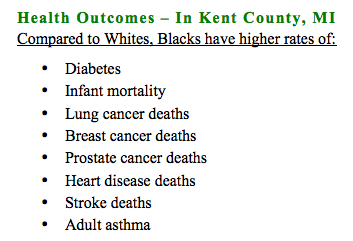
The reality is that there is a disproportionately higher number of African Americans who are at greater risk because of the air quality in Kent County, since the at risk categories listed by the American Lung Association disproportionately impact more African Americans.
According to a 2017 report from the Grand Rapids African American Health Institute (GRAAHI), compared to White people, African Americans are at a higher risk of the following:
In addition, since the American Lung Association listed that poverty was another at risk category in terms of air quality, the graph below, once again, demonstrates that there is a disproportionate amount of African Americans, and communities of color in general, who are experiencing poverty. Another way to look at this is that roughly 80% of Kent County residents are White, yet communities of color account for roughly 88% of those living in poverty in Kent County, based on this graphic.
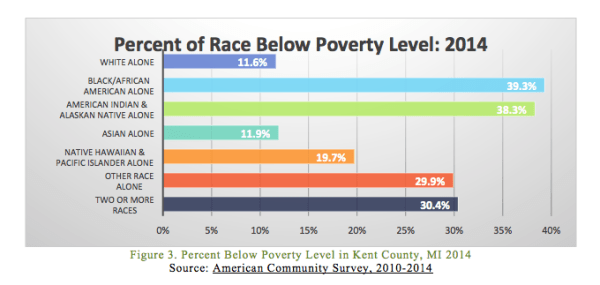
Therefore, not only is White Supremacy normalized in how the news media reports on critical issues like Public Health, White Supremacy is normalized within the very structures and systems which make up the greater Grand Rapids area.
In our analysis of the Grand Rapids Power Structure, we have looked at the a framework for the local power structure in Part I, the most powerful family in Grand Rapids, the DeVos Family in Part II and in Part III we looked at other members of the most powerful members of the private sector.
In today’s post, we want to look at some of the most influential private sector organizations, especially those that influence policy and the economy. However, before we get to those organizations, it is important to acknowledge that there are plenty of private sector corporations, so chain and some local, that also wield significant power in the area, specifically in the economic arena. We are not going to look at these corporations, as there are too many to look at and they have less of a direct impact on policy in Grand Rapids, than do the wealthiest families and the organizations represent their interests.
West Michigan Policy Forum
The West Michigan Policy Forum grew out of the Grand Rapids Chamber of Commerce, with a focus on providing those with powerful business interests a more focused mechanism for crafting policy proposals that would serve those interests.
We have been monitoring the West Michigan Policy Forum (WMPF) since 2008, when they held their initial summit. Since then we have reported on all of their summits, which is primarily where they lay out their policy proposals. At the 2008 summit their main goal was getting the Michigan Business Tax eliminated. In 2010, the focus of the summit was getting Michigan to adopt a Right to Work policy. At the 2010 Summit, they brought in the main Right to Work/anti-union propagandist, Rick Berman.
At the 2012 WMPF Summit, one emphasis was on attracting and creating workforce talent. At this summit, there were presentations by the group Talent 2025, which is a group made up of area CEOs. In 2016, the WMPF Summit focus was on the elimination of Public Sector employee, particularly public school teacher pensions.
The WMPF also organizes more than their bi-annual summits, such as regular strategy meetings and carefully placed opinion pieces in major Michigan newspapers. However, changing state policy is their main objective, which is why they hold their summits every 2 years, just months before state elections.
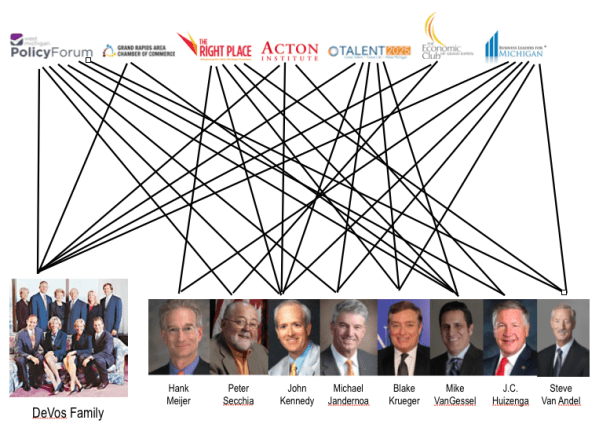
The West Michigan Policy Forum is governed by the very same people, which we have been identifying as members of the Grand Rapids Power Structure, such as Doug DeVos, John Kennedy, Peter Secchia, Michael Jandernoa, Mike VanGessel, Rick Baker, and J.C. Huizenga.These people make up their Executive Committee, but their Board of Directors represents additional names of local elites and the companies they represent.
Grand Rapids Chamber of Commerce
The Grand Rapids Chamber of Commerce has been around for over 100 years and follows the legacy of the state and national Chambers of Commerce.
The Grand Rapids Chamber of Commerce is driven by its mission, which is to defend and advocate for the interests of the business community. This has historically meant that the Chamber of Commerce has opposed any increase in the minimum wage, any efforts to get a living wage, has fought against the $15 an hour national campaign, works to undermine labor unions and generally opposes robust environmental regulation or government regulations in general.
The GR Chamber of Commerce has opposed most progressive/left ballot initiatives and endorses candidates based on their commitment to capitalism. According to the Michigan Campaign Finance Network, the GR Chamber of Commerce spends money lobbying at the state level. In 2016 – 2017, the GR Chamber of Commerce spent around $120,000 lobbying elected officials on state policy.
Their Board of Directors is also made up of many of the same members of the Grand Rapids Power Structure, both the individuals and companies that wield tremendous power in this community, such as representatives from Amway, Meijer, Rockford Construction, Steelcase, Spectrum Health, Huntington Bank, The Right Place Inc. and Lacks Enterprises Inc.
The Right Place Inc.
The Right Place Inc. is an organization that is dedicated to supporting area businesses and attracting new ones to Grand Rapids. This means that The Right Place Inc will uses any and all means to lobby businesses to locate to the area, even using public money to lure them.
We know that some recent examples of The Right Place Inc working to bring companies to Grand Rapids were, 1) their attempt to bring Amazon to the area, which included massive public subsidies , and 2) The Right Place Inc’s role in attracting Israeli military companies to the area, using taxpayer subsidies. On top of that, The Right Place Inc is also a member of the Michigan/Israeli Business Bridge, an entity which develops and encourages trade and business interaction between Michigan-based companies and Israeli companies.
The Right Place Inc. also features many of the same names of those that make up the Grand Rapids Power Structure, such as David Van Andel, John Kennedy, Rick Baker, Mike VanGessel, Hank Meijer, Blake Krueger and many other business leaders and heads of local universities.
Acton Institute
The Acton Institute for the Study of Religion and Liberty has been around since the early 1990s. The Acton Institute is essentially a right wing think tank that takes a pro-capitalist, pro-US Imperialist, anti-union, anti-Muslim, anti-public education stance.
The Acton Institute was founded by Rev. Robert Sirico who has been an advocate for the Capitalist Class since he became a priest. The organization has grown significantly and now has members around the globe.
The Acton Institute works closely with other far right think tanks like the Mackinac Center for Public Policy and the national group known as the State Policy Network. The State Policy Network coordinates efforts to push changes in state policies across the country, policies that embrace neo-liberal capitalism and the austerity measures that come with it.
A major financial supporter of the Acton Institute, since its founding has been the DeVos Family. Numerous members of the DeVos Family have donated to the Acton Institute and have been on the Board of Directors, with Rick DeVos being the latest. Other members of the Grand Rapids Power Structure also sit on the Acton board, such as J.C. Huizenga and John Kennedy.
Talent 2025
Talent 2025 is fundamentally as business focused entity that seeks to influence educational policy for the purpose of creating more talent (which is code for labor) to meet the demands of the market.
Talent 2025 has numerous working groups and uses words like diversity and inclusion, but this is all for the goal of creating work-force ready people. Talent 2025 consists of a CEO Council that also includes many of the members of the Grand Rapids Power Structure, such as Michael Jandernoa, John Kennedy, Mike VanGessel, Blake Krueger, along with companies like Meijer, Amway, Steelcase, Spectrum Health and Cascade Engineering.
Econ Club of Grand Rapids
The Econ Club of Grand Rapids is yet another pro-business entity that primarily hosts regular meetings, featuring speakers from around the US to promote the economic benefits for the Grand Rapids business community.
In March of 2016, the Econ Club of Grand Rapids hosted Michigan Governor Rick Snyder, right in the midst of his criminal treatment of Flint residents over contaminated water. It was reported that those attending the Econ Club event applauded Snyder, with a standing ovation.
The Board of Directors of the Econ Club is also made up of the Grand Rapids Power Structure individuals and business representatives, such as Rick DeVos, Charlie Secchia, Rick Baker, Steelcase, Spectrum Health and Cascade Engineering.
Business Leaders for Michigan
Business Leaders for Michigan (BLM) is not a Grand Rapids entity, but it has many members from the Grand Rapids Power Structure. BLM is a statewide organization of CEOs that work to influence state policy, which benefits the interests of the companies represented by the CEO member base.
Blake Krueger is the President of Business Leaders for Michigan, but it also includes Grand Rapids elites like Mark Bissell, Doug DeVos, Michael Jandernoa, John Kennedy Hank Meijer and Steve Van Andel.
There are certainly more organizations that could be on this list, but those listed above are the most powerful and influential, particularly around state and regional policy. Below is a visual, which demonstrates the interlocking systems of power amongst the Grand Rapids business elites.
 Last week, we wrote a story about a recent speech that Secretary of Education, Betsy DeVos, gave at a fundraiser for Catholic schools.
In that speech, she referenced Acton Institute founder Rev. Robert Sirico, applauding the educational model that he is involved in at the Sacred Heart Academy in Grand Rapids. That speech from DeVos was delivered on May 16.
On May 23rd, just one week later, Rev. Sirico returned the favor and wrote an opinion piece in the Detroit News, affirming Betsy DeVos’ private education mantra and calling her speech “bold.”
Besides echoing the private education position that DeVos took in her speech a week earlier, Rev. Sirico frames his position around the history of anti-Catholicism in the US and the US Catholic Conference of Bishops position on education and tax dollars.
Rev. Sirico pushes the position that Catholic parents, who send their children to parochial schools, are loosing their “freedom” by paying for public school education (through their taxes) and for their own children’s education in Catholic schools.
Such a position is often taken by the Libertarian wing of the contemporary conservative movement. Some in this movement argue against using taxpayer funds for public transit, public education and just about anything that the public, including those who advocate such a position, benefit from.
The Catholic Bishops want a federally mandated program of tax subsidies to Catholic families. Rev. Sirico disagrees with this approach, instead choosing to take the states rights path, allowing individual states to determine their future on education policy. As Rev. Sirico says:
 An “opt-in” approach is more desirable to top-heavy federal mandates and is more manageable at the local level. States, and for that matter municipalities, would have flexibility to provide education freedom to families who know better than federal planners. Not only is opting-in on a state-by-state basis preferable, it has a better chance passing Congress.
None of this is surprising. Rev. Sirico and the Acton Institute have long taken a privatization approach to public policy, especially around education. Equally important is the fact that Betsy DeVos was a former board member of the Acton Institute and her mother, Elsa Prince Broekhuizen, is a current board member. In addition, the DeVos Family has contributed millions of dollars to the Acton Institute over the years, to support their neo-liberal capitalist policy proposals.
The Rev. Sirico and Betsy DeVos have a long history together, which is exactly why DeVos was the featured speaker at the Institute’s annual meeting last fall.
 For years I have been hearing from people in the community, some who even identify as progressives, that Rick DeVos is different from his parents and grandparents.
The first time that someone suggested that Rick DeVos was different than his family’s right-wing history, was just before the first year of ArtPrize. I was told that I just needed to sit down and talk with him and I would see that he was different.
I responded to this claim that unless he has distanced himself from his family’s money and was willing to publicly come out against their stance on issues like gay marriage, labor unions, public education, religion, politics and capitalism, then he is not really operating any differently than the rest of his family.
Rick solidified his continuation of the DeVos Family ethos, when he founded (with Dick & Betsy’s money) 5 x 5 Night and Start Garden. Venture capitalism and entrepreneurism are easy when you come from billionaire parents and grandparents, but Rick wanted to make his own mark in that arena. His most recent project is WakeStream Ventures.
However, if one needed more evidence that Rick DeVos, the son of Dick and Betsy and the grandson of Rich and Helen, was embracing the family’s ideological history, then one need to look no further than the fact that Rick DeVos is now a board member of the Acton Institute for the Study of Religion and Liberty.
Rick DeVos follows in his mom’s footsteps, as a board member of the Acton Institute. Betsy DeVos’ mother, Elsa Prince Broekhuizen, is also a current board member. In addition to serving on the board of directors, DeVos Family members have given millions of dollars to the Acton Institute over the years.

By now serving on the Acton Institute board, Rick DeVos further solidifies his commitment to the same right wing, pro-capitalist and religiosity that his family has embraced for decades. After all, the Acton Institute values the wedding of religion and capitalism, which works beautifully for the DeVos Family to justify their wealth and their politics.
The Acton Institute despises organized labor, public education, has taken hundreds of thousands of dollars from Exxon/Mobil to promote climate denial, supports US imperialism and regularly posts anti-Islamic articles on their blog.
Therefore, one cannot sit on the board of an organization that zealously embraces a far right ideology and not support those same principles. The guy who once said he just wants to see “crazy shit happening all over Grand Rapids,” is nothing more than a neo-liberal capitalist, who defends an anti-union, anti-muslim, anti-public education and US imperialism ethos. Rick DeVos is clearly following in the footsteps of Rich, Helen, Dick and Betsy DeVos.
Grand Rapids City Budget: Omissions, lack of vision and the possibility of Participatory Budgeting
On Sunday, May 27, MLive ran an article headlined, 10 things to know about Grand Rapids’ $587M budget.

The 10 things that MLive wants us to know about the 2018 City Budget are:
- Property taxes will stay the same
- Income tax revenue will increase
- $1M for police-community relations
- $20 million in LED streetlights
- River restoration
- Two fire stations will be replaced
- Trees
- Staffing up communications office
- Seed money for affordable housing fund
- 32 percent of budget in savings
As with all media, these 10 things we should not are crafted and are not necessarily the most relevant things about the 2018 City Budget. There are definitely some things that are omitted from the MLive story and it is also worth noting that there are things about the article that are problematic, in that the article provides no strong context, nor is there any analysis of these 10 points or the city budget as a whole.
One point about these 10 things that MLive thinks we should know, is not they they are completely irrelevant, but that these items are presented primarily based on numbers, on costs. For example, point number three, tells us that the city is going to spend $1 million on police/community relations, yet they fail to mention that a full third of the entire budget is dedicated to the GRPD. One third of the entire budget is roughly $195 million.
A second observation is that in point 8, MLive tells us that the city is planning on adding more communication’s staff, based on recommendations from an audit done by Truscott Rossman. Truscott Rossman is a PR firm that was founded by John Truscott, the former spokesperson for Michigan Governor John Engler. Truscott Rossman has primarily worked with corporate clients, but also has a history with the City of Grand Rapids.
A third point worth making is about point number 9, the affordable housing fund. While setting aside money for such efforts, there is no real discussion about how the amount of funds the city will set aside is grossly inadequate, but there is also no information about how it will be administered and who gets to decide about affordable housing. Will construction companies and non-profit housing agencies get to decide or will those struggling to find affordable housing have a say it how these funds will be used? All indications so far, suggests that those who have made up the Mayor’s Affordable Housing Task Force will get to decide, which doesn’t include a single person who is struggling to find affordable housing.
A fourth point has to do with point number 10, which says the City will be operating in the black, with funds in a savings account. Here it is important to point out that revenue sharing is left out of the MLive article all together. Like all municipalities, Grand Rapids has lost a ton of money that they used to get through revenue sharing from the state. One of the main projects that the Snyder administration took on soon after it began in 2011, was to impose neo-liberal economic policies on municipalities, specifically austerity measures. These austerity measures were to push the privatization of former public services and to eliminate public sector employee benefits and pensions.
The fact that the city is experiencing a savings is not so much about good fiscal management, but about embracing neo-liberal capitalist principles of attacking public sector unions and adopting privatization.
 The last point about the MLive article is that it mentions near the beginning that people will have a chance to comment on the budget during the June 5th City Commission meeting. While this may seem like the city is really seeking public input, this is really a weak and lazy approach to public participation into determining the budget.
What the City of Grand Rapids needs to do, is to provide a mechanism for the public to democratically decide on how budget funds should be spent. In fact, there is an international movement called Participatory Budgeting, which provides an important model on how people who live in communities get to decide on budget priorities. IN many cases, those who participate in this process will be involved in making decisions in a process that takes a year and then continues for 12 months every year to ensure that there is real transparency and real democracy for anyone who wants to take part in the process.

