A recent article in the monthly publication, In These Times, had excellent information and analysis on the corporations that have contracts with ICE.
The article focuses mostly on the immigration detention facilities and all the businesses that are complicit with ICE violence against the immigrant community. The number of businesses complicit with ICE in regards to detention is pretty astounding, as you can see from the graphic here below.

This matrix of private collusion with Immigration and Customs Enforcement got me thinking about how many private and public entities have a contractual relationship with ICE in Kent County.
We have known for the past six months now, that the Kent County Sheriff’s Department has had a contract with ICE since 2012. This contract was renewed in 2017, but has been challenged by the immigrant community and some allies since June of 2018 to end the contract with ICE.
On October 1st, Movimiento Cosecha GR and GR Rapid Response to ICE organized a protest for the national NoBusinessWithICE day. The target of the action on October 1st was the Edmark Developement Company, which is located at 161 Ottawa Ave. NW in downtown Grand Rapids. The reasons for targeting Edmark, is because they rent to the Department of Homeland Security in their Water’s Center building.
However, there are many more entities that are complicit with ICE in Kent County. First, there are at least two other ICE offices in Grand Rapids (that we know of), both of which lease space from private companies.
The ICE office at 517 Ottawa Ave. NW, just north of 196, is owed by FMS Property Management LLC. FMS Property Management LLC has their office right next door, located at 525 Ottawa Ave. NW.
The other ICE office is located at 545 Michigan St. NE on the Medical Mile. This is a new ICE office, which deals with people who have been arrested or detained at on point, but are now no longer in custody, but need to check in with ICE regularly so that the agency can keep tabs on them until the courts decide their fate. This ICE office is owned by NAI Wisniski of West Michigan.
In addition to office space that ICE rents in Kent County, there are numerous other private entities that are listed on the graphic above, which also operate in Kent County. First, there is Aramark, the food service company that operates across the country and has numerous contracts with ICE detention facilities. Aramark also happens to have a contract with the Kent County Jail.
Then there is GPS, which makes the ankle trackers that many ICE arrestees must wear so that ICE can keep tabs on them. Those who work with the GR Rapid Response to ICE project are aware of several people who have been arrested by ICE and asked for their assistance, that must wear these GPS trackers.
Another company listed on the above graphic is Akal Security Inc. Akal Security Inc. is another national entity that works closely with government law enforcement. According to their website, they have an office a 1 Division Ave NW in Grand Rapids, which interestingly enough is the building that houses the GRPD.
There is also the G4S company, which is an international corporation that has contracts with ICE. G4S also has an office in Grand Rapids, located at 1444 Michigan St NE, a few blocks east of Fuller, where they rent space in a small office complex.
Lastly, there is the Keefe Group, which has a contract with ICE to provide financial services. The Keefe Group has an office located just off of Kraft Ave SE and 32nd St, just off of highway 96.
Organizing and Resistance Opportunities
It is bad enough that ICE operates in Kent County and is doing serious harm to immigrant families on a weekly basis. However, with more information about the private and public entities that are complicit with ICE, through contractual agreements, his provides us with greater opportunities to organize, resistance and eventually abolish ICE’s presence in Kent County.
Movimiento Cosecha GR and GR Rapid Response to ICE are already committed to working on reducing ICE harm to immigrant families in Kent County. These two grassroots and autonomous groups are also working on a campaign to end the ICE contract with Kent County and we exposed the relationship between the Edmark Development Company on NoBusinessWithICE day on October 1st.
However, we need more people and organizations to be part of this movement to kick ICE Out of Kent County. We need a multi-pronged attack against ICE and in order to do that we need people who can commit to doing education, organizing and contributing funds to Movimiento Cosecha GR and GR Rapid Response to ICE. We need people who are willing to confront the other entities listed in the Matrix of ICE in Kent County.
For instance, GVSU also has a food service contract with Aramark. If GVSU students, faculty or staff would join the campaign to kick ICE out of Kent County by informing people on campus, boycotting Aramark or resisting other ways, that would be an important contribution for this movement.
In many ways, the effort to abolish ICE is similar to the current BDS campaign, which is seeking to win justice for Palestine, but it is also similar to the South African Anti-Apartheid campaign, which was a significant part of the process to defeat the racist Apartheid system in South Africa. The South African anti-Apartheid Movement took decades to eventually win and the Palestinian BDS campaign is nearing a decade of organizing. However, like all social movements, these struggles take time and we need people who are committed to the long fight. If you are interested, contact Movimiento Cosecha GR or GR Rapid Response to ICE. Hasta La Huelga!

How is Columbus Day still a fucking holiday: The resiliency of White Supremacy in West Michigan
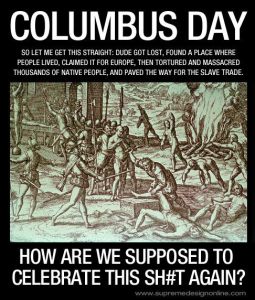 “As Native American peoples in this red quarter of Mother Earth, we have no reason to celebrate an invasion that caused the demise of so many of our people, and is still causing destruction today.”
Suzan Shown Harjo – Creek & Cheyenne
Just last week, the City of Cincinnati passed a resolution to recognize Indigenous Peoples’ Day on what is known on the calendar as Columbus Day. This kind of action has been taking place in several cities across the country in recent years, as Native communities and their allies have raised the issue and accurately called out Columbus Day as an ongoing manifestation of White Supremacy. Challenging the legitimacy of Columbus Day is an important anti-racist act, but it must be seen in the larger context of challenging White Supremacy.
It is increasingly imperative that we come to terms with the function that Columbus played in the European conquest/colonization of the what we now call the Americas. Columbus was commissioned by the Spanish Crown and sanctioned by Catholic Church (through a 1493 Papal Bull) to conquer new lands and extract resources to benefit Spain. Therefore, Columbus not only is the primary symbol of the 500 years of genocide and slavery that has plague the western hemisphere, he is the symbol of political, religious, social and cultural imperialism that continues to the present by a White Supremacist system of Capitalism.
I don’t want to spend much time further exploring these historical dynamics, as I want to get to what it is that White people should be doing confront the legacy of Columbus Day. However, there are a few resources that I would highly recommend for people who want to investigate this history. (See Resources listed at the end of this article.)
Undoing part of White Supremacy: A Proposed Agenda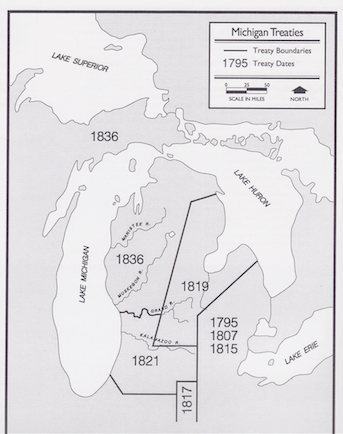
The list that follows includes not only some clear principles of Racial Justice, but are directed specifically towards White people who inhabit what we refer to as Michigan or as Indigenous people often say, Anishinaabe territory that is currently occupied by the State of Michigan. These are proposed actions and are meant to create discussion, while ultimately leading to concrete action for those of us who have White privilege. While these actions might not seem urgent in the face of recent US politics and with the upcoming election in November, it is critical that we come to terms with the fact that the land we stand on, the land we occupy, was stolen from Native people. In addition to coming to terms with this reality, this admission should inform how we organize for something more than just getting the right leaders elected, because at the end of the day, whoever is elected will still ignore and dismiss the fact that we are currently on stolen land.
Grand Rapids was founded on Settler Colonialism – As a foundational framework, it is vital that we come to terms with the fact that Grand Rapids, like virtually all US cities, were founded on what Native scholar Roxanne Dunbar Ortiz calls Settler Colonialism. Settler Colonialism in West Michigan is the result of a larger White Supremacist strategy that included legal means (treaties), forced relocation, spiritual violence (role of churches) and cultural imperialism, most radically seen with the policy of putting Native children in boarding schools with the goal of, “Killing the Indian, Saving the Man.”
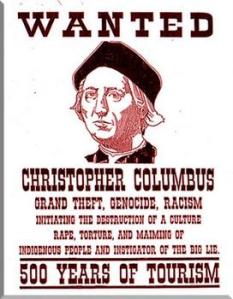 Get the City of Grand Rapids to denounce Columbus Day – For those of us who claimed to be against White Supremacy and want to engage in acts of racial justice, here is a concrete action to organize around. The fact that the City of Grand Rapids still recognizes Columbus Day means they support the White Supremacist narrative of Settler Colonialism and what was done/is being done to Native people in this area. We need to organize to end Columbus Day in Grand Rapids. If the Native community wants them to rename October 12 Indigenous People’s Day, we should support that, but that is a decision for Native people to make.
Resist Economic Policies that Negatively Impact Native People – Over the next several days there will be Columbus Day sales, which would be equivalent to Himmler Day sales in Germany. This is low hanging fruit, but we should not shop at stores having Columbus Day sales, we should be protesting them. More importantly we need to find out how larger economic policies, particularly extractivist policies impact Native communities. The extraction of oil and gas worldwide disproportionately impacts Native people, which is why Native communities 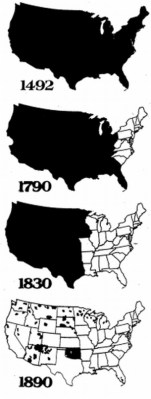 are at the forefront of campaigns to resist projects like the Alberta Tars Sands and all the pipelines connected to such projects. Groups like Idol No More and the Indigenous Environmental Network are groups that we need to be in solidarity with by providing whatever support they are asking for. Nuclear energy should also be resisted, since uranium mining in the US happens on or adjacent to Native land. (see If You Poison Us: Uranium and Native Americans)
Demand that Land be Given Back to Native Nations – As the map here illustrates, the amount of land that was inhabited by Native people before the European Conquest was massive. The US government and State governments have violated virtually all treaties signed with Native Nations (remember, treaties can only be signed between nations) and one of the major aspects of the Native Sovereignty Movement in the US is to reclaim some of the land taken in the process of Settler Colonialism. What this would look like in West Michigan is for Native people to decide, but those of us who claim to support racial justice must make this a priority. Land is justice.
End Native Cultural Appropriation – We have to stop appropriating Native culture and Native spirituality in all its forms. White people are notorious for appropriating Native traditions and making them their own and this has to STOP. Whether we are talking about sports mascots, sweat lodges or any other Native cultural and spiritual traditions, we have to stop appropriating them and challenge other people from doing the same.
Accomplices Not Allies – Lastly, I would highly recommend that people read, Accomplices Not Allies: Abolishing The Ally Industrial Complex. This article/zine is reflective of the important and uncomfortable work that White people need to do if we are to take seriously our role in dismantling White Supremacy.
While this list is short it provides White people with a lot of opportunities to practice racial justice and confront White Supremacy. This has to be our work. In the same way that men have to make the end of rape culture a priority, White people have to make the end of White Supremacy a priority. Let’s get to it.
Some Resources:
The Canary Effect (film) https://www.youtube.com/watch?v=lD7x6jryoSA
An Indigenous People’s History of the United States, by Roxanne Dunbar Ortiz
All Our Relations: Native Struggles for Land and Life, by Winona LaDuke
The 500 Years of Resistance Comic Book, by Gord Hill
Custer Died for Your Sins, by Vine Deloria Jr.
A Little Matter of Genocide: Holocaust and Denial in the Americas 1492 to the Present, by Ward Churchill
GRPD threatened to arrest members of Movimiento Cosecha for chanting near the ArtPrize closing ceremony event
 Last night, Movimiento Cosecha began its 5-day pilgrimage from Grand Rapids to Lansing, to demand drivers licenses for all.
This campaign not only highlights another repressive component of state violence – not allowing immigrants to obtain a drivers license – it demonstrates the resiliency and commitment of a movement led by immigrants.
An estimated 50 people gathered at Fountain Street Church last night, in order to share food and get last minutes instructions on 5-day pilgrimage, which would end in Lansing on October 9th for a state wide rally at the Capitol building.
However, before beginning the pilgrimage, Movimiento Cosecha organizers decided to hold a press conference by the statue at Rosa Parks Circle. The participants walked from Foundation Street Church to Rosa Parks circle and along the way they were met by cops with the GRPD.
This has been a pattern that Movimiento Cosecha GR and GR Rapid Response to ICE have seen in the past 18 months since they began organizing around immigrant justice, ICE violence and demanding an end to Kent County’s contract with ICE. Police have been intimidating, harassing and attempting to prevent participants in this movement from engaging the public through a variety of tactics. Within the last few weeks, we have seen an even larger police presence, most notably at the People Commission Action on September 13, an anti-ICE action that took place during the opening ceremony of ArtPrize on September 19th, and the NoBusinessWithICE action on October 1st.
 This is what DeVos money buys in Grand Rapids
It was discovered a few days ago, that ArtPrize was further restricting what people could have on their person while coming to the closing ceremony in Rosa Parks Circle, displaying these signs at the entrance to a completed closed and policed event.
So, when the Drivers Licenses for All pilgrimage decided to walk by the Rosa Parks Circle, in order to get to the statue of Rosa Parks for their press conference, it was clear that the police were going to try to prevent them from disrupting the ArtPrize festivities.
There were no less than 50 members of the GRPD present around or near Rosa Parks circle – on foot, in cruisers, on bicycle, on horseback and using segways. This was on top of the ArtPrize security personnel, which were place at all of the entrances to Rosa Parks circle, which was completely closed off aside from one main entrance on the east side of the park. There was fencing place around the entire park and they police presence was so extreme, you would have thought they were trying to protect the Arc of the Covenant. (the pictures are grainy, since it was dark and raining, but you can get a sense of where the cops were stationed around the perimeter of Rosa Parks Circle)


Allies with Movimiento Cosecha who were providing crows safety were met by a line of cops, near the southeast entrance to Rosa Parks Circle. When they asked to speak to someone who was in charge the cops present called for one of the captains to come over. The crowd safety personnel were told that people walking with Movimiento Cosecha could got through the park, as long as they didn’t use bullhorns or making any noise that would disrupt the ArtPrize event.
Movimiento Cosecha participants walked through and when they got to the area of the northwest corner of the Art Museum, they began chanting and handing out flyers about the drivers license campaign. The cops were extremely agitated and told some of the crowd safety personnel that they would start arresting people if the chanting didn’t stop. However, those walking were continuously moving and eventually made it to the statue of Rosa Parks.
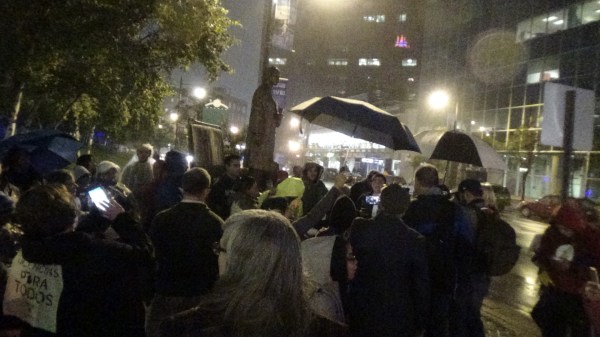
Once they arrived at the statue, they used a technique, which was made popular during the Occupy Movement, the People’s Mic. The People’s Mic is where someone says a sentence and then the entire crowd repeats it back, thus amplifying what was being said. The police did not stop this from happening and the press conference continued.
As is with all Movimiento Cosecha actions, the press conference was conducted in Spanish and English. There were no major news agencies present, but there were at least two Spanish-language entities there, filming the entire event, along with someone from the Rapidian.
Once the press conference was over, the pilgrimage officially began. Participants walked up Monroe Center, passing the ArtPrize event and chanting along the way. Once they arrived at Fulton St., they stayed on Fulton Street the entire time until they reached the destination of their first stop along the pilgrimage. The police followed the pilgrimage at least until Lafayette Street, making sure that the Movimiento Cosecha participants were not going to come back and further disrupt the ArtPrize event.
You can follow the progress of the pilgrimage to Lansing, by checking the Movimiento Cosecha GR Facebook page, where there will be regular posts throughout the next several days.
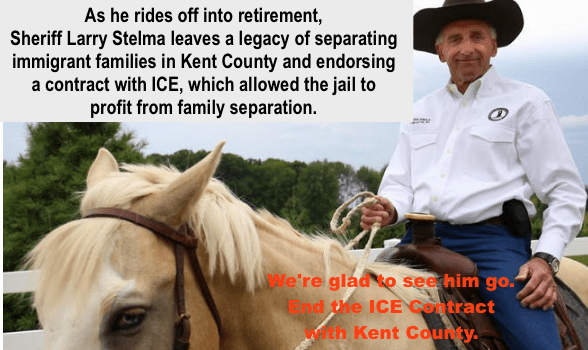
 It was announced a few months ago that Kent County Sheriff Larry Stelma was retiring.
The announcement of his retirement came in the midst of the campaign led by Moviemiento Cosecha GR and GR Rapids Response to ICE to end the county’s contract with ICE.
In an article announcing his retirement, Stelma said that the campaign to end the contract with ICE had nothing to do with his decision to retire. While it is up for debate whether or not the campaign to end the ICE contract had anything to do with his decision to retire, it certainly is part of the legacy that Sheriff Stelma will leave behind.
Larry Stelma served as Sheriff during a time of jail expansion, which means that he presided over an increase in Kent County’s role in the Prison Industrial Complex and Mass Incarceration. Thousands of people who have come through the Kent County Jail were there for non-violent offenses, which speaks to the county’s failure to provide adequate alternatives for people who did not need to go to jail.
In 2012, Sheriff Stelma agreed to a contract with Immigration and Customs Enforcement (ICE), a contract that saw an increase in arrests, detentions and deportation during the Obama administration and the subsequent Trump administration.
In 2017, Kent County signed an extension of the ICE contract, a contract which provided financial incentives for the Kent County Sheriff’s Department.
Sheriff Stelma signed onto a letter from the National Sheriff’s Association in March of 2018, which is more of an ideological statement about immigration. Part of that letter reads:
Congress must act to pass legislation to secure our borders through enforcing immigration laws, tightening border security, support the replacement and upgrades to current barriers and fencing and construction of barriers along the U.S. and Mexico international boundary as requested by those areas where it is needed, suspending and/or monitoring the issuance of visas to any place where adequate vetting cannot occur, end criminal cooperation and shelter in cities, counties, and states, and have zero tolerance and increased repercussions for criminal aliens. I stand firm with my fellow Sheriffs throughout our nation to have our borders secured first, in full cooperation and support of our promise and mission to uphold and enforce our nation’s laws, and we expect nothing less from Congress.
This ideological commitment to criminalize immigrants became evident as soon as the End the Contract with ICE campaign began in late June of this year. In late July, after organizers from the End the Contract campaign went to Kent County Commission Chair Jim Saalfeld’s home, Stelma had these words to say:
“Trying to intimidate anyone just isn’t the American way.”
We responded with an article headlined, Kent County Sheriff Stelma is either stupid or in denial about intimidation being un-American.
The Sheriff’s Department, under Larry Stelma’s leadership, has continued to hold firm on their position that they will not end the County’s contract with ICE, despite the growing opposition to the contract and numerous meetings that organizers have had with county officials.
As Sheriff Larry Stelma is set to retire by the end of October, it is important to point out that he leaves a legacy of separating immigrant families in Kent County and endorsing
a contract with ICE, which allowed the jail to profit from family separation. I, for one, am not sorry to see him go.
Neoliberal Diversity, Equity and Inclusion: What the Grand Rapids Chamber of Commerce really practices
The Grand Rapids Chamber of Commerce endorsement of Republican candidate for Governor Bill Schuette continues to generate plenty of controversy, particularly because of his stance over LGBT issues.
 We wrote an article a few weeks ago in response to the backlash against the Chamber’s endorsement, which asked why did the endorsement of Schuette generate such controversy, when the Chamber of Commerce has a history of endorsing candidates that embrace a political vision that is part of the larger neoliberal economic platform, which disproportionately impacts communities of color, the working poor, queer and immigrant communities.
There have been some businesses and organizations that have withdrawn their membership, but most have remained, which provides a perfect opportunity to examine the GR Chamber’s politics, especially since they are hosting their Diversity, Equity and Inclusion Summit today in Grand Rapids.
As social movements continue to challenge systems of power around racial, economic and LGBT justice, the business community has grappled with how to win social capital with these movements and not abandon their primary goal of representing the capitalist class.
The history of the US Chamber of Commerce and all of its chapters around the country has been a history that exclusively focuses on how the most powerful members of the business community can ban together to further their political agenda and expand their wealth. Lets be honest about the fact that even though a business of any size can be part of the Chamber of Commerce, the larger businesses and corporations are what driver Chamber policy. This is the case with the national US Chamber of Commerce and it is the case with the Grand Rapids Chamber. Just look at who sits on the Board of Directors and you can see who is making the decisions about the direction of this entity. Many of the people and businesses represented on the GR Chamber board are also part of the Grand Rapids Power Structure.
So, why does an entity that represents the interests of the capitalist class hold Diversity, Equity and Inclusion summits?
First, as mentioned earlier, there is a tremendous amount of social capital to be gain by embracing diversity, equity and inclusion. Having more people of color, women or members of the LGBT community as part of the business community is a buffer against accusations that the business class are racist, sexist and homophobic. However, there are significant limitations to businesses that adopt diversity, equity and inclusion language and policies, specifically if they are adopted as a form of identity politics. Businesses love having more diversity in the board room or on their staff as long as those people buy into what Crystal Fleming, author of How to be Less Stupid About Race, identifies as neoliberal inclusion. For Fleming, neoliberal inclusion is a form of tokenism that does not address larger systems of oppression like White Supremacy, Patriarchy, Homophobia and Capitalism.
Longtime educator and organizer Elizabeth Martinez says that using the word racism is problematic, since it does not name the system of racial power that exists, which is White Supremacy. Martinez’s definition of White Supremacy is:
White Supremacy is an historically based, institutionally perpetuated system of exploitation and oppression of continents, nations and peoples of color by white peoples and the European continent, for the purpose of maintaining and defending a system of wealth, power and privilege.
Contrast this definition of White Supremacy with the what the Grand Rapids Chamber of Commerce does, which according to their own mission is to be a champion for West Michigan business. This means that the Grand Rapids Chamber of Commerce primary focus and work is to look out for the interests of the business community. Some might say this is self evident, but the point here is that because this is their focus they will use whatever means they can to support that mission, even if it means to host a diversity, equity and inclusion summit.
In fact, such a strategy is smart on their part. If you can get people who have been the most marginalized by White Supremacy, Patriarchy, Homophobia to feel included in the GR Chamber, then you have won a great deal of social capital that not only diverts attention away from the primary mission – more profits and more political influence for the capitalist class – it allows people to not have to think about the harm being done to the most marginalized in this society.
Lets be real, this form of tokenism is widely practiced and embraced by non-profits all over the country. Take for instance the Human Rights Campaign, which puts out an annual Corporate Equality Report, rating corporations that have positive policies towards the LGBTQ community. In their 2018 report they list corporations like Wal-Mart, Exxon Mobil, Chevron, Amazon as having great ratings. These are all companies that exploit their workforce and fight against labor unions. These are corporations that pillage the earth and destroy indigenous lands all across the globe. However, in the world of diversity, equity and inclusion you can exploit and pillage as long as you have LGBT-friendly policies.
This is exactly the kind of logic that the Grand Rapids Chamber of Commerce embraces. The GR Chamber has OutPro, because it wins them social capital, but it simply means that those who identify as LGBT can also be part of the capitalist class and exploit and pillage as well as straight people. This is exactly why Crystal Fleming names this as Neoliberal Inclusion, because the capitalist class is more than happy to have people of color, women and members of the LGBTQ community as long as they embrace the neoliberal economic model.
Any organization that cares about social justice issues and fights against systems of oppression would not only end their membership in the Chamber of Commerce, they would see them clearly as an organization inherently in opposition to social movements that fight for collective liberation.
How People in Power see Social Movements: A Kent County Administrator and the End the Contract with ICE campaign narrative
 It is always instructive to see how those who hold positions of power view the world.
When talking about historical events, those in power prefer to highlight the “official history” of what took place. “Official history” is the view of history from those in power often seen as the historical winners. This view of history serves those in power and attempts to minimize the role that social movements played throughout history. For example, those in power like to say that Abraham Lincoln freed the slaves, when in fact the abolition of slavery was done almost exclusively by African Americans who rioted against their slave masters, burned the plantation houses, sometimes killed the master, fled the plantation, sought refugee in the underground railroad or fled the country.
In this example we are led to believe that a politician freed those in slavery, using legal and acceptable means of achieving a goal. Those who actually freed themselves and were assisted by other former slaves or allies, used whatever means necessary to engage in what historian David Roediger calls, self-emancipatory tactics. It is true that Lincoln did present the Emancipation Proclamation, but this was merely a law that supplanted a previous law which made it ok for white people to enslave black people.
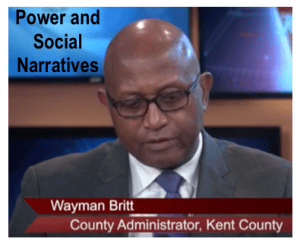
A recent example of how those in power view history, can be seen in an interview on WKTV (Public Access TV) with Kent County Administrator Wayman Britt, which you can view here below.
There are several things worth pointing out about what Britt said, which I want to address.
First, early on in the interview he talks about how the Kent County Jail’s contract with ICE, “ensures that any detainees are treated properly and fairly.” This is a smart play on words by Britt, but it is misleading, since aren’t all people who are being held in the Kent County Jail treated properly and fairly? In other words, why try to make a distinction? Britt makes this statement up front as a way of putting viewers at easy about detainees, without having to actually address the real harm that ICE does to the immigrant community.
Second, Britt makes the claim that the Sheriff’s Department can’t say no the ICE, because it is a federal law. This is simply not true. One, there are numerous communities across the country that are making the decision to end their contracts with ICE or passing resolutions that will prevent said communities from using any resources that would support or aid ICE to do harm against the immigrant community. Two, Britt’s statement also ignores plenty of historical examples of local governments defying federal laws, especially those used to oppress groups of people.
Third, the Kent County Administrator says that after 72 hours people could be released and that the county wants to make sure that citizen’s rights are protected. Again, he uses language that is deceptive. More importantly, Britt uses the phrase citizen’s rights, which based on the actual reason that the federal government is using ICE to target people in the immigrant community, is because of their status as undocumented. The federal government and ICE do not see immigrants who are undocumented as citizens, which is exactly why they are being targeted by ICE.
Fourth, when talking about the organized effort to get the county’s contract with ICE terminated, Britt uses the good protestor/bad protestor argument. He says there are times that they (protestors) have done a good job during public comment and then there are times that they (protestors) have disrupted and interrupted the County Commission meetings. This good protestor/bad protestor statement is meant to reflect his view (someone in power) views as acceptable tactics and unacceptable tactics.
Fifth, Britt gives his view of the campaign to end the contract, which began in late June of 2018. Britt refers to the People’s Commission Meeting, which was held in September, but pretty much ignores all the other examples since June 28th. Britt also states that, “we don’t want to remove people from the room or arrest people.” However that is exactly what they have done on a few occasions, along with engaging in other tactics to deter public participation – putting up barriers and signs in the commission chambers, sending cops out to intimidate people before they come to the meeting, not allowing people to bring their backpacks into the meeting, etc.
Sixth, the County Administrator says, “it’s odd to me that people would not take the road to working with state and federal legislators.” One, this ignores and dismisses that work that many people in this community have done to change state and federal law on immigration policy. Two, it ignores the fact that many people are still working on changing state and federal policy. Three, it also ignores the rich history of people working to confront local governments as one strategy to change state and federal policy. Confronting local government on policies that are imposed by the federal government is a large part of the Civil Rights Movement, but it has also been a tactic in the environmental justice, anti-war and anti-apartheid movements, just to name a few.
Seventh, towards the end of the interview Britt states, “I’m as concerned as they are…..but ending the contract is not something we can do.” One, there is no evidence that they are as concerned as those confronting them about the ICE contract. Britt then engages in mansplaining, as if people don’t know what the issue is all about.
Lastly, the County Administrator says we need to resolve this through discourse, by listening and if we want to resolve the issue those protesting need to do so with federal legislators. These final comments by Britt again re-affirms his belief that the County can do nothing about it, plus he places value on discourse, which is just a convenient way of saying that this is a tactic that is respectable. The fact is that members of Movimiento Cosecha GR and GR Rapid Response to ICE have had numerous conversations with county officials, commissioners and the Sheriff’s Department, but there has be no willingness on the part of the county to end the contract. If they are unwilling to end the contract, then what is the point of discourse.
As a contrast, WKTV did interview two members of Movimiento Cosecha GR, an interview we are posting here below.
Last night, some 25 people participated in the national No Business With ICE Action Day, here in Grand Rapids. Cities across the country participated in the action to draw attention to the many corporations and businesses that have contracts with ICE, and to demand that they end their contracts with an agency that does tremendous harm to the immigrant community.
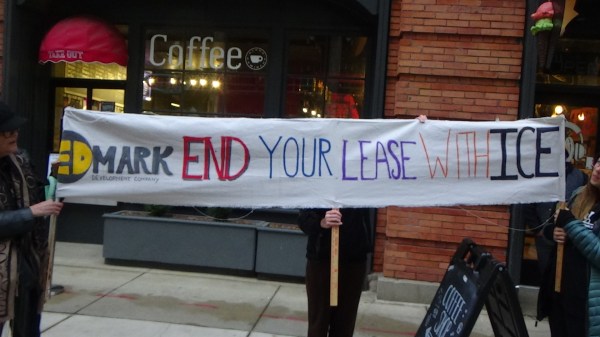
The target in Grand Rapids was the Edmark Development Company. Edmark, which now owns the Waters Center building, leases space to the Department of Homeland Security/ICE at 161 Ottawa NW. However, you wouldn’t know this, since there is no information listed at their online directory or the directory in the building’s lobby.
Movimiento Cosecha GR and the GR Rapid Response to ICE group were handing out flyers with information about Edmark, along with ways for people to contact them to demand that they end their lease with the Department of Homeland Security/ICE. The number to call for Edmark is 616.575.6051. There is also an online petition that people can sign.
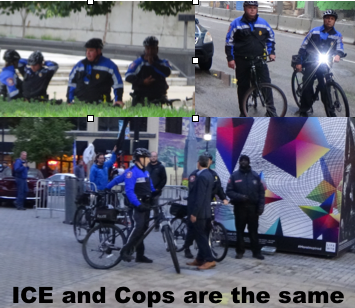 However, before going to the Waters Center, people gathered at Calder Plaza, where they were met by 12 – 15 cops from the GRPD. The cops told the group that if they went into the Waters Center building and disrupted people there for entertainment (the Waters Center is an ArtPrize venue), they would be arrested.
It was a cold and raining night in Grand Rapids, which meant there wasn’t much foot traffic, so the action moved from the Waters Building and decided to go to Rosa Parks Circle to see if there were more people that they could share the flyer with.
Upon arriving at Rosa Parks Circle the group stood in front of the Grand Rapids Art Museum, specifically where channel 8 has their ArtPrize studio, holding up banners and signs and chanting. After about 5 minutes, the GRPD (which followed them down) told people they had to move off the brown colored bricks onto the grey colored bricks or they would be arrested.
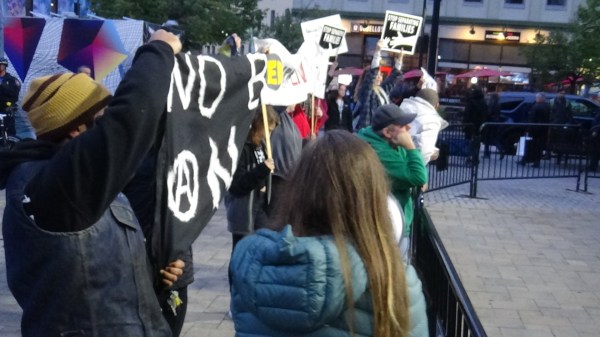
The group then went down to the arena district and continued to hand out flyers and to chant about ICE, Edmark and the cops, since the cops kept following the group the entire way. The action ended at the ArtPrize office on Sheldon & Weston, where flyers were left for ArtPrize staff.
Movimiento Cosecha GR and GR Rapid Response to ICE also wrote up a statement, which was delivered to the Edmark Development Company office. It is a powerful statement, which we will re-post here:
To: Edmark Development Company
161 Ottawa NW, Grand Rapids, MI 49508
From: Movimiento Cosecha GR
GR Rapid Response to ICE
Concerned citizens
Date: October 1, 2018, A National Day of #NoBusinessWithICE
We demand that you cancel your contract with ICE and stop renting office space to the Department of Homeland Security.
Why?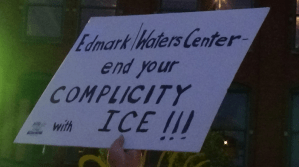
- It’s morally wrong to be complicit with ICE. ICE abuses immigrants and children.
There’s evidence that there have been over 33,000 complaints filed against ICE over the last 7 years, alleging a wide range of abuses in immigration detention. Those included sexual abuse. There are cases in which complying with a demand could get an immigrant released -but they could be deported to the wrong country if they didn’t.
The ACLU has obtained over 30,000 pages of documented abuses of immigrant children in ICE custody. ICE officers have:
- Punched a child’s head three times, kicked a child in the ribs
- Used a stun gun on a boy, causing him to fall to the ground, shaking, with his eyes rolling back in his head
- Subjected a 16-year-old girl to a search that ended in a sexual assault which was too graphic to describe here.
- They’ve done many other things – calling children dogs, threatening them with sexual assault by other inmates, running over a teen with a patrol vehicle, refusing to let children stand up for days, and more.
This is the organization that you are allowing in your building.
- ICE separates families and hurts our community.
In 2016, the number of undocumented immigrants in Kent County was over 13,000. The undocumented share of the immigrant population was over 26%.
This means that most immigrant families and many non-immigrant families here have loved ones who are under-documented, and the fear of their detention and deportation affects all areas of their lives. The fear of losing a loved one. Of losing a family member. Of losing the income they need to live.
Even when they are not abused by ICE like in the examples above, children are traumatized and do poorly in school when a parent is taken. Mental and physical health, productivity, and quality of life all suffer greatly when a family is separated.
Yet it is estimated that immigrants contribute $3.3 billion a year to Kent County’s economy. Immigrants are our valued neighbors, working, living, learning, and playing alongside of us in our day-to-day lives. We must stand with them.
- We must make it so that ICE cannot do their violence in our city.
Businesses all over the country have stopped doing business with ICE. Virgin Airlines won’t use their flights to deport people anymore. Several local municipalities have canceled their contracts with ICE and ordered ICE detainees to be released. By making it difficult for ICE to work in our city, we can help to stop the violence and keep families together.
Stop renting to ICE. Support the immigrant community.
Betsy DeVos Watch: Freedom, Free Speech on Campus and the National Constitution Center
 A few weeks ago, Secretary of Education Betsy DeVos spoke at an event organized by the National Constitution Center for their annual Constitution Day.
The speech that DeVos gave in September, was instructive on many levels. A primary theme of the Secretary of Education’s speech centered around freedom and freedom of speech. In many ways, Secretary DeVos was chastising both students and campus administrators of limiting ideas and information. Such a claim seems rather laughable coming from a person who justifies her family’s contribution of millions of dollars during election cycles as “free speech.”
Another point that DeVos addressed was the issue of civility. Civility is a topic and theme that more and more campuses are pushing, especially since there are more and more students and community members who are challenging what they would identify as hate speech.
A good example of hate speech is the student-led protests that have confronted the white supremacist leader Richard Spencer. More and more student groups or community groups that are marginalized – black, latino, immigrant or queer communities – are protesting, interrupting or even trying to prevent those who promote white supremacy, homophobia, closed borders and privatizing education, as a few examples.
These are examples that are in sharpe contrast to the examples that Betsy DeVos does provide. One example, DeVos gives states:
An official student activities board at the College of William & Mary, a public campus in Virginia, recently hosted a director of the American Civil Liberties Union for a discussion on free speech. Almost as soon as the event got underway, students rushed the stage and began to shout down the ACLU representative, an organization typically allied with many of the same causes shared by those who were shouting. The event never resumed.
What DeVos failed to mention is that those protesting the event were members of a Black Lives Matter chapter that were specifically challenging the ACLU’s defense of people like Richard Spencer and other white supremacists to have a public forum to spew their hate. This protest was held in October of 2017, so the BLM protest was drawing attention to the ACLU’s defense of the white supremacist gathering in Charlottesville, Virginia.
A second example that Betsy DeVos gave in her speech was about U of M students bringing Alveda King to campus and then being charged by the university to provide security. DeVos also mentioned that she was the niece of Dr. Martin Luther King Jr. What DeVos failed to mention in her speech was that Alveda King was invited to campus, since she was an anti-abortion activist and was invited by an anti-abortion student group. When other students found out that King would be speaking about  her anti-abortion views, the university decided that security would be needed and then charged the group that brought King to campus.
One last example that DeVos mentions was the joint statement that Princeton’s Robby George and Harvard’s Cornel West issued on freedom of thought. While Cornel West issued such a statement, DeVos again failed to mention that Dr. West was part of the counter-demonstration in Charlottesville attempting to shut down the white supremacy march.
Betsy DeVos also stated that the country has “abandoned truth.” Yes, a person who grew up in a wealthy family that was part of the religious right and married into an even wealthier family that is part of the religious right movement that seeks to impose its values on the rest of society, had the audacity to tell students that people have abandoned truth.
Grand Rapids Police Task Force Recommendations: False solutions and the need for Radical Imagination
 For several years now the City of Grand Rapids and the GRPD have been reviewing their policies and making some adjustments because of public pressure.
Most of the public pressure has been coming from communities most negatively impacted by police presence and police practices, specifically the African American and Latino/Latinx communities.
This pressure coincided with increased police brutality and police killings of black people across the US, especially since Michael Brown was murdered by cops in Missouri a little more than four years ago.
The most recent round of recommendations that have been developed by a Task Force made up of cops and some residents is just the latest list of recommendations that ultimately present a false solution.
There are 38 recommendations put forth dealing with the following areas:
- Staffing and Deployment
- Internal Affairs (Accountability)
- Training
- Youth Policy (this was added at the request of the police chief)
- Community Policing and Crime Reduction
- Recruiting and Hiring
 As you can see from the list, the recommendations are internal to the GRPD and are essentially mild reforms that do not address the fundamental role of cops, which is to protect power and maintain the status quo. To quote Alex Vitale, author of the book, The End of Policing:
The problem is not police training, police diversity, or police methods. The problem is the dramatic and unprecedented expansion and intensity of policing in the last forty years, a fundamental shift in the role of police in society. The problem is policing itself.
Do we really believe that if police officers take cultural competency courses that it will result in a reduction of policing and arrests in black and brown communities? Do we really believe that hiring more minority officers or female officers will fundamentally change the function of policing? Does having more cops in neighborhoods, walking a beat and getting to know the residents mean that crime will be reduced? These are all reformist solutions that are generally presented to communities all across the country, yet the results are still the same.
- The US has the highest incarceration rates in the world and the highest percentage of people who are on parole, on probation, in jail or prison are disproportionately black and brown communities experiencing poverty.
- Police harassment and violence directed at communities of color are on the rise.
- Police departments have become more militarized.
- Police departments are engaging in increasing levels of surveillance.
- Police departments are using massive amounts of city budgets – 1/3 of the Grand Rapids City Budget is devoted to policing.
Take for instance the idea of community policing. In the new recommendations, there are eight community policing recommendations:
Recommendation 5.1: Recognizing that community policing works best when it is supported by elected leaders and is a subset of community-based governance; the Mayor and City Commission should adopt a Resolution that mandates community policing as the operating philosophy of the police department and require all city departments to contribute to enhance public safety through community collaboration.
Recommendation 5.2: GRPD should develop a citywide community policing plan that incorporates crime reduction strategies, community engagement and partnerships, and police department oversight.
Recommendation 5.3: GRPD should include community members in its CompStat process.
Recommendation 5.4: Develop a patrol strategy that allows Beat officers time to engage with the community in non-enforcement activities (e.g., foot and bicycle patrols).
Recommendation 5.5: Require Problem-Oriented Policing (POP) training to all sworn officers. This training teaches officers how to solve community problems in partnership with the community and through a mode that is comprehensive and evidence-based.
Recommendation 5.6: Incorporate the core principles of community policing – engagement, collaboration, problem-solving, and building trust and legitimacy in annual performance evaluations for all officers.
Recommendation 5.7: GRPD Beat officers should be required, and given the time, to initiate and complete at least one POP project on a quarterly basis.
Recommendation 5.8: GRPD should develop a specific POP incentive program(s) that recognizes and highlights GRPD staff – both sworn and civilian – in problem-solving with the community.
These recommendations might sound like a good idea, but that is only because we fail to understand the essential function of police departments as protecting power and maintaining the status quo. Within this framework of understanding, community policing is essentially a form of counterinsurgency, which seeks to win over the populace of any community, to gain access to information about populations they consider dangerous, and to undermine efforts for collective liberation.
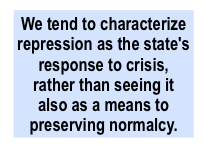 Kristian Williams, in his book, Life During Wartime: Resisting Counterinsurgency, examines the history of community policing and the disastrous impact it has had on communities of color and poor communities.
In Williams’ book, he looks at the research done by the RAND Corporation, which studied community policing. The Rand Corporation says this about community policing as its paradigm for counterinsurgency:
Pacification is best thought of as a massively enhanced version of the ‘community policing’ technique that emerged in the 1970s. Community policing centered on a broad concept of problem solving by law enforcement officers working in an area that is well-defined and limited in scale, with sensitivity to geographic, ethnic, and other boundaries. Patrol officers form a bond of trust with local residents, who get to know them as more than a uniform. The police work with local groups, businesses, churches, and the like to address the concerns and problems of the neighborhood. Pacification is simply the expansion of this concept to include greater development and security assistance.
Does this assessment by the RAND Corporation sound eerily like the recommendations put forth by the GRPD?
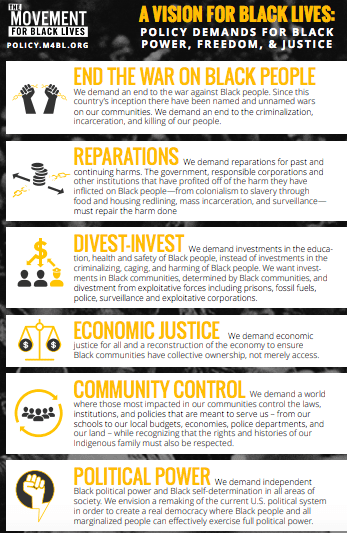 A Community-based vision for Liberation that doesn’t include cops
Part of the work that community-based organizing must do, is to challenge all of us to engage in radical imagination. Radical imagination simply means to envision a world that is outside of the acceptable and existing frameworks. For instance, instead of proposing that those with tremendous wealth donate to projects that provide affordable housing, we could propose that housing is a fundamental right and if everyone had a livable wage they could afford adequate housing.
When we talk about radical imagination and policing, many movements propose that every community should be able to determine how to create safe and secure communities. This is exactly, what many communities of color, specifically black communities have been calling for since Michael Brown was murdered by a cop in Ferguson, Missouri in 2014. This is exactly what the Movement for Black Lives has been calling for in the radically imaginative vision, seen here on the right.
We all most push for a radically new way to create safe and free communities. We all need to radically imagine our communities that no longer includes state violence in the form of police or prisons. Together we can imagine something new.
Don’t be fooled by Wolverine Worldwide’s PR stunt during ArtPrize!
 Corporations go to great lengths these days to present themselves as being environmentally sustainable or practicing social responsibility. Hell, even oil companies have very slick PR campaigns to communicate to the rest of us that they are a “green” company.
Within the capitalist framework, corporations want to tap into public concerns about hunger, homelessness or environmental sustainability. Within this framework, corporations can encourage consumers to buy their product, which will result in the corporations donating a portion of their profits to some non-profit.
These corporate campaigns tap into a very vulnerable aspect of humanity, in that they want people to feel good, while at the same time contribute to the ongoing consumption of the world’s resources.
Manipulating this kind of public sentiment is very dangerous and it has dangerous consequences. One way that the purchase our way to social justice is dangerous is that it tends to redirect our thinking, even our collective imagination away from what the root cause is of any given social problem. For instance, if I purchase Boxed Water, they will donate a portion of their profits to plant trees. Sounds good on the surface, but it distracts use from the ridiculousness of buying water, when water should be a right that we all have access to. Secondly, buying boxed water distracts us from thinking about all the energy and resources it takes to manufacture the boxes and transport them, when people could just be drinking tap water.
Another way that purchasing to achieve social justice is dangerous, it that it means that we believe that simply donating money will solve our social problems. For instance, the current housing crisis that millions face in the US, cannot simply be fixed by monetary donations. The real housing crisis is a crisis that the so-called free market has creates, which results in millions of people not being able to afford to buy a home or rent an apartment. The market dictates the cost of housing and at the same time (we are told), the market determines what kind of wages that businesses can pay. Not so ironically, this same market, which has forced skyrocketing housing costs and stagnate/low wages also directs billions of dollars to the real estate industry and property management companies.
Lastly, the danger of purchasing our way to social justice thinking also tends to reward the same companies that are responsible for the theft of public funds, racism, homophobia or environmental catastrophes and threats to public health. A great example of this is taking place this Friday, September 29th during ArtPrize.
The Why We Walk project is being sponsored by Wolverine Worldwide where participants will turn their ArtPrize experience into a donation for one of three local charities: Habitat for Humanity of Kent County, Family Promise of Grand Rapids or Western Michigan Center for Arts + Technology.
According to the Facebook event page:
Wolverine Worldwide will donate $50,000 but your steps will determine how much money each charity will receive – why we walk. Simply show us why you walk ArtPrize and for every one-mile you walk (or 2,000 steps), you will be given a token to vote for a charity. At the end of the day, the charity with the most votes will receive $25,000; the charity with the 2nd most votes will receive $15,000 and the charity with the 3rd most votes will receive $10,000. While you’re out walking and exploring ArtPrize and the local community use #WhyWeWalk for a chance to win gift baskets filed with Wolverine Worldwide brand product. At 5pm we’ll draw a random winner from all the #WhyWeWalk hashtag users; the more times you use #WhyWeWalk, the better the chances for winning the gift basket. All participants will be given a discount code to use on any Wolverine Worldwide brand product.
Again, this all sounds good and might even give us some warm fuzzies. However, such charity functions should not distract us from what the real function is of this PR stunt by Wolverine Worldwide.
First, this PR stunt is primarily a way to distract us from or minimize the harsh truth that Wolverine Worldwide has been lying the the public for decades about their environmental contamination in Kent County. Wolverine Worldwide’s toxic dumping is resulting in millions of public money being used for cleanup and massive health costs to families that have been and will suffer from the corporation’s contamination. On top of that, Wolverine Worldwide is still denying most of the damage they have done. (Check out the Facebook page of Michigan Demands Action Group for updates and analysis on the Wolverine Worldwide contamination https://www.facebook.com/groups/demandaction/)
Second, Wolverine Worldwide’s $50,000 donation is insulting when one considers the fact that the company has eliminated over 500 jobs in the last decade and their CEO, Blake Krueger, has a total compensation package (salary, stocks options and bonuses) of nearly $8 million in 2016. The company’s charity during ArtPrize will simply hide the gross inequities that they engage in as a matter of practice.

Of course there will be people who will be fooled by these corporate hucksters and then there are those that say Wolverine Worldwide’s donation will benefit needy families, so don’t be so hard on them. I say, no amount of charity can hide an injustice and no amount of charity can reverse the systemic harm being perpetrated on the people of Kent County.
Don’t be fooled by Wolverine Worldwide’s PR stunt during ArtPrize!

