Company proposing a new immigrant detention facility in Ionia, presented their case before the Ionia City Council earlier this week
 In October, it was first reported that a proposed immigration detention center might be coming to Ionia. We wrote about this on the same day, in an article entitled, Proposal for new immigration detention facility in Ionia indicates an increase in ICE activity in Michigan.
The proposal comes from the Immigration Centers of America (ICA), which was founded in 2008 and provides detention and transportation services for the US Department of Homeland Security. Their Farmville Detention Facility in Virginia, is often cited as a shinning example of the kind of services they offer to Homeland Security.
On Wednesday, WOOD TV8 ran a follow up story about the proposed immigration detention center in Ionia, after a lawyer representing the company that plans to build the facility, had presented their case before the Ionia City Council on Tuesday.
The channel 8 story is worth examining. First, there are three different perspectives provided; the lawyer representing ICA, the Mayor of Ionia and the executive director of Migrant Legal Aid, which opposes the need for a new detention facility.
We checked the City of Ionia Commission meeting agenda for January 8, but there is no mention of the detention center proposal on the agenda and the minutes from that meeting have not as of yet been posted.
In the WOOD TV 8 story, it states, “ICE made a presentation to the Ionia City Council Tuesday evening. No residents made statements.” We assume that the presentation was given by the lawyer representing ICA, but we won’t know for sure until the minutes from that meeting are posted.

In that same channel 8 story, Dennis Muchmore, the lawyer representing ICA, was quoted as saying, “No one wants to be detained, but these people are not criminals. They are just in the country illegally.” This is an interesting admission and it contradicts how the Department of Homeland Security frames why immigrants are being detained and deported.
At the very end if the story, Muchmore states, “Will a detention center be built? The answer is yes. Will it be built in Ionia? No one knows whether it will be built in Ionia or some other community.” This statement seems to reflect that the proposed detention facility in Ionia is not a done deal and that ICA might have proposals for a detention facility in other states.
Once the Ionia City Council minutes for the January 8th meeting are posted, we will provide an update on this story. In addition, there will be a statewide gathering soon of people who plan to organize and prevent this proposed immigration detention facility from happening.
Agri-Business, Corporate Welfare and the US Farm Bill: How MiBiz reported on the passage of the 2018 Farm Bill
 As we reported in December, the 2018 Farm Bill passing received a great deal of praise from the agri-business sector, when Michigan Senator Debbie Stabenow announced the bill’s passage.
One of the main points we made in our December article was that virtually everyone that Senator Stabenow included in her Press Release announcing the passage of the Farm Bill, were those who were large farmers or those representing various agri-business associations, like the Michigan Farm Bureau.
Now, the local business press is providing an opportunity for the agri-business sector to sing the praises of the 2018 Farm Bill. MiBiz posted posted a story recently, entitled, ‘HUGE WIN’: What the 2018 Farm Bill means for Michigan’s ag industry.
The MIBiz article only relies on three sources in their article. The first perspective we see is that of Jim Byrum, president of the Michigan Agri-Business Association. Apart from being an agri-business association, this group does a great deal of lobbying on behalf of their members to make sure that they benefit from the corporate welfare of the Farm Bill.
A second major voice in the article was John Kran, the national legislative counsel for the Michigan Farm Bureau. Kran spends his time in Washington as a lobbyist for the agri-business sector in Michigan, so it’s no surprise that he praises the passage of the 2018 Farm Bill. According to OpenSecrets.org, the Michigan Farm Bureau has contributed several million dollars to legislators (especially Senator Stabenow) to make sure that the Farm Bill would benefit those they represent in the agri-business sector.

The only other voice represented in the MiBiz article was that of Case Visser of Zeeland-based Visser Farms LLC.  Visser is the only grower sourced in the story, but they are also a member of the agri-business sector and in no way represents small farmers and growers. In fact, Visser Farms LLC is a recipient of corporate welfare from the Farm Bill, so naturally they would praise the Farm Bill’s passage.
Lastly, there was a section in the MiBiz article that provided some history on the US Farm Bill, although the history was skewed in favor of the agri-business model. For those who really want to understand the history of the Farm Bill and how it has changed since its inception, please read Wenonah Hauter’s book, Foodopoly: The Battle Over the Future of Food and Farming in America.
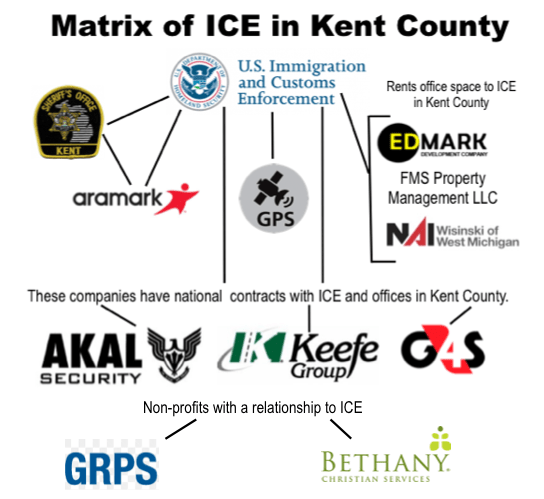
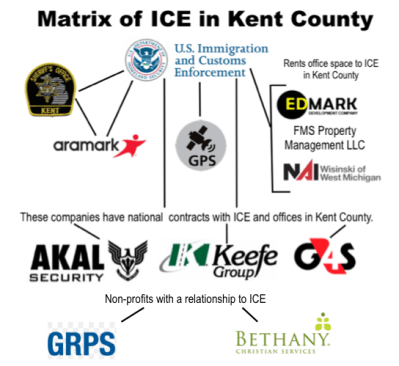 If anyone is familiar with this blog, then they know that there has been dozens of posts in the past two years dedicated to investigating the presence of the Department of Homeland Security in Grand Rapids, specifically ICE – Immigration and Customs Enforcement.
We have investigated where ICE has offices in Kent County and which companies have contracts with them. We have also written a great deal about the Kent County Sheriff Department’s contract with ICE, a contract which could expire at the end of September 2019.
Now, because of the work of local activists with GR Rapid Response to ICE and Movimiento Cosecha GR, there is new information about the partnership between the Department of Homeland Security and the Grand Rapids Public Schools.
In an article posted on January 5th from MLive, we learn about all these new ways that the Grand Rapids Public Schools are diversifying to create career opportunities for students. In the section headlined Academy of Hospitality & Tourism it states:
Grand Rapids schools is partnering with hospitality and tourism industry leaders on a new Academy of Hospitality & Tourism launching the 2019-20 school year.
The college-prep academy will be among six planned at Ottawa Hills High School, 2055 Rosewood& Ave. SE. A culinary program will be added eventually to the Academy of Hospitality and Tourism after some building renovations.
The other academies planned are:
- Academy of Advance Manufacturing and Supply Chain Management
- Academy of Public Safety, Homeland Security and Cybersecurity
- Academy Physical Therapy and Sports Management
- Academy of Media Production
- Academy of Cosmetology
When activists asked the GRPS about this fact, they replied:
There is a huge talent need in the City of Grand Rapids, Grand Rapids Police Department and Grand Rapids Fire Department. Also, Grand Rapids is a designated cyber security hub with well paying jobs.
Activists were pointing out how the GRPS having this kind of a relationship with the Department of Homeland Security is highly problematic, since there are literally thousands of students in the GRPS system who have parents who are part of the undocumented and under-documented community.
In checking the Department of Homeland Security site with relationships they have with High Schools, this is what I was able to find under the heading ICE Pathways Programs
On Dec. 27, 2010, President Obama issued Executive Order 13562 – Recruiting and Hiring Students and Recent Graduates. This Executive Order established the Internship Program and Recent Graduates Program, which, along with the Presidential Management Fellows Program, are collectively known as the Pathways Programs.
ICE also has a Student Volunteer Program. This program is not part of the Pathways Program, but provides volunteer opportunities for students. Learn more about our Student Volunteer Program.
Now, some of these programs are geared toward college students, but there are opportunities for high school students. One opportunity is what is called the Internship Program. The description here makes it clear that high school students are welcomed to participate, where it could lead to career opportunities.
The Internship Program replaces the Student Career Experience Program (SCEP) and Student Temporary Employment Program (STEP). This Program is designed to provide students enrolled in a wide variety of educational institutions, from high school to graduate level, with opportunities to work in agencies and explore Federal careers while still in school and while getting paid for the work performed. Students who successfully complete the program may be eligible for conversion to a permanent job in the civil service.
This is all very disturbing news, but it is consistent with the GRPS, which has been increasing their partnership with the Grand Rapids Police Department to increase provide students with increased opportunities to be directed into a career as a cop.
We hope that this new information about how the Department of Homeland Security and ICE is weaving itself into our public institutions, will not only create greater awareness, but will mobilize students, parents, teachers and community members to challenge this unjust and dangerous partnership.
Because of the new relationship between the Department of Homeland Security/ICE and the Grand Rapids Public Schools, we felt it was time for us to update our Matrix of ICE in Kent County graphic.
By Local Food System, they mean a food system which benefits those with racial and class privilege in West Michigan
 Last Friday, MLive posted an article headlined, West Michigan’s regional food system the focus of new Culinary Conversations.
The article focuses on the new “community conversations” that the Downtown Market will offer beginning this month. Mimi Fritz, the president and CEO of the Downtown Market is quoted as saying:
Feeding and nourishing our community is the core function of our food system and connecting food innovators with experts will help us build a healthy ecosystem. A healthy local food system is an excellent economic indicator — and West Michigan is on the right track to becoming self-sufficient to feed everyone who makes this place their home.
First of all, it should be noted that the Downtown Market is part of a food system that is unjust, unsustainable and caters to the desires of primarily white, upper class people. Therefore, if people from the Downtown Market are talking about a local food system, then it is important to point out that what they mean is a food system based on making a profit, a food system that ignores how workers are exploited in the process and a food system that necessitates that food charity be the solution for those living in poverty.
Second, these community conversations that the Downtown Market will host are designed to bring people together who share their vision of local food, not so much to assess and improve a local food system.
Third, the Downtown Market CEO doesn’t seem to understand that what it means to be self-sufficient in terms of a food system. The head of the Downtown Market fails to acknowledge that the current food system for West Michigan heavily relies on massive farm subsidies (as does the rest of the country) through the Farm Bill. In addition, the current food system is not self-sufficient, since they are a great many food items consumed in this market that come from outside of the state and outside the country. A food system is never self-sufficient if it relies on food that has to travel more than a thousands miles before it is consumed.
Lastly, the very fact that these local food conversations are co-sponsored by Start Garden, just underscores the point that the focus will be on food as commodities for profit and niche markets that benefit those with privilege.
In contrast to what the Downtown Market will be hosting, I suggest that people read The Grand Rapids Local Food Discussion through a Food Justice Lens, which was written after an urban grower critiqued the Downtown Market, plus a post we wrote a few years ago entitled, Community organizing as points of intervention in the Food System: A Grand Rapids perspective.
Like some demonic, destructive suction tube: Martin Luther King Jr and US militarism Part I
 This is the first of a three part series, leading up to the celebration of Dr. Martin Luther King Jr.’s birthday. Using one of the major themes from Dr. King’s historic Beyond Vietnam speech, we want to explore three aspects of US militarism since he have this speech in April of 1967.
Early on in the speech, Dr. King stated:
Since I am a preacher by calling, I suppose it is not surprising that I have seven major reasons for bringing Vietnam into the field of my moral vision. There is at the outset a very obvious and almost facile connection between the war in Vietnam and the struggle I and others have been waging in America. A few years ago there was a shining moment in that struggle. It seemed as if there was a real promise of hope for the poor, both black and white, through the poverty program. There were experiments, hopes, new beginnings. Then came the buildup in Vietnam, and I watched this program broken and eviscerated as if it were some idle political plaything on a society gone mad on war. And I knew that America would never invest the necessary funds or energies in rehabilitation of its poor so long as adventures like Vietnam continued to draw men and skills and money like some demonic, destructive suction tube. So I was increasingly compelled to see the war as an enemy of the poor and to attack it as such.
Dr. King could not separate the relationship to US militarism/imperialism and how we treat those experiencing poverty, what he calls the poor. Later in this same speech, Dr. King then says:
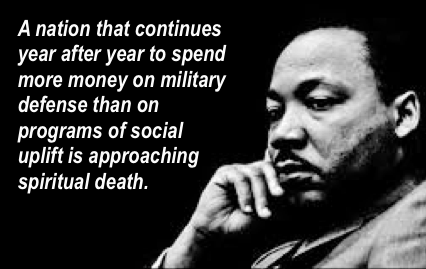
“A nation that continues year after year to spend more money on military defense than on programs of social uplift is approaching spiritual death.”
The civil rights leader could not reconcile the massive amounts of money the US spent on militarism, while at the same time not making sure that the people living in the US had access to basic rights like housing, education, health care, etc.
Unfortunately, this intersectional analysis of US militarism is rarely applied today, even though many people get the idea that spending money on militarism and security detracts from spending money on basic human needs. The most recent example is the money the Trump administration wants to spend on the so-called wall on the US?Mexican border. There are many who have been saying that the money that Trump is demanding to build the wall could be better spent on things like health care. And while I agree with that sentiment, it doesn’t usually translate into people taking action that would confront US military spending or as Dr. King said this demonic, destructive suction tube.
Over the next few weeks, we want to explore three aspects of Dr. King’s analysis on US militarism. In Part, I we will explore how every US administration since 1967 has ignored Dr. King’s plea to reduce military spending and focus on programs of social uplift. In Part II, I will look at US anti-war/anti-militarism organizing since 1967, with a focus on Grand Rapids. And lastly, in Part III, I will look at how we need to see US militarism as a war on the poor, with a proposal on how anti-militarism should be part of every social justice movement.
US Militarism and Imperialism: A Bi-partisan affair
When Dr. King gave his Beyond Vietnam speech in 1967, Lyndon Johnson was president. Johnson escalated the US war in Vietnam during his administration until he left office at the end of 1968.
When Richard Nixon took office at the beginning of 1969, Nixon continued the war in Vietnam, but expanded the war to other countries, involving Laos and Cambodia, which is why there are many historians that refer to this war as the US war in Southeast Asia.
In addition to Nixon’s war in Southeast Asia, his administration was supporting US militarism in other parts of the world like Indonesia, Ethiopia and Chile. However, it is important to think about King’s notion of US militarism as more than right out war. His analysis and ours should see US militarism as US military bases abroad, covert and CIA operations, US military training of other armies, weapons sales and sanctions against other nations. If we expand our understanding of US militarism to include these aspects, then the Nixon administration was also involved with NATO, the ongoing operations to undermine Cuba, Nixon’s support of Israel and Iran. The Nixon administration was also supporting dictatorships in Haiti, Brazil, Nicaragua, Guatemala and Panama.
The Ford administration continued with Nixon’s war in Vietnam until 1975, but was also involved in Indonesia’s invasion of East Timor, maintaining the embargo against Cube, supporting the brutal regime in Iran, funding the Israeli occupation of Palestinian land and expanding the US/CIA role in Angola and South Africa. Of course, all US presidents since Johnson were deeply involved in NATO, maintained over 100 US military bases abroad and were engaged in weapons sales, military aid and training to numerous countries as well.
The Carter administration was busy with US militarism in El Salvador, Nicaragua, Haiti, Iran, Angola and had begun providing lots of money and training to Afghanis who were fighting the Soviet occupation. The Carter administration also continued the US embargo against Cuba and massive amounts of military aid to Israel and Egypt.
The Reagan administration was deeply involved in funding the Afghanis fighting the Soviet occupation, providing weapons to both countries in the Iran-Iraq war, invaded Grenada, funded and trained the Contra war in Nicaragua and the counterinsurgency wars in El Salvador and Guatemala. The Reagan administration continued to support South African Apartheid, funding Israeli, Egypt and Saudi Arabia, along with dictatorships in Haiti and Panama.
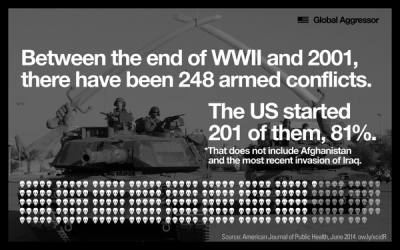 The George H.W. Bush administration continued most of the same forms of US militarism abroad that previous administration had engaged in, plus there was the US invasion of Panama, the Gulf War and the escalation of US military aid and military bases in Colombia to fight the so-called War on Drugs.
The Clinton administration continued the same forms of US militarism since King’s 1967 speech – NATO, US military bases in over 100 countries, US weapons sales, US military training and the US embargo of Cuba. In addition, the Clinton administration engaged in warfare in Somalia, bombed Sudan, the war in Kosovo, supported a military coup in Haiti, supported $1 million a day for the war in El Salvador until the cease fire in 1994, expanded the drug war in Colombia and bombed Iraq regularly for 8 years, along with the harshest economic sanctions that were ever imposed on a country – Iraq, which led to the deaths of 500,000 children. Clinton’s Sec. of State, Madeleine Albright, when asked if the 500,000 Iraqi child deaths were worth it replied, “yes, we think it was worth it.”
The George W. Bush administration continued most of the same forms of US militarism, but began a US occupation of Afghanistan in 2001 (which continues to the present), went to war with Iraq over falsified intelligence, began US subversion of Venezuela, supported another coup against Haiti, continued the economic embargo against Cuba, began to further militarize violence in Mexico with Plan Merida and maintained massive US military aid to Israel, Egypt and Saudi Arabia.
The Obama administration continued most of the same forms of US militarism abroad, escalated the US occupation of Afghanistan, supported to brutal Israeli assaults on Gaza (2008-2009 and 2014), supported the military coup in Honduras, provided military support for the war in Libya, expanded drone wars in Yemen, Pakistan and Syria, continued the drug war policies in Colombia and maintained the US subversion of Venezuela.
The Trump administration has also maintained most of the same forms of US militarism, including Afghanistan and Syria, harassment of Iran, continued the US military presence in Africa known as AFRICOM (started under Obama), massive weapons sales to Israel and Saudi Arabia, continuing to support the dictatorships in Honduras, military aid to Mexico, NATO expansion and nearly 1,000 US military bases abroad.
It is quite evident that US militarism and US imperialism has been consistent since Dr. King gave his Beyond Vietnam speech in 1967. In addition, the US Congress (regardless of who controls the House of the Senate) has voted for an increase in US military spending every years since 1967, with the current US Defense Budget at $716 billion. In other words, US militarism is a bi-partisan affair.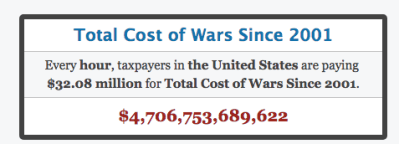
To further investigate the US military budget I highly recommend the resources at the War Resister League annual pie chart of how much of US tax dollars go to militarism and the solid work that the National Priorities Project does to look at US military spending since 9/11, along with how US military spending could be used, to use King’s words, for programs of social uplift.
In Part II, I will look at the history of resistance to US militarism since 1967, specifically in Grand Rapids and what we can learn from those anti-militarism movements.
 Members of GR Rapid Response to ICE and Movimiento Cosehca GR attended the Kent County Commission meeting today to continue to call for an end to the contract that the Sheriff’s Department has with Immigration and Customs Enforcement (ICE).
One of the themes that came up during the public comment was the fact that as of today, there were 271 days remaining on the current Kent County contract with ICE. The contract with ICE had been renewed in 2017 and the document from that renewal clearly states that the contract will expire in September 30th, 2019.
All four of those who spoke during public comment, however, made it clear that the contract needed to be ended now, since there is tremendous harm being inflicted every day on the immigrant community. One member of the affected community switched from English to Spanish during their comments, partly to make a point about how people who do not speak English are left out of the commission meetings, which are conducted entirely in English. Another public comment read testimony from a woman who had her husband picked up by ICE last year.
One additional public comment stayed with a numbers theme and we thought it was powerful enough to reprint in its entirely:
My name is JR martin. i live on Anishinaabe land, sometimes referred to as Kent County.
I’m here again to join my friends and neighbors in demanding an end to the contract between Kent County and ICE. so i want to repeat the number that people have given you: there are 271 days until the contract officially expires. you can end it before then. i also thought we might benefit contextually from some counting in the other direction.
It’s been 9 days since christmas day, when christians celebrate the birth of a refugee child who was later killed by the state, and when, this past year, 8-year-old Felipe Alonzo Gomez died in border patrol custody.
It’s been 26 days since 7-year-old Jakelin Caal Maquin died in border patrol custody.
It’s been 225 days since 20-year-old Claudia Patricia Gomez Gonzalez was shot in the head and killed by a border patrol agent in Texas.
And it’s been 223 days since may 25, 2018, when Roxsana Hernandez, a 33-year-old HIV-positive transgender woman, fleeing violence in Honduras and seeking a better life, died in ICE custody.
each of these deaths was a murder, whether the weapon was a gun or the denial of care and medical services. it’s always been clear that they were murders. but you may have heard, also, about the findings from an independent autopsy conducted in November, which showed that Roxsana Hernandez had been beaten while in ICE custody before her death.
the border is a death-haunted and death-dealing structure. ICE is a death and trauma machine. as of right now, at the start of a new year, that machine is rolling right along, and Kent County is effectively rolling with it.
It’s been 353 days since the journalist Ayesha Siddiqi wrote on twitter in January 2018: “ICE *is* the fascist roundup people imagine as something to anticipate in a worse future. ICE is it. don’t cooperate! don’t let them in if they knock, don’t speak to them if they ask. you decide what you let happen in your neighborhoods. protect your neighbors.”
and that’s all there is. you can end the contract. you decide what happens in your neighborhood. protect your neighbors.

New Commission, Same indifference to the harm being done to the Immigrant community
Most of energy today was directed around the swearing in of two new commissioners and one who retired. There were lots of photo opportunities and a lot of talk about public service. Yet, when it came to the issue of the Kent County contract with ICE, little was said at the end during the miscellaneous portion of the commission meeting.
There was a great deal of talk about diversity, equity and making Kent County a Welcoming community, but these were mere empty platitudes that had no credibility, especially since the affected community and their allies has been calling for an end to the ICE contract since June of last year.
Several commissioners did mention the newly established Immigration Focus Group. The new Kent County Commission Chair said that they hoped to get the focus group off the ground soon. However, this raises numerous questions, like:
- Who will be on the immigration focus group?
- Will there be immigrants on the focus group?
- Will the focus group lead to an end to the ICE contract?
Those with Movimiento Cosecha GR and GR Rapid Response to ICE did not call for this focus group, rather a call to End the Contract with ICE. ICE continues to do real harm, to traumatize members of the immigrant community and separate families. Thus, end the contract would be a positive step for the county to take in order to build any kind of trust with the immigrant community.
La Lucha Sigue!
 Today, begins the annual Calvin January Series. This series of lectures and celebration of the arts has come to be known throughout the country because of its annual lineup.
The list of speakers for the 2019 series also includes some big names, such as president of the American Enterprise Institute, Author Brooks and New York Times Columnist Nicholas Kristof. Both Kristof and Brooks are political conservatives, but there are a few liberal voices speaking about racism, climate justice and the Larry Nassar sexual assault scandal.
The list of speakers this year is fairly standard for Calvin’s January Series, where there are a few conservative speakers and a few liberal speakers, with the majority of voices coming from a christian perspective. That Calvin has numerous christian speakers each year in the series is understandable, as they are a christian college.
What you don’t find very often in this lecture series (archived here), are people who are highly critical of US foreign policy or people who are part of social movements that challenge systems of power. Sure, Calvin has had people like Matthew Desmond, who wrote a great book on housing and gentrification in the US entitled, Evicted: Poverty and Profit in the American City. Calvin has also included people like Eric Michael Dyson, who has written powerful books on race and politics in the US, and the even brought to the lecture series one of the founders of the Southern Poverty Law Center, Morris Dees.
However, there have never been people like Noam Chomsky or Howard Zinn, Angela Davis or bell hooks, and no trans speakers or speakers on White Supremacy as the dominant racial policy in the US. Calvin has never brought people from countries that are suffering directly from US foreign policy or people who are part of global justice movements, especially ones who challenge US imperialism and global capitalism.
Now, I don’t expect that Calvin College would have speakers who would address the above themes, especially those who are against systems of oppression and take an anti-capitalist stance. I get that these speakers are not invited and are not likely to be invited, even though there are plenty of people in the area who would come to see them.
Having speakers who provide a radical critique of white supremacy, colonialism or capitalism would fall outside of Calvin College’s liberal/conservative framework. Calvin is ok with liberal speakers and conservative speakers, since speakers from these two political categories will never challenge colonialism, capitalism and white supremacy. In fact, the lineup of speakers they have often defend these systems of oppression.
Part of the reason for the liberal/conservative lineup of speakers at the Calvin January Series is due to the companies, non-profits and foundations that underwrite the speakers. This has always been the case and is reflected in this year’s underwriters, including Howard Miller, GMB Architects & Engineers and Miller Johnson.
 However, there is another reason why the Calvin January Series fits nicely into the Conservative/Liberal framework and doesn’t challenge systems of oppression. The primary funder of the christian college has been the DeVos family, which are not only opposed to challenging systems of oppression, they are the beneficiaries of those same systems, like colonialism, white supremacy and capitalism.
Based on the 990s from the various DeVos family foundations between 2014 – 2016, the DeVos family has contributed $8,835,000. In just three years they contributed just under 9 million, so it is safe to say that in the past 20 years, the DeVos family has contributed over $50 million. Donors of that caliber don’t give that kind of money without strings attached. Often, the strings attached that wealthy donors determine center around having lots of input into the politics and policies of any college or university.
What We Can Learn from the Zapatista Rebellion on the 25th Anniversary of their uprising
 Twenty Five years ago, the world became aware of a new resistance movement known as the Ejercito Zapatista Liberacion Nacional (EZLN), or simply the Zapatistas.
In the southern most state of Mexico, the world became aware of the Zapatistas, as they interrupted the New Year’s celebration in the city of San Cristobal de las Casa, Chiapas. San Cristobal is a tourist city, but the EZLN came to destroy government records that falsely claimed that non-indigenous people controlled the land in a area that was made up of mostly indigenous people.
On that fateful night, on the eve of the beginning of 1994, the EZLN came out of the shadows to declare that they would not allow the North American Free Trade Agreement (NAFTA) be their death sentence.
Instead, the Zapatistas made their presence known to the Mexican government and to the world, with a bold declaration from the Lacandon jungle that they would fight this idea of globalization.
The EZLN stated early on in their struggle:
“Silence is what the powerful offer our pain in order to make us small. When we are silenced we remain very much alone. Speaking heals the pain. Speaking, we accompany one another.”
I have been grateful to have been part of international solidarity work in Chiapas, specifically in the Zapatista communities on three separate occasions – 1997, 1998 and 2001. In addition, I have read a great deal about their movement and learned from their struggle, as the EZLN has a great deal to teach us about our own struggles for liberation. As they stated during the First Intergalactic Encuentro in Chiapas in 1995, “we need to globalize the resistance” and “you all need to be the Zapatistas in your own community.”
9 things we can learn from the Zapatistas
 While we can be in solidarity with other movements around the world, we need to be the resistance in our own communities. This statement is particularly true in the US, since US imperialism touches virtually every corner of the world. We have to be the resistance in OUR community and make the connections and the links between global oppression and the oppression in our own communities. Resisting oppression in our own community, therefore, requires that we identify and name the systems, organizations and members of the capitalist class, which were perpetrating oppression right here in Grand Rapids.
- Mandar Obedeciendo – Lead by Obeying. The armed insurgency known as the EZLN is not a traditional insurgent movement, where the strategy and tactics are developed by political and military leaders. For the Zapatistas, they take their orders directly from the communities that make up Chiapas. One of the first things they did even before the January 1, 1994 uprising began, was to construct these open air assemblies, where people could meet, discuss and plan. The EZLN would visit these places in every community and ask, “What do you want us to do?” Such a notion of leadership is so foreign to how politics functions in the US. The type of leadership that we practice in the US, especially political leadership is very much top-down, where people are vetted by the political/capitalist class to make sure that their interests are the priority. This type of leadership even permeates movement politics at times, but if we are serious about organizing to confront systemic oppression, then we need to adopt a position of leadership that is to follow the will of those most affect, most marginalized and those who’s voices have been most suppressed.

- We do not seek to take power, but to create spaces for civil society to be empowered. Another powerful lesson from the Zapatistas is the idea that real power doesn’t come from above or from those who run things, rather real power is the belief that we all can have power with each other. The EZLN have never sought to take state power or overthrow the government. Their goal has been to provide political, economic, social and cultural space for civil society to create the kind of power that is contrary to power over others, instead a power that is with others. Taking power, whether that is by force or through elections is still power that is dictated from above. In our work and our movements, we must never seek to take power that is from above, but to create spaces where people can have power with each other, instead of relying on the state to take care of them.
- Comunidades Autonomo o caracoles. The EZLN believes that their communities should be autonomous – politically, economically, social and culturally. Autonomy is what the Zapatistas have fought for from the beginning. Autonomy is not some ideological notion, rather it comes out of the lived experiences of oppression communities and tells them that no one can represent you other than yourselves. This is why the Zapatistas have told the Mexican government and the state of Chiapas that they do not want to be governed, but to govern themselves. The other major benefit of autonomy is that you are not beholden to anyone outside of your communities. This means that you are not beholden to political parties, to nationalism, to the capitalist class, to funders or any other entity which claims to represent you. The Zapatistas call their autonomous communities caracoles, which is Spanish for snails, because their notion of autonomy moves very slowly, but it is consistently faithful to the principles of being autonomous.
 We, the zapatista children, think that our work as children is to play and to learn. During the time that I spent with the Zapatistas, it became very clear that despite the constant harassment from the Mexican military, they wanted their children grow up in a world where children could simply be children. This didn’t mean that children didn’t help with chores – cooking, cleaning, working in the garden or gathering firewood, but they spent most of their days simply being children. This meant that children played a great deal, in the woods, in the streams or anywhere in the communities. The EZLN say: “In our dream children are children and their work is to be children… I do not dream of the agrarian redistribution, of big mobilizations, of the fall of the government and elections and the victory of a left-wing party, or whatever. I dream of the children and I see them being children.”
- We have the right to defend ourselves. Our world is contaminated will too much violence. Everywhere you turn violence is being perpetrated by systems of oppression against those who are the most marginal. White Supremacy does violence against communities of color. Patriarchy does violence against women, children, men and those who are gender non-conforming. Capitalism does violence against the majority of the worlds population and it commits violence against all other living beings and ecosystems. However, just because violence is the dominant social narrative, it doesn’t mean that people don’t have the right to defend themselves. I agree that most of how we organize ourselves should be done in a non-violent manner, but when non-violence becomes dogmatic and rigid, it ends up not only causing harm, but it limits our radical imagination to do things that allows us to defend and protect ourselves. The EZLN has arms, but has rarely used them. They believe in defending their communities, but they do not seek to attack systems of oppression militarily. The Zapatistas have used global awareness, global communication and the invitation to global solidarity as their primary weapons against state repression.
 Use methods of communication as a tactic to create change. One thing the EZLN did in 1994 and ever since, has been to “get the word out” about their revolution. The Zapatistas, through the use of communiques and the internet, have made it a priority to globalize the resistance. Their idea of communicating to the rest of the world was to develop as much solidarity as possible so that the Mexican government could not easily isolate them and marginalize their struggle. The Zapatistas have done this so well that even the prestigious RAND Corporation did a study of how effective the EZLN has been in what they call, The Zapatista Social Netwar. The Zapatistas Social Netwar consists of three main objectives: 1) Make civil society the forefront of the attention; 2) Make information operations a key weapon, by demanding freedom of access and information; and 3) Make swarming a distinct objective. Swarming is where you overwhelm your opponent with information that they (governments and other systems of oppression) cannot keep up with or easily suppress. We have to be as creative with our means of communication and see it as a strategic objective. Too often we put out a lot of information, but with no strategic objective.
 - Preguntando caminamos – Asking we walk. This is one of the most important statements from the Zapatistas. Asking we walk is a statement of solidarity. It is saying that if you want to be with us, walk with us in our struggle, then you need to keep asking us what we need and not what you think we need. This is critical for those of us who carry a great deal of privilege in society, whether is is racial, gender or class privilege. If we are to be part of movements for social change, then we must embrace this idea……asking we walk. This is the real meaning of solidarity and is the opposite of the practice of white saviorism.
- We need to develop movements of resistance that are beautiful and poetic. This may be the hardest for those of us accept or to understand, since we may not make it a priority, but there is a poetic beauty in the way that the Zapatistas communicate and just how they are in the world. Instead of me trying to explain this, let me suggest that you watch this short video that I shot during the 2001 New Year’s eve gathering in the Zapatista community of Oventic. This video was shot on the 7th anniversary of the Zapatista uprising and is from my film, Reversing the Missionary Position: Learning Solidarity on Mayan Time, which you can watch at this link.
GRIID End of the Year Review Part III – Monitoring the Local News
 In our continuing look at the major themes we have reported on for 2018, Part I was about monitoring systems of power and oppression in Grand Rapids and in Part II we chronicled local social movements.
In our third and final post for 2018, we look at our watchdog reporting on how local news media has covered critical issues in this community.
As we mentioned in Part I, we regularly monitor what Secretary of Education Betsy DeVos is doing in her position. While this is not necessarily a function that West Michigan news media are required to fulfill, it is something that they could do as a way of continuously investigating local ties to federal policy.
One of the major themes in our critique of local news media has to do with how they report on local government policy. For instance, in late January of 2018, MLive provided an overview of former City Manager Greg Sundstrom’s 8 years in that position. We pointed out how limiting that story was and provided a different perspective on Sundstrom’s 8 years as City Manager.
There were numerous stories we critiqued that had to do with the GRPD and community relations, beginning with a January 30th GR Press editorial. Here are a few more articles we dissected when it came to the GRPD:
MLive, a pro-policing narrative and the lack of radical imagination
Another theme in our Dissecting Local News Media work involved how the news media dealt with how they covered those with the most power in our community. We already noted in Part I that the coverage of Rich DeVos’s death was nothing short of canonizing the billionaire.
However, we also wrote critiques of MLive’s reporting on Amway and DeVos family philanthropy.
We also dissected how the local news media reported on Jeb Bush’s talk at the 2018 West Michigan Policy Forum conference.
Immigration and immigration policy was certainly a topic that the local news covered and we critiqued how they reported on what Sheriff Stelma had to say, how they reported on rally to End the Contract at the Kent County Jail how a public access TV station presented the ICE contract with Kent County issue a look at how an immigrant-led protest was framed and local coverage of a racist response to migrant workers.
One last area we looked at was how local news media dealt with historical events and people. MLive’s eulogy for Billy Graham was standard reporting on how the white preacher cozied up to power, without any real critique of his role within systems of power and oppression.
We also provided a critique of a Michigan Public Radio series on the 1967 riot in Grand Rapids.
GRIID began as a local media watchdog and we think it is important that part of our work continues to monitor how local news reports on issues of the day or how they fail to report on issues that impact the community.
In Part I of our End of the Year Review, we wrote about our monitoring and analysis about the Grand Rapids Power Structure. In today’s post, we will be providing an overview of the Grand Rapids Social Movement activity of the past year.
2018 was an election year, which means that social movements often take a back seat. Electoral politics often redirects the energy and resources that people invest in social movements and 2018 was no exception to that dynamic.
There was some organizing around housing issues in Grand Rapids, but most of that was done through non-profits and not the people most directly affected by homelessness and gentrification. There was also some organizing around police violence, specifically directed at the black and latino/latinx communities, but it was not sustained, so one would be hard pressed to call it a movement.
Then there was some limited organizing and public debate around gun control, especially after the Parkland shooting. However, besides a few small protests, these efforts, mostly involving students, were quickly redirected to electoral politics instead of movement building.

The reality is, that the only sustain social movement in Grand Rapids was around immigration, mostly led by immigrants, but also involving allies working with the group Movimiento Cosecha GR.
The first major immigration action took place in January, when Congress was debating whether or not to continue the federal policy known as DACA. People from Grand Rapids went to DC to take part in actions and then organized an action on January 19, where protestors shut down traffic at an intersection by the Grand Rapids Federal Building.
At that January 19 action, police officers did not act when motorists forced their way through the protestors on the street. Movimiento Cosecha GR held a press conference in response to this form of state violence in February. The GRPD showed up to intimidate the immigrant-led group and then waited in the parking lot to make sure that they could talk to the news media that came to the press conference.

Then in March, a church which was working with the group GR Rapid Response to ICE, publicly declared themselves a sanctuary for undocumented immigrants.
Beginning in early April, Movimiento Cosecha GR began promoting their upcoming days of action, which would begin at the end of April. These four days of action were part of a larger strategy of getting to a seven day strike, where immigrants and allies would demonstrate the kind of economic power they have to force the country to come to terms with the unjust immigration policies that currently permeate the US.
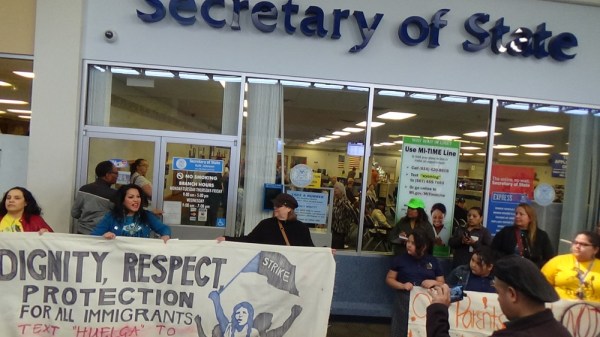
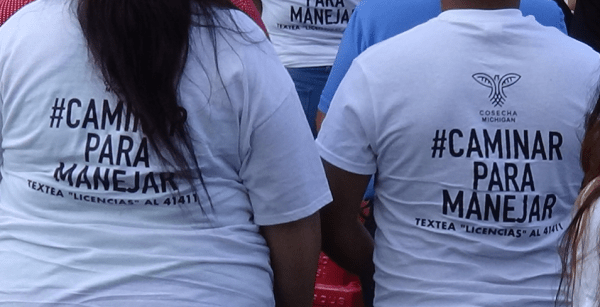
Movimiento Cosecha GR also used these four days of action to kick-off their campaign to get drivers licenses for all in Michigan. On April 30th, the movement participated in an action at the Secretary of State’s office in Wyoming, MI.
On May 1st, an estimated 2,000 people marched in the streets of Grand Rapids to demonstrate the power of immigrants. The GRPD had increased their presence during the march and tried to dictated the route, but movement organizers would not comply, thus demonstrating their commitment to a truly grassroots politics that took its direction from the people most impacted by the unjust immigration policies.
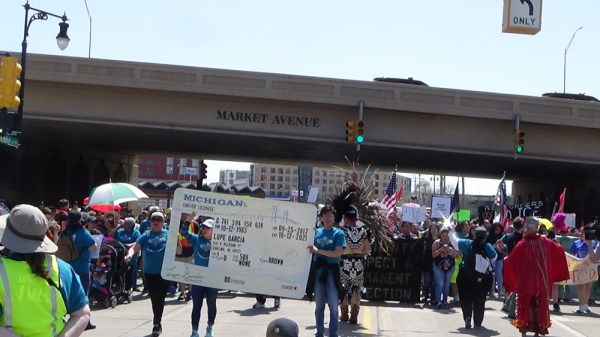
While these actions were being organized, Immigration and Customs Enforcement (ICE) was continuing to terrorize the immigrant community in West Michigan and GRIID consistently wrote about ICE oppression, like in an article we published in early May.
Then the Trump administration decided to further criminalize immigrants and took action against immigrant families at the US/Mexican border in June. Images of children being taken from their families and put in cages soon went viral and Movimiento Cosecha GR and GR Rapid Response to ICE began a campaign to end the contract that ICE had with the Kent County Sheriff’s Department. The first big action took place on June 28th, where several hundred people came to Kent County Commission meeting and ended up taking over the meeting.

Since the End the Contract campaign began in late June, Movimiento Cosecha GR and GR Rapid Response to ICE have participated in over a dozen actions on the contract, plus Movimiento Cosecha GR organized a 5 day pilgrimage to Lansing for their drivers licenses for all campaign. Here is a list of the posts we did to document this powerful movement for justice:
Cosecha GR confronts the contradictions of July 4th in America
End the Contract with ICE campaign visits Commissioner Saalfeld’s house
Some observations on the End the Contract action at the Kent County Commission meeting
End the Contract Rally at the Jail: What you wouldn’t learn from the Fox 17 story
End the Contract campaign returns to the County Commission meeting
ICE out of Kent County campaign disrupts ArtPrize event
Grand Rapids participates in the national No Business With ICE Action Day
We don’t want promises, We want Licenses: Movimiento Cosecha rally inspires!
Documents from FOIA request about Kent County ICE Contract reveal several important points
Diversity of Tactics, Movement Building and the campaign to End the ICE contract with Kent County
Kent County Administrative Staff and Commissioners establish Immigration Focus Group